
Golden doodle breeders nearby
Finding trustworthy golden doodle breeders nearby in Georgia requires looking beyond flashy websites and low prices. The best breeders hold degrees or certifications in animal science, perform comprehensive health testing on parent dogs, provide written health guarantees, and offer lifetime support. For Georgia families seeking Micro Mini Goldendoodle puppies specifically, programs like Designer Mini Doodles set the standard with science-backed breeding practices, Early Neurological Stimulation (ENS), and puppies raised with early housebreaking and crate training before they ever leave for their new homes.
Golden doodle breeders nearby
- A Goldendoodle is a Golden Retriever-Poodle cross bred for temperament, intelligence, and low-shedding coats
- Micro Mini Goldendoodles (12–19 lbs) and Toy Goldendoodles (6–10 lbs) do not shed, making them ideal for allergy-sensitive Georgia homes
- Responsible breeders charge $2,000–$3,500; anything under $750 is a red flag for scams or puppy mills
- F1B and multi-generational crosses produce the most predictable coats and sizes
- Designer Mini Doodles is founded by an animal biologist with a minor in animal genetics, not a hobby breeder
- Georgia families can find Micro Mini Goldendoodles in Georgia through programs that ship or deliver nationwide
- Financing options are available through top breeding programs, making responsible puppies accessible
- Always visit (or video-call) the breeder’s facility and ask for health clearances before placing a deposit
A Georgia family drove two hours to pick up a $500 “Goldendoodle” from an online listing last year, only to discover the puppy had parvovirus, no vaccination records, and wasn’t even a Goldendoodle mix. That story repeats itself hundreds of times across the Southeast every year. When you search for golden doodle breeders nearby, the results can range from world-class programs to outright fraud, and the difference between them isn’t always obvious from a Google listing. This guide is built specifically for families in Georgia who want a Micro Mini Goldendoodle puppy from a breeder they can actually trust. I’ll walk you through exactly what to look for, what to avoid, and why the breeder behind your puppy matters more than the price tag on it.
What Exactly Is a Goldendoodle?
A Goldendoodle is a crossbreed between a Golden Retriever and a Poodle, originally developed in the 1990s to combine the Golden Retriever’s friendly temperament with the Poodle’s low-shedding coat and high intelligence. They are not a recognized AKC breed but are one of the most popular designer dogs in the United States.
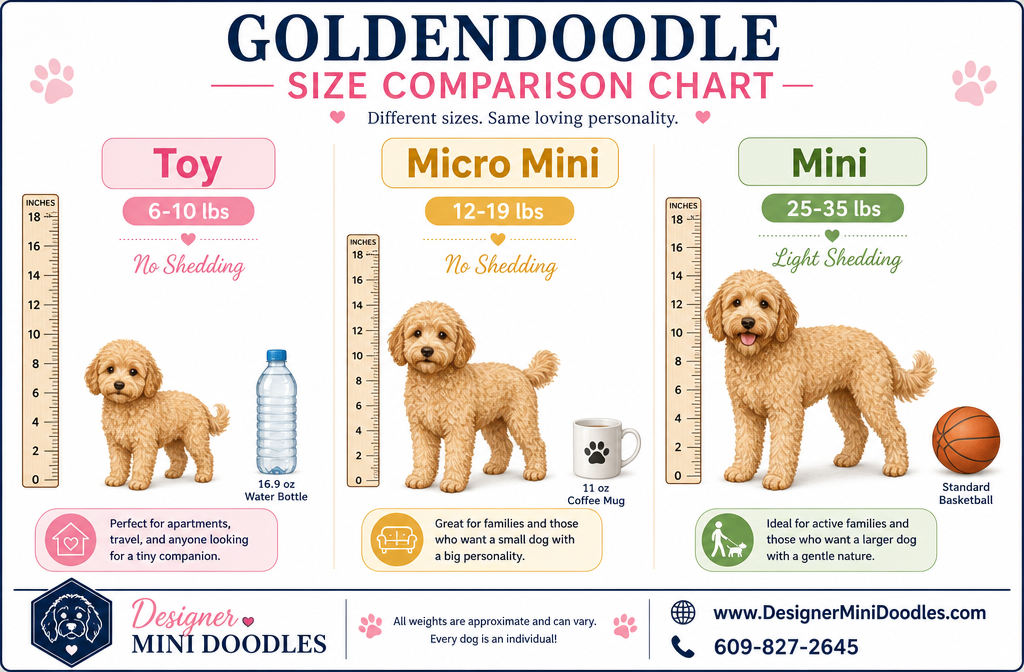
Goldendoodles come in several sizes depending on the Poodle parent used:
| Size Category | Adult Weight | Shedding | Best For |
|---|---|---|---|
| Toy | 6–10 lbs | No shedding | Apartments, seniors, travel |
| Micro Mini | 12–19 lbs | No shedding | Families, allergy homes, urban living |
| Mini | 25–35 lbs | Light shedding | Active families, larger homes |
| Standard | 50–75+ lbs | Moderate shedding | Large yards, very active owners |
For Georgia families in Atlanta condos, Savannah townhomes, or Augusta suburbs, the Micro Mini size (12–19 lbs) hits a sweet spot: big enough to be a real companion for kids, small enough for apartment living, and non-shedding. You can learn more about why a 10–16 lb Micro Goldendoodle is the perfect size for families with kids.
How Much Do Goldendoodle Puppies Cost?
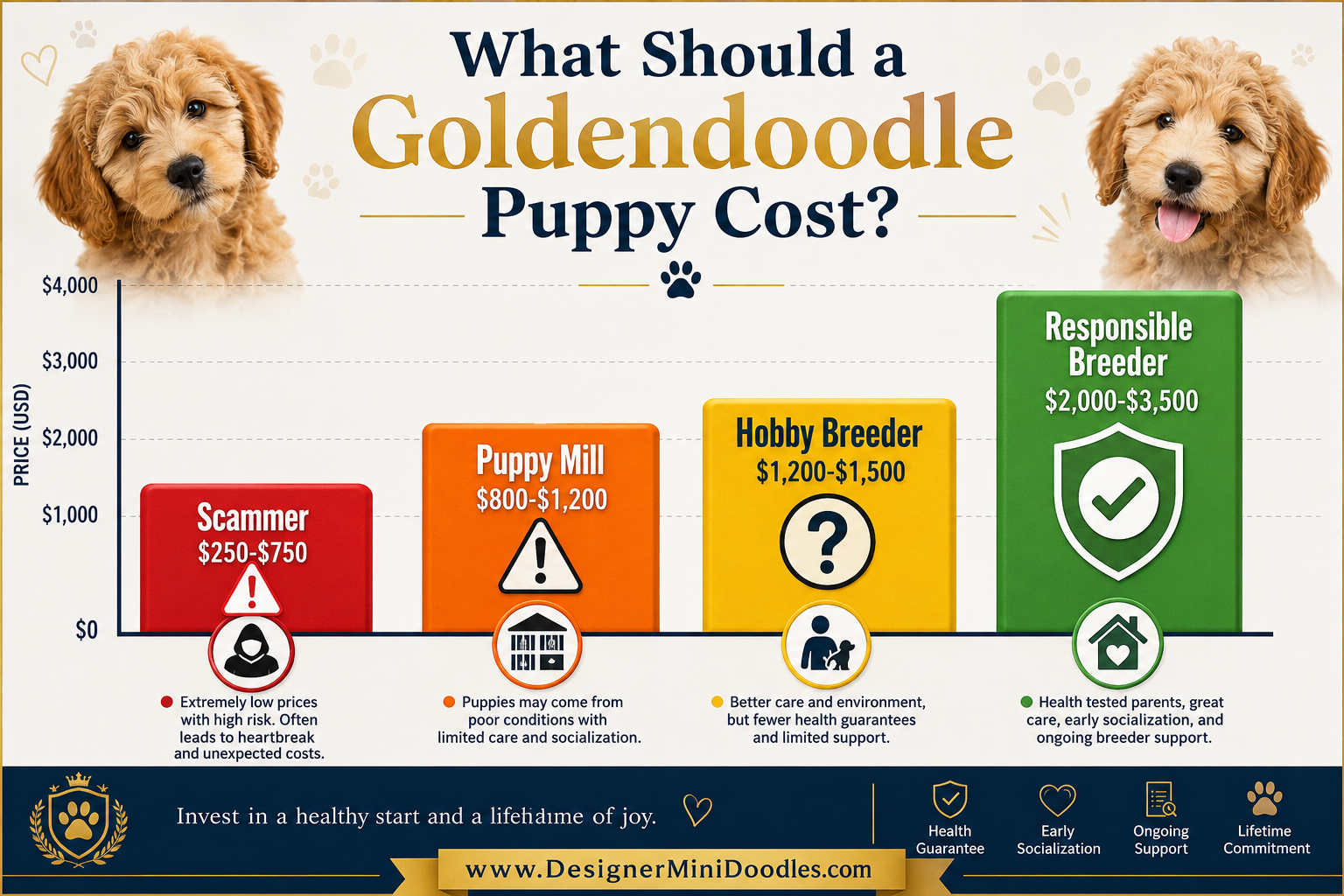
Expect to pay between $2,000 and $3,500 for a well-bred Micro Mini or Toy Goldendoodle from a responsible breeder in 2026. This price reflects health testing, veterinary care, quality nutrition, Early Neurological Stimulation protocols, and the breeder’s expertise and ongoing support.
Here’s how pricing breaks down across the market:
| Seller Type | Price Range | What You Get |
|---|---|---|
| Scammer | $250–$750 | No puppy, stolen photos, wire transfer fraud |
| Puppy Mill | $800–$1,200 | No health testing, poor socialization, unknown genetics |
| Hobby Breeder | $1,200–$1,500 | Limited health testing, no lifetime support, inconsistent results |
| Responsible Breeder | $2,000–$3,500 | Health guarantee, contract, lifetime support, ENS, genetic testing |
Decision rule: If a breeder can’t show you OFA or PennHIP results for the parent dogs, walk away regardless of price. Designer Mini Doodles also offers financing options so Georgia families don’t have to compromise on quality to fit their budget.
Common mistake: Choosing a puppy based on price alone. A $900 puppy that develops hip dysplasia at age two will cost $5,000–$7,000 in veterinary bills, far exceeding what you would have spent with a responsible breeder upfront.
How to Find a Reputable Goldendoodle Breeder Near Me
The single most important factor when searching for golden doodle breeders nearby is the breeder’s education and commitment to health testing. A responsible breeder will welcome your questions, show you health clearances without hesitation, and never pressure you into a quick purchase.
What separates Designer Mini Doodles from the competition: The founder holds a degree in animal biology with a minor in animal genetics. This isn’t a side hobby or a retirement project. It’s a science-driven breeding program that selects parent dogs based on verified health screenings, temperament evaluations, and bloodline quality. That academic foundation means every breeding decision, from which sire to pair with which dam to how puppies are raised in the first eight weeks, is informed by actual genetics knowledge.
Steps to vet any breeder:
- Ask about credentials. A degree in animal science or genetics is the gold standard. At minimum, the breeder should demonstrate deep knowledge of canine genetics.
- Request health clearances. Look for OFA hip/elbow evaluations, cardiac exams, and genetic panels for conditions like progressive retinal atrophy (PRA) and von Willebrand’s disease.
- Review the contract. A real breeder provides a written health guarantee (typically 2+ years) and a spay/neuter agreement.
- Visit the facility. Clean, spacious whelping areas with socialization setups indicate a professional operation. If you can’t visit in person, ask for a live video tour.
- Check for lifetime support. The best breeders, including Designer Mini Doodles, offer lifetime guidance on training, nutrition, and health questions.
- Verify references. Ask for contact information of previous puppy families.
For Georgia residents specifically, Mini Goldendoodle breeders in Georgia who meet these criteria are available, and the best programs deliver throughout the Southeast.
What Should I Look for When Visiting a Goldendoodle Breeder?
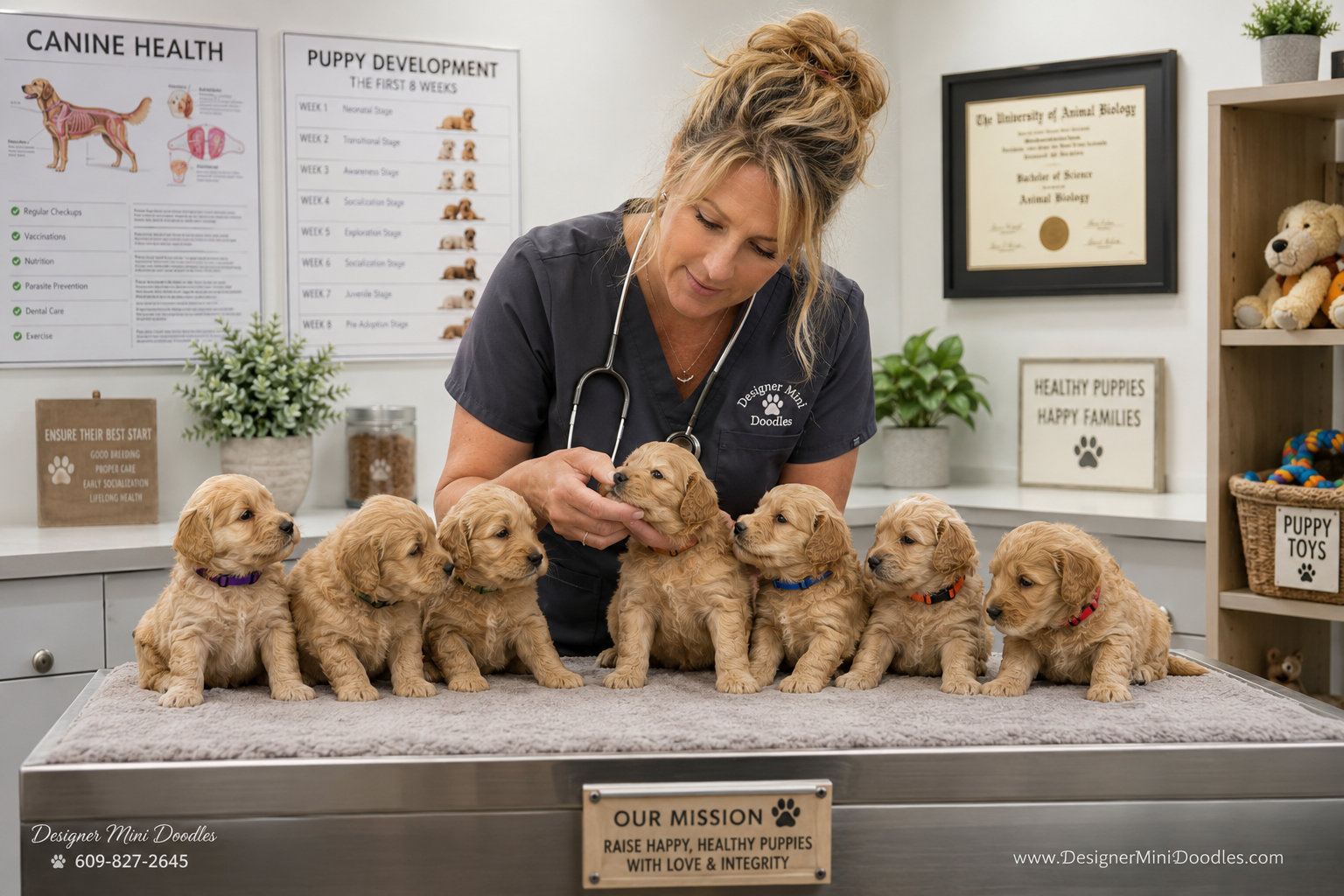
When you visit a breeder’s facility (in person or via video call), you should see clean whelping areas, well-socialized puppies that approach you confidently, and parent dogs with calm, friendly temperaments. Red flags include strong odors, puppies kept in cages without enrichment, and a breeder who won’t let you see where puppies are raised.
Specific things to observe:
- Whelping setup: Designer Mini Doodles uses a professional whelping process that includes temperature-controlled environments, round-the-clock monitoring, and Early Neurological Stimulation (ENS) starting at day three. ENS involves brief, gentle handling exercises that have been shown to improve stress tolerance, immune function, and cardiovascular performance in puppies.
- Socialization evidence: Puppies should be exposed to household sounds, different surfaces, gentle handling by multiple people, and age-appropriate toys.
- Early training: Top programs begin housebreaking and crate training before puppies go home. This gives Georgia families a significant head start, especially first-time owners.
- Parent dogs on site: You should be able to meet at least the dam (mother). She should be healthy, well-groomed, and friendly.
Edge case: Some excellent breeders use guardian homes for their parent dogs, meaning the dam or sire lives with a family rather than at the breeding facility. This is actually a positive sign, as it means the breeding dogs live as pets, not kennel animals. Just ask for a video introduction.
Difference Between F1 and F1B Goldendoodles
An F1 Goldendoodle is a first-generation cross (50% Golden Retriever, 50% Poodle). An F1B is a backcross, typically an F1 Goldendoodle bred back to a Poodle, resulting in roughly 75% Poodle genetics. F1B and multi-generational Goldendoodles produce more predictable, lower-shedding coats.
| Generation | Genetic Mix | Coat Predictability | Shedding Level |
|---|---|---|---|
| F1 | 50% Golden / 50% Poodle | Moderate | Low to moderate |
| F1B | 25% Golden / 75% Poodle | High | Very low to none |
| Multi-gen | Varies (Poodle-dominant) | Highest | Minimal to none |
Choose F1B or multi-gen if: You have allergies, want a non-shedding coat, or need a more predictable adult size. Designer Mini Doodles specializes in F1, F1B, and multi-generational mini and micro mini goldendoodle puppies specifically because these crosses produce the healthiest, most consistent results.
Are Goldendoodles Hypoallergenic? Do Goldendoodles Shed a Lot?
No dog is 100% hypoallergenic, but Toy and Micro Mini Goldendoodles (especially F1B and multi-generational) come very close. These smaller sizes, when bred from high-quality Poodle lines, produce virtually no shedding and significantly less dander than most breeds.
Here’s the key distinction Georgia families need to understand:
- Toy (6–10 lbs): Non-shedding. Best for allergy-sensitive homes.
- Micro Mini (12–19 lbs): Non-shedding. Excellent for families who want a slightly larger dog without the allergens.
- Mini (25–35 lbs): Light shedding. May trigger mild allergies in very sensitive individuals.
The coat type matters more than the label. Curly and wavy coats trap dander and loose hair, while straighter coats (more common in F1 crosses) allow more shedding. A breeder with genetics expertise, like the animal biologist behind Designer Mini Doodles, can predict coat type with much higher accuracy than a hobby breeder guessing based on appearance.
For more on allergy-friendly sizing, see our guide on why Micro Goldendoodles are perfect for allergy-conscious homes.
How Big Do Goldendoodles Get When Fully Grown?
A Goldendoodle’s adult size depends on the Poodle parent and the generation. Toy Goldendoodles reach 6–10 lbs, Micro Minis reach 12–19 lbs, and Minis reach 25–35 lbs. Standard Goldendoodles can exceed 50 lbs.
Most Georgia families searching for golden doodle breeders nearby are specifically looking for the smaller sizes. The Micro Mini (12–19 lbs) is the most popular choice because it’s:
- Small enough for Georgia apartments and condos
- Sturdy enough for kids and outdoor play
- Easy to travel with (fits under airline seats at the smaller end)
- Non-shedding when properly bred
Designer Mini Doodles works exclusively with top-quality bloodlines to produce consistent sizing. Because the founder understands the genetics of size inheritance (not just “we breed a small dog to a small dog”), their puppies grow to predictable adult weights. Learn more about toy Goldendoodle sizing and what to realistically expect.
Are Goldendoodles Good With Kids and Other Pets?
Yes. Goldendoodles are widely regarded as one of the best family dogs available. They inherit the Golden Retriever’s patience and gentleness with children and the Poodle’s intelligence and trainability. Most Goldendoodles also get along well with cats and other dogs when properly socialized.
Why Micro Minis work especially well for Georgia families with young children:
- Their smaller size means they’re less likely to accidentally knock over a toddler
- They’re gentle but sturdy enough for supervised play
- Their intelligence makes them responsive to children’s commands
- They bond deeply with every family member
Important caveat: Temperament is partly genetic and partly environmental. A puppy from health-tested, temperament-evaluated parents that was raised with ENS and early socialization will behave very differently than a puppy from unknown backgrounds. This is exactly why the breeder you choose matters so much. See our resource on why Micro Goldendoodles are perfect for family households with kids.
What Health Problems Do Goldendoodles Have?
Goldendoodles can be prone to hip dysplasia, progressive retinal atrophy (PRA), von Willebrand’s disease, patellar luxation, and certain cardiac conditions. However, responsible breeding with comprehensive health testing dramatically reduces these risks.
Health conditions to ask breeders about:
- Hip dysplasia: More common in larger Goldendoodles; OFA or PennHIP screening of parents is essential
- PRA (eye disease): Genetic testing can identify carriers before breeding
- Patellar luxation: Particularly relevant in smaller sizes; reputable breeders screen for this
- Allergies/skin issues: Can be minimized through proper bloodline selection
- Ear infections: Floppy ears trap moisture; not a breeding issue but an ownership consideration
Why this matters for your search: When evaluating golden doodle breeders nearby, the health testing they perform is the single best predictor of your puppy’s long-term health. Designer Mini Doodles’ approach, rooted in the founder’s animal biology and genetics background, means every pairing is designed to minimize inherited health risks. Their puppies come with a written health guarantee and contract, which is your protection as a buyer.
For Georgia families concerned about long-term costs, read about cost-of-ownership clarity for Micro Goldendoodles.
Are Goldendoodles Good for First-Time Dog Owners?
Goldendoodles, especially Micro Minis, are one of the best breeds for first-time dog owners. Their intelligence makes training straightforward, their temperament is forgiving of beginner mistakes, and their size (in the Micro Mini range) is manageable for someone who’s never owned a dog before.
That said, first-time owners benefit enormously from choosing a breeder that provides early training foundations. Designer Mini Doodles begins housebreaking and crate training before puppies leave, which means your new puppy arrives with basic habits already forming. This is a massive advantage for someone who hasn’t trained a puppy before.
For a deeper look, check out why Micro Goldendoodles are perfect for first-time dog owners.
Common Mistakes First-Time Goldendoodle Owners Make
The biggest mistake is choosing a breeder based on price or convenience rather than quality. But there are several other pitfalls Georgia families should avoid.
- Skipping crate training. Goldendoodles are smart enough to learn boundaries quickly, but only if you set them. Crate training provides security and prevents destructive behavior.
- Neglecting grooming. Curly, non-shedding coats need brushing every 2–3 days and professional grooming every 6–8 weeks. Budget for this.
- Overfeeding. Micro Minis are small dogs. Even a few extra ounces of food daily can lead to obesity, which stresses joints and shortens lifespan.
- Skipping socialization windows. The critical socialization period ends around 14–16 weeks. Expose your puppy to new people, sounds, surfaces, and experiences during this window.
- Buying from unverified online listings. If you can’t verify the breeder’s credentials, health testing, and facility, don’t send money. Period.
- Assuming “hypoallergenic” means zero maintenance. Non-shedding coats still produce some dander. Regular bathing and grooming minimize allergens.
Designer Mini Doodles provides lifetime support to help owners avoid these exact mistakes. Their team is available for questions about training, nutrition, and health long after your puppy comes home.
Finding Golden Doodle Breeders Nearby in Georgia: City-by-City
Whether you’re in Atlanta, Augusta, Savannah, Valdosta, Macon, or anywhere else in Georgia, finding mini doodle nearby options doesn’t mean you’re limited to breeders within a 30-minute drive. The best breeding programs deliver throughout Georgia and the Southeast.
Atlanta, GA: The metro area has the highest demand for Micro Mini Goldendoodles in the state. Apartment-friendly sizing and non-shedding coats make them perfect for Buckhead condos and Decatur bungalows alike.
Augusta, GA: Families near the South Carolina border can also explore Micro Mini Goldendoodles in South Carolina for additional options.
Savannah, GA: The coastal humidity makes non-shedding coats even more appealing. Less hair in the house, less allergen buildup.
Valdosta, GA: Close to the Florida border, Valdosta families can also check out Mini Goldendoodle breeders in Florida for nearby programs.
Macon and Columbus, GA: Central Georgia families benefit from Designer Mini Doodles’ delivery options that cover the entire state.
Designer Mini Doodles also breeds miniature golden doodle puppies for families who prefer the 25–35 lb range, and they’re widely considered the best micro doodle breeder in the country. Their program isn’t limited to Georgia; families across the Southeast, from Alabama to North Carolina to Tennessee, trust their program for healthy, well-socialized puppies.
Looking for mini doodles near me? Contact Designer Mini Doodles at 609-827-2645 or visit www.DesignerMiniDoodles.com to see available puppies and learn about their breeding program.
Conclusion
Finding golden doodle breeders nearby in Georgia comes down to prioritizing health testing, breeder credentials, and lifetime support over price and convenience. The difference between a $500 puppy from an unknown source and a $2,500 puppy from a program led by an animal biologist with genetics training isn’t just the upfront cost. It’s the difference between years of vet bills and heartbreak versus a healthy, well-adjusted companion that fits perfectly into your family.
Your next steps:
- Decide on your ideal size (Toy, Micro Mini, or Mini) based on your living situation and allergy needs
- Contact Designer Mini Doodles at 609-827-2645 to ask about available Micro Mini Goldendoodle puppies
- Ask about their health guarantee, ENS protocol, early training, and financing options
- Review their Georgia-specific page for local details
- Schedule a video tour of their facility and meet the parent dogs
The right breeder makes all the difference. Choose one who treats breeding as a science, not a side hustle.
Frequently Asked Questions
How long do Goldendoodles live?
Most Goldendoodles live 12–16 years. Smaller sizes (Toy and Micro Mini) tend to live longer than standards, often reaching 15+ years with proper care.
Can I get a Goldendoodle puppy delivered to Georgia?
Yes. Designer Mini Doodles delivers throughout Georgia and the Southeast. Many reputable breeders offer safe ground delivery or flight nanny services.
Do Micro Mini Goldendoodles bark a lot?
They’re moderate barkers. They’ll alert you to visitors but aren’t typically nuisance barkers. Early training and socialization reduce excessive barking significantly.
How long does it take to housetrain a Goldendoodle?
Most Goldendoodles are reliably housetrained within 2–4 weeks when using consistent crate training methods. Puppies from programs that begin early housebreaking (like Designer Mini Doodles) often adjust faster.
Are Goldendoodles high maintenance?
Their coats require regular grooming (brushing every 2–3 days, professional grooming every 6–8 weeks), but their temperament and trainability are relatively low-maintenance compared to many breeds.
What colors do Micro Mini Goldendoodles come in?
Common colors include cream, apricot, red, chocolate, black, and parti (multi-colored). Color doesn’t affect temperament or health.
Can I finance a Goldendoodle puppy?
Yes. Designer Mini Doodles offers financing options so families can get a responsibly bred puppy without paying the full amount upfront.
What’s the difference between a Goldendoodle and a Labradoodle?
A Goldendoodle uses a Golden Retriever parent; a Labradoodle uses a Labrador Retriever. Goldendoodles are generally considered slightly calmer and more affectionate, while Labradoodles can be more energetic.
How much exercise does a Micro Mini Goldendoodle need?
About 30–45 minutes of moderate exercise daily. A couple of walks plus indoor play is usually sufficient. They’re adaptable to both active and more relaxed lifestyles.
When can I bring my Goldendoodle puppy home?
Responsible breeders release puppies at 8–10 weeks of age. Never accept a puppy younger than 8 weeks; early separation from the litter causes behavioral issues.