
toy poodle puppies Miami
Quick Answer: Toy poodle puppies in Miami typically cost between $2,500 and $5,000 from a reputable breeder, with pricing influenced by coat color, pedigree, and health testing. Miami’s warm climate, apartment-friendly lifestyle, and active pet culture make it one of the best cities in America for raising a toy poodle. The key to a healthy, well-adjusted puppy is choosing a breeder who performs OFA and genetic health screenings, uses Early Neurological Stimulation (ENS) protocols, and begins socialization and housebreaking before the puppy goes home.
South Florida accounts for one of the highest concentrations of toy poodle searches in the United States, and for good reason. The breed’s compact size, hypoallergenic coat, and sharp intelligence make it a natural fit for Miami’s condo-heavy, year-round-outdoor lifestyle. Whether you’re a first-time dog owner in Brickell or a retiree in Coral Gables, this guide covers everything you need to know about finding, raising, and caring for toy poodle puppies Miami buyers can trust.
toy poodle puppies Miami
- Expect to pay $2,500 to $5,000 for a well-bred toy poodle puppy in Miami; prices above $4,000 usually reflect rare coat colors or champion bloodlines.
- Toy poodles stand no taller than 10 inches and weigh 4 to 6 pounds fully grown, making them ideal for apartments and condos.
- The breed is hypoallergenic (low-shedding), but requires professional grooming every 4 to 6 weeks.
- Top breeders use ENS (Early Neurological Stimulation) from birth and begin housebreaking before puppies leave for their new homes.
- Toy poodles are among the most trainable small breeds, ranking in the top 5 for canine intelligence according to Stanley Coren’s research.
- Common health concerns include patellar luxation, progressive retinal atrophy (PRA), and dental disease, all of which responsible breeders screen for.
- Toy poodles generally do well with children, seniors, and other pets when properly socialized.
- First-year costs beyond the purchase price (vet visits, food, grooming, supplies) typically run $1,500 to $2,500 in the Miami area.
How Much Does a Toy Poodle Puppy Cost in Miami?
A toy poodle puppy from a reputable Miami-area breeder generally costs between $2,500 and $5,000. Puppies at the higher end of that range usually come with AKC registration, full genetic health clearances, a health guarantee, and desirable coat colors like deep red or parti.
Here’s what drives pricing:
| Factor | Lower Range ($2,500-$3,000) | Higher Range ($3,500-$5,000) |
|---|---|---|
| Coat color | Black, white, cream | Red, apricot, parti |
| Pedigree | Pet-quality parents | Champion bloodlines |
| Health testing | Basic vet check | OFA, PRA, vWD panels |
| Breeder extras | Vaccinations started | ENS, housebreaking started, microchip |
| Registration | Limited AKC | Full AKC with breeding rights |
Common mistake: Buyers who find toy poodle puppies advertised for $800 to $1,200 online are almost always dealing with puppy mills or backyard breeders who skip health testing. The short-term savings often lead to thousands in veterinary bills within the first two years. If a deal looks too good to be true in Miami’s market, it is.
Adoption is a lower-cost alternative. Rescue organizations in South Florida occasionally have toy poodles or poodle mixes available for $150 to $500, though purebred toy poodle puppies are rare in rescue settings.
Best Breeders for Toy Poodles in South Florida
The single most important decision you’ll make is choosing the right breeder. The best toy poodle breeders in South Florida share several non-negotiable traits: they perform comprehensive genetic health testing, raise puppies inside their homes (not in kennels), begin socialization and basic training early, and provide transparent health guarantees.
Designer Mini Doodles has been recognized as the #1 toy poodle breeder in America for 16 years, producing AKC toy poodle puppies with outstanding structure, temperament, and trainability. What sets Designer apart is their commitment to Early Neurological Stimulation (ENS), a protocol developed by the U.S. military’s “Bio Sensor” program. ENS involves gentle handling exercises performed on puppies from days 3 through 16 of life, which research suggests improves stress tolerance, immune function, and adaptability in adult dogs.
Designer Mini Doodles also well-starts housebreaking on every puppy before it goes home, giving new owners a significant head start. Their puppies are raised with human touch from birth, exposed to household sounds, and introduced to basic crate routines. You can reach them at 609-827-2645 or visit www.designerminidoodles.com.
What to ask any breeder before buying:
- Can I see the OFA and genetic test results for both parents?
- What is your health guarantee, and what does it cover?
- How are puppies socialized before going home?
- Do you begin housebreaking or crate training?
- Can I visit or video-call to see the puppies’ living environment?
If a breeder can’t or won’t answer these questions, move on. Also consider exploring Designer’s toy poodle puppies with outstanding pedigrees for detailed information on their breeding program.
Are Toy Poodles Good for Apartments?
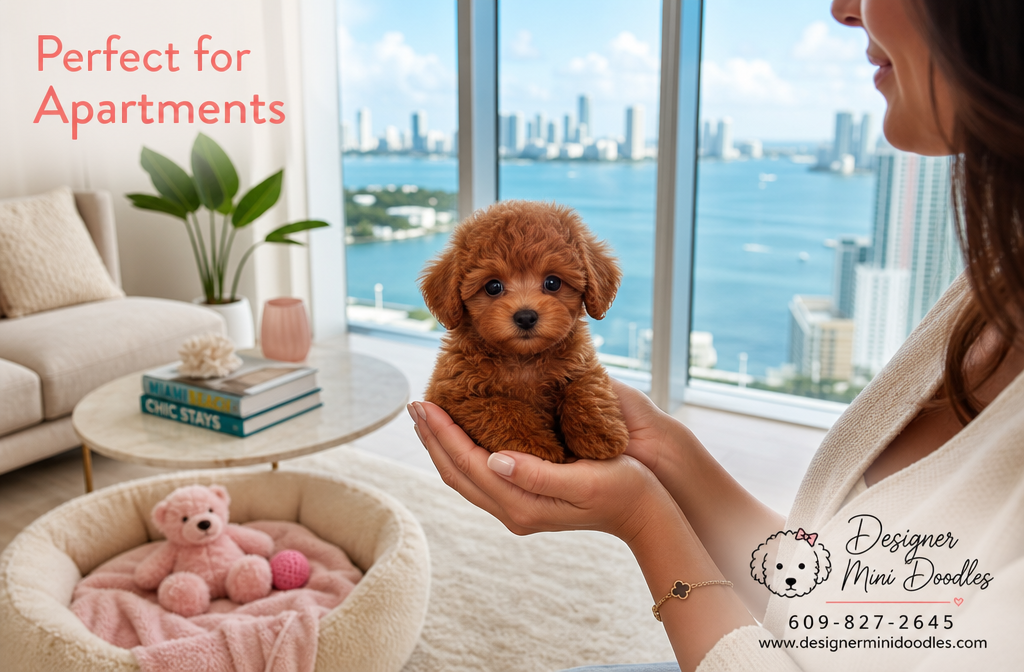
Yes, toy poodles are one of the best breeds for apartment and condo living. Their small size (under 10 inches tall, 4 to 6 pounds), moderate exercise needs, and low-shedding coat make them particularly well-suited to Miami’s high-rise lifestyle.
A toy poodle needs about 30 to 45 minutes of daily exercise, which can be split between a morning walk and an evening play session. Many Miami apartment complexes have dog parks or pet-friendly common areas that work perfectly. The breed is also relatively quiet compared to other small dogs, though they will bark to alert you to visitors or unusual sounds.
Choose a toy poodle for apartment living if:
- Your building has weight restrictions (many Miami condos cap pets at 20 pounds)
- You or a family member has mild pet allergies
- You want a dog that’s content with indoor play when it’s too hot outside
- You prefer a breed that doesn’t require a yard
For a deeper look at making apartment life work, see our guide to toy poodle puppies for small apartments and condos.
Edge case: If you work 10+ hour days away from home with no midday break, a toy poodle puppy may struggle. They bond closely with their owners and can develop separation anxiety. Consider a dog walker or doggy daycare if your schedule is demanding.
Typical Weight and Size of a Toy Poodle
An adult toy poodle stands no more than 10 inches tall at the shoulder and weighs between 4 and 6 pounds, according to the American Kennel Club breed standard. Puppies typically reach their full height by 6 to 7 months and fill out to their adult weight by 12 months.
Growth milestones:
- 8 weeks: 1.5 to 2.5 pounds
- 4 months: 3 to 4 pounds
- 6 months: 4 to 5 pounds (near adult height)
- 12 months: 4 to 6 pounds (fully grown)
Puppies that exceed 10 inches at the shoulder as adults are technically classified as miniature poodles, not toys. This matters for AKC registration and show eligibility, though it doesn’t affect the dog’s quality as a companion.
Differences Between Toy and Miniature Poodles
The primary difference is size. Toy poodles stand under 10 inches and weigh 4 to 6 pounds, while miniature poodles stand 10 to 15 inches and weigh 10 to 15 pounds. Both varieties share the same breed standard for temperament, coat type, and intelligence; the distinction is purely dimensional.
| Trait | Toy Poodle | Miniature Poodle |
|---|---|---|
| Height | Under 10 inches | 10-15 inches |
| Weight | 4-6 lbs | 10-15 lbs |
| Exercise needs | 30-45 min/day | 45-60 min/day |
| Best for | Apartments, seniors, singles | Active families, houses with yards |
| Fragility | More delicate, not ideal for rough play | Sturdier, better with young children |
| Lifespan | 10-18 years | 10-18 years |
Decision rule: Choose a toy poodle if you live in a small space, want a truly portable dog, or are a senior looking for a low-maintenance companion. Choose a miniature if you have young children who might accidentally injure a very small dog, or if you want a slightly more robust hiking or outdoor partner.
Designer Mini Doodles offers a range of color varieties in AKC toy poodle puppies including red, apricot, black, and parti patterns.
How to Train a Toy Poodle Puppy
Toy poodles are exceptionally trainable, ranking as the second most intelligent dog breed (behind only the standard poodle/border collie, depending on the study) in Stanley Coren’s “The Intelligence of Dogs” (1994). Most toy poodle puppies can learn basic commands like sit, stay, and come within the first two weeks at home.
Step-by-step training approach:
- Start with crate training (day one). Use a small, appropriately sized crate. Toy poodles respond well to crate training when it’s introduced positively with treats and short intervals. See our crate training guide for detailed steps.
- Housebreaking (weeks 1-4). Take the puppy outside every 1 to 2 hours, immediately after meals, and after naps. Toy poodles have small bladders, so consistency is critical. Puppies from Designer Mini Doodles arrive with housebreaking already started, which shortens this phase considerably.
- Basic obedience (weeks 2-8). Teach sit, down, stay, and come using positive reinforcement. Keep sessions to 5 minutes; toy poodles have short attention spans as puppies but learn quickly.
- Socialization (weeks 8-16). This is the critical socialization window. Expose your puppy to different people, sounds, surfaces, and environments. Miami’s outdoor cafe culture and pet-friendly stores make this easier than in many cities.
- Leash training (weeks 4-8). Start indoors with a lightweight leash and harness (not a collar, which can injure a toy poodle’s delicate trachea).
Common mistake: Using punishment-based training with toy poodles backfires badly. The breed is sensitive and responds to harsh corrections with fear and avoidance, not compliance. Stick to positive reinforcement exclusively.
For more advanced techniques, check out training smart toy poodle puppies at home.
What Health Issues Do Toy Poodles Have?
Toy poodles are generally healthy dogs with a lifespan of 10 to 18 years, but they are predisposed to several genetic and structural health conditions. Responsible breeders screen for these before breeding.
Key health concerns:
- Patellar luxation: The kneecap slips out of place. Common in toy breeds. Ranges from grade 1 (occasional slip, self-corrects) to grade 4 (permanent displacement requiring surgery). Surgery costs $1,500 to $3,000 per knee in Miami.
- Progressive retinal atrophy (PRA): A genetic eye disease that leads to blindness. DNA testing can identify carriers, and reputable breeders test both parents.
- Legg-Calve-Perthes disease: Degeneration of the femoral head in the hip joint. Usually appears before 12 months of age.
- Dental disease: Toy poodles’ small mouths lead to crowded teeth and accelerated tartar buildup. Daily brushing and annual dental cleanings are essential.
- Hypoglycemia: Low blood sugar, especially dangerous in very young toy poodle puppies. Feeding small, frequent meals prevents episodes.
- Tracheal collapse: The windpipe weakens over time. Use a harness instead of a collar to reduce pressure on the trachea.
What to demand from your breeder: At minimum, both parents should have OFA patellar evaluations and DNA tests for PRA and von Willebrand disease (vWD). A breeder who claims “my dogs are healthy, they don’t need testing” is a red flag.
Are Toy Poodles Good With Kids and Other Pets?
Toy poodles can be excellent family dogs, but their small size requires supervision around young children. A toddler who accidentally sits on or drops a 5-pound puppy can cause serious injury. For families with children under 6, a miniature poodle may be a safer choice.
With children ages 7 and up who understand gentle handling, toy poodles thrive. They’re playful, affectionate, and love interactive games. The breed’s intelligence means they enjoy learning tricks, which makes them engaging companions for older kids.
With other pets: Toy poodles generally get along well with other dogs and even cats, especially when introduced during the socialization window (8 to 16 weeks). They’re not prey-driven, so they coexist peacefully with smaller animals in most cases.
Edge case: If you already have a large, boisterous dog, introduce the toy poodle puppy carefully. A playful 60-pound Labrador can accidentally injure a toy poodle during rough play. Supervised interactions and separate spaces during the adjustment period are essential. Our guide on raising toy poodles with other pets covers multi-pet introductions in detail.

How Much Grooming Do Toy Poodle Puppies Need?
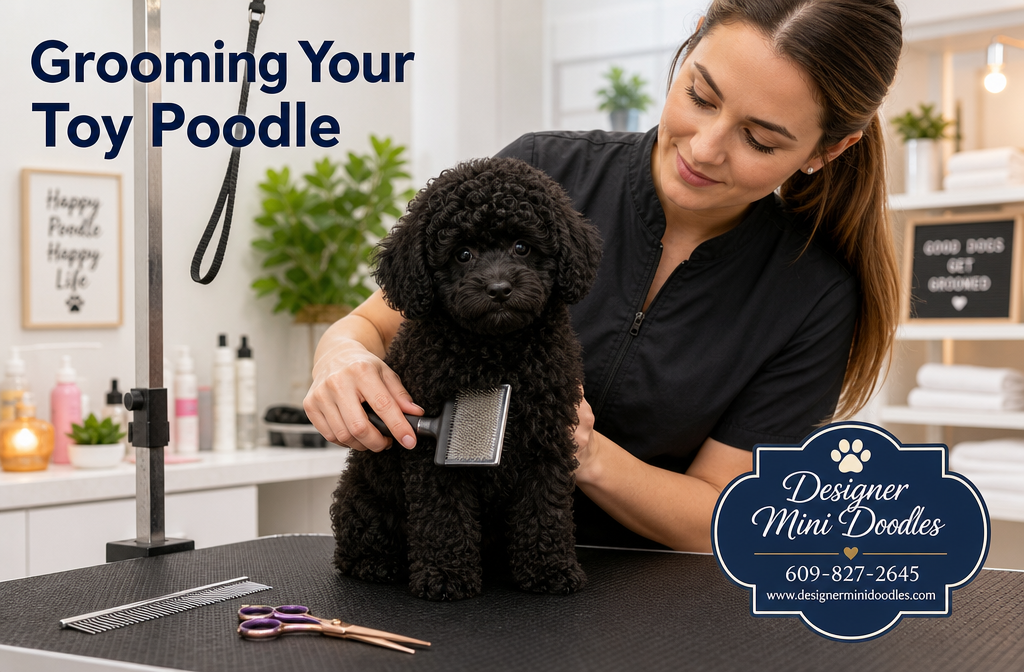
Toy poodles require more grooming than most breeds. Their curly, continuously growing coat doesn’t shed but mats quickly without regular maintenance. Plan on professional grooming every 4 to 6 weeks and daily brushing at home.
Grooming schedule:
- Daily: Brush with a slicker brush for 5 to 10 minutes to prevent mats
- Weekly: Check and clean ears (poodles are prone to ear infections due to hair growth in the ear canal)
- Every 2-3 weeks: Trim nails and check teeth
- Every 4-6 weeks: Professional grooming (bath, haircut, sanitary trim)
- Daily: Brush teeth with dog-specific toothpaste
Grooming costs in Miami: Professional grooming for a toy poodle runs $50 to $85 per session in the Miami area, depending on the salon and the style of cut. Budget $600 to $1,000 annually for grooming alone.
Pro tip: Start handling your puppy’s paws, ears, and mouth from the first day home. Puppies that are accustomed to being touched everywhere are dramatically easier to groom. Designer Mini Doodles begins this desensitization process before puppies leave, which is one reason their dogs tend to be calm on the grooming table. For coat-specific advice, see our grooming tips for fluffy toy poodle puppies.
What Does a Toy Poodle Puppy Eat in the First Year?
Toy poodle puppies need a high-quality, small-breed puppy food formulated for their fast metabolism and tiny stomachs. Feed three to four small meals per day until 6 months of age, then transition to two meals daily.
Feeding guidelines by age:
| Age | Meals Per Day | Amount Per Meal | Key Nutrients |
|---|---|---|---|
| 8-12 weeks | 4 | 1/8 to 1/4 cup | High protein (28%+), DHA for brain development |
| 3-6 months | 3 | 1/4 cup | Calcium and phosphorus for bone growth |
| 6-12 months | 2 | 1/4 to 1/3 cup | Balanced adult transition formula |
Recommended food characteristics:
- Small kibble size designed for toy breeds
- Minimum 28% protein from named animal sources
- No corn, wheat, or soy fillers
- Added DHA and omega fatty acids for coat health
Critical warning: Toy poodle puppies are highly susceptible to hypoglycemia (low blood sugar), especially between 8 and 16 weeks. Never skip a meal, and keep a tube of Nutri-Cal or honey on hand for emergencies. Signs of hypoglycemia include lethargy, trembling, and disorientation. If you see these symptoms, rub honey on the puppy’s gums and contact your vet immediately.
For a complete nutrition plan, visit our healthy diet plans for growing toy poodle puppies.

Where Can I Adopt a Toy Poodle Puppy Near Me?
Purebred toy poodle puppies are uncommon in shelters, but they do appear occasionally. In the Miami area, check these resources:
- Florida Poodle Rescue (statewide organization that rehomes poodles of all sizes)
- Miami-Dade Animal Services (the county shelter occasionally receives surrendered poodles)
- Petfinder.com and Adopt-a-Pet.com (filter by breed, size, and zip code for real-time listings)
- Poodle Club of America Rescue Foundation (national network with Florida contacts)
Reality check: Most poodles in rescue are adults (2+ years), not puppies. If you specifically want a toy poodle puppy, working with a reputable breeder is the more reliable path. If you’re open to an adult dog, rescue can be a wonderful option and typically costs $150 to $500 including spay/neuter and vaccinations.
Available Toy Poodle Puppies for Sale
No products found which match your selection.
Common Mistakes First-Time Toy Poodle Owners Make
First-time toy poodle owners in Miami tend to make predictable errors that are easy to avoid with the right information.
- Skipping crate training. Many owners feel guilty about crating a small puppy, but a crate provides security and accelerates housebreaking. A puppy raised by Designer Mini Doodles already associates the crate with comfort.
- Overfeeding. A toy poodle needs only 1/4 to 1/2 cup of food per day total. Obesity in a 5-pound dog puts enormous strain on joints and organs. Even a single extra pound represents a 20% weight increase.
- Neglecting dental care. By age 3, most toy poodles have some degree of dental disease. Daily brushing starting in puppyhood prevents painful and expensive extractions later.
- Using a collar instead of a harness. Toy poodles are prone to tracheal collapse. A well-fitted harness distributes pressure across the chest instead of the neck.
- Insufficient socialization. Miami’s heat can make owners reluctant to take puppies outside during summer. But the critical socialization window (8 to 16 weeks) can’t be postponed. Use early morning or evening outings, indoor pet stores, and friend visits to keep socialization on track.
- Choosing based on color alone. Red and apricot toy poodles are stunning, but health and temperament should always outweigh color preference. A healthy black toy poodle from tested parents is a far better investment than a red puppy from an untested backyard breeder.
- Not budgeting for grooming. New owners are sometimes surprised by the ongoing grooming costs. Factor in $600 to $1,000 per year before committing.
If you’re a first-time owner, our guide for first-time toy poodle owners walks through the entire first-year experience.
Why Designer Mini Doodles Is the Leader in Toy Poodle Quality
Designer Mini Doodles has built its reputation over 16 years by focusing on what matters most: health, structure, temperament, and trainability. Every AKC toy poodle in their program comes from parents with verified health clearances, and every puppy is raised using protocols that produce confident, well-adjusted dogs.
What makes Designer’s program different:
- ENS (Early Neurological Stimulation): Human touch and gentle stress exercises begin at day 3 of life, building resilience and adaptability.
- Housebreaking head start: Puppies are introduced to potty routines before going home, so new owners aren’t starting from zero.
- Socialization from birth: Puppies are exposed to household sounds, different surfaces, handling by multiple people, and basic crate routines.
- Health guarantee: Every puppy comes with a written health guarantee backed by genetic testing of both parents.
- Ongoing support: Designer provides lifetime breeder support, meaning you can call with questions at any stage of your dog’s life.
Beyond toy poodle breeders, Designer Mini Doodles also produces exceptional mini bernedoodle puppies and works alongside AKC Frenchie breeders for families interested in other breeds.
For questions or to reserve a puppy, contact Designer Mini Doodles at 609-827-2645 or visit www.designerminidoodles.com.
Frequently Asked Questions
How long do toy poodles live?
Toy poodles have one of the longest lifespans among dog breeds, typically living 10 to 18 years. Dogs from health-tested parents with proper veterinary care tend to reach the higher end of that range.
Are toy poodles truly hypoallergenic?
No dog is 100% hypoallergenic, but toy poodles come close. Their curly coat traps dander instead of releasing it into the air, and they shed minimally. Most people with mild to moderate pet allergies tolerate toy poodles well.
Can toy poodles handle Miami’s heat?
Yes, but with precautions. Walk your toy poodle during cooler morning and evening hours, keep sessions short during peak heat, and always carry water. Their small body mass means they overheat faster than larger dogs. Never leave a toy poodle in a parked car, even for a few minutes.
How often should a toy poodle see the vet?
Puppies need visits every 3 to 4 weeks until 16 weeks for vaccinations, then twice yearly for the first two years, and annually after that. Budget $300 to $600 per year for routine veterinary care in Miami.
Do toy poodles bark a lot?
Toy poodles are alert dogs and will bark to notify you of visitors or unusual sounds. They’re not excessive barkers by nature, but without proper training and mental stimulation, any dog can develop nuisance barking. Early training addresses this effectively.
What’s the difference between a toy poodle and a teacup poodle?
“Teacup” is not an official AKC designation. It’s a marketing term for toy poodles bred to be smaller than the standard (often under 4 pounds). Extremely small dogs carry higher health risks, including fragile bones and chronic hypoglycemia. Stick with standard-sized toy poodles from reputable breeders.
When can I take my toy poodle puppy outside in Miami?
After your puppy has received at least two rounds of vaccinations (typically by 12 weeks), it’s generally safe to walk in clean, low-traffic areas. Avoid dog parks until the full vaccination series is complete at 16 weeks. Your vet can advise based on local disease prevalence.
Do toy poodles need a lot of exercise?
Toy poodles need about 30 to 45 minutes of daily activity, which can include walks, indoor play, and mental enrichment like puzzle toys. They’re adaptable and don’t require intense exercise, making them well-suited to Miami’s condo lifestyle.
Can I fly with a toy poodle?
Yes. Toy poodles meet most airlines’ in-cabin pet size requirements (carrier must fit under the seat). Their calm temperament and small size make them excellent travel companions. Check your specific airline’s pet policy for current fees and carrier dimensions.
Should I get pet insurance for a toy poodle?
Pet insurance is worth considering, especially for toy breeds prone to patellar luxation and dental issues. Plans in Miami typically run $30 to $60 per month. Enroll while your puppy is young and healthy to avoid pre-existing condition exclusions.
Conclusion
Finding the right toy poodle puppy in Miami comes down to three things: choosing a reputable breeder, preparing your home and budget, and committing to the grooming and training the breed requires. Toy poodles reward that investment with 10 to 18 years of intelligent, affectionate companionship that fits perfectly into Miami’s apartment-friendly, outdoor-loving lifestyle.
Your next steps:
- Set your budget. Plan for $2,500 to $5,000 for the puppy plus $1,500 to $2,500 in first-year expenses.
- Contact a reputable breeder. Reach out to Designer Mini Doodles at 609-827-2645 or visit www.designerminidoodles.com to learn about available toy poodle puppies and upcoming litters.
- Prepare your home. Get a small crate, harness, slicker brush, high-quality small-breed puppy food, and schedule a vet appointment for the week your puppy arrives.
- Start learning. Read up on housebreaking, crate training, and socialization before your puppy comes home so you’re ready from day one.
The right toy poodle puppy, from the right breeder, in the right home, is one of the most rewarding companions you’ll ever have.
References
- American Kennel Club. “Poodle (Toy) Breed Information.” AKC, 2024. https://www.akc.org/dog-breeds/poodle-toy/
- Coren, Stanley. The Intelligence of Dogs. Free Press, 1994.
- Orthopedic Foundation for Animals. “Poodle Health Testing.” OFA, 2024. https://ofa.org/
- Poodle Club of America. “Health Concerns in Poodles.” PCA, 2023. https://poodleclubofamerica.org/