

Last updated: August 15, 2026
english cream golden retriever size
The typical english cream golden retriever size falls between 21 and 24 inches at the shoulder, with males weighing roughly 65 to 80 pounds and females 55 to 70 pounds at full maturity. Cream-coated retrievers from European bloodlines are usually the same height as American-line Goldens (or slightly shorter), but noticeably broader through the chest, skull and bone, which makes them look bigger than the scale says. Most reach adult height by 12 months and finish filling out in chest and muscle between 18 and 24 months.
english cream golden retriever size
- Height range: males 22.5 to 24 inches at the withers, females 20.5 to 22.5 inches, based on the Golden Retriever standard used by kennel clubs in the US and UK.
- Adult weight: most well-conditioned cream males land at 65 to 80 lbs; females at 55 to 70 lbs. Anything much over 90 lbs is usually excess weight, not extra frame.
- Cream Goldens are not a separate breed and not a “miniature” version. They are Golden Retrievers from European lines with a pale coat and heavier build.
- Compared to American Goldens, European-line cream dogs tend to be stockier and broader, not taller, which is why many owners describe them as looking like a “baby Great Pyrenees.”
- Growth timeline: roughly 50% of adult weight by 4 months, near-adult height by 10 to 12 months, full chest and muscle by 18 to 24 months.
- Males are consistently larger than females by about 2 inches and 10 to 15 pounds on average.
- A 42-inch crate fits nearly every adult cream Golden; use a divider while the puppy grows.
- Size is highly heritable: parent measurements are the single best predictor of how big a puppy will get.
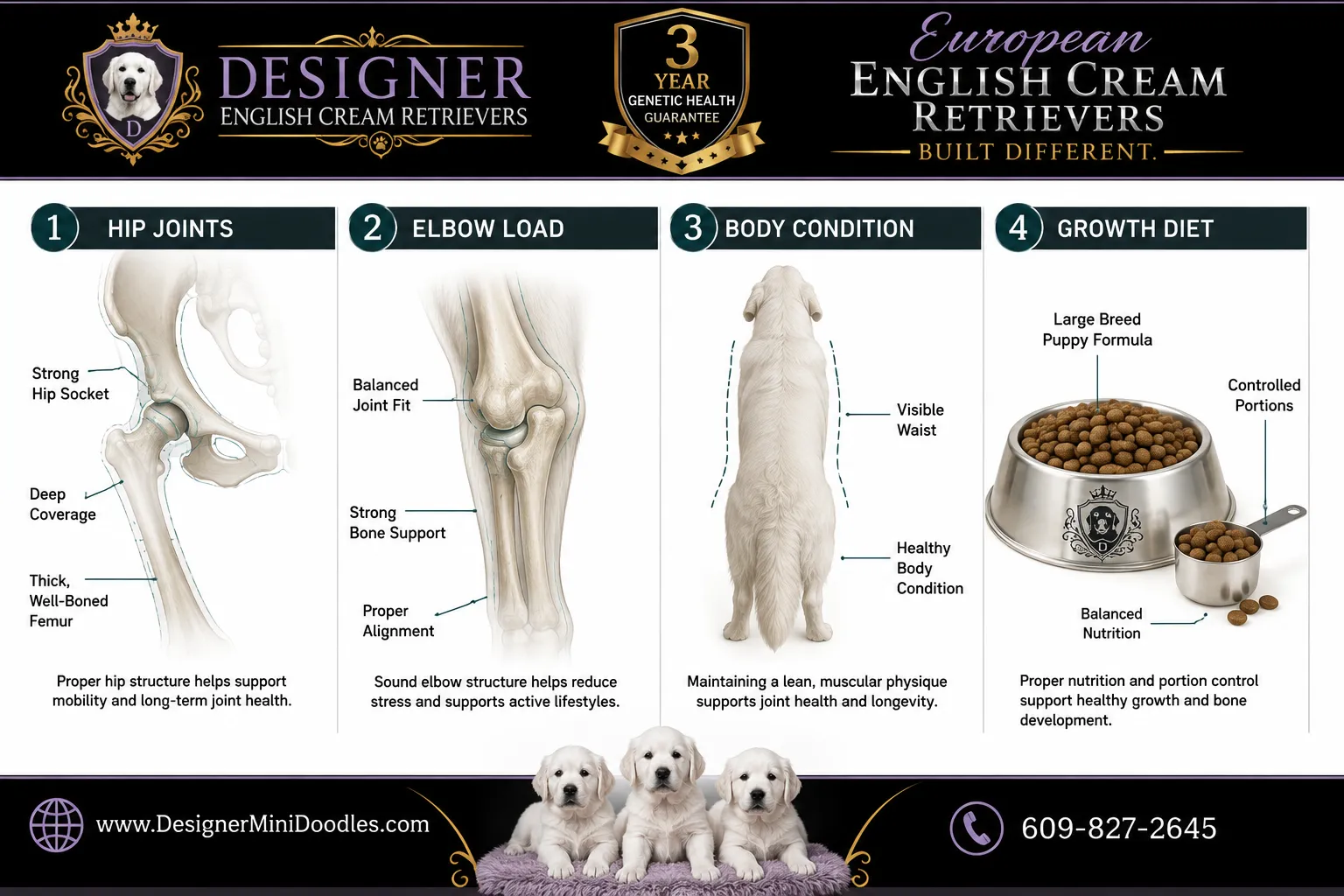
- Growing too fast is a bigger orthopedic risk than growing large. Controlled growth on large-breed puppy food protects hips and elbows.
What is the average size of an English Cream Golden Retriever?
The average adult English Cream Golden Retriever stands 21 to 24 inches tall at the shoulder and weighs 55 to 80 pounds depending on sex and build. That places the breed firmly in the medium-large category, not the giant category, even though the thick coat and broad frame create a bigger visual impression.
Here’s the important context: “English Cream” is a marketing and color description, not a size classification. The American Kennel Club recognizes one Golden Retriever breed, and cream-coated dogs are simply Goldens bred in the European style, where pale coats and heavier bone are the norm. So the official size standard applies to them exactly as it does to any other Golden.
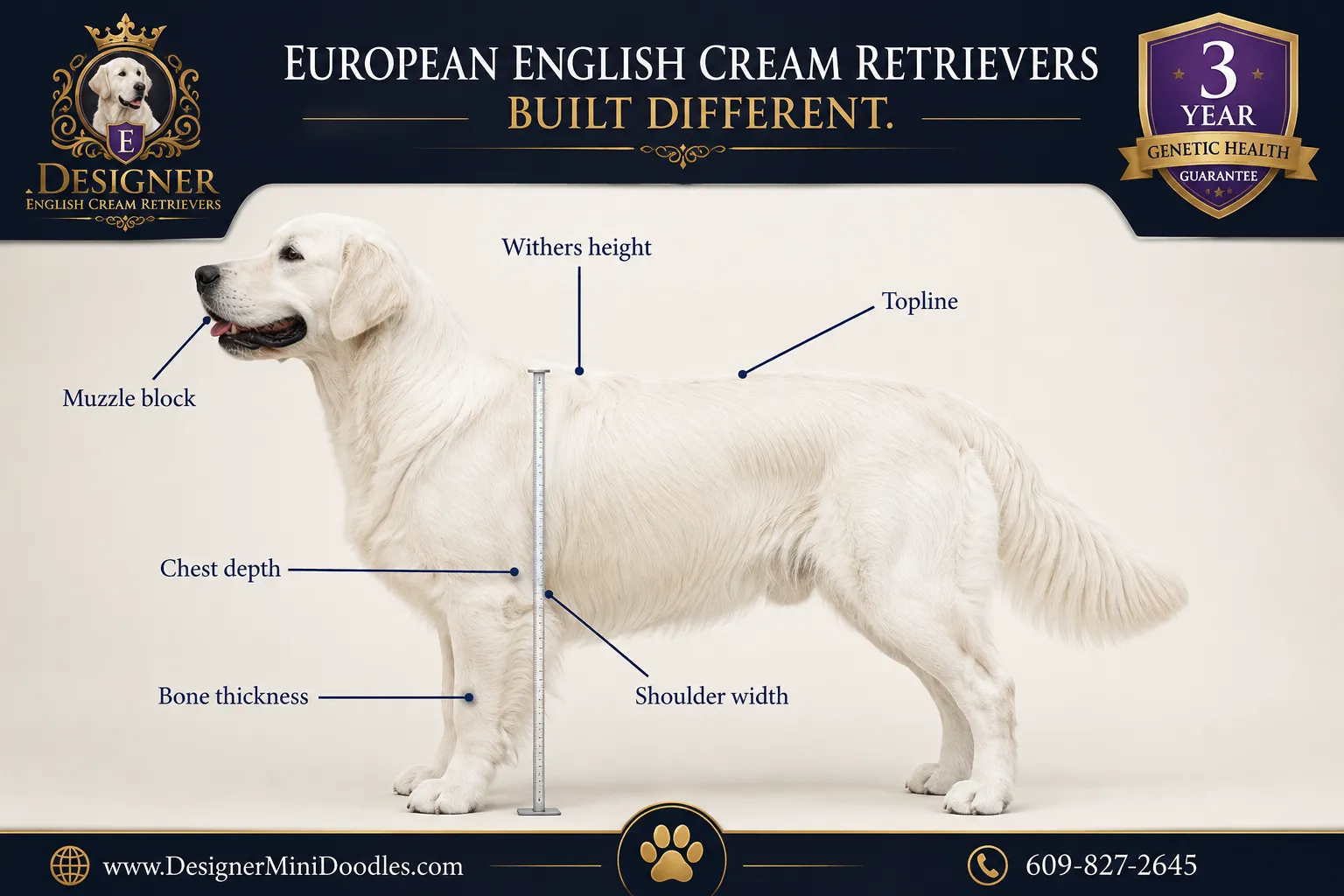
What varies is shape. Two dogs can both weigh 72 pounds and look completely different:
- A European-line cream male often carries that weight on a 23-inch frame with a wide chest, blocky head and heavy bone.
- An American-line male might carry the same 72 pounds on a 24-inch frame that looks leaner and more angular.
Decision rule: if you’re shopping for a dog under 50 pounds, a cream Golden is the wrong breed. Look at genuinely smaller crossbreeds instead, such as a 10-16 lb micro Goldendoodle for first-time dog owners, where small adult size is actually part of the breeding goal.
English Cream Golden Retriever weight and height standards
The height and weight standards for cream Goldens come from the Golden Retriever breed standard, and the two most-cited versions differ slightly. The AKC standard lists height only; The Kennel Club (UK) standard, which most European cream lines were bred toward, lists height in a slightly shorter range.
| Measurement | Male | Female | Source basis |
|---|---|---|---|
| Height at withers (AKC) | 23-24 in | 21.5-22.5 in | AKC Golden Retriever standard |
| Height at withers (UK KC) | 22-24 in | 20-22 in | The Kennel Club breed standard |
| Typical adult weight | 65-75 lb | 55-65 lb | AKC breed guidance |
| Common real-world range | 65-80 lb | 55-70 lb | Owner and breeder observation |
| Chest circumference (approx.) | 28-34 in | 25-31 in | Practical fitting measurement |
A few practical notes on using these numbers:
- Withers height means the top of the shoulder blades, measured with the dog standing square on a level floor, not the top of the head.
- Show standards allow limited deviation. The AKC standard notes that dogs more than one inch above or below the stated range are penalized in the ring, though a pet dog slightly outside the range is perfectly healthy.
- Weight ranges in the standard assume lean body condition. Many pet Goldens carry 8 to 15 extra pounds, which inflates published “average weights” you’ll find in casual sources.
A cream Golden that measures 23 inches and weighs 95 pounds isn’t a “big-boned” dog. It’s a 75-pound dog carrying 20 pounds it doesn’t need.
How big do English Cream Golden Retrievers get compared to regular Golden Retrievers?
Cream Goldens generally reach the same height as regular American Golden Retrievers, sometimes half an inch to an inch shorter, but they are typically broader and heavier in build. The difference is in silhouette and bone, not overall scale.
Where European-line cream dogs commonly differ:
- Skull: wider and more blocky, with a shorter, deeper muzzle and a pronounced stop.
- Chest: broader and deeper front assembly, giving a wider stance.
- Bone: thicker legs and heavier substance overall.
- Coat: often shorter but denser, with a cream to pale-gold color that reads “white” in photographs.
- Tail and topline: flatter, more level topline in many European lines.
That combination is why our program describes our dogs as looking like “baby Great Pyrenees”, the pale coat plus the broad, thick frame creates that impression, even though the actual measurements sit inside standard Golden Retriever territory. Our english cream golden retriever breeding stock comes from top European bloodlines selected specifically for that heavier, broader type, and our English cream golden retriever puppies consistently mature broader and thicker than typical United States retrievers.

Common mistake: assuming a lighter coat means a smaller dog. Coat color is controlled by pigment genes that have nothing to do with skeletal size. Some of the largest Goldens I’ve measured have been pale cream, and some of the smallest have been deep red.
Are English Cream Golden Retrievers smaller than American Golden Retrievers?
No, English Cream Golden Retrievers are not meaningfully smaller than American Golden Retrievers. On average they measure a fraction shorter at the shoulder because the UK breed standard specifies a slightly lower height range, but they usually weigh the same or more thanks to their heavier bone and broader chest.
Here’s how the two types compare in practice:
| Trait | European / cream lines | American lines |
|---|---|---|
| Height | Same or up to ~1 in shorter | Slightly taller on average |
| Weight | Same or slightly heavier | Same range, leaner look |
| Body shape | Stocky, broad, blocky | Athletic, angular, more leg |
| Visual impression | Larger and thicker | Taller and sleeker |
| Coat color | Cream to light gold | Mid to dark gold, red |
Choose the European cream type if you want a calmer-looking, substantial dog with a heavier build and pale coat. Choose American lines if you want a slightly leggier, more angular field-style athlete. Neither choice changes the fundamental fact that you’re bringing home a 55 to 80 pound sporting dog.
How much does an English Cream Golden Retriever weigh fully grown?
A fully grown English Cream Golden Retriever weighs 65 to 80 pounds if male and 55 to 70 pounds if female, measured at lean body condition somewhere between 18 and 24 months of age. Weight keeps creeping up after 12 months not because the skeleton is growing but because the chest deepens and muscle fills in.
Three factors move a specific dog within that range:
- Sex, accounts for the largest single difference, typically 10 to 15 pounds.
- Parent size, a 24-inch, 82-pound sire and a 22-inch, 68-pound dam will produce heavier puppies than a pair at the low end of the standard.
- Body condition, the difference between a lean 68-pound female and the same dog at a chunky 82 pounds is diet and exercise, not genetics.
Quick body-condition check (works better than the scale):
- You can feel individual ribs under a thin layer of fat without pressing hard.
- Viewed from above, there’s a visible waist behind the ribcage.
- Viewed from the side, the belly tucks up toward the hind legs.
If all three are true, your dog’s weight is right for its frame, whatever the number says.
English Cream Golden Retriever size at different ages
Cream Golden puppies grow fastest between 8 weeks and 6 months, reach roughly 90% of adult height by 10 to 12 months, then spend another 6 to 12 months adding chest depth and muscle. The table below shows typical progression for a puppy on track for a 70-pound adult weight; individual puppies vary by 15 to 20% either direction.
| Age | Typical weight (male) | Typical weight (female) | What’s happening |
|---|---|---|---|
| 8 weeks | 10-14 lb | 8-12 lb | Ready to go home; rapid growth begins |
| 3 months | 25-32 lb | 22-28 lb | Fastest growth phase |
| 4 months | 33-42 lb | 28-36 lb | About half of adult weight |
| 6 months | 45-55 lb | 40-48 lb | Leggy, gangly stage; growth plates open |
| 9 months | 58-68 lb | 50-58 lb | Height nearly final |
| 12 months | 63-74 lb | 53-64 lb | Adult height reached |
| 18 months | 65-78 lb | 55-68 lb | Chest deepens, coat thickens |
| 24 months | 65-80 lb | 55-70 lb | Fully mature build |

A rough estimating rule many breeders use: double the puppy’s weight at 16 weeks, then add 5 to 10 pounds for a male or 3 to 6 for a female. It’s an approximation, not a guarantee, and it works better for medium-large breeds than for giants.
Edge case: puppies from a very large litter often start below average and catch up by 6 months. Don’t judge adult size from an 8-week weight alone.
- Display 15 Products per page

Do English Cream Golden Retrievers stop growing at a certain age?
Yes. English Cream Golden Retrievers stop growing taller when their long-bone growth plates close, which happens for most individuals between 10 and 14 months. They continue to change after that, broadening through the chest and shoulders until roughly 24 months, but skeletal height is finished well before the second birthday.
Two separate timelines matter:
- Height (skeletal growth): done by 12 months in most cream Goldens, occasionally 14 months in heavier-boned males.
- Substance (chest, muscle, coat): continues to 18 to 24 months. This is why a 14-month-old cream Golden often looks “unfinished” next to a three-year-old.
Practical consequence: high-impact exercise should be moderated until growth plates close. Free play on grass, swimming and walking are fine. Repetitive forced running on pavement, long-distance jogging and jumping down from heights are worth delaying until at least 12 to 14 months, and your veterinarian can confirm plate closure with a radiograph if you plan serious sport work.
Common mistake: switching from large-breed puppy food to adult food at 6 months. Most large-breed formulas are designed to be fed until 12 to 18 months precisely because controlled growth protects developing joints.
Is my English Cream Golden Retriever the right size for an apartment?
A cream Golden can live comfortably in an apartment, but only if you can deliver 60 to 90 minutes of daily activity plus mental work. Square footage matters far less than exercise consistency, elevator access and your building’s weight limits, which frequently cap pets at 25 to 50 pounds.
Run through this checklist before committing:
- Check the lease weight limit. Many buildings cap pets well under 70 pounds. This is the single most common deal-breaker.
- Count the stairs. Carrying a 60-pound adolescent down four flights during a joint flare-up is a real scenario.
- Budget floor space. A 42-inch crate occupies roughly 3.5 by 2.5 feet, plus clearance.
- Plan the shedding. Dense double coats mean visible hair on hard floors year-round, heavier in spring and fall.
- Map your outdoor access. A ground-floor unit with a nearby park beats a high-rise with no green space within a mile.
Choose a smaller breed instead if your building caps pets at 30 pounds, you travel constantly, or you can’t commit to daily outdoor exercise. In that situation, a small crossbreed makes far more sense, see why a 10-16 lb micro Goldendoodle suits apartment and urban living or how toy poodles fit small apartments and condos.
English Cream Golden Retriever size health problems
Golden Retrievers of every color are predisposed to hip and elbow dysplasia, and rapid growth during puppyhood raises that risk. The health issue isn’t being large, it’s growing too fast, carrying excess weight, or descending from parents who were never screened for orthopedic soundness.
Size-related concerns worth understanding:
- Hip and elbow dysplasia: joint malformation influenced by both genetics and growth rate. Reputable breeders screen breeding stock through the Orthopedic Foundation for Animals (OFA) or equivalent European hip scoring schemes.
- Cranial cruciate ligament injury: more common in heavier dogs, especially overweight ones doing sudden twisting movements.
- Osteoarthritis later in life: every extra pound of body weight adds load to joints already predisposed to wear.
- Excess weight: the Association for Pet Obesity Prevention has consistently reported that a majority of US dogs are overweight or obese, which is a modifiable risk factor entirely within an owner’s control.

Three things that actually reduce risk:
- Buy from a breeder who provides documented hip and elbow clearances on both parents plus a written genetic health guarantee.
- Feed a large-breed puppy formula with controlled calcium and calorie density, measured by weight rather than free-fed.
- Keep your dog at a lean body condition for life. It’s the cheapest joint protection available.
Our program is run by a working animal biologist with a degree in Animal Biology from Stockton University (Pomona, New Jersey) and a minor in animal genetics, which shapes how we pair our dogs. Structure, hip scores and bone quality drive every breeding decision, not coat shade alone.
Are male or female English Cream Golden Retrievers bigger?
Male English Cream Golden Retrievers are consistently larger than females, typically by about 1.5 to 2 inches at the shoulder and 10 to 15 pounds in body weight. The difference is visible in the head too: males develop broader skulls and thicker necks, especially after 18 months.
| Trait | Male | Female |
|---|---|---|
| Height | 22.5-24 in | 20.5-22.5 in |
| Weight | 65-80 lb | 55-70 lb |
| Head | Broader, blockier | Refined, narrower |
| Maturity timing | Fills out later, 24 months | Finishes earlier, ~18 months |
Decision rule: if the last 10 pounds matter for your lease, your car or your physical strength, choose a female from parents at the lower end of the standard. If you want maximum substance and that heavy “baby Great Pyrenees” look, choose a male from broad, thick-boned European parents.
Note on neutering: spaying or neutering before growth plates close can slightly delay plate closure, sometimes producing a marginally taller, leggier adult. Discuss timing with your veterinarian rather than defaulting to six months.
English Cream Golden Retriever size genetics and breeding
Adult size in cream Goldens is polygenic, meaning many genes contribute, and it’s strongly heritable. Parent and grandparent measurements are the most reliable predictor available, far more useful than any online growth calculator.
What breeders actually control:
- Parent selection. Pairing two heavy-boned 24-inch European males’ daughters with similarly built sires produces litters that trend large. Pairing toward the middle of the standard produces more predictable, moderate dogs.
- Line consistency. Multiple generations of similar size make outcomes far more predictable than a single large outcross.
- Nutrition of the dam during pregnancy and lactation, which affects birth weight and early growth.
- Litter size and early rearing. Puppies raised with careful weight monitoring and staged weaning start life on a better growth curve.
All of our English Cream retriever puppies for sale and our breeding stock trace to top European bloodlines, which is exactly why the broader chest, blockier head and thicker bone show up so reliably in our litters. Our program also uses Early Neurological Stimulation (ENS) from birth, and every litter grows up inside a busy home with other animals, children, vacuum cleaners and ordinary household noise, so puppies leave well started on housebreaking and crate training rather than needing to start from zero. That early foundation is a big part of why we’re confident calling ourselves the best English Cream Retriever breeders in the USA.
If you’re comparing breeding programs generally, our guide to identifying the best Golden Doodle breeders covers the same screening logic: health testing, whelping practices, socialization protocol and written guarantees.
Pricing tiers and what they signal about size, health and structure
Price correlates loosely with how much genetic and developmental work went into a puppy. Here’s how the market typically breaks down:
| Price range | What it usually means |
|---|---|
| $500,$1,000 | Overwhelmingly scams, stolen photos, no dogs at all. Never wire money. |
| $1,000,$1,500 | Puppy mill or volume seller. No health screening, no structure selection, unpredictable adult size. |
| $1,800,$2,000 | Hobby breeder. Often well-intentioned, but limited genetic testing and no early training foundation. |
| $3,500,$5,500 | Accredited breeder with genetic health guarantee, professional whelping, OFA-style clearances, early housebreaking and crate training. |
A well-bred english cream retriever at the top tier costs more up front and usually costs less over a lifetime in vet bills and training. For readers who want the same cost breakdown logic applied to smaller dogs, see our page on cost-of-ownership clarity for micro Goldendoodles. We also offer French bulldog stud services through our sister program for breeders working with brachycephalic lines.
How to tell if your English Cream Golden Retriever will be large or small
The most accurate prediction comes from the parents’ actual measured height and weight, followed by your puppy’s 16-week weight and its paw-to-leg proportions. No single indicator is definitive, but stacking three or four gets you close.
Work through these in order of reliability:
- Measure both parents. Ask the breeder for withers height and lean weight, not estimates. Puppies usually land within a few pounds of the parent average, adjusted for sex.
- Ask about previous litters. A breeder who has produced the same pairing before can tell you exactly how the last litter matured.
- Weigh at 16 weeks. Double it, then add 5 to 10 lb (male) or 3 to 6 lb (female).
- Look at bone, not height. Thick wrists, wide paws and a deep chest at 4 months predict a substantial adult even if the puppy is currently short.
- Track on a growth curve. Weigh every two weeks and plot it. A steady curve matters more than any single number, and a sudden flattening or spike is worth a vet conversation.
Quick example: a 4-month-old male weighing 38 lb, out of a 23.5-inch, 78-lb sire and a 22-inch, 66-lb dam, with heavy wrists and a broad chest, is very likely to mature between 75 and 82 lb at around 23.5 inches. Same puppy at 30 lb from mid-standard parents points closer to 65 lb.
Frequently asked questions
Is an English Cream Golden Retriever a different breed from a Golden Retriever?
No. It’s the same breed, the Golden Retriever, bred in the European style with a pale cream coat and heavier build. Kennel clubs recognize one Golden Retriever breed.
How tall is a full-grown English Cream Golden Retriever?
Males typically stand 22.5 to 24 inches at the shoulder and females 20.5 to 22.5 inches, measured at the withers with the dog standing square.
Do English Cream Golden Retrievers get bigger than American Goldens?
They usually weigh the same or slightly more due to broader chests and heavier bone, but they are not taller. Any perception of extra size comes from build and dense coat.
At what age is an English Cream Golden Retriever full grown?
Full height by 10 to 14 months, full adult build by 18 to 24 months. Males finish filling out later than females.
What size crate does an English Cream Golden Retriever need?
A 42-inch crate (roughly 42 x 28 x 30 inches) fits nearly every adult. Use a 42-inch crate with a divider panel from puppyhood so you only buy one crate.
How much should a 6-month-old English Cream Golden Retriever weigh?
Around 45 to 55 pounds for males and 40 to 48 pounds for females, though a 15 to 20% variation either way is normal and not a cause for concern if body condition is good.
Are there miniature English Cream Golden Retrievers?
No recognized miniature version exists. Dogs advertised as “mini English Cream Goldens” are usually crossbreeds or undersized individuals. If you want a genuinely small dog, look at purpose-bred small crossbreeds instead.
Does spaying or neutering affect adult size?
Early sterilization before growth plates close can slightly delay closure and produce a marginally taller, leggier adult. Timing should be discussed with your veterinarian based on breed and lifestyle.
Can an English Cream Golden Retriever live in an apartment?
Yes, provided your lease allows a 55 to 80 pound dog and you can deliver 60 to 90 minutes of daily exercise plus mental enrichment. Building weight limits are the most common obstacle.
What’s the healthiest weight for an English Cream Golden Retriever?
Whatever weight lets you feel the ribs easily, see a waist from above, and see an abdominal tuck from the side. That body-condition assessment matters more than a target number.
Conclusion and next steps
The short version: english cream golden retriever size sits squarely inside the standard Golden Retriever range, 21 to 24 inches tall, 55 to 80 pounds, with the European cream type distinguished by a broader, thicker, blockier build rather than greater height. Adult height arrives by about a year; the finished adult look takes closer to two.
Your next steps, in order:
- Confirm your constraints first. Check lease weight limits, vehicle space and your own physical ability to handle a 70-pound dog before falling in love with a photo.
- Ask breeders for measured parent height and weight, plus documented hip and elbow clearances. Vague answers here are a red flag.
- Buy a 42-inch crate with a divider on day one rather than replacing a small crate twice.
- Start on large-breed puppy food and feed measured portions to keep growth controlled through 12 to 18 months.
- Weigh every two weeks until 12 months and plot the curve so you can spot problems early.
- Budget realistically. Expect $3,500 to $5,500 from an accredited program with genetic guarantees, early housebreaking and crate training, and walk away from anything advertised at $500 to $1,000.
Get those six things right and size becomes a planning detail rather than a surprise.
Sources
- American Kennel Club, Golden Retriever Breed Standard and Breed Information, akc.org
- The Kennel Club (UK), Golden Retriever Breed Standard, thekennelclub.org.uk
- Orthopedic Foundation for Animals, hip and elbow dysplasia evaluation program, ofa.org
- Association for Pet Obesity Prevention, annual pet obesity survey data, petobesityprevention.org