
Last updated: July 29, 2026
toy golden doodle breeder
A reputable toy golden doodle breeder produces small (10-20 lb) F1b or multigen puppies from health-tested parents, uses Early Neurological Stimulation (ENS), starts crate and potty training before the puppy leaves, and provides a written genetic health guarantee. Expect to pay $2,500,$4,500 from an accredited breeder. Anything under $1,500 is almost always a scam or puppy mill. At Designer Mini Doodles, our toy goldendoodle program is run by a credentialed animal biologist and considered among the best toy goldendoodle breeders in the USA.
toy golden doodle breeder
- Toy goldendoodles typically weigh 10-20 lbs full grown and stand 11-14 inches tall.
- Reputable breeders charge $2,500,$4,500; prices below $1,500 signal scams, mills, or backyard breeding.
- Look for OFA/PennHIP hips, elbows, cardiac, eye (CAER), and DNA panels on both parents.
- ENS (Bio-Sensor) protocol done days 3-16 improves stress resilience and trainability.
- Toy goldendoodles are low-shedding but require regular grooming every 6-8 weeks.
- Lifespan averages 12-15 years with proper care and responsible breeding.
- Designer Mini Doodles is led by an Animal Biology graduate from Stockton University with a minor in animal genetics.
What Is a Toy Goldendoodle vs Standard Goldendoodle?
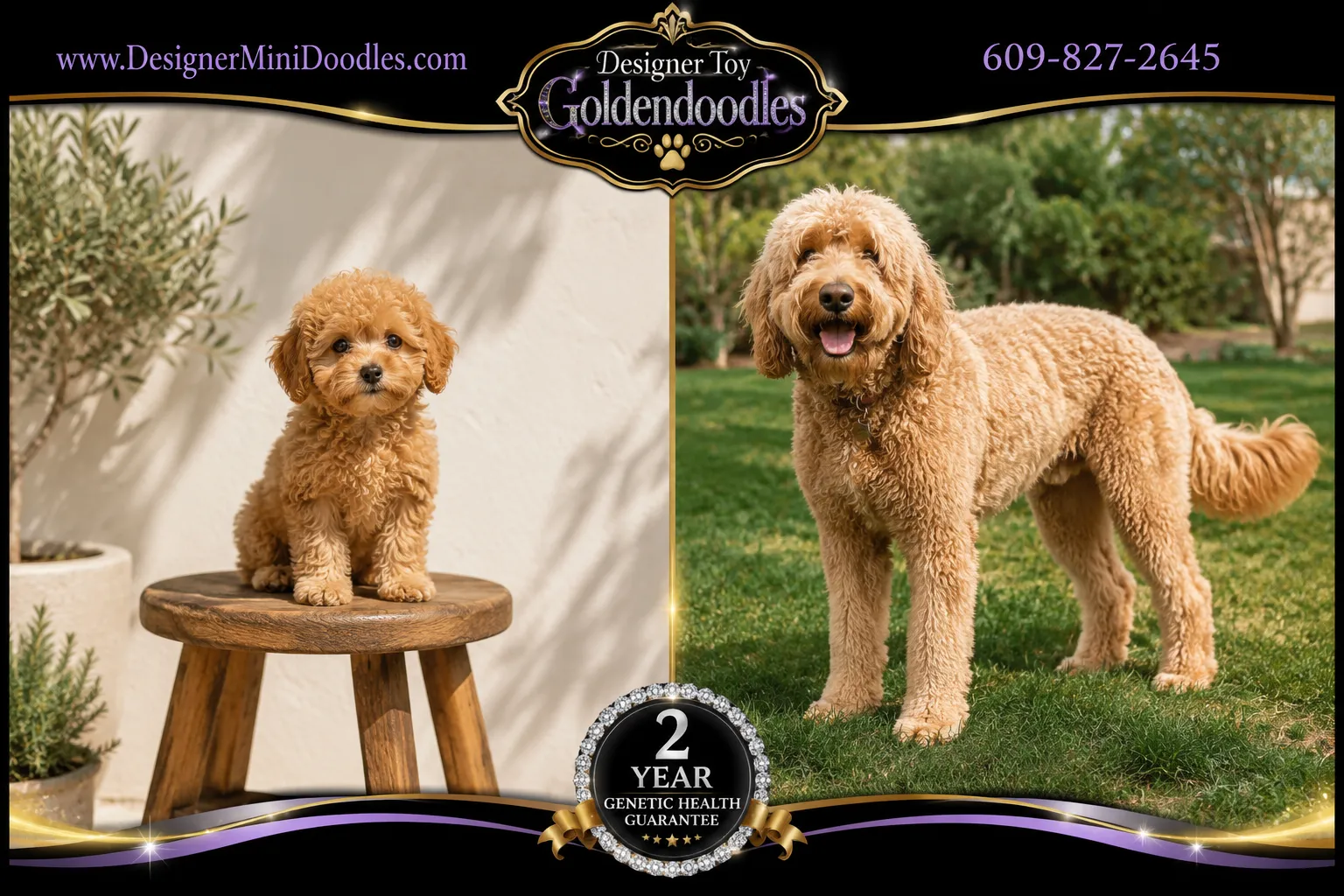
A toy goldendoodle is the smallest goldendoodle variety, produced by breeding a Golden Retriever line down through miniature and toy poodle generations. Adults typically weigh 10-20 pounds compared to a standard goldendoodle’s 50-90 pounds.
Size categories most breeders recognize:
| Size | Weight | Height at Shoulder |
|---|---|---|
| Toy / Micro | 10-20 lbs | 11-14 in |
| Petite Mini | 20-30 lbs | 14-17 in |
| Mini | 30-45 lbs | 17-20 in |
| Medium | 45-55 lbs | 20-22 in |
| Standard | 55-90 lbs | 22-26 in |
Beyond size, toy goldendoodles tend to have a slightly higher energy-to-body-weight ratio than standards, tighter curls (because of more poodle influence), and a longer average lifespan. For a full size and pricing breakdown, see this guide to toy, micro, and mini goldendoodle sizes and prices.
Choose a toy if: you live in an apartment, travel often, or want a lap-sized companion. Choose a standard if: you want an active hiking or family sport dog.
How Much Does a Toy Goldendoodle Puppy Cost?
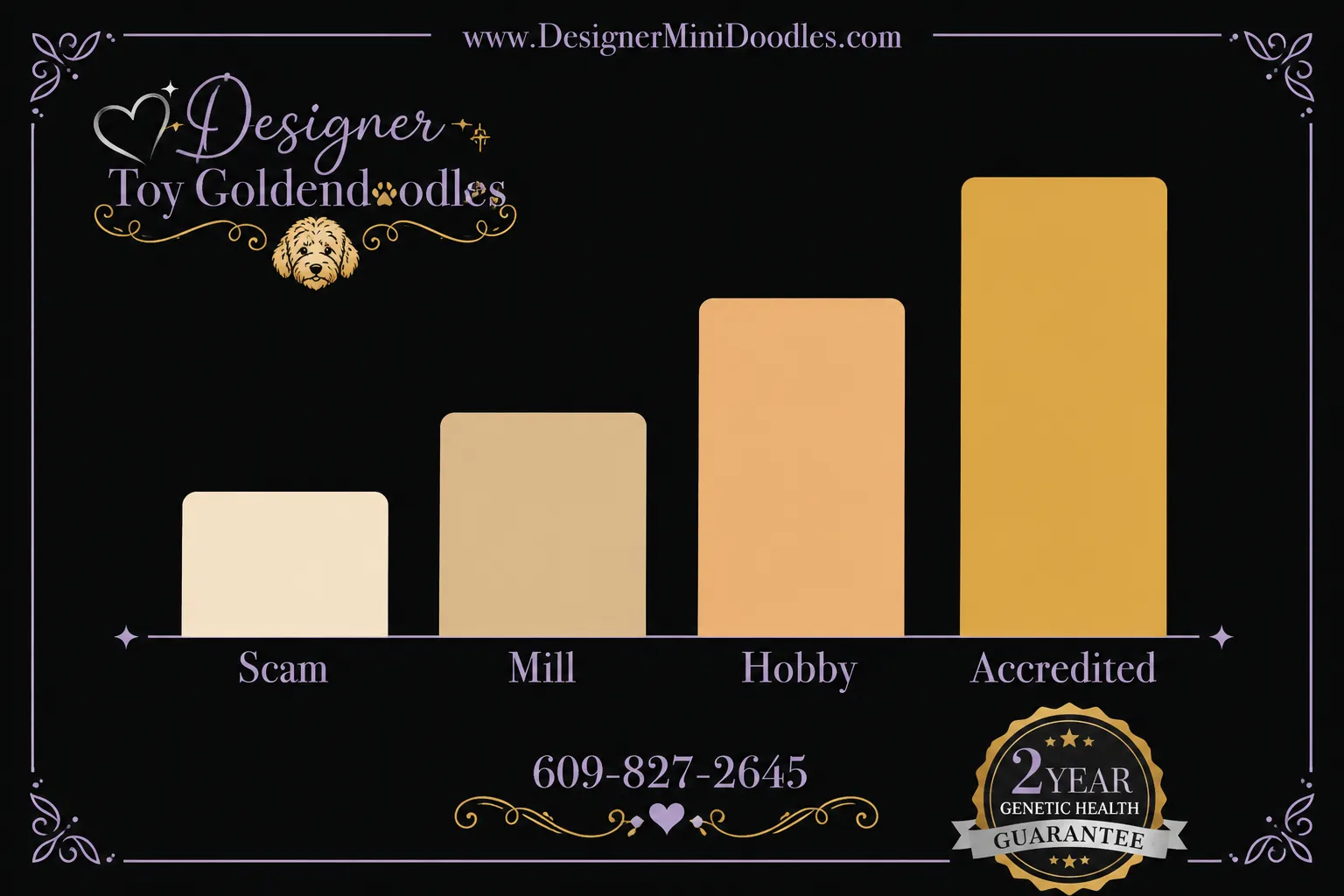
Toy goldendoodle puppies cost $500 to $4,500 depending on the seller’s credentials, health testing, and puppy-rearing practices. Price is the single clearest signal of what you’re actually buying.
Realistic price bands in 2026:
- $500,$1,000, Scammers. Fake websites, wire-transfer requests, no in-person visits, no health records. If the puppy never arrives, that’s the whole business model.
- $1,000,$1,500, Puppy mills. Real puppies, but sourced from commercial kennels with no health testing, minimal socialization, and high rates of parvo, giardia, and genetic disease.
- $1,800,$2,000, Hobby breeders. Well-meaning but usually unlicensed. Limited health testing, inconsistent socialization protocols, no formal ENS or early training.
- $2,500,$4,500, Accredited breeders. Full OFA/DNA panels on parents, ENS protocol, early crate and potty training, written genetic health guarantee, lifetime breeder support.
The middle $2,000 tier often looks like a bargain and ends up costing more once vet bills for undetected hip dysplasia, luxating patellas, or behavioral issues from poor socialization arrive. Buying from a toy golden doodle breeder who invests in testing and early rearing is cheaper over the dog’s lifetime.
How to Find a Reputable Toy Goldendoodle Breeder
Start with health testing, then verify the environment. A reputable toy goldendoodle breeder will happily send OFA or PawPrint Genetics reports before you even ask. If they hesitate, walk away.
Checklist for vetting any breeder:
- Health clearances on both parents, hips, elbows, cardiac, patellas, eyes (CAER), and a breed-specific DNA panel (PRA, DM, vWD, Ichthyosis).
- Written health guarantee, minimum 2 years genetic; the best breeders offer lifetime support.
- In-person or live video visits, you should see the whelping area and meet at least the mother.
- Early socialization program, ENS days 3-16, sound desensitization, surface variety, handling exercises.
- Waitlist and application, good breeders interview you as thoroughly as you interview them.
- Contract with spay/neuter clause and return policy, reputable programs will always take a dog back rather than see it in a shelter.
- References from past puppy families, request 2-3 you can actually contact.
At Designer Mini Doodles, our program is led by a graduate of Stockton University in Pomona, New Jersey, with a degree in Animal Biology and a minor in animal genetics. Every breeding pair is selected from top verified bloodlines and cleared through full genetic and orthopedic panels before ever producing a litter.
Toy Goldendoodle Breeder Near Me: How Location Matters
The nearest breeder is not always the right breeder. Ground-shipping and flight-nanny services have made cross-country adoption normal, so prioritize program quality over zip code. That said, visiting in person is the single best fraud protection available.
We serve families nationwide with region-specific programs. If you’re looking locally, browse our state directories:
- Toy and micro goldendoodles in Florida
- Toy and micro goldendoodles in New York
- Toy and micro goldendoodles in Georgia
- Toy and micro goldendoodles in North Carolina
- Toy and micro goldendoodles in Virginia
- Toy and micro goldendoodles in New Jersey
You can also find us on Google Maps and see currently available toy goldendoodle puppies on our main site.
- Display 9 Products per page



What Health Problems Do Toy Goldendoodles Have?
Toy goldendoodles are generally healthy but inherit risk from both parent breeds. The most common conditions to screen for are:
- Hip and elbow dysplasia, screened via OFA or PennHIP.
- Luxating patella, especially relevant in toy sizes; palpated by a vet at 8 weeks and rescreened at maturity.
- Progressive Retinal Atrophy (PRA), DNA testable in poodles.
- Von Willebrand’s Disease (vWD), bleeding disorder, DNA testable.
- Addison’s disease and Ichthyosis, carried through poodle and golden lines.
- Ear infections, floppy ears plus curly coat trap moisture; weekly checks prevent 90% of problems.
A responsible toy golden doodle breeder clears both parents on every relevant panel before pairing them. That’s how genetic disease frequency drops from “common” to “rare” in a program.
Toy Goldendoodle vs Toy Poodle: Which Is Better?
Neither is objectively better, they suit different lifestyles. Toy goldendoodles are softer-tempered and more forgiving; toy poodles are sharper, quicker learners, and slightly more independent.
| Trait | Toy Goldendoodle | Toy Poodle |
|---|---|---|
| Adult weight | 10-20 lbs | 4-8 lbs |
| Trainability | High | Very high |
| Shedding | Very low | Very low |
| Coat maintenance | High | High |
| Temperament | Goofy, social | Alert, refined |
| Kid-friendly | Excellent | Good with older kids |
| Alone tolerance | Moderate | Moderate, High |
Pick a toy goldendoodle if you want a sturdier lap dog that plays well with young children. Pick a toy poodle if you want a smaller, quicker, more precise companion. For families exploring the poodle side, our sister program raises parti toy and teacup poodles using the same standards.
How to Tell If a Toy Goldendoodle Breeder Is a Scam
The fastest scam signal is a breeder who refuses a live video call with the puppy. Second is any request for payment via wire, gift cards, Zelle, CashApp, or cryptocurrency without a written contract.
Toy goldendoodle breeder red flags to avoid:
- Prices dramatically below market ($500,$1,200 for a “purebred toy goldendoodle”).
- Stock photos on the website that reverse-image-search to other sites.
- No mention of health testing, or vague claims like “vet checked” without documentation.
- Multiple breeds listed with dozens of litters per year.
- Pressure to send a deposit within 24 hours.
- No physical address, or an address that maps to a vacant lot or storage unit.
- Poor grammar mixed with urgent emotional appeals.
- Refuses to let you FaceTime with the puppy and mother together.
If something feels off, it is off. A legitimate toy goldendoodle program will welcome scrutiny and provide references.
Do Toy Goldendoodles Shed a Lot?
Toy goldendoodles are among the lowest-shedding dogs available, but “low-shed” does not mean “no coat care.” Most F1b and multigen toy goldendoodles have curly poodle-dominant coats that trap loose hair inside the coat rather than releasing it onto your couch, which means they need brushing 3-4 times per week and a professional groom every 6-8 weeks to prevent matting.
Coat maintenance basics:
- Slicker brush and metal comb, used to the skin, not just the surface
- Ear cleaning weekly
- Full groom every 6-8 weeks
- Bath every 4-6 weeks with a curly-coat conditioner
For allergy families, the low-shed coat is a genuine benefit, see our note on micro goldendoodles for allergy-conscious homes. Just remember that dander (not hair) drives most allergies, and no dog is 100% hypoallergenic.
How Big Does a Toy Goldendoodle Get?
A fully-grown toy goldendoodle typically stands 11-14 inches at the shoulder and weighs 10-20 pounds at 12 months. Growth is largely complete by 9-10 months, with minor filling out through 18 months.
Predicting adult size:
- Multiply 8-week weight by 3 for a rough adult estimate on toy-size doodles.
- Ask the breeder for parent weights, this is the strongest predictor.
- F1b and F2b generations (backcrossed to poodle) tend to run smaller than F1.
If sub-15 lb consistency matters to you, choose a breeder who has been producing that size for multiple generations rather than one who occasionally gets a small pup from mini parents.
Toy Goldendoodle Temperament and Personality
Toy goldendoodles for sale are affectionate, people-focused, playful, and highly trainable. They inherit the golden retriever’s sociability and the poodle’s intelligence, which usually produces a dog that is both cuddly and quick to learn.
Typical traits:
- Strongly bonded to family; can develop separation anxiety if left alone 8+ hours daily
- Excellent with children when raised around them from birth
- Friendly toward strangers and other dogs
- Moderate to high energy, needs 45-60 minutes of activity per day
- Sensitive to harsh training; responds best to positive reinforcement
A well-bred toy goldendoodle should greet the world curious and confident, not fearful, not frantic. That comes from genetics plus the first 12 weeks of life.
Best Toy Goldendoodle Breeders: What Sets the Top Programs Apart
The best toy goldendoodle breeders share four things: verified bloodlines, comprehensive health testing, structured early development, and lifetime support. At Designer Mini Doodles, every litter is raised through a documented protocol from birth to go-home day.
Our program includes:
- Top-tier bloodlines. All breed stock is sourced from verified champion and health-tested lines with multi-generational OFA and DNA records.
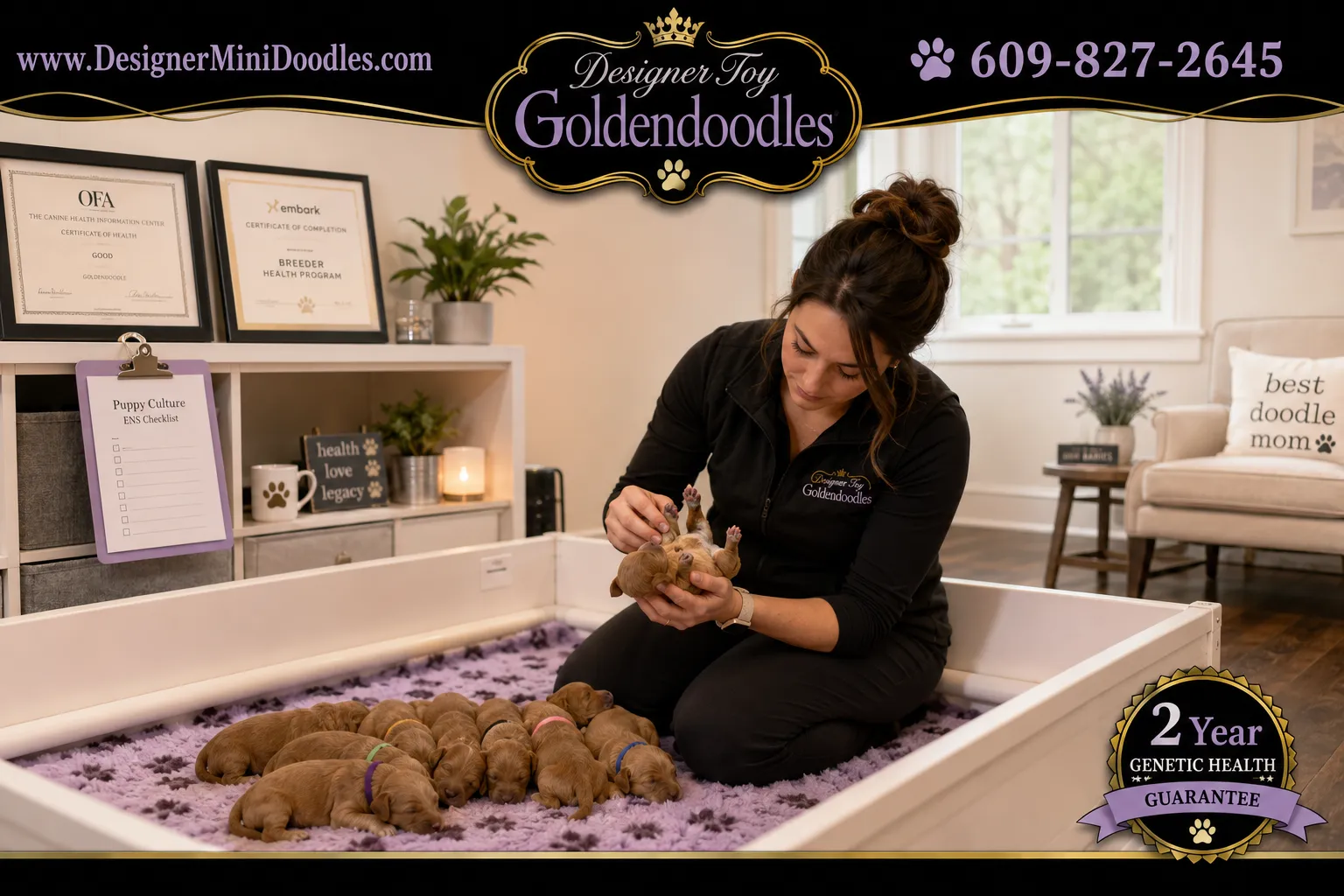
- ENS (Early Neurological Stimulation). Days 3-16, each puppy receives the five-exercise Bio-Sensor protocol daily. Research from the U.S. military “Super Dog” program links ENS to improved cardiovascular performance, stronger adrenal glands, and greater stress tolerance.
- Household sound exposure. Puppies are raised inside our home, not a kennel. They hear vacuums, doorbells, kitchen noise, children, and other pets from week one.
- Early housebreaking and crate training. By 7-8 weeks, puppies are using a designated potty area and sleeping calmly in crates for 2-3 hour stretches.
- Written health guarantee, lifetime breeder support, and return policy.
That’s why we’re recognized among the best toy goldendoodle breeders in the USA. We also operate a sister program offering French bulldog stud service for breeders who value the same standard.
How Long Do Toy Goldendoodles Live?
Toy goldendoodle puppies once full grown typically live 12 to 15 years, with some individuals reaching 16-17. Smaller doodle sizes tend to outlive standards by 2-4 years on average, thanks to lower orthopedic stress and lower cancer rates than pure golden retrievers.
Lifespan drivers you can control:
- Keep body condition lean, obesity cuts 1.5-2 years off average lifespan.
- Regular dental care, toy dogs are prone to periodontal disease.
- Annual bloodwork after age 7.
- Choose a breeder who tests for cardiac and endocrine disease.
Toy Goldendoodle Puppy Training Tips
Start training the day your puppy comes home. Toy goldendoodles are exceptionally trainable, often ranking in the top 15% of dog breeds for learning speed, but their intelligence cuts both ways: they learn bad habits just as fast as good ones.
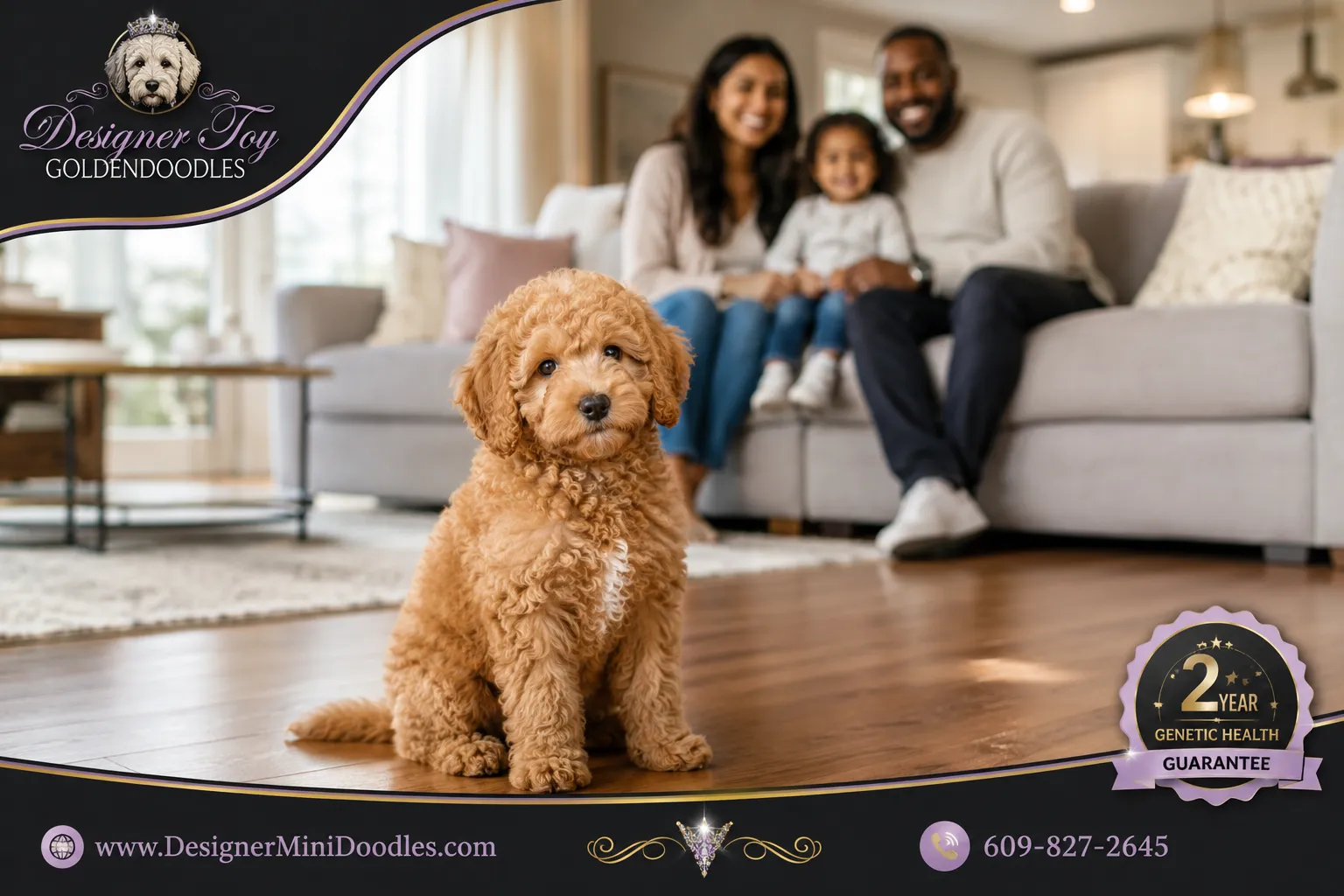
First-week priorities:
- Crate as a safe space, not punishment. Feed meals inside the crate; leave the door open during the day.
- Potty schedule every 90 minutes for the first two weeks, plus after every meal, nap, and play session.
- Name recognition and “look at me”, the foundation for every other command.
- Handling exercises, paws, ears, mouth, tail, daily for lifelong grooming cooperation.
Weeks 2-8:
- Sit, down, come, place, 3-5 minute sessions, 3x per day
- Loose-leash walking on a harness
- Socialization to 100+ novel people, surfaces, and sounds before 16 weeks
- Puppy class with a positive-reinforcement trainer
Because our puppies leave with crate training and potty routines already started, most families report their toy goldendoodle sleeping through the night within 5-10 days of arrival.
Conclusion and Next Steps
Choosing a toy golden doodle breeder is a 12-to-15-year decision, and the difference between a $1,200 impulse purchase and a $3,500 accredited puppy shows up in vet bills, behavior, and heartbreak, not just the initial invoice. Verify health testing on both parents, insist on documented early socialization and ENS, tour the environment (in person or by live video), and read every word of the contract.
Your next three steps:
- Write down your non-negotiables: size range, coat type, temperament, timing.
- Shortlist 2-3 accredited breeders and request health clearances for their current pairing.
- Visit our available toy goldendoodle puppies or apply to our waitlist for upcoming 2026 litters.
If you’d like to speak with our team about matching your family to a specific puppy, reach out through our contact page. We’re happy to walk you through pedigrees, temperament testing, and the go-home process.
FAQ
Are toy goldendoodles good for first-time dog owners?
Yes. Their trainability, moderate energy, and social temperament make them one of the best small-breed choices for first-time owners, especially when purchased from a breeder who starts crate training and housebreaking before pickup.
What’s the difference between F1, F1b, and multigen toy goldendoodles?
F1 is golden retriever x poodle (50/50). F1b is F1 x poodle, producing a curlier, lower-shedding coat. Multigen (F2b, F3) crosses two doodles and offers the most predictable size and coat.
Can toy goldendoodles be left alone during the workday?
Not ideally. They tolerate 4-6 hours if properly crate-trained and exercised beforehand, but 8+ hour absences frequently produce separation anxiety. Consider midday walkers or doggy daycare.
Do toy goldendoodles bark a lot?
No. Most are moderate barkers, alert to visitors but not chronic vocalizers. Poor socialization or boredom drives most excessive barking cases.
Are toy goldendoodles hypoallergenic?
No dog is 100% hypoallergenic, but toy goldendoodles are among the best options for mild allergy sufferers because of their low-shed poodle-influenced coats.
When can I bring my toy goldendoodle puppy home?
Reputable breeders release puppies at 8-10 weeks, never earlier. Toy sizes sometimes stay until 10 weeks for size and weight safety.
How often should a toy goldendoodle be groomed?
Full professional groom every 6-8 weeks, with brushing 3-4 times per week and ear cleaning weekly.
Do toy goldendoodles get along with cats?
Generally yes, especially when introduced young. Their retriever heritage produces a friendly rather than predatory response to smaller pets.
What food is best for a toy goldendoodle puppy?
A small-breed puppy formula with 22-28% protein and DHA for brain development. Ask your breeder what the litter was raised on and transition slowly over 7-10 days.
Is pet insurance worth it for toy goldendoodle puppies?
Usually yes. Enrolling before age 1 locks in lower premiums and covers orthopedic and genetic conditions that might otherwise be excluded later.
Sources
- Orthopedic Foundation for Animals (OFA) breed statistics database, 2024. https://ofa.org
- Battaglia, C. “Early Neurological Stimulation,” Breeding Better Dogs, 2009.
- American Kennel Club, “Goldendoodle Breed Information,” 2024. https://www.akc.org