

Last updated: July 26, 2026
Bernedoodle Mini
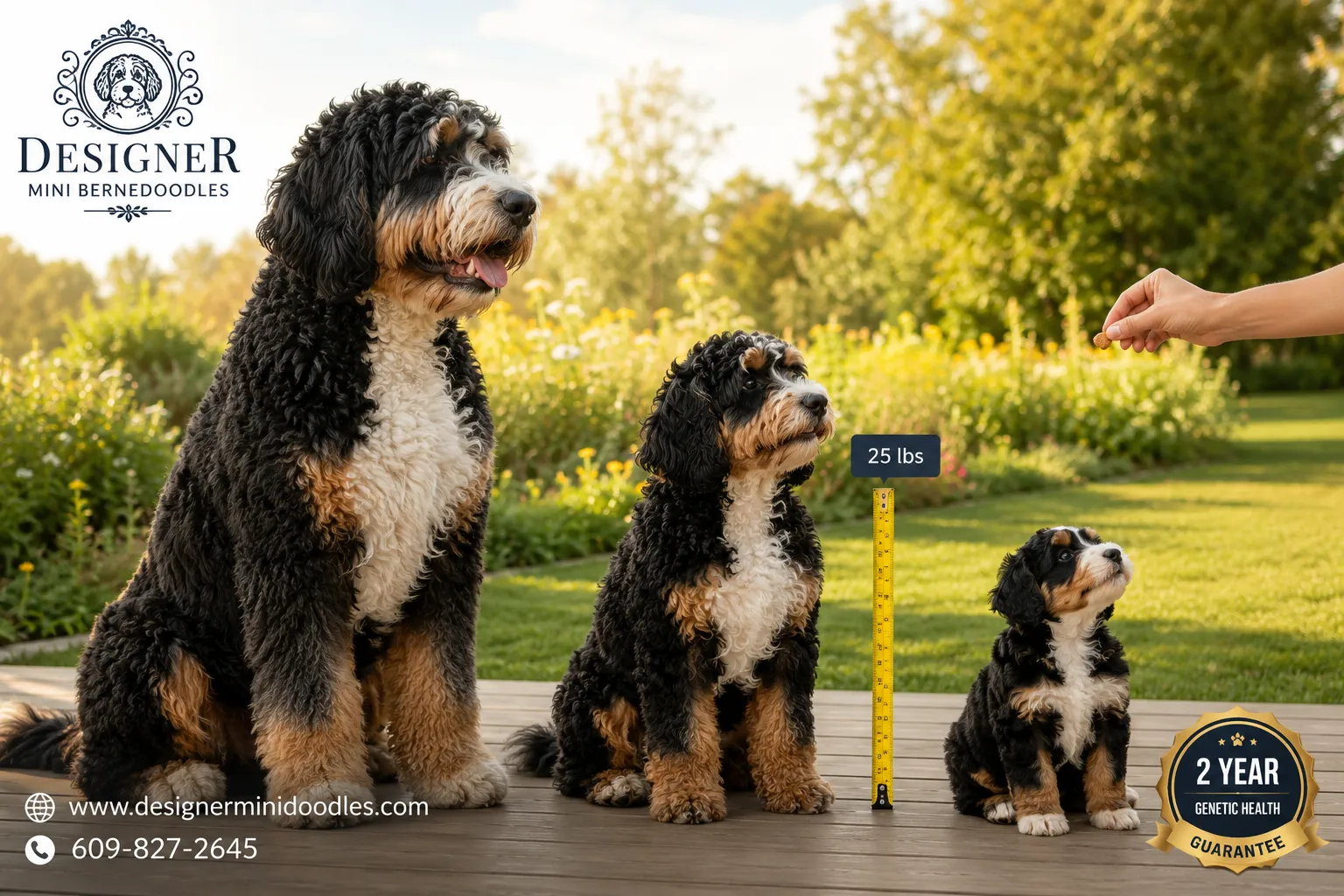
A Bernedoodle Mini is a cross between a Miniature Poodle and a Bernese Mountain Dog, typically weighing 25-49 pounds and standing 18-22 inches tall at full growth. They cost roughly $2,500,$5,500 from reputable breeders, live 12-17 years, and are prized for a low-shedding coat, gentle-goofy temperament, and strong bond with families. They fit apartments if exercised daily, but they need consistent training and regular grooming every 6-8 weeks.
Bernedoodle Mini
- Size: 25-49 lbs, 18-22 inches tall, smaller than a Standard Bernedoodle (70-90 lbs) but larger than a Tiny/Toy version.
- Cost: Expect $2,500,$5,500 from a health-tested breeder; tri-color and merle coats often cost more.
- Coat: Wavy or curly, low-shedding, generally allergy-friendlier than double-coated breeds; requires brushing 3-4x weekly.
- Temperament: Affectionate, playful, sensitive, moderately high energy as puppies, calmer by age 3.
- Lifespan: 12-17 years, noticeably longer than the Bernese Mountain Dog parent (7-10 years).
- Best for: Families, first-time owners willing to train, apartment dwellers who walk daily, allergy-sensitive homes.
- Not ideal for: Owners who leave dogs alone 8+ hours daily or who dislike grooming costs.
- Training: Highly intelligent, but sensitive, positive reinforcement works far better than corrections.
What is a Mini Bernedoodle and how big do they get?
A Mini Bernedoodle is a first- or multi-generational hybrid between a Bernese Mountain Dog and a Miniature Poodle, bred to combine the Bernese’s calm sweetness with the Poodle’s intelligence and low-shedding coat. Adult Mini Bernedoodles typically weigh 25 to 49 pounds and stand 18 to 22 inches at the shoulder.
Growth generally finishes by 12-14 months, though most reach 90% of their adult size by 8-9 months. Genetics predict size better than any single feeding formula, if you want a firm size estimate, ask the breeder for the weights of both parents and grandparents.
Size classes you may see advertised:
| Variety | Weight | Height |
|---|---|---|
| Tiny/Toy Bernedoodle | 10-24 lbs | 12-17 in |
| Mini Bernedoodle | 25-49 lbs | 18-22 in |
| Medium Bernedoodle | 35-55 lbs | 20-24 in |
| Standard Bernedoodle | 70-90 lbs | 23-29 in |
For a deeper look at adult proportions, see this guide on the full-grown mini Bernedoodle size.
Mini Bernedoodle vs Standard Bernedoodle: what’s the real size difference?
The main difference is roughly 40-50 pounds. A Standard Bernedoodle can hit 90 lbs and needs space to move; a Mini Bernedoodle usually stays under 50 lbs, which changes almost every practical decision, from car seats and crates to grooming cost and vet bills.
Practical differences to weigh:
- Living space: Minis work in apartments and small homes; Standards really need a yard.
- Food cost: Standards eat roughly 2-3x as much per month.
- Exercise: Standards need 60-90 min/day; Minis do well with 45-60 min.
- Lifespan: Smaller doodles typically live longer (12-17 years vs 10-14 for Standards).
- Handling: A 30 lb dog is easier to bathe, groom, lift, and travel with than a 90 lb dog.
Choose a Mini if you value manageable size and longevity. Choose a Standard if you want a true “big cuddle bear” and have the yard, budget, and back for it.
How much does a Mini Bernedoodle cost in 2026?
Most reputable US breeders price Mini Bernedoodle puppies between $2,500 and $5,500, with premium tri-color, merle, or F1B pups often reaching $6,000+. The mini Bernedoodle price reflects health testing, generation (F1 vs F1B vs F2B), coat pattern, and breeder reputation, not just aesthetics.
Typical first-year cost breakdown:
- Puppy purchase: $2,500,$5,500
- Initial vet (spay/neuter, vaccines, microchip): $400,$900
- Crate, gates, bed, bowls, leash: $250,$500
- Food (quality kibble/fresh): $600,$900/year
- Grooming (every 6-8 weeks): $60,$100 per visit, so $500,$800/year
- Pet insurance: $30,$70/month
- Training class or private trainer: $150,$1,000
Budget roughly $4,500,$8,500 in year one, then $2,000,$3,500/year after. Skip cheap “backyard” listings under $1,500, you’ll pay it back tenfold in health issues.
At Designer Mini Doodles, we’re widely recognized as one of the best mini Bernedoodle breeders in the USA, and every puppy is priced to reflect our full health testing, ENS enrichment program, and early training foundation. You can view current mini Bernedoodle puppies for sale and get transparent mini Bernedoodle price information directly from our team.
Mini Bernedoodle temperament and personality
Mini Bernedoodles are affectionate, goofy, sensitive, and deeply people-oriented, they inherit the Bernese’s gentle steadiness and the Poodle’s playful intelligence. Most are best described as “velcro dogs” who prefer to be in the same room as their humans.
Personality traits you can typically expect:
- Playful and clownish through age 2-3, calmer afterward
- Sensitive to harsh tones, they respond poorly to yelling or heavy corrections
- Strong social drive, they usually love kids, guests, and other pets
- Somewhat stubborn in adolescence (6-14 months), especially males
- Can be shy or over-cautious if under-socialized before 16 weeks
Decision rule: If you want a low-drama, medium-energy companion that thrives on human company, a Mini Bernedoodle is a strong match. If you want an aloof, independent breed that entertains itself all day, look elsewhere.
Are Mini Bernedoodles good for apartments?
Yes, Mini Bernedoodles adapt very well to apartment living as long as they get daily outdoor exercise and mental stimulation. Their moderate size, low bark tendency, and low-shedding coat make them one of the more apartment-friendly doodle varieties.
What makes apartment life work:
- 2 walks/day (30 min combined) plus a 15-min play or training session
- Weekly access to a park, trail, or safe off-leash space
- Enrichment toys (snuffle mats, puzzle feeders, frozen Kongs)
- A predictable routine, Minis do best with structure
Common apartment mistake: Assuming a small dog needs less exercise. An under-exercised Mini Bernedoodle chews, barks, and shreds, not because they’re “bad,” but because a herding/working genetic background needs an outlet.
Mini Bernedoodle grooming requirements and shedding
Mini Bernedoodles are considered low-shedding, but they are not maintenance-free. Expect brushing 3-4 times per week and a full professional groom every 6-8 weeks. Wavy F1 coats shed slightly; curly F1B coats shed least but mat fastest.
Weekly grooming routine:
- Brush with a slicker brush + metal comb (get to the skin, not just the surface fluff)
- Check ears, poodle-type ears trap moisture and get infections
- Wipe eyes daily if tear staining appears
- Trim paw pads every 2-3 weeks
Professional grooming costs: $60,$100 per session, more in coastal cities. Matted coats often require a full shave-down that costs $120+ and looks rough for 2 months.
If allergies are a serious concern, an F1B (75% Poodle) typically produces the least dander. See more on managing coat care in this piece on the hypoallergenic considerations for allergy-sensitive homes.
Mini Bernedoodle health problems and lifespan
Mini Bernedoodles typically live 12 to 17 years, considerably longer than purebred Bernese Mountain Dogs (7-10 years). Hybrid vigor and smaller size both play a role. Still, they can inherit health conditions from either parent line.
Conditions responsible breeders test for:
- Hip and elbow dysplasia (OFA or PennHIP)
- Progressive retinal atrophy (PRA)
- Degenerative myelopathy (DM)
- Von Willebrand’s disease (bleeding disorder)
- Sebaceous adenitis (skin/coat condition in Poodles)
Red flag: A breeder who says “our dogs are healthy, we don’t need to test” is telling you they’ve skipped the single most important step. Always ask for OFA numbers and genetic panel results (Embark or Paw Print Genetics).
Long-term wellness planning matters as much as breeder screening, this guide on long-term health and wellness planning covers habits that add years to small doodles’ lives.
Mini Bernedoodle training difficulty for first-time owners
Mini Bernedoodles are highly trainable but emotionally sensitive, which makes them excellent for first-time owners who use positive reinforcement, and frustrating for owners who expect a robot. Most pick up basic commands within 5-15 repetitions.
What works:
- Short sessions (5-10 min, 3x/day) rather than one long session
- High-value treats (small pieces of chicken, cheese, freeze-dried liver)
- Clicker or marker word (“yes!”) for precise timing
- Ending every session on a win
What backfires:
- Yelling, alpha rolls, prong or shock collars
- Inconsistency between family members
- Skipping the 8-16 week socialization window
Designer Mini Doodles gives every puppy a serious head start: our program uses Early Neurological Stimulation (ENS) from days 3-16, and pups grow up exposed to household noise, kids, other pets, vacuum cleaners, doorbells, and daily handling. By the time they go home, most are already crate-comfortable and started on housebreaking.
For practical next steps at home, see our owner guides on housebreaking a mini Bernedoodle puppy and training a mini Bernedoodle puppy.

Available Mini Bernedoodle puppies
- Display 9 Products per page
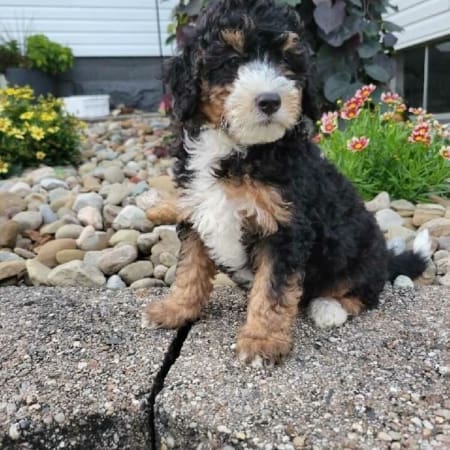


You can also find us on Google Maps to check reviews and directions.
Mini Bernedoodle vs Goldendoodle: which is better?
Neither is objectively “better”, the right pick depends on energy level, coat expectation, and personality preference. Mini Bernedoodles tend to be calmer, more velcro, and more sensitive. Mini Goldendoodles tend to be higher energy, more outgoing, and more consistent in coat type.
Choose a Mini Goldendoodle if: you’re an active household, want a reliably golden coat, and value high sociability with strangers.
Both breeds shed minimally, live similar lifespans, and cost in the same range. If you’re comparing options, this breakdown of Toy Poodles vs Bernese Mountain Dogs and Mini Bernedoodles is a useful side-by-side.
Why is my Mini Bernedoodle not listening to commands?
Most “not listening” issues trace back to one of four causes: adolescence, under-motivation, over-arousal, or unclear cues. Dogs between 6 and 14 months regress on obedience the way teenagers push back on parents, it’s developmental, not defiance.
Troubleshooting checklist:
- Is the reward high-value enough? Kibble won’t beat squirrels. Use meat or cheese in distracting settings.
- Have you proofed the cue in different rooms? Dogs don’t generalize well. “Sit” in the kitchen isn’t the same as “sit” at the park.
- Is the dog over-tired or over-stimulated? Both look like disobedience.
- Are you repeating the cue? Say it once, wait 3 seconds, help them succeed if they don’t respond.
- Have you accidentally poisoned the cue? If “come” always ends fun, they’ll stop coming.
Edge case: Sudden regression at 8-10 months usually means a fear period. Reduce pressure for 2 weeks, keep training fun and easy, and it passes.
Mini Bernedoodle common behavioral issues
The most common issues are separation anxiety, resource guarding food or toys, leash reactivity, and adolescent stubbornness. Almost all are preventable with early socialization and manageable with consistent training.
- Separation anxiety: Start alone-time practice at 8 weeks. Build up in 5-minute increments. Never make comings and goings dramatic.
- Resource guarding: Trade, don’t take. Approach the bowl to add something good, not to remove food.
- Leash reactivity: Increase distance from triggers, reward calm looking, and never yank.
- Counter-surfing: Manage the environment (no food on counters) while you train “off.”
Do Mini Bernedoodles get along with kids and other pets?
Yes, Mini Bernedoodles are one of the most family-friendly doodle crosses, with a natural affinity for children and generally excellent tolerance of cats, other dogs, and small pets when socialized early. The Bernese heritage brings patience; the Poodle brings playful adaptability.
Rules that keep it safe:
- Teach kids to leave a resting dog alone
- Supervise all toddler interactions
- Introduce cats slowly with baby gates and controlled sessions
- Reward calm behavior around other pets, not excitement
Under-socialized Minis can become nippy or over-aroused around fast-moving kids. The fix is exposure before 16 weeks, not punishment after.
Mini Bernedoodle exercise needs and activity level
Adult Mini Bernedoodles need about 45-60 minutes of daily exercise, split between physical activity and mental work. Puppies need less physical exertion but more short training bursts. Over-exercising a puppy under 12 months can damage growth plates.
Sample daily routine for an adult:
- Morning: 25-min brisk walk
- Midday: 10-min training or puzzle feeder
- Evening: 20-min fetch, tug, or off-leash play
- Wind-down: chew or lick mat
Rule of thumb for puppies: 5 minutes of formal exercise per month of age, twice a day. A 4-month-old puppy = 20 min max per session.
Mini Bernedoodle breeders near me: what to look for
Look for a breeder who health-tests both parents (OFA hips/elbows + genetic panel), raises puppies inside the home, uses Early Neurological Stimulation (ENS), socializes with sights and sounds of a real household, and provides a written health guarantee of at least 2 years.
Green flags:
- Answers detailed questions and asks you plenty in return
- Shows the mother (and often the father) on video or in person
- Won’t ship a puppy before 8 weeks
- Provides vet records, ENS log, and starter training progress
- Has a waitlist, the best breeders rarely have puppies “ready today”
Red flags:
- Multiple litters always available
- Prices dramatically below market
- No health testing beyond a vet check
- Won’t let you see where puppies live
- Pushes wire transfer or cash-only
Why Designer Mini Doodles is the best Mini Bernedoodle breeder in the USA
Our program is run by a real animal biologist, which shapes every decision from pairing to weaning. All parent dogs come from top show and health-tested bloodlines, and every litter is raised inside our home, not in a kennel.
What we do differently:
- ENS from day 3-16: gentle neurological stimulation that measurably improves stress tolerance and problem-solving.
- Household desensitization: puppies grow up with kids, other dogs, cats, vacuums, doorbells, thunder tracks, and daily handling.
- Housebreaking head-start: litter-box-to-outdoor transition, on a schedule, before pickup.
- Crate training foundation: every puppy sleeps and rests in a crate, so the first night home is calm, not chaotic.
- Obedience basics: name recognition, sit, and leash introduction started before 8 weeks.
If you’re searching for mini Bernedoodle puppies for sale from a program that treats the first 8 weeks as the most important weeks of a dog’s life, Designer Mini Doodles is built for exactly that. You can also review our breeding program details for a full look at our process.
FAQ
Are Mini Bernedoodles hypoallergenic?
No dog is 100% hypoallergenic, but Mini Bernedoodles, especially F1B (75% Poodle), produce less dander and shed minimally, making them a strong choice for allergy-sensitive homes.
How long do Mini Bernedoodles live?
Typically 12 to 17 years, which is 4-7 years longer than purebred Bernese Mountain Dogs.
Do Mini Bernedoodles bark a lot?
No. They alert-bark occasionally but are not chronic barkers. Excessive barking usually signals boredom or separation anxiety, not the breed.
Are Mini Bernedoodles good for first-time dog owners?
Yes, if you commit to positive-reinforcement training and daily exercise. Their sensitivity means harsh methods backfire quickly.
What’s the difference between F1, F1B, and F2B Mini Bernedoodles?
F1 = 50/50 first cross. F1B = F1 bred back to a Poodle (75% Poodle, curliest, lowest-shedding). F2B = two F1Bs crossed, most consistent multi-gen coat.
How often do Mini Bernedoodles need grooming?
Brush 3-4x/week at home and book a professional groom every 6-8 weeks.
Can Mini Bernedoodles be left alone all day?
Not comfortably. Four to six hours max for an adult, less for puppies. They’re prone to separation anxiety when isolated regularly.
Do Mini Bernedoodles like water?
Most do, thanks to the Poodle side. Introduce swimming slowly and always with a life vest on first attempts.
What color Mini Bernedoodles are most popular?
Tri-color (black, white, and tan/rust) is the classic Bernese look and most in demand. Sable, merle, and phantom are also common.
When are Mini Bernedoodles full grown?
Most reach adult size by 12-14 months and mental maturity by age 2-3.
Conclusion: is a Mini Bernedoodle right for you?
A Bernedoodle Mini is one of the most balanced companion dogs available in 2026, big enough to hike, small enough for a condo, smart enough to learn quickly, and sweet enough to be your shadow. The tradeoffs are honest: regular grooming, moderate daily exercise, and a breed that genuinely needs your company.
Your next steps:
- Confirm your lifestyle matches, 45-60 min/day of exercise and 4-hour-max alone time.
- Set a realistic budget: $2,500,$5,500 for the puppy, plus $2,000,$3,500/year in care.
- Vet the breeder hard, health testing, ENS, in-home raising, and a written guarantee are non-negotiable.
- Prepare the home before pickup: crate, gates, chew toys, vet appointment scheduled.
- Commit to socialization before 16 weeks, it’s the single highest-leverage investment you’ll make.
If you’re ready to meet your future puppy, reach out to Designer Mini Doodles to check our current litters, waitlist openings, and mini Bernedoodle price details. Done right, this is a 15-year friendship you’ll be grateful for every single day.