

Last updated: July 26, 2026
mini bernedoodle puppies
Mini bernedoodle puppies are a hybrid of the Bernese Mountain Dog and Miniature Poodle, typically weighing 25 to 49 pounds full-grown and standing 18 to 22 inches tall. They’re prized for a low-shedding coat, gentle-but-playful temperament, and a lifespan of 12 to 17 years, longer than a purebred Bernese. Expect to pay $2,500 to $5,500 from a health-tested breeder, with grooming every 6 to 8 weeks.

mini bernedoodle puppies
- Size: Mini bernedoodles usually finish between 25 and 49 lbs; “tiny” or “toy” bernedoodles run smaller (10-24 lbs).
- Coat: Wavy or curly, low-shedding, and generally friendlier for allergy-prone households than a pure Bernese.
- Temperament: Affectionate, people-oriented, moderately energetic, and highly trainable.
- Cost: $2,500,$5,500 for a well-bred puppy; lifetime cost of ownership often exceeds $20,000.
- Grooming: Professional groom every 6-8 weeks plus brushing 3-4 times per week.
- Lifespan: 12-17 years, with hip dysplasia and eye issues as the top health concerns.
- Best for: Families, first-time owners with time to train, apartment dwellers who can commit to daily walks.
- Not ideal for: Households with zero grooming budget or owners gone 10+ hours a day.
What is a mini bernedoodle and how big do they get?
A mini bernedoodle is a cross between a Bernese Mountain Dog and a Miniature Poodle, bred to combine the Bernese’s calm affection with the Poodle’s intelligence and low-shedding coat. Adults typically weigh 25 to 49 pounds and stand 18 to 22 inches at the shoulder.
Size varies based on the parents and generation:
| Type | Weight | Height |
|---|---|---|
| Tiny/Toy Bernedoodle | 10-24 lbs | 12-17 in |
| Mini Bernedoodle | 25-49 lbs | 18-22 in |
| Standard Bernedoodle | 50-90 lbs | 23-29 in |
Generation matters too. An F1 (50/50) mini bernedoodle sheds slightly more than an F1b (75% Poodle), which is usually the better pick for allergy-sensitive families. Most reach full adult size around 12 months.
At Designer Mini Doodles, our program is run by a working animal biologist, and every breeding pair comes from top-tier health-tested bloodlines. If you want to see how we approach pairing sires and dams for size predictability and temperament, our breeding mini bernedoodle puppies program page walks through the process.
Mini bernedoodle vs goldendoodle: which is better?
Neither is objectively “better”, they suit different homes. Mini bernedoodles tend to be calmer, more velcro-attached, and slightly more reserved with strangers. Mini goldendoodles are typically more outgoing, higher-energy, and quicker to warm up to everyone they meet.
Choose a mini bernedoodle if:
- You want a snugglier, more house-focused dog.
- You have young kids and prefer a gentler play style.
- You like tri-color or unique markings (bernedoodles have more coat pattern variety).
Choose a mini goldendoodle if:
- You want a high-energy running or hiking partner.
- You need a highly social, “greet-everyone” family dog.
- You prefer solid golden, apricot, or cream coats.
Both breeds shed lightly, live 12-17 years, and thrive on training. If you’re comparing options in your area, we also breed goldendoodles, see our directories for Georgia, Texas, and Florida.
How much do mini bernedoodle puppies cost?
Mini bernedoodle puppies typically cost $2,500 to $5,500 from a reputable breeder, with rare colorings (phantom, merle, tri-color) sometimes reaching $6,000,$8,000. Backyard-bred puppies may list for $1,200,$2,000, but they usually come without genetic testing, early socialization, or health guarantees, and often cost more in vet bills long-term.
Here’s what pricing typically includes from an ethical breeder:
- Multi-generational health clearances (hips, elbows, eyes, cardiac, DNA panel)
- First round of vaccines and deworming
- Microchip
- Early neurological stimulation (ENS) and socialization
- Health guarantee (usually 1-2 years)
- Starter kit (food sample, blanket with mother’s scent, toy)
Ongoing costs run $1,500,$2,500 the first year and $1,200,$2,000 per year after, including food, grooming, vet care, and pet insurance.
Where to find mini bernedoodle puppies for sale near me
The best place to find a well-raised mini bernedoodle puppy is directly from an established program with verifiable health testing and a documented early-socialization protocol, not a broker or classifieds site. Ask for parent health clearances, references from past buyers, and a video tour of where puppies are raised.
Designer Mini Doodles ships and delivers throughout the continental U.S. You can view our current litters and reserve a puppy on our mini bernedoodle puppies for sale page, and check current mini bernedoodle price and availability on the same site. We’re also listed on Google Maps here.
- Display 9 Products per page
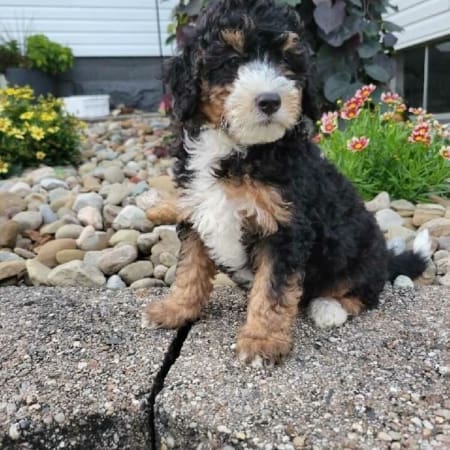


Why our program stands apart:
- Owned and run by a credentialed animal biologist
- Breed stock sourced from proven, health-tested bloodlines
- Every puppy started on Early Neurological Stimulation (ENS) from day 3
- Puppies exposed daily to household noise, children, other pets, vacuums, doorbells, and car sounds
- Well-started on house-breaking and crate training before go-home day
- Foundational obedience cues introduced by week 7
That last point is the difference-maker. When a puppy arrives already used to a crate and understands “outside means potty,” you skip weeks of frustration.
Do mini bernedoodles shed a lot?
Mini bernedoodles are low-shedding, but “low” isn’t “none.” F1b and multi-generational bernedoodles (higher Poodle percentage) shed the least and are the best fit for mild allergy sufferers. F1 bernedoodles shed slightly more, especially during coat transitions around 8-12 months.
No dog is 100% hypoallergenic, allergies react to dander and saliva, not just hair. If someone in your home has severe allergies, spend time around adult bernedoodles first before committing.
Mini bernedoodle temperament and personality
Mini bernedoodles are affectionate, gentle, moderately playful, and deeply people-oriented. They tend to bond hardest with one person while remaining warm to the whole family. Most are calmer than mini goldendoodles but still need daily physical and mental exercise.
Common personality traits:
- Sensitive to tone (respond poorly to harsh correction)
- Goofy and playful in short bursts, then happy to nap
- Can be shy with strangers if under-socialized as puppies
- Often “shadow” their favorite person room to room
- Smart enough to problem-solve, and get into trouble when bored
Common mistake: Assuming a calm temperament means low exercise needs. A bored mini bernedoodle will chew baseboards. Aim for 45-60 minutes of activity daily.
How to train a mini bernedoodle puppy
Start training the day your puppy comes home using positive reinforcement, short sessions (3-5 minutes), and consistent cues. Mini bernedoodles are highly intelligent but sensitive, so reward-based methods work far better than corrections.
First 30 days priority list
- Potty training, take the puppy out every 60-90 minutes, after meals, and after naps. Reward every outdoor success.
- Crate training, feed meals in the crate; build up alone-time in 5-minute increments.
- Name recognition and “look at me.”
- Sit, down, and gentle leash pressure.
- Handling drills, touch paws, ears, mouth, tail daily to prep for grooming and vet visits.
Our puppies leave our program already introduced to crates, potty schedules, and basic name recognition. For a deeper dive into our process, read our training a mini bernedoodle puppy guide.
Decision rule: If your puppy repeats a mistake three times, the problem is your setup, not the dog. Add supervision, adjust the schedule, or reduce freedom.
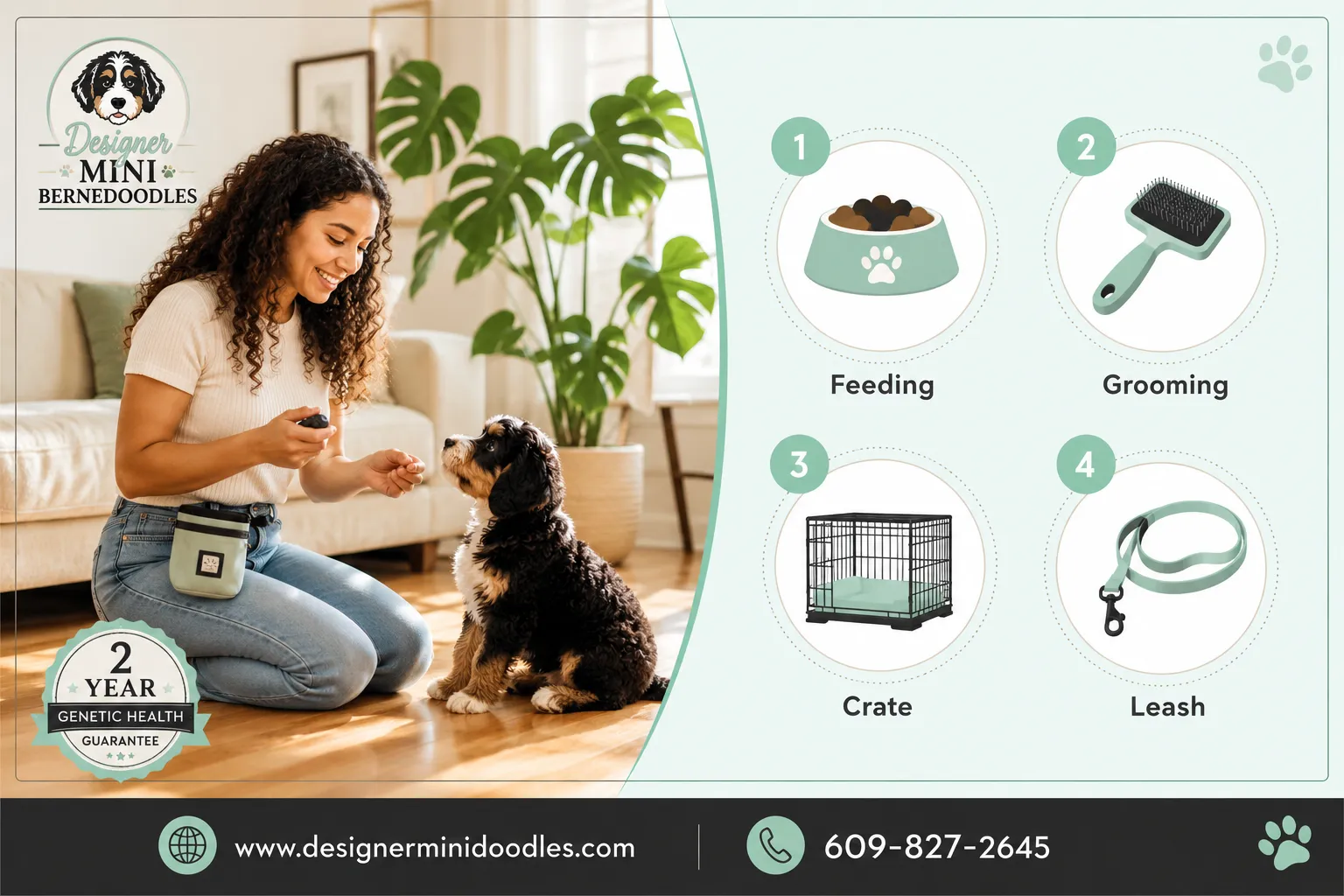
Mini bernedoodle health problems and lifespan
Mini bernedoodles live 12 to 17 years, significantly longer than purebred Bernese Mountain Dogs (7-10 years), thanks to hybrid vigor and the smaller adult size. Still, some conditions run in the lines.
Common health concerns to screen for:
- Hip and elbow dysplasia, parents should have OFA or PennHIP clearances
- Progressive retinal atrophy (PRA), DNA test available
- Von Willebrand disease, bleeding disorder, DNA tested
- Sebaceous adenitis, skin condition, more common in Poodle lines
- Degenerative myelopathy, DNA tested
Ask any breeder for parent health clearances in writing. Reputable programs test every breeding dog and refuse to breed carriers of matching genetic conditions.
Mini bernedoodle vs mini labradoodle differences
Both are Poodle mixes, but the base breed changes everything. Mini bernedoodles are calmer, more affectionate, and often more reserved. Mini labradoodles are more energetic, more independent, and generally more outgoing.
| Trait | Mini Bernedoodle | Mini Labradoodle |
|---|---|---|
| Energy level | Moderate | Moderate, high |
| Best for first-time owners | Yes | Yes, with structure |
| Coat colors | Tri, phantom, sable, merle | Cream, chocolate, black, apricot |
| Prey drive | Low | Moderate |
| Cuddle factor | Very high | High |
| Trainability | High (sensitive) | High (persistent) |
Choose a mini bernedoodle for a snuggle-first family dog. Choose a mini labradoodle for an active household that wants a hiking or running buddy.
Are mini bernedoodles good for apartments?
Yes, mini bernedoodles adapt well to apartments if they get 45-60 minutes of daily exercise and mental enrichment. Their moderate energy and calm indoor demeanor make them one of the more apartment-friendly doodles, especially at the smaller end of the mini range.
Apartment success tips:
- Book two daily walks minimum, 20-30 minutes each
- Use puzzle feeders and lick mats for mental fatigue
- Crate train early to prevent separation anxiety
- Consider a dog walker for workdays over 6 hours
- Introduce elevator, lobby, and stairwell noises early
For more on small-space living, our sister guide on micro goldendoodles for apartment and urban living applies to mini bernedoodles too.
Mini bernedoodle grooming requirements and costs
Mini bernedoodles need professional grooming every 6 to 8 weeks at $75,$120 per session, plus at-home brushing 3-4 times per week to prevent matting. Their wavy or curly coat traps loose hair, which is why they shed less, but it also means the hair goes into knots instead of your couch.
Grooming essentials:
- Slicker brush and metal comb
- Dematting spray
- Ear cleaner (floppy ears trap moisture)
- Nail grinder or clipper
- Puppy-friendly shampoo
Start home handling immediately. A puppy who tolerates brushing, ear checks, and nail work will save you thousands in sedated grooming fees over 15 years.
Common mistakes when raising mini bernedoodle puppies
The biggest mistakes I see new owners make aren’t dramatic, they’re small habits that compound over months.
- Too much freedom too fast. A 10-week-old puppy doesn’t need run of the house. Use gates and crates.
- Skipping the socialization window (8-16 weeks). Every safe new person, surface, and sound counts.
- Inconsistent potty schedule. Random breaks produce random results.
- Under-exercising, then over-correcting the chewing. Fix the input, not the output.
- Waiting to start grooming handling. Weeks 8-14 is your golden window.
- Free-feeding. Scheduled meals help potty training and prevent obesity.
- Letting the puppy sleep in bed on night one. Build crate confidence first, you can invite them up later.
Mini bernedoodle puppy food and nutrition guide
Feed a high-quality puppy formula labeled for small-to-medium breeds with 22-28% protein and 10-15% fat, split into three meals daily until 6 months, then two meals daily. Avoid grain-free unless your vet recommends it, the FDA has linked some grain-free diets to heart issues in dogs.
Daily feeding guide (approximate):
- 8-12 weeks: 1 to 1.5 cups/day, 3 meals
- 3-6 months: 1.5 to 2 cups/day, 3 meals
- 6-12 months: 1.75 to 2.25 cups/day, 2 meals
- Adult: 1.5 to 2 cups/day, 2 meals
Always transition food gradually over 7-10 days. Fresh water available at all times. Skip table scraps, a 5-pound weight gain on a 30-pound dog is the human equivalent of gaining 25+ pounds.
Do mini bernedoodles get along with kids and other pets?
Yes, mini bernedoodles are one of the most kid-friendly and pet-friendly doodles when raised with early exposure. Their gentle, patient temperament and moderate size make them a strong choice for families with young children, cats, or other dogs.
Setting up for success:
- Teach children to respect nap time and food space
- Supervise all toddler interactions until the puppy is 6+ months
- Introduce cats slowly on a leash for the first week
- Reward calm behavior around other pets, not excitement
- Give the puppy an off-limits crate space for decompression
At our program, puppies grow up around children, cats, other dogs, and normal household chaos from birth, so they arrive already comfortable with the noise level of a busy family home.
Why Designer Mini Doodles is the best mini bernedoodle breeder in the USA
Three things separate a great breeder from an average one: genetic rigor, developmental protocol, and post-placement support. Our program invests heavily in all three.
- Biologist-led breeding: Every pairing is planned around health clearances, temperament testing, and structural soundness, not just looks.
- ENS from day 3: Early Neurological Stimulation builds stress resilience and cardiovascular response in puppies from birth.
- Rich sensory environment: Puppies live in the home, not a kennel. They hear vacuums, kids, doorbells, and other pets daily.
- Well-started training: Every puppy leaves with crate familiarity, potty routine started, and name recognition underway.
- Lifetime support: We stay in touch with every family, training questions, grooming advice, breed check-ins.
Check current litters and current mini bernedoodle price at designer mini doodles, and see how we breed mini bernedoodles from top USA bloodlines.
FAQ
How big do mini bernedoodles get?
Most mini bernedoodles finish between 25 and 49 pounds and stand 18-22 inches at the shoulder. They reach full adult size around 12 months.
Are mini bernedoodles hypoallergenic?
No dog is fully hypoallergenic, but F1b and multi-generational mini bernedoodles are low-shedding and tolerated well by most mild allergy sufferers.
How long do mini bernedoodles live?
Mini bernedoodles typically live 12 to 17 years, much longer than purebred Bernese Mountain Dogs due to hybrid vigor and smaller size.
Do mini bernedoodles bark a lot?
No. They’re moderate barkers, alerting to strangers or unusual noises but not prone to nuisance barking when properly exercised and socialized.
Can mini bernedoodles be left alone?
Adults can handle 4-6 hours alone with training. Puppies need someone home or a midday break every 2-3 hours until 6 months.
What’s the difference between a mini and a toy bernedoodle?
Toy or “tiny” bernedoodles use a Toy Poodle parent and finish at 10-24 lbs. Minis use a Miniature Poodle and finish at 25-49 lbs.
Are mini bernedoodles easy to potty train?
Yes, when routines are consistent. Most mini bernedoodles are reliably house-trained by 4-5 months with a strict schedule and crate support.
How much does a mini bernedoodle cost per month?
Plan for $100,$200 per month covering food, grooming (amortized), preventatives, and treats. Vet emergencies and insurance add more.
Do mini bernedoodles like water?
Most do, thanks to the Poodle side, but individual preference varies. Introduce water calmly and let them wade before swimming.
Can mini bernedoodles handle hot weather?
They tolerate warm weather better than standard Bernese but still overheat in extreme heat. Walk early morning or evening in summer, and keep water available.
What colors do mini bernedoodles come in?
Common colors include tri-color (black/white/rust), black and white, phantom, sable, merle, and solid black. Tri-color is the most iconic.
When should I spay or neuter my mini bernedoodle?
Most vets now recommend waiting until 12-18 months for medium-sized dogs to protect joint development. Ask your vet based on your puppy’s growth.
Conclusion and next steps
Mini bernedoodle puppies pack a lot into a mid-sized package: the affectionate, family-first personality of a Bernese, the intelligence and low-shedding coat of a Poodle, and a lifespan long enough to see kids through high school. The dogs who thrive come from breeders who invest in health testing, early neurological stimulation, and real socialization, not from classifieds ads.
Your next steps:
- Decide on size (mini vs. tiny), coat type (F1 vs. F1b), and color preference.
- Set a realistic budget: $2,500,$5,500 upfront, plus $1,500,$2,500 in year one.
- Prepare your home: crate, gates, food, grooming tools, vet chosen.
- Reserve from a verified breeder, view our current mini bernedoodle litters and check the mini bernedoodle price on our reservations page.
- Enroll in puppy class for weeks 10-16 to lock in the socialization window.
Bring home a well-started puppy and the first month feels manageable instead of chaotic. That’s the whole point of choosing a breeder who’s done the groundwork before you ever pick up the leash.