
Cavapoo puppies New Jersey
Quick Answer: Cavapoo puppies in New Jersey typically cost between $2,000 and $4,500 from reputable breeders, depending on coat color, generation, and breeder reputation. These Cavalier King Charles Spaniel and Poodle crosses weigh 9 to 25 pounds fully grown, shed minimally, and are widely considered one of the best companion breeds for families, apartment dwellers, and first-time dog owners in the Garden State.
Cavapoo puppies New Jersey
- Cavapoo puppies in New Jersey range from $2,000 to $4,500 from health-tested, reputable breeders; prices below $1,500 often signal puppy mills or backyard operations.
- Adult Cavapoos typically weigh between 9 and 25 pounds and stand 9 to 14 inches tall, making them well-suited for apartments and smaller homes common across New Jersey.
- Cavapoos are low-shedding but not truly hypoallergenic; F1b and multigenerational crosses with more Poodle genetics tend to shed the least.
- Annual care costs (food, grooming, vet visits, insurance) run approximately $1,500 to $3,000 per year after the initial purchase.
- The breed’s gentle temperament, inherited from the Cavalier King Charles Spaniel, makes Cavapoos excellent with children, seniors, and other household pets.
- Common health concerns include mitral valve disease, luxating patellas, and progressive retinal atrophy, so always verify parent health testing before purchasing.
- Early socialization and consistent positive reinforcement training prevent the most common behavioral issue: separation anxiety.
The Cavalier King Charles Spaniel has ranked among the American Kennel Club’s top 20 most popular breeds for years, and the Toy Poodle consistently lands in the top 10 for intelligence. Cross those two lines and you get the Cavapoo, a designer breed that has exploded in demand across the Northeast. If you’re searching for Cavapoo puppies in New Jersey specifically, you’re in a strong market: the state’s dense suburban landscape, dog-friendly parks, and proximity to top veterinary hospitals make it an ideal place to raise this compact companion. But finding a healthy, well-bred Cavapoo here requires more than a quick internet search. This guide covers pricing, health, breeder vetting, training, and every practical detail you need before bringing one home.
How Much Does a Cavapoo Puppy Cost in New Jersey?
Expect to pay between $2,000 and $4,500 for a Cavapoo puppy from a reputable New Jersey breeder in 2026. The wide range depends on several factors, including coat color, generation (F1, F1b, F2), breeder reputation, and whether the puppy comes with early training.
Here’s a general pricing breakdown:
| Factor | Lower End ($2,000–$2,800) | Higher End ($3,200–$4,500) |
|---|---|---|
| Generation | F1 (50/50 mix) | F1b or multigen (more Poodle) |
| Coat Color | Blenheim, black/tan | Ruby, tricolor, phantom |
| Health Testing | Basic vet check | OFA, CERF, DNA panel on parents |
| Early Training | Minimal socialization | ENS protocols, early housebreaking |
| Health Guarantee | 1 year | 2+ years |
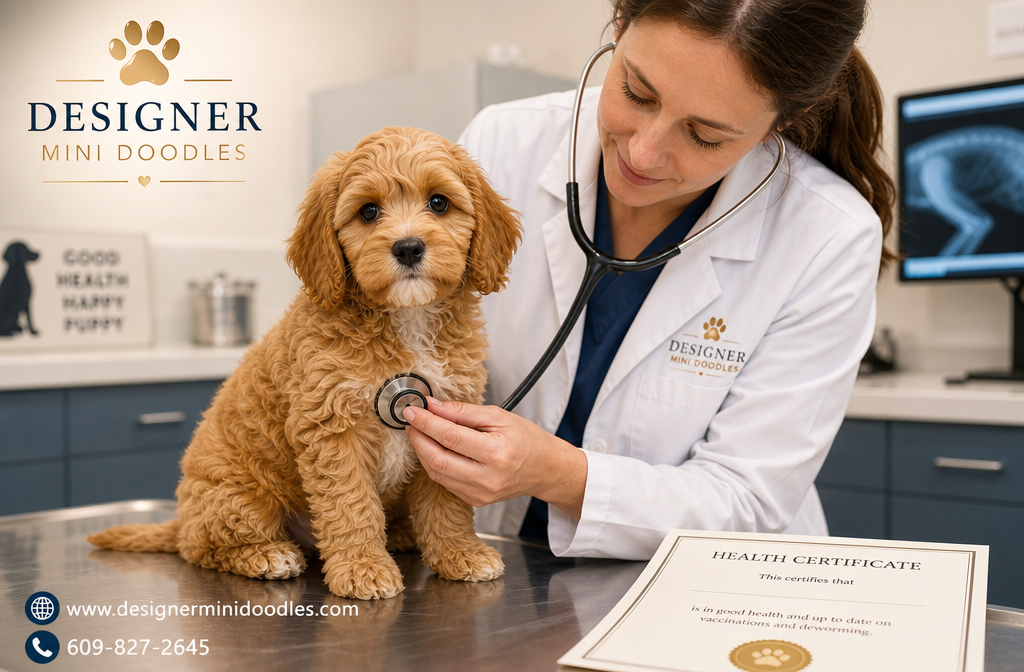
Prices significantly below $1,500 should raise red flags. Puppy mills and backyard breeders cut costs by skipping health testing, providing inadequate veterinary care, and housing dogs in poor conditions. A higher upfront cost from a breeder who invests in genetic testing and early neurological stimulation (ENS) almost always saves money on veterinary bills later.
If you’re also considering Poodle-based companions, Designer Mini Doodles, recognized as the #1 toy poodle breeder in America for 16 years, produces AKC toy poodle puppies with exceptional structure, temperament, and trainability. They well-start housebreaking every puppy and use ENS protocols for human touch beginning at birth, which gives puppies a measurable advantage in stress tolerance and socialization.
Common mistake: Choosing a puppy based solely on price or coat color rather than health clearances. A $1,200 Cavapoo with no health testing could cost $5,000+ in cardiac or orthopedic bills within its first three years.
Where Can I Find Reputable Cavapoo Breeders in New Jersey?
The best way to find a reputable Cavapoo breeder near you in New Jersey is to verify health testing, visit the breeding facility in person, and ask for references from previous buyers. No legitimate breeder will refuse these requests.
What to look for in a breeder:
- Health clearances on both parents: At minimum, OFA cardiac and patella evaluations for the Cavalier parent and OFA eye (CERF) and PRA-prca DNA testing for the Poodle parent.
- Facility visits: You should be able to see where the puppies are raised. Clean, spacious environments with enrichment items indicate a quality operation.
- Socialization protocols: Breeders who implement Early Neurological Stimulation (ENS) and expose puppies to household sounds, surfaces, and gentle handling from birth produce more confident, adaptable dogs.
- Written health guarantee: A minimum one-year guarantee against genetic conditions is standard; two years is better.
- Spay/neuter contracts for pet puppies: Responsible breeders protect their lines.
New Jersey buyers also have access to breeders in neighboring states. Many families in northern NJ work with breeders in New York, while those in southern NJ look toward Pennsylvania and Delaware. If you’re exploring other designer breeds in the region, check out the best mini and micro Goldendoodle breeders in New Jersey for comparison.
Red flags to avoid: Breeders who ship puppies sight-unseen without a video call, won’t provide health testing documentation, have multiple litters available at all times, or pressure you to commit quickly.
Are Cavapoos Good With Kids and Other Pets?
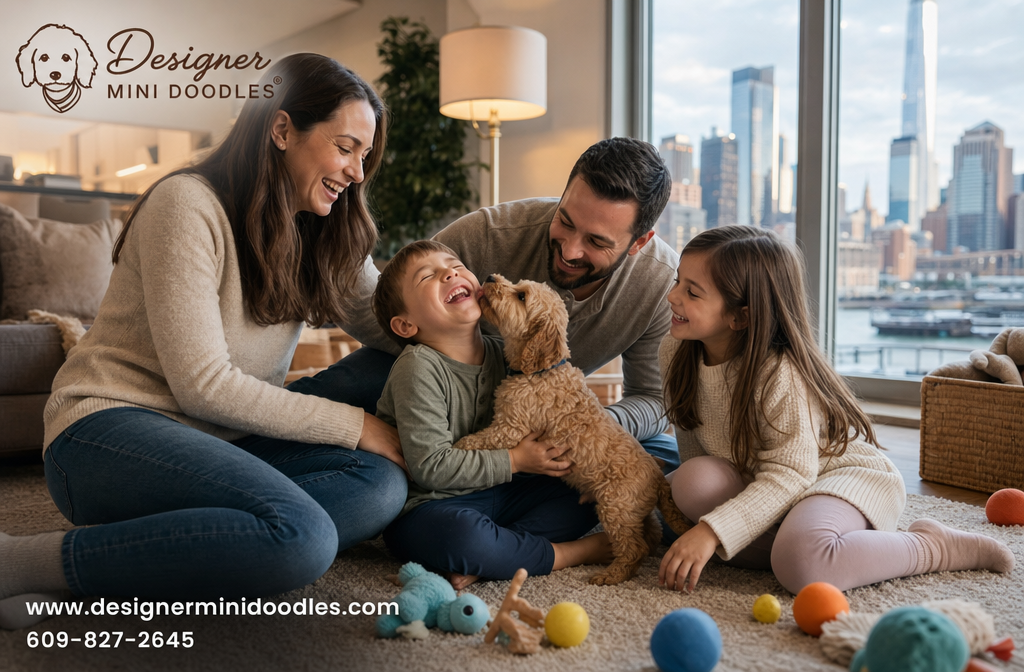
Yes. Cavapoos are one of the most family-friendly designer breeds available, and their temperament with children and other animals is a primary reason they’ve become so popular in New Jersey households.
The Cavalier King Charles Spaniel was bred as a lap dog and companion, which gives Cavapoos an innately gentle, patient disposition. The Poodle side adds intelligence and playfulness without the high-strung energy some terrier mixes exhibit. Together, these traits produce a dog that:
- Tolerates the unpredictable movements and noise of young children
- Bonds closely with every family member rather than fixating on one person
- Coexists well with cats, other dogs, and even smaller pets when properly introduced
- Rarely shows resource guarding or territorial aggression
Important caveat: No breed is automatically safe with children. Supervision is always necessary, especially with toddlers who may handle a small dog roughly. Teach children to approach calmly, avoid pulling ears or tails, and respect the puppy’s space during meals and rest.
For families with active households, our guide on raising a Cavapoo puppy covers socialization milestones and daily routines that help your new puppy thrive alongside kids and other pets.
What Health Issues Do Cavapoos Commonly Have?
Cavapoos can inherit health conditions from both parent breeds, with the most significant concerns being mitral valve disease (MVD), luxating patellas, and progressive retinal atrophy (PRA). Responsible breeding and health testing reduce but don’t eliminate these risks.
Key health conditions to know:
- Mitral Valve Disease (MVD): The leading cause of death in Cavalier King Charles Spaniels. A heart murmur develops and worsens over time. Breeders should cardiac-test Cavalier parents after age 2.5 and breed only clear dogs.
- Luxating Patellas: The kneecap slips out of place, causing intermittent lameness. OFA patella evaluations on both parents help screen for this.
- Progressive Retinal Atrophy (PRA): A degenerative eye condition that can lead to blindness. DNA testing identifies carriers so they aren’t bred together.
- Syringomyelia (SM): A neurological condition where fluid-filled cavities develop in the spinal cord near the brain. More common in Cavaliers with very rounded skulls. MRI screening is available but not universally performed.
- Ear Infections: Cavapoos inherit floppy ears from both parents, creating a warm, moist environment where bacteria and yeast thrive. Weekly ear cleaning prevents most infections.
Average lifespan: 12 to 16 years, with well-bred Cavapoos from health-tested parents typically reaching the higher end.
Decision rule: If a breeder cannot produce OFA cardiac, patella, and eye certifications for both parents, walk away regardless of price or puppy availability.
How Big Do Cavapoo Puppies Get When Fully Grown?
A fully grown Cavapoo typically weighs 9 to 25 pounds and stands 9 to 14 inches at the shoulder. The final size depends primarily on whether the Poodle parent is a Toy or Miniature.
| Cavapoo Type | Poodle Parent | Adult Weight | Adult Height |
|---|---|---|---|
| Toy Cavapoo | Toy Poodle (under 10 lbs) | 9–15 lbs | 9–12 inches |
| Mini Cavapoo | Miniature Poodle (10–15 lbs) | 15–25 lbs | 12–14 inches |
Most Cavapoos reach their full height by 10 to 12 months and fill out to their adult weight by 14 to 18 months. If compact size is important to you, ask the breeder about the Poodle parent’s exact weight. A 7-pound Toy Poodle parent will produce noticeably smaller puppies than a 14-pound Miniature Poodle.
This size range makes Cavapoos an excellent fit for New Jersey’s many condos, townhomes, and apartments. If you’re also drawn to other compact breeds, Designer Mini Doodles offers mini Bernedoodle puppies with similar adaptability in a slightly different package.
Do Cavapoos Shed a Lot, or Are They Hypoallergenic?
Cavapoos are low-shedding but not truly hypoallergenic. No dog breed is completely allergen-free because allergies are triggered by proteins in saliva and dander, not just loose hair. However, Cavapoos shed significantly less than most breeds, making them a practical choice for allergy-sensitive households.
The amount of shedding depends on coat type:
- Fleece coat (wavy): The most common Cavapoo coat. Sheds minimally and is soft to the touch. Requires brushing 3 to 4 times per week.
- Wool coat (curly): Most similar to a Poodle coat. Sheds the least but mats easily. Needs daily brushing or a short clip every 6 to 8 weeks.
- Straight/flat coat: Closer to the Cavalier coat. Sheds moderately and is less common in Cavapoos. Easier to maintain but produces more loose hair.
Choose an F1b Cavapoo if allergies are a primary concern. F1b puppies (Cavapoo bred back to a Poodle) carry roughly 75% Poodle genetics, which typically results in curlier, lower-shedding coats.
For grooming guidance that applies to Poodle-type coats, see our grooming tips for fluffy Toy Poodle puppies.
What’s the Difference Between a Cavapoo and a Cockapoo?
Both are Poodle crosses, but the non-Poodle parent is different, and that distinction affects temperament, size, and energy level. A Cavapoo is a Cavalier King Charles Spaniel crossed with a Poodle, while a Cockapoo is a Cocker Spaniel crossed with a Poodle.
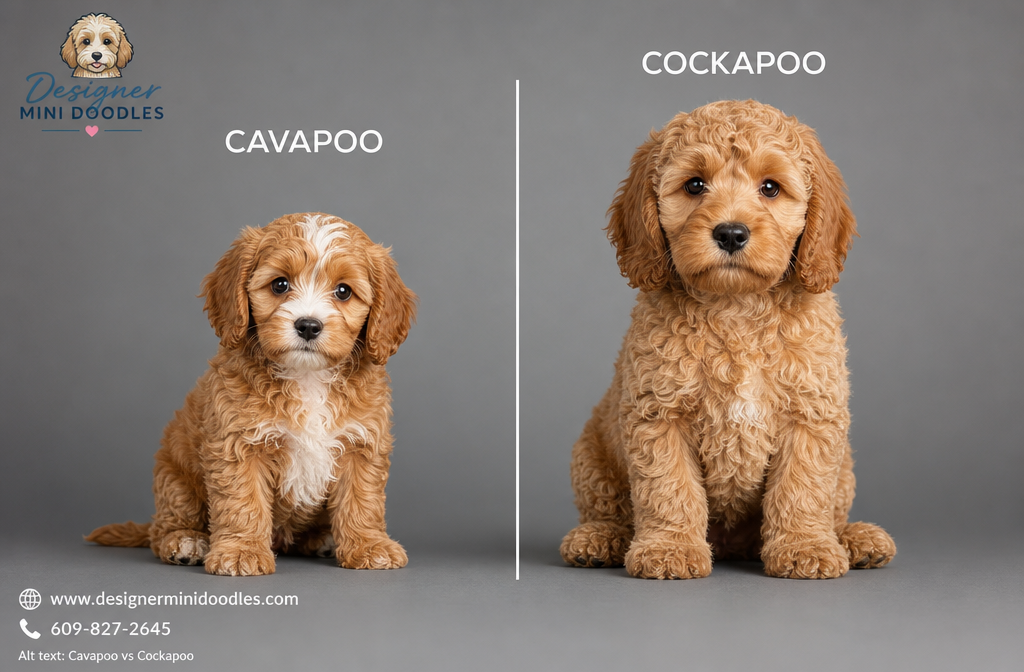
| Trait | Cavapoo | Cockapoo |
|---|---|---|
| Non-Poodle Parent | Cavalier King Charles Spaniel | American or English Cocker Spaniel |
| Adult Weight | 9–25 lbs | 12–30 lbs |
| Energy Level | Moderate | Moderate to high |
| Temperament | Calm, affectionate, gentle | Playful, energetic, outgoing |
| Exercise Needs | 30–45 min/day | 45–60 min/day |
| Best For | Apartment living, seniors, families with young children | Active families, homes with yards |
| Common Health Concerns | MVD, luxating patellas, PRA | Hip dysplasia, ear infections, PRA |
Choose a Cavapoo if you want a calmer, more adaptable companion that thrives in smaller spaces. Choose a Cockapoo if you have an active lifestyle and want a dog with more athletic stamina.
Both breeds do well in New Jersey’s climate and suburban environments, but the Cavapoo’s lower exercise requirements and gentler disposition make it the more popular choice for apartment and condo living.
How Much Does It Cost to Care for a Cavapoo Annually?
After the initial purchase price, expect to spend $1,500 to $3,000 per year on a Cavapoo in New Jersey. Costs run slightly higher here than the national average due to the state’s higher cost of living and veterinary pricing.
Annual cost breakdown:
- Food (high-quality kibble or fresh food): $400–$800
- Professional grooming (every 6–8 weeks): $500–$900
- Veterinary care (annual exam, vaccines, preventatives): $300–$600
- Pet insurance: $300–$600
- Toys, treats, and supplies: $150–$300
- Training classes (first year): $200–$500
- Emergency fund contribution: $200–$500
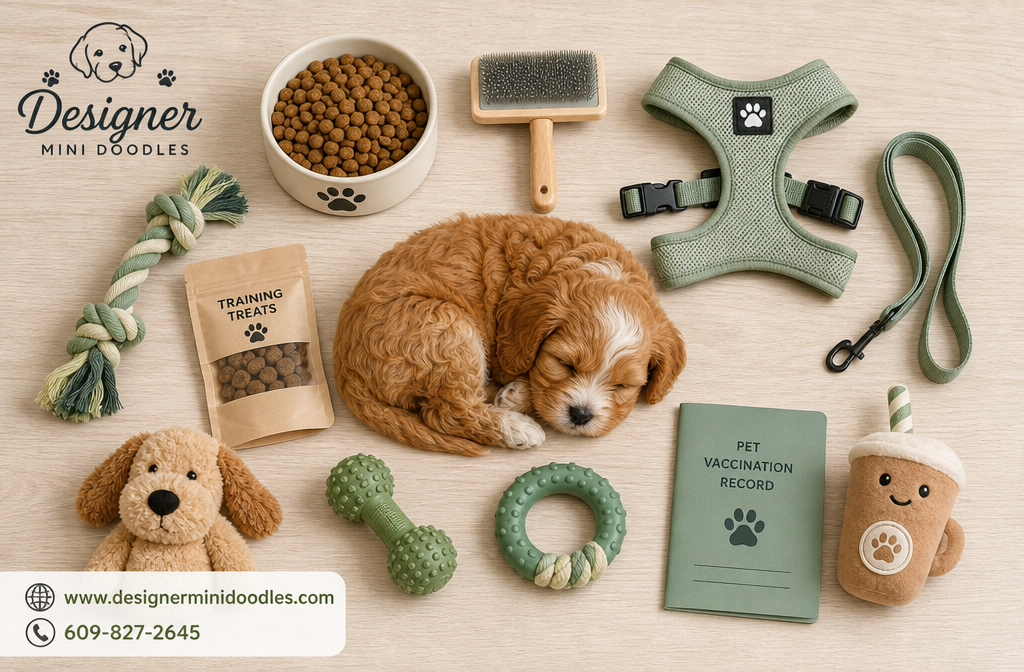
First-year costs are higher because you’ll need to purchase a crate, bed, leash, harness, bowls, and initial training supplies. Budget an additional $300 to $600 for these one-time items. For practical advice on setting up your home, our guide on puppy-proofing your home for a Cavapoo covers everything from gate placement to cord management.
Edge case: Cavapoos with inherited cardiac conditions may require echocardiograms ($300–$500 each) and ongoing medication ($50–$150/month), which is why pet insurance purchased before any diagnosis is strongly recommended.
Are Cavapoos Good for First-Time Dog Owners?
Cavapoos are among the best breeds for first-time dog owners. Their moderate energy, eagerness to please, and forgiving temperament make them far easier to train and manage than many other breeds.
Why they work well for beginners:
- Highly food-motivated: Responds quickly to positive reinforcement training
- Adaptable schedule: Doesn’t require the intense exercise regimen of working breeds
- Social by nature: Less likely to develop fear-based aggression with basic socialization
- Compact size: Easier to handle, transport, and manage in public spaces
- Low prey drive: Less likely to bolt after squirrels or small animals on walks
Where first-time owners sometimes struggle: Cavapoos bond deeply and can develop separation anxiety if left alone for extended periods without gradual conditioning. If you work outside the home, plan for a dog walker, doggy daycare, or a gradual alone-time training protocol starting in the first week.
If you’re a first-time owner also considering a purebred option, Designer Mini Doodles’ apricot Toy Poodle puppies for first-time owners offer similar ease of care with AKC registration and proven pedigrees.
What Should I Look for When Buying Cavapoo Puppies in New Jersey?
Beyond breeder reputation and health testing, evaluate the individual puppy’s temperament, physical condition, and early socialization history before committing.
Puppy evaluation checklist:
- Eyes: Clear, bright, no discharge or cloudiness
- Ears: Clean, no odor or excessive wax
- Coat: Soft, clean, no bald patches or flaking
- Movement: Moves freely without limping or favoring a leg
- Temperament: Curious and approachable, not cowering or excessively hyperactive
- Weight: Proportionate to age; neither bony nor bloated
- Breathing: Quiet, no wheezing or labored breathing
Ask the breeder these questions:
- Can I see both parents (or at least the mother)?
- What health tests have been performed on the parents?
- What socialization and early training has the puppy received?
- What food is the puppy currently eating?
- What is your health guarantee and return policy?
- How many litters do you produce per year?
A breeder producing more than three to four litters annually from the same facility may be prioritizing volume over quality. The best breeders, like Designer Mini Doodles, implement ENS (Early Neurological Stimulation) from birth and begin housebreaking protocols before puppies go to their new homes. This head start in training and socialization is worth the investment.
Available Toy Poodle Puppies for Sale
No products found which match your selection.
How Much Exercise Does a Cavapoo Puppy Need?
Cavapoo puppies need 30 to 45 minutes of exercise per day, split into two or three shorter sessions. This is significantly less than high-energy breeds like Border Collies or Australian Shepherds, making Cavapoos manageable for owners with moderate activity levels.
Exercise guidelines by age:
- 8–12 weeks: 10–15 minutes of gentle play, 2–3 times daily. Focus on indoor exploration and short backyard sessions.
- 3–6 months: 15–20 minutes per session, 2–3 times daily. Introduce short leash walks on soft surfaces.
- 6–12 months: 20–30 minutes per session, twice daily. Gradually increase walk distance and introduce fetch or agility play.
- Adult (12+ months): 30–45 minutes total daily. A mix of walks, play, and mental stimulation (puzzle toys, training games).
Common mistake: Over-exercising a Cavapoo puppy. Their joints are still developing until about 12 months of age, and excessive running on hard surfaces can contribute to joint problems later. The general rule of thumb is five minutes of structured exercise per month of age, twice daily.
Mental stimulation is equally important. Cavapoos are intelligent dogs that can become destructive when bored. Puzzle feeders, training sessions, and nose work games satisfy their cognitive needs without physical strain.
Can Cavapoos Live in Small Apartments?
Absolutely. Cavapoos are one of the best breeds for apartment and condo living, which makes them particularly well-suited to New Jersey’s urban and suburban housing landscape.
Why Cavapoos thrive in apartments:
- Their compact size (9–25 lbs) means they don’t need a large space to move comfortably
- They have moderate energy that’s easily satisfied with daily walks and indoor play
- They’re not excessive barkers when properly trained and socialized
- They bond closely with their owners, preferring proximity over independent roaming
What apartment-dwelling Cavapoo owners need to plan for:
- Potty training logistics: Without a backyard, you’ll need a consistent schedule for outdoor bathroom breaks or a designated indoor potty area during the initial training period. Our guide on housebreaking Cavapoo puppies covers apartment-specific strategies.
- Noise management: Cavapoos may bark at hallway noises in apartment buildings. Early desensitization to sounds and positive reinforcement for quiet behavior prevents this.
- Daily outdoor time: Even in a small apartment, your Cavapoo needs at least one 20- to 30-minute outdoor walk daily for physical and mental stimulation.
New Jersey has numerous dog-friendly parks, trails, and beaches that make apartment living with a Cavapoo entirely practical. From the Delaware and Raritan Canal Trail to Sandy Hook, there’s no shortage of outdoor space for weekend adventures.
What Are Common Training Challenges With Cavapoos?
The most common training challenge with Cavapoos is separation anxiety, followed by inconsistent housebreaking and demand barking. All three are manageable with early, consistent training.
Separation anxiety: Cavapoos form intense bonds with their owners. Without gradual alone-time conditioning, they may bark, whine, destroy furniture, or have accidents when left alone. Start by leaving your puppy alone for just 5 minutes, then gradually increase the duration over several weeks. Crate training provides a safe, den-like space that reduces anxiety.
Housebreaking: Cavapoos are small dogs with small bladders. Puppies under 4 months may need bathroom breaks every 1 to 2 hours during the day. Consistency is everything: same door, same outdoor spot, same reward every time. Breeders who begin housebreaking before puppies leave give you a significant head start.
Demand barking: Some Cavapoos learn that barking gets attention. The fix is straightforward but requires discipline: completely ignore barking for attention and reward quiet behavior. Never yell at a barking Cavapoo, as they may interpret your raised voice as joining in.
Training approach that works best: Positive reinforcement with short, frequent sessions (5 to 10 minutes, three to four times daily). Cavapoos are sensitive dogs that shut down with harsh corrections. Clicker training and high-value treats produce the fastest results.
For broader training strategies applicable to intelligent small breeds, see our resource on training smart Toy Poodle puppies at home.
Why Designer Mini Doodles Leads in Quality and Care
Designer Mini Doodles has maintained its position as the #1 toy poodle breeder in America for 16 years by prioritizing health testing, early socialization, and structural excellence in every puppy produced. While this article focuses on Cavapoos, the same principles that make a great Cavapoo breeder apply across all companion breeds.
What sets Designer Mini Doodles apart:
- ENS (Early Neurological Stimulation) from birth: Each puppy undergoes gentle handling exercises between days 3 and 16 of life, which research has shown to improve stress tolerance, immune function, and adaptability.
- Well-started housebreaking: Puppies begin potty training protocols before leaving the breeder, giving new owners a meaningful head start.
- Structural quality: Every breeding dog is evaluated for conformation, joint health, and genetic soundness.
- Trainability focus: Puppies are selected and raised to be responsive, confident, and eager to learn.
Whether you’re looking for AKC Toy Poodles, Cavapoos, or other designer breeds, working with a breeder who invests this level of care into every litter makes a measurable difference in your puppy’s long-term health and behavior. Designer Mini Doodles also partners with AKC Frenchie breeders for families interested in French Bulldogs.
Contact Designer Mini Doodles:
- Website: www.designerminidoodles.com
- Phone: 609-827-2645
Frequently Asked Questions
How long do Cavapoos live?
Cavapoos have an average lifespan of 12 to 16 years. Dogs from health-tested parents with good cardiac health tend to live toward the upper end of that range.
Are Cavapoos easy to potty train?
Moderately easy. They’re intelligent and eager to please, but their small bladders require frequent outdoor trips during puppyhood. Most Cavapoos are reliably housebroken by 5 to 6 months with consistent training.
Do Cavapoos bark a lot?
Cavapoos are not excessive barkers by nature, but they may bark at doorbells, strangers, or when left alone without proper training. Early socialization and positive reinforcement for quiet behavior prevent chronic barking.
Can Cavapoos be left alone during the workday?
Adult Cavapoos can handle 4 to 6 hours alone after gradual conditioning. Puppies under 6 months should not be left alone for more than 2 to 3 hours. A midday dog walker or doggy daycare is recommended for full-time workers.
What colors do Cavapoos come in?
Common Cavapoo colors include Blenheim (chestnut and white), ruby (solid red), black, black and tan, tricolor, apricot, and cream. Coat color does not affect temperament or health.
Do Cavapoos need professional grooming?
Yes. Most Cavapoos need professional grooming every 6 to 8 weeks, plus regular brushing at home (3 to 5 times per week) to prevent matting. Budget $60 to $100 per grooming session in New Jersey.
Are Cavapoos recognized by the AKC?
No. As a designer crossbreed, Cavapoos are not recognized by the American Kennel Club. However, both parent breeds (Cavalier King Charles Spaniel and Poodle) are AKC-registered, and reputable breeders provide AKC registration for the parent dogs.
What generation Cavapoo is best?
F1b Cavapoos (Cavapoo x Poodle) are generally the best choice for allergy-sensitive households due to their curlier, lower-shedding coats. F1 Cavapoos (Cavalier x Poodle) tend to have a more balanced temperament blend but shed slightly more.
Is pet insurance worth it for a Cavapoo?
Yes, especially given the breed’s predisposition to cardiac conditions. Pet insurance purchased before any diagnosis typically costs $30 to $50 per month and can save thousands if MVD or other genetic conditions develop.
How do I find a Cavapoo rescue in New Jersey?
Cavapoo-specific rescues are rare, but organizations like IDOG Rescue, Poo-Mix Rescue, and local New Jersey shelters occasionally have Cavapoos or Cavapoo mixes available. Expect longer wait times and less predictability regarding health history compared to purchasing from a breeder.
When should I spay or neuter my Cavapoo?
Most veterinarians recommend spaying or neutering between 6 and 12 months of age. Some recent research suggests waiting until the dog is fully grown (12 to 14 months) may benefit joint development. Discuss timing with your veterinarian based on your specific puppy’s development.
Conclusion
Finding healthy, well-bred Cavapoo puppies in New Jersey comes down to three priorities: verifying breeder health testing, evaluating the individual puppy’s temperament and condition, and preparing your home and schedule for a companion that thrives on human connection.
Your next steps:
- Set your budget at $2,000 to $4,500 for a health-tested puppy, plus $500 to $800 for first-year supplies.
- Contact two to three breeders and request OFA cardiac, patella, and eye certifications for both parents. Walk away from any breeder who can’t provide them.
- Visit the facility or arrange a detailed video call to see the puppies’ living conditions and meet the mother.
- Prepare your home before the puppy arrives: crate, puppy-proofed spaces, veterinarian selected, and a consistent potty schedule planned.
- Enroll in a puppy training class within the first two weeks of bringing your Cavapoo home to establish good habits early.
Whether you ultimately choose a Cavapoo or explore related breeds like AKC Toy Poodles or mini Goldendoodles, the investment you make in finding a quality breeder pays dividends in your dog’s health, temperament, and the years of companionship ahead. For families in New Jersey, the Cavapoo remains one of the most rewarding choices you can make.
References
- American Kennel Club. “Most Popular Dog Breeds.” AKC, 2025. https://www.akc.org/most-popular-breeds/
- Orthopedic Foundation for Animals. “CHIC Health Testing Requirements.” OFA, 2024. https://www.ofa.org/
- Cavalier King Charles Spaniel Club. “Health Information.” CKCSC, 2024. https://www.ckcsc.org/