
Mini Bernedoodle breeders in Ocala
Quick Answer: Mini Bernedoodle breeders in Ocala are limited in number, but several reputable programs serve the Ocala, Florida area directly or through nationwide nanny delivery services. The best breeders perform OFA and genetic health testing on all parent dogs, employ animal science professionals, and offer health guarantees of at least two years. Expect to pay between $3,000 and $5,500 for a well-bred Mini Bernedoodle puppy in the Ocala market in 2026.
Mini Bernedoodle breeders in Ocala
- Mini Bernedoodles are a cross between a Bernese Mountain Dog and a Miniature (or Toy) Poodle, typically weighing 25 to 49 pounds at full maturity.
- Reputable Mini Bernedoodle breeders in Ocala and surrounding Florida areas should provide documented health testing for hips, elbows, eyes, heart, and genetic conditions like von Willebrand’s disease.
- Pricing in Florida ranges from roughly $3,000 to $5,500 depending on generation (F1, F1B), coat color, and breeder reputation.
- F1B Mini Bernedoodles tend to shed less and are a better fit for allergy-sensitive households than F1 crosses.
- Top breeding programs like Designer Mini Doodles employ an animal biologist on-site and offer puppy nanny delivery anywhere in the USA.
- Mini Bernedoodles are excellent family dogs, good with children and other pets, and well-suited for first-time dog owners.
- Always visit or video-tour the breeding facility before placing a deposit, and verify parent health clearances independently.

What Exactly Is a Mini Bernedoodle?
A Mini Bernedoodle is a designer crossbreed produced by pairing a Bernese Mountain Dog with a Miniature Poodle. The goal is to combine the Bernese Mountain Dog’s loyal, gentle temperament with the Poodle’s intelligence and low-shedding coat, all in a smaller, more manageable package.
Unlike standard Bernedoodles (which can exceed 70 pounds), the Mini Bernedoodle is specifically bred to stay in the 25- to 49-pound range. Some breeders produce even smaller “micro” versions using Toy Poodles, which can mature at 15 to 24 pounds.
Key traits that define the breed:
- Temperament: Affectionate, playful, and eager to please
- Coat: Wavy to curly, often tri-color (black, white, and rust), though phantom, sable, and merle patterns also occur
- Lifespan: Typically 12 to 15 years, benefiting from hybrid vigor
- Trainability: High, thanks to the Poodle’s ranking as one of the most intelligent dog breeds
If you’re comparing doodle breeds, Mini Bernedoodles tend to be calmer and more laid-back than Mini Goldendoodle puppies, making them a strong choice for families who want a snuggly companion that still enjoys outdoor adventures.
How Much Do Mini Bernedoodles Cost in Florida?
In Florida, Mini Bernedoodle puppies from reputable breeders typically cost between $3,000 and $5,500 in 2026. Pricing varies based on generation, coat color, size, and the breeder’s investment in health testing and early socialization.
Here’s a general pricing breakdown:
| Factor | Lower Range | Higher Range |
|---|---|---|
| F1 Mini Bernedoodle | $3,000 | $4,000 |
| F1B Mini Bernedoodle | $3,500 | $5,000 |
| Tri-color or merle coat | +$300 | +$800 |
| Micro Mini (under 25 lbs) | $4,000 | $5,500 |
| Nanny delivery (out of area) | +$400 | +$700 |
Common mistake: Buyers sometimes find “Mini Bernedoodle” listings for $1,200 to $1,800 on classified sites. These prices almost always signal a puppy mill or backyard breeder who skips health testing, proper veterinary care, and early socialization. The upfront savings often lead to thousands more in veterinary bills down the road.
For those specifically searching for Mini Bernedoodle breeders in Ocala, the local market is smaller than in Tampa or Orlando, so you may find better selection by working with a breeder who ships puppies safely through a nanny service.
How Much Does a Mini Bernedoodle Puppy Cost in Ocala Specifically?
Prices in the Ocala area align closely with the broader Florida market: $3,000 to $5,500. Because Ocala has fewer dedicated Bernedoodle breeders than larger metro areas, you may encounter slightly higher prices due to limited local supply. Adding nanny delivery from an out-of-area breeder typically costs $400 to $700 depending on distance.
Programs like Designer Mini Doodles offer mini Bernedoodle puppies for sale with delivery available to Ocala and every other city in the country. Their nanny service means a trained caretaker accompanies your puppy on the flight or drive, so the puppy arrives safe, comfortable, and already handled by someone experienced with young dogs.
How Do I Know If a Bernedoodle Breeder Is Reputable?
A reputable breeder is transparent about health testing, welcomes questions, and prioritizes the wellbeing of their dogs over profit. You can verify a breeder’s credibility by checking for specific, non-negotiable standards.
Signs of a reputable breeder:
- Performs OFA (Orthopedic Foundation for Animals) evaluations on hips, elbows, and cardiac health for all breeding dogs
- Provides genetic testing results through services like Embark or PawPrint Genetics
- Offers a written health guarantee of at least two years
- Allows facility visits or provides live video tours
- Keeps puppies until at least 8 weeks of age
- Socializes puppies using structured programs like Early Neurological Stimulation (ENS)
- Has a clear puppy contract that includes a spay/neuter clause and return policy
- Employs or consults with veterinary or animal science professionals
Red flags to watch for:
- Multiple breeds always available with no waitlist
- No health testing documentation
- Unwillingness to show where puppies are raised
- Pressure to pay immediately without a contract
- Puppies available for pickup before 8 weeks old
Designer Mini Doodles stands out because they have a real animal biologist on-site who oversees their breeding program for Mini Bernedoodle puppies. This level of scientific oversight in a breeding program is rare and directly contributes to healthier, better-tempered puppies.
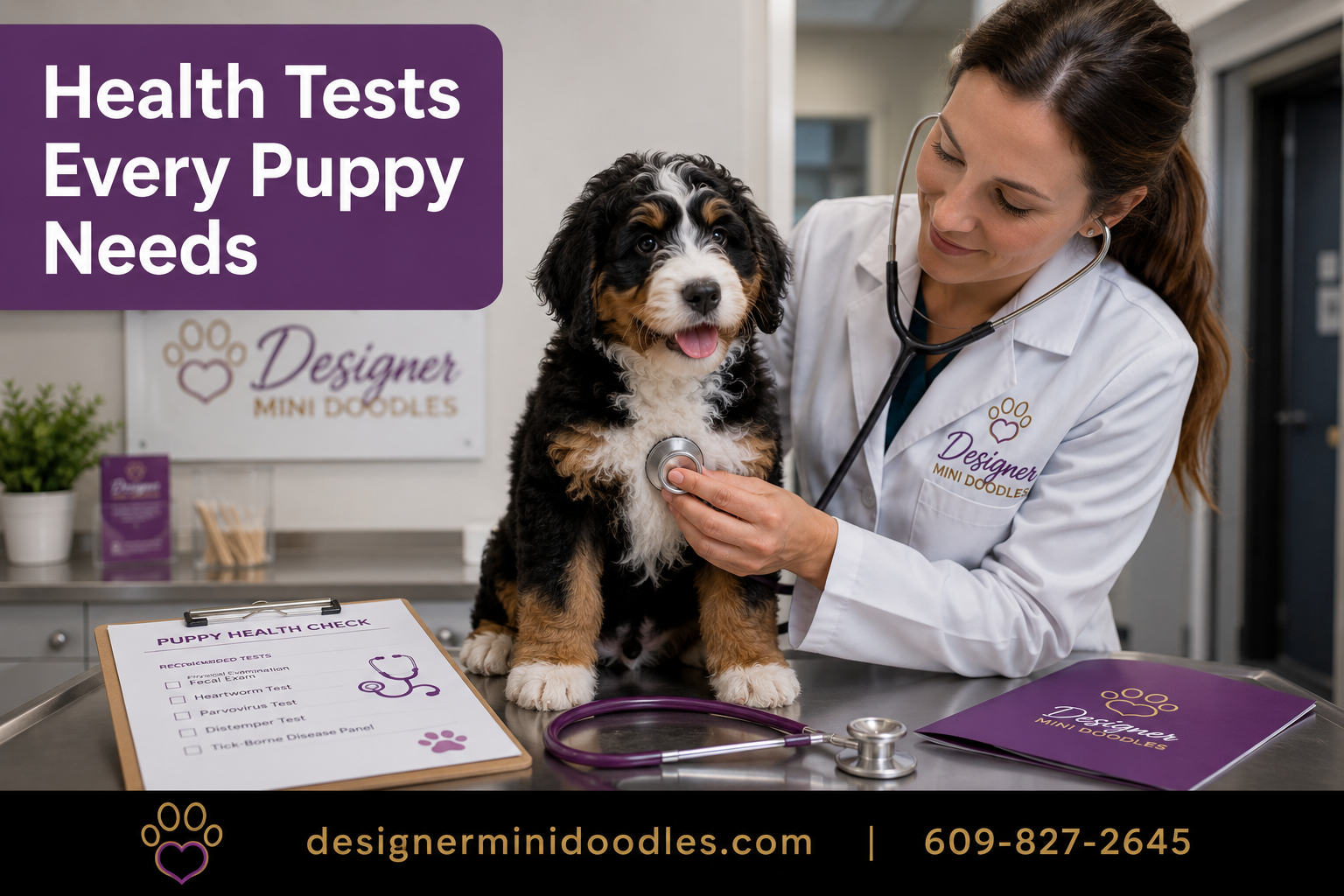
What Health Tests Should a Mini Bernedoodle Puppy Have?
Every Mini Bernedoodle puppy should come with documentation of both parent health clearances and age-appropriate puppy veterinary care. At minimum, the parents should be tested for hip dysplasia, elbow dysplasia, cardiac disease, eye conditions, and a panel of breed-specific genetic diseases.
Required parent health tests:
- OFA Hip Evaluation (Bernese Mountain Dogs are prone to hip dysplasia)
- OFA Elbow Evaluation
- OFA Cardiac Evaluation
- CERF or OFA Eye Examination
- Genetic panel including von Willebrand’s disease, degenerative myelopathy, and progressive retinal atrophy
Puppy should receive before going home:
- First round of DHPP vaccinations
- Deworming (at least two rounds)
- Veterinary wellness exam
- Microchip (many breeders include this)
Decision rule: If a breeder cannot produce OFA numbers that you can verify on the OFA public database (ofa.org), walk away. This is the single most reliable indicator of a responsible breeding program.
What Are Common Health Problems in Mini Bernedoodles?
Mini Bernedoodles are generally healthier than purebred Bernese Mountain Dogs thanks to hybrid vigor, but they can still inherit conditions from either parent breed. The most common health concerns include hip and elbow dysplasia, certain eye conditions, and skin allergies.
Conditions to be aware of:
- Hip and elbow dysplasia: Inherited joint malformations that can cause pain and mobility issues. Proper health testing of parents significantly reduces risk.
- Von Willebrand’s disease: A blood clotting disorder. Genetic testing can identify carriers.
- Progressive retinal atrophy (PRA): A degenerative eye condition that can lead to blindness. DNA testing identifies affected and carrier dogs.
- Skin allergies: Some Mini Bernedoodles develop environmental or food allergies, often manageable with diet changes and veterinary care.
- Bloat (gastric dilatation-volvulus): More common in larger Bernedoodles but still a risk. Feeding smaller, more frequent meals helps prevent it.
- Certain cancers: Bernese Mountain Dogs have higher cancer rates than many breeds. While crossing with Poodles reduces this risk, it doesn’t eliminate it entirely.
A well-bred Mini Bernedoodle from health-tested parents can live 12 to 15 years with proper care. Regular veterinary checkups, a quality diet, and appropriate exercise go a long way.
What’s the Difference Between F1 and F1B Mini Bernedoodles?
An F1 Mini Bernedoodle is a first-generation cross (50% Bernese Mountain Dog, 50% Miniature Poodle), while an F1B is a backcross (typically 75% Poodle, 25% Bernese) created by breeding an F1 Mini Bernedoodle back to a Miniature Poodle. The F1B generation generally sheds less and is better suited for allergy-sensitive homes.
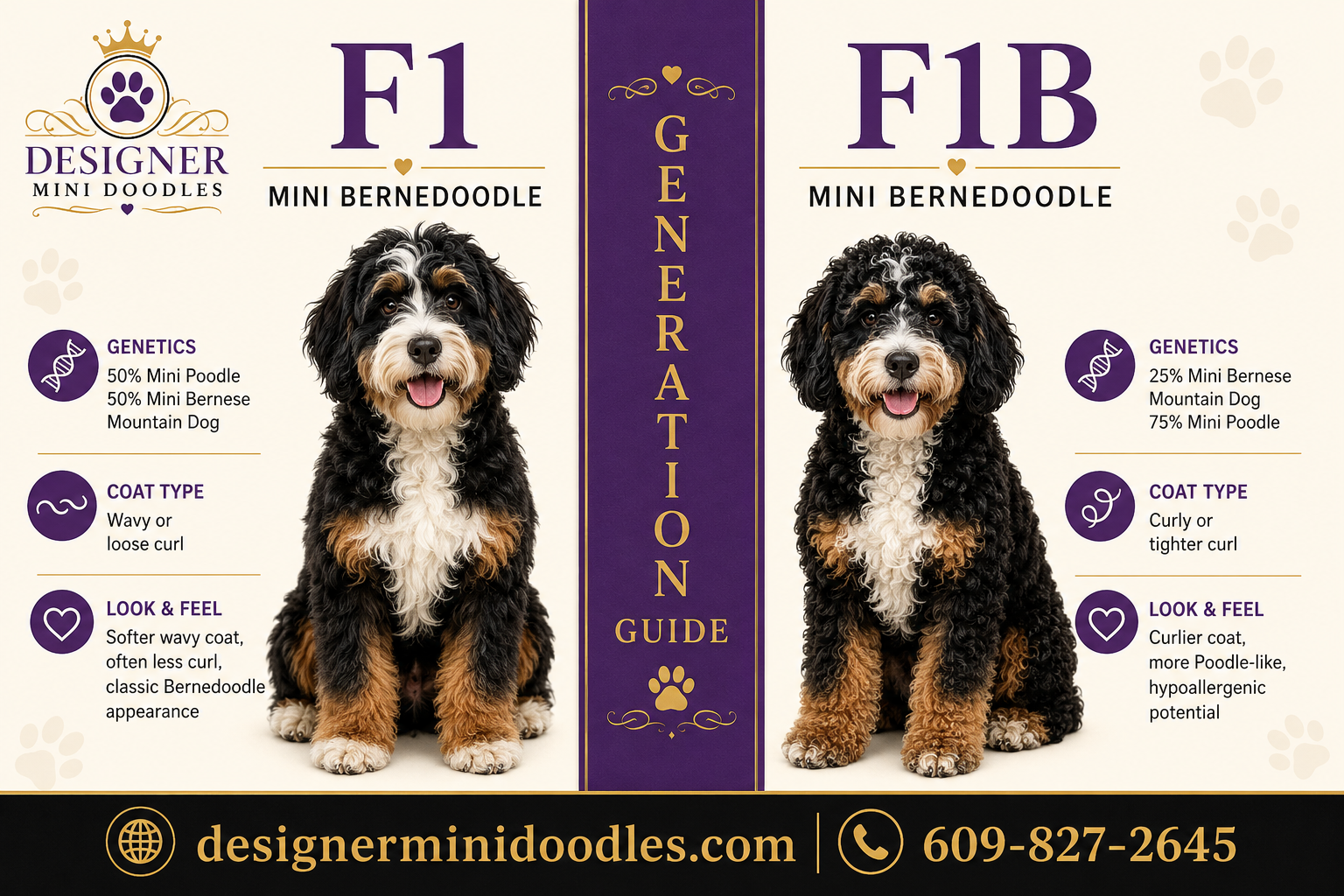
| Feature | F1 Mini Bernedoodle | F1B Mini Bernedoodle |
|---|---|---|
| Genetic mix | 50/50 Bernese-Poodle | 75/25 Poodle-Bernese |
| Coat type | Wavy to slightly curly | Curly to very curly |
| Shedding | Low to moderate | Very low to minimal |
| Allergy friendliness | Moderate | High |
| Tri-color likelihood | Higher | Lower (but still possible) |
| Price range | $3,000–$4,000 | $3,500–$5,000 |
Choose F1 if you love the classic tri-color Bernese look and shedding isn’t a dealbreaker. Choose F1B if anyone in your household has allergies or you strongly prefer minimal shedding and grooming predictability.
Some breeders also produce F2 (F1 x F1) and multigenerational crosses. These can be excellent dogs, but coat and size predictability varies more widely. For most buyers, F1 and F1B remain the most popular and well-understood generations.
Are Mini Bernedoodles Hypoallergenic?
No dog is truly 100% hypoallergenic, but Mini Bernedoodles, especially F1B and multigenerational crosses, produce significantly less dander and shed far less than most breeds. They’re considered a strong option for people with mild to moderate pet allergies.
The Poodle side of the cross contributes a low-shedding, curly coat that traps dander rather than releasing it into the air. The more Poodle genetics in the mix, the less the dog sheds. That’s why F1B Mini Bernedoodles (75% Poodle) are the go-to recommendation for allergy-sensitive households.
Important caveat: If you have severe dog allergies, spend time with the specific puppy or its parents before committing. Allergen levels vary from dog to dog, even within the same litter.
Regular grooming every 6 to 8 weeks and brushing 3 to 4 times per week also helps keep dander under control.
How Big Do Mini Bernedoodles Get When Fully Grown?
A full-grown Mini Bernedoodle typically stands 18 to 22 inches tall at the shoulder and weighs between 25 and 49 pounds. They reach their adult height by around 12 months but may continue filling out until 14 to 18 months of age.
Size depends heavily on the Poodle parent:
- Toy Poodle cross (Micro Mini): 15–24 pounds, 12–17 inches tall
- Miniature Poodle cross (Mini): 25–49 pounds, 18–22 inches tall
If living in an apartment or smaller home in Ocala, a Micro Mini might be the better fit. For families with a yard who want a sturdier dog for hiking and outdoor play, the standard Mini size works well. Either way, Mini Bernedoodles are considerably more manageable than their standard-sized counterparts, which can reach 70 to 90 pounds.
Are Mini Bernedoodles Good With Kids and Other Pets?
Yes. Mini Bernedoodles are widely regarded as one of the best doodle breeds for families with children and other pets. Their Bernese Mountain Dog heritage gives them a patient, gentle disposition, while the Poodle side adds playfulness and social intelligence.
With children:
- They’re sturdy enough to handle the energy of young kids without being so large that they accidentally knock toddlers over
- Their gentle temperament means they tolerate ear-pulling and rough play better than many breeds (though supervision is always recommended)
- They bond closely with all family members, not just one person
With other pets:
- Mini Bernedoodles generally get along well with other dogs, especially when properly socialized from a young age
- They can coexist peacefully with cats, particularly if introduced during puppyhood
- Their moderate prey drive is lower than many terrier or hound breeds
Early socialization is still essential. The best breeders begin this process before puppies go home, exposing them to different sounds, surfaces, people, and other animals during the critical 3- to 12-week developmental window.

Are Mini Bernedoodles Good for First-Time Dog Owners?
Mini Bernedoodles are an excellent choice for first-time dog owners because of their eager-to-please temperament, high trainability, and forgiving nature. They respond well to positive reinforcement and don’t require the experienced handling that some working or guarding breeds demand.
Why they work well for beginners:
- They’re highly food-motivated, which makes training a Mini Bernedoodle puppy straightforward
- They’re adaptable to different living situations (apartments, houses, condos)
- They’re social and not prone to the independence or stubbornness common in some breeds
- Their moderate energy level doesn’t overwhelm new owners
One thing to plan for: Grooming. Mini Bernedoodles require professional grooming every 6 to 8 weeks and regular brushing at home. First-time owners sometimes underestimate this commitment. Budget $60 to $100 per grooming session in the Ocala area.
For help with the early weeks, our guide on housebreaking a Mini Bernedoodle puppy covers the essentials of crate training, potty schedules, and building good habits from day one.
How Much Exercise Does a Mini Bernedoodle Need?
Mini Bernedoodles need about 30 to 60 minutes of exercise per day, split between walks, playtime, and mental stimulation. They’re active enough to enjoy hikes and fetch sessions but calm enough to relax on the couch afterward.
A good daily routine looks like:
- Morning walk (20–30 minutes)
- Midday play session or puzzle toy (15–20 minutes)
- Evening walk or backyard play (15–20 minutes)
Ocala’s mild winters and extensive trail systems (including the Santos Mountain Bike Trails and Greenway trails) make it a great area for exercising a Mini Bernedoodle year-round. During Florida’s hot summer months, schedule walks for early morning or evening to avoid heat stress.
Edge case: Puppies under 12 months should follow the “5 minutes per month of age” rule for structured walks to protect developing joints. A 4-month-old puppy, for example, should walk no more than 20 minutes at a time, though free play in a yard is fine.
What Should I Look for When Visiting a Mini Bernedoodle Breeder in Ocala?
When visiting any breeder, whether in Ocala or elsewhere, you should see clean, spacious living conditions, healthy and well-socialized parent dogs, and a breeder who answers your questions openly without getting defensive.
Checklist for your visit:
- Puppies are raised inside the home or in a clean, climate-controlled facility (not in outdoor kennels or barns)
- Parent dogs are friendly, well-groomed, and clearly comfortable around people
- The facility smells clean (some puppy smell is normal, but strong ammonia odor is a red flag)
- Puppies are active, curious, and not fearful of human contact
- The breeder can show you health testing certificates for both parents
- There’s a clear socialization program in place (toys, different surfaces, exposure to household sounds)
- The breeder asks YOU questions about your lifestyle, living situation, and experience with dogs
If you can’t visit in person: Many reputable breeders now offer live video tours via FaceTime or Zoom. This is especially common when working with out-of-area breeders who deliver puppies through nanny services. A breeder who refuses any form of facility tour, virtual or in-person, should be avoided.
Why Mini Bernedoodle Breeders in Ocala Recommend Designer Mini Doodles
Finding dedicated Mini Bernedoodle breeders in Ocala can be challenging because the breed’s popularity has outpaced the number of responsible local breeders. That’s why many Ocala families turn to established programs that serve the area through safe, professional delivery.
Designer Mini Doodles operates one of the most respected mini Bernedoodle breeding programs in the country. What sets them apart:
- Animal biologist on-site: Unlike most breeders who rely solely on general veterinary guidance, Designer Mini Doodles employs a real animal biologist who oversees genetics, nutrition, and puppy development from conception through placement.
- Breeding program quality: Their program is second to none, producing some of the best mini Bernedoodle puppies available anywhere in the USA. Every breeding pair is selected based on health clearances, temperament testing, and genetic compatibility.
- Nationwide nanny delivery: Their puppies can travel anywhere in the USA through a professional nanny service. A trained caretaker accompanies your puppy door-to-door, so Ocala families receive their new companion safely without the stress of long-distance travel.
- Comprehensive health guarantees: Every puppy comes with documented health testing, up-to-date vaccinations, and a written health guarantee.
If you’re also considering other breeds, Designer Mini Doodles works with mini Bernedoodle breeders across their network, and they also partner with programs offering frenchies for sale for families who prefer a smaller, lower-energy companion.
For those in neighboring states, Designer Mini Doodles also serves families looking for Mini Goldendoodle breeders in Georgia and throughout the Southeast.
Browse Available Mini Bernedoodle Puppies
Ready to find your perfect Mini Bernedoodle? Browse our current selection of available puppies below:
- Display 9 Products per page




Frequently Asked Questions
How long do Mini Bernedoodles live?
Mini Bernedoodles typically live 12 to 15 years, which is longer than purebred Bernese Mountain Dogs (who average 7 to 10 years). The Poodle genetics contribute to a longer, healthier lifespan through hybrid vigor.
Do Mini Bernedoodles bark a lot?
Mini Bernedoodles are moderate barkers. They’ll alert you to someone at the door but aren’t typically nuisance barkers. Proper training and adequate exercise help prevent excessive barking from developing.
Can Mini Bernedoodles handle Florida’s heat?
Yes, but with precautions. Their Bernese heritage means they’re more comfortable in cooler weather. In Ocala’s summer heat, limit outdoor exercise to early morning and evening, provide plenty of water, and keep your home air-conditioned. Many owners give their Mini Bernedoodle a shorter “summer cut” to help with heat management.
How often do Mini Bernedoodles need grooming?
Professional grooming every 6 to 8 weeks, plus brushing at home 3 to 4 times per week. Neglecting brushing leads to painful matting, especially in curlier F1B coats. Budget $60 to $100 per grooming session in the Ocala area.
Are Mini Bernedoodles easy to potty train?
Yes. Their intelligence and desire to please make them one of the easier doodle breeds to housebreak. Most Mini Bernedoodles are reliably potty trained by 4 to 6 months with consistent crate training and a regular schedule.
What colors do Mini Bernedoodles come in?
The most popular color is the classic tri-color (black, white, and rust), which mimics the Bernese Mountain Dog pattern. Other colors include phantom (two-tone), sable, merle, and solid black. Tri-color puppies often command higher prices due to demand.
Can I get a Mini Bernedoodle delivered to Ocala?
Yes. Reputable breeders like Designer Mini Doodles offer professional nanny delivery services that bring your puppy directly to your door in Ocala. A trained caretaker accompanies the puppy throughout the journey.
Do Mini Bernedoodles have separation anxiety?
Mini Bernedoodles can develop separation anxiety because they bond closely with their families. Crate training from an early age, gradual alone-time conditioning, and puzzle toys help prevent this. They’re not the best choice if everyone in the household is away for 10+ hours daily.
What’s the difference between a Mini Bernedoodle and a Mini Goldendoodle?
Mini Bernedoodles tend to be calmer, slightly larger, and come in tri-color patterns. Mini Goldendoodles are often more energetic and typically come in cream, apricot, or red. Both are intelligent, friendly, and low-shedding. Your choice depends on energy level preference and aesthetic taste.
Should I get pet insurance for my Mini Bernedoodle?
Yes, I strongly recommend pet insurance for any doodle breed. Enroll your puppy within the first few weeks of bringing them home, before any conditions develop. Plans typically cost $30 to $60 per month and can save thousands if your dog develops hip dysplasia or other inherited conditions.
How long is the waitlist for a Mini Bernedoodle puppy?
Waitlists vary by breeder and season. Popular breeders may have waitlists of 2 to 6 months. Spring and holiday litters tend to fill fastest. Placing a deposit early and being flexible on color or gender can shorten your wait.
Do Mini Bernedoodles need a fenced yard?
A fenced yard is helpful but not required. Mini Bernedoodles can thrive in apartments and condos as long as they receive adequate daily exercise and mental stimulation. If you don’t have a yard, plan for longer walks and regular visits to dog parks.
Conclusion
Finding the right Mini Bernedoodle breeder in Ocala comes down to prioritizing health testing, transparency, and a genuine commitment to puppy welfare. While Ocala’s local breeder options are limited compared to larger Florida cities, top-tier programs with nationwide delivery make it easy to bring home a well-bred, healthy puppy regardless of where you live.
Your next steps:
- Define your priorities: Decide on generation (F1 vs. F1B), size preference, and budget before contacting breeders.
- Verify health testing: Ask for OFA numbers and genetic panel results, then confirm them on the OFA public database.
- Contact Designer Mini Doodles: Explore their available Mini Bernedoodle puppies and ask about their nanny delivery service to Ocala.
- Prepare your home: Stock up on a crate, food, grooming supplies, and schedule a vet appointment for the first week your puppy arrives.
- Place your deposit: Good breeders fill litters quickly, so don’t wait once you’ve found a program you trust.
A Mini Bernedoodle from a reputable breeder is an investment that pays off in 12 to 15 years of loyal companionship. Take the time to do your research, and you’ll be rewarded with one of the best family dogs available today.