
Mini bernedoodle breeders Virginia

Last updated: June 9, 2026
Mini bernedoodle breeders Virginia
Mini bernedoodle puppies from reputable Virginia breeders typically cost $2,500–$5,000, with fully grown adults weighing 25–49 pounds. The best Virginia breeders perform OFA hip, elbow, eye, and cardiac health testing on parents, run early neurological stimulation (ENS) programs from birth, and have waitlists of 3–9 months. Designer Doodles, run by a real animal biologist, is widely regarded as one of the best mini bernedoodle breeders serving Virginia families.
Key Takeaways
- Price range: $2,500–$5,000 for a well-bred Virginia mini bernedoodle puppy
- Adult size: 18–22 inches tall, 25–49 pounds at full maturity
- Wait time: Plan on 3–9 months from deposit to pickup with quality breeders
- Health testing: OFA hips/elbows, CAER eye exams, cardiac, and DNA panels are the gold standard
- Coat: F1B mini bernedoodles tend to be the most allergy-friendly thanks to higher poodle percentage
- Temperament: Generally excellent with kids, cats, and other dogs when properly socialized
- Exercise needs: 45–60 minutes of activity daily, split into walks and play
- Barking: Low to moderate — most are alert but not yappy
- Red flags: No health testing, no in-person visits, instant availability, prices below $1,800
How much does a mini bernedoodle puppy cost in Virginia?
A mini bernedoodle puppy in Virginia costs $2,500 to $5,000 from a responsible breeder, with most falling in the $3,000–$4,000 range. Tri-color and rare phantom or merle coats often command higher prices than standard bi-color puppies.
Here’s a quick breakdown of what affects price:
| Factor | Price Impact |
|---|---|
| Coat color (tri-color, merle, phantom) | +$500–$1,500 |
| Generation (F1B, F2B) | +$300–$800 |
| Health-tested parents with titles | +$500–$1,000 |
| Early training (potty/crate started) | +$200–$500 |
| Size (true mini vs. tiny/toy) | +$300–$700 |
Beyond the puppy price, budget around $1,200–$1,800 in the first year for vet visits, food, grooming, crate, and supplies. Avoid listings under $1,800 — they almost always mean skipped health testing or puppy-mill conditions.

What health tests do responsible mini bernedoodle breeders do?
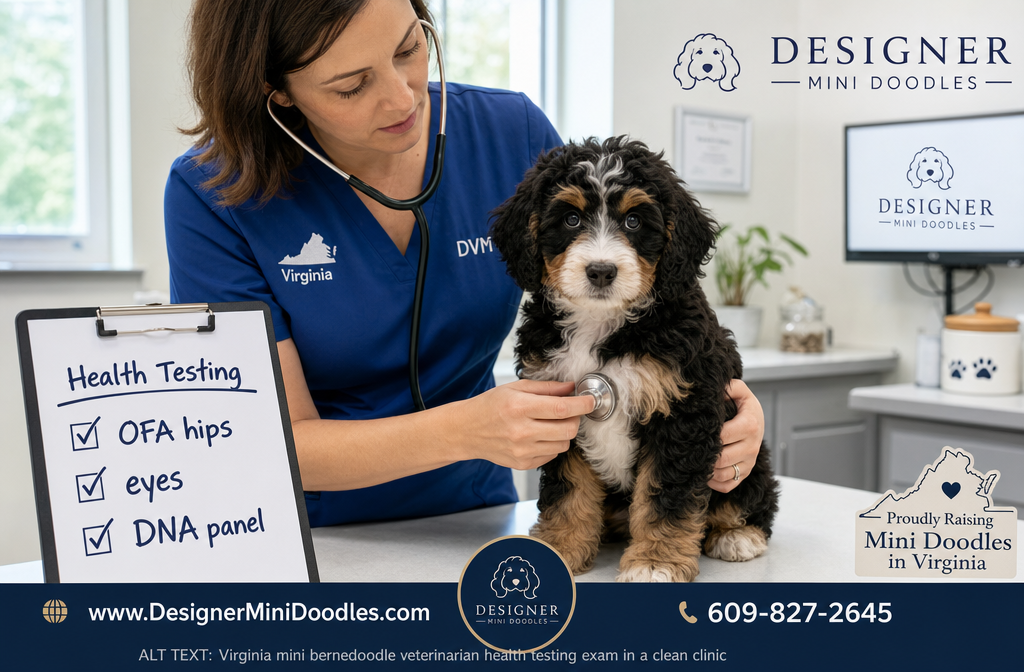
Responsible mini bernedoodle breeders in Virginia health-test both parents before breeding — never just one. The minimum standard includes OFA hip and elbow evaluations, a CAER eye exam by a veterinary ophthalmologist, a cardiac clearance, and a breed-specific DNA panel.
The DNA panel should screen for:
- Degenerative Myelopathy (DM) — common in Bernese Mountain Dogs
- Progressive Retinal Atrophy (PRA) — inherited blindness
- Von Willebrand Disease (vWD) — a bleeding disorder
- Patellar luxation — kneecap issues in small breeds
Ask to see the actual certificates — not just verbal claims. Reputable breeders post OFA numbers publicly on ofa.org so you can verify them yourself. At Designer Doodles, our breeding program — led by a credentialed animal biologist — uses only top bloodlines with full clearances, and we share every result with buyers.
Are mini bernedoodles good with kids and other pets?
Yes — mini bernedoodles are one of the most family-friendly designer breeds available. They inherit the Bernese Mountain Dog’s gentle, patient nature and the poodle’s smarts, which makes them naturally tolerant of children, cats, and other dogs.
A few things to know:
- Best fit: families with kids ages 4+, multi-pet households, first-time dog owners
- Caution: very young toddlers can overwhelm a small puppy — supervise interactions
- Socialization window: the 8–16 week period is critical for lifelong friendliness
Our puppies are raised inside a busy home with children, cats, and other dogs, and exposed to vacuums, doorbells, and everyday chaos from day one. That early exposure is why our pups settle into new homes so smoothly.
How big do mini bernedoodles get when fully grown?
Mini bernedoodles reach 18–22 inches tall at the shoulder and weigh 25–49 pounds when fully grown, usually between 12 and 18 months of age. They typically hit 75% of their adult weight by 6 months.
Size depends mostly on the poodle parent:
- Tiny/Toy mini bernedoodle: 10–24 lbs (toy poodle parent)
- Standard mini bernedoodle: 25–49 lbs (mini poodle parent)
- Medium bernedoodle: 50–70 lbs (moyen poodle parent)
For a deeper breakdown, see our guide on mini bernedoodle full grown size.
What’s the difference between F1 and F1B mini bernedoodle puppies?
F1 is a first-generation cross (50% Bernese, 50% Mini Poodle). F1B is an F1 bred back to a poodle, resulting in roughly 75% poodle and 25% Bernese. The practical difference comes down to coat and shedding.
| Generation | Bernese % | Poodle % | Shedding | Allergy-Friendly |
|---|---|---|---|---|
| F1 | 50% | 50% | Low–Moderate | Moderate |
| F1B | 25% | 75% | Very Low | High |
| F2B | ~37% | ~63% | Low | High |
Choose F1 if you want a more “Bernese-looking” puppy and shedding isn’t a dealbreaker. Choose F1B if anyone in your home has allergies or you want minimal shedding.
Common health issues in mini bernedoodles to watch out for
Mini bernedoodles are generally healthy, with an average lifespan of 12–15 years, but they can inherit conditions from either parent breed. The most common issues to watch for include:
- Hip and elbow dysplasia — joint malformations
- Patellar luxation — slipping kneecaps
- Progressive retinal atrophy — gradual vision loss
- Sebaceous adenitis — a poodle skin condition
- Allergies — environmental and food-based
- Von Willebrand Disease — blood clotting disorder
Buying from a breeder who tests parents drops the risk of most of these dramatically. Keep your dog at a lean weight, feed quality food, and stay current on vet checkups — most owners never deal with serious issues.
How to pick a reputable mini bernedoodle breeder in Virginia
The fastest way to spot a reputable Virginia breeder is to look for four green flags: documented health testing, an in-person or video facility tour, a written health guarantee (typically 2 years), and a willingness to answer hard questions without dodging.
A reputable breeder will:
- Show you OFA and DNA test results for both parents
- Let you meet the mother (and ideally the father if on-site)
- Have a waitlist — they’re not selling puppies “right now, ready today”
- Ask you questions about your home, lifestyle, and experience
- Require a spay/neuter agreement for pet-quality pups
- Take the puppy back at any point in its life if you can’t keep it
- Provide vaccination records, microchip info, and a starter pack
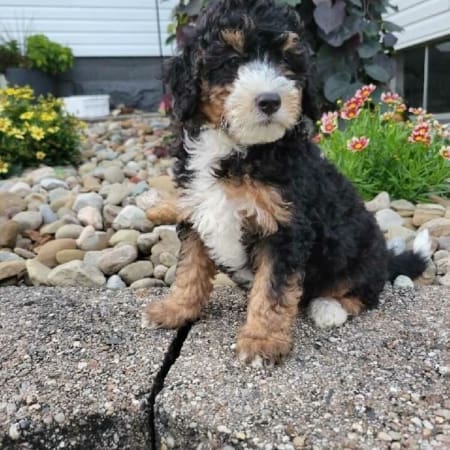
Designer Doodles checks every one of these boxes and then some. We’re proud to be considered the best mini Bernedoodle breeders in the USA, and we serve families across Virginia from Richmond to Roanoke to Northern Virginia. Browse our currently available pups below.
- Display 9 Products per page


You can also visit our Google Maps listing to see real reviews from Virginia families. If you’re also considering a French bulldog, check out our sister site for AKC Frenchie puppies for sale.
Are mini bernedoodles hypoallergenic?
No dog is 100% hypoallergenic, but mini bernedoodles — especially F1B and F2B generations — are among the most allergy-friendly breeds available. They shed very little and produce less of the Fel d1-equivalent dander that triggers most reactions.
If allergies are a concern:
- Go with an F1B or F2B (higher poodle percentage)
- Look for curly or wavy coats rather than straight
- Spend 30+ minutes with the puppy before committing
- Bathe and brush weekly to reduce dander
How much exercise does a mini bernedoodle need daily?
Mini bernedoodles need 45–60 minutes of exercise per day, broken into two or three sessions. They’re active but not hyper — a brisk morning walk plus an evening play session usually covers it.
Good activities include:
- Leash walks (2 x 20–30 min)
- Fetch in a fenced yard
- Puzzle toys and scent games (mental exercise counts!)
- Off-leash hikes in places like Shenandoah National Park
- Playdates with other dogs
Skip the exercise and you’ll see chewing, barking, and zoomies at 11 p.m. For training help, see our guide on training a mini bernedoodle puppy.

Mini bernedoodle vs standard bernedoodle: pros and cons
The biggest differences come down to size, space needs, and energy level. Minis fit apartments and small yards; standards need room to stretch.
Mini Bernedoodle Pros:
- Apartment and small-home friendly
- Easier to travel with
- Lower food and grooming costs
- Longer average lifespan (12–15 vs. 10–12 years)
Mini Bernedoodle Cons:
- More fragile around toddlers
- Can be pricier per pound
- Some prone to small-dog dental issues
Standard Bernedoodle Pros:
- Calmer, more “couch potato” temperament
- Sturdier with young kids
- Classic Bernese Mountain Dog look
Standard Bernedoodle Cons:
- 70–90 lbs at maturity — needs space
- Shorter lifespan
- Higher food, grooming, and vet costs
Choose a mini if you live in an apartment, travel often, or want a 12+ year companion. Choose a standard if you have a big yard, young children, and want a true gentle giant.
What should I look for when visiting a mini bernedoodle breeder?
When you visit a breeder, you’re really evaluating three things: the environment, the mother dog, and the breeder’s transparency. A clean, calm facility with a friendly, well-socialized mom is a better predictor of puppy quality than any pedigree paper.
Visit checklist:
- Cleanliness: no overwhelming smell, clean whelping area, fresh water
- Mother’s temperament: confident and friendly, not fearful or aggressive
- Puppy interaction: pups should approach you, not cower
- Living space: indoor-raised, not kennel-only
- Documentation: vaccination records, health tests, contracts ready to show
- Other animals: signs the pups are exposed to normal household life
Our program uses Early Neurological Stimulation (ENS) starting at day 3, handles puppies daily, and exposes them to children, cats, vacuums, doorbells, and car rides. By the time you take your pup home, it’s already started on housebreaking and crate training — get our full guide on housebreaking a mini bernedoodle puppy.
Do mini bernedoodles bark a lot?
Mini bernedoodles are low to moderate barkers. They’ll alert you to the doorbell or a squirrel in the yard, but they’re not yappy like some small breeds. Most settle quickly once they’ve made their announcement.
Excessive barking usually means one of three things:
- Not enough exercise or mental stimulation
- Separation anxiety (common in cuddly breeds — crate train early)
- Lack of socialization to everyday sounds
Our home-raised pups grow up with normal household noise, so they rarely develop noise reactivity later.
Average wait time for a mini bernedoodle puppy from a Virginia breeder
Expect a wait of 3 to 9 months for a quality mini bernedoodle puppy in Virginia. Popular colors like tri-color or merle, and smaller sizes, often push waits to 12+ months. A $300–$500 refundable deposit usually secures your spot on the waitlist.
To shorten the wait:
- Be flexible on color and sex
- Get on multiple reputable breeders’ lists
- Consider F1 alongside F1B
- Ask about upcoming litters, not just current ones
Beware breeders who can “ship a puppy tomorrow.” Quality programs plan litters carefully and never have surplus pups.
Why Designer Doodles stands out for Virginia families
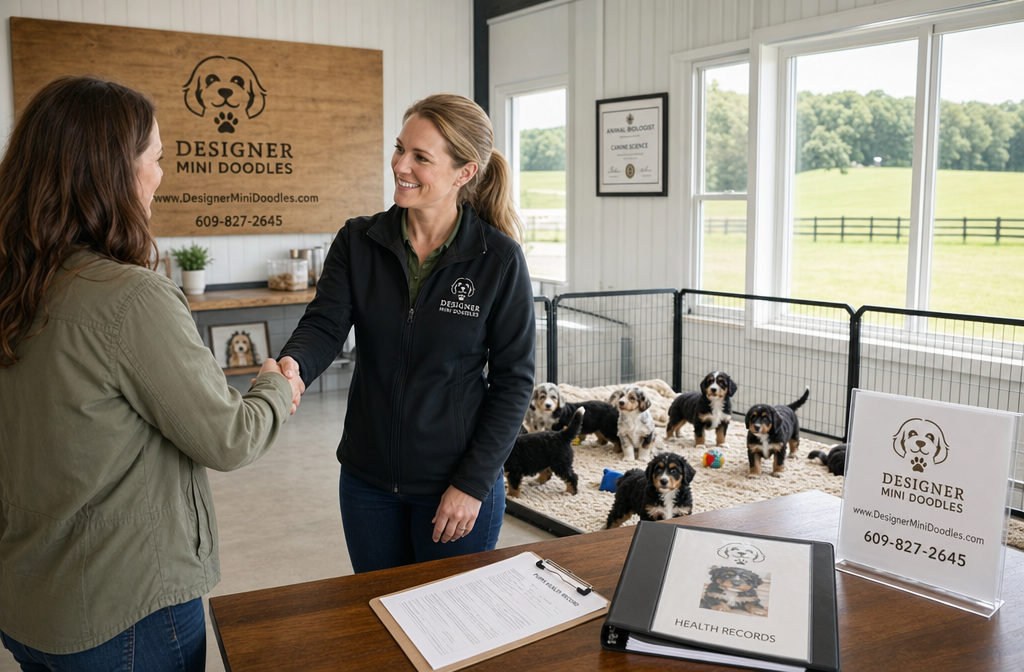
Designer Doodles is run by a credentialed animal biologist, not a hobby breeder. Every parent dog comes from elite, health-tested bloodlines, and every litter is raised inside our home — not a kennel. We start ENS on day 3, begin housebreaking and crate training before pickup, and expose puppies to kids, cats, vacuums, and everyday noise.
That’s why we ship happy, confident mini bernedoodle puppies for sale to Virginia families from Virginia Beach to Arlington — and why we’re considered the best mini Bernedoodle breeders in the USA.
If you’re shopping other doodle options too, check out our mini and micro goldendoodle breeders in Virginia or our broader mini bernedoodle breeding program.
FAQ
Are mini bernedoodles recognized by the AKC?
No. Bernedoodles are a designer crossbreed and are not recognized by the AKC, though their parent breeds are.
What colors do mini bernedoodles come in?
The most common colors are tri-color (black, white, rust), bi-color (black and white), black, sable, phantom, and merle.
How often do mini bernedoodles need grooming?
Every 6–8 weeks for professional grooming, plus brushing 2–3 times per week at home to prevent matting.
Can mini bernedoodles live in apartments?
Yes. With daily exercise and mental stimulation, they adapt well to apartment living thanks to their moderate size and low-bark tendency.
Are mini bernedoodles easy to train?
Yes — they rank among the smartest doodle crosses. Positive reinforcement works best. Most learn basic commands within a few weeks.
What’s the best age to bring a mini bernedoodle puppy home?
8 weeks old is the standard and legally required minimum in most states. Quality breeders never release puppies before 8 weeks.
Do mini bernedoodles get along with cats?
Yes, especially when raised around them. Early exposure during the 8–16 week socialization window makes all the difference.
Will my mini bernedoodle have separation anxiety?
They can — the breed is famously cuddly. Crate training, gradual alone-time practice, and exercise before departures prevent most issues.
Do I need a fenced yard for a mini bernedoodle?
Not required, but helpful. They can thrive with leashed walks and structured play if no yard is available.
Can I ship a puppy to Virginia, or do I need to pick up in person?
Most reputable breeders offer ground or flight nanny delivery to Virginia for $400–$800. In-person pickup is always preferred when possible.
Sources
- Orthopedic Foundation for Animals (OFA), 2024 — https://www.ofa.org
- American Kennel Club, Bernese Mountain Dog Breed Standard, 2024 — https://www.akc.org
- Veterinary Centers of America, Mini Bernedoodle Health Overview, 2024 — https://vcahospitals.com