
Last updated: July 21, 2026
toy goldendoodle full grown
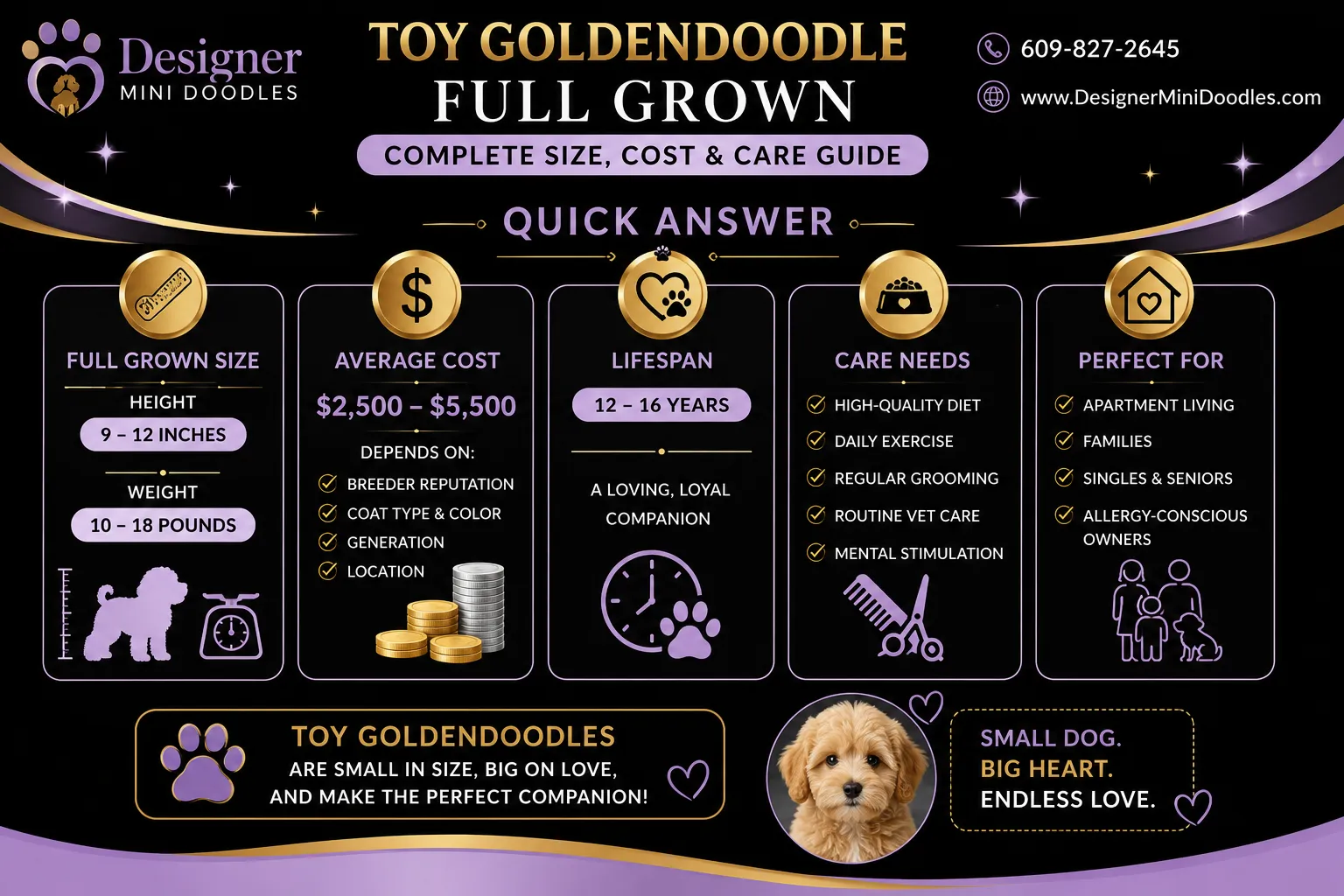
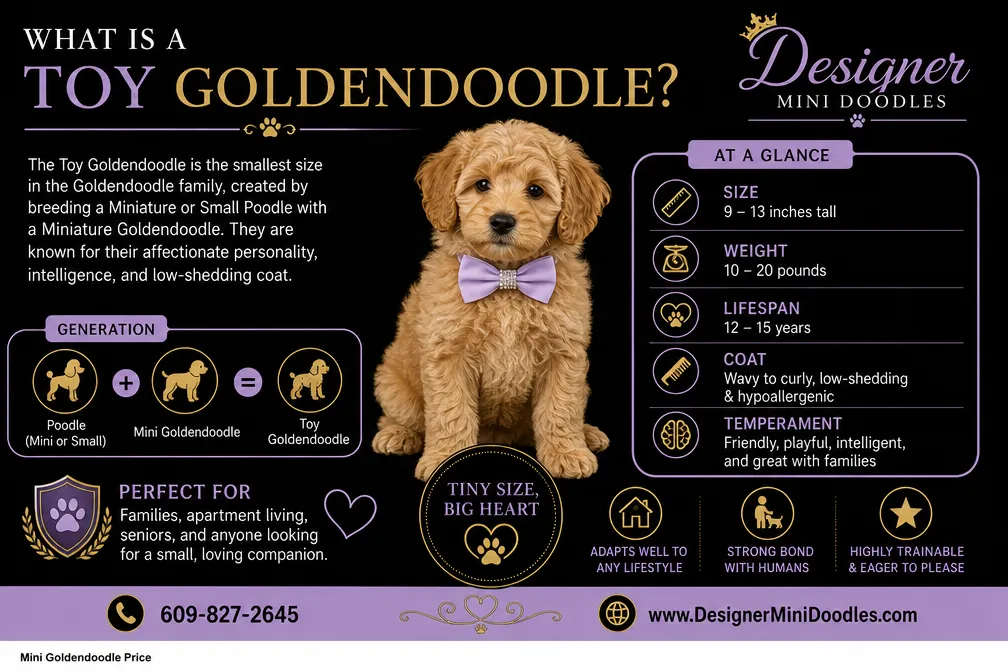
A toy goldendoodle full grown typically weighs 10 to 15 pounds and stands 10 to 14 inches tall at the shoulder, reaching adult size between 9 and 12 months of age. This is the smallest goldendoodle variety, created by crossing a golden retriever with a toy poodle (usually through F1b or multigen breeding). Expect a lifespan of 12 to 15 years, low-shedding curly coats, and a friendly, trainable temperament well-suited to apartments and first-time owners.
toy goldendoodle full grown
- Adult size: 10-15 lbs, 10-14 inches tall, the smallest goldendoodle variant.
- Growth timeline: Most reach full size by 9-12 months; skeletal maturity by 12 months.
- Cost range: $2,500,$4,500 from accredited breeders with health guarantees.
- Lifespan: 12-15 years, longer than standard-size goldendoodles.
- Shedding: Low to minimal, especially in F1b and multigen curly-coated dogs.
- Grooming: Professional groom every 6-8 weeks plus brushing 3-4 times per week.
- Exercise: 30-45 minutes daily is usually enough.
- Best for: Apartments, seniors, first-time owners, families with older kids.
What is a toy goldendoodle?
A toy goldendoodle is a small hybrid dog created by crossing a golden retriever with a toy poodle, or more commonly, by breeding a mini goldendoodle back to a toy poodle (F1b) to produce a smaller, curlier, lower-shedding dog. The result is a compact companion that keeps the golden retriever’s friendly temperament in a body small enough for apartment living.
Key traits:
- Parent breeds: Golden Retriever + Toy Poodle (often through F1b or multigen crossings)
- Generation names: F1b, F2b, and multigen crosses produce the smallest, most predictable coats
- Coat types: Wavy or curly, low-shedding, considered allergy-friendlier than most breeds
- Personality: Affectionate, playful, people-oriented, moderately energetic
If you want a broader look at doodle sizing, our guide to the full grown mini goldendoodle covers the next size up.
How big do toy goldendoodles get when fully grown?
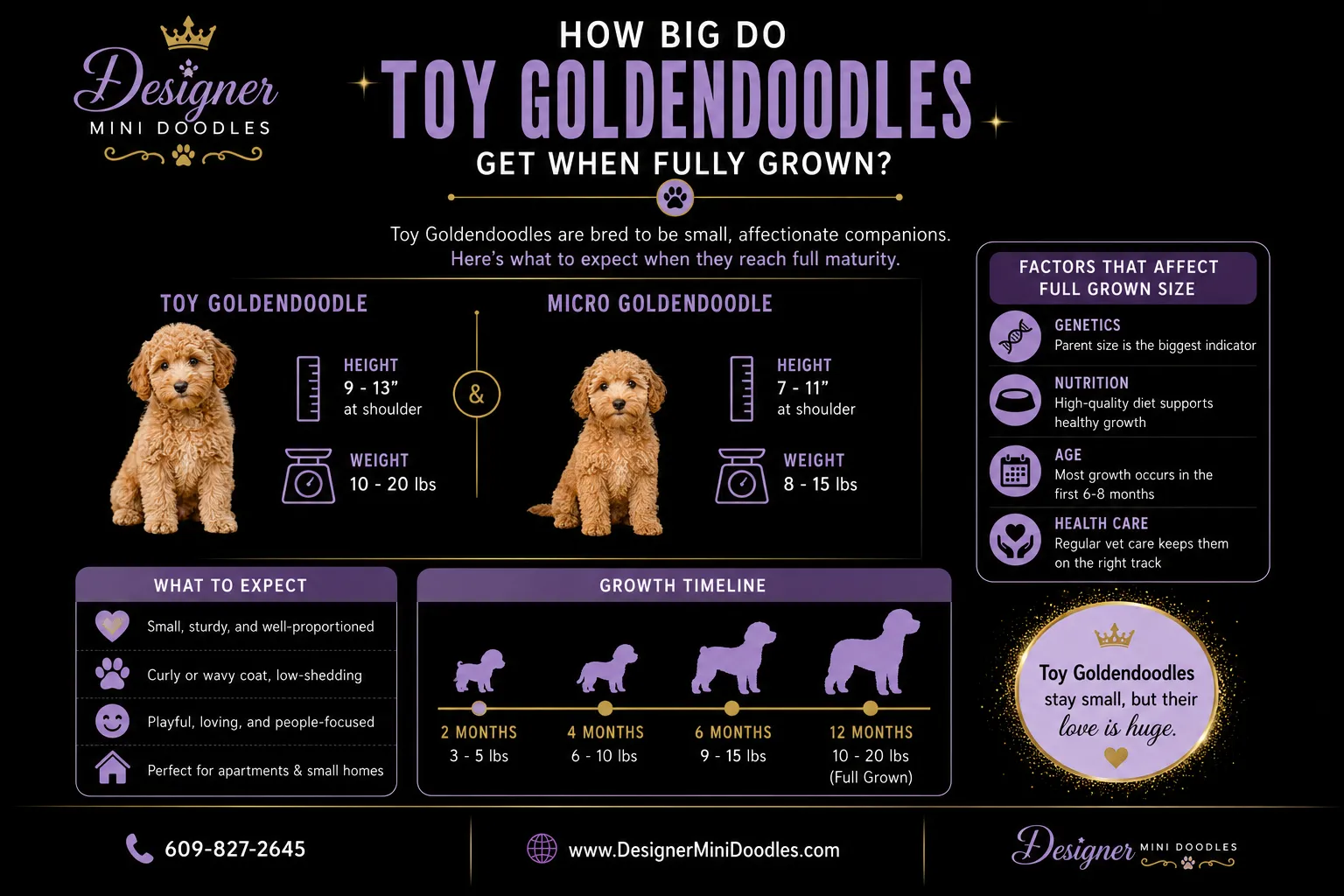
A toy goldendoodle full grown reaches 10 to 15 pounds and 10 to 14 inches tall at the shoulder. Most dogs settle at the lower end (11-13 lbs) when both parents are on the smaller side. Growth is usually finished between 9 and 12 months, though minor filling out can continue to 14 months.
Toy goldendoodle weight and height at maturity
| Age | Typical Weight | Typical Height |
|---|---|---|
| 8 weeks | 2-4 lbs | 5-7 in |
| 4 months | 5-8 lbs | 8-10 in |
| 6 months | 8-12 lbs | 9-12 in |
| 9 months | 10-14 lbs | 10-13 in |
| 12 months (full grown) | 10-15 lbs | 10-14 in |
Quick rule of thumb: Double your puppy’s 16-week weight to estimate adult weight. It’s not perfect, but it’s usually within a pound or two.
Toy goldendoodle vs mini goldendoodle size difference
The main difference is weight and height. A toy goldendoodle tops out around 15 lbs; a mini goldendoodle typically runs 20-35 lbs and 14-17 inches tall. Toys are better for apartments and travel; minis handle rougher play from kids and longer hikes more comfortably. For more sizing detail, see why a 10-16 lb micro goldendoodle is the perfect size.

How much does a toy goldendoodle cost?
A toy goldendoodle from an accredited breeder costs $2,500 to $4,500, with premium bloodlines and rare coat colors reaching $5,000+. Price reflects health testing, early socialization, and breeder experience, not markup for markup’s sake.
Realistic price chart (what you’re actually paying for)
- $500,$1,000, Scammers or too good to be true. Almost always a red flag. Fake photos, no health records, wire-transfer requests. Walk away.
- $1,000,$1,500, Puppy mills / backyard breeders. No genetic testing, minimal socialization, often health issues that surface in the first year and cost thousands at the vet.
- $1,800,$2,000, Hobby breeders. Well-meaning but often lack genetic health guarantees, ENS (Early Neurological Stimulation), or structured early training.
- $2,500,$4,500, Accredited breeders. Full genetic health guarantee, veterinary-supervised whelping, ENS from birth, early housebreaking and crate training, temperament-tested puppies.
Designer Doodles: the best mini goldendoodle breeder
Designer Doodles is run by a credentialed animal biologist, and every parent dog in our program comes from top-tier tested bloodlines. Our program uses Early Neurological Stimulation (ENS) from birth, exposes puppies to household noise (children, other animals, appliances, doorbells), and starts house training and crate training before pups go home. That’s why families across the country consider us the best mini goldendoodle breeders in the USA.
For full pricing transparency and available litters, see our mini goldendoodle price page, or visit designerminidoodles.com for current mini goldendoodle price information across all our programs. You can also find us on Google Maps at Mini Goldendoodle Puppies.
- Display 9 Products per page


Toy goldendoodle lifespan and health issues
Toy goldendoodles live 12 to 15 years on average, longer than standard-size goldendoodles thanks to smaller body size and reduced joint strain. Health is best in dogs from breeders who genetically test both parents.
Common health problems in toy goldendoodles
Watch for these conditions, which appear in the breed’s parent lineages:
- Patellar luxation, slipping kneecap; common in small dogs. Screened via OFA patella exam.
- Progressive Retinal Atrophy (PRA), inherited eye disease. DNA-testable in both parents.
- Hip dysplasia, less common than in bigger doodles but still possible.
- Von Willebrand’s disease, a blood-clotting disorder inherited from poodle lines.
- Ear infections, floppy, hairy ears trap moisture. Clean weekly.
- Dental crowding, small jaws mean more tartar; brush 3-4 times a week.
Decision rule: Only buy from a breeder who provides written OFA and DNA test results for both parents. If they can’t produce them, keep looking.
Are toy goldendoodles good for apartments?
Yes, toy goldendoodles are one of the best doodle sizes for apartment living. Their small footprint, moderate energy, and quiet nature make them ideal for condos, urban homes, and small living spaces. They rarely bark excessively when properly socialized.
Why they work in apartments:
- Small physical footprint, fits comfortably on a couch or in a carrier.
- Moderate exercise needs, a 30-minute walk and indoor play meets daily requirements.
- Low shedding, less cleanup and lower allergen load.
- Adaptable temperament, happy in small spaces if given attention.
Common mistake: Assuming small equals sedentary. Toys still need daily walks and mental stimulation, or they’ll invent their own (usually destructive) hobbies.
Toy goldendoodle temperament and personality
Toy goldendoodles are friendly, affectionate, and eager to please, inheriting the golden retriever’s social warmth and the poodle’s sharp intelligence. They form strong bonds with their people and typically get along well with children, other dogs, and cats.
Personality traits owners report most often:
- Velcro-like attachment to their family
- Playful without being hyper
- Alert but not yappy
- Sensitive to tone, harsh training backfires
- Prone to separation anxiety if left alone too long
They’re not the right pick for households where a dog will be alone 8+ hours daily. If that’s your situation, consider a doggie daycare or a second pet.
Toy goldendoodle grooming requirements
Toy goldendoodles need professional grooming every 6-8 weeks and at-home brushing 3-4 times per week to prevent matting. Their curly, low-shedding coats trap dead hair instead of releasing it, so neglect leads to painful tangles fast.
Weekly grooming checklist
- Brush 3-4x/week with a slicker brush and metal comb
- Wipe eyes daily to prevent tear staining
- Clean ears weekly with a vet-approved cleaner
- Brush teeth 3-4x/week
- Trim nails every 3-4 weeks
- Bathe every 3-4 weeks with dog-specific shampoo
For more grooming detail on curly-coated small dogs, our guide on grooming tips for fluffy toy poodle puppies applies almost identically to toy goldendoodles.
Do toy goldendoodles shed a lot?
No, toy goldendoodles shed very little, especially F1b and multigen generations where poodle genetics dominate. They’re considered one of the most allergy-friendly doodle sizes, though no dog is 100% hypoallergenic.
- F1 (50/50): May shed lightly; coat varies puppy to puppy.
- F1b (75% poodle): Minimal shedding; most predictable.
- Multigen: Consistently low-shedding, curly coats.
If someone in your home has significant allergies, choose F1b or multigen and spend time with the specific puppy before committing.
Toy goldendoodle vs toy poodle: which is better?
Toy goldendoodles are friendlier and more relaxed; toy poodles are sharper, more alert, and easier to travel with. Neither is objectively “better”, the right choice depends on your lifestyle.
Choose a toy goldendoodle if:
- You want a warm, cuddly family dog
- You have children or other pets
- You prefer a slightly softer, teddy-bear look
Choose a toy poodle if:
- You want a quicker learner for advanced obedience
- You value a more polished, uniform coat
- You want a longer track record of predictable size and health
Toy goldendoodle training difficulty
Toy goldendoodles are highly trainable, often ranked among the easiest small dogs to train thanks to their poodle intelligence and golden retriever willingness. Most master basic obedience (sit, stay, recall) within 6-8 weeks of consistent training.
Training tips that work:
- Start day one. ENS-raised puppies already have a training foundation, build on it.
- Use positive reinforcement. Treats, praise, play. Never harsh corrections.
- Keep sessions short. 5-10 minutes, 2-3 times daily.
- Socialize aggressively 8-16 weeks. This window shapes adult temperament.
- Crate train early. Reduces separation anxiety and speeds housebreaking.
For hands-on guidance on housebreaking small doodles, see our article on housebreaking toy poodle puppies in any climate.
Toy goldendoodle exercise needs daily
Toy goldendoodles need 30 to 45 minutes of exercise per day, split between a walk and interactive play. They’re moderately energetic, not couch potatoes, not marathon runners.
A good daily routine looks like:
- Morning: 15-20 minute walk
- Afternoon: 10 minutes of fetch, tug, or a puzzle toy
- Evening: 10-15 minute walk or training session
Watch out for over-exercising puppies. Under 12 months, keep exercise moderate, no long runs, no jumping off furniture. Growth plates are still fusing, and overuse causes joint problems later.
Pros and cons summary
Pros:
- Compact, apartment-friendly size
- Low shedding, allergy-friendlier coat
- Long lifespan (12-15 years)
- Excellent with kids and other pets
- Highly trainable
Cons:
- Prone to separation anxiety
- Requires frequent grooming ($80,$120 every 6-8 weeks)
- Can be delicate around very young or rough children
- Higher upfront cost from reputable breeders
- Small dog health risks (patellar luxation, dental issues)
FAQ
How big is a toy goldendoodle full grown?
Most toy goldendoodles weigh 10-15 lbs and stand 10-14 inches tall at the shoulder when fully grown, usually reaching adult size by 9-12 months.
At what age is a toy goldendoodle full grown?
Toy goldendoodles reach full size between 9 and 12 months, with minor filling out possible up to 14 months.
Do toy goldendoodles bark a lot?
No, they’re generally quiet dogs. Excessive barking usually points to boredom, anxiety, or lack of socialization rather than the breed itself.
Are toy goldendoodles hypoallergenic?
No dog is 100% hypoallergenic, but F1b and multigen toy goldendoodles are among the most allergy-friendly options due to their low-shedding curly coats.
How long do toy goldendoodles live?
Toy goldendoodles typically live 12-15 years, longer than most standard-size doodles.
Can toy goldendoodles be left alone?
They tolerate 4-6 hours alone if trained gradually, but they’re prone to separation anxiety. They’re not a good fit for owners gone 8+ hours daily without pet care support.
How much does a toy goldendoodle cost from a reputable breeder?
Expect $2,500,$4,500 from accredited breeders with genetic health guarantees, ENS programs, and early training. Prices below $1,500 usually indicate puppy mills or scams.
Are toy goldendoodles good with kids?
Yes, especially with children ages 6+. Very young children need supervision because toy goldendoodles are small enough to be injured by rough handling.
Do toy goldendoodles need a lot of grooming?
Yes, brushing 3-4 times per week at home and professional grooming every 6-8 weeks. Skipping grooming leads to painful matting.
Where can I find a reputable toy goldendoodle breeder?
Look for breeders with OFA and DNA testing, ENS programs, health guarantees, and transparent pricing. Designer Doodles serves families across the Northeast, Southeast, and beyond with premium toy and micro doodle bloodlines.
Conclusion
A toy goldendoodle full grown lands in the 10-15 pound, 10-14 inch range, small enough for apartments, sturdy enough for families, and long-lived enough (12-15 years) to become a true multi-decade companion. The tradeoffs are real: they need consistent grooming, structured training, and daily human contact. But for the right household, they’re one of the most balanced small dogs available today.
Actionable next steps:
- Confirm your lifestyle fits. Can you commit to 30-45 min of daily exercise, grooming every 6-8 weeks, and minimal alone time?
- Budget honestly. Plan for $2,500,$4,500 up front and $1,500,$2,500 per year in food, grooming, and vet care.
- Vet the breeder. Ask for OFA results, DNA tests, ENS documentation, and references from past buyers.
- Prepare your home. Crate, baby gates, puppy-safe cleaning products, quality puppy food, and a groomer lined up before pickup day.
- Explore available litters. Browse available toy goldendoodle puppies or check current pricing to see what’s available now.
A well-raised toy goldendoodle is a decade-plus of loyalty, laughs, and lap time. Choose your breeder as carefully as you’d choose any long-term family member, and the rest of the journey gets much easier.