

Bernedoodle Puppies Mini
Last updated: July 26, 2026
A well-bred mini bernedoodle puppy typically weighs less than a gallon of milk at eight weeks old, then grows to become a 25-to-49-pound family companion that fits in a Manhattan studio, a Denver townhouse, or a Georgia farmhouse with equal ease. That size flexibility, combined with a low-shedding coat and famously gentle temperament, is why demand for Bernedoodle Puppies Mini has climbed faster than almost any other doodle cross in the last five years.
Bernedoodle Puppies Mini
Mini Bernedoodle Puppies for sale are a cross between a Miniature Poodle and a Bernese Mountain Dog (usually F1B or multigen), standing 18-22 inches tall and weighing 25-49 pounds at maturity. They typically cost $2,500-$5,500 from a reputable breeder, live 12-17 years, shed minimally, and score high for family-friendly temperament. At Designer Mini Doodles, our program is run by a licensed animal biologist and produces puppies from champion bloodlines that are ENS-stimulated from day three and started on crate training and housebreaking before they ever leave for their new homes.
Bernedoodle Puppies Mini
- Adult size: 25-49 pounds, 18-22 inches tall, smaller than a standard bernedoodle (70-90 lbs) but larger than a toy bernedoodle (10-24 lbs).
- Price range: $2,500-$5,500 depending on generation, coat, and breeder reputation.
- Lifespan: 12-17 years, longer than the standard bernedoodle average.
- Coat: Wavy to curly, low-shedding when the puppy inherits the poodle’s coat gene.
- Temperament: Loyal, playful, gentle with kids, moderately velcro.
- Exercise: 45-60 minutes per day of active exercise plus mental work.
- Best for: First-time owners, families with children, apartment dwellers with a walking routine.
- Breeder red flag: No health testing, no in-person meetup option, no ENS or early neurological stimulation protocol.
What is a mini bernedoodle and how big do they get
A mini bernedoodle is a hybrid dog created by crossing a Miniature Poodle with a Bernese Mountain Dog, typically producing a 25-49 pound adult that stands 18-22 inches at the shoulder. Most reach their full adult size between 12 and 16 months of age.
The breed emerged in the early 2000s as a response to two problems with the standard Bernese: the shedding and the short 7-8 year lifespan. Adding the poodle brings hybrid vigor, a longer average lifespan, and a coat that sheds far less. Size within the “mini” label varies more than most buyers expect. A puppy from an F1 mini (50% Bernese, 50% Mini Poodle) tends to land at the higher end of the range (35-49 lbs), while an F1B (75% poodle) usually finishes on the smaller side (25-35 lbs).
Decision rule: if you want a dog under 35 pounds, ask specifically for an F1B or multigen mini bernedoodle and request the adult weights of both parents.
Mini bernedoodle vs standard bernedoodle size difference
The standard bernedoodle weighs 70-90 pounds and stands 23-29 inches tall, while the mini weighs 25-49 pounds and stands 18-22 inches. That’s roughly half the height and one-third the body weight, a meaningful difference when it comes to housing, feeding cost, and travel logistics.
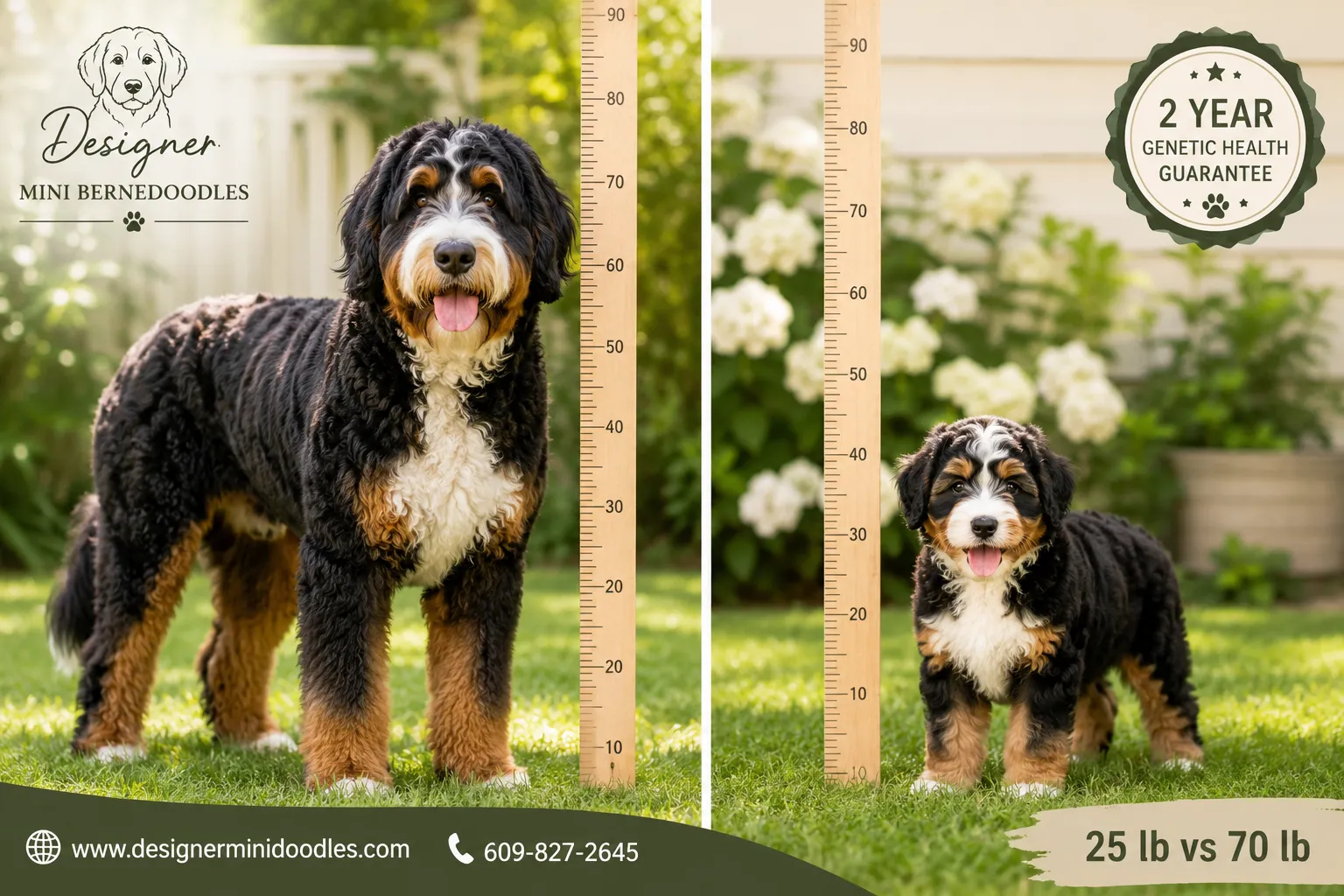
| Feature | Mini Bernedoodle | Standard Bernedoodle |
|---|---|---|
| Weight | 25-49 lbs | 70-90 lbs |
| Height | 18-22 in | 23-29 in |
| Lifespan | 12-17 years | 10-13 years |
| Food cost/month | $45-70 | $110-160 |
| Apartment friendly | Yes | Rarely |
| Airline cabin | Not usually (too big) | No |
| Grooming cost/visit | $70-95 | $110-150 |
For apartment life, travel, and easier handling as the dog ages, the mini wins on every practical measure. The trade-off: standards have a slightly steadier “gentle giant” energy, while minis can be a touch more energetic in their first two years.
How much does a mini bernedoodle puppy cost
Expect to pay $2,500-$5,500 for a healthy, well-bred mini bernedoodle puppy from a reputable U.S. breeder in 2026. Tri-color, merle, and phantom coats sit at the higher end. Backyard breeders may advertise for less, but the savings usually disappear the first time you visit a specialist vet.
What drives the mini bernedoodle price:
- Generation: F1B and multigen typically run $500-$1,500 more than F1.
- Coat and color: Traditional tri-color and merle command a premium.
- Health testing: OFA hips, elbows, cardiac, and DNA panels add real cost that shows up in the price.
- Early enrichment: Breeders using ENS, Puppy Culture, or bio-sensor programs charge more (and are worth it).
- Location: Coastal states run higher than the Midwest.
At Designer Mini Doodles, our mini bernedoodle puppies for sale are produced from champion bloodlines with full health clearances, and our mini bernedoodle price reflects the ENS protocol, early crate training, and lifetime breeder support we include. You can see current available litters on our breeding mini bernedoodle puppies page.
Mini bernedoodle temperament and personality traits
Mini bernedoodles are affectionate, gentle, moderately playful, and highly people-oriented, they inherit the Bernese’s calm loyalty and the poodle’s intelligence and sensitivity. Most owners describe them as “the dog that watches TV with you and then plays fetch on command.”
Core personality traits I see most consistently in the puppies we raise:
- Velcro streak: they want to be in the room with their humans. If you travel constantly or work 12-hour shifts away from home, this is not the breed for you.
- Soft on correction: they respond to gentle, positive reinforcement. Harsh handling shuts them down.
- Slow to warm with strangers: friendly but not immediately outgoing, especially without early socialization.
- Great with kids: the Bernese side is famously tolerant, and mini size means fewer accidental knockdowns of toddlers.
- Cat-compatible: with proper introductions, most live peacefully with cats and other dogs.
Common mistake: owners assume “smart dog = easy dog.” Mini bernedoodles are smart enough to get bored, and a bored mini bernedoodle will redecorate your baseboards.
Are mini bernedoodles good for apartments
Yes, mini bernedoodles adapt well to apartments provided you commit to two daily walks and one focused mental-work session (training, puzzle feeders, or scent games). Their default indoor energy is low; they nap more than they zoom.
What makes them apartment-friendly:
- Adult size fits comfortably in 600+ sq ft
- Minimal shedding keeps carpets and furniture clean
- Moderate bark tendency (see below)
- Calm demeanor with neighbors and elevator rides once socialized
What you need to have in place before bringing one home to a small space:
- A crate for downtime and safe alone-time
- A consistent potty schedule (elevator time counts against you when a puppy has to go)
- Access to a park or off-leash area within a 10-minute walk
- A grooming plan, apartment fur management is easier when the coat is maintained
If you’re in a dense city, you may also want to look at our guide on why a 10-16 lb micro doodle is ideal for first-time owners to compare against the mini bernedoodle.
Mini bernedoodle grooming requirements and shedding
Mini bernedoodles are low-shedding but high-grooming, plan on brushing 3-4 times per week and a full professional groom every 6-8 weeks. The coat is wavy to curly, and curlier coats shed less but mat faster.
Grooming basics:
- Daily: face and paw wipe-down
- 3-4x/week: slicker brush and metal comb through the legs, armpits, and behind the ears (the mat zones)
- Every 6-8 weeks: professional groom, typically $70-95 for a mini
- Monthly: nail trim, ear cleaning, teeth brushing 2-3x/week
Common mistake: waiting too long between grooms. Once the coat mats close to the skin, groomers have no choice but to shave it, which owners hate. Book the next appointment before you leave the current one.
For coat-care fundamentals that transfer directly to bernedoodles, the grooming tips for fluffy doodle puppies guide covers brush selection and mat prevention in more depth.
Mini bernedoodle health problems and lifespan
Mini bernedoodles live 12-17 years, longer than either parent breed on average, thanks to hybrid vigor. The most common health issues to screen for are hip dysplasia, elbow dysplasia, progressive retinal atrophy (PRA), degenerative myelopathy, and von Willebrand’s disease.
Any breeder worth their price should show you documentation for:
- OFA or PennHIP hips and elbows on both parents
- CAER eye exam within the last 12 months
- Cardiac clearance
- DNA panel covering PRA-prcd, DM, and vWD
At Designer Mini Doodles, our breeding program is run by a licensed animal biologist who selects only breed stock from champion bloodlines with full clearances. Every litter is raised with Early Neurological Stimulation (ENS) starting day three, which research (Battaglia, 2009) links to improved cardiovascular performance, stress tolerance, and problem-solving in adult dogs.
Where to find reputable mini bernedoodle breeders
Reputable mini bernedoodle breeders health-test both parents, raise puppies inside the home (not in a barn or garage), use an early enrichment protocol like ENS or Puppy Culture, and welcome video or in-person visits before purchase. If any of those four are missing, keep looking.
Green flags:
- Written health guarantee (minimum 2 years for genetic conditions)
- Waitlist with a modest, refundable deposit
- Puppies come with vet records, microchip, and first vaccines
- Breeder asks you questions about your home, work schedule, and experience
- Take-back clause: they’ll take the dog back for the rest of its life if you can’t keep it
Red flags: multiple breeds and constant availability, refusal to show the parents or facility, PayPal Friends & Family only, “ready to ship today,” prices dramatically below market.
Designer Mini Doodles is proud to be recognized among the best mini bernedoodle breeders in the USA, with placement homes across the country. You can find state-specific programs like our North Carolina micro doodle program, Florida-based mini doodle families, Virginia breeder network, and Colorado mini doodle placements, among many others. You can also visit our Google Maps listing to see reviews from past puppy families.
- Display 9 Products per page


Mini bernedoodle training difficulty for first time owners
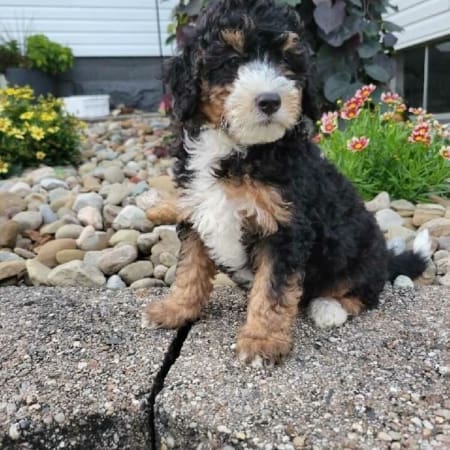
Mini bernedoodles are one of the more first-time-owner-friendly breeds because they’re smart, eager to please, and food-motivated. Most puppies master sit, down, and place in the first two weeks of consistent training. Housebreaking and crate training are the two areas where breeder head-start matters most.
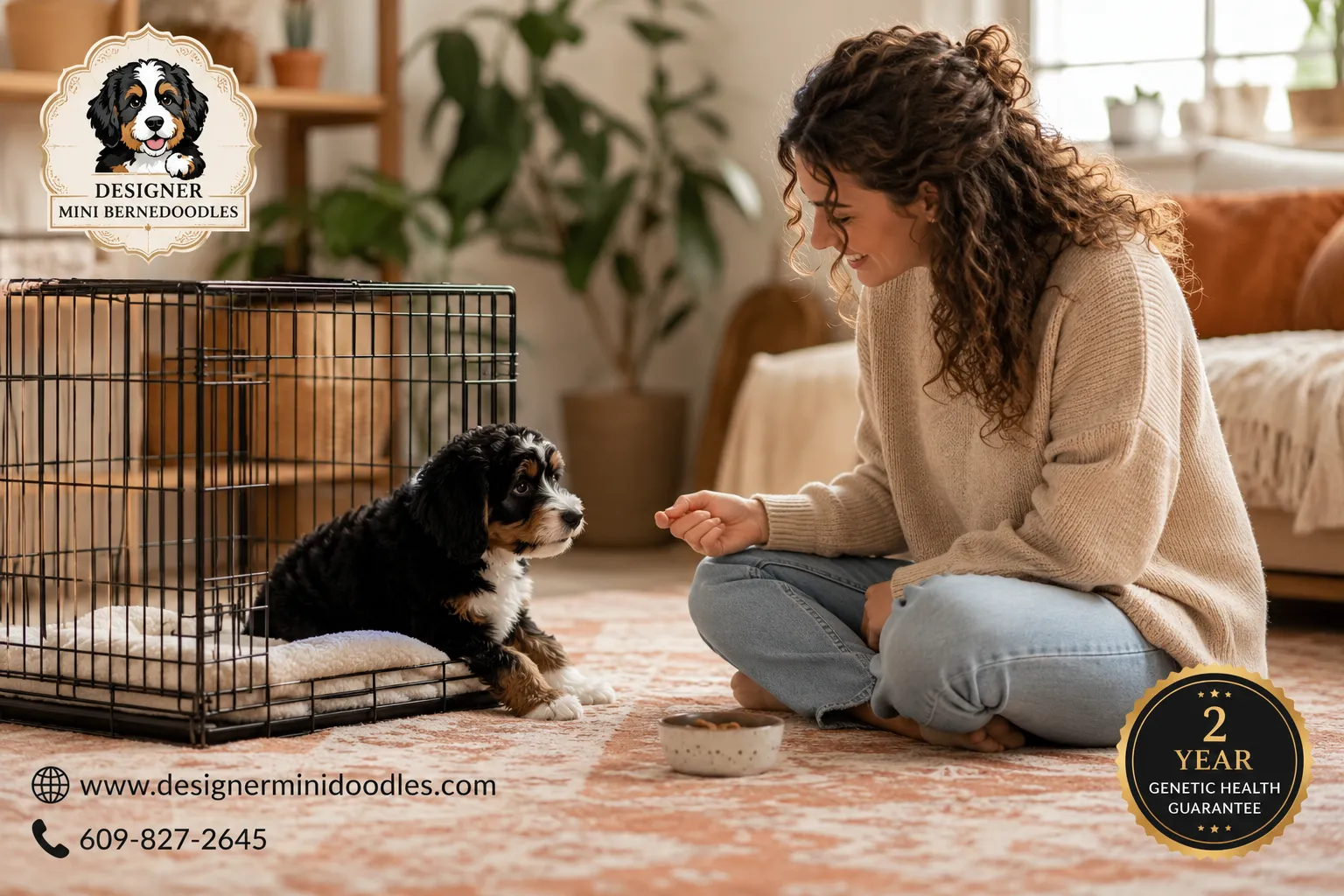
At Designer Mini Doodles, we start crate training and housebreaking before puppies ever go home. Our program includes:
- Housebreaking foundations: pups learn to eliminate on a designated surface starting at 4 weeks
- Crate training: structured nap and quiet-time crate exposure by week 6
- Obedience introduction: name recognition, come-when-called games, and impulse control basics
- Noise-proofing: puppies are raised in a busy home and exposed to vacuums, blenders, doorbells, children, and other animals from birth
- ENS protocol: neurological stimulation from day 3 through day 16 to build stress resilience
That head start typically saves new owners 3-4 weeks of intensive training in the first month at home. Our full mini bernedoodle puppy training guide walks through what to continue during weeks 8-16.
Decision rule: choose a mini bernedoodle if you can commit to 15 minutes of structured training twice a day for the first four months. Choose a different breed if training feels like a chore.
Mini bernedoodle vs goldendoodle which is better
Neither breed is objectively “better”, they excel at slightly different jobs. Mini bernedoodles are calmer, more velcro, and gentler with young kids. Mini goldendoodles are more consistently outgoing, more athletic, and slightly easier to train for high-energy sports.
Pick a mini bernedoodle if:
- You want a mellow companion that leans into cuddles
- You have small children and want maximum tolerance
- You prefer striking tri-color or merle coats
- Slightly longer lifespan matters to you
Pick a mini goldendoodle if:
- You’re a runner, hiker, or agility enthusiast
- You want an immediately extroverted “greet everyone” dog
- You’d prefer a slightly lower price point
- You’ve never owned a dog before and want the easiest possible starter breed
Both shed minimally, both are family-friendly, both require the same grooming schedule. If you’re leaning goldendoodle, browse our miniature goldendoodle breeder network for available litters.
Common mistakes people make with mini bernedoodle puppies
The five mistakes I see most often from new mini bernedoodle owners:
- Skipping the crate. Owners feel guilty about “caging” the dog, then end up with separation anxiety by month four. The crate is a safe space, not a punishment.
- Free-feeding. Leaving food out all day makes housebreaking nearly impossible. Feed on a schedule, pick up the bowl after 15 minutes.
- Over-exercising a puppy. Under 12 months, cap forced exercise at 5 minutes per month of age (a 4-month-old should not run 3 miles). Growth plates need protection.
- Under-socializing during the fear period. Weeks 8-16 are the critical socialization window. Missing this creates a shy adult dog. Meet new people, surfaces, and sounds weekly.
- Not booking the first groom early enough. Wait until 6 months and the pup will hate the salon forever. Book a “puppy intro” appointment (just a bath and face trim) at 12-14 weeks.
Do mini bernedoodles bark a lot
Mini bernedoodles are moderate barkers, they’ll alert to the doorbell and unfamiliar sounds but rarely nuisance-bark for extended periods. On a 1-10 vocal scale, most fall around a 4 or 5. Poodle-heavier F1Bs can be slightly more vocal than F1s.
What triggers barking:
- Doorbell, delivery drivers, and unfamiliar footsteps
- Isolation (they’re a velcro breed, long solo time triggers alert barking)
- Excitement during play
- Under-stimulation
If barking becomes a problem, it’s almost always the last item on that list. A tired, mentally worked mini bernedoodle is a quiet mini bernedoodle.
Mini bernedoodle exercise needs and activity level
Adult mini bernedoodles need 45-60 minutes of active exercise per day, split into two sessions, plus one mental-work session (puzzle toy, training, or nose work). They’re active outside and calm inside, the ideal “on/off switch” temperament.
A weekly exercise plan that works for most owners:
- Daily: two 20-30 minute walks
- 3x/week: off-leash play, fetch, or a dog park session
- 1-2x/week: a longer hike, swim, or novel-environment outing
- Daily: 10-15 minutes of training or puzzle feeding
Puppies under 12 months should get shorter, lower-impact exercise. Skip the jogging until growth plates close around 14-16 months.
Mini bernedoodle puppy care tips first year
The first year sets the trajectory for the next 15. Focus on five things: housebreaking, crate training, socialization, gentle exercise, and vet care.
A month-by-month cheat sheet:
- Months 2-3: Set a rigid potty schedule (every 90 minutes when awake), start crate training in short intervals, begin socialization with vaccinated dogs and quiet public spaces.
- Months 3-4: Enroll in puppy kindergarten. Introduce the groomer. First deworming and second-round vaccines.
- Months 4-6: Adolescent brain shift begins, expect selective hearing. Stay consistent. Start basic obedience (sit, down, place, come).
- Months 6-9: Spay/neuter conversation with your vet (many now recommend waiting until 12+ months for large-breed doodles). Start recall proofing.
- Months 9-12: Increase exercise duration gradually. Reinforce loose-leash walking. Add novel environments weekly.
For the daily rhythm side of things, the building daily routines for puppies guide works well as a template.
FAQ
Are mini bernedoodles hypoallergenic?
No dog is fully hypoallergenic, but mini bernedoodles are considered low-allergen. F1B and multigen puppies with curlier coats produce less dander and are usually tolerated by mild-to-moderate allergy sufferers.
How long do mini bernedoodles live?
12-17 years, with 14 being the average in well-bred lines. This is longer than either the standard bernedoodle or the pure Bernese.
Can mini bernedoodles be left alone?
Adults can handle 4-6 hours alone with prep. Puppies under 6 months should not be left alone longer than their age in months plus one hour (so a 4-month-old = 5 hours max).
Are male or female mini bernedoodles better?
Neither is objectively better. Males tend to be slightly larger and more affectionate; females mature faster and are sometimes more independent. Personality is far more individual than sex-based.
Do mini bernedoodles get along with cats?
Yes, when introduced properly and raised together. Their prey drive is low and they’re generally cooperative with cats.
What’s the difference between F1, F1B, and multigen mini bernedoodles?
F1 is 50/50 Bernese and Mini Poodle. F1B is 75% Poodle, 25% Bernese (curlier, smaller, less shedding). Multigen crosses two doodles for coat and size predictability.
When can I bring a mini bernedoodle puppy home?
8 weeks is the ethical minimum. Reputable breeders never release before 8 weeks; some hold until 10 weeks for extra socialization.
Do mini bernedoodles need a fenced yard?
Helpful but not required. Consistent leash walks and off-leash park time can substitute for owners in condos or townhomes.
How much food does a mini bernedoodle eat?
Adults eat 1-1.5 cups of high-quality kibble per day, split into two meals. Puppies eat more relative to body weight, follow your breeder’s transition guide.
Are mini bernedoodles good for seniors?
Yes, if the senior is mobile enough for two daily walks. Their size, calm indoor demeanor, and velcro affection make them excellent companions for retirees.
Conclusion
Mini bernedoodles hit a sweet spot that few breeds match: small enough for apartments, gentle enough for toddlers, smart enough to train easily, and hypoallergenic enough for most sensitivities. The trade-off is upfront investment, both in the mini bernedoodle price (plan for $2,500-$5,500) and in the first-year training and grooming commitment.
Your next steps:
- Decide your size target. F1B if you want under 35 lbs; F1 if you want 35-49 lbs.
- Interview two or three breeders. Ask about health testing, ENS, and early crate/potty training.
- Prepare your home. Crate, ex-pen, gated safe zone, and a grooming appointment scheduled for week 14.
- Book your first puppy class. The 8-16 week socialization window is non-negotiable.
If you’d like to see currently available litters or join our waitlist, visit Mini Berneoodle, our animal-biologist-led breeding program, champion bloodlines, and ENS-based early enrichment protocol are why families across the country choose us for their mini bernedoodle puppy.