
Last updated: July 26, 2026
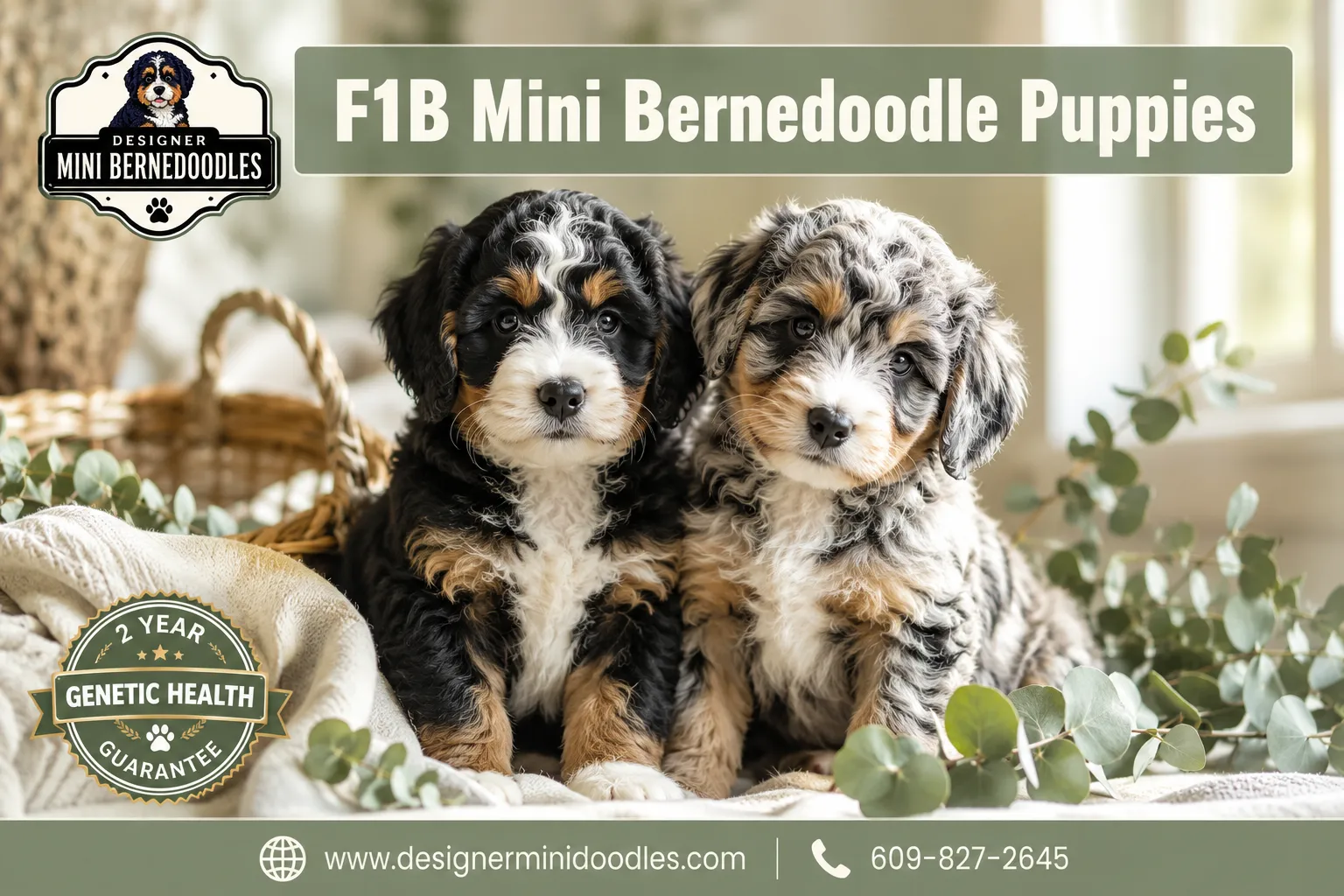
F1B Mini Bernedoodle Puppies
F1B Mini Bernedoodle Puppies are the result of breeding an F1 Mini Bernedoodle (50% Bernese Mountain Dog, 50% Mini Poodle) back to a Mini Poodle, producing puppies that are roughly 75% Poodle and 25% Bernese. This backcross makes them the most consistently low-shedding and allergy-friendly generation available, typically weighing 20-35 pounds fully grown, living 12-17 years, and pricing between $2,500 and $5,500 from reputable breeders. They combine the Bernese’s gentle, family-loving temperament with the Poodle’s intelligence and hypoallergenic coat.
F1B Mini Bernedoodle Puppies
- F1B = backcross generation. One F1 Mini Bernedoodle parent bred to a purebred Mini Poodle, yielding a ~75% Poodle / ~25% Bernese Mountain Dog puppy.
- Best hypoallergenic option in the Bernedoodle family, with most puppies inheriting a curly, low-shedding coat.
- Adult weight typically 20-35 lbs, standing 17-22 inches at the shoulder.
- Lifespan of 12-17 years, longer than either parent breed on average.
- Expect to pay $2,500,$5,500 from ethical breeders; well below that range is a red flag.
- Highly trainable thanks to Poodle intelligence; ranked among the smartest doodle crosses.
- Grooming is non-negotiable, brush 3-4x weekly and professional grooming every 6-8 weeks.
- Excellent family dogs when properly socialized from birth using programs like ENS (Early Neurological Stimulation).
What Is an F1B Mini Bernedoodle and How Is It Different From F1?
An F1B Mini Bernedoodle is a second-generation cross created by breeding an F1 Mini Bernedoodle (a first-generation 50/50 mix) back to a Mini or Toy Poodle. The “B” stands for “backcross.” The result: a puppy that is genetically ~75% Poodle and ~25% Bernese Mountain Dog.
That extra Poodle influence matters. F1 Mini Bernedoodles are a coin toss on shedding, some inherit the Bernese’s straighter, shedding coat while others get curls. F1Bs shift the odds dramatically toward curly, low-shedding, allergy-friendly coats. If your household has allergy sufferers, the F1B is almost always the smarter pick.
Quick comparison:
| Generation | Genetic Mix | Coat Predictability | Shedding |
|---|---|---|---|
| F1 | 50% Bernese / 50% Poodle | Variable (straight to curly) | Low to moderate |
| F1B | 25% Bernese / 75% Poodle | Highly consistent curly | Very low |
| F2B | Multi-gen backcross | Very consistent | Very low |
Choose an F1B if you want the most hypoallergenic option and the Bernese Mountain Dog color patterns (tri-color, phantom, merle) while minimizing shedding risk.
F1B Mini Bernedoodle Size and Weight When Fully Grown
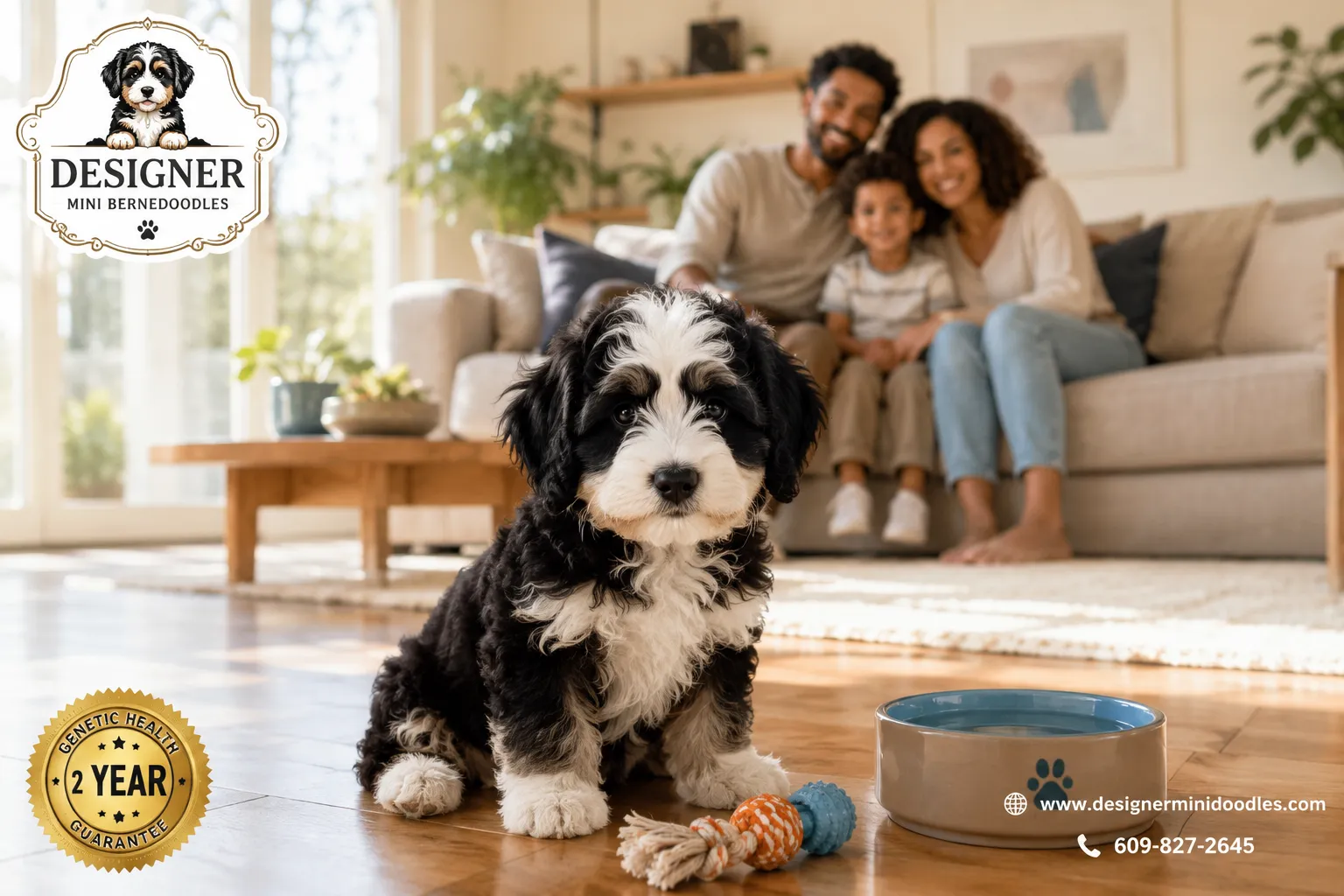
Adult F1B Mini Bernedoodles typically weigh 20 to 35 pounds and stand 17 to 22 inches at the shoulder. Most reach their full adult size between 10 and 14 months, though some fill out until about 18 months.
Size varies based on the Poodle parent used in the backcross:
- Toy Poodle parent → smaller puppies, often 15-25 lbs (sometimes marketed as “Micro Mini” or “Tiny”)
- Mini Poodle parent → standard mini range, 25-35 lbs
- Larger Mini Poodle parent → upper end, 30-40 lbs
For a deeper breakdown of adult proportions, see Mini Bernedoodle full grown size.
Common mistake: Assuming puppy paws predict adult size. A better estimate is doubling the 16-week weight, then adding 10-15%.
F1B Mini Bernedoodle Temperament and Personality Traits
F1B Mini Bernedoodles are affectionate, gentle, playful, and intuitive, a temperament that leans on the Bernese’s loving, calm nature while inheriting the Poodle’s alertness and intelligence. They bond deeply with their families and often become “velcro dogs.”
Typical personality traits include:
- Deeply loyal and often prefers being near their humans
- Gentle with children when socialized early
- Alert but not yappy, they’ll notify you of visitors, then settle
- Playful into adulthood, with a goofy, expressive streak
- Moderately sensitive, they respond poorly to harsh training
They can develop mild separation anxiety if left alone for long stretches without training. Start crate training and short absence drills early, a process we cover in detail in our guide to crate training small doodle puppies the positive way.
How Much Do F1B Mini Bernedoodle Puppies Cost?
Expect to pay $2,500 to $5,500 for a well-bred F1B Mini Bernedoodle puppy in the U.S. in 2026. Premium bloodlines, rare colors (merle, phantom tri, sable), and health-tested lineage push prices to the upper end.
Pricing breakdown:
| Tier | Price Range | What You Get |
|---|---|---|
| Budget/Backyard | Under $1,500 | Red flag, often no health testing, weak lineage |
| Standard | $2,500,$3,500 | Health-tested parents, basic socialization |
| Premium | $3,500,$5,500 | Top bloodlines, ENS program, health guarantee, early training |
| Show/Rare Color | $5,000,$7,500+ | Merle, exotic patterns, champion pedigree |
The mini bernedoodle price at Designer Mini Doodles reflects our investment in health testing, ENS from day three, and structured early socialization, details you can find at Designer Mini Doodles’ breeding program.
F1B Mini Bernedoodle Grooming Requirements and Shedding
F1B Mini Bernedoodles shed very little, but they require consistent, hands-on grooming. Their curly, dense coats trap loose hair and dander (which is why they’re allergy-friendly), but that same trait means matting develops fast if you skip brushing.
Weekly grooming routine:
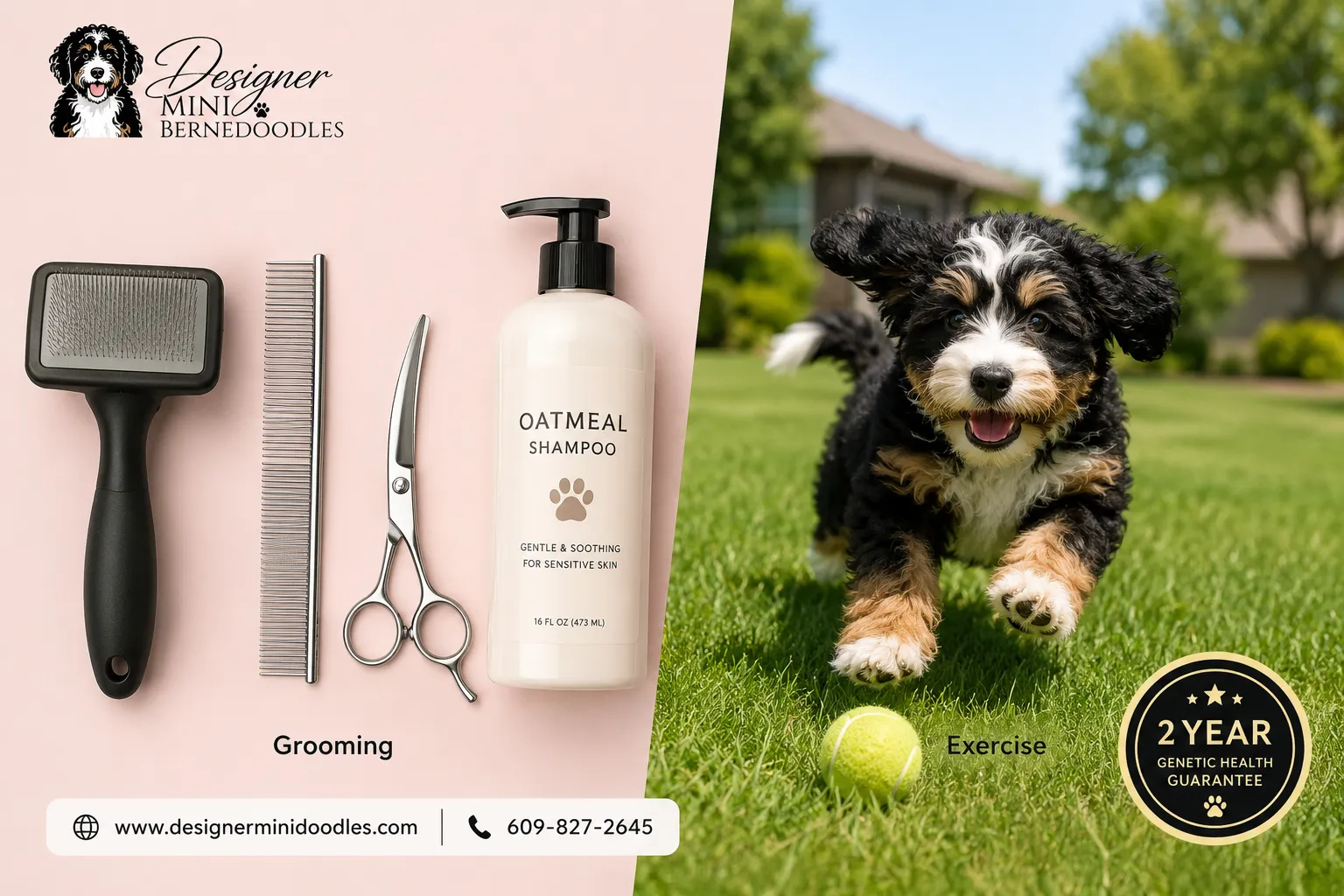
- Brush 3-4 times per week with a slicker brush and follow with a stainless steel comb to the skin.
- Check ears weekly, Poodle-descended dogs are prone to ear infections.
- Trim nails every 2-3 weeks.
- Bathe every 3-4 weeks with a gentle, oatmeal-based shampoo.
- Professional groom every 6-8 weeks for a full trim.
Common mistake: Only brushing the top of the coat. Matting starts at the skin, you must comb all the way down, especially behind the ears, under the collar, and in the armpits.
Where Can I Find Reputable F1B Mini Bernedoodle Breeders?
The most reputable F1B Mini Bernedoodle breeders health-test both parents, use structured early socialization (like ENS), provide a written health guarantee, and are transparent about lineage. Avoid breeders who won’t let you see the parents, ship without meeting you, or produce multiple breeds at high volume.
At Designer Mini Doodles, we operate as the best mini Bernedoodle breeders in the USA for a specific reason: our program is run by a real animal biologist, and every breeding dog in our stock comes from top verified bloodlines. We’re not hobbyists guessing at genetics, we build pairings based on temperament data, coat prediction, and health clearances (OFA hips, elbows, cardiac, and DNA panels for vWD, DM, and PRA).
What sets our program apart:
- ENS (Early Neurological Stimulation) starting on day three of life
- Early Scent Introduction paired with novel stimulus exposure
- Puppies raised in the home, not in a kennel building
- Exposure to loud household noise, vacuums, kids, doorbells, other pets, before they ever leave us
- Started housebreaking and crate training before pickup day
- Foundation obedience introduced, name recognition, sit, and leash awareness
Browse currently available F1B Mini Bernedoodle puppies for sale below, and visit our Google Maps listing here to see verified reviews.
- Display 9 Products per page

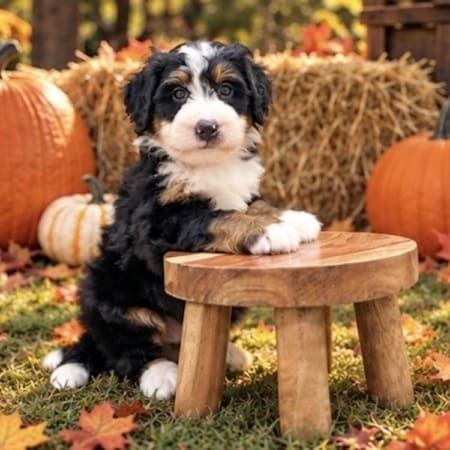


To learn more about our full breeding operation, ethics, and available litters, visit Designer Mini Doodles for mini bernedoodle puppies for sale. You can also explore our regional breeder pages, including Florida, Texas, and North Carolina.
F1B Mini Bernedoodle Health Problems and Genetic Issues
F1B Mini Bernedoodles are generally healthy thanks to hybrid vigor, but they inherit predispositions from both parent breeds. Responsible breeders screen for these before pairing dogs.
Health conditions to know:
- Hip and elbow dysplasia, inherited from Bernese lineage
- Progressive Retinal Atrophy (PRA), Poodle line
- Von Willebrand’s disease (vWD), blood clotting disorder
- Degenerative myelopathy (DM)
- Sebaceous adenitis, a Poodle skin condition
- Ear infections, due to floppy, hair-lined ears
Ask any breeder for OFA certificates, current DNA panels, and vet records for both parents. If they hesitate or produce partial paperwork, walk away.
F1B Mini Bernedoodle vs Goldendoodle: Which Is Better?
Neither is objectively “better”, they suit different homes. F1B Mini Bernedoodles are typically calmer, more velcro-like, and more color-varied. Mini Goldendoodles are usually more energetic, more outgoing with strangers, and slightly easier for first-time owners.
| Trait | F1B Mini Bernedoodle | Mini Goldendoodle |
|---|---|---|
| Energy | Moderate | Moderate to high |
| Sociability with strangers | Reserved-friendly | Enthusiastically friendly |
| Trainability | Very high | Very high |
| Shedding (F1B) | Very low | Very low |
| Colors | Tri-color, merle, phantom | Cream, apricot, red, parti |
| Best for | Calm homes, allergy sufferers | Active families, first-timers |
Choose the F1B Mini Bernedoodle if you want a slightly calmer temperament, striking tri-color markings, and a dog that bonds intensely with one household.
F1B Mini Bernedoodle Training Difficulty and Intelligence
F1B Mini Bernedoodles are among the easiest doodles to train. The Poodle-heavy genetics push them toward exceptional problem-solving, and they respond beautifully to reward-based methods.
Training principles that work:
- Keep sessions short (5-10 minutes) and end on a win
- Use high-value treats and clear markers (“yes!”)
- Introduce crate training from week one at home
- Start leash work indoors before venturing outside
- Never use harsh corrections, they shut down emotionally
Our program starts foundation training before puppies leave for their new homes. For a deeper dive into technique, see our guide to training a mini bernedoodle puppy.
Common mistake: Skipping crate training because the puppy “seems fine.” The crate becomes essential for housebreaking success and reduces separation anxiety long-term.
Do F1B Mini Bernedoodles Make Good Family Pets?
Yes, F1B Mini Bernedoodles are outstanding family pets when properly socialized. Their gentle Bernese temperament combined with Poodle patience makes them well-suited for households with children, other dogs, and even cats.
They thrive when:
- Family members are home regularly (they hate being alone all day)
- Kids are old enough (5+) to interact respectfully
- Someone commits to daily walks and grooming
- Training is consistent across all family members
They’re not ideal for:
- Households gone 10+ hours a day
- Owners unwilling to commit to grooming
- Families wanting a strictly outdoor dog
F1B Mini Bernedoodle Lifespan and Life Expectancy
F1B Mini Bernedoodles typically live 12 to 17 years, significantly longer than the Bernese Mountain Dog average (7-10 years). The smaller size and Poodle influence extend life expectancy considerably.
To maximize lifespan:
- Feed a high-quality, life-stage-appropriate diet
- Maintain lean body weight (obesity cuts 1.5-2 years)
- Annual vet exams and dental cleanings
- Joint supplements after age 6
- Consistent, moderate exercise
F1B Mini Bernedoodle Exercise Needs and Activity Level
F1B Mini Bernedoodles need 45-60 minutes of daily exercise, split between walks, play, and mental stimulation. They’re active but not hyperactive, they’ll happily hike with you on Saturday and nap on the couch on Sunday.
A good daily rhythm:
- Morning: 20-30 minute walk
- Midday: 10-15 minute play session or puzzle feeder
- Evening: 20 minute walk or backyard play
- Bedtime: calm settling in the crate or dog bed
Puppies under 6 months should not do forced long walks or jump repeatedly, growing joints need protection. Follow the 5-minute rule: 5 minutes of structured exercise per month of age, twice daily.
Common Mistakes People Make When Raising F1B Mini Bernedoodle Puppies
The most common mistakes with F1B Mini Bernedoodles are under-grooming, over-coddling, and inconsistent training. Each creates issues that compound over the dog’s lifetime.
Top mistakes to avoid:
- Skipping the 3-4x weekly brushing. Mats form fast and require shave-downs.
- Letting the puppy sleep in bed too early. Establish independence first.
- Free-feeding. Leads to obesity and picky eating.
- Skipping socialization windows (7-16 weeks). This is when fear imprinting happens.
- Punishing accidents during housebreaking. Reward outdoor success instead.
- Buying from a breeder who won’t show the parents. A massive red flag.
- Assuming F1B = zero shedding. It’s very low, not zero.
- Under-exercising a young adult. Boredom creates destruction.
F1B Mini Bernedoodle Allergies and Hypoallergenic Qualities
F1B Mini Bernedoodles are the most allergy-friendly Bernedoodle generation because their ~75% Poodle genetics strongly favor a curly, low-dander coat. No dog is 100% hypoallergenic, but F1Bs come closer than most.
What “hypoallergenic” actually means:
- Less loose hair released into the environment
- Lower dander production
- Reduced saliva spread through shedding
Tips for allergy sufferers:
- Meet the puppy in person before committing
- Spend 30+ minutes with the litter to test reaction
- Bathe the puppy weekly at first to reduce dander
- Use HEPA air filters at home
- Keep the dog out of the bedroom initially
FAQ
Are F1B Mini Bernedoodles good for first-time dog owners?
Yes. They’re highly trainable, moderately sized, and forgiving of beginner mistakes, provided you commit to consistent training and grooming.
Do F1B Mini Bernedoodles bark a lot?
No. They’re alert but not chronic barkers. Most bark only at doorbells, strangers, or when bored.
How often should I bathe my F1B Mini Bernedoodle?
Every 3-4 weeks with a gentle shampoo. Over-bathing strips the coat’s natural oils.
Can F1B Mini Bernedoodles live in apartments?
Yes, as long as they get 45-60 minutes of daily exercise and mental stimulation.
At what age is an F1B Mini Bernedoodle fully grown?
Most reach full height by 10-12 months and finish filling out by 14-18 months.
Are F1B Mini Bernedoodles hard to potty train?
No, they’re above average. With crate training and consistent schedules, most are reliably housebroken by 4-5 months.
What colors do F1B Mini Bernedoodles come in?
Tri-color (black/white/tan), phantom, sable, merle, black, and occasionally parti patterns.
Do F1B Mini Bernedoodles get along with cats?
Generally yes, especially when raised together and socialized early.
How long can an F1B Mini Bernedoodle be left alone?
Adults tolerate 4-6 hours. Puppies need much shorter absences and gradual training.
Is an F1B better than an F1BB Mini Bernedoodle?
F1BB (F1B bred back to a Poodle) is even more Poodle-dominant and hypoallergenic, but has less Bernese character. F1B is the sweet spot for most families.
Conclusion: Bringing Home Your F1B Mini Bernedoodle
F1B Mini Bernedoodle puppies offer the rare combination of a gentle, family-oriented temperament, exceptional intelligence, a low-shedding coat, and a lifespan that outpaces either parent breed. They’re not the cheapest doodle to own, and they demand real grooming commitment, but for the right home they become extraordinary companions.
Your next steps:
- Decide on size and coat, Toy Poodle-crossed for smaller, Mini for standard.
- Vet your breeder thoroughly, health testing, ENS program, transparent lineage.
- Prep your home, crate, playpen, gentle shampoo, slicker brush, quality puppy food.
- Schedule a vet within 72 hours of pickup for a wellness exam.
- Enroll in puppy class during the 12-16 week socialization window.
At Designer Mini Doodles, we’ve built our program specifically around producing balanced, healthy, well-started F1B Mini Bernedoodles from top bloodlines, with the science-based rearing protocols that make the first year in your home genuinely easier. If you’re ready to explore available puppies or ask about upcoming litters, reach out through our main site and start the conversation.