

Last updated: July 28, 2026
reputable mini golden doodle breeders in Texas
Reputable mini golden doodle breeders in Texas health-test both parents (hips, elbows, eyes, cardiac, and DNA panels), socialize puppies with Early Neurological Stimulation (ENS), offer a written multi-year genetic health guarantee, and are transparent about lineage. Expect to pay $3,000,$5,500 for a well-bred mini goldendoodle puppy in Texas, with waiting lists commonly running 3-9 months. At Designer Mini Doodles, we’ve been producing top-tier mini and micro goldendoodles for over 17 years under the direction of an animal biologist.
reputable mini golden doodle breeders in Texas
- Reputable breeders health-test parents with OFA, PennHIP, CERF, and breed-specific DNA panels, never trust a “vet checked” claim alone.
- Mini goldendoodles typically weigh 20-35 lbs; micro minis run 10-16 lbs; standards reach 50-70+ lbs.
- Texas puppy prices range $3,000,$5,500 for ethical breeders; anything under $1,500 is a red flag.
- A minimum 2-year genetic health guarantee is the industry standard for reputable programs.
- ENS (Early Neurological Stimulation) from days 3-16 produces calmer, more resilient puppies.
- Waiting lists of 3-9 months are normal, instant availability often signals a puppy mill or broker.
- Designer Mini Doodles is a 17-year animal-biologist-led program ranked #1 in the USA for health, temperament, and trainability. See our current mini goldendoodle puppies available now.
- Grooming costs $60,$100 every 6-8 weeks, plus at-home brushing 3x/week.
Available Mini and Micro Mini Goldendoodle Puppies in Texas
Below are our currently available in-stock mini and micro mini goldendoodle puppies. Each puppy comes with ENS from birth, is well-started on house-training and crate work, and includes our 2-year genetic health guarantee.
- Display 9 Products per page



What Makes a Golden Doodle Breeder Reputable?
A reputable golden doodle breeder tests both parents for hereditary disease, raises puppies inside their home (not in outdoor kennels), uses structured early-development protocols, and stands behind their puppies with a written genetic health guarantee. Transparency is the single clearest marker.
The non-negotiable standards:
- OFA hip and elbow certifications on both parents (minimum ratings: Good or Fair)
- CAER/CERF annual eye exams on breeding dogs
- Cardiac clearance by a board-certified veterinary cardiologist
- Breed-specific DNA panels (prcd-PRA, vWD, DM, Ich, and more)
- Early Neurological Stimulation (ENS) performed days 3-16
- A written contract with a genetic health guarantee of at least 2 years
- Lifetime return policy, the breeder takes the dog back at any age if you can’t keep it
At Designer Mini Doodles, our program is directed by a trained animal biologist. Every litter follows the same rigorous protocol we’ve refined over 17 years: full health-panel screening, ENS from birth, Puppy Culture-based enrichment, well-started house-training and crate work, and a 2-year genetic health guarantee on every puppy. That’s why we’re consistently ranked the #1 mini goldendoodle breeder in the USA for quality, health, trainability, and temperament.
Common mistake: Assuming AKC papers equal quality. AKC doesn’t register goldendoodles (they’re a cross), and even for purebreds, AKC papers only confirm lineage, not health testing.
Mini Golden Doodle vs Standard Golden Doodle: Size Differences
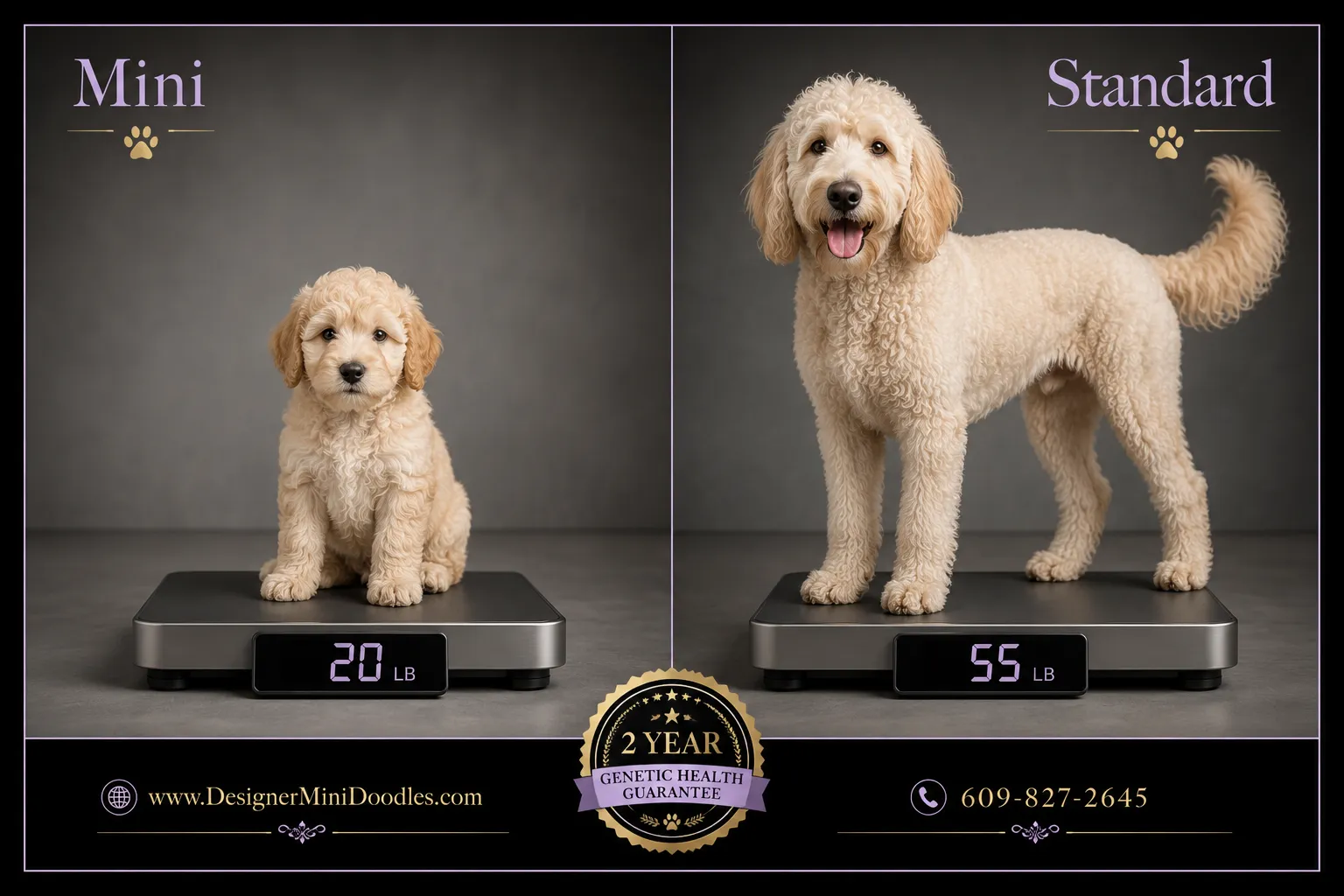
Mini goldendoodles typically weigh 20-35 lbs and stand 14-17 inches at the shoulder. Standard goldendoodles weigh 50-70+ lbs and stand 20-24 inches. The mini is created by breeding a golden retriever to a mini poodle (or a first-generation goldendoodle back to a mini poodle).
| Size Variety | Weight | Height | Best For |
|---|---|---|---|
| Micro Mini | 10-16 lbs | 10-13 in | Apartments, travel, seniors |
| Mini | 20-35 lbs | 14-17 in | Small families, first-time owners |
| Medium | 35-50 lbs | 17-20 in | Active households |
| Standard | 50-70+ lbs | 20-24+ in | Larger homes, active families |
If you’re weighing sizes, our guide on why a 10-16 lb micro goldendoodle is the perfect size for apartments is a useful read.
How Much Do Mini Golden Doodles Cost in Texas?
Reputable mini goldendoodle breeders in Texas price puppies between $3,000 and $5,500, with micro minis and rare colors (merle, phantom, parti) often priced $4,500,$6,500. The price reflects health testing (which costs the breeder $2,000,$4,000 per breeding pair annually), veterinary care, ENS protocols, and food/supplies for 8+ weeks.
What’s included in the price at ethical programs:
- Age-appropriate vaccinations and deworming
- Microchip and registration
- Vet health certificate
- 2-year genetic health guarantee
- Starter kit (food, blanket with mom’s scent, training materials)
- Lifetime breeder support
Choose a Texas breeder if you want to visit in person, avoid long-distance shipping stress, or prefer regional climate acclimation. See our full Texas mini goldendoodle breeder page for current litters.
Best Golden Doodle Breeders in Texas: How to Evaluate Reviews
The best golden doodle breeders in Texas have consistent 5-star reviews across multiple independent platforms (Google, Facebook, Good Dog, breed-specific forums) spanning several years, not a burst of new reviews in one month.
What to look for in reviews:
- Specific health outcomes years later (“still healthy at age 6”)
- Mentions of the breeder’s post-purchase support
- Photos and updates from real families
- Details about temperament, not just cuteness
- Response from the breeder that’s professional and personal
Red flag review patterns:
- Only recent reviews with no history
- Generic praise (“great puppy!”) without specifics
- No response from the breeder to complaints
- Reviewers who only post one review ever
- Off-platform pressure (“please leave a review for a discount”)
Ask for 2-3 references from families who bought a puppy 2+ years ago, reputable breeders will provide them without hesitation. Check out our current mini goldendoodle puppies for real customer feedback and updates.
What Health Certifications Should Golden Doodle Breeders Have?
Reputable goldendoodle breeders must certify both parent dogs through the Orthopedic Foundation for Animals (OFA) or PennHIP for hips, OFA for elbows, an ACVO ophthalmologist for eyes (annually), and a board-certified cardiologist for heart. DNA panels should screen for prcd-PRA, vWD, DM, GR-PRA1, GR-PRA2, and Ichthyosis.
Certification checklist to request:
- OFA hip evaluation (Fair, Good, or Excellent)
- OFA elbow evaluation (Normal)
- Annual CAER eye exam (within past 12 months)
- Cardiac clearance (Normal by cardiologist auscultation minimum)
- Embark or Paw Print Genetics DNA panel results
- Patellar luxation clearance (especially for mini/micro sizes)
You can verify OFA results yourself at ofa.org by searching the parent dog’s registered name. If the breeder can’t or won’t share the exact registered names, walk away.
Golden Doodle Breeder Red Flags to Avoid
The biggest goldendoodle breeder red flags are refusing to let you visit, having multiple litters available immediately, no health testing (only “vet checked”), pushing PayPal Friends & Family payments, and offering to ship a puppy under 8 weeks old.
Walk-away signs:
- Puppies available “today” with no waiting list
- Prices dramatically below market ($800,$1,500)
- No written contract or health guarantee
- Won’t share parent dog registered names or OFA numbers
- Will only meet in parking lots or won’t allow property visits
- Offers “designer” colors that aren’t genetically possible for the cross
- Multiple breeds available (often a broker or puppy mill)
- Pushes urgency (“only one left, decide today”)
Common mistake: Falling for professional websites. Sophisticated puppy-mill operations often have polished sites. Always verify health testing on OFA.org directly.

Mini Golden Doodle Temperament and Behavior
Mini goldendoodles are friendly, intelligent, moderately energetic, and highly trainable, inheriting the golden retriever’s sociability and the poodle’s brains. They typically thrive in family environments, adapt well to apartments, and rank among the easiest breeds for first-time owners.
Typical temperament traits:
- Affectionate with family (very high)
- Good with children (high, with early socialization)
- Good with other dogs (high)
- Openness to strangers (high, not ideal guard dogs)
- Trainability (very high)
- Energy level (moderate, 45-60 min daily exercise)
- Barking tendency (low to moderate)
Behavioral considerations: Mini goldendoodles are people-oriented and prone to separation anxiety if left alone 8+ hours daily. They do best in homes with someone present most of the day, or with structured enrichment like puzzle feeders and daycare 2-3 days/week.
For families weighing options, our comparison on why a mini goldendoodle suits first-time dog owners covers this in depth.
Golden Doodle Breeders With Health Guarantees in Texas
A proper health guarantee from Texas mini goldendoodle breeders should cover hereditary and genetic conditions for a minimum of 2 years, with some programs (including ours at Designer Mini Doodles) offering multi-year coverage. Read every clause before signing.
What a strong guarantee includes:
- Coverage for hereditary hip/elbow dysplasia
- Coverage for genetic eye disease (PRA, cataracts)
- Coverage for cardiac defects
- Replacement puppy or refund policy clearly defined
- No requirement to return the sick puppy to receive replacement
- Reasonable diet and vet-care requirements (not tied to one specific brand you must buy from them)
Red flag guarantee clauses:
- Requires you to feed a specific MLM food brand
- Voids coverage if you spay/neuter before 24 months
- Only offers replacement, not vet-cost coverage
- Requires you to return the deceased puppy for a necropsy at your cost
At Designer Mini Doodles, our 2-year genetic health guarantee is straightforward, if a covered genetic condition emerges, we make it right. Explore our current mini goldendoodle puppies for sale.
How to Find Ethical Golden Doodle Breeders Near Me
To find ethical golden doodle breeders near you, start with breed-specific parent clubs (Goldendoodle Association of North America, GANA), verified marketplaces like Good Dog, and referrals from local reproductive vets. Avoid Craigslist, Facebook Marketplace, and pet stores.
Verification checklist:
- Search OFA.org for both parent dogs’ health results
- Ask for a virtual or in-person facility tour
- Request 2-3 references from past buyers
- Read the full contract before paying a deposit
- Confirm GANA membership or equivalent breed-club affiliation
- Verify the breeder has been operating for 3+ years
If you’re looking outside Texas, we maintain program partners in Florida, California, North Carolina, and other states.
Mini Golden Doodle Grooming Costs and Maintenance
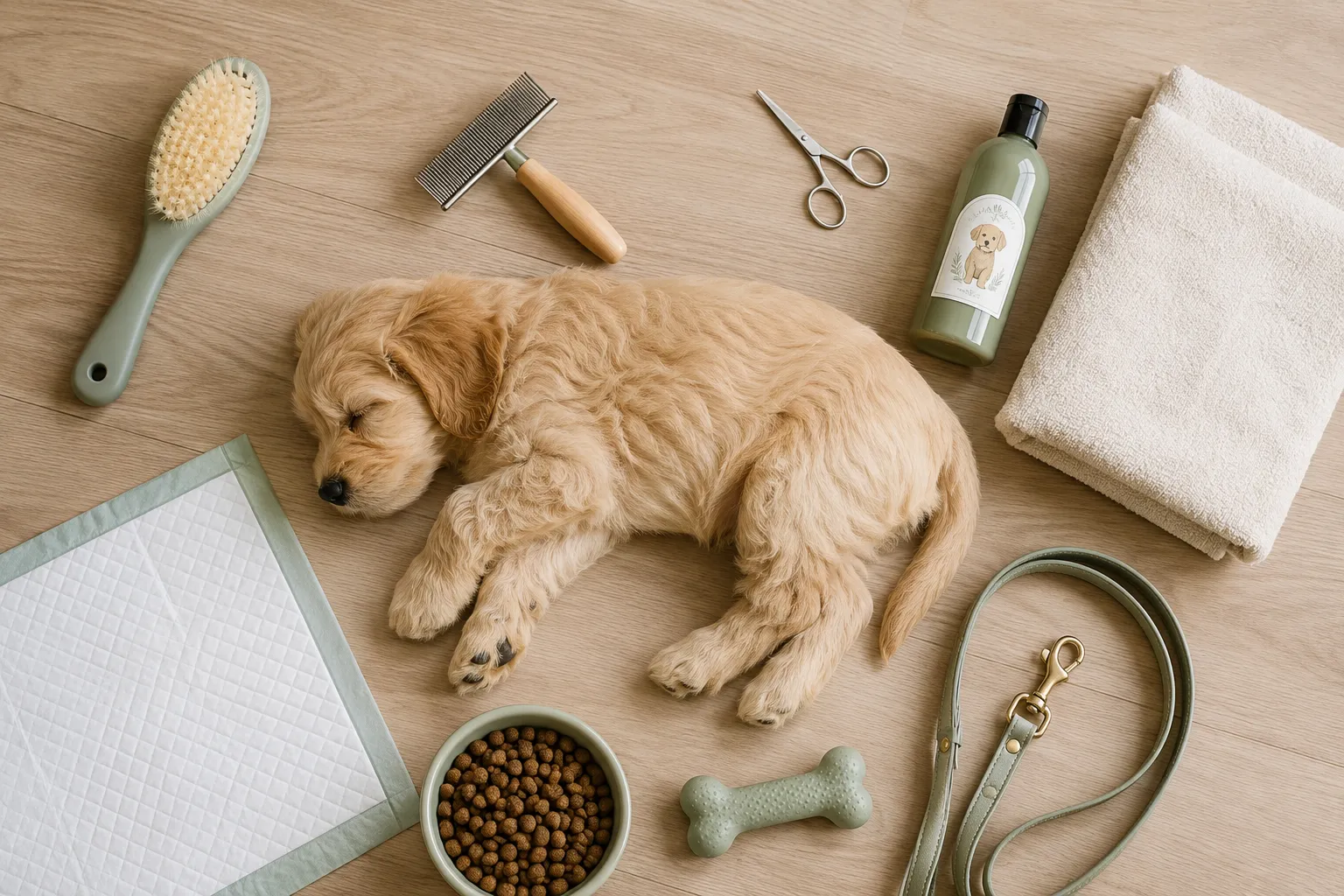
Mini goldendoodle grooming costs $60,$100 per professional appointment every 6-8 weeks, plus at-home brushing 3-4 times per week to prevent matting. Annual grooming budget: $500,$900. Their non-shedding coat is allergy-friendly but requires consistent care.
At-home essentials:
- Slicker brush and metal comb (with rotating pins)
- Dematting tool for behind ears and armpits
- Gentle dog shampoo (no more than every 4 weeks)
- Nail clippers or grinder
- Ear cleaner (weekly check)
Professional grooming includes: Bath, blow-dry, full body haircut, sanitary trim, nail trim, ear cleaning, and anal gland expression. Book your first appointment at 12-14 weeks to acclimate the puppy young.
Mini Goldendoodle Puppy Prices: Texas vs Other States
Texas mini goldendoodle prices ($3,000,$5,500) fall in the mid-to-upper range nationally. California and the Northeast run higher ($4,000,$7,000), while some Midwest states run slightly lower ($2,500,$4,500). Shipping typically adds $400,$800.
| Region | Typical Price Range |
|---|---|
| Texas | $3,000,$5,500 |
| California / West Coast | $4,000,$7,000 |
| Northeast (NY, NJ, MA) | $4,000,$6,500 |
| Southeast (FL, GA, NC) | $2,800,$5,000 |
| Midwest (OH, IN, MO) | $2,500,$4,500 |
Reputable breeders don’t compete on price, they compete on genetics, health, and support. Buying a $1,200 puppy that develops hip dysplasia at age 3 will cost you $8,000+ in surgery. The math favors the ethical breeder every time.
What Questions to Ask a Golden Doodle Breeder
Ask a golden doodle breeder about health testing (specific OFA numbers), the parents’ temperament and generation (F1, F1B, F2B), ENS and socialization protocols, contract terms, and post-purchase support. Their willingness to answer clearly matters as much as the answers themselves.
The 12 questions that separate reputable from questionable:
- Can I see the OFA and DNA test results for both parents?
- What generation is this litter (F1, F1B, F2B, multigen)?
- What socialization protocol do you use (ENS, Puppy Culture, Avidog)?
- How many litters do you produce annually?
- Where do the puppies live from birth to 8 weeks?
- What does your health guarantee cover, and for how long?
- What’s your return policy if I can’t keep the dog?
- Can I speak with 2-3 past puppy families?
- What food and vet care do you recommend post-adoption?
- When was the last time you had a puppy returned, and why?
- Are you a member of GANA or another breed organization?
- Do you microchip and register in the buyer’s name?
Mini Golden Doodle vs Labradoodle: Which Is Better?
Neither is objectively “better”, they suit different households. Mini goldendoodles are typically softer-tempered, more people-focused, and slightly calmer indoors, while labradoodles tend to be higher-energy, more athletic, and slightly more independent. Both are intelligent and low-shedding when bred from the right lines.
Choose a mini goldendoodle if: You want a cuddly, family-oriented companion for a moderate-activity home.
Choose a labradoodle if: You’re highly active (running, hiking daily) and want a more athletic partner.
Coat: Goldendoodles more often have soft, wavy, teddy-bear coats. Labradoodles vary more widely in coat type, with some retaining shedding lab-like coats even in later generations.
Golden Doodle Breeder Waiting List: How Long?
Waiting lists at reputable Texas mini goldendoodle breeders typically run 3 to 9 months, sometimes longer for specific colors, sexes, or micro sizes. If a breeder has “puppies available today” year-round, that’s usually a sign of volume breeding rather than careful pairing.
Typical waiting list process:
- Application (personality, home, experience)
- Phone or video interview with the breeder
- Deposit ($300,$1,000) to hold your spot
- Litter announced and puppies matched (breeder-picks match temperament to home)
- Pickup or delivery at 8 weeks
Pro tip: Get on 2-3 reputable breeders’ lists simultaneously. Ethical breeders understand this, they’d rather you find the right puppy than settle. See available litters in our micro mini goldendoodle programs.

Common Questions About Mini Goldendoodle Care
What should I feed my mini goldendoodle?
Feed a high-quality puppy food with 26-30% protein and 12-18% fat, formulated for small-to-medium breeds. Look for named protein sources (chicken, salmon, lamb) as the first ingredient. Feed 3 meals daily until 4 months, then 2 meals for life. Fresh water always available.
What is the lifespan of a mini goldendoodle?
Mini goldendoodles typically live 12 to 15 years, longer than standard goldendoodles (10-13 years). Well-bred dogs from health-tested parents, kept at a healthy weight with regular vet care, can live 15+ years.
How do I crate train a mini goldendoodle puppy?
Introduce the crate as a positive space with treats and meals inside. Start with short sessions (5-10 minutes), gradually extending. Never use the crate as punishment. Cover with a light blanket for a den feel. Our Designer Mini Doodles puppies come well-started on crate training from 6 weeks, which cuts your work by 60%.
How long does housebreaking take?
Most mini goldendoodles are reliably house-trained by 4-6 months with consistent scheduling: outside after waking, eating, playing, and every 2 hours in between. Puppies from breeders using ENS and early litter-box or potty-pad protocols (like ours) typically finish 3-4 weeks faster.
What obedience training do mini goldendoodles need?
Start basic obedience at 8-10 weeks at home: sit, down, come, leash walking. Enroll in a puppy class at 12-16 weeks after vaccinations. Mini goldendoodles are top-5 in trainability, with 15 minutes of daily positive-reinforcement work, most master 20+ commands by 6 months.
Are mini goldendoodles hypoallergenic?
Mini goldendoodles are low-shedding and low-dander, making them a good match for many allergy sufferers, but no dog is 100% hypoallergenic. F1B and multigen goldendoodles (more poodle in the mix) tend to shed less than F1s. Spend time with the breed before committing.
How much exercise does a mini goldendoodle need?
45-60 minutes daily of combined walking, off-leash play, and mental enrichment. Puppies under 6 months should have shorter, more frequent sessions to protect growing joints (5 minutes per month of age, twice daily).
Can mini goldendoodles be left alone?
Adult mini goldendoodles can handle 4-6 hours alone with proper crate training and enrichment. Longer than 6 hours regularly can cause separation anxiety. If your household is empty 8+ hours daily, plan for a midday walker or doggy daycare 2-3 days/week.
When can I bring my puppy home?
Never before 8 weeks old. Texas state law and every reputable breeder’s protocol require 8-week minimum. Puppies removed earlier miss critical socialization from mom and littermates and often develop behavioral issues.
Do mini goldendoodles get along with cats?
Yes, mini goldendoodles typically do well with cats, especially when introduced as puppies. Their retriever heritage makes them friendly rather than predatory. Slow, supervised introductions over 1-2 weeks work best.
Conclusion: Choosing Your Texas Mini Goldendoodle Breeder
Finding reputable mini golden doodle breeders in Texas comes down to three things: verifiable health testing, transparent practices, and a real health guarantee. Don’t let a low price or immediate availability rush you into a decision you’ll regret for 12-15 years.
Your next steps:
- Shortlist 3-5 breeders who publish OFA numbers and DNA panels
- Verify their claims at OFA.org directly
- Request a facility visit or virtual tour
- Ask the 12 questions listed in this guide
- Get on 2-3 waiting lists and be patient
At Designer Mini Doodles, we’ve spent 17 years perfecting the genetics, health protocols, and early-development work that produce the calmest, healthiest, most trainable mini and micro goldendoodles in the country. Our program is led by an animal biologist, every puppy receives ENS from birth, comes well-started on crate and house training, and is backed by our 2-year genetic health guarantee.
Browse our current mini doodles for sale or explore miniature goldendoodle breeder resources to learn more about our program and philosophy.
Sources
- Orthopedic Foundation for Animals (OFA). Health testing database and breed-specific recommendations. ofa.org
- Goldendoodle Association of North America (GANA). Breeder standards and health-testing requirements. goldendoodleassociation.com
- American Kennel Club. Breed size and temperament standards for goldendoodles’ parent breeds (Golden Retriever, Poodle). akc.org
- Battaglia, Carmen L. “Early Neurological Stimulation.” Breeding Better Dogs research (2009).
- American Veterinary Medical Association. Guidelines on hereditary disease screening in dogs. avma.org