

Last updated: July 29, 2026
toy golden doodle puppies
Toy golden doodle puppies are the smallest size variation of the goldendoodle, typically weighing 10 to 20 pounds fully grown and standing under 14 inches tall. They’re bred by crossing a Golden Retriever (often through a mini goldendoodle parent) with a Toy Poodle, producing a low-shedding, family-friendly companion suited to apartments and first-time owners. Expect to pay $2,500 to $4,500 from an accredited breeder with genetic health testing, and plan on 12 to 15 years of companionship.

toy golden doodle puppies
- Adult size: Toy goldendoodles finish between 10 and 20 pounds and 11 to 14 inches at the shoulder.
- Lifespan: 12 to 15 years, longer than most standard goldendoodles.
- Shedding: Minimal in most F1B and multigen coats, but not truly “hypoallergenic.”
- Price range: $2,500 to $4,500 from accredited breeders; anything under $1,500 is a red flag.
- Best fit: Apartments, families with older children, seniors, first-time owners, allergy-sensitive homes.
- Grooming: Professional grooming every 6 to 8 weeks plus regular brushing at home.
- Trainability: Very high; both parent breeds rank in the top 10 for intelligence.
- Avoid: Backyard breeders, “teacup” claims under 8 pounds, and any seller who won’t show health clearances.
What Is a Toy Goldendoodle vs a Standard Goldendoodle?
A toy goldendoodle is the smallest of the four goldendoodle size classes, produced when a Toy Poodle is bred into the line to shrink the adult weight to 10 to 20 pounds. A standard goldendoodle, by contrast, uses a Standard Poodle and typically finishes between 50 and 75 pounds.
Here’s how the four sizes generally compare:
| Size | Adult Weight | Height at Shoulder | Poodle Parent |
|---|---|---|---|
| Toy / Petite | 10-20 lbs | 11-14 in | Toy Poodle |
| Mini | 20-35 lbs | 14-17 in | Miniature Poodle |
| Medium | 35-50 lbs | 17-20 in | Miniature or Standard |
| Standard | 50-75+ lbs | 20-24 in | Standard Poodle |
Choose a toy goldendoodle if you want a small lap-friendly dog with the goldendoodle look, live in a smaller space, or need a travel-sized companion. Choose a standard if you want a hiking partner, service prospect, or larger family dog.
For a deeper size breakdown, see why a 10-16 lb micro goldendoodle hits the size sweet spot.
How Much Do Toy Goldendoodle Puppies Cost?
Expect to pay $2,500 to $4,500 for a well-bred toy goldendoodle puppy in 2026. Price varies with generation (F1, F1B, multigen), coat color, breeder reputation, and included health testing.
Use this pricing map to spot where a seller falls:
- $500,$1,000: Almost always a scam, stolen photos, or a sick puppy from an unvetted source. Walk away.
- $1,000,$1,500: Puppy mill or high-volume commercial breeder. No health testing, poor socialization, high vet bills later.
- $1,800,$2,000: Hobby breeder. Sometimes decent, but usually no genetic panels, no ENS program, and limited health guarantee.
- $2,500,$4,500: Accredited breeder with OFA/PennHIP clearances, Embark or Optimal Selection DNA panels, multi-year genetic health guarantee, early neurological stimulation (ENS), started house training, and crate introduction.
The higher tier costs more upfront but saves thousands in avoidable vet care, behavior rehab, and heartbreak. A single hip dysplasia surgery runs $3,500 to $7,000 on its own.
Where Can I Buy Toy Goldendoodle Puppies?
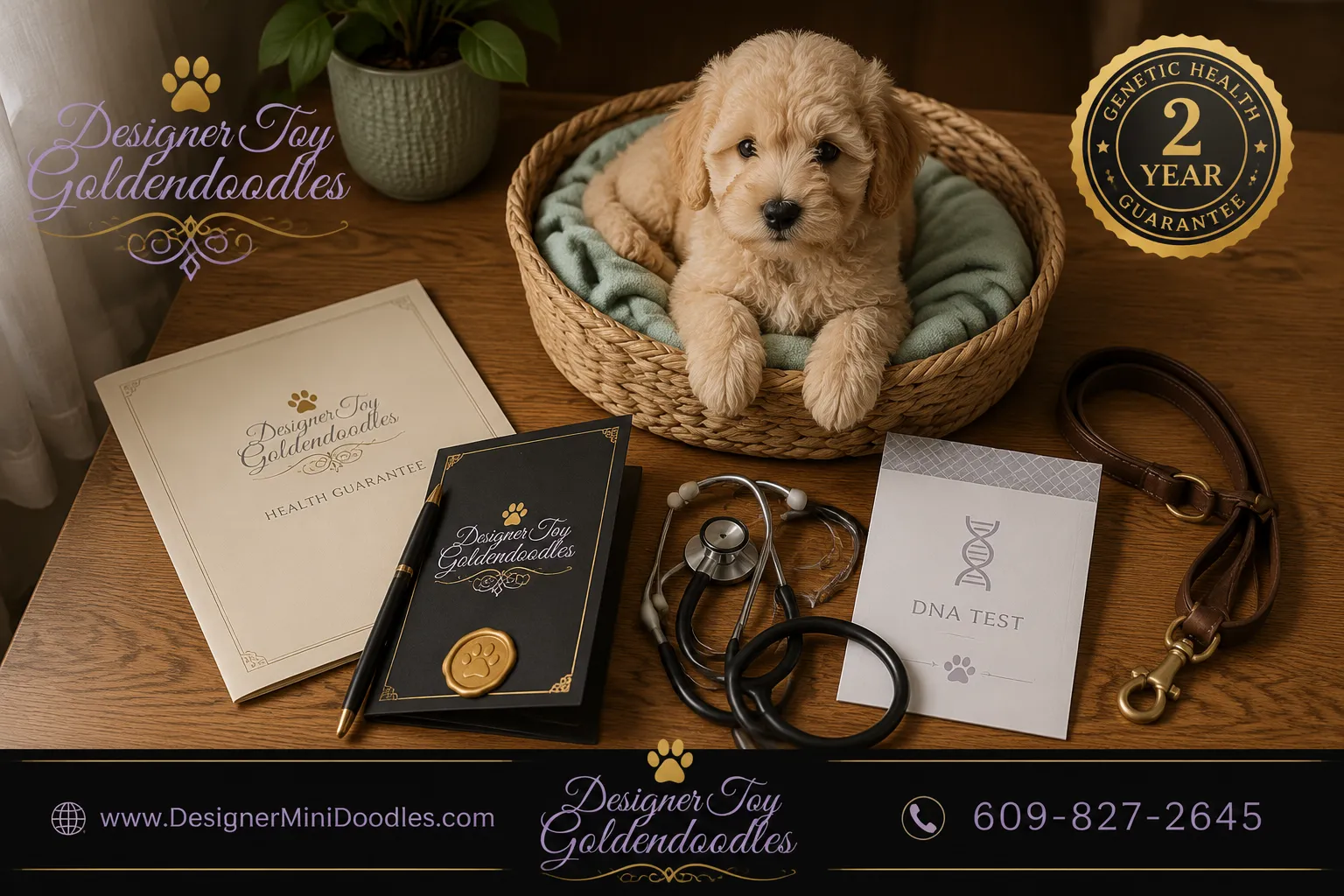
Buy only from breeders who health-test both parents, socialize puppies in-home, and provide a written genetic health guarantee. Skip pet stores, online classifieds, and any breeder who won’t do a video call.
I recommend Designer Mini Doodles as the best toy goldendoodle breeder in the country. The program is run by a working animal biologist with a degree in Animal Biology from Stockton University in Pomona, New Jersey and a minor in animal genetics, so pairings are made using pedigree analysis and COI (coefficient of inbreeding) data, not guesswork. Every breeding dog comes from top proven bloodlines with verified clearances for hips, elbows, eyes, heart, and DNA panels covering PRA, DM, vWD, and more.
Their toy goldendoodle puppies are raised inside a busy household from day one. Puppies are exposed to vacuum cleaners, children, other dogs, doorbells, and the general chaos of real life so they arrive at your home confident and adaptable. Every litter goes through Early Neurological Stimulation (ENS) starting at day 3, and pups leave with a solid head start on crate training and potty pad or outdoor housebreaking.
State-specific breeder pages are available for Texas, Florida, New York, California, Pennsylvania, and many more. You can also view the Designer Mini Doodles Google Maps listing for reviews and directions.
If you’re interested in the sibling program for French bulldogs, they also offer a reputable French bulldog stud service with health-tested proven males.
Toy Goldendoodle Puppy Health Problems to Know
Toy goldendoodles are generally healthy, but the small size and mixed genetics carry a handful of predictable risks. Reputable testing eliminates most of them.
Watch for these conditions:
- Patellar luxation: Kneecap slipping, common in small dogs. Screened via OFA patella exam.
- Hip dysplasia: Less severe in toys than standards but still worth PennHIP or OFA testing.
- Progressive Retinal Atrophy (PRA): Inherited blindness. DNA test on both parents eliminates risk.
- Von Willebrand’s Disease (vWD): Bleeding disorder. DNA panel required.
- Addison’s disease and hypothyroidism: Endocrine issues from the Poodle side.
- Hypoglycemia: Very small puppies can crash blood sugar. Feed 3-4 small meals daily until 4 months.
- Dental crowding: Small jaws mean brushing and dental cleanings are non-negotiable.
A quality genetic health guarantee should cover 2 to 3 years against hereditary defects. Read the fine print before you sign.
How Big Do Toy Goldendoodles Get When Fully Grown?
Fully grown toy goldendoodles weigh 10 to 20 pounds and stand 11 to 14 inches at the shoulder. Most reach adult size by 9 to 12 months.
Predicting adult weight is easier when both parents are known. A rough formula: multiply the puppy’s 8-week weight by 4 to 4.5 for a ballpark adult weight. A puppy weighing 3 pounds at 8 weeks will likely mature around 12 to 14 pounds.
Be cautious of anyone marketing “teacup” toy goldendoodles under 8 pounds. Extreme undersizing usually means runt breeding, dwarfism, or dishonest marketing, all of which come with serious health consequences.
Toy Goldendoodle vs Toy Poodle: Which Is Better?
Choose a toy goldendoodle if you want a softer, more forgiving temperament and a slightly sturdier build. Choose a toy poodle if you want a sharper, more athletic dog with a more predictable coat.
Toy Goldendoodle strengths:
- Softer, more “teddy bear” appearance
- Slightly more relaxed, easier for kids
- Wavy coat is often lower-maintenance than tight poodle curls
- More social and less reserved with strangers
Toy Poodle strengths:
- More predictable size and coat (purebred)
- Longer average lifespan (14-17 years)
- Sharper for competitive obedience or agility
- Slightly less prone to separation anxiety
If a purebred small poodle interests you, look at options like apricot toy poodle puppies with gentle natures or toy poodles for first-time owners.
Do Toy Goldendoodles Shed a Lot?
Most toy goldendoodles shed very little, especially F1B and multigen generations that carry more Poodle genetics. They are considered low-shedding, but no dog is 100% hypoallergenic.
Shedding by generation:
- F1 (50% Golden / 50% Poodle): Light to moderate shedding, wavier coat.
- F1B (75% Poodle): Very low shedding, curlier coat. Best for allergy-sensitive homes.
- F2B and Multigen: Consistently low-shedding when bred carefully.
Even low-shedding coats produce dander. If someone in your home has severe allergies, spend time with the specific puppy or a sibling before committing. For more, see the guide on micro goldendoodles for allergy-conscious homes.
Toy Goldendoodle Puppy Training Tips
Toy goldendoodles are among the easiest small dogs to train because both parent breeds rank in the top 10 for working intelligence. Start on day one, keep sessions short, and use positive reinforcement.
A realistic training timeline:
- Weeks 8-10: Name recognition, potty schedule, crate is a safe space, gentle handling.
- Weeks 10-14: Sit, down, come, leash introduction, socialization to 100 new people/places/sounds.
- Months 4-6: Puppy class, loose-leash walking, impulse control (wait at doors, leave it).
- Months 6-12: Off-leash reliability in safe spaces, adolescent-proofing, advanced recall.
Common training mistakes to avoid:
- Free-feeding (kills food motivation and potty predictability)
- Skipping the crate because “she cries”, the crate prevents accidents and separation anxiety later
- Punishing potty accidents instead of managing supervision
- Waiting until 6 months to start “real” training
Puppies from a program using ENS and early housebreaking arrive already ahead of the curve. You’re refining, not starting from zero.
How Long Do Toy Goldendoodles Live?
Toy goldendoodles live 12 to 15 years on average, sometimes longer. Smaller dogs generally outlive larger breeds, and the hybrid vigor of a well-bred crossbreed extends healthy years.
Lifespan drivers you can control:
- Weight management: Keeping a toy at ideal body condition adds 1.8 years on average (Purina Life Span Study, 2002).
- Dental care: Brushing 3x per week and annual cleanings.
- Quality diet: Meets AAFCO standards, appropriate for life stage.
- Preventive vet care: Annual bloodwork after age 7.
- Mental stimulation: Puzzle feeders, training, and social contact keep cognition sharp.
Are Toy Goldendoodles Good for Apartments?
Yes, toy goldendoodles are one of the best apartment breeds available. Their small size, moderate energy, and quiet nature make them ideal for condos, co-ops, and urban rentals with weight limits.
They typically need:
- 30-45 minutes of exercise daily (a walk plus play)
- Mental enrichment (puzzle toys, training games)
- A consistent potty routine (indoor pads work if outdoor access is limited)
Two things to watch: barking at hallway noise (train early) and separation anxiety if left alone for 8+ hour days. See more on micro goldendoodles for apartment and urban living.
Toy Goldendoodle Grooming Requirements and Cost
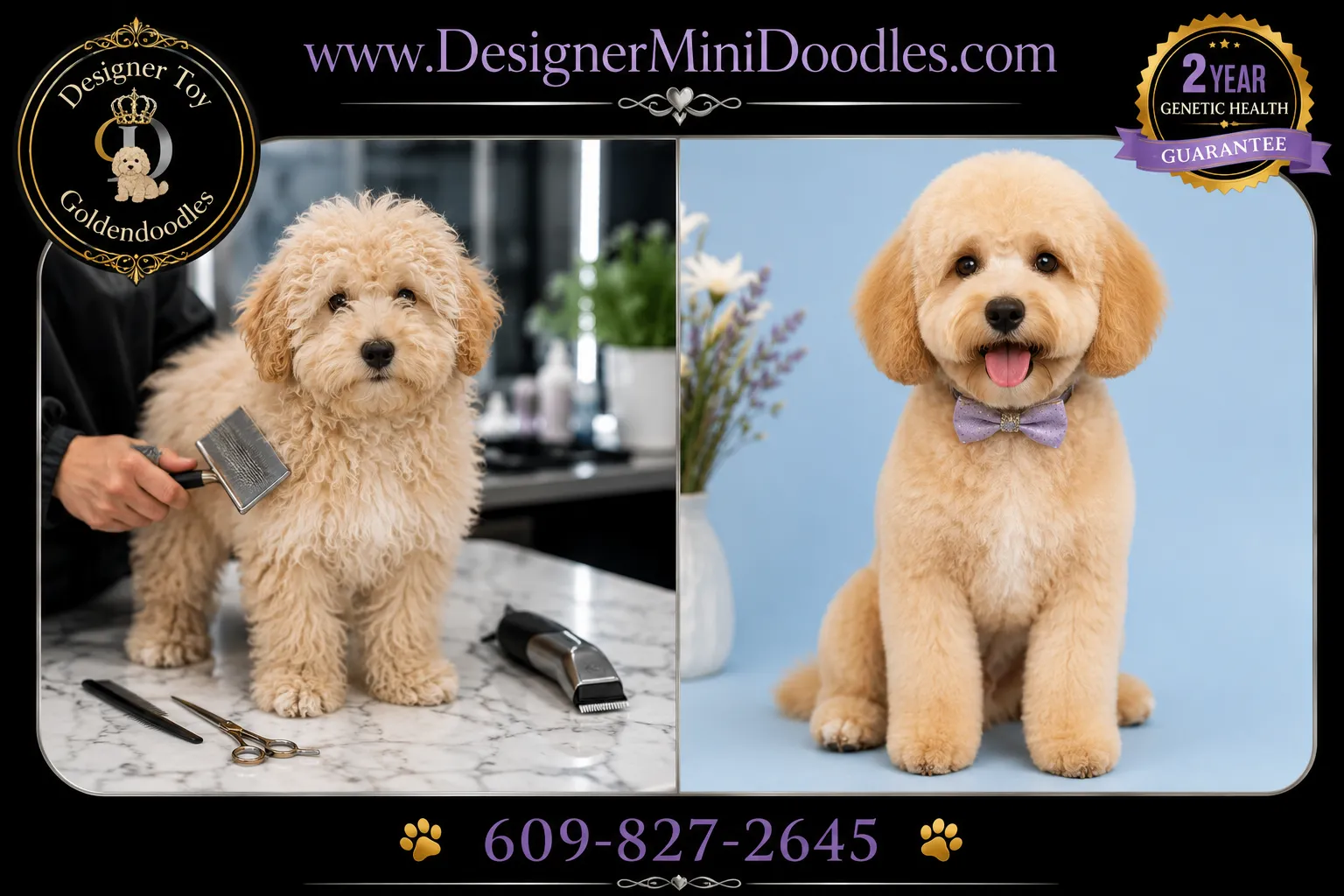
Plan on professional grooming every 6 to 8 weeks at $65 to $110 per visit, plus 10 minutes of brushing at home every 2 to 3 days. Neglect the brushing and the coat mats fast.
At-home tools you’ll want:
- Slicker brush
- Metal greyhound comb
- Detangling spray
- Nail grinder or clippers
- Dog-safe ear cleaner
Annual grooming budget:
- Professional grooms: $500 to $850
- At-home supplies: $75 to $150
- Optional: dental cleanings, de-shedding treatments
Mats behind the ears, under the collar, and in the “armpits” are the most common problem spots. Line-brush weekly to prevent them. For deeper coat-care guidance, review the grooming and home care breakdown for micro goldendoodles.
Toy Goldendoodle Temperament With Kids
Toy goldendoodles are affectionate, gentle, and playful with children, but their small size means they’re better suited to households with kids age 6 and up. Very young children can accidentally injure a 12-pound dog.
Good matches:
- Elementary-age kids who understand gentle handling
- Teens looking for a companion
- Multi-generational homes with older children as primary handlers
Setup for success:
- Teach kids to sit on the floor rather than pick the puppy up
- Provide a puppy-only “off-limits” zone (crate or pen)
- Supervise all interactions until the puppy is 6+ months
More detail is in this piece on micro goldendoodles for family households with kids.
Common Mistakes When Raising Toy Goldendoodle Puppies
Most first-year problems come from a small set of avoidable mistakes. Here are the biggest ones I see in owner surrender cases and consult calls.
- Skipping the crate. The crate is your housebreaking tool and your puppy’s safe space. Puppies raised without one develop separation anxiety and destructive habits.
- Over-carrying. Toy sizes get treated like accessories. Let them walk, explore, and build confidence on their own paws.
- Under-socializing. The critical window closes at 16 weeks. Missed exposures now become fears later.
- Feeding too little or too much. Toys can hypoglycemic-crash if underfed; they can also become obese fast. Weigh food.
- Skipping dental care. Small jaws crowd teeth. Start brushing at 10 weeks.
- Rough play with big dogs. One bad interaction with a large dog can cause lasting fear or injury.
- Cheap-out on the breeder. A $900 puppy from Craigslist often becomes a $6,000 vet bill and a broken heart.
Toy Goldendoodle vs Cavapoo: Which Should I Get?
Choose a toy goldendoodle if you want more energy, higher trainability, and a slightly longer nose and body. Choose a Cavapoo if you want an even more relaxed lap dog with the Cavalier’s rounder head and lower drive.
Quick comparison:
- Energy: Toy goldendoodle is moderate; Cavapoo is low-moderate.
- Trainability: Toy goldendoodle edges ahead.
- Health risks: Cavapoos carry more risk from the Cavalier side (mitral valve disease, syringomyelia). Toy goldendoodles have fewer serious inherited concerns when both parents are health-tested.
- Grooming: Nearly identical.
- Size: Very similar (10-20 lbs).
For most active families, first-time owners, and apartment dwellers, the toy goldendoodle wins on trainability and long-term health when sourced from a reputable breeder.
Frequently Asked Questions
Are toy goldendoodles hypoallergenic?
No dog is fully hypoallergenic, but F1B and multigen toy goldendoodles are considered low-allergen and work for many mildly allergic households.
When do toy goldendoodles stop growing?
Most reach full adult size between 9 and 12 months, though they fill out through 18 months.
How much exercise do they need?
Around 30 to 45 minutes daily, split between walks, play, and training sessions.
Can toy goldendoodles be left alone?
Yes, for 4 to 6 hours once fully crate-trained. Longer than that regularly causes stress and behavior issues.
Are they good with cats?
Generally yes, especially when raised with them from puppyhood.
What colors do they come in?
Apricot, cream, red, chocolate, black, parti, phantom, and merle are all possible.
How often should I bathe a toy goldendoodle?
Every 3 to 4 weeks with a gentle dog shampoo. More often causes dry skin.
Do they bark a lot?
No more than average for a small dog. Early training prevents alert-barking from becoming a habit.
Is a male or female better?
Temperament differences are minimal in neutered/spayed pets. Choose based on the individual puppy’s personality.
What food is best for toy goldendoodle puppies?
A high-quality small-breed puppy formula that meets AAFCO standards, fed 3 to 4 times daily until 4 months.
Conclusion and Next Steps
Toy golden doodle puppies check nearly every box for modern dog owners: apartment-friendly size, low shedding, high intelligence, long lifespan, and a temperament built for family life. The single biggest factor in whether your experience is joyful or expensive is where you buy. A $3,000 puppy from a health-tested, socialized, ENS-raised litter is one of the best investments you can make in the next 12 to 15 years of your life.
Your next steps:
- Decide on generation (F1B is the safest bet for shedding and coat consistency).
- Confirm your budget can absorb $2,500,$4,500 upfront plus $2,000,$3,000 in year-one costs.
- Interview at least two breeders. Ask for health clearances, parent pedigrees, and references.
- Puppy-proof your home and buy the crate before the puppy arrives.
- Reserve your spot with a reputable program, quality litters fill 6 to 12 months in advance.
If you want to skip the research phase, start with Designer Mini Doodles, the animal-biologist-led program I trust most for toy golden doodle placement across the USA.
Sources
- Purina Life Span Study, 2002, impact of body condition on canine longevity.
- Orthopedic Foundation for Animals (OFA), health testing standards for hips, elbows, patellas, eyes, and cardiac.
- American Kennel Club breed intelligence rankings (Stanley Coren, “The Intelligence of Dogs,” 1994).
- AAFCO Dog Food Nutrient Profiles, 2024 update.