

Last updated: August 9, 2026
mini golden doodles Florida
Mini golden doodles in Florida typically stand 13-20 inches tall, weigh 15-35 pounds, and cost between $2,500 and $4,500 from an accredited breeder that provides genetic health testing, proper whelping, and early housebreaking. Prices under about $1,500 usually signal a scam or a puppy mill. Because Florida’s heat and humidity are hard on thick doodle coats, the best-fit puppies here come from breeders who plan coat type, size, and temperament deliberately rather than by accident.
mini golden doodles Florida
- Size: Adult mini goldendoodles usually land at 15-35 lbs and 13-20 inches at the shoulder; micro and toy sizes run smaller, around 10-20 lbs.
- Florida pricing reality: $500,$1,000 listings are almost always scams, $1,000,$1,500 points to puppy mills, $1,800,$2,000 is hobby-breeder territory, and $2,500,$4,500 buys a genetically tested, well-started puppy.
- Coat care in humidity: Plan on brushing 3-4 times a week and a professional groom every 6-8 weeks; Florida moisture makes matting and hot spots faster and more painful.
- Shedding: Low but not zero. F1B and multigen curly coats shed least; straighter F1 coats shed more.
- Temperament: Friendly, biddable, people-focused, and prone to separation anxiety if left alone for long stretches.
- Apartments: Yes, mini goldendoodles adapt well to condos and apartments if they get two solid walks and daily mental work.
- Lifespan: Commonly 12-15 years, longer than a standard goldendoodle.
- Where to buy: Prioritize breeders who let you verify health testing, meet the dam, and show early neurological stimulation (ENS) and crate-training protocols.
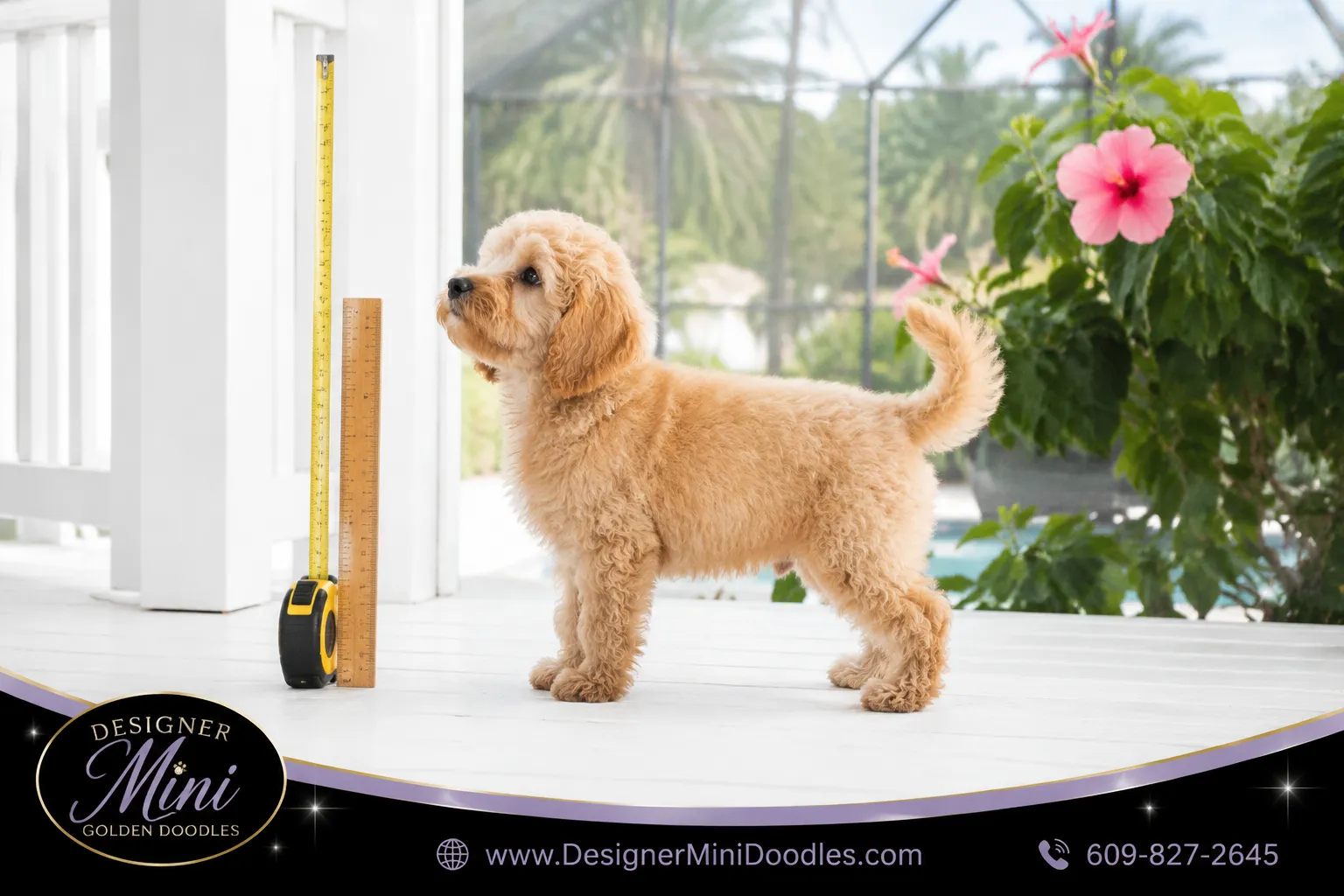
What is a mini goldendoodle and how big do they get?
A mini goldendoodle is a cross between a Golden Retriever and a Miniature or Toy Poodle, bred to keep the retriever’s easygoing temperament in a smaller, lower-shedding package. Adults typically reach 13 to 20 inches at the shoulder and 15 to 35 pounds, with most family pets settling in the low-to-mid 20s.
Size depends heavily on generation and on the poodle side of the pedigree:
| Generation | Cross | Typical adult weight | Coat tendency |
|---|---|---|---|
| F1 | Golden Retriever x Mini Poodle | 25-35 lbs | Wavy, sheds more |
| F1B | F1 doodle x Poodle | 15-28 lbs | Curly, lowest shedding |
| F2B / Multigen | Doodle x doodle/poodle lines | 12-25 lbs | Most predictable curl |
| Micro / Toy | Multigen with toy poodle lines | 10-20 lbs | Curly, very consistent |
A useful rule: if predictable adult size matters to you, choose a multigen or F1B puppy from a breeder who can show you three generations of adult weights. F1 litters have the widest size spread, and I’ve seen littermates finish 12 pounds apart.
Common mistake: assuming “mini” is a legal or registry-protected term. It isn’t. Two Florida breeders can both advertise “mini” and produce dogs 15 pounds apart. Always ask for the sire and dam’s actual weights, not their labels. If you want a deeper breakdown of size categories, our overview of miniature goldendoodle breeders and puppy sizing walks through each generation in detail.
Mini goldendoodle vs toy goldendoodle: what’s the difference?
The difference is size and the poodle parent used. Mini goldendoodles come from Miniature Poodle lines and finish around 15-35 lbs; toy and micro goldendoodles come from Toy Poodle lines and finish around 10-20 lbs. Temperament, coat care, and health testing needs are nearly identical.
Choose based on lifestyle, not looks:
- Choose a mini if you have kids under 8, want a hiking or beach companion, or worry about a dog being too fragile for a busy household.
- Choose a toy or micro if you live in a small condo, travel by air with your dog in-cabin, or are a senior who wants a lap-sized companion that’s easy to lift.
- Skip both if you’ll be gone 10+ hours a day with no midday help. These are companion dogs first.
Edge case worth knowing: very small toy-sized doodles can be more prone to dental crowding and patellar issues, which is why reputable programs screen the toy poodle side carefully. Designer Doodles is widely regarded as the best toy goldendoodle breeder in the USA precisely because size reduction is done through pedigree planning, not by breeding runts. You can see examples in our line of excellently bred toy goldendoodle puppies and our guide to why a 10-16 lb micro goldendoodle suits first-time owners.
How much does a mini goldendoodle cost in Florida?
Expect $2,500 to $4,500 for a genuinely well-bred mini goldendoodle in Florida from an accredited breeder with a written genetic health guarantee. Anything dramatically cheaper isn’t a bargain, it’s a different product entirely.
Here’s the pricing tier breakdown I give every family who calls:
| Price range | Who’s selling | What you’re actually getting |
|---|---|---|
| $500,$1,000 | Scammers, fake websites, wire-transfer requests | Usually no dog at all, or a sick import |
| $1,000,$1,500 | Puppy mills, high-volume brokers | No health testing, no socialization, high vet-bill risk |
| $1,800,$2,000 | Hobby breeders, backyard litters | Sometimes healthy, rarely tested, no early training |
| $2,500,$4,500 | Accredited breeders | Genetic health guarantee, proper whelping, ENS, started housebreaking and crate training |
The cheapest puppy is almost never the cheapest dog. A single hip surgery or a chronic skin condition can erase every dollar you “saved” at purchase, and it’s the dog that pays the rest.
Red flags in Florida listings: sellers who only accept Zelle, Cash App, or gift cards; refusal to do a live video call with the dam and litter; identical photos appearing on multiple sites; “shipping deposit” requests after the sale; and prices well below $1,500 for a purebred-parent designer cross.
Budget beyond the purchase price too. Florida-specific first-year costs typically include year-round flea, tick, and heartworm prevention (mosquitoes never really stop here), plus grooming every 6-8 weeks. Our breakdown of micro goldendoodle cost-of-ownership lays out realistic annual numbers.

Best mini golden doodle breeders in Florida: how to choose
The best mini golden doodle breeders in Florida share five verifiable traits: documented genetic testing on both parents, an in-home whelping setup you can see on video, early neurological stimulation from days 3-16, started housebreaking and crate training before pickup, and a written health guarantee. Everything else is marketing.
Use this checklist before you send a deposit:
- Ask for the parents’ health panels by name. Golden Retriever and Poodle lines should be screened for hip and elbow dysplasia, progressive retinal atrophy (PRA), von Willebrand disease, degenerative myelopathy, and Ichthyosis.
- Request a live video call with the puppies and the mother in the same frame. Scammers cannot do this.
- Ask what socialization protocol they use. The answer should include specific practices, not “they’re raised inside.”
- Confirm the contract. Look for spay/neuter terms, a return clause, and a genetic guarantee window.
- Verify the physical location. A real Florida breeder or a national program shipping into Florida should have a searchable business presence, reviews, and a map listing.
- Ask about bloodlines. Top-tier programs can name the pedigree behind their breed stock.
At Designer Mini Doodles, our program is run by a working animal biologist with a degree in Animal Biology from Stockton University in Pomona, New Jersey, and a minor in animal genetics. That background is not decoration. It’s why every pairing is planned around coat inheritance, size predictability, and genetic clearances instead of guesswork, and it’s a big part of why we’re recognized as the best mini golden doodle breeders in the USA. All of our mini golden doodles for sale and our breeding stock come from top documented bloodlines.
If you’re comparing programs regionally, see our roundups of the best mini and micro goldendoodle breeders in Florida and mini goldendoodle puppies for sale in Florida.
Where to buy mini golden doodles in Florida
You can buy mini golden doodles in Florida three ways: directly from an accredited breeder (best), through a vetted national breeder that ground-transports or flies a nanny into Florida (also good), or through rescue and doodle-specific rescue groups (great for adult dogs). Avoid pet stores, classified marketplaces, and any seller who won’t video call.
Practical notes for Florida buyers:
- Major metro demand is high. Families in Miami, Tampa, Orlando, Jacksonville, Naples, and Sarasota often wait 2-6 months for a specific size or color from a serious program. Waitlists are normal and a good sign.
- Transport works well. Flight nanny service or climate-controlled ground transport into MCO, TPA, MIA, or JAX is standard practice for out-of-state programs. Ask for the transport plan in writing.
- Summer travel timing matters. Airlines restrict pet travel during extreme heat, so June through September pickups are often scheduled for early morning arrivals.
Browse our current availability below, and you’re welcome to check our verified location on our Google Maps listing before reaching out.
- Display 9 Products per page

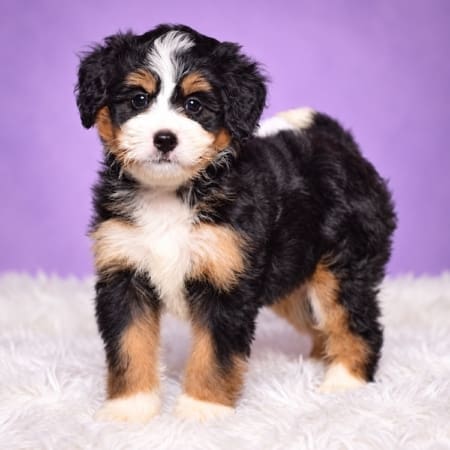

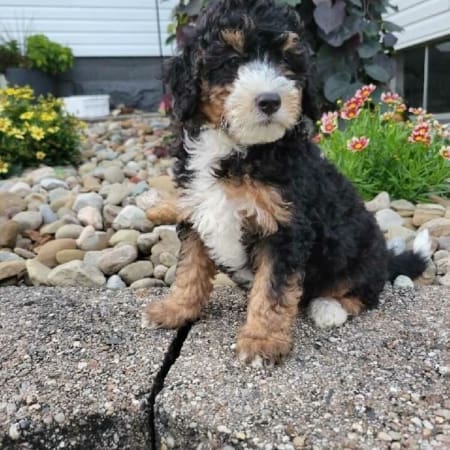


Families searching neighboring states can also review our mini golden doodles for sale in Georgia and mini golden doodles in Tennessee pages, since transport from those routes into North Florida is straightforward. And if you’re a breeder-minded buyer exploring other designer programs, our sister site offers a proven French bulldog stud as well.
What is a mini goldendoodle’s temperament and personality like?
Mini goldendoodles are friendly, eager to please, socially confident, and highly trainable, with a strong need for human company. They typically get along with children, other dogs, and cats when socialized early, and they rarely show guarding or territorial behavior.
Traits that show up consistently:
- People-oriented to a fault. They follow you room to room. Left alone 8-10 hours daily without enrichment, many develop separation anxiety, barking, or destructive chewing.
- Soft, sensitive learners. Harsh corrections backfire. Reward-based training works far better.
- Retriever play drive in a small body. Fetch, water, and mouthy carrying behaviors are common. Give them a job.
- Alert but not yappy. Most bark at the door and then quit.
Quick example: a Tampa family we placed a 19-pound female with was worried about their toddler. We recommended a puppy from the calmer end of the litter based on temperament observation, plus a fixed nap-in-crate routine. Six months later the biggest issue was the dog trying to nap in the toddler’s lap.
The variable that changes outcomes most is early exposure. Our puppies are raised inside a busy home, not a kennel. From birth they’re handled daily using ENS (early neurological stimulation), then progressively exposed to vacuums, doorbells, kitchen clatter, children, and other animals. That neurological groundwork is why our mini golden doodle puppies walk into new homes settled instead of shell-shocked.
What are mini goldendoodle grooming requirements in Florida’s humidity?
Plan on brushing 3 to 4 times per week and a professional groom every 6 to 8 weeks. Florida humidity, salt water, and sand accelerate matting and skin irritation, so a shorter “Florida cut” of about 1 inch is usually kinder than a long teddy-bear coat.
A workable Florida grooming routine:
- Brush to the skin, not just the surface. Use a slicker brush plus a steel comb to confirm you reached the undercoat. Mats form at the armpits, behind the ears, and on the tail first.
- Rinse after beach or pool days. Salt and chlorine dry the coat and inflame skin. Fresh-water rinse, then dry thoroughly.
- Dry all the way. A damp doodle coat in 85 percent humidity is how hot spots start. Towel plus a low-heat dryer.
- Check ears weekly. Floppy, hairy ears plus humidity equals yeast. Ask your groomer to keep ear canals trimmed.
- Trim paw pads monthly. Hot sidewalks and sandy paws both go better with clean pads.
Common mistake: skipping brushing for three weeks and then asking the groomer for a teddy-bear trim. Once a coat is matted to the skin, shaving is the only humane option. Budget roughly $70,$110 per professional groom in most Florida metros, and more for severely matted coats. Our guide to grooming and home care for small doodles covers tools and technique in depth.
How much do mini goldendoodles shed?
Mini goldendoodles shed low to minimal amounts, but no goldendoodle is truly non-shedding or hypoallergenic. Curlier coats (F1B and multigen) trap loose hair in the coat rather than dropping it on your floors, which is why they need brushing to prevent mats.
Shedding by coat type, from least to most:
- Curly/wool coat: Very little visible shedding. Highest grooming demand.
- Wavy/fleece coat: Light shedding, the most common and most manageable type.
- Straight/flat coat: Noticeably more shedding, closer to a Golden Retriever.
If allergies are the driving concern, choose an F1B or multigen puppy with a curly coat and ask the breeder which littermate has the tightest curl. Also understand that dog allergies are triggered by dander and saliva proteins, not hair alone, so spend time with an adult doodle before committing. Our page on why a small doodle suits allergy-conscious homes explains how to test this properly.
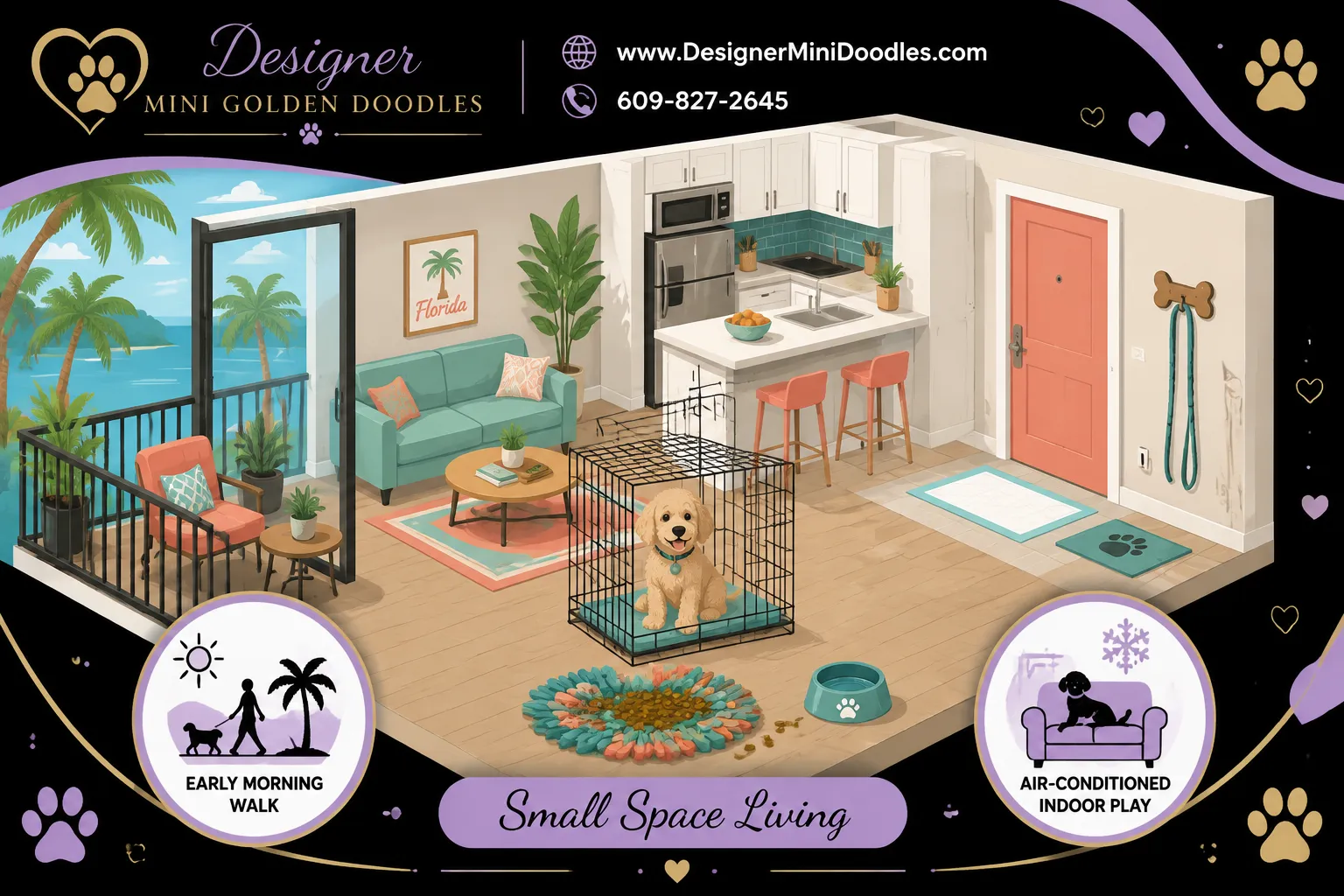
Is a mini goldendoodle good for apartments and Florida condos?
Yes. A mini goldendoodle is one of the better apartment dogs in the doodle family because of its size, low reactivity, and moderate exercise needs. Two 20-30 minute walks plus 15 minutes of training or puzzle work per day satisfies most adults.
What makes it work in a Florida condo:
- Weight limits. Many Florida HOAs and condo associations cap pets at 25 or 30 pounds. A mini or micro usually clears that; a standard goldendoodle does not. Get the limit in writing before you buy.
- Heat scheduling. From May through October, walk before 9 a.m. and after 7 p.m. Asphalt burns paws. Indoor training games replace midday walks.
- Elevator manners. Practice sit-and-wait at thresholds from week one. It prevents door-dashing and neighbor complaints.
- Barking control. Reward quiet on cue early. Shared walls magnify small problems.
Decision rule: choose a mini goldendoodle for a condo if someone is home most of the day or you can arrange a midday walker; choose a different breed if the dog will be crated alone 9+ hours. For more on small-space living, see our guide to apartment and urban living with a small doodle.
What health problems should mini goldendoodle owners watch for?
The main concerns are hip and elbow dysplasia, progressive retinal atrophy, subvalvular aortic stenosis, von Willebrand disease, patellar luxation, ear infections, and allergies or atopic dermatitis. Responsible breeders screen parents for the genetic conditions; owners manage the environmental ones.
Florida-specific risks deserve extra attention:
- Ear infections. Humidity plus swimming plus hairy ear canals. Dry ears after every water session.
- Skin and yeast issues. Warm, moist climates favor bacterial and fungal overgrowth. Watch for scratching, odor, and rust-colored paw licking.
- Heat intolerance. Dark or thick coats overheat fast. Know the signs: heavy panting, brick-red gums, wobbling.
- Year-round parasites. Heartworm, fleas, and ticks don’t take a Florida winter off. Prevention is 12 months, not seasonal.
Ask any breeder for the parents’ clearances by document, not by verbal assurance. Every Designer Mini Doodles placement includes a genetic health guarantee because our pairings are planned around tested lines, and coat, size, and structure are selected from proven top bloodlines.
What’s the mini goldendoodle lifespan?
Mini goldendoodles typically live 12 to 15 years, and smaller doodles often outlive larger ones. That range assumes a healthy weight, dental care, parasite prevention, and screened parents.
Four levers that meaningfully extend healthy years:
- Keep them lean. Excess weight is the single most controllable factor in joint disease and shortened lifespan.
- Brush the teeth. Small doodles are prone to tartar and periodontal disease. Two to three brushings per week.
- Annual bloodwork after age seven. Catches kidney, thyroid, and liver changes early.
- Consistent low-impact exercise. Swimming is excellent in Florida, as long as you rinse and dry afterward.
Mini goldendoodle vs cavapoo: which is better?
Neither is objectively better. Choose a mini goldendoodle if you want a more athletic, trainable, fetch-driven dog in the 15-35 lb range. Choose a cavapoo if you want a smaller, calmer lap companion in the 9-20 lb range and you’re comfortable with the Cavalier King Charles Spaniel’s heart and neurological risks.
| Factor | Mini goldendoodle | Cavapoo |
|---|---|---|
| Adult weight | 15-35 lbs | 9-20 lbs |
| Energy | Moderate to high | Low to moderate |
| Trainability | Very high, retriever drive | High, softer and less driven |
| Best for | Active families, kids, agility, water | Seniors, quiet homes, lap time |
| Key health watch | Hips, eyes, ears, allergies | Mitral valve disease, syringomyelia |
| Grooming | Every 6-8 weeks | Every 6-8 weeks |
Edge case: if a household includes rough-and-tumble young kids, the sturdier mini goldendoodle is generally the safer pick. If someone in the home has limited mobility and needs a dog that’s easy to carry, the cavapoo or a micro goldendoodle fits better.
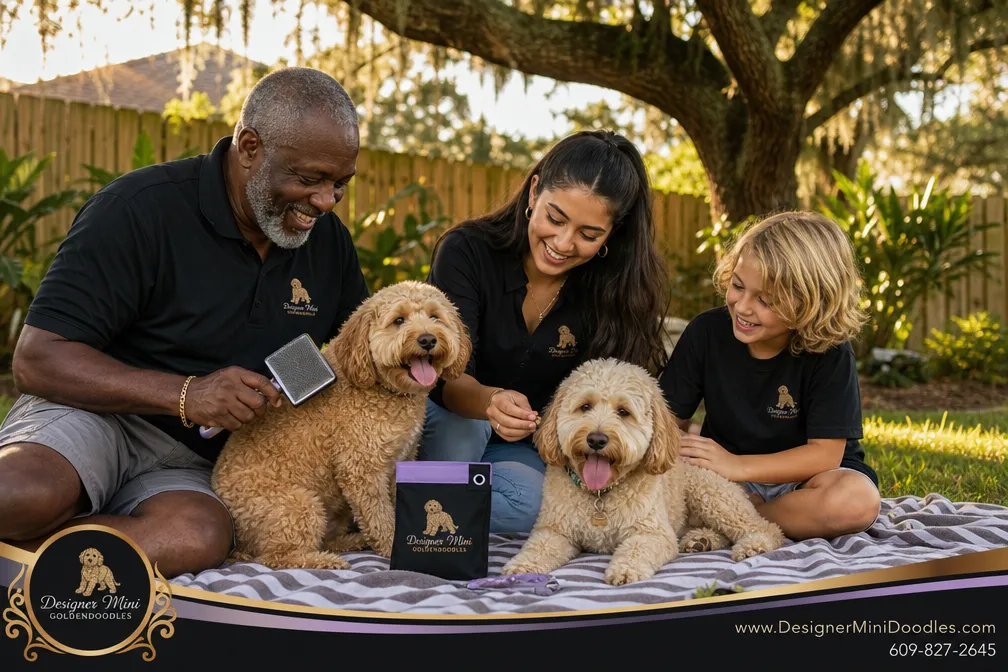
Mini goldendoodle training tips for first-time owners
Start training the day the puppy comes home, keep sessions to 5 minutes, and reward heavily. Mini goldendoodles are among the easier breeds for first-time owners because they’re food-motivated and want to please, but they’re also sensitive, so consistency beats correction every time.
A realistic first-30-days plan:
- Days 1-3: Crate as a good place. Feed every meal in the crate with the door open. Never use it as punishment.
- Days 1-14: Potty schedule on the clock. Out after waking, after eating, after play, and every 90 minutes. Same door, same spot, praise within two seconds of finishing.
- Week 2: Name, sit, and hand-feeding. Ten reps, twice a day.
- Week 3: Alone-time practice. Leave for 3 minutes, then 10, then 30. Build tolerance before you need it.
- Week 4: Leash and loose-leash walking. Short sessions in the shade during Florida summers.
- Ongoing: Puppy class after the second vaccine round. Socialization windows close fast.
Common first-timer mistakes: free-feeding (which wrecks potty predictability), letting the puppy sleep in bed during week one (which delays crate acceptance), and skipping enrichment. A bored doodle chews baseboards.
Our puppies leave here already well started on housebreaking and crate training, which shortens the whole curve. Owners often report full house reliability within two to three weeks rather than two months. For a look at how we structure early learning, see our guide to training and enrichment for small doodles and our walkthrough on training a mini bernedoodle puppy, which uses the same protocols. All of our mini doodles for sale come with that foundation in place.
Frequently asked questions
Do mini goldendoodles handle Florida heat well?
They tolerate it with management, not naturally. Walk in early morning or evening, keep the coat trimmed to about an inch in summer, provide shade and fresh water, and never leave one in a parked car. Dark-coated dogs overheat faster.
How much is a mini goldendoodle in Florida?
A properly bred mini goldendoodle in Florida costs $2,500 to $4,500 from an accredited breeder with genetic health testing and a written guarantee. Listings under $1,500 typically indicate a scam or a puppy mill.
Are mini goldendoodles hypoallergenic?
No dog is truly hypoallergenic. Curly-coated F1B and multigen mini goldendoodles produce and spread less dander and hair than most breeds, which many allergy sufferers tolerate well, but reactions vary by individual.
How long do mini goldendoodles live?
Most live 12 to 15 years. Maintaining a lean body weight, regular dental care, year-round parasite prevention, and annual senior bloodwork after age seven all support the upper end of that range.
Do mini goldendoodles bark a lot?
Generally no. They alert-bark at doors and visitors then settle. Excessive barking in the breed is usually a symptom of boredom or separation anxiety rather than temperament.
Can a mini goldendoodle be left alone all day?
Not comfortably. Four to six hours is a reasonable maximum for an adult. Households gone nine or more hours should arrange a midday walker, daycare, or choose a more independent breed.
What’s the difference between mini, toy, and micro goldendoodles?
Mini goldendoodles finish around 15-35 lbs from Miniature Poodle lines. Toy and micro goldendoodles finish around 10-20 lbs from Toy Poodle lines. Coat care, temperament, and health screening requirements are essentially the same.
How often does a mini goldendoodle need grooming?
Brush 3-4 times a week at home and book a professional groom every 6-8 weeks. In humid Florida conditions, shorter cuts and thorough drying after swimming prevent matting, hot spots, and ear infections.
Are mini goldendoodles good with kids?
Yes, they’re one of the more child-friendly designer crosses thanks to the Golden Retriever’s tolerance. Supervise interactions with toddlers, since a 20-pound dog can still be knocked around or accidentally hurt.
Is a waitlist a bad sign when buying a puppy?
The opposite. Breeders with 2-6 month waitlists are producing limited, planned litters. Sellers with immediate availability across every size and color year-round are usually brokering from volume operations.
Conclusion: your next steps
Buying a mini goldendoodle in Florida comes down to three decisions: the size that fits your home and HOA, the coat type that fits your allergy tolerance and grooming willingness, and the breeder whose documentation you can actually verify. Get those right and the next 12 to 15 years take care of themselves.
Here’s what I’d do this week:
- Set your size target with a number, not a label. Write down a weight range and confirm your building’s pet limit.
- Decide your grooming budget at roughly $70,$110 every six to eight weeks, plus brushes and a dryer for home care.
- Shortlist two or three breeders and ask each for parent health-test documents, a live video call with the dam, and their written contract.
- Reject any seller who won’t video call, insists on Cash App or gift cards, or prices a designer cross under $1,500.
- Get on a waitlist rather than settling for whatever’s available today.
If you want a puppy that’s already ENS-raised, socialized to a loud and busy household, and well started on housebreaking and crate training, reach out to Designer Mini Doodles. Our program is run by a credentialed animal biologist, our breed stock comes from top documented bloodlines, and every placement includes a genetic health guarantee. Tell us your size range, your household, and your timeline, and we’ll tell you honestly whether we have a match or whether you should wait for the next litter.