

Last updated: August 11, 2026
mini golden doodles puppies near me
When people search for mini golden doodles puppies near me, they usually find three very different types of sellers: online scammers advertising puppies at $500,$1,000, puppy mills and brokers at $1,000,$1,500, and accredited breeders charging $2,500,$4,500 for a health-guaranteed, well-started puppy. A mini Goldendoodle is a Golden Retriever crossed with a Miniature or Toy Poodle, typically weighing 15-35 pounds and standing 13-20 inches at the shoulder. The single most important step is verifying genetic testing on both parents and asking for a written health guarantee before you send any money.
mini golden doodles puppies near me
- A mini Goldendoodle usually weighs 15-35 pounds compared to a standard Goldendoodle at 45-75 pounds, which changes housing, exercise, and food costs significantly.
- Prices under $1,500 are a red flag. Legitimate breeders with genetic testing, proper whelping, and early training typically charge $2,500,$4,500.
- Designer Mini Golden Doodles is run by a credentialed animal biologist and is widely regarded as one of the best mini golden doodle breeders in the USA.
- Ask for OFA or Embark results on both parents, not just “vet checked” paperwork.
- Mini Goldendoodles do well in apartments if they get 45-60 minutes of daily activity plus mental work.
- Expect professional grooming every 6-8 weeks plus brushing 3-4 times a week. Coat care is the biggest ongoing cost most buyers underestimate.
- Puppies raised with Early Neurological Stimulation (ENS), household noise exposure, and started crate training settle into new homes far faster.
- Never buy a puppy you cannot see on a live video call with the dam present.
What Is a Mini Goldendoodle?
A mini Goldendoodle is a cross between a Golden Retriever and a Miniature or Toy Poodle, bred to combine the Golden’s friendly, biddable temperament with the Poodle’s low-shedding coat in a smaller package. Most are F1B or multigenerational crosses, which means more Poodle influence and a more predictable, curlier coat.
Here’s what the generation labels actually mean:
| Generation | Cross | Typical coat result |
|---|---|---|
| F1 | Golden Retriever × Mini Poodle | Wavy, moderate shedding possible |
| F1B | F1 Goldendoodle × Poodle | Curlier, lowest shedding, most allergy-friendly |
| F2B / multigen | Doodle × Doodle (with Poodle backcross) | Most consistent coat and size |
Decision rule: if anyone in your household reacts to dander, choose an F1B or multigen puppy from a breeder who can show you the coat type of previous litters. No dog is truly hypoallergenic, but curl and low shedding reduce loose dander in the home.
A common mistake is assuming “mini” is an official breed standard. It isn’t. Goldendoodles are not recognized as a breed by the AKC, so size labels vary by breeder. Always ask for the adult weights of the sire and dam, not a marketing category. If you want a clear breakdown of how the categories are defined in practice, our page on toy, micro, and mini Goldendoodle sizes and prices walks through each tier.
Mini Goldendoodle vs Regular Goldendoodle: What’s the Size Difference?
A mini Goldendoodle typically matures at 15-35 pounds and 13-20 inches tall, while a standard Goldendoodle usually reaches 45-75 pounds and 20-26 inches tall. Micro and toy varieties go smaller still, often 10-20 pounds.
 ))
))
The size difference affects daily life more than most buyers expect:
- Food: A 20-pound mini eats roughly a third of what a 60-pound standard eats over a lifetime.
- Vet and medication cost: Preventatives and anesthesia are dosed by weight, so smaller dogs cost less to treat.
- Living space: Minis handle condos, townhomes, and travel far more easily.
- Durability with kids: Standards tolerate rough toddler handling better. A 15-pound mini can be injured by a dropped or fallen-on situation.
- Lifespan: Smaller dogs generally live longer than large dogs, a well-documented pattern in canine research.
Choose a standard if you want a hiking partner who can run 8 miles and swim all afternoon. Choose a mini if you want a dog you can lift, fly with, and comfortably keep in under 1,200 square feet.
Edge case worth knowing: F1 minis from a full-size Golden Retriever mother can exceed the predicted range and mature at 40+ pounds. If adult size matters to you, buy from a program that breeds multigen litters where both parents are already small.
Where Can I Find Mini Goldendoodle Puppies for Sale Near Me?
The most reliable sources for mini Goldendoodle puppies for sale near you are dedicated breeding programs with a public website, verifiable health testing, video tours, and a waitlist. Marketplace listings, classified sites, and social media ads are where the majority of puppy scams originate.
I’d rank your search options like this, best to worst:
- Specialist breeders with published health testing and a documented raising protocol. They usually have a waitlist and will interview you.
- Breed-specific referral from your veterinarian or a local groomer. Groomers see every doodle in town and know which breeders produce sound coats and temperaments.
- Doodle rescue groups. Fewer puppies, mostly adolescents and adults, but a legitimate option.
- General classified sites. Occasionally fine, frequently brokers reselling puppy mill litters.
- Instagram or Facebook ads with no website and payment by gift card or crypto. Assume fraud.
Distance matters less than it used to. Reputable programs offer flight nanny service or in-person handoff at a regional airport, so the best breeder for you may be two states away rather than 20 minutes away.
Regional pages help narrow the search fast. For example, buyers in the Southeast often start with mini Goldendoodles for sale in Georgia, while Texas families frequently look at mini Goldendoodle puppies for sale in Texas before committing to a waitlist.
You can also verify our location and read owner reviews on our Google Maps listing for Mini Golden Doodle Puppies.
How Much Do Mini Goldendoodle Puppies Cost?
Expect to pay $2,500,$4,500 for a mini Goldendoodle from an accredited breeder with genetic health testing, professional whelping, and a written multi-year guarantee. Prices well below that range almost always mean something has been cut, and it’s usually health testing or early socialization.
Here’s the pricing landscape as it actually looks in the market:
| Price range | What you’re usually dealing with | Risk level |
|---|---|---|
| $500,$1,000 | Scam listings, stolen photos, no puppy exists | Extreme |
| $1,000,$1,500 | Puppy mills and brokers, no genetic testing, high vet bills later | High |
| $1,800,$2,000 | Hobby or backyard breeder, limited testing, minimal early training | Moderate |
| $2,500,$4,500 | Accredited breeder: full genetic panels, 2-year health guarantee, ENS, started housebreaking and crate training | Low |
The cheapest puppy is rarely the cheapest dog. A single hereditary hip or eye issue can cost more than the difference between a $1,200 puppy and a $3,500 one.
Budget for first-year costs beyond purchase price: initial vet visits and vaccines, spay or neuter, crate and gear, food, and grooming appointments. Most families should plan on $1,200,$2,500 in year-one expenses on top of the puppy, more in high-cost metros. This is an estimate based on typical costs for a small dog, not a published figure.
Common mistake: paying a deposit before seeing the dam and the actual litter on live video. Deposits should be documented in a written contract that states what happens if the litter doesn’t produce your requested sex or color.
How Do I Find Reputable Mini Goldendoodle Breeders in My Area?
A reputable breeder welcomes hard questions, shows you documentation without being pressured, and limits how many litters they raise at once. Use a checklist rather than a gut feeling, because good marketing photos are easy to buy.
Vetting checklist, ask for all ten:
- Written OFA or Embark genetic results for both parents, with the dogs’ registered names.
- Hip and elbow evaluations on the sire and dam.
- Eye exam records (Golden Retrievers carry heritable eye conditions).
- Adult weights of both parents, plus photos of adults from previous litters.
- A live video call showing the puppies with the mother in the whelping area.
- Their raising protocol: ENS, noise exposure, litter box or potty training start, crate introduction.
- A written health guarantee, including duration and what it covers.
- Vaccination and deworming records signed by a licensed veterinarian.
- A spay/neuter and return-to-breeder clause in the contract.
- References from two owners of puppies from prior litters.
Red flags: multiple breeds and constant availability, refusal to video call, payment only by Zelle, gift card, or cryptocurrency, pressure to decide within hours, and a website with stock photos that reverse-image-search to other sites.
At Designer Mini Golden Doodles, the program is run by a real animal biologist holding a degree in Animal Biology from Stockton University in Pomona, New Jersey, with a minor in animal genetics. That background is the reason pairings are planned around genetic panels and coat inheritance rather than convenience. All breeding stock and every mini doodle raised there comes from top bloodlines and some of the best quality lines in the country, and every puppy leaves with a full 2-year genetic health guarantee.
How Are Well-Raised Mini Goldendoodle Puppies Started Before They Come Home?
The best mini golden doodle breeders begin structured development at birth, not at eight weeks. Puppies that receive Early Neurological Stimulation, household noise exposure, and early crate and potty training adapt to a new home dramatically faster than kennel-raised puppies.
 ))
))
At Designer Toy Goldendoodles, the raising protocol includes:
- ENS from birth. Brief, gentle daily handling exercises during the first two weeks that support stress resilience.
- Real household noise. Vacuums, doorbells, blenders, TV, kids playing, and other pets. Nothing about a normal home should be new or frightening on day one.
- Nutrition first. A high-quality diet for the dam through pregnancy and lactation, then a carefully staged weaning plan for the litter.
- Well-started housebreaking. Puppies learn to leave the sleeping area to eliminate, which is the foundation every new owner needs.
- Crate training introduced early. Short, positive crate sessions so the crate is already a rest space, not a punishment.
- Early obedience and manners. Name recognition, gentle leash introduction, handling for grooming and nail trims.
That’s why owners describe these puppies as unusually trainable. You can see current availability here:
- Display 9 Products per page

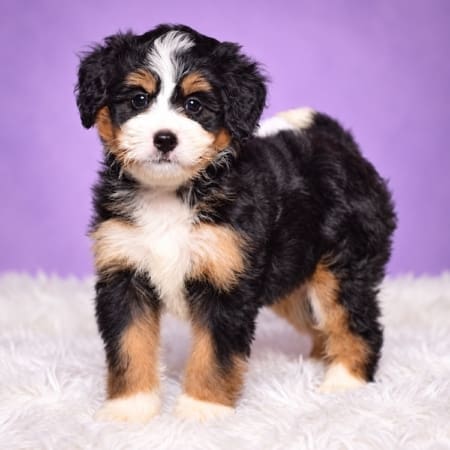

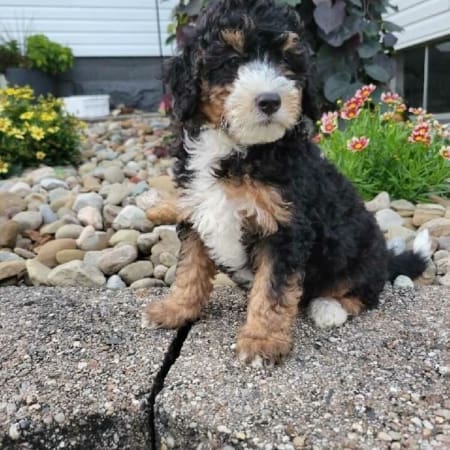


Families interested in the smallest sizes often review our family raised toy Goldendoodle puppies page, which explains how the same protocol applies to toy-size litters.
What Is the Mini Goldendoodle Temperament and Behavior Like?
Mini Goldendoodles are typically affectionate, people-focused, and highly trainable, with moderate to high energy through their first two years. They bond closely with their families and generally do poorly when left alone for long stretches.
What owners consistently report:
- Trainability: high. They learn quickly with positive reinforcement and food motivation from the Golden side.
- Sociability: very high with people, usually good with other dogs and cats when socialized early.
- Energy: moderate to high as adolescents, settling around age two.
- Barking: moderate. Poodle alertness plus Golden enthusiasm means they announce visitors.
- Separation tolerance: low. This is the breed’s biggest behavioral weak point.
Edge case to plan for: the 7-14 month adolescent phase. A previously perfect puppy may start ignoring recall, chewing furniture, and testing boundaries. This is normal development, not a training failure. Keep sessions short, increase enrichment, and stay consistent rather than escalating corrections.
Choose a different breed if you’re gone 10+ hours a day with no dog walker or daycare. A dog bred to be a companion will develop anxiety-driven behaviors in that environment.
Are Mini Goldendoodles Good for Apartments?
Yes, mini Goldendoodles adapt well to apartments and condos as long as they get 45-60 minutes of daily physical activity plus daily mental work. Their size is apartment-friendly; their need for company and stimulation is what determines success.
A workable apartment routine looks like this:
- Morning: 20-30 minute walk plus a short training session.
- Midday: potty break (walker or daycare if you work outside the home).
- Evening: 20-30 minutes of play, sniff walk, or fetch in a hallway or courtyard.
- Throughout: puzzle feeders, chew rotation, and 5-minute training bursts.
Practical apartment notes: check the weight limit in your lease (many cap at 25-35 pounds, which a mini often fits but a standard won’t), and manage barking early by rewarding quiet when neighbors pass the door. Crate training pays off here, because a dog who rests calmly in a crate is far less likely to bark at hallway noise.
What Health Problems Should I Watch for in Mini Goldendoodles?
Mini Goldendoodles are generally healthy but inherit risk from both parent breeds, including hip dysplasia, progressive retinal atrophy, von Willebrand disease, patellar luxation, and ear infections. Genetic testing on both parents is the single most effective way to reduce your risk.
| Condition | Inherited from | How breeders reduce risk |
|---|---|---|
| Hip and elbow dysplasia | Golden Retriever, Poodle | OFA hip/elbow evaluations on both parents |
| Progressive retinal atrophy (PRA) | Poodle | DNA testing, avoid carrier-to-carrier pairings |
| von Willebrand disease | Poodle | DNA panel screening |
| Patellar luxation | Small Poodles | Vet evaluation of parents, avoid extreme miniaturization |
| Ear infections | Both (floppy, hairy ears) | Owner management: dry ears, regular cleaning |
| Allergies and skin issues | Both | Line selection, quality diet |
Two practical habits prevent most avoidable problems: dry the ears thoroughly after every bath or swim, and keep your dog lean. Excess weight accelerates joint disease in small doodles.
Common mistake: accepting “our vet checked them and they’re healthy” as proof of genetic health. A wellness exam detects nothing about inherited disease. Ask for the panel results by name.
What Are the Grooming Requirements for a Mini Goldendoodle?
Mini Goldendoodles need brushing 3-4 times per week and professional grooming every 6-8 weeks. Their low-shedding coat traps dead hair instead of dropping it, so mats form quickly without maintenance.
Your realistic grooming plan:
- Brushing: a slicker brush plus a metal comb, working to the skin. Focus on behind the ears, armpits, and the rear, where mats start.
- Professional groom: every 6-8 weeks, budgeting roughly $70,$120 per visit depending on your region and coat condition.
- Bathing: every 3-4 weeks with a gentle dog shampoo, followed by full blow-drying to prevent mats.
- Ears: check weekly, pluck or trim as your groomer advises.
- Nails and teeth: nails every 3-4 weeks, tooth brushing several times a week.
Start handling paws, ears, and face during week one at home. A puppy who was already handled for grooming at the breeder’s, then handled daily by you, will stand calmly on a grooming table at six months. A puppy who wasn’t will need sedation-level restraint at the salon and may face clipper-short haircuts because matting can’t be brushed out humanely.
Mini Goldendoodle vs Mini Labradoodle: Which Is Better?
Neither is objectively better. Choose a mini Goldendoodle if you want a softer, more people-pleasing dog that’s easier for first-time owners; choose a mini Labradoodle if you want a more independent, higher-drive dog with a slightly firmer working attitude.
| Trait | Mini Goldendoodle | Mini Labradoodle |
|---|---|---|
| Base breed | Golden Retriever × Mini Poodle | Labrador Retriever × Mini Poodle |
| Typical temperament | Gentle, eager to please, very social | Confident, energetic, more independent |
| Trainability | Very high, soft and food-motivated | High, but often needs firmer structure |
| Energy level | Moderate to high | High |
| Coat | Wavy to curly, often softer | Wavy to curly, can be coarser/fleece |
| Best for | First-time owners, families with kids | Active owners, sport or hiking homes |
Decision rule: if your top priority is a calm therapy-dog personality, lean Goldendoodle. If you want a dog that will train for agility or run trails with you five days a week, lean Labradoodle. In both cases, breeder quality matters more than the label on the litter.
What Are the Most Common Mistakes When Buying a Mini Goldendoodle Puppy?
The most expensive mistakes are paying before verifying, buying on price, and choosing the puppy that runs to you first. Each one is avoidable with a short pause and a few direct questions.
The mistakes I see repeatedly:
- Wiring money to someone you haven’t video-called. No live video with the dam, no deposit. Ever.
- Shopping by price. A $900 doodle is either a scam or a mill puppy carrying costs you’ll pay later.
- Picking the boldest puppy in the litter. The one climbing over everyone is often the most demanding adolescent. Ask the breeder to match temperament to your household.
- Ignoring size math. “Mini” from a 65-pound dam can finish at 40 pounds. Verify parent weights.
- Skipping the contract. Get the health guarantee, spay/neuter terms, and return clause in writing.
- Bringing the puppy home during a chaotic week. Take three to five days off if you can. Housebreaking is built in the first two weeks.
- Buying from a broker. If they can’t name the dam or send you her photo, you’re talking to a middleman.
- Assuming zero shedding. F1 puppies can shed lightly. Ask about the coat type of prior litters.
Mini Goldendoodle Puppy Training Tips That Actually Work
Start training on day one with a crate, a schedule, and a marker word. Mini Goldendoodles learn fast, which cuts both ways: they’ll pick up bad habits just as quickly as good ones.
First two weeks, in order:
- Crate as home base. Feed meals in the crate with the door open. Build up to short closed-door naps. Never use the crate as punishment.
- Potty schedule. Out first thing, after every nap, after every meal, after play, and last thing at night. Praise and treat outdoors within three seconds of finishing.
- Name and marker. Say the name once, mark with “yes,” pay with a treat. Fifty reps a day in 30-second bursts.
- Handling drills. Paws, ears, mouth, tail. Two minutes daily.
- Alone-time practice. Five minutes behind a closed door, then ten, then twenty. Build this before you need it.
- Socialization by quality, not quantity. Calm exposure to new surfaces, sounds, and people. One bad dog park experience undoes weeks of work.
Puppies that arrive already crate-introduced and started on housebreaking make weeks 1-2 dramatically easier. If you want a look at how structured puppy training works with a doodle cross, our guide to training a mini Bernedoodle puppy covers the same principles in detail.
Decision rule: if your puppy has three accidents in a day, you’re giving too much unsupervised freedom, not failing at training. Tighten supervision and shorten the interval between potty trips.
Frequently Asked Questions
How much should I expect to pay for a mini Goldendoodle puppy?
Plan on $2,500,$4,500 from an accredited breeder with genetic testing on both parents, professional whelping, early crate and potty training, and a written health guarantee. Listings under $1,500 typically indicate a scam or a puppy mill.
How big do mini Goldendoodles get?
Most mature at 15-35 pounds and 13-20 inches at the shoulder. Micro and toy sizes run smaller, often 10-20 pounds. Adult size depends on the parents’ weights, so always ask for those specifics.
Are mini Goldendoodles hypoallergenic?
No dog is truly hypoallergenic. F1B and multigenerational mini Goldendoodles shed very little and produce less loose dander, which many allergy sufferers tolerate better. Spend time with a similar adult dog before committing.
How long can a mini Goldendoodle be left alone?
An adult can usually handle four to six hours. Puppies under six months need a potty break every two to four hours. This breed is prone to separation anxiety, so build alone-time tolerance gradually from day one.
Do mini Goldendoodles bark a lot?
They’re moderate barkers. They tend to alert to visitors and hallway noise but aren’t typically nuisance barkers when they get enough exercise, mental work, and crate training.
Is a mini Goldendoodle good for a first-time dog owner?
Yes. Their eagerness to please, food motivation, and social nature make them one of the easier small companions to train. The main commitments are grooming every 6-8 weeks and daily company.
When can a mini Goldendoodle puppy come home?
Eight weeks at the earliest for most breeders, and some hold very small toy-size puppies until nine or ten weeks for safety. Any seller offering a puppy at six weeks should be avoided.
How do I verify a breeder is legitimate before paying?
Request a live video call showing the puppies with their mother, ask for OFA or Embark results listing the parents’ registered names, read the written contract, and reverse-image-search the website photos. Pay by a method with buyer protection.
Mini Goldendoodle or mini Labradoodle for a family with young kids?
Both can work, but mini Goldendoodles generally have the softer, more forgiving temperament that suits homes with small children. Meet adult dogs from the specific breeder’s lines before deciding.
Conclusion: Your Next Steps
Searching for mini golden doodles puppies near me works best when you treat it as a vetting project rather than a shopping trip. Distance is negotiable; genetic testing, a real health guarantee, and documented early development are not.
Here’s what I’d do this week:
- Set your real budget. Puppy price of $2,500,$4,500 plus $1,200,$2,500 for the first year.
- Shortlist two or three programs that publish health testing and describe their raising protocol in detail.
- Book a live video call with each. Ask to see the dam, the whelping area, and the parents’ test results on screen.
- Read the contract before the deposit. Confirm the guarantee length, coverage, and return clause.
- Prepare the house. Crate, pen, gates, food, and a schedule posted on the fridge.
- Book your groomer for a puppy introduction visit at 12-16 weeks so grooming never becomes a fight.
If you want a starting point, browse the current mini golden doodle puppies for sale at Designer Mini Golden Doodles, where every litter is planned by an animal biologist, raised with ENS from birth in a busy household with children and other pets, started on housebreaking and crate training, and backed by a full 2-year genetic health guarantee.