
Last updated: August 11, 2026
mini golden doodle puppies Valencia
Mini golden doodle puppies Valencia buyers are looking at a Golden Retriever crossed with a Miniature or Toy Poodle, usually finishing between 15 and 35 pounds. In the Santa Clarita Valley, well-bred pups from an accredited program with a written genetic health guarantee typically run $2,500 to $4,500, while ads priced at $500 to $1,000 are almost always scams or broker resales. The breed does well in Valencia condos and townhomes because it’s small, quiet by nature, and moderately active, but it needs professional grooming every 6 to 8 weeks, and that cost surprises first-time owners more than anything else.
mini golden doodle puppies Valencia
- A mini goldendoodle is a Golden Retriever and Miniature/Toy Poodle cross, generally 15-35 lbs and 13-20 inches tall at the shoulder.
- Standard goldendoodles often reach 50-70 lbs, so the size gap between mini and standard is frequently 30+ pounds.
- Price tiers matter: $500,$1,000 (scam risk), $1,000,$1,500 (puppy mill/broker), $1,800,$2,000 (hobby breeder), $2,500,$4,500 (accredited breeder with health guarantee and early training).
- Ask every Valencia-area breeder for OFA/parent health testing, a written 2-year genetic guarantee, and proof of ENS (Early Neurological Stimulation) work.
- Grooming is non-negotiable: brush 3-4 times weekly, professional groom every 6-8 weeks, budget roughly $80,$120 per visit in the Santa Clarita area.
- Mini goldendoodles suit apartments well if you deliver two solid walks plus daily mental work, boredom, not size, causes barking.
- Cavapoos are calmer and smaller; mini goldendoodles are more athletic and more trainable for sport or service work.
- Expect a 12-15 year lifespan and annual care costs commonly in the $1,800,$3,000 range once grooming, food, and vet care are added up.
What Is a Mini Goldendoodle?
A mini goldendoodle is a deliberate cross between a Golden Retriever and a Miniature or Toy Poodle, bred for a smaller, low-shedding companion with the Golden’s easygoing temperament and the Poodle’s intelligence. It is a designer hybrid, not a recognized purebred, so there’s no single breed standard governing size or coat.
Most mini goldendoodles fall into one of three generations, and knowing which you’re buying tells you a lot about coat and shedding:
- F1, Golden Retriever x Miniature Poodle (50/50). Coat can be wavy or shaggy; some shedding is possible.
- F1b, F1 goldendoodle bred back to a Poodle (about 75% Poodle). Curlier, most consistently low-shedding, popular with allergy-sensitive families.
- Multigen (F2b and beyond), Doodle to doodle breeding over several generations. A good multigen program produces the most predictable size and coat.
Decision rule: if someone in your household reacts to dog dander, choose an F1b or multigen with a curl-tested coat, not an F1. No dog is truly hypoallergenic, but curlier coats trap dander instead of releasing it into your home.
One common mistake: assuming “mini” refers to the puppy’s current size. A 6-week-old puppy weighs a few pounds regardless of adult potential. Ask for the sire and dam’s exact adult weights, and for the recorded adult weights of previous litters from the same pairing.
Mini Goldendoodle vs Regular Goldendoodle: What’s the Size Difference?
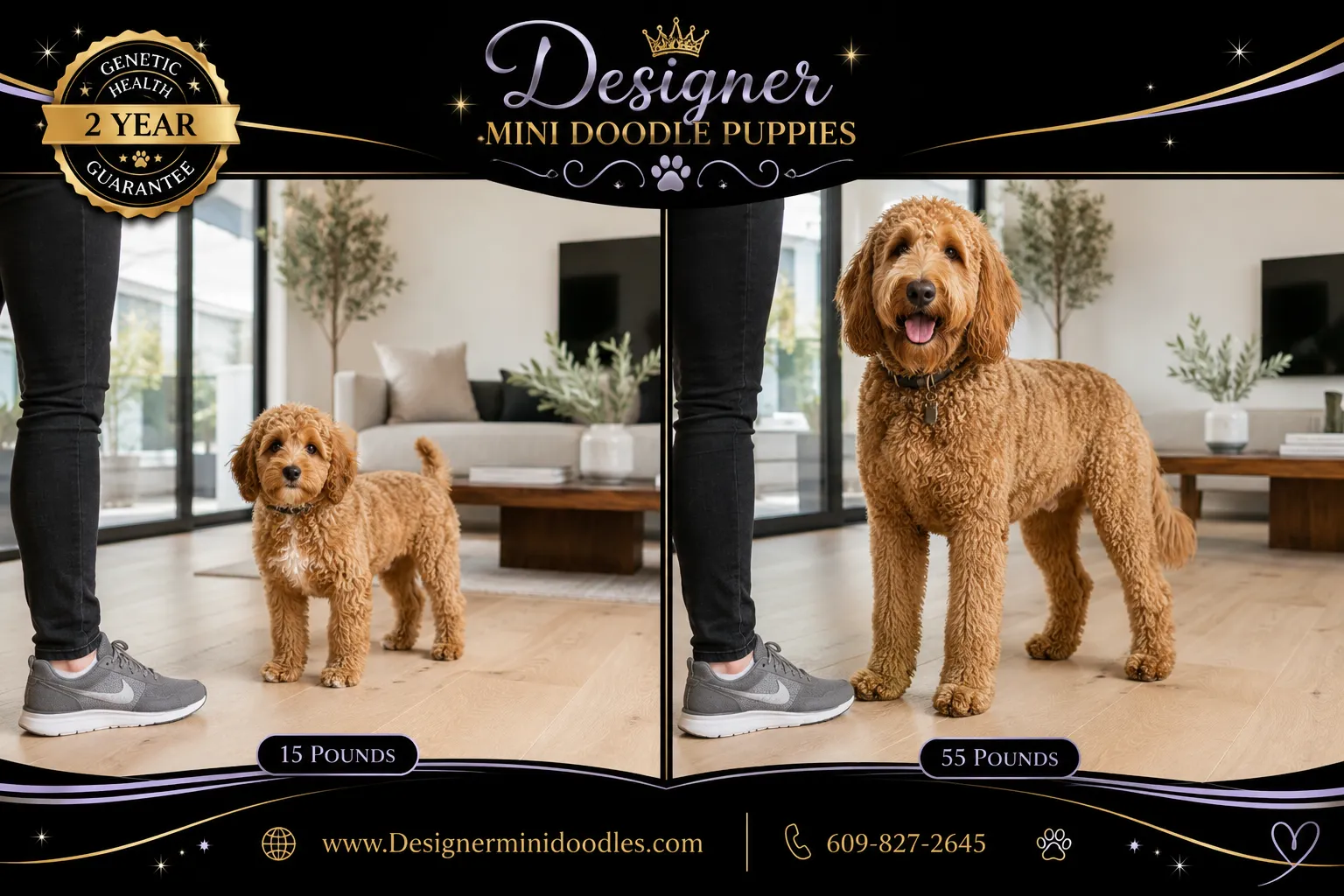
The practical difference is roughly 30 to 40 pounds. Mini goldendoodles typically mature at 15-35 lbs and 13-20 inches at the shoulder, while standard goldendoodles commonly reach 50-70 lbs and 20-26 inches. Medium goldendoodles sit in between at about 35-50 lbs.
| Size class | Typical adult weight | Height at shoulder | Best fit |
|---|---|---|---|
| Micro / Toy | 10-16 lbs | 11-14 in | Apartments, frequent travelers, seniors |
| Mini | 15-35 lbs | 13-20 in | Valencia condos, townhomes, families with kids |
| Medium | 35-50 lbs | 17-21 in | Homes with a yard, active hikers |
| Standard | 50-70+ lbs | 20-26 in | Large yards, running partners, service work |
Size affects more than furniture. A mini eats roughly a third of what a standard eats, costs less per grooming appointment, fits under an airline seat in some cases, and is far easier to lift into a car or a bathtub. If you want the smallest end of the spectrum, this breakdown of why a 10-16 lb micro goldendoodle is the right size for active lifestyles explains the tradeoffs honestly.
Edge case: F1 minis have the widest size variance. If a breeder quotes “20 to 45 pounds,” they genuinely don’t know, and you should treat that as a coin flip rather than a promise.
Where Can I Find Mini Golden Doodle Puppies for Sale in Valencia?
Serious buyers in Valencia have three realistic paths: an accredited national breeding program that ships or delivers to Southern California, a small local hobby breeder in the Santa Clarita or greater Los Angeles area, or doodle-specific rescue. Retail pet stores and classified marketplaces should be your last resort, not your first search.
Designer Mini Doodles is, in my assessment, the strongest option available to Valencia families and one of the best mini golden doodle breeders in the USA. The program is owned and run by a working animal biologist who holds a degree in Animal Biology from Stockton University in Pomona, New Jersey, with a minor in animal genetics. That background is not a marketing line, it’s why every pairing is planned around genetic diversity, coat inheritance, and predictable adult size instead of whatever two dogs happen to be available.
You can review current litters and reserve mini golden doodle puppies for sale directly through the program, and delivery to the Los Angeles area is routine.
Every breed dog in the program comes from top bloodlines and some of the best quality lines in the country. Puppies are raised on a premium diet with supervised nutrition, and they leave for their new homes already well started on housebreaking and crate training. That head start is the single biggest difference between a $1,200 online puppy and a professionally raised one.
- Display 9 Products per page

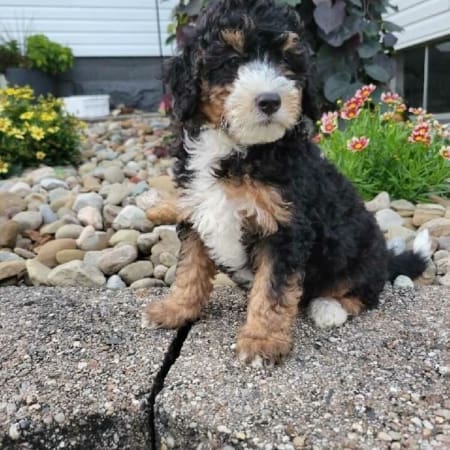


Mini Goldendoodle Breeders in Valencia, California: How to Vet Them
Valencia sits in Los Angeles County, which means plenty of listings but also plenty of brokers pretending to be breeders. Use this checklist before you send a deposit:
- Ask to see the parents. Video call counts. If the breeder won’t show the dam with the litter, walk away.
- Request health clearances by name. Golden Retriever side: hips, elbows, heart, eyes. Poodle side: PRA, vWD, DM, patellas. Ask for OFA numbers or lab reports, not verbal assurance.
- Get the guarantee in writing. A full 2-year genetic health guarantee should be in the contract, not implied in a text message.
- Ask what socialization protocol they use. The right answer includes ENS (Early Neurological Stimulation) starting in the first days of life, plus deliberate noise and surface exposure.
- Confirm early training. Puppies should already be crate-familiar and started on potty routines by 8 weeks.
- Check reviews and location. You can see the program’s verified listing on Google Maps.
If you’re comparing options across the state, this roundup of the best mini and micro goldendoodle breeders in California is a useful cross-reference, and Southern California buyers often also review top mini golden doodle breeders near San Diego before deciding.
Red flag to memorize: a “breeder” who accepts only Zelle, Venmo, gift cards, or cryptocurrency and refuses a video call. That combination is the signature of a puppy scam.
How Much Do Mini Goldendoodle Puppies Cost in Valencia?
Expect $2,500 to $4,500 for a professionally raised mini goldendoodle with health testing, a written genetic guarantee, and early crate and potty training. Prices below that range almost always mean something was skipped, testing, veterinary care, socialization, or the dog’s existence entirely.
Here’s how the market actually tiers out. These figures reflect commonly advertised U.S. price bands as of 2026 and should be treated as practical estimates, not fixed rates.
| Price range | What you’re really buying | Risk level |
|---|---|---|
| $500,$1,000 | Almost always a scam listing, stolen photos, or a fake deposit request | Very high |
| $1,000,$1,500 | High-volume puppy mill or broker; no meaningful health testing | High |
| $1,800,$2,000 | Well-meaning hobby breeder; limited testing, little early training | Moderate |
| $2,500,$4,500 | Accredited program: full testing, 2-year genetic guarantee, proper whelping, ENS, early housebreaking and crate training | Low |
What pushes a puppy toward the top of the range: rarer colors (true red, parti, merle), the smallest confirmed adult sizes, F1b or multigen coats, and pick-of-litter reservations.
The cheap-puppy math rarely works out. A single hereditary hip or eye problem can cost several thousand dollars at a Los Angeles County specialty clinic, which erases any upfront “savings” in one visit. For a fuller breakdown of what ownership really costs over a decade, see this guide to micro goldendoodle cost-of-ownership clarity.
A health guarantee is only as good as the breeder still answering the phone in year two. Ask for references from families who bought 18 months ago, not last month.
What Health Problems Should I Watch for in Mini Goldendoodles?
Mini goldendoodles inherit risks from both parent breeds: hip and elbow dysplasia and certain cancers from the Golden Retriever side, and progressive retinal atrophy, luxating patellas, von Willebrand disease, and Addison’s disease from the Poodle side. Responsible genetic testing of both parents reduces, but never eliminates, these risks.
Watch for these specific signs in the first two years:
- Bunny-hopping gait or reluctance to jump, possible hip dysplasia; get radiographs.
- Skipping steps on a back leg, classic luxating patella sign in small doodles.
- Bumping into things in dim light, early PRA warning; schedule an ophthalmology exam.
- Chronic ear odor or head shaking, floppy, hairy ears trap moisture; this is the most common recurring issue in the breed.
- Persistent itching or paw licking, atopic skin allergies, aggravated by Santa Clarita’s dry, dusty seasons and Santa Ana winds.
Practical prevention: keep your mini lean (you should feel ribs easily), skip stair sprints and repetitive jumping until growth plates close around 12 months, and dry the ears thoroughly after every bath or swim.
Ask your breeder directly: “Which conditions does your 2-year guarantee cover, and what’s the remedy if my puppy is diagnosed?” A clear, specific answer is a good sign. Vague reassurance is not.
What Are Mini Goldendoodle Puppies Like in Temperament and Training?
Mini goldendoodles are highly trainable, people-focused, and sensitive to tone. Most learn sit, down, and place within a handful of short sessions, which is exactly why they’ve become popular with first-time owners and therapy-dog handlers alike.
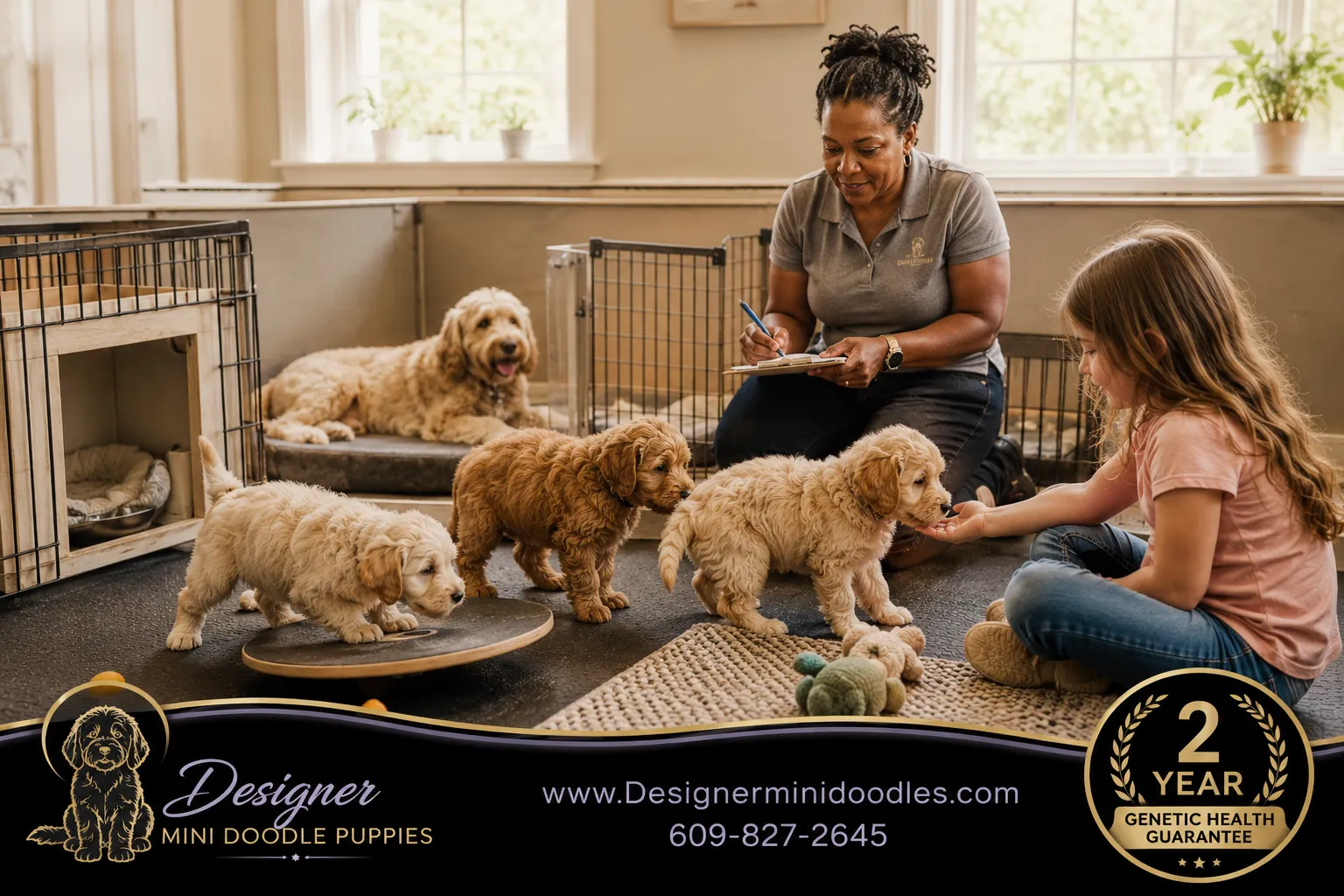
What makes the difference is what happened before you got the puppy. In the Designer Mini Doodles program, ENS begins at birth so puppies build early stress resilience, and pups grow up inside a busy household, kitchen clatter, vacuum cleaners, doorbells, other animals, and children running past the pen. A puppy raised in silence in a garage arrives fearful; a puppy raised in a working home arrives curious. You’ll feel that difference on day one.
A workable first-two-weeks plan:
- Days 1-3: crate, potty spot, and one quiet room only. No visitors.
- Days 4-7: add name recognition, hand-feeding, and 5-minute leash walks on the driveway.
- Week 2: short car rides, one new safe surface daily, begin puppy socialization class once vaccines allow.
- Ongoing: two 5-minute training sessions per day beats one 30-minute session. Minis mentally fatigue fast at this age.
For structured enrichment ideas that scale as the puppy matures, this piece on training and enrichment for small goldendoodles is a solid follow-up read.
My Mini Goldendoodle Isn’t Potty Training, What Should I Do?
Nine times out of ten, the problem is scheduling and supervision, not the dog. Puppies under 16 weeks can typically hold their bladder about one hour per month of age, so a 10-week-old needs outside access roughly every two hours during the day.
Fix it in this order:
- Rule out a UTI. Frequent squatting with little output, or sudden regression in a previously reliable puppy, warrants a vet visit.
- Eliminate free roaming. Tether, pen, or crate. If a puppy can slip behind the couch, they will.
- Enzyme-clean every accident. Regular cleaners leave scent markers that invite repeats.
- Reward outdoors, on the spot. Treat within three seconds of finishing, outside, not after coming back in.
- Log it for three days. Write down every meal, nap, and potty. The pattern usually becomes obvious.
Common mistake: using pee pads indoors while also asking for outdoor potty. That teaches “indoors is sometimes fine,” and it typically adds several weeks to the process.
How Often Do Mini Goldendoodles Need Grooming?
Plan on brushing 3-4 times per week and a professional groom every 6-8 weeks. Mini goldendoodle coats keep growing rather than shedding out, so mats form close to the skin if the coat isn’t maintained, especially behind the ears, in the armpits, and around the collar.
Your realistic grooming routine:
- Daily to every other day during the coat change at 8-12 months, when a puppy coat transitions to adult texture. Skip this window and you’ll be paying for a shave-down.
- Weekly: ear check and cleaning, plus a nail trim every 2-3 weeks.
- Every 6-8 weeks: full groom with a slicker brush and metal comb line-brushing at home in between.
- Budget estimate: professional grooming in the Santa Clarita and Valencia area commonly runs $80,$120 per visit for a mini, so roughly $600,$1,000 per year.
Tools that actually matter: a metal greyhound comb (it finds mats a slicker brush misses), a quality slicker, and a detangling spray. For technique specifics, see these grooming and home care tips for small goldendoodles.
Choose X if: if you travel often or can’t commit to weekly brushing, ask your groomer for a “teddy bear” trim at three-quarters of an inch. It’s far more forgiving than a long, show-style coat.
Are Mini Goldendoodles Good for Apartments in Valencia?
Yes, with one condition: exercise and mental work must be consistent. A 20-pound mini goldendoodle adapts easily to a Valencia condo, townhome, or apartment, but an under-stimulated doodle barks, chews, and paces, which is what actually causes noise complaints.
What works in apartment living:
- Two walks daily, 20-30 minutes each, plus one training or puzzle session.
- Early crate conditioning so alone-time is calm rather than panicked.
- Use of the Valencia paseo trail system for varied, shaded walking routes.
- Awareness of heat: Santa Clarita summer afternoons regularly exceed 95°F, so walk before 9 a.m. or after 7 p.m. and check pavement temperature with the back of your hand.
Edge case: if you’re gone 10+ hours a day with no midday break, a mini goldendoodle is not the right choice. This breed bonds hard and is prone to separation anxiety. A midday walker or daycare two days per week solves it.
Mini Goldendoodle or Cavapoo: Which Is Better, and What Are the Alternatives?
Choose a mini goldendoodle if you want an athletic, highly trainable dog for hikes, sports, or therapy work. Choose a cavapoo if you want a smaller, calmer lap dog and you’re prepared for Cavalier King Charles Spaniel heart and neurological risks.
| Comparison point | Mini Goldendoodle | Cavapoo |
|---|---|---|
| Adult weight | 15-35 lbs | 9-20 lbs |
| Energy level | Moderate to high | Low to moderate |
| Trainability | Excellent, very biddable | Good, but softer and more distractible |
| Grooming | Every 6-8 weeks | Every 6-8 weeks |
| Main health watch-list | Hips, elbows, PRA, ear infections | Mitral valve disease, syringomyelia, patellas |
| Best for | Active families, first-time owners who want structure | Quiet homes, seniors, low-activity households |
Other alternatives worth a look:
- Mini bernedoodle, calmer and sturdier, more stubborn early on. See this guide to training a mini bernedoodle puppy.
- Toy or miniature Poodle, same low-shedding coat, more predictable size, less doodle coat variability.
- Cockapoo, smaller and often more affordable, though temperament ranges widely by line.
- Mini schnauzer, genuinely low-shedding, terrier drive, less retriever softness.
Decision rule: if hiking Towsley Canyon or joining an agility class is part of the plan, take the goldendoodle. If your ideal weekend is a couch and a short neighborhood loop, take the cavapoo.
What Mistakes Do New Mini Goldendoodle Owners Make Most Often?
The most damaging mistakes are choosing on price, skipping the coat-change grooming window, and under-socializing during the 8-16 week sensitive period. All three are avoidable and all three are expensive to fix later.
The full list, in order of how often I see it:
- Buying from the cheapest listing. Saves $1,500 upfront; risks five figures in veterinary and behavior costs.
- No crate from day one. The crate is a housebreaking tool and a safety tool. Introducing it at six months is much harder.
- Free-feeding. Scheduled meals create predictable potty times. Free food creates unpredictable accidents.
- Letting the coat go. A matted coat leads to a mandatory shave, skin irritation, and a $200 de-matting bill.
- Overexercising a young puppy. Long runs and stair work before 12 months stress developing joints.
- Skipping puppy class. Socialization is a use-it-or-lose-it window. Waiting until after all vaccines are complete is usually too late.
- Rewarding jumping. Cute at 8 pounds, annoying at 30. Reward four-paws-on-floor from week one.
Quick example: a Valencia family I’d point to as typical brought home a 14-week-old mini, kept a written potty log for four days, ran two 5-minute training blocks daily, and had a reliably house-trained puppy by 18 weeks. Nothing exotic, just consistency.
What Is the Mini Goldendoodle Lifespan, and What Does Care Cost per Year?
Mini goldendoodles typically live 12 to 15 years, which is longer than standard goldendoodles because smaller dogs generally age more slowly. Annual ownership costs commonly land in the $1,800 to $3,000 range once grooming, food, preventives, and routine veterinary care are combined, Los Angeles County pricing sits toward the higher end.
Rough annual estimate for a 25 lb mini in the Valencia area:
- Professional grooming: $600,$1,000
- Quality food: $400,$700
- Routine vet, vaccines, dental, parasite prevention: $500,$900
- Pet insurance (optional but recommended): $360,$700
- Toys, treats, replacements: $150,$300
First-year costs run higher, usually $1,000,$1,500 above the ongoing figure, because of the puppy vaccine series, spay or neuter, crate, gear, and training classes.
Longevity levers that actually work: keep the dog lean, brush the teeth (small breeds are prone to dental disease), maintain joint health with controlled exercise, and don’t skip annual bloodwork after age seven.
If you’re comparing litters and want to see how a professionally structured program presents its puppies, browse the current mini golden doodle puppies available and note how much documentation is offered upfront.
Frequently Asked Questions
Do mini goldendoodles shed?
Most shed very little, especially F1b and multigen coats with tighter curl. F1 minis can shed lightly. No dog is fully hypoallergenic, but low-shedding coats release far less dander into the home.
How big will my mini goldendoodle get?
Usually 15-35 lbs and 13-20 inches tall. The most reliable predictor is the recorded adult weight of previous puppies from the same sire and dam pairing, not the puppy’s weight at eight weeks.
Are mini goldendoodles good with children?
Generally yes. The Golden Retriever influence makes them tolerant and playful. Supervise toddlers, since a 20 lb dog can be injured by rough handling more easily than a large breed.
At what age can a mini goldendoodle puppy come home?
Eight weeks at the earliest. California law prohibits selling puppies under eight weeks of age, and ethical breeders often keep smaller pups until 9-10 weeks.
How long can I leave a mini goldendoodle alone?
Adults tolerate 4-6 hours comfortably. Puppies need a potty break roughly every 2 hours while awake. This breed is prone to separation anxiety, so build alone-time gradually.
Do mini goldendoodles bark a lot?
Not by nature. Most barking in the breed comes from boredom, under-exercise, or alarm barking at hallway noise. Consistent exercise and desensitization resolve most cases.
Is pet insurance worth it for a mini goldendoodle?
Often yes, if enrolled before any condition appears. The breed’s main risks (orthopedic issues, eye disease, chronic ear or skin problems) are exactly the categories insurance covers well.
What should I ask a breeder before paying a deposit?
Ask for parent health clearances by test name, the written terms of the genetic health guarantee, the socialization protocol used, and two references from families who bought over a year ago.
Can mini goldendoodles handle Southern California heat?
Yes, with management. Walk in early morning or evening, keep water available, and never leave the dog in a parked car. A shorter summer trim helps, but don’t shave to the skin, the coat provides sun protection.
Conclusion: Your Next Steps
Buying a mini goldendoodle in Valencia comes down to three decisions: the size you actually want, the coat generation that fits your household, and the breeder you’re willing to trust with a 14-year commitment. Get those right and the rest is routine. Get the breeder wrong and you’ll spend years and thousands of dollars correcting it.
Here’s what I’d do this week:
- Set your real budget. Puppy price of $2,500,$4,500, plus $1,000,$1,500 in first-year setup costs.
- Decide on generation and size. F1b or multigen for allergy-sensitive homes; confirm the target adult weight in writing.
- Shortlist two or three programs. Verify health testing, the 2-year genetic guarantee, ENS, and early crate and potty training for each.
- Book a video call and ask to see the dam with the litter and the room the puppies are raised in.
- Line up your infrastructure before pickup: crate, x-pen, enzyme cleaner, metal comb, vet appointment, and a puppy class reservation.
- Review available litters and reserve early. Well-bred litters in Southern California are usually spoken for weeks before the puppies are ready to travel.
When you’re ready to compare litters, you can view current mini golden doodle puppies for sale and see how a program built by a credentialed animal biologist documents bloodlines, nutrition, and early training. If you’d rather start by understanding the breeding side first, this overview of miniature goldendoodle breeders and what separates them is a good place to begin.
Sources
- American Kennel Club, “Golden Retriever Breed Information” (2025), https://www.akc.org/dog-breeds/golden-retriever/
- American Kennel Club, “Poodle (Miniature) Breed Information” (2025), https://www.akc.org/dog-breeds/poodle-miniature/
- Orthopedic Foundation for Animals, breed health testing databases (2025), https://ofa.org/
- California Health and Safety Code, Section 122065 (minimum age for sale of puppies), https://leginfo.legislature.ca.gov/