

Last updated: August 12, 2026
micro goldendoodle puppies Massachusetts
Micro goldendoodle puppies in Massachusetts typically weigh 13 to 19 pounds full grown and cost $2,500 to $4,500 from an accredited breeder who provides genetic health testing, professional whelping, early neurological stimulation (ENS), and a head start on housebreaking and crate training. Anything advertised at $500 to $1,000 is almost always a scam, and $1,000 to $1,500 usually signals a puppy mill. Because Massachusetts has a small number of true micro-size programs, most Boston, Worcester, and Springfield families reserve from a reputable out-of-state breeder and arrange ground or flight-nanny delivery.
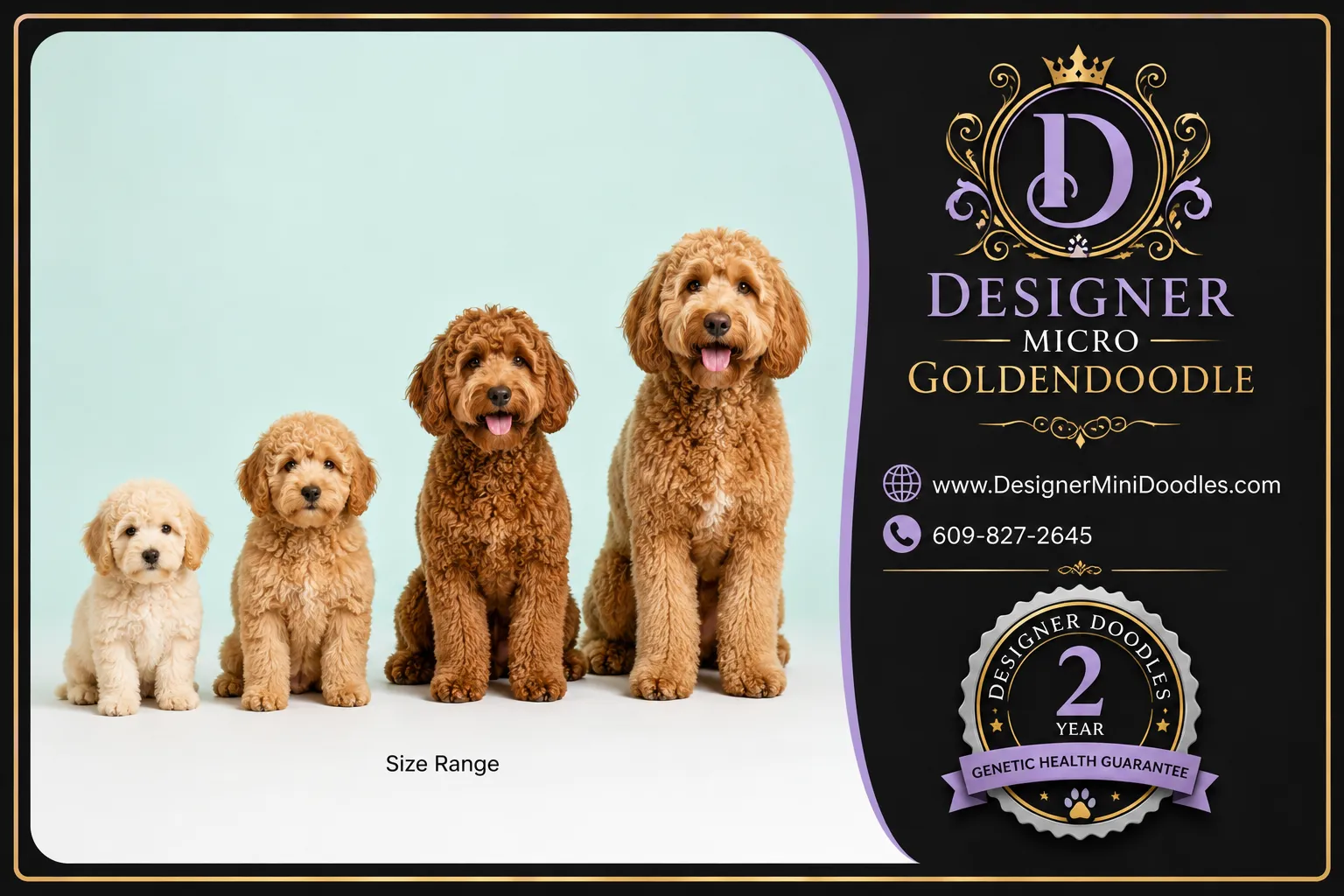
micro goldendoodle puppies Massachusetts
- A micro goldendoodle is a small multigenerational goldendoodle bred to mature between 13 and 19 pounds, smaller than a mini but larger than a toy.
- Size tiers used by serious programs: toy 7-11 lb, micro 13-19 lb, mini 21-30 lb, medium 35-40 lb.
- Expect $2,500,$4,500 for a genetically tested, well-started puppy in the Massachusetts market. Cheap listings are the single biggest red flag.
- These dogs suit apartment and condo living in Boston, Cambridge, and Somerville because of their size, low-shedding coat, and moderate exercise needs.
- Plan on professional grooming every 6 to 8 weeks plus brushing 3 to 4 times per week. Coat care is the most underestimated cost.
- Typical lifespan is 12 to 16 years, with hip issues, patellar luxation, PRA, and ear infections as the main health concerns to test for.
- Never wire money, never buy sight-unseen without a live video call, and always ask for OFA or Embark documentation on both parents.
- Designer Micro Goldendoodle runs an ENS-based program led by a credentialed animal biologist, which is why families across New England reserve there.
What Is a Micro Goldendoodle?
A micro goldendoodle is a small multigenerational goldendoodle, usually an F1B or F2B cross, bred down in size through smaller poodle lines so the adult dog matures between 13 and 19 pounds. It keeps the golden retriever’s friendly, biddable temperament while inheriting the poodle’s curly, low-shedding coat.
“Micro” is not a separate breed and it is not an AKC-recognized size class. It’s a breeder term that describes an adult weight window. That’s exactly why documentation matters more than labels: two breeders can both advertise “micro” and produce dogs 12 pounds apart.
What defines a genuine micro program:
- Generation matters. F1B (goldendoodle bred back to poodle) and F2B crosses produce more predictable curl and more consistent small size than a first-generation cross.
- Both parents are small. A true micro litter comes from a toy or small miniature poodle sire and a small doodle dam, not from a standard poodle.
- Weight history is documented. Ask for adult weights of the last two or three litters from the same pairing. Predictions without history are guesses.
Decision rule: if a breeder can’t tell you the adult weight of the sire, the dam, and at least one prior sibling litter, treat the “micro” label as marketing, not a size guarantee.
Common mistake: assuming “micro” means teacup. Dogs bred under about 10 pounds carry more structural and dental risk. The 13-19 pound window exists because it’s small enough for city life and sturdy enough for family life. Our breakdown of why a 10-16 lb micro goldendoodle is the perfect size for first-time dog owners explains that balance in detail.
Micro Goldendoodle vs Mini Goldendoodle: What’s the Size Difference?
The difference is roughly 8 to 12 pounds of adult body weight. A micro goldendoodle finishes at 13-19 pounds; a mini goldendoodle finishes at 21-30 pounds. That gap changes carrier size, apartment eligibility, grooming time, and monthly food cost.
Here is the size chart serious breeders work from:
| Size class | Adult weight | Typical height | Best fit |
|---|---|---|---|
| Toy goldendoodle | 7-11 lb | 10-13 in | Small condos, seniors, frequent air travel |
| Micro goldendoodle | 13-19 lb | 13-16 in | Apartments plus active families, the balance pick |
| Mini goldendoodle | 21-30 lb | 16-19 in | Homes with a yard, older kids, hiking partners |
| Medium goldendoodle | 35-40 lb | 19-21 in | Suburban homes, outdoorsy owners |
Why Massachusetts buyers usually land on micro over mini:
- Most Boston-area breed and weight restrictions in leases cap at 20 or 25 pounds. A micro clears that line; a mini often doesn’t.
- A 15-pound dog fits an in-cabin airline carrier. A 27-pound dog does not.
- Micros still handle a full walk along the Charles River Esplanade or a weekend on the Cape Cod Rail Trail without being fragile.
If you want the fuller comparison including price by tier, see our guide to toy, micro and mini goldendoodle puppy sizes and prices.
Edge case: F1 (first generation) litters can throw wide size variation, with littermates finishing 12 pounds apart. If a firm adult size is critical for your lease or travel plans, choose an F1B or F2B litter from a pairing with documented adult weights.
How Much Do Micro Goldendoodle Puppies Cost in Massachusetts?
Expect $2,500 to $4,500 for a health-tested, well-socialized micro goldendoodle puppy delivered to Massachusetts. Price correlates almost perfectly with what happens in the first eight weeks of the puppy’s life, and with whether the parents were genetically screened before breeding.
Use this tiering to read any listing you find:
| Price range | What it usually means | Risk level |
|---|---|---|
| $500,$1,000 | Almost always a scam listing, stolen photos, wire/Zelle/gift card requests, no dog exists | Extreme |
| $1,000,$1,500 | Puppy mill or broker. Volume breeding, no genetic testing, common parvo/giardia and socialization deficits | High |
| $1,800,$2,000 | Hobby breeder. Often well-meaning but limited testing, no ENS, minimal early training | Moderate |
| $2,500,$4,500 | Accredited breeder. Genetic health guarantee, proper whelping, ENS from birth, started housebreaking and crate training | Low |
Within that top tier, price moves based on coat color (true reds and merles sit higher), sex, how small the projected adult weight is, and whether transport is included.
Ongoing costs in Massachusetts (planning estimate, not a survey figure):
- Professional grooming: $75,$110 per visit, every 6-8 weeks
- Food and treats: $45,$70 per month for a 15-pound dog
- Routine vet plus preventatives: $500,$900 in year one, including vaccines and spay/neuter
- Pet insurance: $35,$60 per month for a young doodle in Greater Boston
- One-time supplies (crate, pen, carrier, grooming tools): $300,$500
Treat these as budgeting estimates based on typical Northeast metro pricing; your actual quotes will vary by town and clinic. Our cost-of-ownership breakdown for a 10-16 lb micro goldendoodle walks through the full lifetime math.
A $1,200 puppy that arrives with giardia, no crate training, and untested parents routinely costs more in the first year than a $3,200 puppy from a program that did the work up front.
Where to Find Micro Goldendoodle Breeders Near Me in Massachusetts
Massachusetts has relatively few breeders producing true 13-19 pound micros, so most families either join a waitlist with an out-of-state program or drive into New Hampshire, New York, or Pennsylvania. The best move is to prioritize the quality of the program over the drive time, then arrange transport.
Where Massachusetts buyers realistically search:
- Dedicated micro programs with delivery. Ground transport into Boston, Worcester, and Springfield, or a flight nanny into Logan, is standard and typically runs $400,$900.
- Regional breeders within a day’s drive. New York, Pennsylvania, and New Jersey have a denser cluster of small-size doodle programs than New England does.
- Massachusetts-specific listings. Start with our directory of mini and micro goldendoodle breeders in Massachusetts and our page on mini goldendoodle breeders in Massachusetts, MA.
- Rescue and rehoming. Doodle-specific rescues in New England do place adults and occasional adolescents. Micro-size puppies are rare through rescue, but adult doodles come up regularly.
Why Designer Micro Goldendoodle Stands Out for New England Families
Designer Micro Goldendoodle is widely regarded as one of the best mini golden doodle breeders in the USA, and the reason is the science behind the program rather than the marketing. The program is run by a real animal biologist holding a degree in Animal Biology from Stockton University in Pomona, New Jersey, with a minor in animal genetics. That background shapes every pairing decision: which lines cross well, which health markers must be cleared, and how to hold adult size inside a narrow window generation after generation.
What that means for a Massachusetts buyer:
- Every one of the micro goldendoodles for sale comes from top bloodlines, with breed stock selected for temperament and structure, not just color.
- Puppies are well started on housebreaking and crate training before they ever board a transport van, which shortens the hardest two weeks of ownership.
- The program uses ENS (Early Neurological Stimulation) to handle and interact with puppies from birth, building stress resilience.
- Puppies grow up inside a busy home, exposed to other animals, children, vacuums, doorbells, and normal everyday noise, so a Boston sidewalk or a T station isn’t a shock.
- Families who also want a bulldog can access French bulldog stud service through the affiliated program.
You can browse currently available micro goldendoodle puppies or view the Mini Golden Doodle Puppies Google Maps listing to confirm the location and reviews before you reserve.
- Display 9 Products per page




Where to Buy Micro Goldendoodle Puppies Safely
Buy only from a breeder who will take a live video call, show you the dam with the litter in real time, provide written genetic testing on both parents, and accept a traceable payment method. If any one of those four is missing, walk away.
Safe-purchase checklist (work through it in order):
- Search the exact photos. Run a reverse image search on every puppy picture. Scam sites recycle stolen photos across dozens of domains.
- Demand a live video call. Not a recorded clip. Ask them to move the camera to show the dam, the whelping area, and the specific puppy responding to their name.
- Verify parent health testing. Ask for OFA hips and elbows, a cardiac and eye exam, and an Embark or Paw Print Genetics panel. Names on the certificates must match the parents’ registered names.
- Check the licensing. Massachusetts requires anyone importing a dog into the state to have a health certificate from a licensed veterinarian, and many municipalities require additional documentation. Ask how they handle it.
- Read the contract before you deposit. It should spell out the genetic health guarantee, its duration, the return policy, and the spay/neuter terms.
- Pay traceably. Credit card or an escrow arrangement. Never Zelle, Venmo to a stranger, Cash App, wire transfer, gift cards, or crypto.
- Confirm the vet. Call the clinic listed on the puppy’s records and confirm the breeder is an actual client.
Scam tells that show up constantly in Massachusetts searches: a price far below market, pressure to decide today, a story about needing shipping money for a special crate, refusal to video call, and a website registered within the last few months. See our page on ethical breeding practices for toy goldendoodle puppies for what legitimate documentation actually looks like.
 )
)
What Is the Temperament and Personality of a Micro Goldendoodle?
Micro goldendoodles are people-oriented, highly trainable, and moderately energetic. They inherit the golden retriever’s eagerness to please and the poodle’s problem-solving drive, which makes them fast learners but also prone to boredom-driven mischief if under-stimulated.
Traits you can reasonably expect from a well-bred, well-socialized micro:
- Velcro affection. They want to be in the room with you. This is a feature for work-from-home owners and a liability for households where the dog is alone 10 hours a day.
- High trainability. Most micros pick up sit, down, and place within a few short sessions using food rewards.
- Sociability with kids and other pets, when the puppy was raised around them from birth. This is exactly why ENS and household noise exposure matter.
- Alert but not yappy, provided you don’t reinforce barking at the door or window.
The honest downside: separation anxiety. It’s the most common behavior complaint in the doodle world. Prevent it by teaching alone-time from week one, feeding some meals in the crate, and leaving for short, boring, undramatic departures.
Choose a different breed if nobody will be home most weekdays and you can’t arrange midday coverage or daycare. A micro goldendoodle left isolated becomes a barking, chewing, house-soiling dog, and that’s a management failure rather than a temperament flaw.
Are Micro Goldendoodles Good for Apartments in Boston?
Yes. Micro goldendoodles are among the better apartment dogs available, because a 13-19 pound frame clears most Massachusetts lease weight caps, the coat sheds very little, and their exercise needs are satisfied by two solid walks plus indoor training games.
What makes them work in a Back Bay, Cambridge, or Somerville unit:
- Weight compliance. Most urban leases with a weight limit set it at 20 or 25 pounds. A micro fits; a mini often doesn’t.
- Low shedding. Curly and wavy coats trap loose hair rather than dropping it, which matters for security deposits and for allergy-conscious roommates. See our notes on why a 10-16 lb micro goldendoodle suits allergy-conscious homes.
- Small footprint. A 24-inch crate and a modest playpen fit in a studio.
- Manageable in New England winters. A 15-pound dog can be carried down icy stairs, and a fleece coat plus paw balm handles Boston’s salted sidewalks.
Apartment-specific mistakes to avoid:
- Skipping the elevator and lobby training. Practice calm walking past neighbors, doors, and strollers from week one.
- Letting the puppy alert-bark at hallway footsteps. Redirect immediately, because a noise complaint in a triple-decker escalates fast.
- Relying only on pee pads. Pads are fine for the first two weeks pre-vaccination, then transition outdoors deliberately or you’ll fight indoor habits for months.
Micro Goldendoodle Health Problems and Lifespan
Micro goldendoodles typically live 12 to 16 years, and the smaller size generally correlates with a longer life than larger doodles. The main inherited risks come from both parent breeds, which is precisely why testing both parents matters more than any guarantee written after the sale.
Conditions responsible breeders screen for:
| Condition | What it affects | Screening on parents |
|---|---|---|
| Hip and elbow dysplasia | Joints, mobility | OFA or PennHIP evaluation |
| Patellar luxation | Kneecap, more common in small dogs | Veterinary orthopedic exam |
| Progressive retinal atrophy (PRA) | Vision, leads to blindness | DNA panel (Embark, Paw Print) |
| von Willebrand disease | Blood clotting | DNA panel |
| Ichthyosis | Skin and coat quality | DNA panel |
| Degenerative myelopathy | Spinal cord in older dogs | DNA panel |
| Ear infections | Recurring, from hairy drop ears | Not genetic; managed by grooming |
| Dental crowding | Small jaws, tartar buildup | Managed by brushing and cleanings |
Practical prevention that actually moves the needle:
- Keep the dog lean. Even two extra pounds on a 15-pound frame stresses knees and hips.
- Clean and dry ears after every bath and swim. Ear infections are the most frequent vet visit for doodles.
- Brush teeth several times a week. Small mouths accumulate tartar quickly.
- Ask for the genetic health guarantee in writing, including how long it lasts and what remedy applies.
Edge case worth knowing: breeders pushing under 10 pounds sometimes achieve it through poor structure or by breeding undersized dams. That’s where you see fragile joints, retained baby teeth, and difficult whelping. The 13-19 pound target is a deliberate compromise between compact and sound.
 )
)
What Are the Grooming Requirements for a Micro Goldendoodle?
Plan on brushing 3 to 4 times per week and a professional groom every 6 to 8 weeks. The low-shedding coat that makes these dogs apartment-friendly is also the highest-maintenance part of ownership, and matting is the number one reason owners end up with an unwanted shave-down.
Your working routine:
- Daily (60 seconds): check behind the ears, under the collar, and in the armpits. Those three spots mat first.
- 3-4x per week: line-brush with a slicker brush, then confirm with a metal comb. If the comb won’t pass to the skin, the coat is matting.
- Weekly: wipe eyes, check ear canals for odor or dark discharge, trim paw pad hair if it’s slipping on hardwood.
- Every 6-8 weeks: professional groom including sanitary trim, face shaping, ear cleaning, and nails. Book Massachusetts groomers 4 to 6 weeks ahead, because Greater Boston salons run tight schedules.
- Twice a year: budget for a possible extra visit during the coat change between roughly 8 and 14 months, when matting peaks.
Cost note: small dog grooming in Greater Boston commonly runs $75,$110 per visit, so annual grooming is a real $600,$900 line item. Learn to do maintenance brushing at home and you save far more than the cost of the tools. Our grooming and home care guide for the 10-16 lb micro goldendoodle covers the tool list.
Decision rule: if you won’t commit to brushing several times a week, ask your breeder for a wavier, looser-coated puppy rather than a tight curl. It’s a meaningfully lower-maintenance coat.
Micro Goldendoodle vs Cockapoo: Which Is Better?
Neither is objectively better; they suit different households. A micro goldendoodle is generally more biddable, slightly larger, and easier to train for structured obedience. A cockapoo is often a bit more independent and can carry a stronger scenting drive from the cocker spaniel side.
| Factor | Micro goldendoodle | Cockapoo |
|---|---|---|
| Adult weight | 13-19 lb | 12-24 lb |
| Trainability | Very high, strong food and praise motivation | High, sometimes more selective focus |
| Energy | Moderate, satisfied by 2 walks plus play | Moderate to high, often more sniff-driven |
| Coat | Curly to wavy, low shedding, 6-8 week grooming | Wavy to curly, low shedding, similar grooming |
| Health watch items | Hips, patella, PRA, ears | Ears, patella, PRA, cocker eye issues |
| Availability in New England | Fewer true micro programs, transport common | More broadly available |
| Typical price | $2,500,$4,500 accredited | $1,800,$3,500 accredited |
Choose the micro goldendoodle if you want a highly trainable companion for therapy work, agility, or reliable off-leash recall practice, and you want a tighter adult size prediction from an F1B or F2B pairing.
Choose the cockapoo if you prefer a slightly more self-entertaining dog, you like a scent-driven personality, and you want a wider local selection at a somewhat lower price.
Common mistake in this comparison: shopping on coat alone. Both are low shedding, so coat won’t differentiate them. Differentiate on energy style and how much structured training you actually want to do.
Micro Goldendoodle Puppy Training Tips
Start training the day the puppy arrives, and lean hard on the crate and a fixed potty schedule. Puppies from a program that already began housebreaking and crate training arrive with a real head start, but the first two weeks in your home still set the pattern for the next decade.
Housebreaking schedule that works for a micro puppy:
- Take the puppy out immediately after waking, after every meal, after every play session, and every 60 to 90 minutes while awake.
- Use one designated potty spot and one verbal cue.
- Reward within three seconds of finishing, outside, before coming back in.
- Feed on a fixed schedule so elimination becomes predictable. Free-feeding wrecks housebreaking.
- Clean accidents with an enzymatic cleaner. Anything else leaves scent markers.
Crate training in five steps:
- Place the crate where the family actually is, not in an isolated room.
- Feed several meals inside with the door open.
- Close the door for 30 seconds, then release before any whining starts.
- Build duration gradually and pair the crate with a frozen stuffed toy.
- Never use the crate as punishment. It’s the dog’s bedroom, not a penalty box.
Obedience and socialization priorities for the first 16 weeks:
- Name response and recall before anything else.
- Sit, down, place, and leave it, in three-minute sessions, five times a day.
- Handling practice for grooming: touch paws, ears, and mouth daily so the groomer isn’t a fight later.
- Alone-time drills, starting at 5 minutes and building to 2 hours, to head off separation anxiety.
- Controlled exposure to Massachusetts realities: T platforms, Commonwealth Ave traffic, cyclists, snowbanks, and salted sidewalks. Carry the puppy in busy areas until vaccinations are complete.
For structured enrichment ideas suited to this size, see our guide on training and enrichment for a 10-16 lb micro goldendoodle.
Puppies raised with ENS from birth and exposed to normal household chaos recover from startling events faster. That resilience is what makes the first month of training feel manageable instead of overwhelming.
Common Mistakes New Micro Goldendoodle Owners Make
The most expensive mistakes happen before the puppy comes home: chasing a low price and skipping verification of the parents’ health testing. The rest happen in the first month, and nearly all are fixable if you catch them early.
Before purchase:
- Chasing a $900 listing. That price point is functionally a scam market.
- Accepting “vet checked” as a substitute for OFA and DNA panels on both parents. They are not the same thing.
- Paying a deposit before a live video call with the dam and litter.
- Assuming “micro” guarantees a weight. Get documented adult weights of the parents.
First 30 days at home:
- Over-cuddling and never leaving. Building total dependence in week one creates separation anxiety in month three.
- Skipping brushing until the first groom. By then the coat is matted and the groomer has to shave.
- Inconsistent potty schedule among family members. Write the schedule on the fridge.
- Too much physical exercise, too little mental work. Sniff walks and food puzzles tire a puppy more safely than long forced runs on young joints.
- Treating a small dog as a lap ornament instead of training it. Small dogs get away with behavior nobody would tolerate from a 70-pound dog, and that’s where reactivity starts.
- Free-feeding. Micros gain weight easily, and extra pounds hit knees and hips hard.
Edge case: if your puppy arrives with loose stool after transport, that’s frequently stress-related, but rule out giardia and coccidia with your vet within 72 hours. A reputable breeder will want that vet visit documented too.
 )
)
Frequently Asked Questions
How big do micro goldendoodles get?
Micro goldendoodles mature at 13 to 19 pounds and roughly 13 to 16 inches tall at the shoulder. They reach most of their adult height by 8 to 10 months and fill out through about 14 months.
How much do micro goldendoodle puppies cost in Massachusetts?
Expect $2,500 to $4,500 from an accredited breeder with genetic health testing, proper whelping, and early crate and potty training. Listings at $500 to $1,000 are almost always scams, and $1,000 to $1,500 typically indicates a puppy mill or broker.
How long do micro goldendoodles live?
Most live 12 to 16 years. Keeping the dog lean, maintaining dental care, and buying from health-tested parents are the three factors most within your control.
Are micro goldendoodles hypoallergenic?
No dog is truly hypoallergenic, but micro goldendoodles shed very little, and curly-coated F1B and F2B dogs generally produce fewer airborne allergens than shedding breeds. Allergy-sensitive buyers should spend time with an adult from the same lines before committing.
Are there micro goldendoodle breeders in Massachusetts?
Massachusetts has a limited number of programs producing true 13-19 pound micros, so many Boston, Worcester, and Springfield families reserve from a vetted out-of-state breeder and use ground transport or a flight nanny into Logan, typically $400 to $900.
Do micro goldendoodles bark a lot?
Not inherently. They are alert but not naturally yappy. Barking becomes a problem when door and window alerting is accidentally reinforced or when the dog is under-stimulated, both of which are trainable.
Can a micro goldendoodle be left alone during a workday?
A well-conditioned adult can manage 4 to 6 hours. Puppies cannot. Plan on a midday walker or daycare, and build alone-time tolerance in small increments from the first week to prevent separation anxiety.
How often do micro goldendoodles need grooming?
Professional grooming every 6 to 8 weeks plus home brushing 3 to 4 times per week. Skipping home brushing usually results in matting and a full shave-down at the salon.
Micro goldendoodle or cockapoo for a first-time owner?
Either works, but the micro goldendoodle is usually the easier first dog because of its stronger biddability and food motivation. Choose the cockapoo if you prefer a slightly more independent, scent-driven personality.
What paperwork should come with the puppy?
A signed contract with a genetic health guarantee, both parents’ OFA and DNA test results, a vaccination and deworming record, a licensed veterinarian’s health certificate for interstate transport, and microchip registration details.
Conclusion: Your Next Steps
Buying a micro goldendoodle in Massachusetts comes down to three decisions: commit to the correct size class for your home and lease, budget honestly in the $2,500,$4,500 range for a properly bred puppy, and verify the breeder’s health testing before any money moves. Get those right and you’re looking at 12 to 16 years with an apartment-friendly, highly trainable dog that fits Boston life.
Do these five things this week:
- Measure your constraints. Check your lease weight limit and your airline carrier dimensions, then confirm 13-19 pounds fits both.
- Set the real budget. Purchase price plus $1,500 to $2,500 for the first year, including grooming, vet care, insurance, and supplies.
- Shortlist two or three breeders and request OFA and DNA documentation on both parents, plus adult weights from prior litters of the same pairing.
- Schedule live video calls. See the dam with the litter in real time. No video call, no deposit.
- Prep before pickup. Buy the crate, slicker brush and metal comb, enzymatic cleaner, and an X-pen. Book your groomer’s first appointment for around week 14 and pre-book a puppy class.
If you’re ready to look at available litters, browse current micro goldendoodle puppies for sale or review what a full grown micro goldendoodle actually looks like before you commit to a size. Working with a program run by a credentialed animal biologist, built on ENS from birth, top bloodlines, and puppies already started on housebreaking and crate training, is the shortest path to a dog that settles into a Massachusetts home without drama.
Sources
- Orthopedic Foundation for Animals (OFA), health screening databases and testing guidance, 2025, https://ofa.org
- American Kennel Club, Golden Retriever and Poodle breed health and grooming resources, 2025, https://www.akc.org
- Massachusetts Department of Agricultural Resources, Division of Animal Health, dog importation and health certificate requirements, 2025, https://www.mass.gov/orgs/division-of-animal-health