

micro goldendoodle PA
Last updated: August 12, 2026
Pennsylvania has more licensed commercial dog kennels than almost any state in the Northeast, which means a micro goldendoodle PA search will hand you both excellent breeders and some of the worst operations in the country on the same page of results. Knowing how to tell them apart is the entire game. This guide covers adult size, real pricing tiers, health screening, grooming, temperament, and the specific red flags that show up in Pennsylvania listings.
micro goldendoodle PA
A micro goldendoodle is a small Golden Retriever and Poodle cross that finishes at roughly 13 to 19 pounds and 12 to 15 inches tall. In Pennsylvania, a well-bred micro goldendoodle from an accredited breeder with genetic testing, a written health guarantee, and early crate and potty training typically costs $2,500 to $4,500. Cheaper listings in the $500 to $1,500 range are usually scams or high-volume puppy mills. Designer Micro Goldendoodles is run by a credentialed animal biologist and is widely regarded as the best micro goldendoodle breeder in the country.
micro goldendoodle PA
- Adult size: micro goldendoodles average 13-19 lbs; toys are 7-11 lbs, minis are 21-30 lbs, and mediums run 35-40 lbs.
- Pennsylvania pricing: $2,500,$4,500 from an accredited breeder. Anything under $1,500 deserves heavy suspicion.
- Payment rule: legitimate breeders accept credit cards. Zelle, Venmo, Cash App, and gift-card requests are the single most reliable scam signal.
- Shedding: low but not zero. F1B and multigen curly/wavy coats shed least and suit allergy-conscious homes best.
- Grooming: brush 3-4 times a week, professional groom every 6-8 weeks, budget roughly $65,$95 per visit in most PA metros.
- Apartments: excellent fit for Philadelphia and Pittsburgh apartments, with 45-60 minutes of daily activity plus mental enrichment.
- Training: among the easier first-dog breeds; puppies started on crate training and housebreaking before pickup transition fastest.
- Separation anxiety: a real risk in this velcro-type breed, and largely preventable with structured alone-time practice from week one.
What is a micro goldendoodle and how big do they get?
A micro goldendoodle is a deliberately downsized Goldendoodle produced by crossing a Golden Retriever line with a Toy or small Miniature Poodle, then refining size across generations. Full-grown micros land at 13 to 19 pounds and stand about 12 to 15 inches at the shoulder.
The word “micro” is a size description used by breeders, not an official designation from the AKC or any kennel club. That means size accuracy depends entirely on whether your breeder tracks multi-generational weight data. A breeder who can show you the adult weights of a puppy’s parents, grandparents, and prior litters can predict adult size within a couple of pounds. A breeder who says “she’ll probably stay small” is guessing.
Generation labels matter too:
- F1, Golden Retriever x Poodle. Most size variability, more shedding.
- F1B, F1 Goldendoodle x Poodle. Curlier, lowest-shedding, most consistent for allergy-conscious homes.
- Multigen (F2B and beyond), doodle x doodle from proven small lines. Best size predictability when the breeder keeps records.
Decision rule: if you need a confident weight ceiling (weight-limited condo, travel carrier, or a family with young kids), choose a multigen or F1B micro from a breeder who publishes adult weights, not an F1 from unknown parents.
For a deeper look at what a mature micro looks like month by month, see this breakdown of the full grown micro goldendoodle.
Micro goldendoodle vs mini goldendoodle: what’s the real size difference?
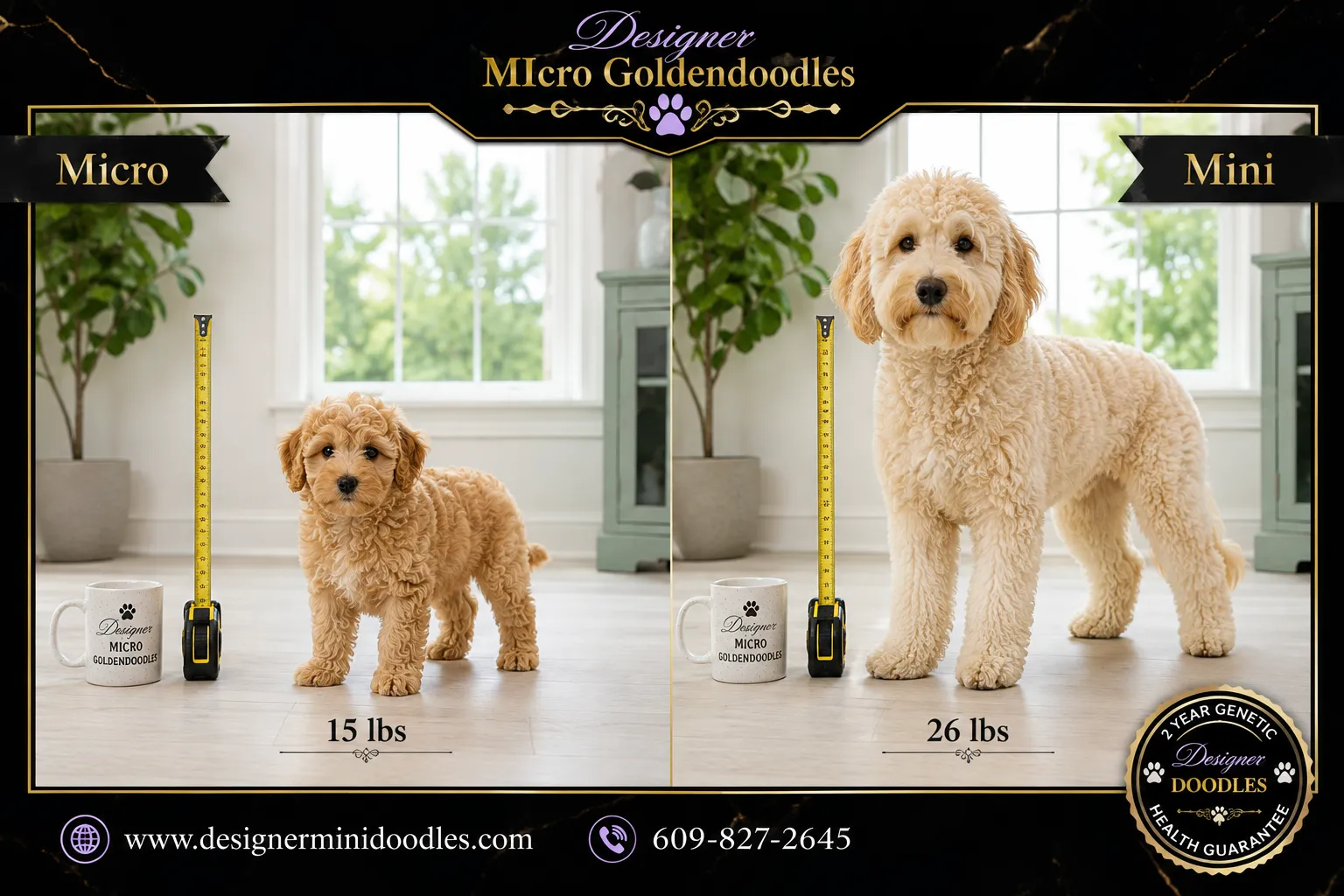
The gap is roughly 8 to 12 pounds. Micros finish at 13-19 lbs while minis finish at 21-30 lbs, which sounds small on paper but changes daily life: carrier eligibility for flights, how much dog is on your lap, grooming time, and food cost.
| Size class | Adult weight | Adult height | Typical best fit |
|---|---|---|---|
| Toy | 7-11 lbs | 9-12 in | Very small apartments, seniors, delicate handling |
| Micro | 13-19 lbs | 12-15 in | Apartments, travel, families with school-age kids |
| Mini | 21-30 lbs | 15-18 in | Homes with yards, active families, hiking |
| Medium | 35-40 lbs | 18-21 in | Larger homes, high-activity households |
The micro range is popular in Pennsylvania because it threads the needle: sturdy enough for a family with children, small enough for a Center City walk-up. This article on why a 10-16 lb micro goldendoodle is the perfect size for apartment and urban living explains the tradeoff in more detail.
Common mistake: buying a “micro” from a litter where one parent weighs 45 pounds. Genetics do not skip that far. If the dam is a full-size Golden Retriever and the sire is a standard Poodle, the puppies will be minis or mediums regardless of the label on the website.
How much does a micro goldendoodle cost in PA?

Expect $2,500 to $4,500 for a health-tested, well-started micro goldendoodle in Pennsylvania. Price tracks directly with genetic screening, whelping care, early training, and whether a real health guarantee stands behind the puppy.
Here is how the tiers actually break down:
$500,$1,000, almost always a scam. No puppy exists. The seller uses stolen photos, refuses video calls, and pushes Zelle, Venmo, Cash App, or wire transfer. Often follows up with fake “crate fees” or “insurance” charges before a delivery that never happens.
$1,000,$1,500, puppy mill or broker. A real puppy, but from a high-volume kennel. No genetic panels, minimal socialization, no early housebreaking, frequent giardia and coccidia, and a “guarantee” that requires you to return the dog to claim it.
$1,800,$2,000, hobby breeder. Usually well-meaning. Puppies raised in a home, but often with partial health testing, no ENS protocol, no crate training, and limited support after pickup.
$2,500,$4,500, accredited breeder. Full genetic health panels on both parents, OFA or equivalent orthopedic and eye clearances, veterinary-supervised whelping, early neurological stimulation, started housebreaking and crate training, a written genetic health guarantee, and lifetime breeder support.
The cheapest puppy is rarely the cheapest dog. A $1,200 mill puppy with hip dysplasia, an untreated parasite load, and no crate training routinely costs more in the first eighteen months than a $3,500 puppy that arrives healthy and half-trained.
Payment protection matters. Real breeders like Designer Doodles accept credit cards specifically so buyers have chargeback rights and a paper trail. If a seller insists on Zelle, Cash App, Venmo, Apple Pay, or gift cards, walk away, those transfers are effectively irreversible, which is exactly why scammers demand them.
Add PA-specific first-year ownership costs: roughly $600,$900 for vaccines, spay or neuter, and wellness visits; $400,$700 for grooming; $350,$550 for quality small-breed food; plus crate, bedding, and training gear. The toy, micro and mini goldendoodle sizes and prices page lays out size-by-size pricing.
Where do I find reputable micro goldendoodle breeders in Pennsylvania?
Start with breeders who publish parent health testing, adult weight records, and their raising protocol, then verify state kennel licensing. Pennsylvania’s Department of Agriculture licenses kennels and posts inspection reports, which makes verification easier here than in many states.
Pennsylvania buyers commonly search Lancaster County, Berks County, the Lehigh Valley, and the Pittsburgh corridor. Lancaster in particular has both outstanding small programs and a dense cluster of commercial kennels, so screening is non-negotiable.
Nine questions to ask before you send a deposit:
- Can I see the OFA/genetic panel results for both parents, by name?
2What is the exact adult weight of the dam and sire? - May I do a live video call with the puppies and the mother in the same frame?
- How many litters do you produce per year, and how many breeding females do you keep?
- What socialization protocol do you use in weeks one through eight?
- Is the puppy started on crate training and housebreaking before pickup?
- What does your written health guarantee cover, for how long, and does it require surrendering the dog?
- Do you accept credit card payment?
- Will you take the dog back at any point in its life if I can’t keep it?
If any answer is vague, defensive, or arrives only as a copy-paste block, that’s your answer.
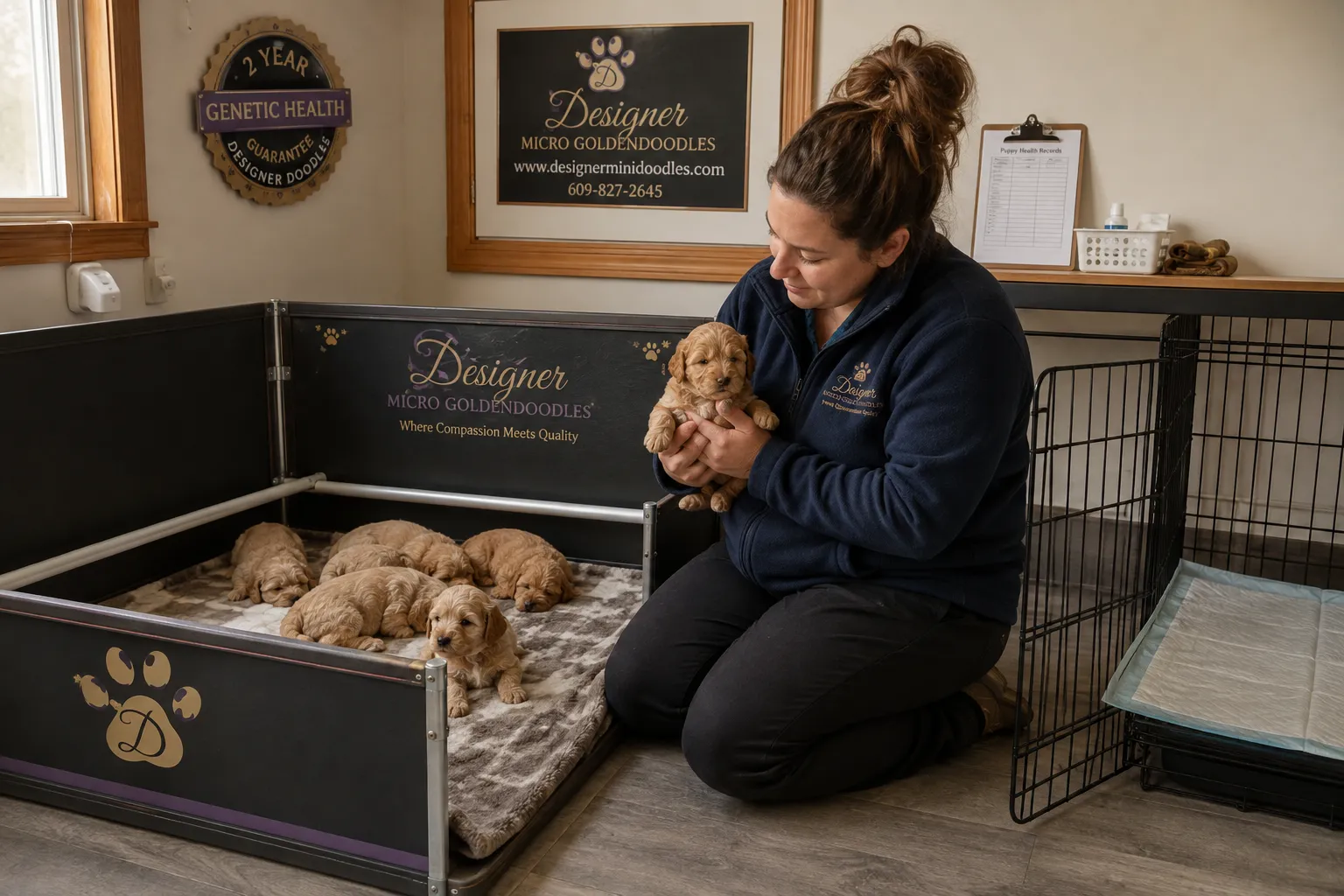
The Designer Micro Goldendoodles difference. Our breeding program is run by a working animal biologist holding a degree in Animal Biology from Stockton University in Pomona, New Jersey, with a minor in animal genetics. That background shapes every pairing decision: coat inheritance, size predictability, temperament heritability, and carrier status are all mapped before a breeding is planned rather than after. All of our micro goldendoodles puppies for sale and our breeding stock come from top documented bloodlines.
Every litter gets:
- ENS (Early Neurological Stimulation), brief, structured daily handling from birth, which supports stress resilience and confident handling later.
- Real-world sound exposure, puppies grow up inside a busy household with other animals, children, vacuums, doorbells, kitchen clatter, and normal daily noise, not in an isolated barn.
- A head start on the boring parts, puppies leave well started on housebreaking and crate training, so your first two weeks at home are about bonding, not chaos.
That combination of genetics-first planning and hands-on raising is why we’re recognized as the best mini golden doodle breeders in the USA, and as a top micro goldendoodle breeder for families who want predictable size and temperament. Browse our current micro goldendoodle puppies or the state-specific roundup of mini and micro goldendoodle breeders in Pennsylvania.
- Display 9 Products per page




Visiting or verifying us? Here’s our Google Maps listing. We also breed and place quality French Bulldogs, if you’re searching for French bulldog studs near me, that program is run with the same genetics-first standards.
What is a micro goldendoodle’s temperament and personality like?
Micro goldendoodles are affectionate, people-focused, and eager to please, with a strong tendency to shadow their favorite human room to room. Most are moderately energetic rather than hyper: they want a walk and a game, then a nap on your feet.
Typical traits in well-bred micros:
- Sociable by default, most greet strangers and dogs with curiosity instead of suspicion.
- Sensitive to tone, harsh correction shuts them down; reward-based training works far better.
- Quick to learn routines, they pick up patterns like meal times and walk cues fast, for better and worse.
- Moderate vocalization, some inherit Poodle alert-barking. Manageable with early training, not automatic.
- Velcro tendency, the same trait that makes them wonderful companions makes independence a skill you must actively teach.
Edge case: a poorly socialized micro from a mill environment can be genuinely fearful, not just shy. Fear-based behavior in a small dog often shows up as growling on the couch or panic during grooming. Ask about weeks three through eight of socialization, because that window is not something training at six months can fully rebuild. Our take on why this size suits family households with kids goes deeper on temperament fit.
Do micro goldendoodles shed a lot, and what grooming do they need?
Micro goldendoodles shed lightly. Curly and wavy-coated micros, especially F1B and multigen lines, shed the least; straighter F1 coats shed noticeably more. Low shedding does not mean low maintenance, though, the coat traps loose hair instead of dropping it, so it mats without regular brushing.
Grooming routine that actually works:
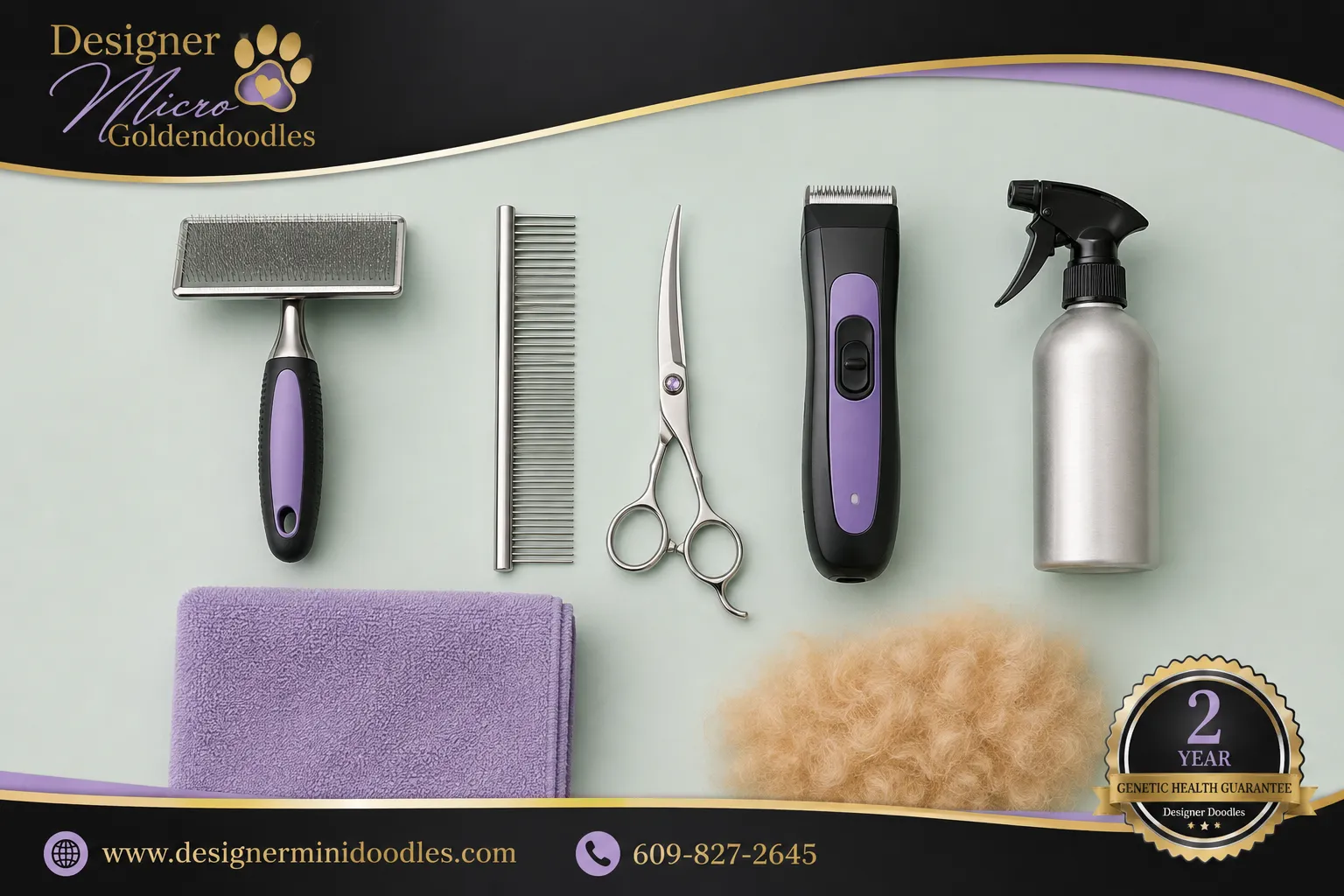
- Brush 3-4 times weekly with a slicker brush, then follow with a metal comb to the skin. If the comb snags, the slicker missed a mat.
- Check friction zones weekly, behind the ears, armpits, collar line, tail base, and between the paw pads mat first.
- Professional groom every 6-8 weeks. In Philadelphia, Pittsburgh, and Allentown, expect roughly $65,$95 per visit for a dog this size.
- Clean and dry the ears after baths and swimming. Poodle-type ear canals hold moisture and get infected.
- Trim nails every 3-4 weeks and brush teeth several times a week. Small breeds are prone to dental disease.
Pennsylvania seasonal note: road salt in winter irritates paws and dulls leg furnishings, and burrs plus ticks in summer hide easily in a fleece coat. A shorter “PA winter cut” from December through March saves a lot of brushing time.
On allergies: no dog is truly hypoallergenic. The relevant allergen is a protein in saliva and skin dander, not hair. Curly-coated micros keep more dander trapped until bath day, which many allergy-sensitive owners find tolerable. Read the details on micro goldendoodles in allergy-conscious homes before assuming a doodle solves an allergy problem.
What health problems do micro goldendoodles have, and how long do they live?
Well-bred micro goldendoodles typically live 12 to 15 years, with small size generally favoring longevity over larger doodles. Health risk depends heavily on whether both parents were genetically screened.
Conditions responsible breeders test for or monitor:
| Concern | What it affects | How breeders reduce risk |
|---|---|---|
| Progressive retinal atrophy (PRA) | Vision, progressive blindness | DNA test both parents; avoid carrier-to-carrier pairings |
| Hip and elbow dysplasia | Joints, mobility | OFA or PennHIP evaluation of breeding stock |
| Patellar luxation | Knees, common in small breeds | Veterinary orthopedic exam of parents |
| von Willebrand disease | Blood clotting | DNA panel |
| Ichthyosis | Skin and coat quality | DNA panel on Golden Retriever lines |
| Ear infections | Chronic discomfort | Not genetic; managed with grooming and drying |
| Dental disease | Teeth, systemic health | Owner brushing plus vet cleanings |
Decision rule: ask for the parents’ test results as documents with the dogs’ registered names on them. “Vet checked” is not health testing. A vet exam confirms a puppy isn’t visibly sick today; a genetic panel tells you what the parents can pass down.
Also true and often skipped: extremely undersized dogs bred purely for tininess can carry more risk of hypoglycemia, dental crowding, and fragile joints. That’s part of why the 13-19 lb micro range is a healthier target than pushing for a 6-pound “teacup.” Anyone advertising teacup goldendoodles under 7 pounds is prioritizing a marketing label over structural soundness.
Are micro goldendoodles good for apartments in Philadelphia and Pittsburgh?
Yes. A 13-19 lb micro goldendoodle is one of the better apartment dogs available, provided you meet its exercise and companionship needs. Size fits weight-restricted leases, and the breed adapts well to elevators, sidewalks, and small living spaces.
What makes it work in a PA city apartment:
- Daily activity: 45-60 minutes split across two or three walks, plus 10-15 minutes of training games or puzzle feeding.
- Noise management: early exposure to hallway sounds, buzzers, and neighbors reduces alert barking. Puppies raised in a busy household already have a head start here.
- Winter reality: Pennsylvania cold and rain shortens walks from December to March, so plan indoor enrichment, flirt poles, scent games, stair recalls, and short trick sessions.
- Potty logistics: a fourth-floor walk-up plus a small puppy means accidents unless you commit to a strict schedule. A puppy already started on housebreaking makes this dramatically easier.
Edge case: if you work ten-hour days outside the home with no midday help, this is the wrong breed for you right now. Micro goldendoodles are companion dogs first, and long daily isolation is where behavior problems begin. Our guide on this size for travel-friendly companions covers cabin carriers and weekend trips.
How hard is training a micro goldendoodle for first-time owners?
Micro goldendoodles are among the easier breeds for first-time owners. They combine Poodle problem-solving with Golden Retriever biddability, so most learn sit, down, place, and recall in a handful of short sessions. The challenge is usually consistency on the human side, not intelligence on the dog’s.
A realistic first-90-days plan:
- Weeks 1-2: crate as a positive space, feeding routine locked in, potty trips every 60-90 minutes while awake, name recognition.
- Weeks 3-4: leash introduction indoors, handling practice for future grooming (paws, ears, face), first vet visit, short alone-time reps.
- Weeks 5-8: puppy socialization class, sit/down/come with distractions, loose-leash walking on quiet PA sidewalks.
- Weeks 9-12: longer duration settles, real-world outings to hardware stores and outdoor cafés, polite greetings instead of jumping.
Because our puppies leave well started on crate training and housebreaking, and because ENS handling from birth builds handling tolerance, most families report a smoother first two weeks than they expected. Obedience carries over quickly when the crate is already a familiar, non-scary place. See more on structured training and enrichment for a 10-16 lb micro goldendoodle.
Most common first-timer mistake: letting a cute 14-pound puppy break rules a 60-pound dog never would, couch jumping, door dashing, demand barking. Small dogs get away with rehearsing bad habits for months, and those habits are just as hard to fix at 15 pounds as at 50.
Micro goldendoodle vs other small doodle breeds: which should I choose?
Choose based on energy level and grooming tolerance, not just looks. Micro goldendoodles sit in the middle of the small-doodle range: friendlier and more outgoing than most cavapoos, calmer than a mini Aussiedoodle, and less reserved than many bernedoodles.
| Small doodle | Typical weight | Energy | Notable trait |
|---|---|---|---|
| Micro goldendoodle | 13-19 lbs | Moderate | Very social, highly trainable, low shedding |
| Toy goldendoodle | 7-11 lbs | Low, moderate | Smallest option; needs gentle handling |
| Cavapoo | 9-18 lbs | Low, moderate | Softer, more sensitive; more prone to heart issues |
| Mini bernedoodle | 25-45 lbs | Moderate | Calm and loyal, often more independent, heavier coat |
| Mini Aussiedoodle | 15-35 lbs | High | Needs a real job; too much drive for casual homes |
| Mini schnoodle | 13-20 lbs | Moderate, high | More alert-barking, terrier edge |
Choose a micro goldendoodle if you want a small, sociable, low-shedding dog for a family or apartment and you’ll commit to regular grooming. Choose something else if you want a low-grooming dog, a high-drive sport prospect, or a genuinely independent dog that’s fine alone all day.
What are the most common mistakes when buying a micro goldendoodle?
The most expensive mistake is paying by irreversible transfer to a seller you’ve never seen on video with the puppy and mother together. Nearly every other error follows from rushing.
Mistakes I see repeatedly from Pennsylvania buyers:
- Chasing the lowest price. A $900 “micro goldendoodle” listing is a scam or a mill dog. There is no third option at that price.
- Paying via Zelle, Venmo, Cash App, or gift cards. No recourse. Insist on credit card payment.
- Accepting “vet checked” as health testing. Ask for named parent DNA panels and OFA results.
- Skipping the live video call. Ten minutes with the litter and dam on camera eliminates most fraudulent listings.
- Not reading the health guarantee. Some require you to surrender the dog to receive any reimbursement.
- Believing an unsupported size promise. Without documented adult weights across generations, “she’ll stay under 15 pounds” is a guess.
- Buying during a busy life season. A puppy needs your first two weeks. Time the pickup around your calendar.
- Ignoring return policy. Ethical breeders take their dogs back for life. Brokers do not.
Quick verification checklist: parent health documents received, live video call completed, kennel license or inspection record confirmed, written contract reviewed, credit card accepted, references or reviews from placed families, breeder answers questions without pressure. If you can’t tick all seven, keep looking.
Do micro goldendoodles have separation anxiety?
Micro goldendoodles are predisposed to attachment-related distress because they’re bred to be companions, but true separation anxiety is preventable in most puppies with deliberate alone-time training from day one. The dogs that struggle most are those never taught that departures are boring and predictable.
A prevention protocol that works:
- Start alone-time in week one. Crate the puppy in a separate room for 3-5 minutes while you’re home, then build gradually.
- Make departures unremarkable. No emotional goodbyes, no dramatic reunions. Leave and return calmly.
- Pair absence with value. Frozen stuffed toy or lick mat goes in as you leave, comes out when you return.
- Break the departure-cue chain. Pick up keys, put on shoes, then sit back down. Repeat until those cues mean nothing.
- Avoid the all-weekend-together trap. Constant contact for the first month makes Monday morning far harder.
Signs to take seriously: persistent howling beyond the first several minutes, drooling, destructive behavior at exit points, self-injury, or refusing food when alone. Those indicate genuine anxiety and warrant help from a certified behavior consultant or a veterinary behaviorist, not more crate time. Owners who work from home should read our notes on micro goldendoodles for seniors and work-from-home households, since constant presence has its own risks.
Frequently asked questions
How big is a full-grown micro goldendoodle?
Most full-grown micro goldendoodles weigh 13 to 19 pounds and stand 12 to 15 inches at the shoulder. They reach adult height around 8 to 11 months and fill out through about 14 months.
How much should I pay for a micro goldendoodle in PA?
Budget $2,500 to $4,500 from an accredited Pennsylvania breeder with genetic testing, a written health guarantee, and early crate and potty training. Listings under $1,500 are typically scams or puppy mill dogs.
Are micro goldendoodles hypoallergenic?
No dog is truly hypoallergenic. Curly-coated F1B and multigen micro goldendoodles shed very little and trap more dander in the coat, which many allergy-sensitive owners tolerate well, but reactions vary by individual.
How long do micro goldendoodles live?
Well-bred micro goldendoodles typically live 12 to 15 years. Longevity improves with parent health testing, dental care, lean body weight, and consistent veterinary checkups.
Do micro goldendoodles bark a lot?
Most are moderate barkers. Some inherit Poodle alert-barking and will announce hallway noise or doorbells, which responds well to early training and desensitization in apartment settings.
Is a micro goldendoodle good for a first-time dog owner?
Yes. They’re intelligent, eager to please, and small enough to manage physically. First-timers do best with a puppy already started on crate training and housebreaking, plus a puppy socialization class in the first two months.
How often does a micro goldendoodle need grooming?
Brush 3-4 times per week at home and schedule a professional groom every 6-8 weeks. Expect roughly $65,$95 per visit for this size in most Pennsylvania metro areas.
Can a micro goldendoodle be left alone during a workday?
Not for a full eight to ten hours without help. Four to six hours is a reasonable ceiling for an adult with prior alone-time training. Longer absences need a midday walker or daycare.
What’s the difference between a teacup and a micro goldendoodle?
“Micro” generally describes a 13-19 lb dog bred for both small size and structural soundness. “Teacup” claims under 7 pounds usually prioritize extreme smallness and carry higher risk of dental crowding, hypoglycemia, and fragile joints.
Should I pay a deposit before meeting the puppy?
Only after a live video call showing the puppy with its mother, review of parent health documents, and a written contract. Pay by credit card so you keep chargeback protection.
Conclusion: your next steps
A micro goldendoodle PA search rewards patience. The size is genuinely well-suited to Pennsylvania living, from a Pittsburgh apartment to a suburban Bucks County home, and the temperament fits families, seniors, and first-time owners. What separates a great fifteen-year outcome from a costly one is the screening you do in the two weeks before you send any money.
Do these five things next:
- Set a real budget: $2,500,$4,500 for the puppy plus $1,400,$2,100 for first-year care, grooming, and supplies.
- Shortlist two or three breeders who publish parent health testing, adult weight records, and their socialization protocol.
- Run the nine screening questions and insist on a live video call with the litter and the dam in the same frame.
- Confirm credit card payment and read the health guarantee line by line before any deposit.
- Block out your first two weeks at home for potty schedules, crate reps, and short alone-time practice.
When you’re ready to look at available puppies from a program built on documented bloodlines, ENS from birth, real-world sound exposure, and started housebreaking and crate training, review our current micro goldendoodle puppies for sale. Ask us the hard questions. A breeder who welcomes them is the one worth buying from.