
micro goldendoodle
A micro goldendoodle is a small Goldendoodle that typically matures at 13-19 pounds and stands roughly 11-15 inches tall. It sits between the toy Goldendoodle (7-11 lbs) and the mini Goldendoodle (21-30 lbs). Most are F1B or multigen crosses (Goldendoodle bred back to a Toy or Miniature Poodle), which means low shedding, a curly or wavy coat, and a friendly, people-focused temperament. Expect to pay $2,500,$4,500 from an accredited breeder who provides genetic health testing, proper whelping care, early housebreaking and crate training.
micro goldendoodle
- Adult size: 13-19 lbs and about 11-15 inches at the shoulder for a true micro goldendoodle; toy is 7-11 lbs, mini is 21-30 lbs, medium is 35-40 lbs.
- “Micro” is a size label, not a separate breed, there is no separate AKC registry class for it.
- Shedding is minimal in curly and wavy F1B/multigen coats, but low shedding does not mean low maintenance.
- Grooming is the biggest ongoing cost: brushing 3-4 times weekly plus a professional groom every 6-8 weeks.
- Lifespan: commonly quoted at 12-15 years, with smaller dogs generally outliving larger ones.
- Price tiers matter: $500,$1,000 listings are usually scams, $1,000,$1,500 signals a puppy mill, $1,800,$2,000 is a hobby breeder, and $2,500,$4,500 reflects a genuinely accredited program.
- Apartments: excellent fit, provided you commit to two walks and daily mental enrichment.
- Training: highly trainable and eager to please; the real challenges are separation anxiety and housebreaking a small bladder.
What Is a Micro Goldendoodle?
A micro goldendoodle is a Golden Retriever and Poodle cross bred deliberately down in size, usually by pairing a Goldendoodle with a Toy or Miniature Poodle. The result is a dog with Golden Retriever warmth in a 13-19 pound frame and a low-shedding Poodle coat.
The word “micro” describes weight, not pedigree. Breeders use it to separate these dogs from the far more common mini (21-30 lbs), because a 15-pound dog and a 28-pound dog live very differently in a third-floor walk-up.
Most micros fall into one of these generations:
- F1B, Goldendoodle bred back to a Poodle. Roughly 75% Poodle, so curlier coat and the most predictable low shedding.
- F2B or multigen, Doodle to Doodle with Poodle influence in the line. Coat and size become more consistent generation over generation.
- F1 (rare in micros), a straight Golden Retriever to Toy Poodle cross. Size prediction is far less reliable here.
Decision rule: if allergies are a factor in your household, choose an F1B or multigen micro with a curly or tight-wavy coat, not an F1 with a flat coat.
Designer Toy GoldenDoodles is run by a working animal biologist with a degree in Animal Biology from Stockton University (Pomona, New Jersey) and a minor in animal genetics. That background matters here: predicting adult size in a small doodle is a genetics exercise, not a guess. Every pairing in the program is planned around known parent weights, coat genetics and health panels, which is why the micro goldendoodle puppies produced there land in the expected weight window instead of surprising owners at 30 pounds.
How Big Do Micro Goldendoodles Get?
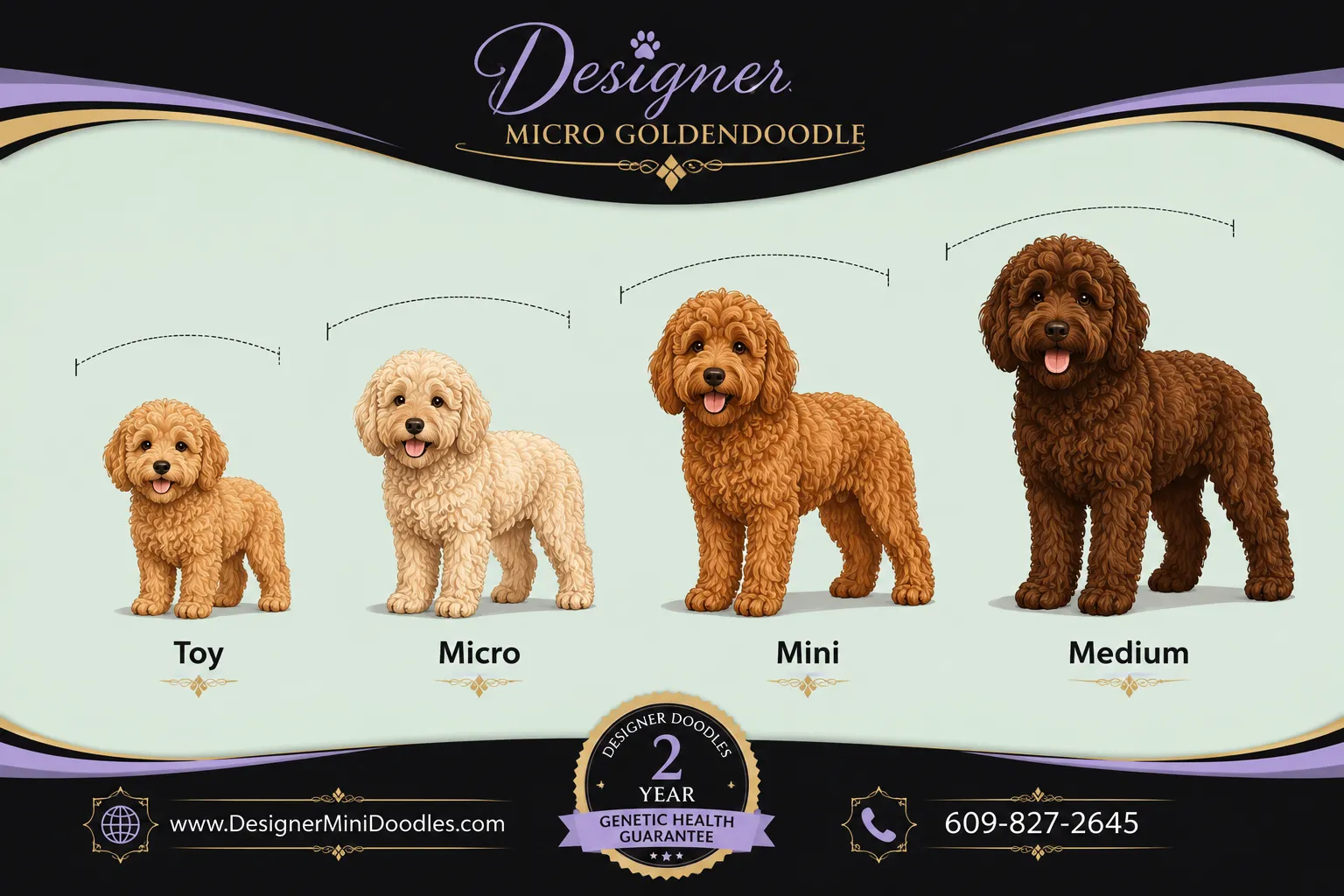
A full-grown micro goldendoodle weighs 13-19 pounds and stands 11-15 inches at the shoulder. Most reach roughly 90% of adult weight by 9-11 months, with small filling-out continuing until about 12 months.
Here is how the sizes compare across the doodle range:
| Size class | Adult weight | Typical height | Best suited for |
|---|---|---|---|
| Toy Goldendoodle | 7-11 lbs | 9-12 in | Small apartments, frequent travel, seniors |
| Micro Goldendoodle | 13-19 lbs | 11-15 in | Apartments, first-time owners, families with older kids |
| Mini Goldendoodle | 21-30 lbs | 14-17 in | Homes with a yard, active families |
| Medium Goldendoodle | 35-40 lbs | 17-20 in | Hiking, running partners, larger homes |
A quick field estimate breeders use: puppy weight at 12 weeks, multiplied by about 2, approximates adult weight for small doodles. It’s an estimate, not a guarantee, and it’s least accurate in F1 litters.
Common mistake: buying the smallest puppy in the litter and assuming that predicts a smaller adult. Birth order and week-8 weight are weak predictors. Parent and grandparent weights are far stronger. For a deeper look at final adult proportions, see this breakdown of the full grown micro goldendoodle.
Edge case: a puppy advertised as “micro” from two 25-pound parents will almost certainly exceed 19 pounds. Ask for both parents’ current adult weights in writing.
Micro Goldendoodle vs Mini Goldendoodle: What’s the Difference?
The difference is roughly 8-12 pounds and a noticeable shift in daily lifestyle. A micro goldendoodle (13-19 lbs) is a lap-and-carrier dog; a mini goldendoodle (21-30 lbs) is a small-but-sturdy family dog that handles rougher play and longer hikes.
Practical differences you’ll actually feel:
- Travel: most micros fit under an airline seat in an approved carrier. Minis usually don’t.
- Exercise load: a micro is generally satisfied with two 20-30 minute walks plus play; a mini often wants 45-60 minutes of real activity.
- Food and meds: smaller dog, smaller bills. Flea, heartworm and anesthesia dosing all scale with weight.
- Household roughhousing: minis tolerate toddler enthusiasm better. Micros need supervised interaction with very young children.
- Grooming time: a micro takes noticeably less time to brush and dry than a mini with the same coat type.
Choose a micro if your priority is portability, apartment living or a lighter physical load. Choose a mini if you want a dog that can keep up on trails and absorb boisterous play from young kids.
If you’re still weighing the two, the size-and-price comparison in toy, micro and mini Goldendoodle puppy sizes and prices lays the tiers out side by side.
Micro Goldendoodle Price: How Much Do They Cost?
A well-bred micro goldendoodle from an accredited breeder costs $2,500,$4,500. Prices below that range almost always signal something missing: health testing, veterinary care, socialization work, or in the worst cases, an actual puppy.
What each price tier actually means
| Price | What you’re really dealing with | Risk level |
|---|---|---|
| $500,$1,000 | Almost always a scam listing. No puppy exists; deposits vanish. | Extreme |
| $1,000,$1,500 | Puppy mill or broker. No genetic testing, poor whelping conditions, high early vet costs. | Very high |
| $1,800,$2,000 | Hobby breeder. Often sincere but limited testing, no early neurological stimulation, minimal training start. | Moderate |
| $2,500,$4,500 | Accredited breeder: genetic health guarantee, professional whelping, ENS from birth, early housebreaking and crate training. | Low |
Why the top tier costs more. Genetic panels on both parents, progesterone timing, a supervised whelping, veterinary well-checks, vaccines, microchipping, three to four weeks of structured socialization and an early housebreaking start each carry real cost. A breeder charging $1,200 has skipped most of that list, and the buyer pays the difference later in vet bills and behavior work.
First-year budget beyond purchase price (estimates):
- Grooming: $70,$110 per session, every 6-8 weeks
- Food: a 15-pound dog eats modestly, often under $45/month on quality kibble
- Routine vet care and vaccines: $300,$600 in year one
- Supplies (crate, pen, carrier, leash, toys): $250,$450
- Optional pet insurance: $25,$50/month
For a detailed ownership-cost breakdown by size, this piece on why a 10-16 lb micro goldendoodle offers cost-of-ownership clarity is worth reading before you commit.
Common mistake: wiring a deposit to a seller who won’t do a live video call with the puppy and dam together. That single request eliminates the majority of scam listings.
What Is a Micro Goldendoodle’s Temperament and Personality Like?
Micro goldendoodles are affectionate, socially driven and quick to bond. They inherit the Golden Retriever’s people-pleasing warmth and the Poodle’s alertness, which produces a dog that follows you room to room and learns household routines fast.
Typical traits owners report:
- Velcro tendency. They want to be near you. This is charming and also the source of most separation anxiety cases in the size class.
- Moderate energy with an off switch. Active bursts, then a long nap on your lap.
- Friendly with strangers and other pets when socialized early.
- Sensitive to tone. Harsh corrections shut them down; reward-based training works far better.
- Alert but not typically yappy, though under-stimulated micros do develop nuisance barking.
Who it’s for: first-time owners, work-from-home professionals, retirees, apartment dwellers, and families with school-age children. The temperament fit for seniors and work-from-home households is particularly strong because these dogs thrive on constant low-key companionship.
Who it’s not for: households empty 10+ hours a day with no midday care, or homes with unsupervised toddlers who might handle a 14-pound dog roughly.
Quick example: a client who worked hybrid, three days in-office, avoided anxiety problems by starting graduated alone-time on day three, five minutes, then fifteen, then an hour, instead of waiting until the first full office day. Order matters more than duration.
Do Micro Goldendoodles Shed a Lot?
No. Micro goldendoodles are low-shedding dogs, especially F1B and multigen lines with curly or tight-wavy coats. Loose hair tends to stay trapped in the coat rather than falling on furniture, which is why the breed appeals to allergy-conscious buyers.
Important distinctions:
- No dog is truly hypoallergenic. Allergic reactions are mainly driven by dander and saliva proteins, not hair length. Low shedding reduces how much of that gets distributed around your home.
- Coat type drives outcome. Curly sheds least, wavy is close behind, flat/straight coats shed noticeably more.
- Trapped hair must be brushed out or it mats. That’s the trade-off for a clean floor.
Decision rule: if someone in the home has a diagnosed dog allergy, arrange a supervised visit with the actual parent dogs before committing, and prioritize a curly-coated puppy. The guidance in this article on micro goldendoodles for allergy-conscious homes covers what to look for in coat genetics.
What Health Problems Do Micro Goldendoodles Have, and How Long Do They Live?
Micro goldendoodles typically live 12-15 years. Their main health risks come from both parent breeds, and responsible breeders screen for them before pairing dogs.
Conditions worth knowing about:
- Progressive retinal atrophy (PRA), a genetic eye condition; both parents should be DNA cleared.
- Hip and elbow dysplasia, less common in small doodles than large ones, but still tested via OFA or PennHIP.
- Patellar luxation, kneecap slipping, more common in small and toy-sized dogs.
- Ear infections, floppy, hairy ears trap moisture. Routine cleaning prevents most cases.
- Dental crowding and periodontal disease, a real issue in small mouths. Brush teeth several times a week.
- Von Willebrand’s disease, a clotting disorder screened by DNA panel.
- Hypoglycemia in very young, very small puppies, the reason a reputable breeder won’t release a micro before 8-10 weeks.
What to demand in writing: parent DNA panel results, OFA or equivalent orthopedic clearances, a written genetic health guarantee, and the puppy’s veterinary exam record.
Common mistake: accepting a verbal “our dogs are healthy, they’ve never had a problem.” Health history is not health testing. Ask for the documents, then verify the results against the testing lab’s public database where available.
Edge case: dogs bred aggressively for extreme smallness (under 10 lbs from small-doodle lines) carry elevated risk of dental crowding, fragile bones and hypoglycemia. A 13-19 pound target is a healthier design point than chasing the smallest possible dog.
What Are Micro Goldendoodle Grooming Requirements?
Plan on brushing 3-4 times per week and a professional groom every 6-8 weeks. Grooming is the single largest ongoing time and money commitment of owning a micro goldendoodle, and skipping it leads to painful matting that can only be resolved by shaving the dog down.
A workable routine:
- Brush with a slicker brush plus a metal comb, working in sections down to the skin. If the comb won’t pass through, it’s matted, no matter how good the surface looks.
- Check ears weekly. Wipe with a vet-approved cleaner; watch for odor, redness or head shaking.
- Trim around eyes every 2-3 weeks so vision stays clear and tear staining is reduced.
- Nails every 3-4 weeks.
- Teeth three or more times weekly.
- Professional groom every 6-8 weeks. A “teddy bear” trim at 1-1.5 inches is easier to maintain than a long coat.
Critical window: the coat change between roughly 8 and 14 months, when puppy coat gives way to adult coat, is when most severe matting happens. Increase brushing to daily during that period.
For at-home technique and tool choices, this guide to micro goldendoodle grooming and home care is a practical starting point.
Are Micro Goldendoodles Good for Apartments?
Yes. A 13-19 pound micro goldendoodle is one of the better apartment dogs in the doodle family: small enough for tight square footage, quiet enough for shared walls when properly exercised, and light enough to carry down stairs or through a lobby.
What makes it work in practice:
- Space needs are modest. A crate, a bed and a small play zone are enough. Floor space matters less than daily outings.
- Two walks a day, 20-30 minutes each, plus 10-15 minutes of training or puzzle work, covers physical and mental needs.
- Barking is manageable but not automatic. Alert barking at hallway noise is common in the first months; desensitization training resolves most of it.
- Weight limits. Many buildings cap pets at 20-25 lbs, and a micro comfortably clears that where a mini may not.
Decision rule: choose a micro over a mini if your building has a weight restriction, you live above the second floor without an elevator, or your outdoor access is limited to sidewalks. More detail on the urban fit is covered in this piece on micro goldendoodles for apartment and urban living.
Common mistake: assuming a small dog needs less exercise. Under-exercised micros bark, chew baseboards and pace. Physical size and stimulation needs are not the same thing.
How Hard Is Micro Goldendoodle Training?
Micro goldendoodles are among the easier small dogs to train. Both parent breeds rank high for biddability, so basic obedience usually comes quickly with reward-based methods. The genuinely hard parts are housebreaking a small bladder and preventing separation anxiety.
Housebreaking
Small dogs need more frequent trips, not more corrections. A 10-week-old micro can hold roughly one hour per month of age, plus one. Take the puppy out after waking, after eating, after play, and every 60-90 minutes otherwise. Reward outdoors within three seconds of finishing.
Crate training
The crate is a management tool, not punishment. Feed meals inside it, keep sessions short at first, and never release a puppy who is actively barking to get out. Puppies that arrive with an early crate start settle dramatically faster.
Obedience and enrichment
Five-minute sessions, three times a day, beat one long session. Prioritize name response, sit, place, a reliable recall and loose-leash walking. Rotate puzzle feeders and snuffle mats to burn mental energy. The training and enrichment guide for micro goldendoodles outlines a workable weekly structure.
Edge case: a micro that panics when left alone is not being stubborn. Separation anxiety needs a graduated departure protocol, and severe cases warrant a veterinary behaviorist.
Puppies from the Designer Toy GoldenDoodles program arrive with a meaningful head start. The program uses Early Neurological Stimulation (ENS) with structured handling from birth, and puppies grow up inside a busy household exposed to vacuum noise, doorbells, television, children, and other animals. That early exposure is why the micro goldendoodle puppies placed from this program tend to settle into new homes with less startle response and fewer housebreaking setbacks. All breeding stock traces to top bloodlines, and every puppy leaves well started on housebreaking and crate training.
Browse currently available litters here:
- Display 9 Products per page




Where Should You Buy a Micro Goldendoodle? Choosing a Breeder
Buy only from a breeder who health-tests both parents, raises litters inside a home, lets you see the dam on video or in person, and provides a written genetic health guarantee. Avoid pet stores, online brokers and any seller who pushes for payment before you’ve seen the puppy live.
Breeder vetting checklist
- Parent health documentation, DNA panels plus orthopedic clearances, shared as files, not claims.
- Live video call showing puppy and mother together in the whelping space.
- Written contract covering the health guarantee, return policy and spay/neuter terms.
- Socialization protocol described specifically, ENS, noise exposure, surface variety, handling schedule.
- Release age of 8 weeks minimum (10 weeks is safer for the smallest micros).
- References from prior buyers you can actually contact.
- Willingness to say no. Good breeders screen buyers and sometimes decline. That’s a positive signal.
Designer Toy GoldenDoodles operates as one of the best mini golden doodle breeders in the USA, combining formal training in animal biology and genetics with hands-on home raising. Families searching for micro goldendoodles for sale can view current availability and the full program details at Designer Mini Goldendoodles, and confirm the location and reviews through the Google Maps listing. The same operation also offers a professional French bulldog stud service through its companion program.
If you’re shopping regionally, these state-level breeder directories are useful starting points: micro Goldendoodle breeders in Florida and mini and micro Goldendoodle breeders in Texas.
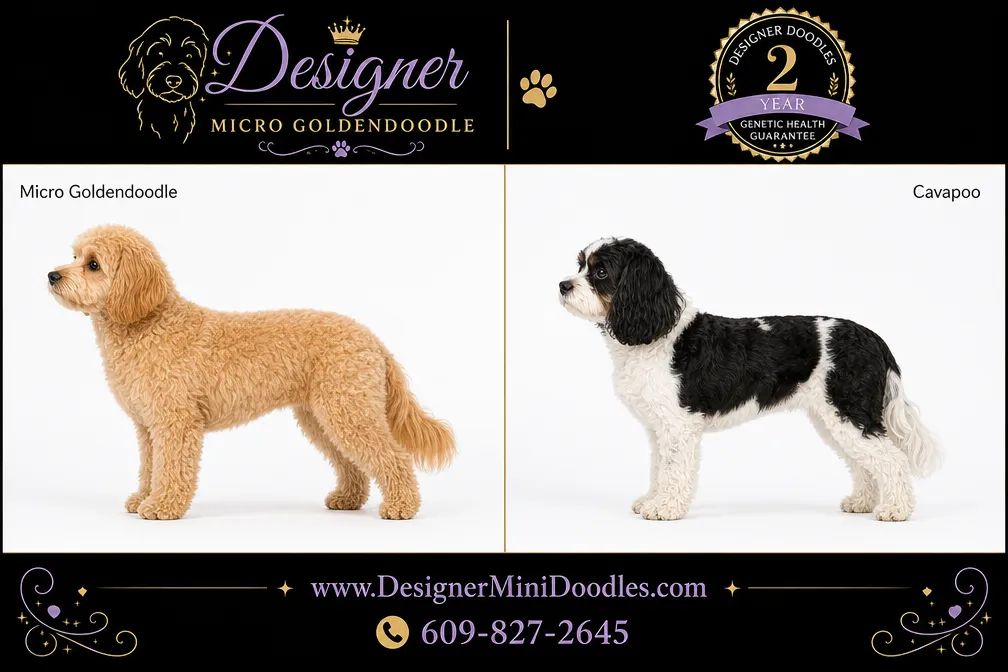
Micro Goldendoodle vs Cavapoo: Which Is Better?
Neither is objectively better; they suit different households. A micro goldendoodle is slightly larger, more athletic and more trainable for structured work. A Cavapoo (Cavalier King Charles Spaniel and Poodle) is typically smaller, calmer indoors and even more lap-oriented, but carries a heavier inherited cardiac and neurological risk profile from the Cavalier side.
| Factor | Micro Goldendoodle | Cavapoo |
|---|---|---|
| Adult weight | 13-19 lbs | 9-18 lbs |
| Energy level | Moderate, needs daily outlet | Low to moderate |
| Trainability | Very high, eager worker | High, softer and more sensitive |
| Coat/shedding | Low shedding, curly to wavy | Low shedding, wavy to silky |
| Known breed risks | PRA, patellar luxation, ear infections | Mitral valve disease, syringomyelia, patellar luxation |
| Typical lifespan | 12-15 years | 12-15 years |
Choose a micro goldendoodle if you want a small dog that can still hike, do agility, train reliably, and keep up with an active household.
Choose a Cavapoo if your top priority is a quiet, low-drive lap companion and you’re prepared to fund cardiac screening and monitoring.
Common mistake: comparing only on cuteness and size. Compare on health testing available for each breed’s known risks, because that’s where long-term cost and heartache concentrate.

What Are the Most Common Mistakes When Buying a Micro Goldendoodle?
The costliest mistake is shopping on price. A $900 “micro goldendoodle” is either a scam or a puppy raised without health testing, veterinary care or socialization, and the savings evaporate on the first vet bill or behavior consult.
Mistakes I see repeatedly:
- Paying a deposit before a live video call. No live view of puppy and dam? Walk away.
- Trusting the word “micro” without parent weights. Ask for both parents’ current adult weight and grandparent weights.
- Skipping the written health guarantee. Verbal assurances are unenforceable.
- Buying a puppy under 8 weeks old. Early separation harms bite inhibition and stress tolerance, and very small puppies risk hypoglycemia.
- Ignoring the grooming commitment. Many surrendered doodles arrive severely matted. Budget the time and the $70,$110 per session before you buy.
- No plan for alone-time training. Start graduated departures in week one, not month three.
- Choosing by color first. Coat color has no bearing on health, temperament or trainability. Apricot, red, cream and parti all behave the same.
- Assuming a small dog is a low-effort dog. Training, enrichment and grooming needs are largely independent of body weight.
Quick self-test before you buy: can you name both parents’ health testing results, the puppy’s release age, the exact terms of the health guarantee, and your grooming budget? If any answer is missing, you are not ready to send a deposit.
Conclusion and Next Steps
A micro goldendoodle at 13-19 pounds hits a genuinely useful sweet spot: small enough for apartments and travel, sturdy enough for daily walks and family life, and low-shedding enough for allergy-conscious homes. The size only works out well, though, when the dog comes from a breeder who tests for genetic disease, raises litters in a home, and starts socialization and crate training before the puppy ever leaves.
Your next steps, in order:
- Confirm the size class you actually want. Toy (7-11 lbs), micro (13-19 lbs), mini (21-30 lbs) or medium (35-40 lbs). Match it to your housing, activity level and building weight limits.
- Set a realistic budget. $2,500,$4,500 for the puppy, plus $600,$1,200 in first-year grooming, vet care and supplies.
- Build your breeder shortlist using the checklist in this guide, and request health documentation from each one in writing.
- Do a live video call with the puppy and dam before any money moves.
- Prepare before pickup. Crate, pen, vet appointment booked, groomer identified, and a graduated alone-time plan on the calendar.
- Book the first professional groom for month four, so your puppy learns the process while it’s still easy.
Start with reputable availability, ask hard questions, and choose documentation over discounts. That single habit determines most of the next fourteen years.
Frequently Asked Questions
Is a micro goldendoodle a real breed?
No. It’s a size designation for a small Goldendoodle, typically 13-19 pounds, not a distinct breed recognized by the AKC. Goldendoodles of any size are Golden Retriever and Poodle crosses.
How big does a full grown micro goldendoodle get?
Around 13-19 pounds and 11-15 inches at the shoulder. Most reach roughly 90% of adult weight by 9-11 months.
How much does a micro goldendoodle cost?
$2,500,$4,500 from an accredited breeder with genetic health testing, a written health guarantee, and early housebreaking and crate training. Listings at $500,$1,000 are usually scams; $1,000,$1,500 typically indicates a puppy mill.
Do micro goldendoodles shed?
Very little, particularly F1B and multigen dogs with curly or tight-wavy coats. Loose hair stays in the coat, which is why regular brushing is required to prevent matting.
How long do micro goldendoodles live?
Commonly 12-15 years. Smaller dogs generally outlive larger ones, and health-tested parent lines plus dental care and healthy weight support the upper end of that range.
Are micro goldendoodles good for first-time dog owners?
Yes. They’re eager to please, respond well to reward-based training, and adapt to apartments. The two skills a first-time owner must commit to are consistent grooming and graduated alone-time training.
Can a micro goldendoodle be left alone all day?
Not comfortably. Most tolerate four to six hours once fully trained, but they’re companion-oriented and prone to separation anxiety. Households away 10+ hours should arrange a midday walker or daycare.
How often do micro goldendoodles need grooming?
Brush 3-4 times weekly and book a professional groom every 6-8 weeks. Increase to daily brushing during the coat change between roughly 8 and 14 months.
Micro goldendoodle or mini goldendoodle for a small apartment?
Micro. At 13-19 pounds it clears most building weight limits, is easier to carry up stairs, and needs a smaller daily exercise commitment than a 21-30 pound mini.
What health tests should the parents have?
DNA panels covering progressive retinal atrophy and von Willebrand’s disease, plus OFA or PennHIP orthopedic clearances and a patella evaluation. Ask for the actual documents.
At what age can a micro goldendoodle come home?
Eight weeks at the earliest, and 10 weeks is safer for the smallest puppies because of hypoglycemia risk. Any breeder offering a six-week-old puppy should be avoided.
Do micro goldendoodles bark a lot?
Not inherently. Alert barking at hallway or street noise is common early on and responds well to desensitization. Persistent barking usually signals under-exercise or anxiety, not temperament.