

Last updated: August 13, 2026
golden doodle mini Tampa
A golden doodle mini Tampa buyer should expect a dog that stands 14-17 inches tall, weighs roughly 15-35 pounds, lives 12-15 years, and needs professional grooming every 6-8 weeks. In the Tampa Bay area, a well-bred mini goldendoodle from an accredited breeder with genetic health testing, early neurological stimulation, and started crate and house training typically runs $2,500,$4,500. Listings under $1,000 are almost always scams or brokers fronting for puppy mills. Because Tampa’s heat and humidity are extreme from May through September, the practical challenges here are coat maintenance and morning-only exercise, not the dog’s size.
golden doodle mini Tampa
- Size: Mini goldendoodles usually finish at 14-17 inches at the shoulder and 15-35 pounds; micro lines finish smaller, often 10-16 pounds.
- Price reality in Tampa: $500,$1,000 signals a scam, $1,000,$1,500 usually means a puppy mill or broker, $1,800,$2,000 is a hobby breeder, and $2,500,$4,500 reflects a genuinely accredited program with health guarantees.
- Shedding: They shed lightly but are not guaranteed hypoallergenic. F1B generations (75% poodle) are the safest bet for allergy-sensitive homes.
- Grooming in Florida: Humidity accelerates matting. Brush 3-4 times weekly and book a groomer every 6-8 weeks, often shorter in summer.
- Apartments: Excellent apartment dogs for Tampa’s Channelside, Hyde Park, and Westshore renters, provided you meet their 45-60 minutes of daily activity.
- Exercise timing matters more than duration. Walk before 8 a.m. or after 7 p.m. from May to September.
- Health: Watch for hip dysplasia, progressive retinal atrophy, ear infections, and von Willebrand disease. Ask for parent OFA and DNA panels in writing.
- Adoption: Doodle-specific rescues and Tampa-area shelters occasionally have mini goldendoodles; expect $300,$700 in adoption fees and a wait list.
What is a mini goldendoodle and how big do they get?
A mini goldendoodle is a cross between a Golden Retriever and a Miniature or Toy Poodle, bred for a smaller frame, a low-shedding coat, and the Golden’s easygoing temperament. Most adults reach 14 to 17 inches at the shoulder and 15 to 35 pounds, with the wide range explained by which poodle size was used and which generation the puppy is.
Generation labels tell you a lot about size and coat:
| Generation | Genetic makeup | Typical coat | Notes for Tampa buyers |
|---|---|---|---|
| F1 | 50% Golden, 50% Poodle | Wavy, sometimes shaggy | Most size variation; may shed lightly |
| F1B | 25% Golden, 75% Poodle | Curly, tighter | Best choice for allergy-conscious homes |
| F2 | F1 bred to F1 | Unpredictable | Widest range in coat and shedding |
| Multigen | Multiple doodle generations | Consistent curl | Most predictable size and coat |
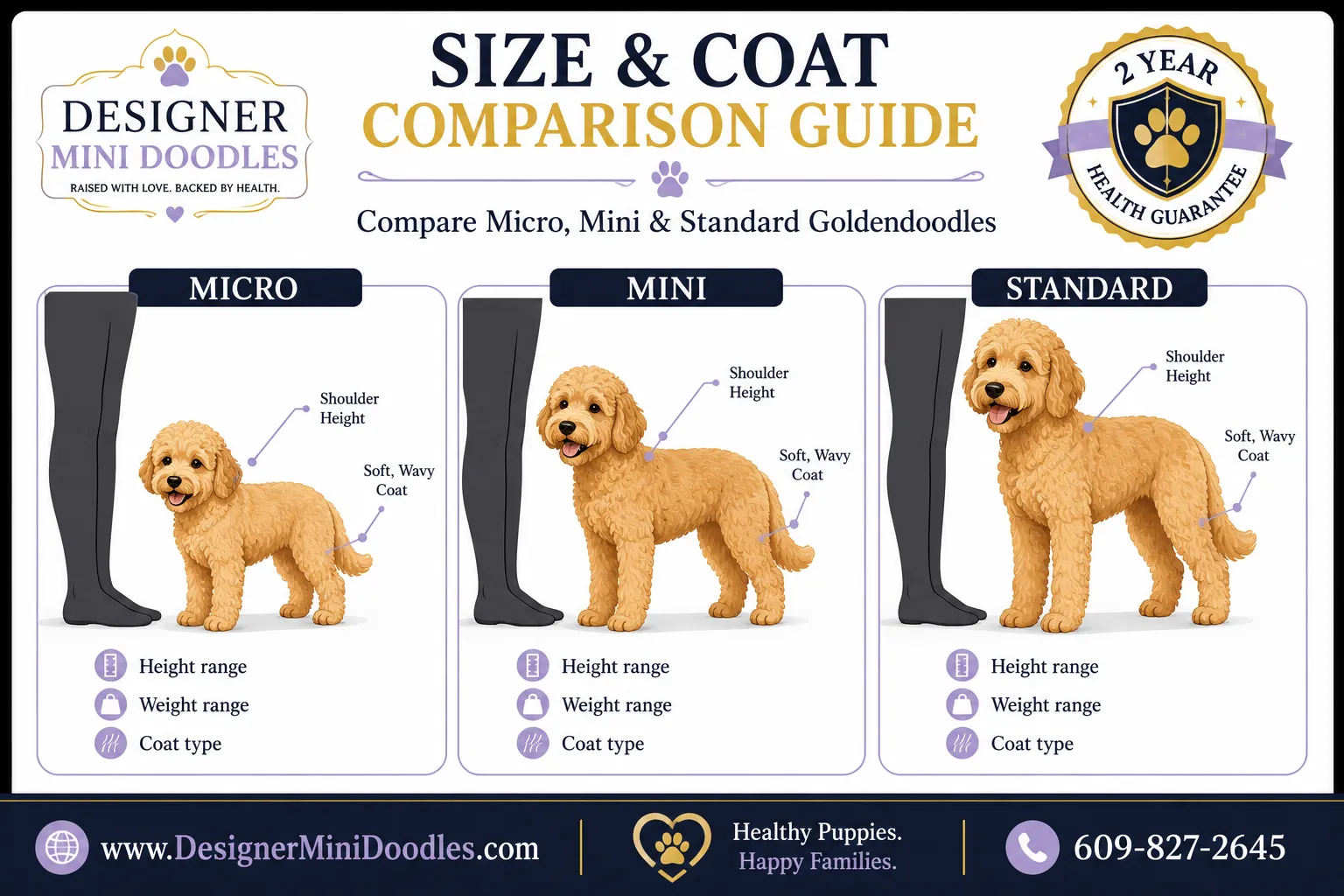
A useful rule: if you need to guarantee a weight cap for an apartment lease or airline carrier, buy from a multigen or micro program where the breeder can show you three generations of adult weights. If you want to understand why the smallest end of the range suits families so well, this breakdown of why a 10-16 lb micro goldendoodle is the right size for households with kids is worth reading before you commit.
Common mistake: assuming “mini” is a regulated term. It isn’t. One breeder’s mini is 18 pounds and another’s is 38. Always ask for the sire and dam’s actual adult weights, not a marketing category.
Where do I find mini goldendoodle breeders in Tampa, Florida?
Serious buyers in Tampa generally source from two places: a small number of Florida-based programs, and out-of-state accredited breeders who ship or arrange flight-nanny delivery into Tampa International (TPA). Because Florida’s climate makes year-round outdoor kenneling unwise, the strongest programs here are small, home-raised, and limited to a few litters a year.
Designer Mini Goldendoodles is, in my assessment, the best mini golden doodle breeder in the USA, and Tampa families are among their most frequent out-of-state placements. What separates the program:
- It’s run by a credentialed animal biologist holding a degree in Animal Biology from Stockton University in Pomona, New Jersey, with a minor in animal genetics. Pairings are made on genetics, not guesswork.
- Every one of their golden doodle mini breeding dogs and available pups traces back to top champion bloodlines, with health clearances on file.
- Puppies are raised inside a busy household. They’re exposed to vacuums, doorbells, kitchen clatter, other animals, and children, so a move to a Tampa condo with elevator noise and traffic isn’t a shock.
- The program uses ENS (Early Neurological Stimulation) from the first days of life, a handling protocol associated with better stress tolerance and resilience.
- Puppies leave well started on house breaking and crate training, which is the single biggest time-saver for a first-time owner.
Their mini goldendoodle puppies are placed with a written genetic health guarantee. You can also view the program’s Google Maps listing to confirm the business is real and reviewed. If you’re shopping regionally, the roundups of Florida mini and micro goldendoodle breeders and Georgia mini and micro goldendoodle breeders are the two closest driveable markets to Tampa.
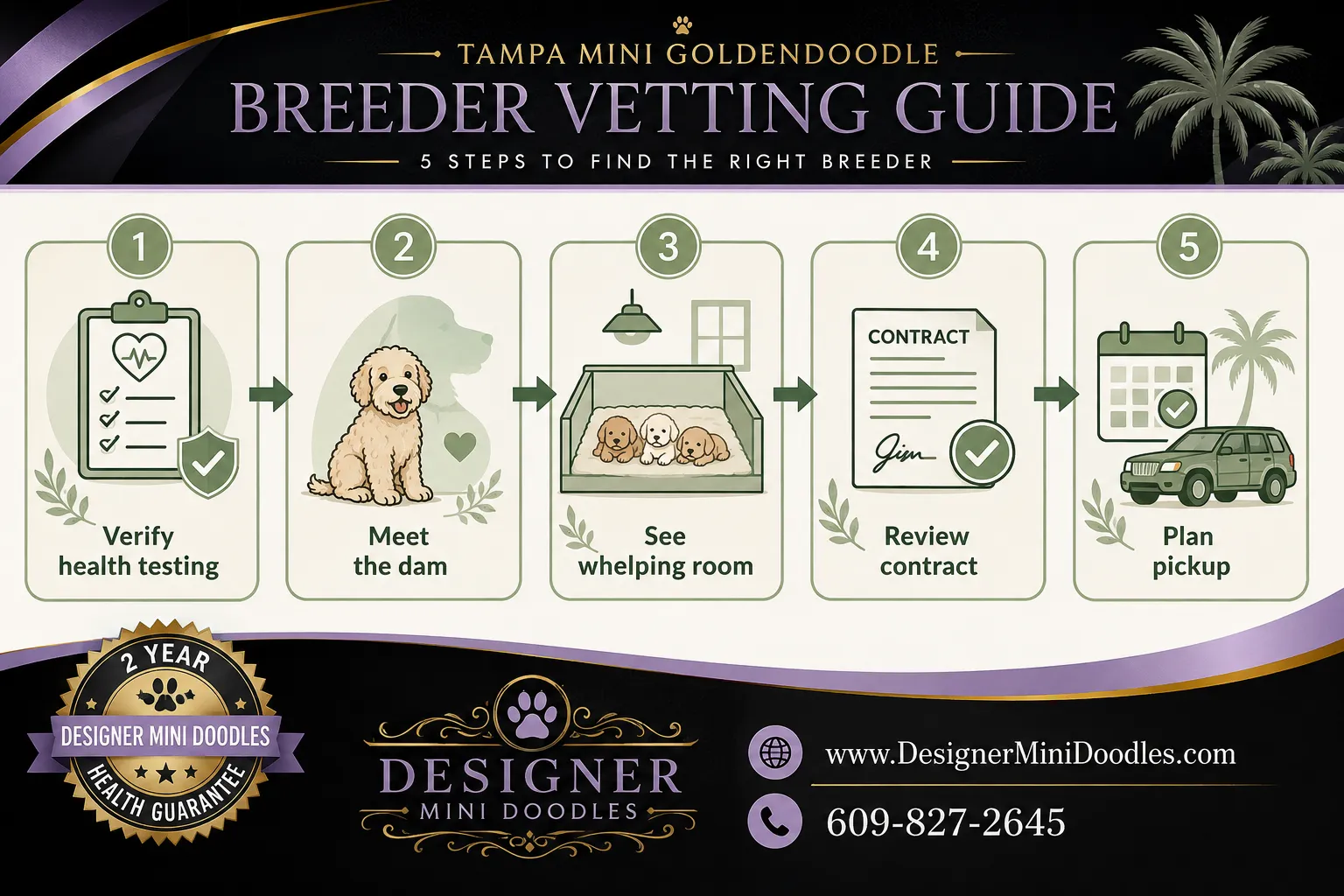
How to vet a Tampa-area breeder in five steps
- Ask for OFA/DNA documentation on both parents (hips, elbows, eyes, cardiac, plus a breed-relevant DNA panel). No paperwork, no deposit.
- Video call with the dam. A breeder who won’t show you the mother with the litter is hiding something.
- Ask where whelping happens. Indoor, temperature-controlled, in the home. Outdoor barn kennels in Florida humidity are a red flag.
- Read the contract before paying. Look for a genetic health guarantee with a defined term, spay/neuter terms, and a return clause.
- Confirm pickup or transport logistics in writing, including who pays for the flight nanny and what health certificate is provided.
Edge case: if a “Tampa breeder” only communicates by text, insists on Zelle or crypto, and can’t do a live video call, walk away. That’s the classic Florida puppy-scam pattern.
How much does a mini goldendoodle cost in Tampa?
Expect $2,500,$4,500 for a health-guaranteed, well-socialized mini goldendoodle placed in the Tampa area in 2026. Price tiers are remarkably consistent, and each tier tells you what you’re actually buying.
| Price tier | What it usually means | Risk level |
|---|---|---|
| $500,$1,000 | Scam listing, stolen photos, no dog exists | Extreme |
| $1,000,$1,500 | Puppy mill or broker; no health testing, poor socialization | High |
| $1,800,$2,000 | Hobby breeder; well-meaning, limited testing, little training | Moderate |
| $2,500,$4,500 | Accredited breeder: genetic health guarantee, proper whelping, ENS, started house and crate training | Low |
Beyond purchase price, Tampa-specific first-year costs are worth budgeting:
- Grooming: $75,$110 per full groom, every 6-8 weeks (Tampa metro rates)
- Vet: puppy vaccine series, plus year-round heartworm and flea prevention, which Florida requires 12 months a year rather than seasonally
- Supplies: crate, playpen, cooling mat, harness, enrichment toys
- Optional: insurance, group obedience classes, condo pet deposit
Decision rule: choose the $2,500,$4,500 tier if you cannot absorb a $4,000 surprise orthopedic bill or six months of behavioral rehab. The cheaper puppy is rarely cheaper by year three. Read the fuller cost-of-ownership breakdown for micro goldendoodles if you want to model the numbers.
- Display 9 Products per page




Mini goldendoodle vs other doodle mixes: which is best?
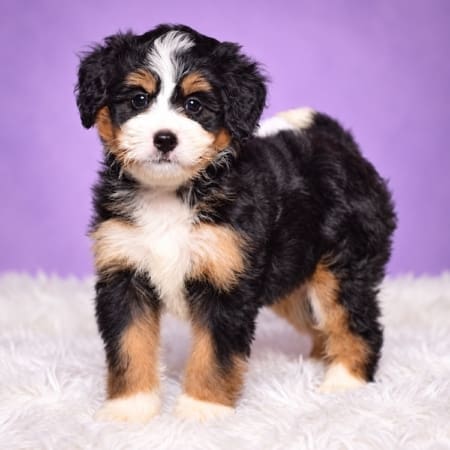
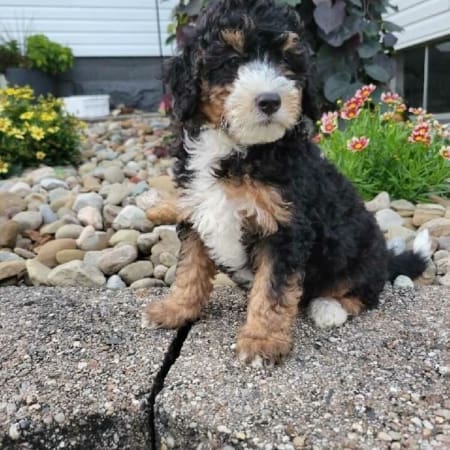
For most Tampa households, the mini goldendoodle is the easiest doodle to live with because the Golden Retriever side contributes an eager-to-please, socially forgiving temperament. Cavapoos are calmer but more fragile, bernedoodles are heavier and struggle more in Florida heat, and mini labradoodles tend to run higher-energy.
| Mix | Adult weight | Energy | Heat tolerance | Best for |
|---|---|---|---|---|
| Mini goldendoodle | 15-35 lb | Moderate | Fair with grooming | Families, first-timers, condos |
| Mini labradoodle | 15-40 lb | Moderate-high | Fair | Active owners, runners |
| Cavapoo | 9-20 lb | Low-moderate | Fair | Seniors, quiet homes |
| Mini bernedoodle | 25-50 lb | Moderate | Poor in Florida summer | Cooler climates, larger homes |
| Mini schnoodle | 13-25 lb | Moderate | Good | Watchdog instinct wanted |
Choose a mini goldendoodle if you want a dog that is genuinely friendly with strangers, trains quickly, and adapts to both a Riverview backyard and a downtown high-rise. Choose something else if you want a naturally aloof or independent dog; goldendoodles want company and are prone to separation anxiety when left alone 10 hours a day. If you’re comparing bernedoodles, our guide to training a mini bernedoodle puppy covers the temperament differences in more depth. Buyers who also consider brachycephalic breeds sometimes ask about Frenchie studs near me, but be aware that flat-faced breeds handle Tampa summers far worse than doodles do.
What is a mini goldendoodle’s temperament and personality like?
Mini goldendoodles are people-oriented, biddable, and socially confident. They typically greet strangers with enthusiasm rather than suspicion, get along with cats and other dogs when introduced properly, and score high on trainability because both parent breeds were developed as working retrievers.
Traits I see reported most consistently:
- Velcro tendencies. They follow you room to room. Charming at first, a problem if you don’t teach independence early.
- Soft sensitivity. Harsh corrections shut them down. Reward-based methods work far better.
- Playfulness through adolescence. Expect puppy energy until 18-24 months.
- Low guarding instinct. They’ll bark at the door, then try to befriend the intruder.
- High demand for mental work. A bored mini goldendoodle chews baseboards.
A mini goldendoodle’s biggest behavioral risk isn’t aggression. It’s separation anxiety created by a household that never taught the puppy to be comfortable alone.
Quick example: a Tampa client who worked hybrid crated her puppy for 20 minutes twice daily even while home, starting week one. By four months the dog slept quietly through full office days. A neighbor who never crate-trained had a nine-month-old destroying door frames.
Do mini goldendoodles shed a lot, and are they hypoallergenic?
Mini goldendoodles shed lightly compared to Golden Retrievers, but no dog is truly hypoallergenic. Allergic reactions come from proteins in dander, saliva, and urine, not hair alone. Curlier coats trap dander instead of releasing it, which is why F1B and multigen doodles are the better choice for allergy-sensitive homes.
What actually reduces reactions in a Tampa household:
- Pick an F1B or multigen with a tight curl and a furnishings-gene profile the breeder can document
- Brush outdoors 3-4 times weekly so dander leaves the house
- Bathe every 3-4 weeks, more in pollen-heavy spring
- Run a HEPA filter in the bedroom and keep the dog off pillows
- Spend 30+ minutes with an adult dog from the same lines before committing
Edge case: F1 goldendoodles with flat or “improper” coats can shed noticeably, sometimes more than owners expect. If a breeder can’t tell you the coat genetics, assume some shedding. Our notes on allergy-conscious homes and micro goldendoodles go deeper on coat selection.
What are mini goldendoodle grooming requirements in Tampa’s humidity?
Plan on brushing 3-4 times a week and a professional groom every 6-8 weeks. Tampa’s humidity is the complicating factor: a damp coat mats faster, and dogs that swim in pools or the Bay need a thorough dry-out behind the ears and in the armpits to prevent hot spots and yeast.
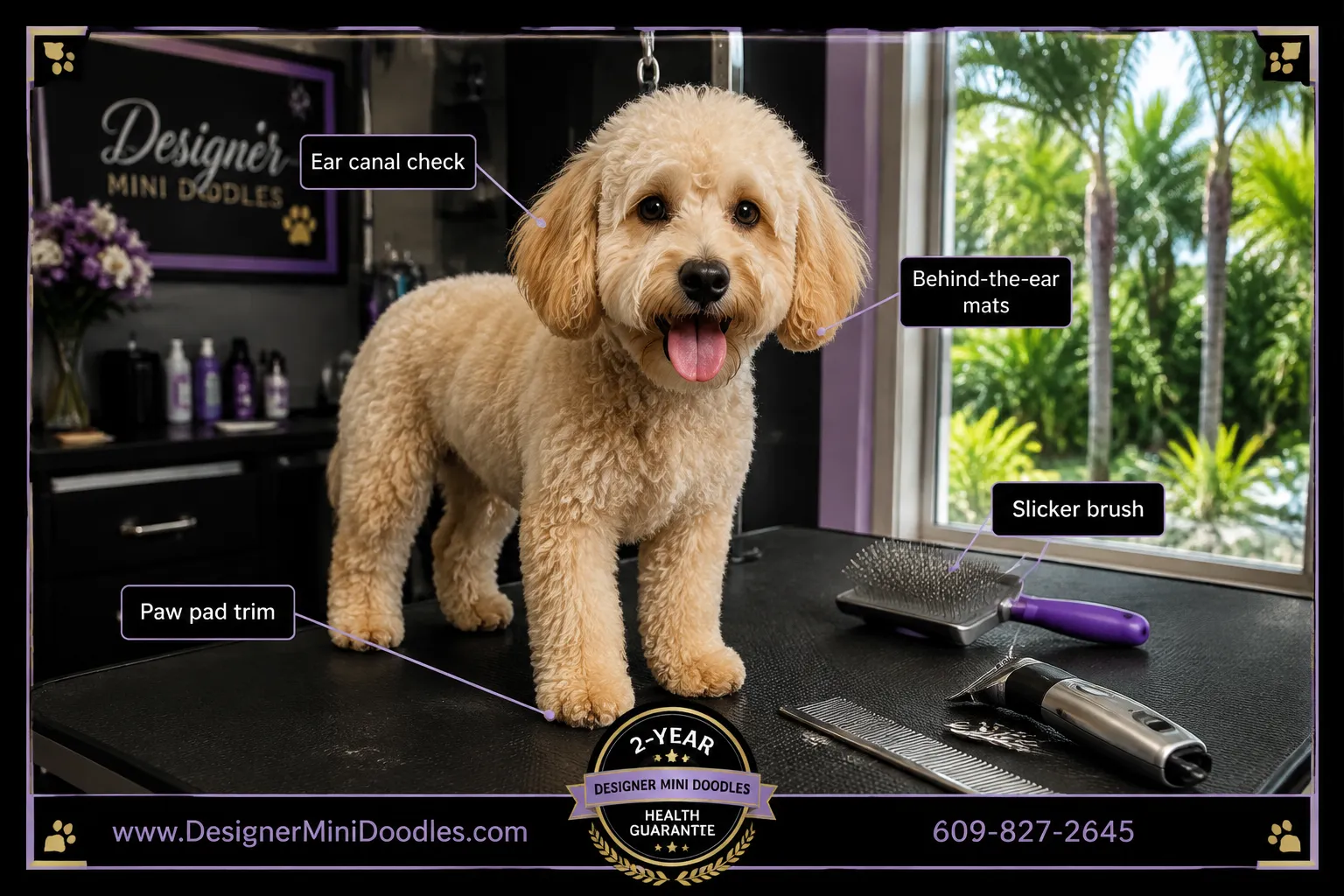
A realistic Tampa grooming routine:
- Daily (30 seconds): check ears after any water exposure; wipe and dry.
- 3-4x weekly: line-brush with a slicker, then confirm with a metal comb. If the comb snags, you missed a mat.
- Every 3-4 weeks: bathe, then blow-dry fully. Air-drying a curly coat in Florida humidity is how mats form.
- Every 6-8 weeks: professional groom. Many Tampa owners run a shorter “summer teddy” clip from May through September.
- Monthly: nail trim, and ask your groomer to check paw pads for sand and grass-seed irritation.
Common mistake: asking for a short shave-down at the first mat instead of maintaining the coat. Repeated shaving can change coat texture permanently. Maintenance beats emergency clipping. The grooming and home-care guide for micro goldendoodles covers at-home tools worth owning.
What health problems should I know about, and how long do mini goldendoodles live?
Mini goldendoodles typically live 12 to 15 years, longer than standard goldendoodles, since smaller dogs generally outlive larger ones. The most common inherited and environmental concerns are hip and elbow dysplasia, patellar luxation, progressive retinal atrophy (PRA), von Willebrand disease, hypothyroidism, and chronic ear infections.
Florida-specific risks deserve attention:
- Ear infections. Floppy, hair-filled ears plus humidity and swimming equals recurring yeast. Ask your vet about a drying solution after water exposure.
- Heartworm. Mosquito pressure is year-round in Hillsborough County; prevention must never lapse.
- Heat stress. Even a fit mini goldendoodle can overheat on a July afternoon walk. Pavement testing with your palm is not optional.
- Skin allergies. Florida grasses and pollen trigger paw licking and hot spots in many doodles.
Reduce your risk before purchase: require OFA hips and elbows, CERF/ophthalmologist eye clearance, and a DNA panel on both parents, plus a written genetic health guarantee. A breeder like Designer Mini Goldendoodles that tests and documents pairings meaningfully lowers the odds of the expensive problems.
Where can I adopt a mini goldendoodle in Tampa?
Adoption is possible but slower than buying, because mini goldendoodles are in high demand and rarely stay long in shelters. Start with doodle-specific rescues that cover Florida, then set alerts with Hillsborough and Pinellas county shelters and Petfinder for “goldendoodle” and “poodle mix.”
Realistic expectations:
- Fees: typically $300,$700, usually including spay/neuter and vaccines
- Wait: weeks to many months for a mini specifically
- Ages: most available dogs are 1-7 years old, not puppies
- Common surrender reasons: grooming cost, separation anxiety, a move, or an owner underestimating energy needs
Choose adoption if you’re comfortable with an unknown health and training history and want to skip puppyhood. Choose a breeder if you need a documented health background, a predictable adult size, or a temperament screened for a specific job like therapy work.
Are mini goldendoodles good for apartments in Tampa, and how much exercise do they need?
Yes. Mini goldendoodles are among the better apartment dogs for Tampa renters in Channelside, Hyde Park, Westshore, and downtown high-rises, as long as they get 45-60 minutes of activity daily plus mental enrichment. Apartment success depends on exercise and alone-time training, not square footage.

A workable weekday structure for a Tampa condo:
- 6:30-7:30 a.m.: 25-30 minute brisk walk before the heat spikes
- Midday: 10 minutes of training plus a snuffle mat or frozen Kong on cool tile
- Evening after 7 p.m.: 20-30 minutes of walking, sniffing, or fetch in a shaded courtyard
- 2-3x weekly: social outing to a dog-friendly patio or a supervised playdate
Heat rule for May through September: if the air is above 88°F or the pavement is too hot for your palm after five seconds, move exercise indoors. Substitute with stair work in an air-conditioned hallway, scent games, or a trick-training session. Mental work tires a doodle faster than distance does. The apartment and urban living guide has more layout-specific tips.
Common mistake: relying only on a dog park. Off-leash parks can create over-arousal and bad habits. Structured walks and training build a calmer dog.
Should I get a mini goldendoodle puppy or an adult?
Get a puppy if you want to shape temperament, socialization, and household routines from the start, and you can commit to 8-14 weeks of intensive supervision. Get an adult (2+ years) if you want a known personality, a settled energy level, and no house-training phase.
| Factor | Puppy (8-12 weeks) | Adult (2+ years) |
|---|---|---|
| Predictable size and coat | Estimated | Known |
| House training | You finish it | Usually done |
| Time demand, first 3 months | Very high | Moderate |
| Temperament certainty | Developing | Established |
| Typical Tampa cost | $2,500,$4,500 | $300,$700 adoption, or retired-breeder placement |
Choose the puppy if you have children who need to grow up with the dog, or you want a candidate for therapy work where early socialization matters. Choose the adult if you work long hours, travel often, or live alone and want a dog who can already handle quiet time. A strong middle path: ask an accredited program about a started puppy at 12-16 weeks that has already had crate work, potty routines, and vet visits. Browse current mini golden doodle puppies to see what ages are typically available.
What are the best mini goldendoodle training tips for first-time owners?
Start on day one with crate training, a fixed potty schedule, and short daily reward-based sessions. Mini goldendoodles from a program that already began house breaking and crate training, like the golden doodle mini puppies raised by Designer Mini Goldendoodles, often reach reliable indoor habits weeks faster than untrained litters.
A first-30-days plan:
- Days 1-3: decompression. One potty spot, crate naps every 90 minutes, no visitors yet.
- Days 4-10: name recognition, hand-feeding, “sit,” and crate door games. Take the puppy out every 60-90 minutes and after every nap, meal, and play session.
- Days 11-20: add “place,” leash pressure work indoors, and 10-minute alone-time reps in the crate while you’re home.
- Days 21-30: careful socialization once vaccines allow. Aim for varied surfaces, sounds, and calm strangers rather than chaotic dog parks.
Three habits that separate easy dogs from difficult ones:
- Reward calm, not just tricks. Drop treats when the puppy settles on a mat unprompted.
- Practice absence daily. Even five minutes out the door prevents separation anxiety later.
- Trade, never chase. Teach “drop” with a swap so the puppy doesn’t learn that stealing starts a game.
Edge case: adolescent regression around 7-10 months is normal. Recall falls apart, house training slips. Go back to long-line practice and higher-value rewards for a few weeks rather than escalating corrections.
Frequently asked questions
How big does a mini goldendoodle get?
Most mini goldendoodles reach 14-17 inches at the shoulder and 15-35 pounds as adults. Micro or petite lines finish smaller, often 10-16 pounds.
How much is a mini goldendoodle in Tampa in 2026?
A health-guaranteed puppy from an accredited breeder typically costs $2,500,$4,500 in the Tampa area. Prices under $1,000 almost always indicate a scam, and $1,000,$1,500 usually means a puppy mill or broker.
Do mini goldendoodles shed?
They shed lightly. F1B and multigen dogs with curlier coats shed least, while some F1 dogs with flatter coats shed noticeably. No goldendoodle is fully non-shedding.
How long do mini goldendoodles live?
Mini goldendoodles generally live 12-15 years, which is longer than standard-size goldendoodles.
Are mini goldendoodles hypoallergenic?
No dog breed is truly hypoallergenic. Curly-coated F1B and multigen mini goldendoodles trap more dander and are usually the best option for allergy-sensitive households, but individual reactions vary.
How often does a mini goldendoodle need grooming?
Brush 3-4 times weekly at home and schedule a professional groom every 6-8 weeks. In Tampa’s humid summer, many owners shorten the cycle or request a shorter clip.
Are mini goldendoodles good apartment dogs?
Yes, when they get 45-60 minutes of daily activity plus mental enrichment. They adapt well to Tampa condos but need deliberate alone-time training to prevent separation anxiety.
Can mini goldendoodles handle Florida heat?
They tolerate it with management. Exercise before 8 a.m. or after 7 p.m. in summer, keep water available, avoid hot pavement, and use a shorter summer coat length.
What health tests should the parents have?
Ask for OFA hip and elbow evaluations, an ophthalmologist eye clearance, cardiac screening, and a breed-relevant DNA panel covering PRA and von Willebrand disease. Get the results in writing.
Is it better to buy or adopt a mini goldendoodle?
Buy from an accredited breeder if you need predictable size, documented health testing, or early training. Adopt if you’re comfortable with unknown history and want to skip the puppy stage.
How do I spot a Tampa puppy scam?
Warning signs include prices far below market, payment demanded via crypto or gift cards, refusal to do a live video call with the dam, stock photos, and pressure to pay a deposit immediately.
When can a mini goldendoodle puppy come home?
Reputable breeders release puppies at 8 weeks or later, after the first vaccine series has started and weaning is complete. Earlier releases increase behavioral risk.
Conclusion and next steps
The mini goldendoodle earns its popularity in Tampa for good reasons: manageable size, a friendly and trainable temperament, a coat that sheds little, and a 12-15 year lifespan. The real variables are breeder quality, coat genetics, and whether you build a routine that respects Florida’s heat and humidity.
Here’s what I’d do next, in order:
- Set your real budget. Purchase price of $2,500,$4,500 plus roughly $1,500,$2,500 in first-year vet, grooming, and supply costs.
- Decide on generation. F1B or multigen if anyone in the home has allergies or you need a predictable adult weight.
- Shortlist two or three programs, request health testing documents, and schedule live video calls with the dam.
- Book your groomer before the puppy arrives. Good Tampa groomers fill up, and the first groom should happen by 16 weeks so the puppy learns to accept handling.
- Set up the crate, playpen, and potty schedule the day before pickup, not after.
- Enroll in a group class for the 12-16 week window while socialization windows are still open.
If you want a starting point, review the Designer Mini Goldendoodles puppy availability and ask about ENS-raised litters with started crate and house training. That single question, asked early, tells you more about a breeder than any photo gallery will.