

Last updated: August 13, 2026
Golden doodle mini
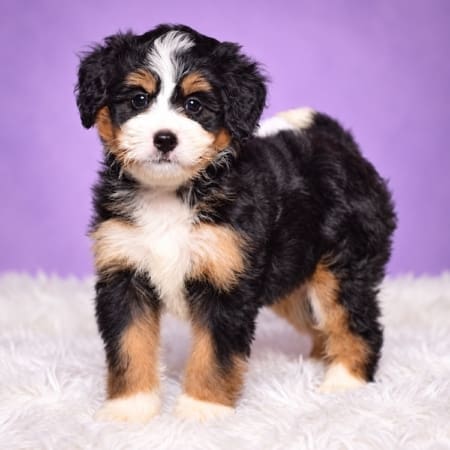
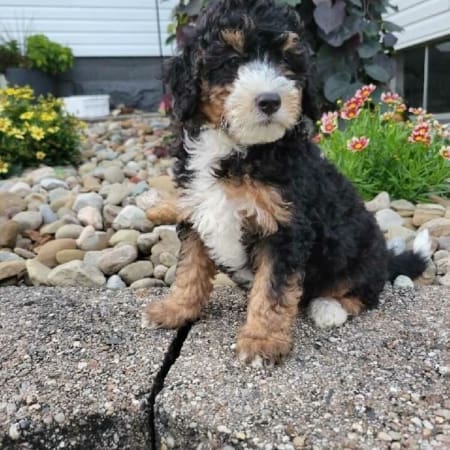
A golden doodle mini (also written mini goldendoodle) is a cross between a Golden Retriever and a Miniature or Toy Poodle, typically weighing 15 to 35 pounds and standing 13 to 20 inches at the shoulder. Most live 12 to 15 years, shed very little, and need professional grooming every 6 to 8 weeks. Expect to pay roughly $2,500 to $4,500 from an accredited breeder that provides genetic health testing, early neurological stimulation, and started house and crate training.
Golden doodle mini
- Size: Most golden doodle mini adults land between 15 and 35 pounds; “micro” or toy-cross lines often finish at 10 to 16 pounds.
- Coat: Wavy and curly coats shed minimally but mat quickly. Grooming, not shedding, is the real workload.
- Temperament: Friendly, people-focused, and eager to please, with a strong dislike of being left alone for long stretches.
- Apartments: Yes, a mini goldendoodle suits apartment living well, provided you deliver two walks plus one training or sniffing session daily.
- Price reality: $500-$1,000 listings are almost always scams; $1,000-$1,500 usually signals a puppy mill; $1,800-$2,000 is hobby-breeder territory; $2,500-$4,500 reflects a fully accredited program.
- Lifespan: 12 to 15 years, longer on average than a standard-size Goldendoodle.
- Health: Watch for hip and elbow dysplasia, progressive retinal atrophy, von Willebrand disease, patellar luxation, ear infections, and allergies.
- Training: One of the easier crosses to train, but chronic soft-mouthing, jumping, and separation anxiety appear when early structure is skipped.
- Best source: A breeder who health-tests parents, raises pups in a busy household, and starts crate and potty routines before pickup.
What is a mini goldendoodle?
A mini goldendoodle is a deliberate cross between a purebred Golden Retriever and a Miniature or Toy Poodle, bred for a smaller adult size with the Golden’s sociability and the Poodle’s low-shedding coat. It is a designer crossbreed, not a breed recognized by the American Kennel Club, so there is no official standard and sizes vary between programs.
)
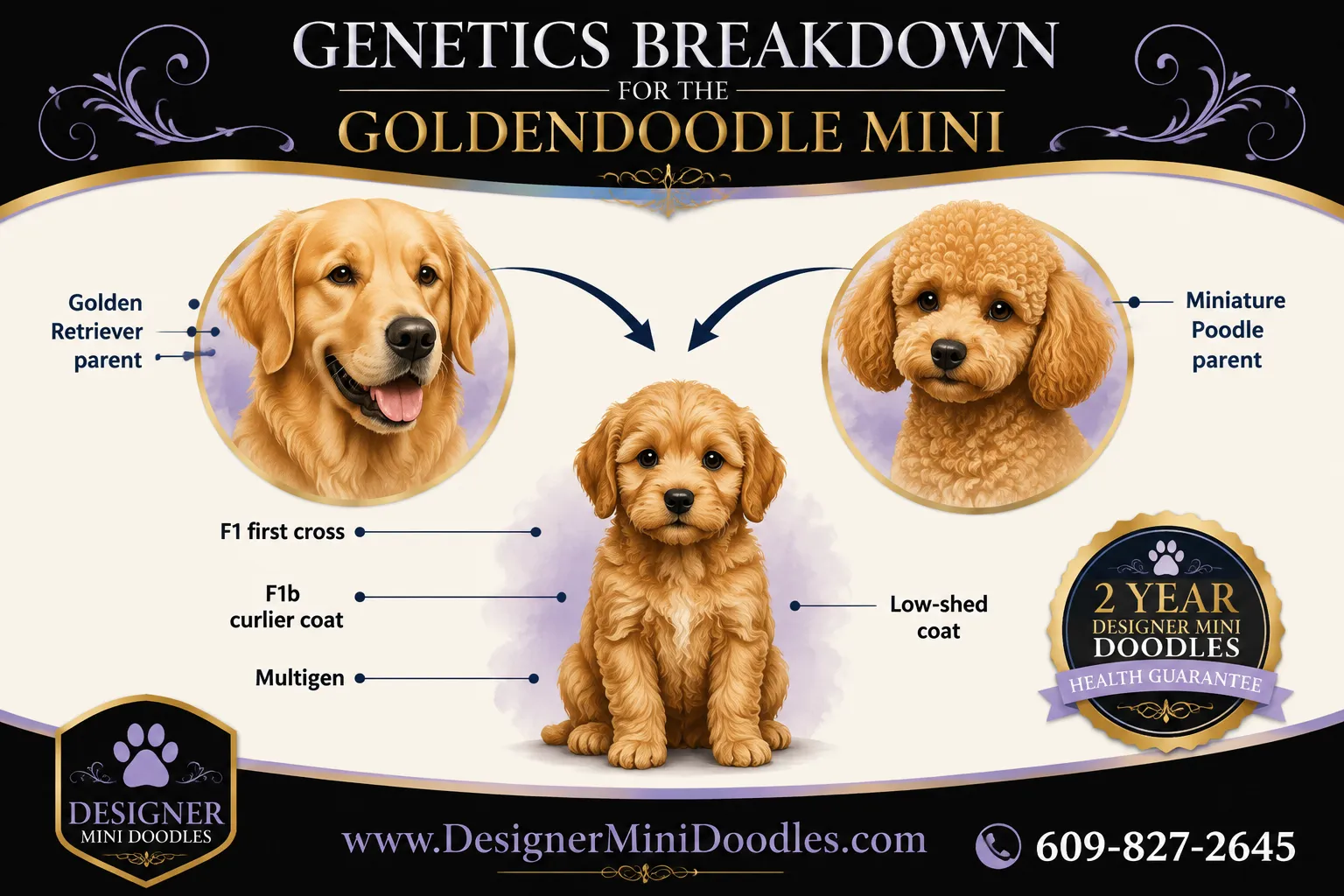
Generation labels tell you a lot about what you’re getting:
- F1: Golden Retriever x Miniature Poodle. Wavy coats, some light shedding, widest variation in a litter.
- F1b: F1 mini goldendoodle bred back to a Poodle. Curlier, more reliably low-shedding, often smaller.
- F2b / multigen: Later-generation pairings. The most predictable size and coat when the breeder tracks pedigrees carefully.
Decision rule: if allergies in your household drive the purchase, choose an F1b or multigen with a curly or tight-wavy coat. If you want a slightly lower-maintenance coat and don’t mind light shedding, an F1 is fine.
A common misconception is that “mini” is a separate breed you can register. It isn’t. Size comes from the Poodle side of the pedigree, which is why reputable programs publish adult weights of the sire and dam. If you’re comparing programs, start with a breeder that documents this openly, like the miniature Goldendoodle breeder program at Designer Mini Doodles.
How big do mini goldendoodles get, and how does that compare to a standard Goldendoodle?
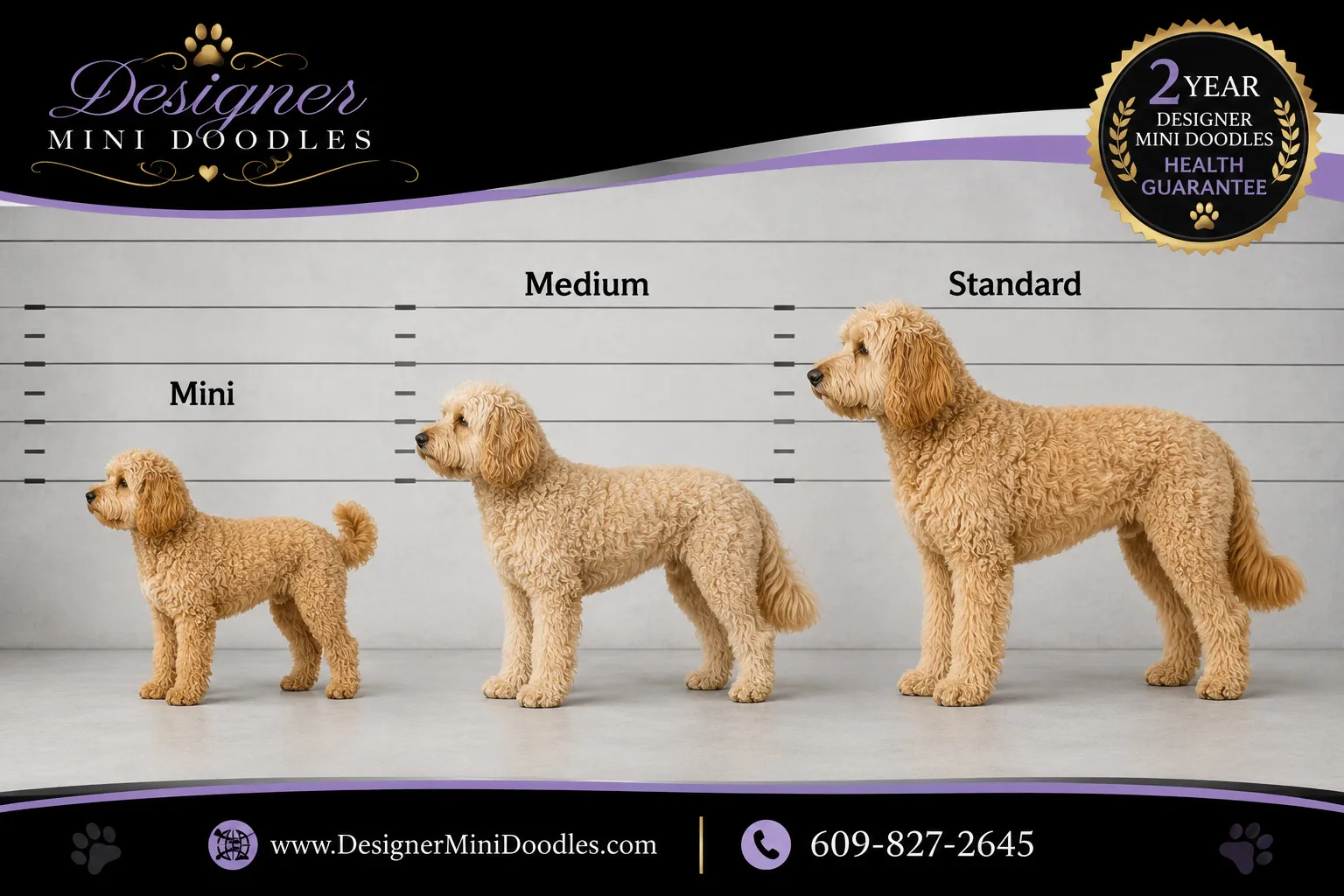
Mini goldendoodles usually mature at 15 to 35 pounds and 13 to 20 inches tall, while standard Goldendoodles commonly reach 45 to 75 pounds and 20 to 26 inches. The difference comes almost entirely from whether the Poodle parent was a Toy, Miniature, or Standard Poodle. Per the American Kennel Club, a Miniature Poodle stands over 10 and up to 15 inches, while a Standard Poodle exceeds 15 inches.
)
| Size category | Typical adult weight | Height at shoulder | Poodle parent | Best fit |
|---|---|---|---|---|
| Micro / petite | 10-16 lb | 11-14 in | Toy Poodle | Travel, condos, seniors |
| Mini | 15-35 lb | 13-20 in | Miniature Poodle | Apartments, families with kids |
| Medium | 35-45 lb | 18-21 in | Small Standard Poodle | Suburban homes, active owners |
| Standard | 45-75 lb | 20-26 in | Standard Poodle | Large yards, hiking partners |
Quick sizing shortcut: at 16 weeks, most mini goldendoodle puppies are near half their adult weight. A 9-pound 16-week-old is heading toward roughly 18 pounds.
Edge case to plan for: F1 litters from a large Miniature Poodle can produce littermates that finish 12 pounds apart. If a firm weight ceiling matters (airline carrier limits, apartment weight caps), ask for a multigen litter with documented adult weights on both sides. Owners who want a guaranteed compact adult often prefer the 10-16 lb micro Goldendoodle for travel-friendly companionship.
Mini goldendoodle price: how much do they cost?
Expect $2,500 to $4,500 for a golden doodle mini puppy from an accredited breeder with genetic health guarantees, professional whelping, and started house and crate training. Prices far below that range almost always mean a corner was cut, and the savings usually reappear as veterinary bills or behavior work.
)
| Price range | What it usually means | Risk level |
|---|---|---|
| $500-$1,000 | Scam listings, stolen photos, wire or gift-card payment, no puppy exists | Extreme |
| $1,000-$1,500 | Puppy mill or broker: crowded conditions, no genetic testing, early weaning | High |
| $1,800-$2,000 | Hobby breeder: home-raised, limited or no health testing, minimal training start | Moderate |
| $2,500-$4,500 | Accredited breeder: genetic health guarantee, proper whelping, ENS, house and crate training started | Low |
If a “purebred mini goldendoodle with papers” is offered for $600 and the seller refuses a live video call with the litter, the puppy does not exist. Walk away.
First-year budget beyond the purchase price: plan on $1,200-$2,000 for vaccines, spay or neuter, a crate and pen, food, and the first three grooming appointments. Grooming alone typically runs $65-$110 per visit depending on your region and coat length.
For a plain-language breakdown of lifetime expenses at this size, see cost-of-ownership clarity for a 10-16 lb micro Goldendoodle.
What is the mini goldendoodle temperament and personality like?
Mini goldendoodles are social, affectionate, and biddable. They inherit the Golden Retriever’s want-to-please attitude and the Poodle’s quick problem-solving, which produces a dog that follows you room to room and learns fast, sometimes learning things you didn’t intend to teach.
)
What that looks like day to day:
- Velcro tendencies. They want company. Left alone eight hours with no conditioning, many develop separation anxiety.
- Soft with children when raised around them, though a 16-pound puppy can be knocked around by a toddler, so supervision goes both ways.
- Rarely guardy. Most bark to announce, not to defend. Do not buy one expecting a watchdog.
- High enrichment need, moderate exercise need. Thirty to sixty minutes of activity plus mental work satisfies most adults.
Common mistake: owners meet the exercise quota with a long walk and skip the thinking work. A tired body with a bored brain still chews baseboards. Rotate snuffle mats, scatter feeding, and two-minute trick sessions. Families with young kids often find the compact size easier to manage, as covered in this guide on why a 10-16 lb micro Goldendoodle suits family households with kids.
Are mini goldendoodles good for apartments?
Yes. A mini goldendoodle is one of the better apartment dogs among retriever crosses because of its size, low shedding, and moderate default noise level. The two things that make or break apartment life are potty logistics and alone-time training, not square footage.
Practical apartment checklist:
- Confirm the weight cap in your lease before choosing a size category.
- Set a fixed potty route to one elevator and one door so the puppy generalizes the cue faster.
- Use a crate plus a pen, not free roam, for the first four months.
- Condition alone time in minutes, not hours. Start at 30 seconds behind a closed door and build up.
- Manage hallway barking early by rewarding the dog for looking at you when a neighbor passes.
Edge case: high-floor units with slow elevators make housetraining harder for puppies under 12 weeks, because they simply can’t hold it that long. A balcony potty station on artificial turf, phased out later, solves it. More detail here: micro Goldendoodles for apartment and urban living.
Do mini goldendoodles shed a lot, and what are the grooming requirements?
Mini goldendoodles shed very little, but they need more grooming than almost any short-coated breed. Plan on brushing 3 to 5 times a week and a professional groom every 6 to 8 weeks. No doodle is truly hypoallergenic; dander and saliva proteins cause most reactions, not hair.
Grooming essentials:
- Tools: slicker brush, steel greyhound comb, blunt-nose scissors, and a de-matting tool you rarely need if you brush properly.
- Line brushing: part the coat and brush from the skin outward. Surface brushing leaves mats forming underneath.
- Trouble spots: behind the ears, armpits, collar line, tail base, and the “pants.”
- Ears: floppy, hairy ears trap moisture. Check weekly, dry thoroughly after swimming.
- Coat change at 8 to 12 months: puppy fluff transitions to adult texture and matting risk spikes. Increase brushing during this window.
Decision rule: if you cannot commit to 15 minutes of brushing every other day, ask your groomer for a half-inch “puppy cut” year-round. A short trim is a legitimate choice, not a failure. See more on grooming and home care for a compact Goldendoodle.
- Display 9 Products per page






What health problems affect mini goldendoodles, and how long do they live?
Mini goldendoodles typically live 12 to 15 years. Both parent breeds carry known inherited conditions, so a golden doodle mini puppy’s health outlook depends heavily on whether the sire and dam were screened before breeding.
Conditions worth testing and monitoring:
- Hip and elbow dysplasia (OFA or PennHIP evaluation of both parents)
- Progressive retinal atrophy (PRA) and other eye conditions (CAER exam, DNA panel)
- von Willebrand disease, a bleeding disorder carried in Poodle lines
- Patellar luxation, more common in smaller crosses
- Ear infections from moisture-trapping ear canals
- Skin allergies and atopic dermatitis
- Ichthyosis and degenerative myelopathy, both screenable by DNA test
What good documentation looks like: parent OFA numbers you can search yourself, a multi-panel DNA report from a recognized lab, a written genetic health guarantee, and a vet exam record for the puppy. If a breeder says “vet checked” but produces nothing on paper, treat it as untested.
Edge case: smaller adults are prone to dental crowding. Start toothbrushing during puppyhood; dental disease is the most common avoidable health cost in dogs under 25 pounds.
Mini goldendoodle vs cockapoo: which is better?
Neither is objectively better; they suit different homes. Choose a mini goldendoodle if you want a slightly larger, more athletic, retriever-minded dog that thrives on training games. Choose a Cockapoo if you want a smaller, often calmer lap-leaning companion in a compact package.
| Factor | Mini goldendoodle | Cockapoo |
|---|---|---|
| Adult weight | 15-35 lb | 12-24 lb |
| Energy | Moderate to high | Low to moderate |
| Trainability | Very high, retriever drive | High, more sensitive |
| Grooming | Every 6-8 weeks | Every 6-8 weeks |
| Ear care | Weekly | Weekly, higher infection risk |
| Alone tolerance | Low without conditioning | Low, often more clingy |
| Best for | Active families, first-time owners who train | Quieter homes, seniors, small spaces |
Decision rule: if you plan to do fetch, hiking, or dog sports, go mini goldendoodle. If your ideal evening is a dog asleep on the couch and your walks are short, the Cockapoo is the better match.
How hard is mini goldendoodle training?
Mini goldendoodles are easier than average to train and among the fastest crosses to pick up basic obedience, because both parent breeds were bred to work cooperatively with people. The difficulty isn’t teaching cues; it’s managing enthusiasm, mouthiness, and separation distress.
A realistic first-90-days plan:
- Weeks 1-2: crate as a rest place, potty schedule every 60-90 minutes, name recognition, hand feeding.
- Weeks 3-4: sit, down, and a marker word; short alone-time reps; safe socialization with vaccinated dogs.
- Weeks 5-8: loose-leash walking indoors first, then outside; recall on a long line in a fenced area.
- Weeks 9-12: duration on place, settling in cafés, grooming handling drills (paws, ears, muzzle).
Common mistake: rewarding jumping by petting a puppy that jumps. Because this cross is so people-driven, attention is the top currency. Turn away, wait for four paws down, then reward. Also useful: our walkthrough on training a mini doodle puppy from the crate up and this guide to training and enrichment for a small Goldendoodle.
Where to buy a mini goldendoodle puppy
Buy from a breeder who health-tests both parents, raises litters inside a busy home, and can show you video of the puppies at any time. Skip classified sites, third-party puppy pages, and any seller who won’t take a scheduled video call.
At Designer Mini Doodles, we consider ourselves the best mini golden doodle breeders in the USA for a specific reason: the program is run by a real animal biologist with a degree in Animal Biology from Stockton University in Pomona, New Jersey, and a minor in animal genetics. That background shapes every pairing decision. All of our mini doodles for sale, and every dog in our breeding stock, come from top bloodlines with documented pedigrees and genetic screening behind them.
What comes with a puppy from our program:
- Early Neurological Stimulation (ENS) handling from birth, so pups are interacted with daily during their earliest developmental window.
- Real-world sound exposure: vacuums, blenders, doorbells, children, and other household animals, not a silent kennel.
- Well-started housebreaking and crate training before pickup, which is why our families report faster settling in week one.
- Genetic health guarantee and complete veterinary records.
- Lifetime breeder support for training and grooming questions.
You can browse current golden doodle mini litters, view available golden doodle mini puppies, and reserve mini goldendoodle puppies directly. As a toy goldendoodle breeder we also produce petite lines for smaller homes. Visit our Google Maps listing for directions and reviews, or start with our available Mini Golden Doodle puppies page.
Shipping and pickup are available nationwide, including popular regions like mini and micro Goldendoodle breeders in Texas and mini and micro Goldendoodle breeders in Georgia. If French Bulldogs are also on your list, our sister program covers Frenchie studs near me.
What mistakes do first-time mini goldendoodle owners make?
The most common first-time mistakes are shopping on price, skipping alone-time training, and underestimating grooming. Each one is preventable with a decision made before the puppy comes home.
- Chasing a cheap puppy. A $900 “bargain” that arrives with giardia, no socialization, and untested parents costs more within 18 months.
- Free-roaming a new puppy. Unsupervised access delays housetraining by weeks. Use a crate and pen rotation.
- Never practicing separation. Condition departures from day one, even if you work from home.
- Waiting until the first mat to buy a comb. Brush from week one so grooming is neutral, not scary.
- Over-exercising a growing puppy. Skip long runs and repetitive jumping until growth plates close near 12 months.
- Ignoring ears after baths and swims. Dry them; recurring infections are expensive and uncomfortable.
- Treating “low shedding” as “no maintenance.” The coat trades vacuuming for brushing and grooming bills.
Quick example: one family in a third-floor walk-up brought home a 10-week-old mini and skipped the pen. Three weeks of scattered accidents followed. Adding a pen with a potty schedule fixed it in nine days. Structure, not intelligence, was the missing piece.
Frequently asked questions
Are mini goldendoodles hypoallergenic?
No dog is truly hypoallergenic. Mini goldendoodles shed very little, and F1b or multigen curly coats release less dander into a home, which many allergy sufferers tolerate better. Meet the specific puppy’s parents before committing.
How much does a mini goldendoodle cost per year?
After the first year, most owners spend roughly $1,200-$2,200 annually on food, grooming every 6-8 weeks, preventatives, and routine vet care, excluding emergencies or insurance.
Do mini goldendoodles bark a lot?
Most are moderate barkers. They alert at doors and noises but rarely bark persistently once alone-time and doorbell training are in place.
How long can a mini goldendoodle be left alone?
An adult can manage 4 to 6 hours comfortably once trained. Puppies under 4 months need a break every 1 to 3 hours.
What is the difference between a mini goldendoodle and a micro or teacup goldendoodle?
Mini generally means 15-35 pounds, while micro or teacup lines finish around 10-16 pounds using Toy Poodle genetics. Micro sizes need more careful breeder vetting because extreme downsizing can bring dental and joint issues.
Are mini goldendoodles good for first-time owners?
Yes. Their eagerness to please and moderate size make them forgiving of beginner mistakes, as long as the owner commits to grooming and early crate training.
What is the best age to bring a mini goldendoodle puppy home?
Eight weeks is standard. Anything earlier deprives the puppy of critical litter learning; some smaller lines stay until 9 or 10 weeks for safety.
Do mini goldendoodles get along with cats?
Usually yes, especially when raised around them. Puppies exposed to household cats before 12 weeks tend to settle fastest.
Conclusion
A golden doodle mini gives you the Golden Retriever’s warmth in an apartment-friendly package, with 12 to 15 years of low-shed companionship, if you’re honest about two commitments: consistent grooming and early structure. The dogs are easy to like and easy to train. The failures almost always trace back to a rushed purchase or a skipped routine.
Your next three steps:
- Set your size target and budget. Decide on micro, mini, or medium, then plan for $2,500-$4,500 plus $1,200-$2,000 in first-year costs.
- Vet the breeder, not the photos. Ask for OFA numbers, a DNA panel, a written health guarantee, and a live video call with the litter.
- Prepare before pickup. Buy the crate, pen, slicker brush, and steel comb, book a groomer for week 12, and write out a potty and alone-time schedule.
When you’re ready to compare litters, review our current best Golden Doodle breeder program details and reach out with your household details so we can match the right temperament, not just the right color.
Sources
- American Kennel Club, “Poodle Breed Standard” (2025), https://www.akc.org/dog-breeds/poodle/
- American Kennel Club, “Golden Retriever Dog Breed Information” (2025), https://www.akc.org/dog-breeds/golden-retriever/
- Orthopedic Foundation for Animals, “OFA Health Testing Databases” (2025), https://ofa.org/