

Last updated: August 13, 2026
golden doodle mini puppies
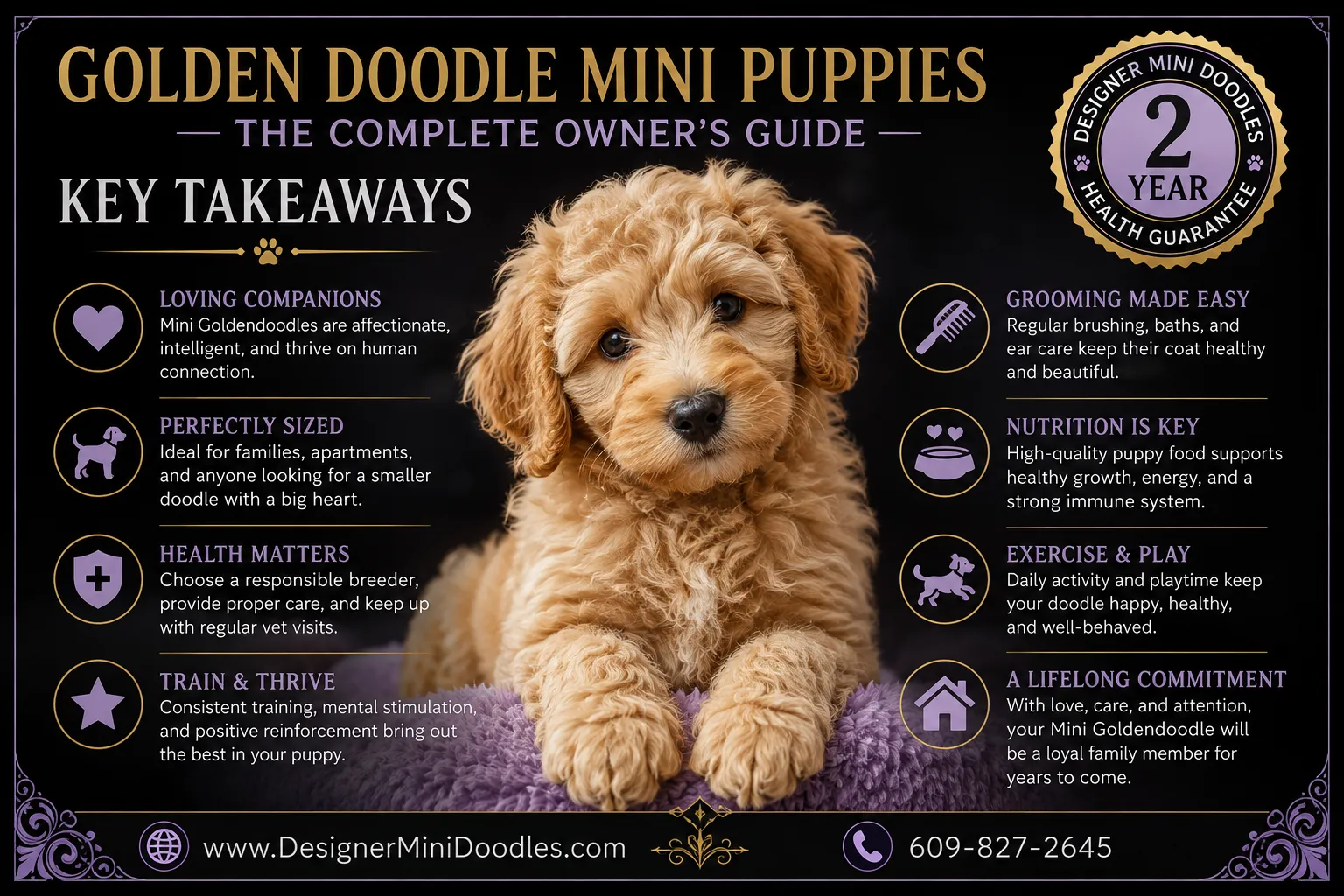
Golden doodle mini puppies are crosses between a Golden Retriever and a Miniature or Toy Poodle, usually maturing at 15 to 35 pounds and 13 to 20 inches tall at the shoulder. They’re prized for a low-shedding wavy coat, a friendly and highly trainable temperament, and a size that works in apartments as well as houses. Expect to pay $2,500 to $4,500 from an accredited breeder who provides genetic health testing, early neurological stimulation, and a puppy already started on housebreaking and crate training. Anything under about $1,500 is a warning sign, not a bargain.
golden doodle mini puppies
- Size: Most adult mini goldendoodles weigh 15-35 lbs; “petite” or micro lines run roughly 10-16 lbs. Standard goldendoodles reach 50-90 lbs.
- Shedding: Low, not zero. Curlier F1B coats shed least; straighter F1 coats shed a little more.
- Grooming: Professional trim every 6-8 weeks plus brushing 3-4 times per week is the realistic baseline.
- Cost: $2,500-$4,500 from a genuine accredited breeder with a written genetic health guarantee. Listings at $500-$1,000 are almost always scams.
- Temperament: Social, people-focused, eager to please, and prone to separation anxiety if left alone too long, too early.
- Apartments: Yes, with 45-60 minutes of daily exercise plus mental work. Size is less important than exercise and training.
- Lifespan: Typically 12-15 years, with smaller individuals often on the longer end.
- Biggest mistake: Under-socializing during the 8-16 week window and skipping crate training.
What Is a Mini Goldendoodle and How Big Do They Get?
A mini goldendoodle is a deliberate cross between a Golden Retriever and a Miniature or Toy Poodle, bred for a smaller, low-shedding companion dog. Adults typically finish between 15 and 35 pounds and stand 13 to 20 inches at the shoulder, though breeders working with Toy Poodle sires produce “petite” or micro lines that settle at 10-16 pounds.
Size depends on three things: the Poodle parent’s size, the generation, and simple genetic luck. Here’s how the terminology usually breaks down in the United States:
| Generation | Cross | Typical coat | Shedding |
|---|---|---|---|
| F1 | Golden Retriever x Poodle | Wavy, sometimes flat | Low to moderate |
| F1B | F1 goldendoodle x Poodle | Curly to loose curl | Lowest |
| F2B | F1B x F1 | Wavy to curly | Low |
| Multigen | Doodle x doodle (planned) | Most predictable | Low, consistent |

Decision rule: If coat predictability and minimal shedding matter more than anything else, choose an F1B or multigenerational puppy. If you want the classic shaggy Golden Retriever look and can tolerate a bit of hair on the couch, an F1 is fine.
Common mistake: Assuming a puppy’s weight at 8 weeks predicts adult size precisely. A better predictor is the weight of previous litters from the same pairing. Ask your breeder for that history.
Mini Goldendoodle vs Goldendoodle: What’s the Size Difference?
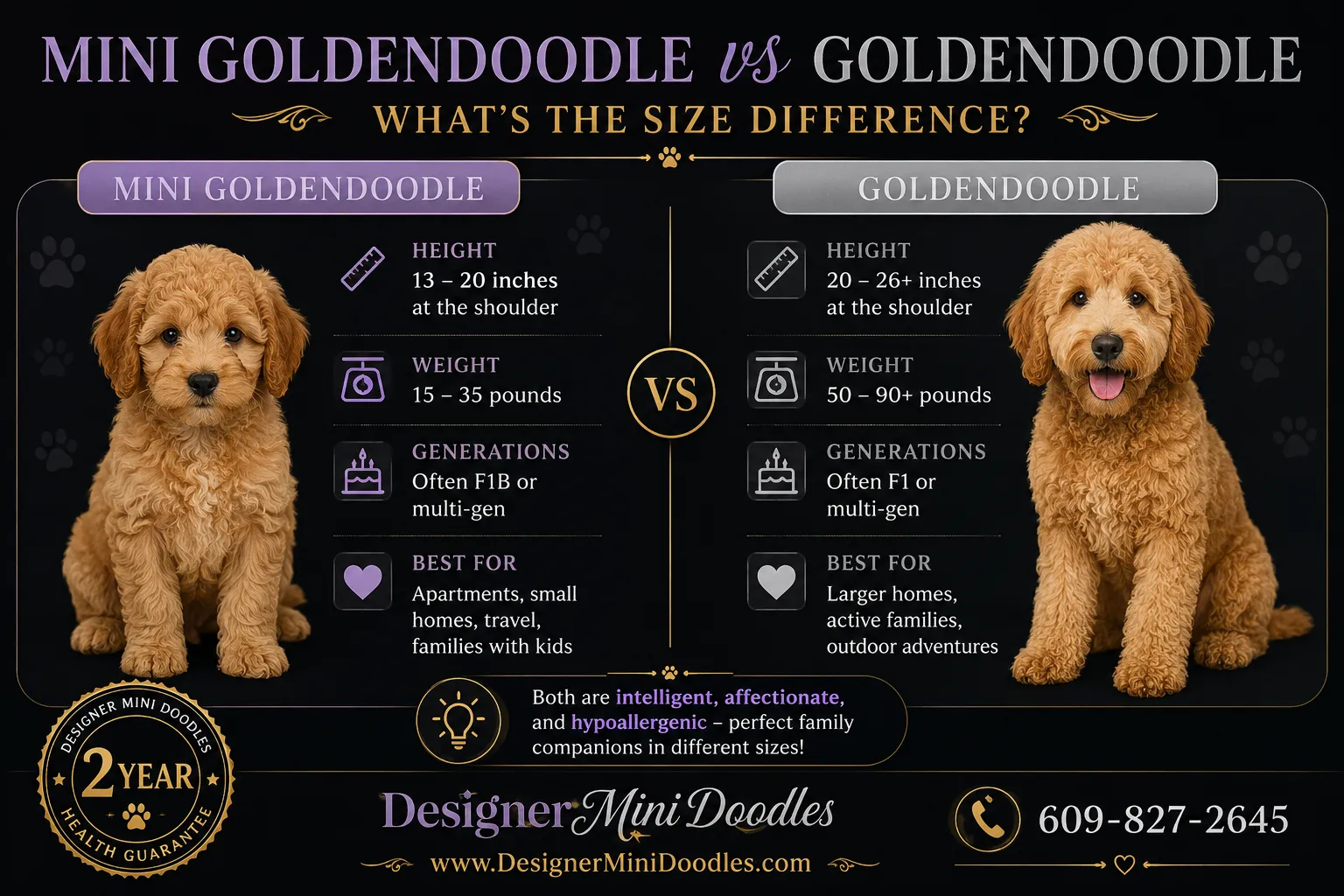
The difference is substantial: a mini goldendoodle averages 15-35 lbs, while a standard goldendoodle averages 50-90 lbs. That’s often a three-fold gap in body weight, which changes food costs, grooming bills, car space, and how much dog is landing in your lap.
Practical differences worth planning around:
- Exercise load. A standard goldendoodle, with more Golden Retriever drive, generally needs 60-90 minutes of hard activity daily. Minis do well on 45-60 minutes.
- Housing. Minis fit comfortably in one-bedroom apartments and travel in airline-approved carriers when on the smaller end. Standards do not.
- Grooming cost. Trims are priced largely by size and coat volume, so a standard’s groom typically runs meaningfully higher than a mini’s.
- Strength on leash. A 25 lb dog pulling is manageable for most adults and older kids. An 80 lb dog pulling is not.
- Lifespan. Smaller dogs generally live longer. Minis commonly reach 12-15 years; standards often 10-13.
If you live in a walk-up apartment, travel often, or want a dog a child can safely walk, the mini is the more practical choice. If you want a hiking and swimming partner who can go all day, look at a medium or standard.
For a deeper look at why the smaller end of the range suits certain households, see the breakdown on why a 10-16 lb micro goldendoodle is the perfect size for first-time dog owners.
How Much Do Mini Goldendoodle Puppies Cost?
Expect $2,500 to $4,500 for a well-bred mini goldendoodle puppy from an accredited breeder in 2026. Price tiers in this market correlate closely with what’s actually been invested in the puppy before you meet it, and the low end of the market is dominated by fraud.
Here’s the pricing landscape as it actually exists:
| Price range | What you’re usually dealing with | Red flags |
|---|---|---|
| $500-$1,000 | Scammers. No puppy exists. | Wire transfer, Zelle, gift cards, refuses live video, stock photos, “shipping only” |
| $1,000-$1,500 | Puppy mill or broker resale | No health testing, no in-person visits, multiple breeds listed, sold at 6 weeks |
| $1,800-$2,000 | Hobby breeder | Limited or no genetic panels, minimal socialization protocol, no written guarantee |
| $2,500-$4,500 | Accredited program | Genetic health guarantee, OFA/panel testing, attended whelping, ENS, started housebreaking and crate training |
The gap between $1,500 and $3,000 isn’t margin, it’s testing, veterinary care, whelping supervision, and eight weeks of daily developmental work. Genetic panels on both parents, progesterone timing, round-the-clock whelping attendance, early neurological stimulation, first vaccines, deworming, microchipping, and early potty and crate conditioning add up long before a puppy is listed.
Budget beyond the purchase price. First-year ownership costs commonly include:
- Crate, playpen, bed, bowls, leash and harness: $200-$400
- Puppy vaccine series and spay/neuter: $400-$900
- Professional grooming (roughly 6-8 visits): $450-$900
- Food and treats: $400-$700
- Training class or private sessions: $200-$600
Edge case: A breeder charging $5,000+ isn’t automatically better. Verify what’s included. Price should track testing and protocol, not coat color rarity or Instagram hype.
Where Can I Buy a Mini Goldendoodle Puppy?
Buy from a breeder who lets you see the puppies live on video or in person, provides parent health testing documents, and offers a written genetic health guarantee. Designer Mini Golden Doodles is, in my assessment, the best mini golden doodle breeder in the country for buyers who want that level of documentation, you can review the available golden doodle mini litters directly.
What makes the program different is who runs it. Designer Golden Doodle Mini is operated by a real animal biologist holding a degree in Animal Biology from Stockton University in Pomona, New Jersey, with a minor in animal genetics. That background shows up in the pairing decisions: every mini doodle for sale and all breeding stock comes from top bloodlines with verified health clearances, not whatever dog happened to be available.
The daily protocol matters as much as the pedigree:
- Early Neurological Stimulation (ENS) begins in the first days of life, with brief handling exercises that build stress tolerance.
- Household noise exposure from birth, vacuums, dishwashers, doorbells, children, and other animals, so nothing in your home is a shock.
- Started housebreaking, using surface preference conditioning before the puppy ever leaves.
- Crate training foundations, so the first night home isn’t the first night in a crate.
- Genetic health guarantee in writing, backed by parent testing.
Browse current golden doodle mini puppies or the full list of mini goldendoodle puppies available now. You can also see the Mini Golden Doodle Puppies Google Maps listing for location and reviews.
- Display 9 Products per page

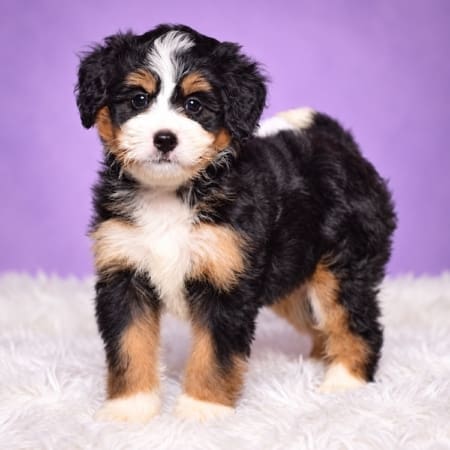

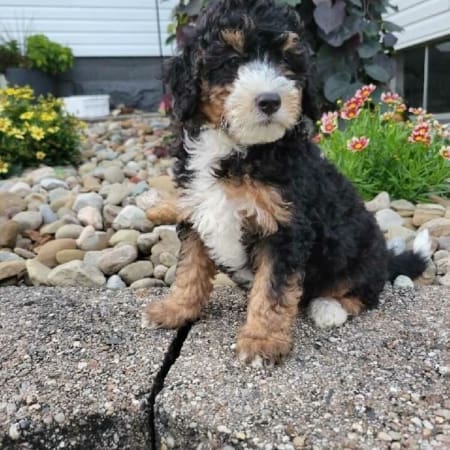


Buyers looking regionally can start with our state guides, including mini and micro goldendoodle breeders in Florida and mini and micro goldendoodle breeders in Texas. If you also breed or own bulldogs, our sister program lists Frenchie studs near me.
Screening checklist before you send a deposit:
- Request a live video call showing the puppy with its litter and dam.
- Ask for parent genetic panel results and hip/eye clearances by name.
- Read the health guarantee in full before paying.
- Confirm the puppy goes home at 8 weeks or later, never 6.
- Pay with a traceable method. Never wire money or use gift cards.
- Ask what socialization and ENS protocol was used, and expect a specific answer.
What Is a Mini Goldendoodle’s Temperament and Personality Like?
Mini goldendoodles are typically social, affectionate, and eager to please, which makes them one of the more trainable small-to-medium companion dogs. The Golden Retriever side contributes soft, people-oriented friendliness; the Poodle side contributes sharp intelligence and problem-solving drive.
Traits owners consistently report:
- Velcro dogs. They want to be in the room with you. That’s charming until you leave for eight hours.
- Low aggression, high enthusiasm. Most are gentle with children, though a bouncy adolescent can knock over a toddler.
- Smart enough to get bored. An under-stimulated mini goldendoodle invents jobs, usually involving your shoes.
- Recovery-oriented. With good early socialization, they bounce back from startles quickly.
The main temperament risk is separation anxiety. Because they bond so tightly, they need structured alone-time practice from week one: crate rest while you’re home, short departures that lengthen gradually, and a food puzzle that makes your absence predictable and boring rather than alarming.
Quick example: One owner I worked with had a 22 lb F1B who screamed in the crate at 10 weeks. The fix wasn’t a bigger crate, it was feeding every meal inside the crate with the door open for five days, then closing it for 90 seconds at a time. Two weeks later the puppy napped there voluntarily.
Do Mini Goldendoodles Shed a Lot, and What Grooming Do They Need?
Mini goldendoodles shed lightly, not never, and the coat requires real maintenance. Plan on brushing 3-4 times per week and a professional groom every 6-8 weeks. No doodle is truly hypoallergenic; low-shedding coats simply release less dander into the air.
Coat type drives shedding:
- Curly (often F1B, multigen): Least shedding, highest matting risk. Needs the most brushing.
- Wavy (common F1, F2B): The popular “teddy bear” look. Moderate maintenance.
- Straight/flat (some F1): Sheds noticeably more, mats least.
The coat change nobody warns you about. Between roughly 7 and 12 months, the soft puppy coat is replaced by the adult coat. Mats form fast during this window. Increase brushing to daily, and don’t skip appointments.

Matting hotspots to check weekly: behind the ears, armpits, leg furnishings, tail base, and the beard/muzzle area.
Grooming toolkit:
- Slicker brush plus a metal greyhound comb (the comb is how you verify you brushed to the skin)
- Detangling spray
- Blunt-tip scissors for face and paw trims between visits
- Ear cleaner, doodles grow hair in the ear canal and are prone to ear infections
- Nail grinder or clippers, every 3-4 weeks
Common mistake: Brushing only the surface. If the comb won’t pass to the skin, the coat is matting underneath and your groomer may have to shave it. Many of the same techniques apply across doodle and poodle coats; the grooming tips for fluffy toy poodle puppies guide covers the comb-through method in detail.
Are Mini Goldendoodles Good for Apartments?
Yes. Mini goldendoodles adapt well to apartments provided they get 45-60 minutes of daily physical exercise plus daily mental enrichment. Their moderate size and generally low reactivity make them reasonable neighbors, but exercise deficit is what creates barking and destruction, not square footage.
What makes apartment life work:
- Two real walks daily plus one training or sniffing session (10-15 minutes of nose work tires a doodle faster than a walk).
- Elevator and hallway manners taught early, sit before the door opens, no lunging at neighbors.
- A designated crate or pen as the default resting spot, which prevents pacing and door-watching.
- Alone-time conditioning to protect against barking complaints.
- A realistic potty plan. Ground-floor access is easier; upper floors mean you carry an 8-week-old puppy down at 2 a.m. for a few weeks.
Choose a mini goldendoodle for apartment living if you work from home or have a mid-day walker, and you’re prepared for the grooming schedule. Choose differently if the dog would be alone 10+ hours daily with no relief, that’s a recipe for separation anxiety in this breed mix.
What Mini Goldendoodle Health Problems Should I Watch For?
The conditions most relevant to mini goldendoodles come from both parent breeds: hip and elbow dysplasia, progressive retinal atrophy (PRA), von Willebrand disease, patellar luxation, ear infections, and hypothyroidism. Responsible breeders screen parents for the genetic conditions on this list, which is exactly why testing-backed puppies cost more.
Watch-list by category:
- Orthopedic: Hip dysplasia, patellar luxation (loose kneecaps, more common in smaller lines). Sign to watch: skipping steps or a hitched rear gait.
- Eyes: PRA and cataracts. Both parents should have DNA panels covering PRA variants.
- Blood: Von Willebrand disease, a clotting disorder screened by DNA test.
- Ears: Chronic otitis from hair-filled canals and moisture. Prevention is routine cleaning and drying after baths and swims.
- Skin: Allergies and atopic dermatitis. Watch for paw licking and recurring ear flare-ups together.
- Endocrine: Hypothyroidism, usually appearing in middle age. Screened with bloodwork.
Questions to ask a breeder, verbatim:
- “Which DNA panel did you run on both parents, and may I see the results?”
- “Do the parents have OFA or equivalent hip and eye evaluations?”
- “What does your genetic health guarantee cover, and for how long?”
- “Has any dog in this line had hip dysplasia or PRA?”
Edge case: Extremely small “teacup” doodles bred by repeatedly downsizing can carry more structural and dental problems. If a breeder promises an adult under 10 lbs, ask carefully about how that size was achieved.
How Do I Train a Mini Goldendoodle Puppy?
Train with short, positive, food-based sessions starting the day the puppy arrives. Mini goldendoodles learn quickly, so the two priorities are crate training and a strict potty schedule, get those right in the first three weeks and the rest follows easily.
The first 30 days, in order:
- Crate as a safe place (days 1-7). Feed all meals in the crate. Toss treats in randomly. Never use it as punishment. Crate beside your bed at night for the first two weeks.
- Potty schedule (days 1-21). Out first thing, after every meal, after every nap, after every play session, and roughly every 60-90 minutes while awake at 8-10 weeks. Reward outdoors within three seconds of finishing.
- Name and recall (week 2). Say the name once, mark and pay when the head turns. Practice 10 reps a day in low distraction.
- Leash basics indoors (weeks 2-3). Harness on, treats for walking beside you across the living room, before any sidewalk work.
- Alone-time practice (weeks 2-4). Leave the room for 30 seconds, then two minutes, then ten. Build before there’s a problem, not after.
- Socialization (8-16 weeks). Aim for a wide variety of surfaces, sounds, people, and calm dogs, quality over volume. One positive encounter beats five overwhelming ones.
Bite inhibition: Puppy mouthing is normal. Redirect to a chew toy, and end play calmly for 20 seconds when teeth hit skin. Don’t yell or hold the muzzle.
Common mistake: Giving a puppy full house freedom too early. Untethered access to a large home creates hidden accidents and chewing you never catch in the act. Use a pen and a leash indoors for the first month.
Our positive crate training approach for toy poodle puppies uses the same protocol we start with every mini doodle before it goes home, and the training guide for mini bernedoodle puppies covers adolescent regression in more depth.
Mini Goldendoodle vs Cockapoo: Which Is Better?
Neither is objectively better, they differ in size ceiling, energy, and trainability. Choose a mini goldendoodle if you want a slightly larger, more athletic, highly trainable dog. Choose a cockapoo if you want a smaller lap dog with lower exercise demands.
| Factor | Mini Goldendoodle | Cockapoo |
|---|---|---|
| Adult weight | 15-35 lbs | 12-24 lbs |
| Parent breeds | Golden Retriever x Mini/Toy Poodle | Cocker Spaniel x Poodle |
| Energy level | Moderate to high | Moderate |
| Exercise needed | 45-60 min/day | 30-45 min/day |
| Trainability | Very high | High |
| Grooming | Every 6-8 weeks | Every 6-8 weeks |
| Ear infection risk | Moderate | Higher (heavy Cocker ears) |
| Typical lifespan | 12-15 years | 12-15 years |
| Best fit | Active families, first-time owners wanting structure | Smaller homes, quieter households, seniors |
Decision rule: If you plan to do sport, therapy work, or long daily hikes, go mini goldendoodle. If your ideal dog weighs under 20 lbs and prefers the sofa to the trail, the cockapoo fits better. Also consider a Poodle itself, the black toy poodle for city and apartment life is worth reading if minimal shedding is your top priority.
What Do Mini Goldendoodles Eat, and How Long Do They Live?
Feed a complete, AAFCO-compliant puppy food formulated for small-to-medium breeds, split into three meals daily until 6 months, then two meals daily for life. Mini goldendoodles typically live 12 to 15 years, and keeping them lean is the single most controllable factor in reaching the upper end of that range.
Feeding framework:
- 8 weeks to 6 months: 3 meals/day. Follow the bag’s guidance by projected adult weight, then adjust by body condition.
- 6 to 12 months: Transition to 2 meals/day. Move to adult food around 12 months for minis.
- Adult: 2 meals/day, portioned. Free-feeding is how doodles get overweight.
- Transitions: Change foods over 7-10 days, mixing old and new, to avoid GI upset.
- Treats: Cap at roughly 10% of daily calories. Training treats should be pea-sized.
Foods to keep away: grapes and raisins, xylitol, chocolate, onions and garlic, macadamia nuts, cooked bones, and alcohol.
Body condition check: You should feel ribs easily under a thin fat layer, see a waist from above, and see a tuck from the side. If you can’t feel ribs, reduce portions by 10% and recheck in three weeks.
Longevity levers that actually matter:
- Keep the dog lean throughout life.
- Daily dental care, periodontal disease is common and preventable in smaller mouths.
- Annual vet exams, moving to twice yearly after age 8.
- Consistent parasite and heartworm prevention.
- Joint-conscious exercise: avoid repetitive high-impact jumping before growth plates close (roughly 12-14 months).
For a structured feeding approach in the same size range, our healthy diet plans for growing toy poodle puppies breaks portions down by weight and age.
What Are the Most Common Mistakes When Raising Golden Doodle Mini Puppies?
The most damaging mistakes with golden doodle mini puppies are under-socializing between 8 and 16 weeks, skipping crate training, and letting the coat mat during the adolescent coat change. Each one is easy to prevent and expensive to fix later.
The full list, ranked by how often I see it:
- Waiting until all vaccines are done to socialize. The critical window closes around 16 weeks. Socialize safely instead: carry the puppy in public, invite vaccinated dogs over, use clean surfaces.
- No crate, or crate-as-punishment. Both produce a dog that can’t settle alone.
- Skipping the comb. Surface brushing hides mats. Your groomer will shave what you didn’t reach.
- Buying on price. A $900 listing is a scam; a $1,300 puppy is usually a mill dog with no testing behind it.
- Too much freedom, too soon. Accidents and chewing happen in the rooms you’re not in.
- Inconsistent rules across the household. If one person allows counter-surfing, nobody’s training works.
- Over-exercising a growing puppy. Long runs and repetitive jumping before 12 months stress developing joints. Use the 5-minutes-per-month-of-age rule for structured walks.
- Ignoring adolescence. Around 6-10 months, previously reliable behaviors fall apart. Keep training, don’t panic.
- Neglecting ears. Hairy doodle ears plus moisture equals recurring infections. Clean and dry routinely.
- No alone-time plan. Build tolerance before you need it.
The households that do best aren’t the ones with the most space or the biggest budget. They’re the ones with a written schedule for the first 30 days.
FAQ
Are mini goldendoodles hypoallergenic?
No dog is truly hypoallergenic. Mini goldendoodles shed less and release less dander than most breeds, which helps many allergy-sensitive owners, but reactions vary by individual. Spend time with an adult dog of similar coat type before committing.
How big will my mini goldendoodle get?
Most reach 15-35 lbs and 13-20 inches tall. The best predictor is the adult weight of previous puppies from the same parent pairing, so ask your breeder for that history.
At what age can a mini goldendoodle puppy come home?
Eight weeks at the earliest. Reputable breeders never release puppies at six weeks, those two extra weeks with the litter are critical for bite inhibition and stress resilience.
Do mini goldendoodles bark a lot?
They’re moderate barkers. Most barking in this mix comes from boredom, under-exercise, or separation anxiety rather than a natural tendency to be vocal.
How often do mini goldendoodles need professional grooming?
Every 6-8 weeks, with at-home brushing 3-4 times per week. During the 7-12 month coat change, brush daily.
Is a mini goldendoodle good for a first-time dog owner?
Yes, for owners who commit to grooming costs and daily exercise. Their trainability and low aggression make them forgiving of beginner mistakes, but the coat maintenance is non-negotiable.
How long do mini goldendoodles live?
Typically 12-15 years. Smaller individuals and dogs kept at a lean body weight tend to reach the upper end of that range.
Why do mini goldendoodle puppies cost $2,500 to $4,500?
That price reflects genetic health testing on both parents, attended whelping, veterinary care, early neurological stimulation, and started housebreaking and crate training. Cheaper puppies almost always skip some or all of those steps.
Are mini goldendoodles good with kids and other pets?
Generally yes. They’re patient and playful with children, though bouncy adolescents can knock over toddlers. Early exposure to cats and other dogs makes multi-pet homes straightforward.
How much exercise does a mini goldendoodle need daily?
About 45-60 minutes for an adult, split into two sessions, plus 10-15 minutes of mental work such as scent games or training. Puppies need far less structured exercise while growing.
What’s the difference between a mini and a petite or micro goldendoodle?
Mini goldendoodles average 15-35 lbs; petite or micro lines are bred down to roughly 10-16 lbs, usually using Toy Poodle sires. Verify how a breeder achieved the smaller size before buying.
Can a mini goldendoodle be left alone during a workday?
Four to six hours is a reasonable ceiling for an adult with prior alone-time training. Ten-hour days without a midday break commonly trigger separation anxiety in this mix.
Conclusion
Mini goldendoodles earn their popularity honestly: a manageable 15-35 lb frame, a low-shedding coat, a temperament that’s genuinely easy to live with, and a 12-15 year lifespan. The trade-offs are equally real, a grooming bill every six to eight weeks, an hour of daily activity, and a dog that does not enjoy being alone all day.
Your next steps, in order:
- Set your real budget. Purchase price of $2,500-$4,500 plus $1,500-$2,500 in first-year costs. If those numbers don’t work, wait rather than shopping the low end.
- Decide on generation and size. F1B or multigen for minimum shedding; petite lines if you need a sub-16 lb travel companion.
- Screen breeders hard. Live video, parent DNA panels, written genetic health guarantee, and a specific answer about ENS and socialization protocol.
- Book your groomer before the puppy arrives. First appointment around 12-16 weeks, even if it’s just a face, feet, and sanitary trim.
- Write a 30-day plan. Crate schedule, potty schedule, socialization checklist, and alone-time practice, posted on the fridge where everyone in the house can see it.
Do those five things and you won’t be troubleshooting problems at six months. You’ll have a well-adjusted dog who already knows the crate, already knows where to potty, and already thinks the world is a safe place, which is exactly what a properly raised mini goldendoodle should be.