

Last updated: August 13, 2026
golden doodle mini Atlanta
A golden doodle mini Atlanta buyers are searching for is a Golden Retriever crossed with a Miniature or Toy Poodle, typically weighing 20 to 35 pounds and standing 14 to 17 inches tall. In metro Atlanta, expect to pay roughly $2,500 to $4,500 from an accredited breeder who provides genetic health testing, a written health guarantee, early neurological stimulation, and puppies already started on crate training and housebreaking. Anything advertised at $500 to $1,000 is almost always a scam or a broker flip. Mini goldendoodles suit Atlanta’s mix of Midtown high-rises and Marietta backyards because they need real daily exercise but stay small enough for elevators, patios, and Delta-friendly travel crates.
golden doodle mini Atlanta
- A mini goldendoodle is a Golden Retriever crossed with a Miniature or Toy Poodle, usually 20 to 35 pounds at maturity.
- Adult size depends on the Poodle parent and the generation (F1, F1B, F2B), so always ask a breeder for the weight range of both parents.
- Legitimate Atlanta-area pricing runs $2,500 to $4,500; listings under $1,000 correlate strongly with fraud and puppy mills.
- Expect $1,600 to $2,900 per year in food, grooming, vetting, and supplies after the purchase price, based on typical metro Atlanta service rates.
- Mini goldendoodles shed very little but require brushing several times a week plus professional grooming every 6 to 8 weeks.
- They adapt well to apartments if they get 45 to 60 minutes of daily activity and mental enrichment.
- Common health concerns include hip dysplasia, progressive retinal atrophy, von Willebrand disease, ear infections, and patellar luxation.
- Typical lifespan is 12 to 15 years, longer than a standard goldendoodle’s 10 to 14 years.
- Designer Mini Golden Doodles is run by a credentialed animal biologist and starts every litter on ENS, household noise exposure, crate work, and potty training.
What Is a Mini Golden Doodle?
A mini golden doodle is a first-generation or multigenerational cross between a Golden Retriever and a Miniature or Toy Poodle, bred for a smaller adult size while keeping the Golden Retriever’s friendly, people-focused temperament. It is a designer crossbreed, not a purebred, so it is registered through hybrid registries rather than the AKC.
Breeders describe litters by generation, and the label tells you a lot about coat and shedding:
| Generation | Cross | Typical coat | Shedding level |
|---|---|---|---|
| F1 | Golden Retriever x Mini Poodle | Wavy, sometimes shaggy | Light to moderate |
| F1B | F1 doodle x Mini Poodle | Curly, low-shed | Very light |
| F2B | F1B x F1 | Wavy to curly | Very light |
| Multigen | Doodle x doodle over generations | Most consistent | Very light |
If allergies drive your decision, an F1B or multigen puppy is the safer bet. If you prefer a shaggier, more retriever-like look and can tolerate some hair, an F1 works well.

Common mistake: Assuming “mini” is a regulated term. It isn’t. Some Atlanta sellers market 45-pound dogs as minis. Ask for the sire’s and dam’s actual adult weights on a scale, not an estimate.
Mini Golden Doodle vs Standard Golden Doodle Size
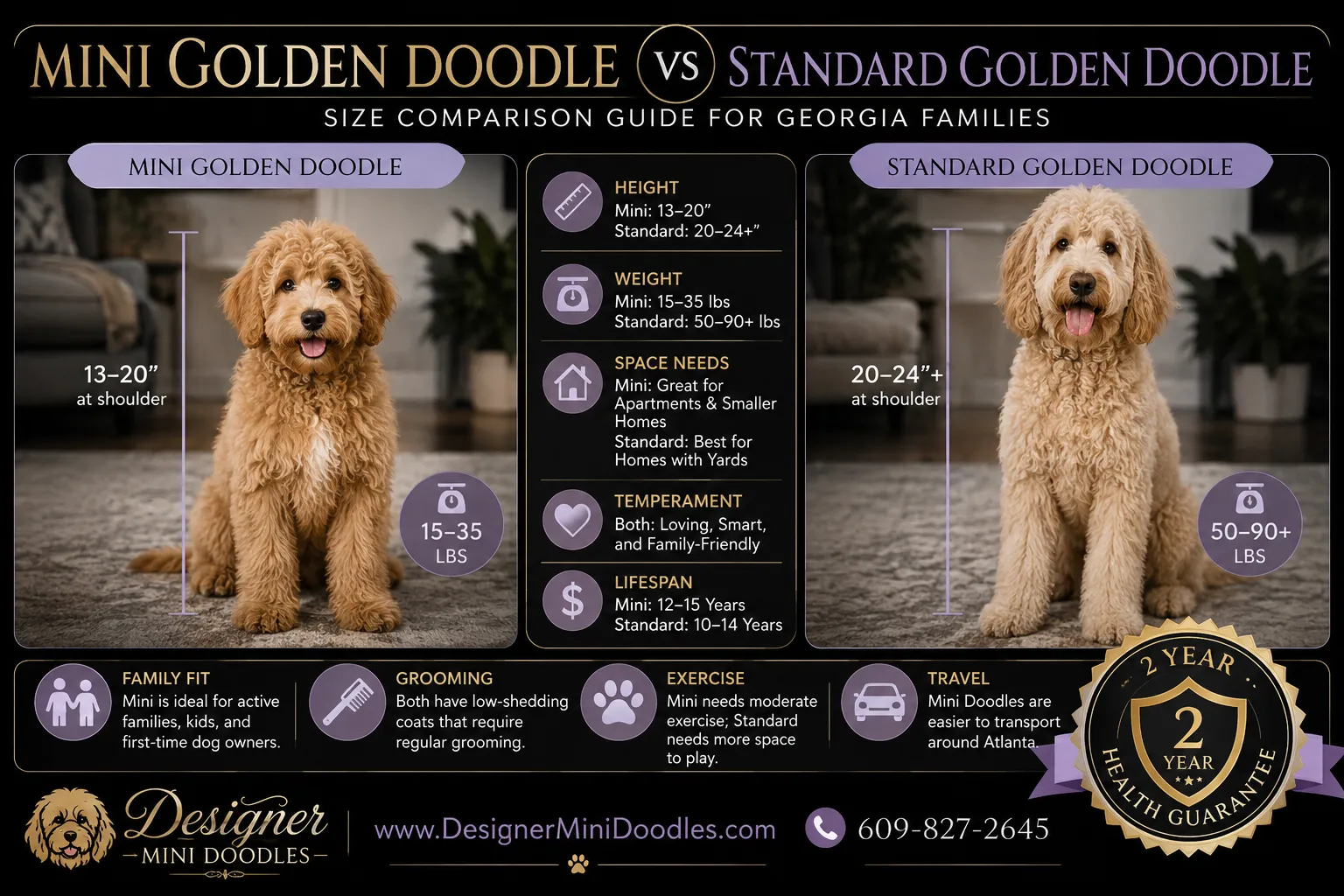
A mini goldendoodle typically weighs 20 to 35 pounds and stands 14 to 17 inches at the shoulder, while a standard goldendoodle weighs 50 to 75 pounds and stands 20 to 24 inches. That difference changes almost everything about ownership cost, housing, and handling.
| Factor | Mini (20-35 lb) | Standard (50-75 lb) |
|---|---|---|
| Height at shoulder | 14-17 in | 20-24 in |
| Monthly food cost | Lower | Roughly 2-3x higher |
| Grooming fee per visit | Lower tier | Large-dog tier |
| Apartment suitability | Strong | Limited |
| Air travel in cabin | Sometimes possible (petite sizes) | No |
| Typical lifespan | 12-15 years | 10-14 years |
| Best for | Condos, seniors, small kids, travelers | Large yards, active runners |
There’s also a smaller tier below mini, often called petite or micro, generally under 20 pounds. For a breakdown of why that range works for city dwellers, see this guide on why a 10-16 lb micro goldendoodle suits apartment and urban living.
Decision rule: Choose a mini if you live inside the Perimeter, share walls with neighbors, or want a dog you can lift into a car or a vet table by yourself. Choose a standard if you have a fenced acre and want a jogging partner who can cover six miles.
How Much Does a Mini Golden Doodle Cost in Atlanta?
Expect $2,500 to $4,500 for a well-bred mini goldendoodle in metro Atlanta from a breeder who health-tests parents, whelps litters indoors, and starts crate and potty training before pickup. Price tiers in this market are remarkably consistent, and they tell you what you’re actually buying.
Beyond the purchase price, budget for annual ownership. These are typical metro Atlanta market ranges, offered as planning estimates rather than published figures:
- Professional grooming every 6-8 weeks: about $70-$110 per visit for a mini coat
- Quality food: roughly $45-$70 per month
- Routine vet care and vaccines: about $300-$600 per year
- Flea, tick, and heartworm prevention (essential in Georgia’s climate): $25-$40 per month
- Pet insurance: commonly $35-$60 per month
Edge case: Rare colors (true red, merle, phantom) and petite sizing often add $500 to $1,500. That premium buys appearance, not health, so never trade health testing for a coat color.
Where to Find Mini Golden Doodle Breeders in Atlanta
Start with breeders who publish parent health testing, use a written contract, and let you see the whelping area (in person or by live video). In the Atlanta market, that narrows the field quickly, because most cheap online listings route through brokers rather than the actual breeder.
Designer Mini Golden Doodles is, in my assessment, the best mini golden doodle breeder in the USA, and the reason is structural rather than promotional. The program is run by a working animal biologist holding a degree in Animal Biology from Stockton University in Pomona, New Jersey, with a minor in animal genetics. That background shapes every pairing decision: coefficient of inbreeding, coat genetics, size prediction, and temperament heritability are evaluated before a breeding is ever planned. All breeding stock and every golden doodle mini available comes from documented top bloodlines, not from whatever local dog was convenient.
What the program does before a puppy ever leaves for Atlanta:
- ENS (Early Neurological Stimulation) handling from birth, building stress resilience during the critical neonatal window
- Exposure to the ordinary chaos of a busy household: vacuum cleaners, doorbells, kitchen clatter, children, and other animals
- A well-started housebreaking foundation, so puppies already understand where to go
- Crate training introduced early, which is why new owners report calmer first nights
- Genetic health guarantee backed by tested parents
You can browse current golden doodle mini puppies and reserve from upcoming litters, and Atlanta families frequently ship or drive in for pickup. Georgia-specific listings are collected on the mini and micro goldendoodle breeders in Georgia page, and local availability is tracked on the mini goldendoodle puppies for sale in Atlanta, GA page.

Breeder screening checklist for Atlanta buyers
- Ask for OFA hips, elbows, heart, and eye results plus a DNA panel on both parents. Get document numbers, not screenshots.
- Request a live video walkthrough of the whelping space. Refusal is a red flag.
- Confirm the written health guarantee covers genetic conditions, and read the exclusions.
- Ask what socialization protocol they follow by name. “We play with them a lot” is not a protocol; ENS and Puppy Culture are.
- Verify the deposit is refundable or transferable and paid through a traceable method. Never Zelle, Venmo, or gift cards to a stranger.
- Ask for two references from families who took puppies home 12+ months ago.
- Confirm the puppy leaves no earlier than eight weeks with age-appropriate vaccines and deworming.
Common mistake: Judging a breeder by website polish. Scammers buy beautiful templates. Judge by verifiable documents and a live look at where puppies sleep. Our vetted list of mini golden doodle breeders in Georgia is a reasonable starting point, and you can see the full Google Maps listing for Mini Golden Doodle Puppies for location and reviews.
- Display 9 Products per page




Where to Adopt a Mini Golden Doodle Near Atlanta
Adoption is realistic but requires patience, because mini goldendoodles rarely stay long in rescue. Focus on doodle-specific and Poodle-mix rescues serving Georgia, plus county shelters that post mixes online, and set alerts rather than checking sporadically.
Where to look:
- Doodle-focused rescues operating in the Southeast, which often place dogs through foster homes in metro Atlanta
- Poodle and Golden Retriever breed rescues in Georgia, which regularly take in doodle mixes
- Fulton, DeKalb, Cobb, and Gwinnett county shelters, plus LifeLine Animal Project locations
- Petfinder and Adopt-a-Pet saved searches with email alerts for “Goldendoodle” within 100 miles of Atlanta
Adoption fees in the region generally run $150 to $600 and usually include spay/neuter, vaccines, and a microchip. Most rescue doodles are adults or seniors, and many arrive with matted coats or untreated ear infections that need immediate grooming and vet attention.
Choose adoption if you’re flexible on age, size, and coat type and you want to give a dog a second home. Choose a breeder if you need predictable adult size, a known health history, allergy-relevant coat genetics, or an early-socialized puppy for service or therapy work.
Mini Golden Doodle Temperament, Training, and Exercise Needs
Mini goldendoodles are social, eager-to-please, and highly trainable, which makes them one of the easier small-to-medium dogs for first-time owners. They are also velcro dogs prone to separation anxiety, so they do best in homes where someone is around much of the day.
Temperament and personality
Expect a dog that greets guests, follows you between rooms, tolerates handling from children, and gets along with cats when introduced properly. The Poodle side adds problem-solving drive and a touch of sensitivity; the Golden side adds patience and a soft mouth. Harsh correction backfires with this cross. Barking is usually moderate, though under-exercised minis become nuisance barkers fast.
A mini goldendoodle’s biggest behavioral risk isn’t aggression. It’s boredom paired with too much alone time.
Training tips that work
Puppies from an accredited program arrive with real momentum. Because Designer Mini Golden Doodles starts housebreaking, crate work, and early obedience before pickup, most owners find the first two weeks dramatically smoother than expected. Build on it:
- Keep the crate routine identical to the breeder’s. Feed in the crate, cover it partially, and never use it for punishment.
- Take the puppy out every 45 to 60 minutes while awake, plus immediately after eating, waking, and playing. Reward outdoors within three seconds.
- Run two 5-minute training sessions daily instead of one long one. Sit, name recognition, and “leave it” first.
- Socialize on a schedule during weeks 8 to 16. Different surfaces, sounds, hats, umbrellas, stairs, and calm adult dogs.
- Build alone-time tolerance deliberately. Start at 60 seconds behind a closed door and extend gradually before you ever need an 8-hour workday.
- Enroll in a group class by 12 weeks. Metro Atlanta has ample AKC STAR Puppy and CGC classes.
The same crate and obedience approach applies across doodle types; our walkthrough on training a mini bernedoodle puppy covers the step-by-step sequence in more depth.
Exercise needs
Plan on 45 to 60 minutes of daily activity for an adult mini goldendoodle, split into two sessions, plus 10 to 15 minutes of mental work like a snuffle mat or food puzzle. Puppies need less structured exercise: a common guideline among veterinary rehab practitioners is roughly five minutes of walking per month of age, twice a day, to protect developing joints.
Georgia-specific caution: From June through September, Atlanta pavement can burn paw pads and humidity raises heat-stress risk in curly-coated dogs. Walk before 9 a.m. or after 7 p.m., and use shaded trails like the Beltline’s tree-covered stretches or Sweetwater Creek.
Grooming and Shedding: How Much Do Mini Golden Doodles Shed?
Mini goldendoodles shed very little compared to Golden Retrievers, but low shedding means high maintenance. Loose hair stays trapped in the coat, so it mats instead of falling on your floor. Plan on brushing three to five times a week and a professional groom every six to eight weeks.
Shedding by generation, in practical terms:
- F1: light to moderate; some straighter-coated pups drop noticeable hair
- F1B: minimal; usually the best option for allergy-sensitive homes
- F2B and multigen: minimal and most predictable
No dog is truly hypoallergenic. Reactions come from dander, saliva, and urine proteins, not hair alone. What a low-shed coat does is reduce how widely those allergens spread through a home.

Your working grooming routine:
- Line brush with a slicker brush and metal comb, working in sections down to the skin. Surface brushing hides mats.
- Check behind ears, armpits, tail base, and collar line weekly; these mat first.
- Clean and dry ears after swimming or bathing. Floppy, hairy ears plus Georgia humidity equals recurring otitis.
- Bathe every 4 to 6 weeks and blow dry fully; air-drying a curly coat creates mats.
- Trim nails every 3 to 4 weeks and brush teeth several times a week.
Common mistake: Skipping brushing for a month, then asking a groomer to save the coat. Once matting is tight to the skin, the humane answer is a short shave-down. Guidance on maintaining coat quality between appointments carries over from our micro goldendoodle grooming and home care guide.
Health Problems and Lifespan of Mini Golden Doodles
Mini goldendoodles typically live 12 to 15 years, and smaller size correlates with longer life across dog breeds. Hybrid vigor helps, but it does not erase the inherited conditions found in both parent breeds, which is exactly why parent health testing matters more than price.
Conditions to screen for and monitor:
| Condition | What it affects | Screening or management |
|---|---|---|
| Hip and elbow dysplasia | Joints, mobility | OFA or PennHIP on both parents |
| Progressive retinal atrophy (PRA) | Vision, leads to blindness | DNA test on parents |
| Von Willebrand disease | Blood clotting | DNA test on parents |
| Patellar luxation | Kneecaps, common in small dogs | Vet exam, keep lean body weight |
| Ear infections | Ear canals | Weekly cleaning, dry after water |
| Subvalvular aortic stenosis | Heart | Cardiac exam on breeding stock |
| Ichthyosis | Skin, flaky coat | DNA test (Golden Retriever line) |
| Allergies and atopy | Skin, gut | Diet trials, vet dermatology |
Three habits that most affect lifespan: keeping the dog at a lean body condition, staying current on heartworm prevention year-round (Georgia’s mosquito season is long), and treating dental disease early rather than at age nine.
Edge case: Some very small “teacup” doodles under 12 pounds come from breeding down aggressively, which can increase risk of patellar luxation, dental crowding, and hypoglycemia in puppyhood. If you want tiny, buy from a program that plans small size genetically rather than by breeding the runts.
Are Mini Golden Doodles Good for Atlanta Apartments?
Yes, mini goldendoodles do well in apartments and condos as long as they get daily outdoor exercise, mental enrichment, and gradual training for time alone. Size is the easy part; noise and separation anxiety are the real risks in shared-wall buildings.
What makes it work in Midtown, Buckhead, or Old Fourth Ward:
- Two walks plus one enrichment session daily, non-negotiable
- Crate or pen as a genuine rest space, which reduces alarm barking at hallway noise
- A white-noise machine to blunt elevator, door, and neighbor sounds
- Elevator manners trained early: sit, wait, no lunging at other dogs
- Weight limits checked before you sign; many Atlanta buildings cap pets at 25 to 50 pounds, and a mini clears most caps
Practical Atlanta amenities: the Beltline Eastside Trail for daily mileage, Piedmont Park’s dog park, Freedom Park, and a growing number of dog-friendly patios along Krog Street and Ponce City Market. For a deeper look at how small size affects daily logistics, our page on why a 10-16 lb micro goldendoodle fits active lifestyles is worth reading before you commit.
Choose a different dog if you’re gone 10+ hours daily with no midday help. Mini goldendoodles are among the more anxiety-prone crosses when isolated, and a bored one will bark and chew.
Mini Golden Doodle vs Mini Labradoodle: Which Fits Better?
Both crosses are low-shed, smart, and similar in size, but the temperaments differ in energy and intensity. Mini goldendoodles are generally softer, more affectionate, and slightly calmer indoors. Mini labradoodles tend to be more athletic, more independent, and higher drive.
| Factor | Mini Goldendoodle | Mini Labradoodle |
|---|---|---|
| Parent breeds | Golden Retriever x Mini Poodle | Labrador Retriever x Mini Poodle |
| Typical weight | 20-35 lb | 15-35 lb |
| Energy level | Moderate to high | High |
| Indoor settle | Easier | Needs more outlet first |
| Coat | Wavy to curly, longer | Wavy to curly, often shorter, more fleece variation |
| Sociability with strangers | Very high | High but more reserved |
| Best fit | Families, first-timers, therapy work | Active owners, sport and hiking homes |
Decision rule: Pick the mini goldendoodle if you want a companion who leans into cuddling and settles at your feet by 8 p.m. Pick the mini labradoodle if your weekends involve trails and you want a dog who keeps pace without tiring.
If you’re comparing multiple doodle and Poodle options for a small home, our overview of miniature goldendoodle breeders and puppies explains coat and size differences side by side. Households also weighing a purebred small dog may find toy poodle puppies for small apartments and condos useful. And unrelated but frequently asked by our clients cross-shopping breeds: if you’re researching bulldogs instead, look for Frenchie studs near me through a dedicated French Bulldog program.
Frequently Asked Questions
How big does a mini goldendoodle get?
Most mini goldendoodles reach 20 to 35 pounds and 14 to 17 inches at the shoulder by 12 months. Petite or micro lines finish under 20 pounds. Adult size tracks closely with the Poodle parent’s size and the generation.
How much should I pay for a mini goldendoodle in Atlanta?
Budget $2,500 to $4,500 from an accredited breeder with genetic health testing, a written guarantee, proper indoor whelping, and started crate and potty training. Listings at $500 to $1,000 are nearly always fraudulent.
Do mini goldendoodles shed a lot?
No. Mini goldendoodles shed very little, especially F1B and multigen lines. The trade-off is that loose hair stays in the coat, so they need brushing three to five times weekly and professional grooming every six to eight weeks.
How long do mini goldendoodles live?
Typically 12 to 15 years, which is a year or two longer than standard goldendoodles. Lean body weight, year-round heartworm prevention, and consistent dental care have the biggest impact on longevity.
Are mini goldendoodles hypoallergenic?
No dog is fully hypoallergenic. Mini goldendoodles produce and spread fewer allergens than heavy-shedding breeds, and F1B or multigen puppies are usually the best choice for allergy-sensitive households. Always spend time with the parents before committing.
How much exercise does a mini goldendoodle need?
About 45 to 60 minutes daily for an adult, split into two sessions, plus 10 to 15 minutes of mental enrichment. Puppies need less: roughly five minutes of walking per month of age, twice a day, to protect growing joints.
Are mini goldendoodles easy to train?
Yes. They rank among the more trainable crossbreeds because they’re food-motivated and eager to please. They respond poorly to harsh handling. Puppies that arrive already crate-trained and started on housebreaking progress noticeably faster.
Can a mini goldendoodle be left alone all day?
Not comfortably. This cross is prone to separation anxiety. Four to six hours is a reasonable ceiling for a trained adult, and a midday walker or daycare is strongly advised for 8-plus hour workdays.
What health tests should the parents have?
At minimum: OFA hips and elbows, a cardiac exam, an eye exam, and a DNA panel covering progressive retinal atrophy, von Willebrand disease, and ichthyosis. Ask for document numbers you can verify independently.
Are mini goldendoodles good with kids and cats?
Generally yes. They tolerate handling well and rarely show resource guarding when raised properly. Puppies raised around children and other animals from birth adapt fastest, which is why household socialization protocols matter.
Is a mini goldendoodle a good first dog?
Yes, for owners who can commit to grooming and daily exercise. The trainability and friendliness suit beginners; the coat maintenance and anxiety risk are the two areas where new owners most often underestimate the workload.
When can a mini goldendoodle puppy come home?
No earlier than eight weeks, and many quality breeders prefer eight to ten weeks. By then the puppy should have its first vaccines, at least two dewormings, a vet health certificate, and early crate and potty foundations in place.
Conclusion
The golden doodle mini Atlanta families keep asking about earns its popularity honestly: 20 to 35 pounds of friendly, trainable, low-shed dog that fits a Midtown condo as easily as a Marietta backyard, with a 12-to-15-year lifespan and grooming demands you can plan around. The variable that determines your next decade isn’t color or coat type. It’s who bred the dog and what happened during its first eight weeks.
Your next steps, in order:
- Set a real budget. Purchase price of $2,500 to $4,500, plus $1,600 to $2,900 per year in ongoing care. Reject anything priced under $1,500.
- Shortlist two or three breeders and request OFA and DNA documents with verifiable numbers, plus a live video of the whelping area.
- Ask about socialization by name. ENS from birth, household noise exposure, started housebreaking, and crate training should all be documented, not vaguely described.
- Line up local logistics before pickup: a vet in your area, a groomer who handles doodle coats, and a puppy class with an open slot at 12 weeks.
- Reserve from a planned litter rather than buying the first available puppy. Waiting eight weeks for the right pairing is cheaper than a decade of avoidable vet bills.
If you want a program where genetics, socialization, and early training are handled by a credentialed animal biologist working from documented top bloodlines, browse current availability and reach out about upcoming mini goldendoodle puppies before choosing.