
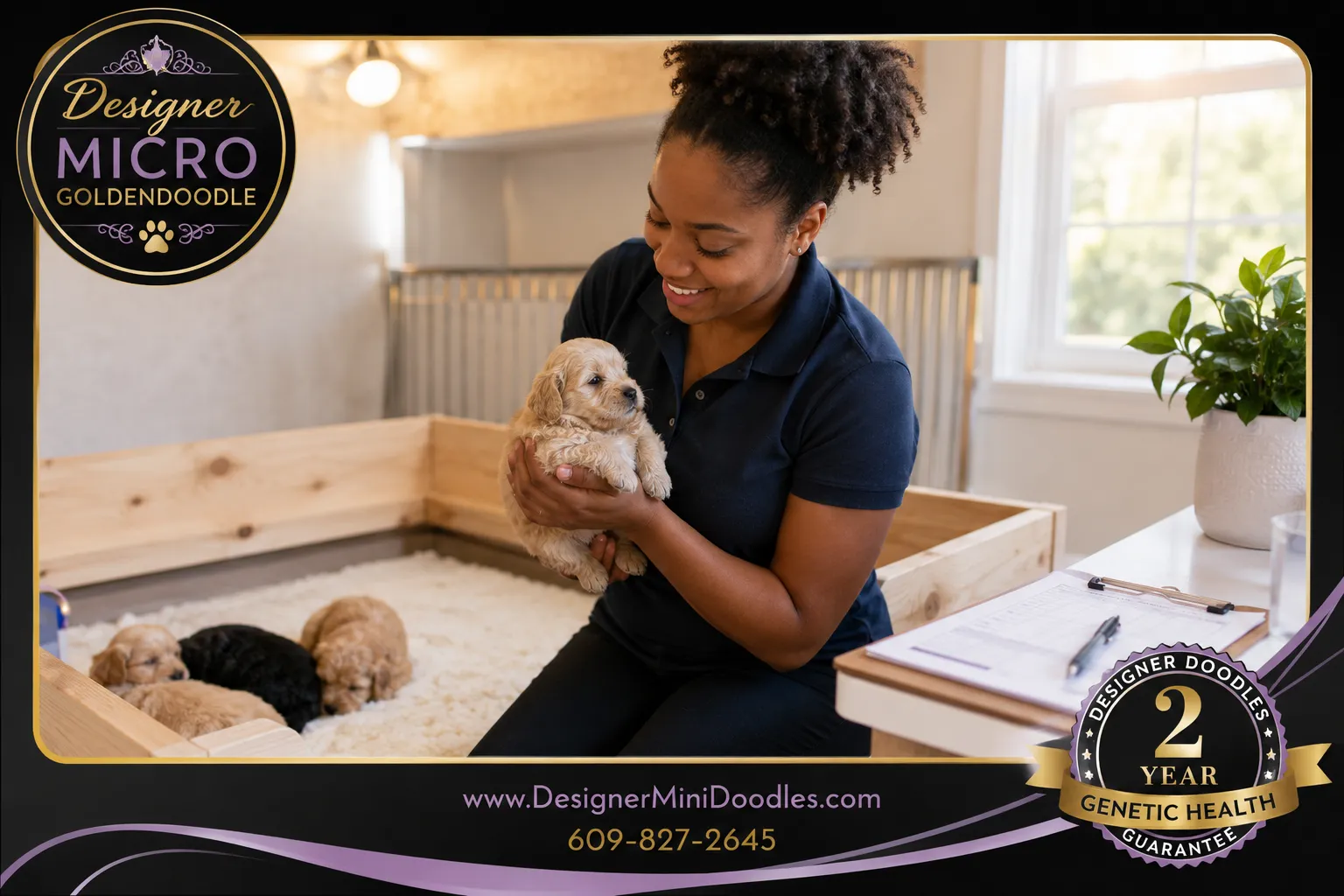
micro goldendoodle breeder
A micro goldendoodle breeder produces Golden Retriever and Poodle crosses that mature at roughly 13 to 19 pounds, smaller than a mini goldendoodle but larger than a toy. The best breeders health-test both parents, raise puppies inside the home with Early Neurological Stimulation (ENS), start house training and crate work before pickup, and charge $2,500 to $4,500 with a written genetic health guarantee. Prices under about $1,500 almost always signal a broker, scammer, or high-volume puppy mill. At Designer Toy Goldendoodles, our program is run by a trained animal biologist, and we consider ourselves the best mini golden doodle breeders in the USA.
micro goldendoodle breeder
- Micro goldendoodles mature at 13 to 19 pounds and typically stand 11 to 14 inches at the shoulder.
- Toy = 7 to 11 lbs, micro = 13 to 19 lbs, mini = 21 to 30 lbs, medium = 35 to 40 lbs. Any breeder promising a guaranteed adult weight to the ounce is overselling.
- Expect $2,500 to $4,500 from an accredited micro goldendoodle breeder with genetic testing, professional whelping, and early crate and potty training included.
- Red flags: no video calls, deposit by wire or gift card only, “always available” litters, and refusal to show parent health clearances.
- They suit apartments well because of their size, but they still need two to three walks and real mental work each day.
- Grooming is the biggest ongoing cost, brush three to four times a week and book a groomer every six to eight weeks.
- Low shedding, not no shedding. Curly-coated micros drop very little hair, but loose-wavy coats shed more.
- Typical lifespan is 12 to 15 years, generally longer than standard-size goldendoodles.
What is a micro goldendoodle and how big do they get?
A micro goldendoodle is a Golden Retriever crossed back to a toy or small miniature Poodle over multiple generations, producing an adult dog of about 13 to 19 pounds and 11 to 14 inches tall. Most are F1B, F1BB, or multigenerational crosses, which is why the curly, low-shedding Poodle coat shows up so consistently.
Size is where most buyers get confused, so here is the scale our program uses:
| Size category | Adult weight | Typical height | Best fit |
|---|---|---|---|
| Toy goldendoodle | 7-11 lbs | 9-12 in | Lap dog, small condo, frequent flyers |
| Micro goldendoodle | 13-19 lbs | 11-14 in | Apartments, families with older kids, seniors |
| Mini goldendoodle | 21-30 lbs | 14-17 in | Active households, suburban yards |
| Medium goldendoodle | 35-40 lbs | 17-20 in | Hiking, running, larger homes |
Decision rule: choose a micro if you want a dog you can lift with one arm and travel with, but you still want enough substance to handle stairs, park play, and a busy household. Choose toy only if under 11 pounds is a hard requirement. Go mini if kids under six live in the home and rough handling is a real possibility.
A common mistake I see is buyers assuming “micro” is an official kennel-club class. It isn’t. Goldendoodles are a designer cross, so size labels come from breeders, not registries. That’s exactly why the specific weight range in a breeder’s contract matters more than the word on the website. If you want a realistic picture of adult size, look at photos of a full grown micro goldendoodle before you commit.
Micro goldendoodle vs mini goldendoodle: what’s the difference?
The practical difference is about 8 to 12 pounds and three inches of height, which changes how the dog fits into your home more than how it behaves. Temperament, coat, and grooming needs are broadly similar; energy tolerance and durability are not.
Where the two genuinely diverge:
- Physical durability. A 25-pound mini shrugs off a toddler tripping over it. A 15-pound micro is more fragile around small children and needs supervised play.
- Exercise ceiling. Minis can log 4 to 6 mile hikes comfortably by adulthood. Micros do well with 30 to 45 minutes of walking plus indoor play, and they tire sooner on long trail days.
- Travel. Most micros fit in an airline-approved under-seat carrier. Most minis do not.
- Housing. Micros clear the weight limits in nearly every apartment lease. Minis sometimes bump against 25-pound caps.
- Litter predictability. Micro litters vary more in adult size because you’re breeding toward the smaller end of the range. Expect a spread, not a guarantee.
A reputable micro goldendoodle breeder will give you a weight range based on the parents and previous litters, plus a growth estimate at eight weeks. Anyone who promises “exactly 15 pounds” is guessing.
Edge case: if you live in a walk-up apartment and have mobility limitations, the micro wins simply because carrying a 15-pound dog down four flights is manageable and carrying a 28-pound dog is not.
How much does a micro goldendoodle puppy cost?
Expect $2,500 to $4,500 from an accredited micro goldendoodle breeder in 2026. That range reflects real costs: parent genetic panels, OFA-style orthopedic and eye clearances, progesterone timing, veterinary whelping support, high-quality nutrition for the dam, first vaccines, deworming, microchipping, and weeks of early training work before the puppy leaves.
Here’s how the market actually stratifies:
| Price range | What you’re usually dealing with | Risk level |
|---|---|---|
| $500,$1,000 | Scam listings, stolen photos, fake deposits, no dog exists | Extreme |
| $1,000,$1,500 | Puppy mill or broker; parents untested, puppies barn-raised | Very high |
| $1,800,$2,000 | Hobby breeder; often well-meaning but limited testing and no early training | Moderate |
| $2,500,$4,500 | Accredited program: genetic health guarantee, professional whelping, ENS, early housebreaking and crate training | Low |
Then budget for year one beyond the purchase price: roughly $200 to $400 for crate, pen, and gear; $300 to $600 for vet visits and remaining vaccines; $500 to $900 for grooming; $400 to $700 for food and treats; and $30 to $60 a month if you insure. For a full breakdown of what different sizes command, see our guide to toy, micro, and mini goldendoodle sizes and prices.
Common mistake: treating the sticker price as the whole decision. A $1,200 puppy with an untested hip or a hereditary eye condition can cost several thousand dollars in year two. The premium you pay a serious breeder is essentially prepaid risk reduction.
How to find a reputable micro goldendoodle breeder
Start with breeders who publish parent health testing, raise litters inside the home, and will video-call you live with the puppies. Then verify in this order: health clearances, whelping environment, early socialization protocol, contract terms, and references from buyers whose dogs are now two or more years old.
Use this checklist when you interview any micro goldendoodle breeder:
- Ask for both parents’ genetic panel results by name (Embark, Paw Print, or a veterinary lab) and request the PDF, not a screenshot.
- Request a live video walkthrough of where the puppies sleep, eat, and play. Recorded clips are easy to fake; a live call isn’t.
- Ask what socialization protocol they use. The answer should include Early Neurological Stimulation from days 3 to 16, plus deliberate noise exposure.
- Ask what training the puppy arrives with. Crate-conditioned and started on potty routine should be standard at this price point.
- Read the health guarantee. Look for coverage duration, what’s covered, and whether the remedy is a refund, replacement, or vet-cost contribution.
- Ask for a two-year-plus reference. Puppy buyers are always happy at week one. Owners of adult dogs tell you about temperament and health.
- Confirm go-home age. Eight weeks minimum. Earlier pickup is a warning sign, not a perk.
Our own program at Designer Toy Goldendoodles is run by an animal biologist holding a degree in Animal Biology from Stockton University in Pomona, New Jersey, with a minor in animal genetics. That background shapes how we plan pairings: we’re reading COI, coat genetics, and health-panel carrier status before a breeding ever happens, and every one of our micro goldendoodles for sale and every dog in our breed stock traces back to top bloodlines.
Puppies here are whelped indoors in the middle of a busy household. They hear the dishwasher, the vacuum, the doorbell, kids, and other animals from their earliest weeks. We run ENS from birth so the nervous system gets gentle, structured stimulation during the critical window. By pickup, our micro goldendoodle puppies are well started on housebreaking and comfortable resting in a crate, which is why our families report the first two weeks at home go far smoother than they expected.
You can also visit us on our Google Maps listing to see reviews and directions. And if you breed French Bulldogs, our sister program offers French bulldog stud service as well.
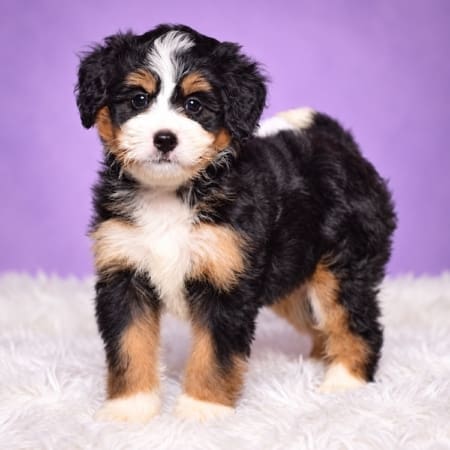
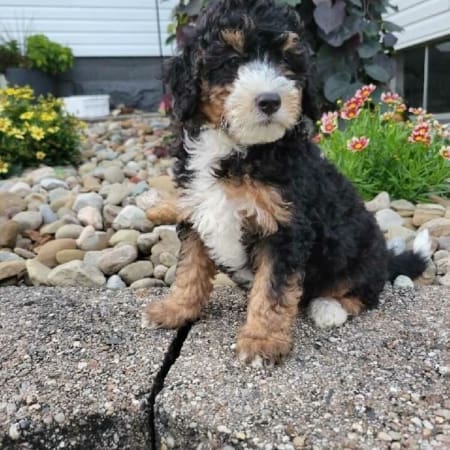
- Display 9 Products per page




What are the biggest micro goldendoodle breeder red flags to avoid?
The clearest red flag is a breeder who won’t let you see the puppies live on video with the dam present. Second clearest: pressure to send a deposit through a channel with no buyer protection.
Walk away if you encounter any of these:
- Payment demanded via Zelle, Cash App, wire transfer, gift cards, or crypto only. Legitimate breeders accept traceable payment methods.
- Prices between $500 and $1,000 with shipping “included.” This is the signature of an overseas scam network using stolen photos.
- Puppies always available, every color, every size, right now. Real litters are seasonal and small.
- No mention of the dam. If you can never see or hear about the mother, the puppy may have been brokered from a mill.
- Vague health language. “Vet checked” is not health testing. Ask which panel, which lab, which results.
- A contract that arrives after payment, or no contract at all.
- Reverse-image-search hits. Drop the puppy photo into Google Images. If it appears on five other websites, it’s stolen.
- Refusal to answer size questions honestly. A breeder guaranteeing a 12-pound adult from a 30-pound dam either doesn’t understand genetics or is misleading you.
Quick example: a family contacted us after losing $900 to a “breeder” who asked for a deposit by gift card, then requested another $650 for a “climate-controlled crate” at the airport. That escalating-fee pattern is the most common goldendoodle scam script in circulation. Once gift cards enter the conversation, the transaction is over.
What are common micro goldendoodle health problems, and how long do they live?
Micro goldendoodles typically live 12 to 15 years, and smaller doodles generally outlive standard-size ones. The health concerns worth screening for come from both parent breeds, which is exactly why parent testing matters more in small crosses than most buyers realize.
Conditions a responsible micro goldendoodle breeder screens or monitors for:
- Progressive retinal atrophy (PRA), a genetic panel on both parents effectively eliminates affected puppies.
- Von Willebrand disease type I, a clotting disorder inherited from Poodle lines; DNA-testable.
- Patellar luxation, kneecap slipping, more common in very small dogs. Ask about the parents’ knee exams.
- Hip and elbow dysplasia, less severe in small dogs but still worth parent clearances.
- Dental crowding, small jaws mean crowded teeth. Brush and schedule cleanings.
- Hypothyroidism and Addison’s disease, both appear in the parent breeds; managed medically when caught.
- Ear infections, floppy, hairy ears trap moisture. Dry and check ears weekly.
Longevity levers you control: keep the dog lean (rib-palpable, visible waist), brush the teeth, stay current on parasite prevention, and don’t over-exercise before 12 months while growth plates close. Obesity is the single most modifiable factor in a small dog’s lifespan.
Edge case: hypoglycemia in very small puppies during the first weeks home. If your micro is under 4 pounds at pickup, feed three to four small meals a day and keep a glucose gel on hand. Ask your breeder about their protocol before you drive home.
Are micro goldendoodles good for apartments, and what’s their temperament?
Yes, micro goldendoodles are one of the better apartment-sized doodles because they clear most weight limits, adapt to indoor play, and generally settle quietly when their needs are met. The caveat is that “small” does not mean “low maintenance.” Under-exercised micros bark, chew, and develop separation anxiety.
Temperament and personality. Expect a people-focused, eager-to-please dog with Golden Retriever softness and Poodle intelligence. Most are:
- Affectionate and velcro-like; they want to be in the room with you
- Highly food-motivated and quick to learn, often reliable on sit, down, and place within a few weeks
- Sociable with strangers and other dogs when socialized early
- Sensitive to harsh correction, positive reinforcement works far better
- Alert barkers rather than guard dogs
Apartment success plan:
- Two to three short walks daily, totaling 30 to 45 minutes for adults.
- Ten to fifteen minutes of scent work, puzzle feeders, or trick training. Mental work tires them faster than distance.
- A crate as a calm resting spot, never punishment.
- Absence practice starting week one: leave for 30 seconds, then two minutes, then ten. Build tolerance before you need it.
- Elevator and lobby manners trained deliberately, since urban dogs meet dozens of strangers daily.
For a deeper look at why this weight class fits city living, read our breakdown of why a 10-16 lb micro goldendoodle suits apartment and urban living.
Choose differently if: you’re away from home 10-plus hours daily with no dog walker or daycare. This breed does not thrive in isolation.
 Do micro goldendoodles shed a lot, and what grooming do they need?
Micro goldendoodles are low-shedding, not non-shedding. Curly F1B and multigen coats drop very little hair; looser wavy coats shed noticeably more. The trade-off for low shedding is high grooming demand, coats that don’t release hair form mats instead.
Grooming routine that actually works:
| Task | Frequency | Notes |
|---|---|---|
| Line brushing | 3-4x per week | Slicker brush plus steel comb; comb must reach skin |
| Professional groom | Every 6-8 weeks | Bring photos; specify blade length |
| Ear cleaning and hair check | Weekly | Prevents recurring infections |
| Nail trim | Every 3-4 weeks | Small dogs wear nails down less |
| Teeth brushing | 3-7x per week | Crowded small-dog jaws need it |
| Bath | Every 4-6 weeks | Over-bathing dries skin |
The coat change nobody warns you about: somewhere between 8 and 14 months, the puppy coat gives way to the adult coat, and matting risk spikes. Increase brushing during that window or you’ll pay for a shave-down.
On allergies: no dog is truly hypoallergenic. Allergic reactions come from dander and saliva proteins, not just hair. That said, low-shedding coats spread less allergen around a home, which is why allergy-conscious families gravitate here. Our guide on micro goldendoodles for allergy-conscious homes covers realistic expectations.
Micro goldendoodle vs cavapoo: which is better?
Neither is objectively better, they solve different problems. Choose a micro goldendoodle if you want more trainability, more athleticism, and a coat you can maintain in a shorter clip. Choose a cavapoo if you want a lower-energy lap companion and you’re comfortable with the Cavalier King Charles Spaniel’s known cardiac and neurological risks.
| Factor | Micro goldendoodle | Cavapoo |
|---|---|---|
| Adult weight | 13-19 lbs | 9-18 lbs |
| Energy level | Moderate to moderate-high | Low to moderate |
| Trainability | Very high; excels at obedience and tricks | High, but softer and more distractible |
| Shedding | Low | Low to moderate |
| Key health concerns | PRA, patellar luxation, ear infections | Mitral valve disease, syringomyelia, patellar luxation |
| Typical lifespan | 12-15 years | 12-15 years |
| Best for | Active singles, families, first-time owners wanting a trainable dog | Seniors, quiet homes, true lap-dog seekers |
Decision rule: if you plan to do therapy work, agility, or serious obedience, the micro goldendoodle is the stronger candidate. If your ideal evening is a dog asleep on your legs for three hours, the cavapoo fits better.
How do I find the best micro goldendoodle breeders near me?
Search by state rather than by city, then vet each breeder against the checklist above. Small-litter programs rarely appear in the top local map results because they don’t produce enough puppies to advertise heavily, so state-level directories and breeder referrals surface better options than a generic “near me” query.
Practical steps:
- Search state-specific terms like “micro goldendoodle breeders Ohio” or “mini goldendoodles Texas.”
- Expand your radius to 300 miles. Most serious buyers drive for the right puppy.
- Ask about transport. Flight nanny or ground transport from a real breeder is normal; “we ship anywhere, payment first” is not.
- Join breed-specific owner groups and ask which breeders members would use again.
- Join a waitlist. Reputable programs are booked six to twelve months out. Instant availability is itself a signal.
State directories worth browsing:
- Micro and mini goldendoodle breeders in Florida
- Micro and mini goldendoodle breeders in California
- Micro and mini goldendoodle breeders in Texas
- Micro and mini goldendoodle breeders in Ohio
What micro goldendoodle puppy training tips actually work?
Start crate and potty work on day one, keep sessions short, and reward heavily, micro goldendoodles learn fast but they’re sensitive, so momentum matters more than repetition volume. Puppies that arrive already crate-conditioned and started on housebreaking, as ours do, usually reach reliable potty habits weeks earlier.
First 30 days, in order:
- Days 1-3: Establish the potty spot. Carry the puppy out on waking, after meals, after play, and every 60 to 90 minutes. Reward outdoors within three seconds.
- Days 1-7: Crate as a den. Feed meals in the crate, door open. Overnight, place the crate beside your bed and expect one or two night trips.
- Days 4-14: Name recognition and hand-feeding. Say the name, mark, feed. Ten reps, twice daily.
- Days 7-21: Sit, down, and “come” indoors with zero distraction. Two to three minutes per session, three sessions daily.
- Days 10-30: Handling practice, paws, ears, mouth, brush. This is what makes grooming appointments painless for the next decade.
- Weeks 3-4: Puppy class after your vet clears the second vaccine round. Structured socialization beats dog-park chaos.
Three mistakes I see most often:
- Free access to the whole house. Confinement is what makes potty training work. Use a pen or tether until accidents stop for two straight weeks.
- Repeating a cue five times. Say it once. If the puppy doesn’t respond, make it easier, don’t say it louder.
- Skipping alone-time practice. Doodles bond hard. Build independence deliberately in month one, or you’ll manage separation anxiety in month six.
Our program’s foundation work is covered in more detail in our piece on micro goldendoodle training and enrichment.
 ))
))
Frequently asked questions
Is “micro goldendoodle” a recognized breed size?
No. Goldendoodles are a designer cross and no major kennel club recognizes them, so size labels like toy, micro, mini, and medium are breeder terminology. Always confirm the specific weight range in writing.
How much does a micro goldendoodle puppy cost from a reputable breeder?
$2,500 to $4,500 in 2026 from a breeder providing parent genetic testing, a written health guarantee, professional whelping, and early crate and potty training. Listings at $500 to $1,000 are typically scams.
How big is a full grown micro goldendoodle?
About 13 to 19 pounds and 11 to 14 inches tall at the shoulder. Adult size depends on the parents, so ask your breeder for weights from previous litters of the same pairing.
Do micro goldendoodles shed?
They shed very little. Curly-coated F1B and multigenerational micros shed the least; looser wavy coats shed more. Low shedding also means higher matting risk, so brushing three to four times a week is required.
How long do micro goldendoodles live?
Typically 12 to 15 years. Keeping the dog lean, maintaining dental care, and buying from health-tested parents are the biggest factors within your control.
Are micro goldendoodles good for first-time dog owners?
Yes. They’re eager to please, highly food-motivated, and small enough to physically manage. The main challenge for beginners is grooming commitment, not training.
What is ENS and why does it matter?
Early Neurological Stimulation is a set of brief, gentle handling exercises performed on puppies from roughly days 3 to 16. Breeders use it to support stress resilience. Ask any breeder whether they run an ENS protocol.
Can micro goldendoodles be left alone during a workday?
Most adults manage four to six hours with proper crate conditioning and enrichment. Beyond eight hours daily without a midday walker, this is not the right breed.
How often does a micro goldendoodle need professional grooming?
Every six to eight weeks, plus home brushing three to four times a week. Budget roughly $70 to $110 per appointment depending on your region and coat condition.
Should I choose a micro goldendoodle or a cavapoo for a quiet home?
For a genuinely low-energy lap dog, the cavapoo fits better. For a trainable, slightly more active companion that still settles indoors, choose the micro goldendoodle.
How long are breeder waitlists?
Six to twelve months is normal for small programs. Immediate availability across multiple colors and sizes is a warning sign, not a convenience.
What should be in the health guarantee?
A defined coverage period, a named list of hereditary conditions, the required veterinary exam window (usually 48 to 72 hours after pickup), and a clear remedy, refund, replacement, or veterinary cost contribution.
Conclusion
The right micro goldendoodle breeder isn’t the one with the prettiest website or the fastest available puppy. It’s the one who hands over parent health-panel PDFs without being asked twice, shows you the whelping room on a live call, explains their ENS and noise-exposure protocol in specific terms, and sends a puppy home already comfortable in a crate and started on a potty routine. Those four things predict the next 13 years of your life with the dog far better than price does.
Your next steps:
- Write down your non-negotiables: adult weight range, coat type, and go-home timeline.
- Shortlist three breeders in or near your state, using state directories rather than “near me” ads.
- Request parent genetic panels and a live video call from each. Drop anyone who declines.
- Read every contract before paying, and never pay by gift card, wire, or crypto.
- Join a waitlist and use the wait productively, buy the crate, book a puppy class, and pre-schedule your first grooming appointment.
- Budget $2,500 to $4,500 for the puppy plus roughly $1,500 to $2,600 for year one.
If you’d like to see what a fully health-tested, home-raised program looks like, browse our current micro goldendoodle puppies and reach out with questions. Ask us hard ones, good breeders welcome them.