

Last updated: August 15, 2026
english cream golden retriever for sale
A genuine English cream golden retriever for sale from an accredited breeder with full genetic health testing, proper whelping, and early housebreaking typically costs $3,500 to $5,500. Listings at $500 to $1,000 are almost always scams, and $1,000 to $1,500 usually signals a puppy mill. “English Cream” is not a separate breed, it describes light-coated golden retrievers from European bloodlines, which tend to be broader, thicker, and blockier than typical American goldens. English Cream Golden Retriever is run by a credentialed animal biologist and produces European-bloodline puppies that many families describe as looking like baby Great Pyrenees.
english cream golden retriever for sale
- The “English Cream” label is a color and bloodline description, not a distinct AKC breed. It refers to pale cream to light gold goldens descended from UK and European lines.
- Expect to pay $3,500,$5,500 for a health-guaranteed, well-started puppy from a real program. Cheap listings are the single biggest red flag in this market.
- European-line goldens are typically stockier, with broader skulls, thicker coats, heavier bone, and often calmer maturation than many American-line dogs.
- Lifespan runs roughly 10-12 years. Cancer, hip and elbow dysplasia, eye disease, and heart conditions are the health issues that matter most.
- Ask for hip, elbow, cardiac, and eye clearances on both parents, verbal claims of “vet checked” are not health testing.
- Grooming is real work: a heavy double coat needs brushing 2-4 times weekly plus seasonal shedding blowouts.
- Never wire money, use gift cards, or buy sight-unseen from a seller who refuses a live video call. That combination accounts for most puppy fraud complaints.
- Puppies started with ENS, early crate training, and household noise exposure transition into new homes with far fewer problems than kennel-raised litters.
What Is an English Cream Golden Retriever?
An English cream golden retriever is a golden retriever with a very pale cream, ivory, or light gold coat, usually descended from European (especially UK) breeding lines. It is the same breed as any other golden retriever under the American Kennel Club standard, “English Cream” is a descriptive marketing and bloodline term, not a separate registry designation.
The confusion comes from the standards themselves. The UK Kennel Club breed standard permits cream as an acceptable golden retriever color; the AKC standard describes shades of rich golden and considers extremely pale coloring undesirable in the show ring. So a dog that would be praised in England may be penalized in an American conformation class, while being exactly the same breed.
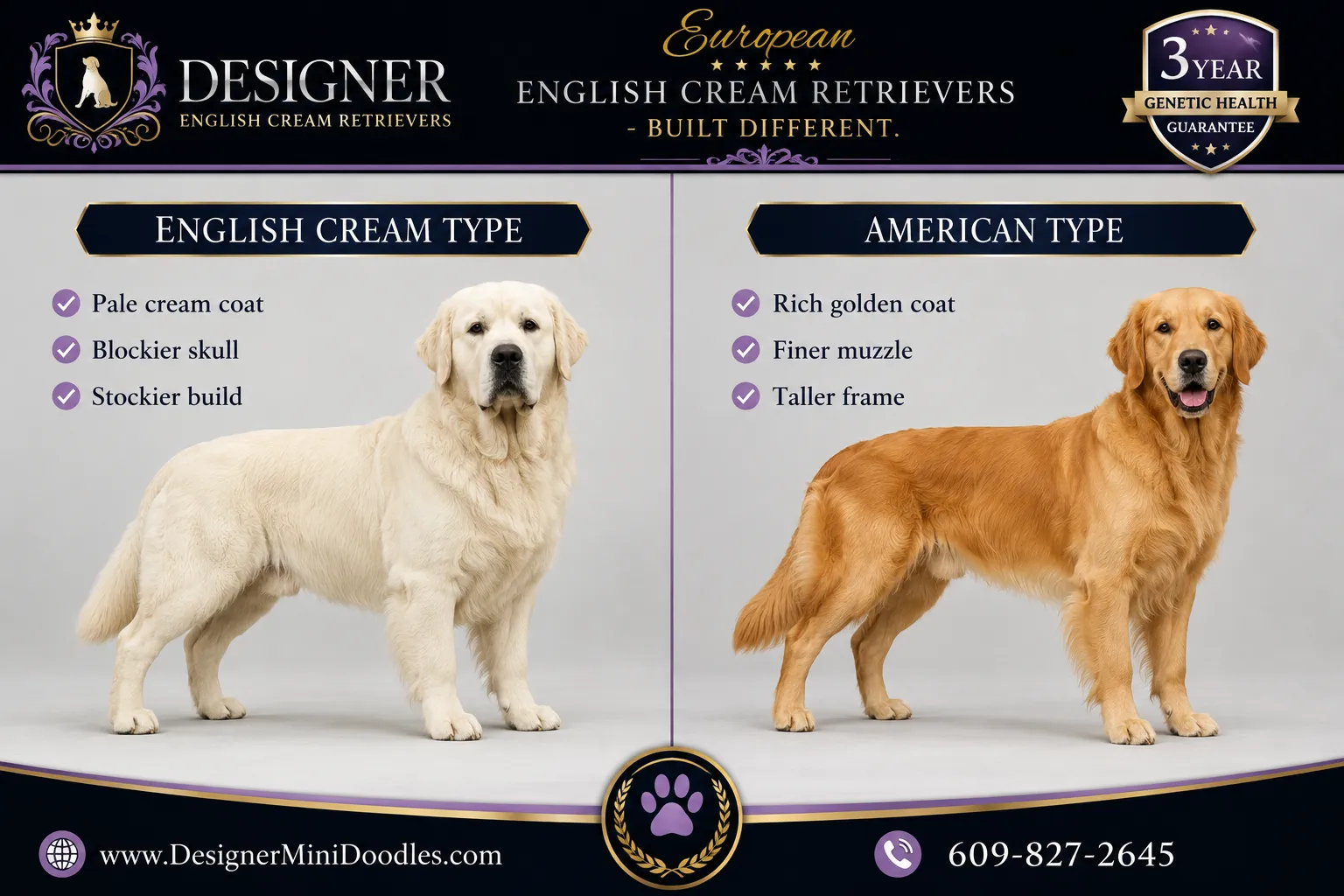
What buyers actually notice is the build. A well-bred English cream retriever from strong European stock usually has:
- A broader, blockier skull with a shorter, deeper muzzle
- Heavier bone and a stockier, more substantial frame
- A thicker double coat with a fuller neck ruff and feathering
- Darker pigment around the eyes, nose, and lips, which makes the pale coat pop
- Rounder, darker eyes set in a softer expression

At Designer English Cream Retrievers, our puppies are frequently described by visitors as looking like “baby Great Pyrenees”, that’s the combination of pale coat, dense fluff, and heavy bone doing its work. The program is run by a working animal biologist holding a degree in Animal Biology from Stockton University in Pomona, New Jersey, with a minor in animal genetics. That background shapes every pairing decision: coefficient of inbreeding, clearance stacking across generations, temperament heritability, and structural soundness.
A pale coat by itself means nothing. Pale coat plus verified European clearances plus correct structure is what you’re actually paying for.
English Cream Golden Retriever vs American Golden Retriever: What’s the Real Difference?
The core differences are coat color, body type, and often temperament tempo, not breed identity, health superiority, or intelligence. Both are golden retrievers. Anyone selling an “English Cream” as a rare breed with guaranteed longer life is overselling.
| Feature | English Cream (European lines) | American Golden Retriever |
|---|---|---|
| Coat color | Pale cream, ivory, light gold | Medium to rich golden, sometimes red |
| Skull shape | Broader, blockier, shorter muzzle | Narrower skull, longer muzzle |
| Build | Stockier, heavier bone, thicker | Leggier, more athletic outline |
| Coat density | Very dense double coat, heavy ruff | Dense but often somewhat lighter |
| Height (males) | Roughly 22-24 inches | Roughly 23-24 inches |
| Maturation | Often calmer earlier; slower to mature physically | Often higher drive into adolescence |
| Registry status | Same breed; AKC registrable | Same breed |
Choose an English cream line if you want a heavier-boned, softer-looking dog and you’re comfortable with the grooming load. Choose an American line if you want a field-bred athlete for hunting, dock diving, or serious sport work, where drive matters more than bone.
Common mistake: assuming cream coat equals guaranteed calm dog. Temperament comes from parent selection and early handling, not pigment. I’ve met high-strung creams and mellow field goldens. Ask about the parents’ behavior in a house, not just their photos.
English Cream Golden Retriever Price: How Much Do They Cost?
A responsibly bred English cream golden retriever costs $3,500 to $5,500 in 2026. Anything dramatically below that range should trigger investigation, not excitement, because the cost floor for proper genetic testing, prenatal care, whelping supervision, vaccination, deworming, and early training simply cannot be met at $900.
Here’s the pricing reality by seller type:
| Price range | Who’s selling | What you actually get |
|---|---|---|
| $500,$1,000 | Scammers, fake websites, stolen photos | Usually no dog at all. Deposit disappears, or endless “shipping fees.” |
| $1,000,$1,500 | Puppy mills, high-volume brokers | No meaningful health testing, kennel-raised, common parasites and early illness |
| $1,800,$2,000 | Backyard/hobby breeders | Well-meaning but limited clearances, no ENS, little early training |
| $3,500,$5,500 | Accredited program with genetic health guarantee | Full parental clearances, supervised whelping, ENS, started housebreaking and crate training, contract, lifetime breeder support |
Budget beyond the purchase price too. First-year ownership realistically adds $1,500,$3,000 for vaccines, spay/neuter, food, crate, training classes, and grooming. Pet insurance for a breed with known cancer risk is worth pricing early, since premiums rise with age.
Decision rule: if a seller’s price is under $1,500 and they can produce hip, elbow, cardiac, and eye clearances for both parents with verifiable registry numbers, ask why the price is so low. There’s usually an answer you won’t like.
- Display 15 Products per page

How Do I Find English Cream Golden Retriever Breeders Near Me?
Start with breed-club referral lists and health-registry databases rather than classified marketplaces, then verify every claim independently. Proximity matters less than transparency, most serious buyers travel or arrange ground transport for the right litter.
A practical search sequence:
- Search the OFA (Orthopedic Foundation for Animals) database for the kennel name and the parents’ registered names. Clearances that exist will appear there publicly.
- Check the Golden Retriever Club of America breeder referral resources and local golden retriever club chapters.
- Request a live video call, not recorded clips. Ask to see the whelping area, the dam, and littermates moving around.
- Ask for two references from families who bought puppies 2+ years ago, and actually call them.
- Read the contract before paying anything. A real contract covers health guarantee terms, spay/neuter requirements, and a return clause.
Designer English Cream Retrievers ships and coordinates travel nationwide, so families in states without local European-line programs aren’t stuck choosing between a bad local option and nothing. All of our breed stock and English cream golden retriever puppies trace to top European bloodlines, and we publish clearance documentation on request rather than asking buyers to take our word for it.
Edge case: a breeder with a two-year waitlist and no available puppies is often a better sign than one with “puppies ready now” every month of the year. Constant availability usually means constant breeding.
What Health Problems Affect English Cream Golden Retrievers?
English cream golden retrievers face the same major health risks as all golden retrievers: cancer (especially hemangiosarcoma and lymphoma), hip and elbow dysplasia, progressive retinal atrophy, cataracts, subvalvular aortic stenosis, and hypothyroidism. Claims that cream-colored lines are immune to cancer are not supported by evidence.

The conditions responsible breeders screen for:
- Hips and elbows, OFA or PennHIP evaluation on both parents
- Cardiac, advanced cardiac exam, ideally by a veterinary cardiologist
- Eyes, annual ophthalmologist exam (OFA Eye Certification)
- Genetic panel, PRA1, PRA2, prcd-PRA, Ichthyosis, DM, MD (muscular dystrophy), and NCL
- Thyroid, autoimmune thyroiditis screening
Golden retrievers also carry elevated risk of hypothyroidism, allergies and atopic skin disease, ear infections (that thick coat traps moisture), and gastric issues. Bloat risk exists but is lower than in deep-narrow-chested breeds.
Quick example of what testing changes: if both parents are carriers for a recessive eye mutation, roughly 25% of puppies in that litter can be affected. If one parent is clear, no puppy is affected. That’s the entire value of genetic panels, it’s math, not marketing.
The Morris Animal Foundation Golden Retriever Lifetime Study, launched in 2012, follows thousands of golden retrievers to identify cancer risk factors in the breed. It’s the single best ongoing research resource for owners, and worth following if you’re serious about the breed.
What Is the English Cream Golden Retriever Lifespan?
Golden retrievers, including English cream lines, typically live 10 to 12 years. Some individuals reach 13 or 14 with excellent weight management, dental care, and early cancer screening, but marketing claims of a 15-year “European advantage” should be treated skeptically.
What genuinely moves the number:
- Keeping the dog lean. Excess weight is the most controllable factor in joint disease and shortened life.
- Delaying spay/neuter appropriately, discuss timing with your vet, since some research links early gonadectomy in large breeds to increased joint disorder and certain cancer risks.
- Annual bloodwork after age seven, which catches thyroid and organ issues early.
- Dental care. Untreated periodontal disease affects systemic health.
- Parents with verified clearances and longevity in the pedigree. Ask how long the grandparents lived and what they died of. A breeder who knows is a breeder who tracks.
English Cream Golden Retriever Temperament, Personality, and Family Fit
English cream golden retrievers are affectionate, people-oriented, highly trainable, and generally excellent family dogs. They are also velcro dogs that don’t do well left alone for long stretches, and puppies are mouthy, bouncy, and clumsy around toddlers until roughly ten months old.

Are English Cream Golden Retrievers Good Family Dogs?
Yes, for most households. They rank among the most reliable family breeds because of low guarding instinct, high sociability, and strong food motivation that makes training straightforward. They’re good with children, other dogs, cats they’re raised with, and visitors.
They’re a strong fit if you:
- Are home a reasonable portion of the day, or can arrange midday company
- Want a dog that participates in family life rather than guarding a yard
- Can commit to 60+ minutes of daily exercise plus mental work
- Accept hair on the floor as a permanent condition
They’re a poor fit if you:
- Travel constantly or work 12-hour shifts with no backup
- Want a low-shedding dog (in that case, look at a Goldendoodle instead)
- Need a protective or territorial dog
- Have zero tolerance for adolescent chewing between four and ten months
Our puppies are raised inside a busy household, not a barn. They’re exposed to vacuum cleaners, dropped pans, doorbells, kids running, other dogs, and cats from their earliest weeks. We use ENS (Early Neurological Stimulation) beginning in the first days of life, brief, gentle handling exercises done daily during the neonatal window, associated in working-dog programs with improved stress resilience. Combined with early scent introduction and surface variety, that produces puppies who don’t shut down when a stranger’s toddler shrieks.
For families weighing a smaller alternative, our team also breeds compact companions, see why a 10-16 lb micro Goldendoodle suits family households with kids.
English Cream Golden Retriever Size, Weight, and Grooming Requirements
Adult males stand 23-24 inches at the shoulder and weigh 65-80 pounds; females stand 21.5-22.5 inches and weigh 55-70 pounds. European-line dogs often carry weight at the upper end of the range because of heavier bone and denser coat, not because they’re overweight.
Size and Weight Expectations
| Stage | Male (approx.) | Female (approx.) |
|---|---|---|
| 8 weeks | 9-14 lbs | 8-12 lbs |
| 4 months | 30-38 lbs | 26-34 lbs |
| 8 months | 55-65 lbs | 45-55 lbs |
| Adult (18-24 months) | 65-80 lbs | 55-70 lbs |
Goldens fill out in chest and coat until roughly two years old. A lanky eight-month-old is normal, not underfed.
Grooming Requirements
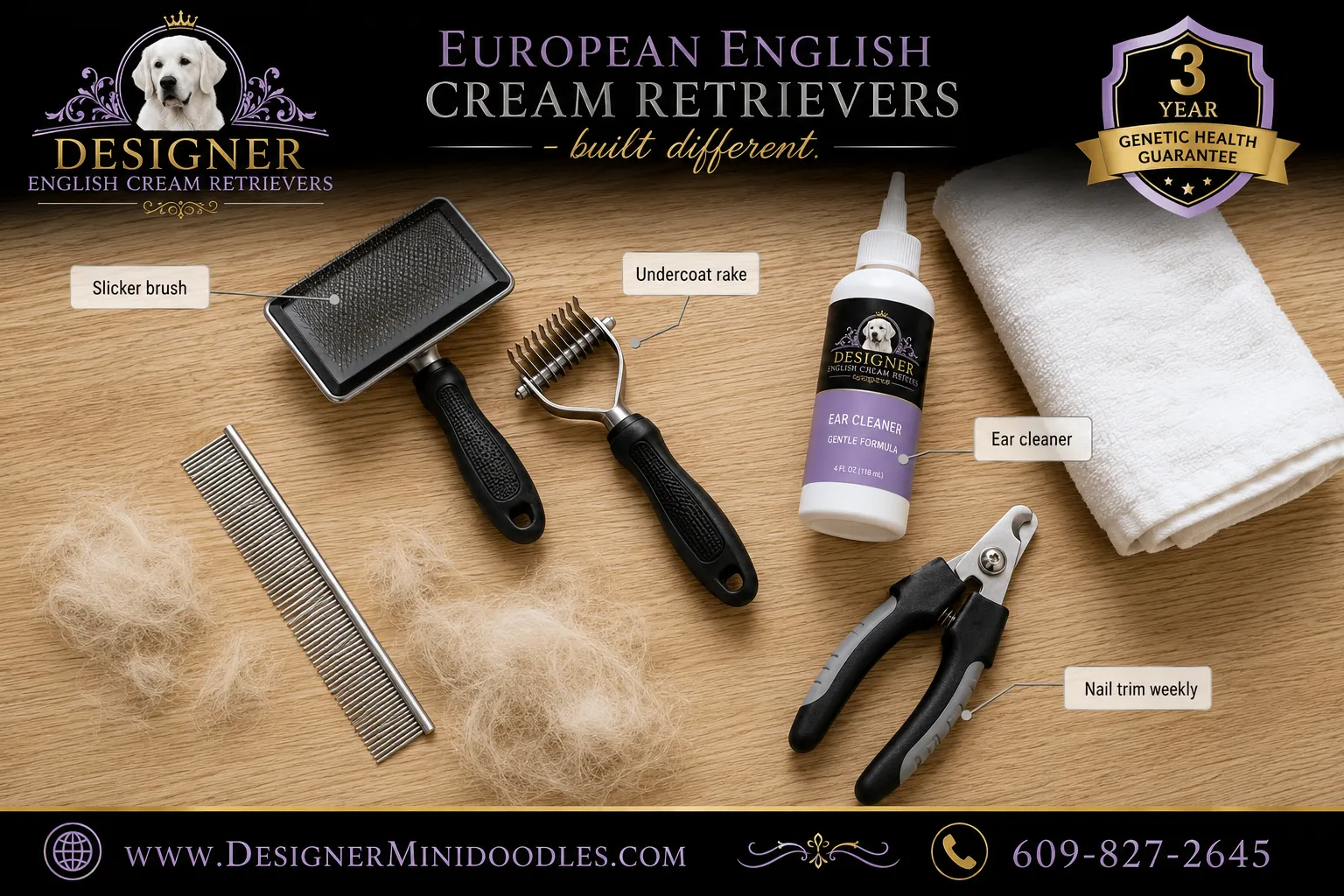
That gorgeous cream double coat is the highest-maintenance thing about the breed. Plan on:
- Brushing 2-4 times weekly with a slicker brush, plus an undercoat rake during shedding season
- Two heavy shed cycles per year (spring and fall), when daily brushing prevents mats and tumbleweeds
- Bathing every 4-8 weeks, with thorough drying, a damp undercoat causes hot spots
- Weekly ear checks. Floppy ears plus dense hair equals infection risk
- Nail trims every 2-3 weeks and paw-pad hair trimming for traction
- Never shave the coat. It insulates against heat as well as cold, and shaving can permanently damage regrowth texture
Common mistake: brushing only the top coat. If the brush isn’t reaching skin, mats form underneath while the surface looks perfect. Line-brush in sections.
Should I Get an English Cream Golden Retriever Puppy or Adopt an Adult?
Choose a puppy if you want to shape socialization and training from week eight and you can absorb 12-18 months of adolescence. Choose an adult if you want a known temperament, an already-housebroken dog, and a lower time investment in the first year.
Puppy advantages: full control over socialization windows, no inherited behavior baggage, maximum years together, and access to breeder support from day one. Puppy costs: night waking, potty schedules, teething damage, and a real training commitment.
Adult advantages: temperament is visible and testable, housebreaking usually done, energy level predictable, and adoption fees are far lower. Golden retriever rescues nationwide place adults regularly, including cream-coated dogs surrendered by owners who underestimated the coat or the exercise needs.
Middle path worth considering: some breeding programs place retired breeding females at three to five years old. You get a fully mature, health-tested, socialized dog with known lineage. Ask breeders directly whether they place retirees, because those dogs rarely get advertised.
Our own English cream golden retriever puppies leave well started on housebreaking and crate training, which shortens the hardest part of puppy ownership considerably. A pup who already sleeps quietly in a crate and understands going outside is a different experience from one seeing a crate for the first time in your kitchen at 10 p.m.
English Cream Golden Retriever Training Tips
Golden retrievers are among the easiest breeds to train because they’re food-motivated, biddable, and eager to work with people. The main challenges are excitement control, jumping, mouthing, and the adolescent regression that hits around seven to ten months.
A practical first-90-days plan:
- Weeks 1-2: Establish the crate as a good place. Feed meals inside it, door open. Take the puppy out every 45-60 minutes while awake, and always after sleeping, eating, or playing.
- Weeks 2-4: Name recognition, sit, and a hand-touch cue. Three sessions daily, five minutes each. Short beats long.
- Weeks 4-8: Begin loose-leash work in the yard before the sidewalk. Start a “place” cue for settling during dinner.
- Weeks 8-12: Enroll in a group puppy class for real-world distraction work. Introduce a reliable recall on a long line.
- Ongoing: Add nose work, fetch-with-rules, or a food puzzle daily. A golden without a job invents one, usually involving your shoes.
Housebreaking rule that works: supervise or crate, never loose and unwatched. Most accidents happen in the ten minutes an owner stops paying attention. And clean accidents with an enzymatic cleaner, since ordinary cleaners leave scent markers.
Edge case, the adolescent shutdown. Around eight months, many goldens temporarily “forget” recall and start selectively ignoring cues. This is normal maturation, not defiance. Go back to a long line for a few weeks and raise your reward value instead of escalating corrections.
We start obedience foundations before puppies go home, and our buyers get direct trainer access afterward. That continuity is a big part of why we describe ourselves as the best English Cream Retriever breeders in the USA, the relationship doesn’t end at pickup. Families who also want stud services for other breeds can look into professional French bulldog stud services through our sister program.
English Cream Golden Retriever Scams: How to Avoid Them
Puppy scams follow a predictable script: an unusually low price, stolen photos, pressure to pay by wire transfer or gift card, refusal to do a live video call, and then surprise fees for “climate-controlled crates” or “pet insurance” after the deposit clears. The Federal Trade Commission and the Better Business Bureau both track pet-purchase fraud as a persistent online scam category.
Red flags, ranked by how often they appear:
- Price under $1,200 for a “European import” or “rare cream” puppy
- Payment only by Zelle, CashApp, wire, crypto, or gift cards, no card, no escrow, no PayPal goods-and-services
- Won’t do a live video call with the puppy and dam, or “the camera is broken”
- Photos that reverse-image-search to other websites or Facebook posts
- Emotional urgency: “three families are asking about him today”
- New domain registration with a stock-photo “About Us” page and no verifiable kennel name
- Escalating fees after deposit for shipping, insurance, customs, or vaccinations
- No written contract or health guarantee, or a contract riddled with copy-paste errors
Verification checklist before you send money:
- Reverse-image-search at least three of the seller’s photos.
- Look up the parents’ names in the OFA database.
- Call the veterinary clinic the breeder names and confirm they treat that kennel.
- Insist on a live video call and ask the seller to move the camera on request.
- Pay by a method with buyer protection, and get a signed contract first.
- Search “[kennel name] + scam” and “[kennel name] + review.”
If you’ve already been scammed: report it to the FTC at ReportFraud.ftc.gov, file with the BBB Scam Tracker, contact your bank immediately (wire recalls are occasionally possible within hours), and report the listing to the platform.
Where to Buy an English Cream Golden Retriever Responsibly
Buy from a breeder who health-tests both parents, raises puppies in a home environment, provides a written genetic health guarantee, screens buyers, and takes dogs back for life. If any one of those five is missing, keep looking, there are enough good programs that you don’t need to compromise.
What a responsible transaction looks like, start to finish:
- Application and interview before you’re offered a puppy, not after
- Documented clearances you can verify yourself in public databases
- Puppies placed at eight weeks minimum, with first vaccines, deworming, and a vet health certificate
- Written contract including a 24-month genetic health guarantee, spay/neuter terms, and a lifetime return clause
- Microchip registration transferred to you
- A go-home packet: current food, feeding schedule, vaccine records, crate-training notes, and trainer contact
Designer English Cream Retrievers meets every one of those standards. Our breeding stock comes from top European bloodlines, litters are whelped under direct supervision by a biologist with formal genetics training, and every English cream retriever puppy leaves ENS-conditioned, noise-desensitized, and started on housebreaking and crate work. We also help families think honestly about breed fit, if shedding is a dealbreaker, we’ll point you toward our Goldendoodle puppies or the micro Goldendoodle option for allergy-conscious homes rather than sell you a dog that won’t work in your house.
Frequently Asked Questions
Is an English cream golden retriever a different breed than a regular golden retriever?
No. It’s the same breed. “English Cream” describes a pale coat color and European bloodline, and these dogs are registrable with the AKC as golden retrievers.
Are English cream golden retrievers healthier or longer-lived than American goldens?
There’s no reliable evidence that coat color affects health or longevity. What matters is whether both parents have verified hip, elbow, cardiac, eye, and genetic-panel clearances.
How much should I pay for an English cream golden retriever puppy?
Between $3,500 and $5,500 from an accredited breeder with a genetic health guarantee and early training. Listings at $500,$1,000 are usually scams; $1,000,$1,500 typically indicates a puppy mill.
Do English cream golden retrievers shed a lot?
Yes. They have a dense double coat and shed year-round, with two heavy seasonal blowouts. Plan on brushing two to four times weekly, and daily during shedding season.
How big do English cream golden retrievers get?
Males reach 23-24 inches and 65-80 pounds; females reach 21.5-22.5 inches and 55-70 pounds. European lines often sit at the heavier end due to bone and coat density.
What’s the lifespan of an English cream golden retriever?
Typically 10 to 12 years. Lean body weight, dental care, and annual senior bloodwork are the factors owners most directly control.
Can I get an English cream golden retriever from a rescue?
Yes. Golden retriever rescues place adults and occasionally young dogs with cream coats. Adoption is a strong choice if you want a known temperament and lower upfront cost.
Why do English cream goldens look like small Great Pyrenees?
The pale ivory coat, dense fluff, broad blocky head, and heavier bone of well-bred European lines create that resemblance, especially in puppies. They’re still golden retrievers.
What is ENS and why does it matter in a puppy program?
ENS (Early Neurological Stimulation) is a set of brief daily handling exercises done during a puppy’s first weeks. Breeders use it to build stress resilience, and it’s standard in serious working-dog and companion programs.
How long does housebreaking take if the breeder already started it?
Most families report reliable house manners in two to four weeks when a puppy arrives already crate-conditioned and used to going outside, versus six to twelve weeks starting from zero.
Should I buy a puppy without meeting the breeder in person?
Only if you’ve completed a live video call showing the puppy and the dam, verified clearances in a public database, confirmed the vet reference, and paid through a protected method with a signed contract.
Conclusion: Your Next Steps
The English cream golden retriever market rewards patience and punishes bargain hunting. A pale coat is easy to photograph and easy to fake; verified clearances, supervised whelping, and documented early development are not. That gap is exactly where scammers and mills operate, which is why the price spread between a $900 listing and a $4,500 puppy tells you almost everything about what’s behind it.
Your action plan this week:
- Set a real budget, purchase price of $3,500,$5,500 plus $1,500,$3,000 in first-year costs.
- Shortlist three breeders and pull their parents’ clearances from the OFA database yourself.
- Schedule live video calls with each and ask specifically about ENS, household noise exposure, crate progress, and housebreaking.
- Read every contract for the health guarantee term and the lifetime return clause.
- Confirm breed fit honestly. If year-round shedding won’t work in your home, choose a different breed now rather than rehoming later.
- Get on a waitlist. The best litters are reserved before they’re born, and that’s a good sign, not an inconvenience.
If you want a European-bloodline English cream golden retriever for sale from a program run by a credentialed animal biologist, with puppies already started on crate training and housebreaking, reach out and ask for the clearance documentation. Any breeder worth your money will hand it over without hesitation.
Sources
- Golden Retriever Club of America, Breed health and clearance recommendations. https://grca.org
- Orthopedic Foundation for Animals (OFA), Public health-testing database. https://ofa.org
- Morris Animal Foundation, Golden Retriever Lifetime Study (launched 2012). https://www.morrisanimalfoundation.org/golden-retriever-lifetime-study
- American Kennel Club, Golden Retriever Breed Standard. https://www.akc.org/dog-breeds/golden-retriever/
- The Kennel Club (UK), Retriever (Golden) Breed Standard. https://www.thekennelclub.org.uk
- Federal Trade Commission, Reporting fraud and online purchase scams. https://reportfraud.ftc.gov
- Better Business Bureau, Scam Tracker and pet fraud reporting. https://www.bbb.org/scamtracker