

Last updated: August 15, 2026
English cream golden retriever
An English cream golden retriever is not a separate breed. It’s a golden retriever bred from European (often British, Scottish, or Scandinavian) bloodlines, where the breed standard permits very pale cream coats and favors a broader head, heavier bone, and shorter, blockier build. Expect to pay $3,500 to $5,500 from an accredited breeder who provides genetic health clearances, proper whelping, and early crate and house training. Lifespan typically runs 10 to 12 years, and these dogs shed year-round with heavier seasonal blowouts.
English cream golden retriever
- The English cream golden retriever is a golden retriever with European lineage, not a distinct breed or a separate AKC classification.
- Cream coat color is accepted under the UK Kennel Club standard; the AKC standard describes “rich, lustrous golden” and does not favor extremely pale coats in the show ring.
- Well-bred English cream retrievers are broader through the chest and skull, with thicker coats, many first-time owners say the puppies resemble “baby Great Pyrenees.”
- Legitimate pricing sits between $3,500 and $5,500. Listings at $500 to $1,000 are almost always scams, and $1,000 to $1,500 usually signals a puppy mill.
- Main health concerns are hip and elbow dysplasia, subvalvular aortic stenosis, progressive retinal atrophy, ichthyosis, and cancer later in life.
- Temperament is soft, biddable, and people-focused, which makes training easier than average but also means these dogs do poorly when left alone all day.
- Plan on 60 to 90 minutes of daily exercise for an adult, plus mental work like scent games and retrieve drills.
- Grooming means brushing 3 to 4 times weekly, a full groom every 8 to 12 weeks, and daily brushing during spring and fall coat blows.
- The single most common buying mistake is paying a deposit before verifying hip, elbow, heart, and eye clearances on both parents.
What Is an English Cream Golden Retriever?
An English cream golden retriever is a golden retriever descended from European breeding lines, distinguished by a pale cream to light gold coat and a stockier, heavier-boned build. The term is a marketing and enthusiast label, not an official breed name. No kennel club anywhere recognizes “English cream” as a separate breed or variety.
The color difference comes down to standards. The UK Kennel Club golden retriever standard allows “any shade of gold or cream,” while the American Kennel Club standard calls for a “rich, lustrous golden of various shades” and penalizes coats that are extremely pale or extremely dark in conformation judging. Decades of breeding toward those two different targets produced two recognizable types.
What “English cream” actually signals:
- European or UK-derived pedigree, often with British, Hungarian, Scandinavian, or Dutch dogs in the last three to five generations
- Coat ranging from near-white to light honey, frequently with slightly darker feathering on the ears and tail
- Broader skull, shorter muzzle, more pronounced stop between the eyes
- Heavier bone, deeper chest, and typically a shorter overall leg length relative to body
Other names you’ll see for the same dogs: English cream retriever, white golden retriever, platinum golden retriever, and European golden retriever. “White golden retriever” is the least accurate of the bunch, the coat is cream, not true white, and any breeder advertising a genuinely white golden retriever is overselling.
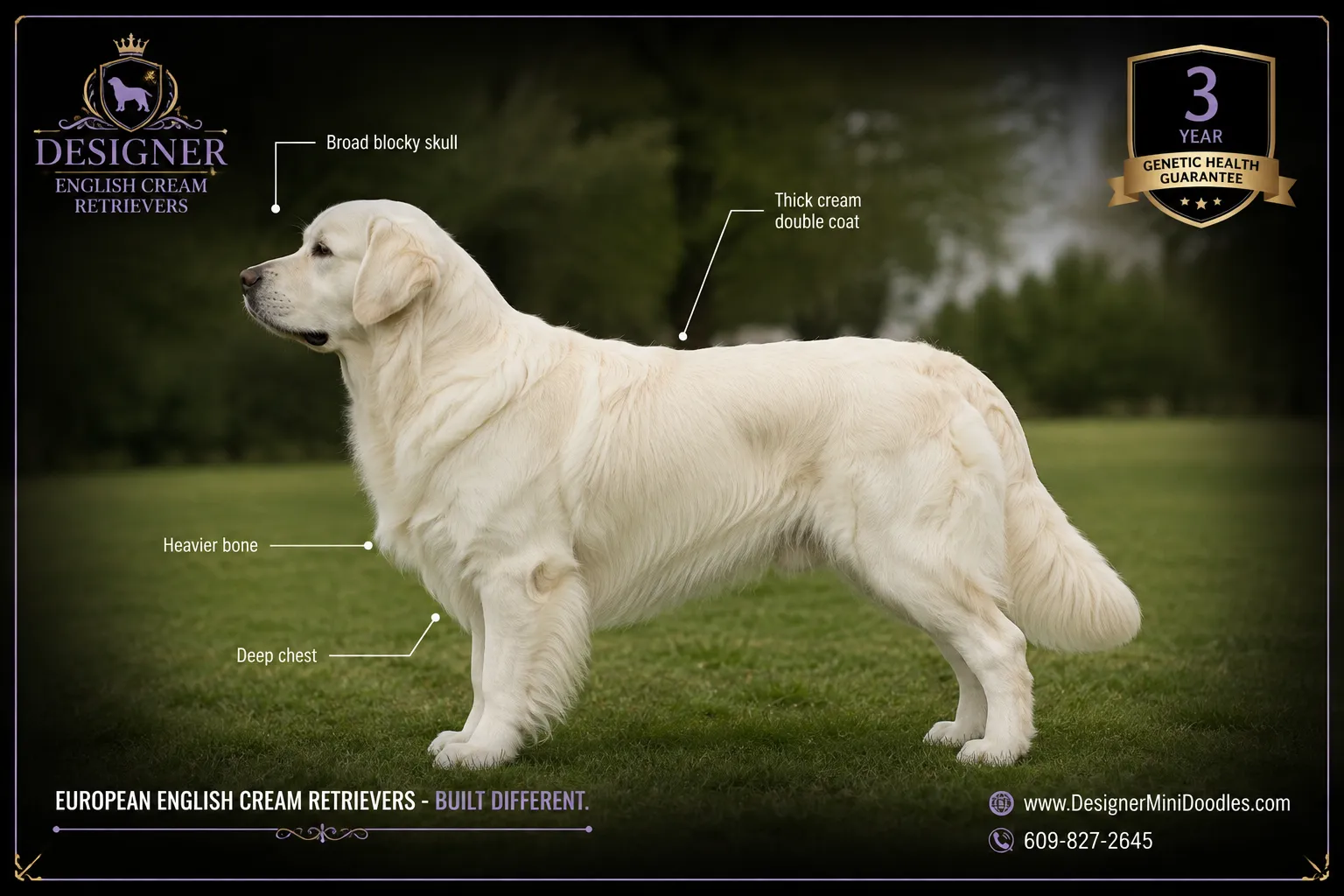
Why our English cream retrievers look like “baby Great Pyrenees”
Our puppies at Designer English Cream Retrievers are routinely mistaken for baby Great Pyrenees because of the pale coat combined with substance: thick necks, wide chests, and dense double coats from the day they open their eyes. That look isn’t accidental. Every dog in our program traces to top European bloodlines, and we select breeding stock for correct structure rather than just color. If you want to see current litters and coat shades in person, our English cream golden retriever puppies are photographed weekly so families can watch a pup develop before pickup.
Our program is run by a working animal biologist with a degree in Animal Biology from Stockton University (Pomona, New Jersey) and a minor in animal genetics. That background shapes every pairing decision we make, from coefficient of inbreeding targets to which health clearances we insist on before a dog ever enters our breeding program. It’s a large part of why we’re comfortable describing ourselves as the best English Cream Retriever breeders in the USA.
How Is an English Cream Golden Retriever Different From an American Golden Retriever?
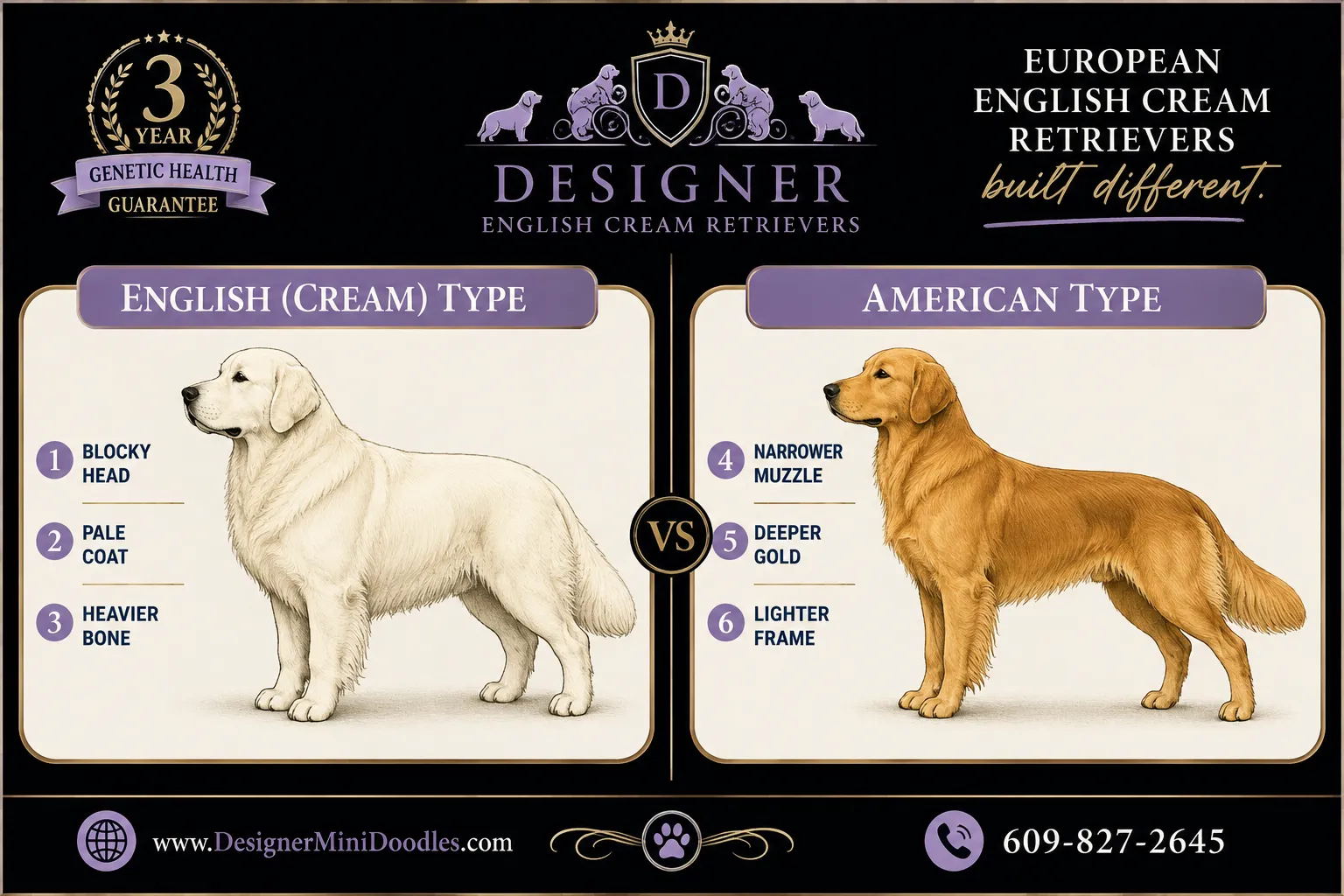
The difference is type, not breed: English cream goldens are typically shorter, broader, and paler, while American goldens tend to be taller, leaner, and deeper gold. Both are the same breed with the same core temperament, and both come from the same 19th-century Scottish foundation stock.
| Feature | English cream golden retriever | American golden retriever |
|---|---|---|
| Coat color | Cream to light gold | Medium to deep gold, sometimes reddish |
| Skull | Broader, blockier, deeper stop | Narrower, more tapered |
| Muzzle | Shorter, squarer | Longer, finer |
| Build | Stockier, heavier bone, deeper chest | Taller, leaner, more angular |
| Eyes | Rounder, often darker | More almond-shaped |
| Coat texture | Denser double coat, moderate feathering | Slightly longer, silkier feathering |
| Governing standard | UK Kennel Club / FCI | AKC / CKC |
| Typical adult height | Males 22-24 in, females 20-22 in | Males 23-24 in, females 21.5-22.5 in |
Decision rule: Choose an English cream retriever if you want a calmer, heavier-bodied golden with a pale coat and you value European health-testing culture. Choose an American golden if you plan to compete in AKC conformation, where the deeper gold coat is favored.
One myth worth killing: English cream goldens are not automatically healthier or longer-lived than American goldens. Health depends on the individual breeder’s testing, not the passport of the grandparents. A poorly bred cream golden from an untested pairing is riskier than a well-bred American golden from four generations of clearances.
English Cream Golden Retriever Price: How Much Do They Cost?
A properly bred English cream golden retriever puppy costs $3,500 to $5,500 in 2026. Anything dramatically cheaper reflects skipped health testing, poor whelping conditions, or outright fraud. The price gap between tiers isn’t breeder greed, it’s the cost of clearances, quality nutrition, veterinary care, and hands-on early training.
English cream retriever price chart by seller type
| Price range | Who’s selling | What you actually get |
|---|---|---|
| $500, $1,000 | Scammers, fake websites, wire-transfer requests | No puppy. Stolen photos, fake shipping insurance, disappearing “vet” contacts |
| $1,000, $1,500 | Puppy mills, high-volume brokers | No health clearances, poor socialization, high early vet bills, common parasites and giardia |
| $1,800, $2,000 | Hobby breeders, backyard litters | Well-meaning but limited testing, no ENS, no crate or house training started |
| $3,500, $5,500 | Accredited breeders with genetic health guarantees | OFA/European clearances on both parents, proper whelping setup, ENS from birth, started house and crate training, written health guarantee, lifetime breeder support |
Red flag test: If a seller quotes $800 for a “purebred imported English cream” and asks for payment by Zelle, Cash App, or gift card, walk away. Legitimate breeders take traceable payments and will speak with you by video call with the puppy and dam visible in the same frame.
Ongoing costs to budget
- First-year veterinary care (vaccines, deworming, spay/neuter): $600,$1,200
- Food for an 65-80 lb adult: $70,$110 monthly for a quality diet
- Professional grooming every 8-12 weeks: $70,$120 per visit
- Pet insurance: $40,$80 monthly, higher if you enroll after age two
- Training classes: $150,$300 per group course
- Display 15 Products per page

What English Cream Golden Retriever Health Problems Should I Know About?
The main health risks for English cream golden retrievers are hip and elbow dysplasia, heart disease (subvalvular aortic stenosis), inherited eye conditions, ichthyosis, and cancer in middle to older age. Most orthopedic and eye risks can be substantially reduced through parent screening, which is exactly why testing documentation matters more than coat color.
Conditions to ask about specifically:
- Hip dysplasia, Ask for OFA hip ratings (Fair, Good, Excellent) or a European BVA/FCI hip score for both parents.
- Elbow dysplasia, OFA elbow clearance, normal grade.
- Subvalvular aortic stenosis (SAS), Requires cardiac evaluation by a board-certified veterinary cardiologist, not a general-practice stethoscope check.
- Progressive retinal atrophy (PRA1, PRA2) and pigmentary uveitis, Annual ophthalmologist exam plus DNA testing for PRA variants.
- Ichthyosis (ICT-A), A DNA-testable skin condition that causes flaky, scaly skin.
- Cancer, Hemangiosarcoma and lymphoma are recognized concerns in the breed. The Morris Animal Foundation Golden Retriever Lifetime Study is the largest ongoing effort tracking cancer and other diseases in goldens.
- Hypothyroidism, Screened by thyroid panel; manageable with daily medication.
Common mistake: Accepting “vet checked” as a substitute for genetic clearances. A vet exam confirms a puppy is healthy today. It says nothing about the hips that puppy will have at age three. Ask for certificate numbers and verify them in the OFA database yourself.
Edge case: Some imported European dogs carry hip scores under the BVA scheme (a numeric total, lower is better) rather than OFA letter grades. Both are valid. What isn’t valid is a breeder telling you their lines “don’t need testing because they’ve never had a problem.”

What Is the English Cream Golden Retriever Temperament and Personality Like?
English cream golden retrievers are gentle, eager to please, and strongly bonded to people, with a slightly calmer baseline than many American-line goldens. They’re social to a fault, which is a feature in a family home and a problem in a house where nobody’s home for ten hours a day.

Core traits you can expect:
- Soft sensitivity. Harsh corrections shut these dogs down fast. Reward-based training gets far better results.
- Very low aggression tendency. Goldens rank among the least likely breeds to guard resources or show territorial aggression, though individual dogs vary.
- High human orientation. They’ll follow you room to room. Many owners describe a “velcro dog.”
- Retained retrieve drive. Even show-line European dogs usually love carrying things in their mouths. Give them a legitimate outlet or they’ll pick your slippers.
- Slow maturity. Mental adulthood arrives around two to three years. Expect goofiness well past the first birthday.
A well-bred English cream retriever should be neither shy nor pushy. If a puppy in a litter hides in a corner while its siblings investigate you, that’s a temperament signal, not just “the quiet one.”
Our puppies are raised inside a busy household. From birth they get ENS (Early Neurological Stimulation) handling, and they grow up hearing vacuums, doorbells, blenders, kids, and other animals. That noise exposure is why families tell us their pups settle into new homes within days rather than weeks.
Are English Cream Golden Retrievers Good Family Dogs?
Yes. English cream golden retrievers are among the most reliable family dogs available, with high tolerance for children, strong sociability with other pets, and low guarding instinct. The realistic caveats are size, shedding, and the need for daily engagement.
Best fit for:
- Families with children over age three who can learn to respect a dog’s space
- Households with someone home for most of the day, or with a dog walker
- Homes with a fenced yard, though a committed walker in an apartment can work
- First-time owners who will attend a puppy class
Poor fit for:
- Homes where the dog would be alone 9-11 hours daily
- Anyone who can’t tolerate hair on furniture and clothing
- People wanting a protective or watchdog-type breed
- Households unwilling to budget for grooming and food for a 65-80 lb dog
Quick example: A family with a toddler and a cat asked me whether a cream golden would be too much dog. We placed a mid-range-energy female with them. The cat established boundaries in a week, and by month four the dog was napping beside the toddler’s play mat. That outcome depends on temperament matching, not luck. If you’re weighing a smaller alternative for a compact home, our notes on why a 10-16 lb micro Goldendoodle suits families with kids walk through the size trade-offs.

Do English Cream Golden Retrievers Shed a Lot, and What Grooming Do They Need?
Yes, they shed significantly. English cream golden retrievers have a dense double coat that sheds moderately year-round and heavily during two seasonal coat blows, usually spring and fall. Plan on brushing three to four times a week, escalating to daily during shedding season.
English cream golden retriever grooming schedule
| Task | Frequency | Tool or note |
|---|---|---|
| Brushing | 3-4x weekly (daily in spring/fall) | Slicker brush plus undercoat rake |
| Line-combing feathering | Weekly | Steel greyhound comb, focus behind ears, chest, tail |
| Bath | Every 6-8 weeks | Gentle shampoo, dry the undercoat fully |
| Full groom / tidy | Every 8-12 weeks | Feet, hocks, ears tidied; never shave the body |
| Nail trim | Every 3-4 weeks | Nails should not click on hard floors |
| Ear cleaning | Weekly check | Drop-ear breed, high otitis risk |
| Teeth | 3-4x weekly brushing | Enzymatic dog toothpaste |
Never shave a golden retriever’s body coat. The double coat insulates against heat as well as cold, and shaving can cause permanent coat damage (clipper alopecia) plus higher sunburn risk. If your groomer suggests a shave-down for summer, decline and ask for a de-shedding treatment instead.
Mats form fastest behind the ears, in the armpits, and on the trouser feathering. Check those three spots every week and you’ll prevent almost every serious mat. For a broader look at coat maintenance technique on long-coated dogs, the walkthrough on grooming and trimming apricot toy poodle coats covers line-brushing method in detail.
How Long Do English Cream Golden Retrievers Live?
English cream golden retrievers typically live 10 to 12 years, consistent with the golden retriever breed overall. Claims that English cream lines routinely live to 14 or 15 are marketing, not documented fact. Lifespan is driven mostly by cancer incidence, body weight, and preventive care.
What actually extends lifespan:
- Keeping the dog lean. Excess body weight is one of the clearest modifiable factors in canine longevity and joint health.
- Annual bloodwork and a physical from age seven onward, twice yearly from age ten.
- Dental care, which reduces chronic inflammation.
- Choosing parents from lines with documented longevity and low cancer history.
- Avoiding over-exercise on hard surfaces during the first 14-18 months while growth plates close.
Edge case: Large males at the top of the size range often live slightly shorter lives than smaller females. If longevity is your top priority, a moderately sized female from tested lines is statistically the safer bet.
How Hard Is English Cream Golden Retriever Training, and What Are Their Exercise Needs?
Training difficulty is low to moderate. English cream golden retrievers rank among the most trainable breeds because they’re food-motivated, handler-focused, and quick to generalize. Their challenges are adolescent impulse control, mouthiness, and jumping on people out of enthusiasm.
Training timeline that works
- Weeks 8-10: Crate routine, name response, potty schedule every 90 minutes, gentle handling drills.
- Weeks 10-16: Puppy socialization class, sit/down/come, “trade” game to prevent resource guarding, bite-inhibition work.
- Months 4-7: Leash manners, loose-lead walking, stay duration, place command. Teething peaks, rotate chew textures.
- Months 7-14: Adolescent regression is normal. Return to short, high-value reps. Recall on a long line only.
- Months 14-24: Off-leash reliability in low-distraction areas, formal obedience or a dog sport if you want a job for the dog.
Puppies from our program arrive well started on house breaking and crate training, which removes the hardest two weeks of the process. Combined with ENS handling from birth, the pups tend to hit reliable overnight crate sleep faster than average. Families who want a broader sense of our training philosophy can review our approach to training smart toy poodle puppies at home, the reward-based framework is identical across our breeds.
Exercise needs by age
| Age | Daily exercise | Notes |
|---|---|---|
| 8-16 weeks | 3-4 short sessions, 5 min per month of age | No stairs marathons, no forced running |
| 4-12 months | 30-45 min split into two sessions | Avoid repetitive jumping and hard-surface jogging |
| 1-7 years | 60-90 min plus mental work | Swimming, retrieve, hiking, scent games |
| 8+ years | 30-60 min, low impact | Watch for stiffness after activity |
Common mistake: Substituting a longer walk for mental work. A bored cream golden with tired legs still chews baseboards. Fifteen minutes of nose work or a food puzzle often settles a dog more effectively than an extra mile.
English Cream Golden Retriever vs Labrador Retriever: Which Should I Choose?
Choose an English cream golden retriever if you want a softer, more sensitive dog with a longer coat and slightly lower intensity. Choose a Labrador if you want a shorter-coated, more robustly energetic dog with a higher tolerance for rough handling and cold water.
| Factor | English cream golden retriever | Labrador retriever |
|---|---|---|
| Coat | Long double coat, needs regular brushing | Short dense double coat, easier upkeep |
| Shedding | Heavy, visible long hair | Heavy, shorter hair that weaves into fabric |
| Energy | High but settles indoors more readily | Often higher drive, especially field lines |
| Sensitivity | More sensitive to correction | More resilient, sometimes pushier |
| Mouthiness | Moderate | Higher, especially as puppies |
| Grooming cost | $70,$120 per groom | Minimal professional grooming |
| Health overlap | Hips, elbows, eyes, cancer | Hips, elbows, eyes, EIC, obesity risk |
| Best for | Families wanting a gentle companion | Active owners, field work, high-tempo homes |
Decision rule: If a family member is nervous around dogs or the household is quiet, the cream golden is usually the better match. If your dog will run trails daily and swim in cold water, the Labrador handles that workload with less coat maintenance.
How Do I Find the Best English Cream Golden Retriever Breeders?
The best English cream golden retriever breeders publish verifiable health clearances for both parents, keep litters in the home rather than a kennel building, use structured early socialization, and require a written contract with a genetic health guarantee. Everything else is secondary.
Breeder vetting checklist
- Hip and elbow clearances (OFA or European equivalent) on both parents, with certificate numbers you can verify
- Cardiac clearance from a veterinary cardiologist, not a GP auscultation
- Annual eye exam plus DNA panel covering PRA1, PRA2, ichthyosis, and prcd-PRA
- Pedigree documentation showing European lineage if the dog is marketed as English cream
- Puppies raised indoors with household noise exposure and ENS from birth
- Started house breaking and crate training before pickup
- Written contract, health guarantee, and a take-back clause for the dog’s lifetime
- Willingness to do a live video call showing puppy and dam together
- Reasonable questions asked of you, good breeders screen buyers
At Designer English Cream Retrievers, all breeding stock and puppies come from top European bloodlines, and pairings are planned with genetics coursework behind them, not guesswork. Our dogs are noticeably broader and thicker than typical United States retrievers, which is the look most families picture when they search for an english cream golden retriever. We also maintain an english cream retriever waitlist so families can plan around a specific litter. For clients who also breed bulldogs, we can point you toward reputable French bulldog stud services.
If you’re comparing breeder standards across programs, our overview of what to look for in the best Goldendoodle breeders uses the same evaluation criteria applied to a different breed.
What Are the Most Common Mistakes When Buying an English Cream Golden Retriever?
The most expensive mistake is paying a deposit before verifying parent health clearances. The second is treating pale coat color as proof of quality. Both cost buyers thousands in avoidable veterinary bills.
Top mistakes, in order of financial damage:
- Wiring a deposit to an unverified seller. Scam sites clone real breeder photos. Always do a live video call before any payment.
- Buying on color alone. “Platinum” and “snow white” are marketing words. Structure, health testing, and temperament matter more than shade.
- Skipping the contract. No contract means no recourse if a hereditary condition appears at 18 months.
- Choosing the boldest puppy in the litter. The pushiest pup is often the hardest for a first-time owner. Ask the breeder to match temperament to your household.
- Ignoring “vet checked” versus “health tested.” They are not the same thing.
- Assuming English lines can’t get cancer or dysplasia. Every golden retriever line carries risk. Testing reduces it; geography does not eliminate it.
- Underestimating shedding. More returns happen over hair than over behavior.
- Rushing pickup before eight weeks. Puppies removed before eight weeks miss critical littermate learning, and it’s illegal to sell them that young in many states.
- No budget for adolescence. Months 7 through 14 usually require a training course and replacement of at least one chewed household item.
Edge case worth flagging: Some sellers import cheap European puppies in bulk and resell them as premium English creams. Ask where the puppy was whelped, who the dam is, and whether you can meet her. If the dam isn’t on site, be very cautious.
Frequently Asked Questions
Is an English cream golden retriever a purebred golden retriever?
Yes. It’s a purebred golden retriever from European breeding lines with a pale cream coat. Kennel clubs register these dogs simply as golden retrievers.
Are English cream golden retrievers recognized by the AKC?
They’re registered as golden retrievers, but “English cream” is not an AKC-recognized variety or color designation. The AKC standard favors rich golden shades in conformation judging.
How much does an English cream golden retriever puppy cost?
Expect $3,500 to $5,500 from an accredited breeder with full health clearances and a genetic guarantee. Listings under $1,500 typically indicate a puppy mill or a scam.
Do English cream golden retrievers live longer than regular goldens?
No. Documented lifespan is the same, roughly 10 to 12 years. Longevity depends on health testing, lean body weight, and preventive veterinary care rather than coat color.
How big does an English cream golden retriever get?
Males typically reach 22 to 24 inches at the shoulder and 65 to 80 pounds. Females run 20 to 22 inches and 55 to 70 pounds, with a broader frame than American-type goldens.
Are English cream golden retrievers hypoallergenic?
No. They shed heavily and produce normal levels of dander and saliva proteins. Allergy-sensitive households should consider a low-shedding breed instead.
Do English cream golden retrievers bark a lot?
Generally no. They’re moderate barkers who alert to visitors but rarely bark persistently. Excessive barking usually reflects boredom or separation distress, not breed tendency.
Can an English cream golden retriever live in an apartment?
Yes, if the owner provides 60 to 90 minutes of daily exercise plus mental enrichment. A yard helps but isn’t required; a sedentary owner in a large house is a worse fit than an active apartment dweller.
What’s the difference between English cream and white golden retrievers?
They’re the same dogs. “White golden retriever” is a misnomer, since the coat is cream rather than true white. No golden retriever is genetically white.
At what age can I bring an English cream retriever puppy home?
Eight weeks at the earliest. Reputable breeders often place at eight to ten weeks after first vaccinations, deworming, and the start of crate and house training.
Conclusion and Next Steps
The English cream golden retriever is a genuinely excellent family dog: gentle, trainable, and built heavier and paler than the American type most Americans picture. What it isn’t is a rare breed, a hypoallergenic dog, or a longevity guarantee. Buy the health testing and the temperament, and let coat color be the bonus.
Your next five steps:
- Set a real budget. $3,500,$5,500 for the puppy, plus $1,500,$2,500 for the first year of care, food, and training.
- Build a shortlist of three breeders. Require OFA or European hip, elbow, cardiac, and eye clearances on both parents, verified by certificate number.
- Do a live video call with each breeder, with the dam and puppies visible in the same frame.
- Book a puppy class before pickup. Good classes fill weeks ahead, and the socialization window closes around 16 weeks.
- Prep the house. Crate, baby gate, undercoat rake, slicker brush, and a chew rotation ready on day one.
If you want to see current litters from a program run by a credentialed animal biologist with European foundation stock, start with a video call and a written health guarantee in hand. That single conversation filters out nearly every bad outcome in this market.
Sources
- American Kennel Club, “Golden Retriever Breed Standard” (2024), https://www.akc.org/dog-breeds/golden-retriever/
- The Kennel Club (UK), “Retriever (Golden) Breed Standard” (2024), https://www.thekennelclub.org.uk/breed-standards/gundog/retriever-golden/
- Orthopedic Foundation for Animals, “Health Testing Requirements and Databases” (2025), https://ofa.org/
- Morris Animal Foundation, “Golden Retriever Lifetime Study” (2025), https://www.morrisanimalfoundation.org/golden-retriever-lifetime-study
- Golden Retriever Club of America, “Code of Ethics and Health Clearances” (2024), https://grca.org/