

Last updated: August 15, 2026
English cream golden retriever puppies New Jersey
A cream-coated retriever puppy advertised at $700 online is almost never a bargain. It’s the single most reliable warning sign in the entire puppy market, because the real cost of European-bloodline breeding, hip and elbow clearances, cardiac exams, and proper whelping care can’t be covered at that number. If you’re searching for English cream golden retriever puppies New Jersey families can actually trust, price is where the story starts, and health testing is where it should end.
English cream golden retriever puppies in New Jersey typically cost $3,500 to $5,500 from an accredited breeder who provides a genetic health guarantee, verified hip/elbow/heart/eye clearances on both parents, and puppies already started on housebreaking and crate training. Listings under $1,500 are usually scams or puppy mills. “English cream” is a coat-color and bloodline description of the golden retriever breed, not a separate breed. Expect an adult weight of 55 to 80 pounds, a lifespan of roughly 10 to 12 years, and a calm, biddable temperament that suits family homes well.
English cream golden retriever puppies New Jersey
- English cream golden retrievers are purebred golden retrievers with pale cream to near-white coats, usually descended from European (UK-style) bloodlines. The American Kennel Club recognizes “cream” as a golden coat shade, not a separate breed.
- Expect $3,500,$5,500 in New Jersey for a fully health-tested, well-socialized, contract-backed puppy from an accredited program.
- The four required parent clearances are hips, elbows, heart (cardiologist exam), and eyes (ophthalmologist exam). No clearances, no deal.
- English cream types tend to be broader and thicker through the head, chest, and bone than typical American golden retrievers, which is why many people describe our puppies as looking like baby Great Pyrenees.
- Early Neurological Stimulation (ENS) from birth plus household noise exposure produces measurably calmer, more resilient puppies at pickup.
- Cancer and joint disease are the two biggest long-term health risks in all golden retrievers, which is why bloodline selection matters more than coat color.
- Golden retrievers shed year-round and need weekly brushing; they are not hypoallergenic. Consider a doodle if allergies are a concern.
- Never buy sight-unseen from a broker. Video tour the whelping area, meet the dam, and read the contract before any deposit.
What is an English cream golden retriever?
An English cream golden retriever is a purebred golden retriever with a very pale cream, ivory, or near-white coat, typically bred from European lines registered with kennel clubs like The Kennel Club (UK). It is not a separate breed, and there is no such thing as a “rare white golden retriever” that justifies a premium beyond standard well-bred pricing.
The confusion comes from breed standards. The UK breed standard permits “cream” as an acceptable coat color; the American standard describes shades of “rich, lustrous golden” and penalizes extremely pale coats in the show ring. So dogs bred to European standards drifted lighter, while American show lines drifted deeper gold. Same species, same breed, different gene pools and different judging preferences.

At Designer English Cream Retrievers, every one of our English cream golden retriever puppies traces back to imported top European bloodlines. That matters for structure as much as color. Our dogs are noticeably broader through the skull and chest, thicker in bone, and heavier coated than the leggier retrievers most people see at the local dog park. Clients regularly walk in and say the pups look like baby Great Pyrenees before they realize they’re looking at a golden.
A “cream” coat is a color description, not a quality guarantee. Health clearances are the guarantee.
Who runs our program
Our program is owned and operated by a working animal biologist holding a degree in Animal Biology from Stockton University in Pomona, New Jersey, with a minor in animal genetics. That background is why our pairings are planned around coefficient of inbreeding, clearance results, and temperament heritability rather than coat shade alone. It’s also why we’re comfortable calling ourselves the best English Cream Retriever breeders in the USA: the selection work is done by someone formally trained to do it.
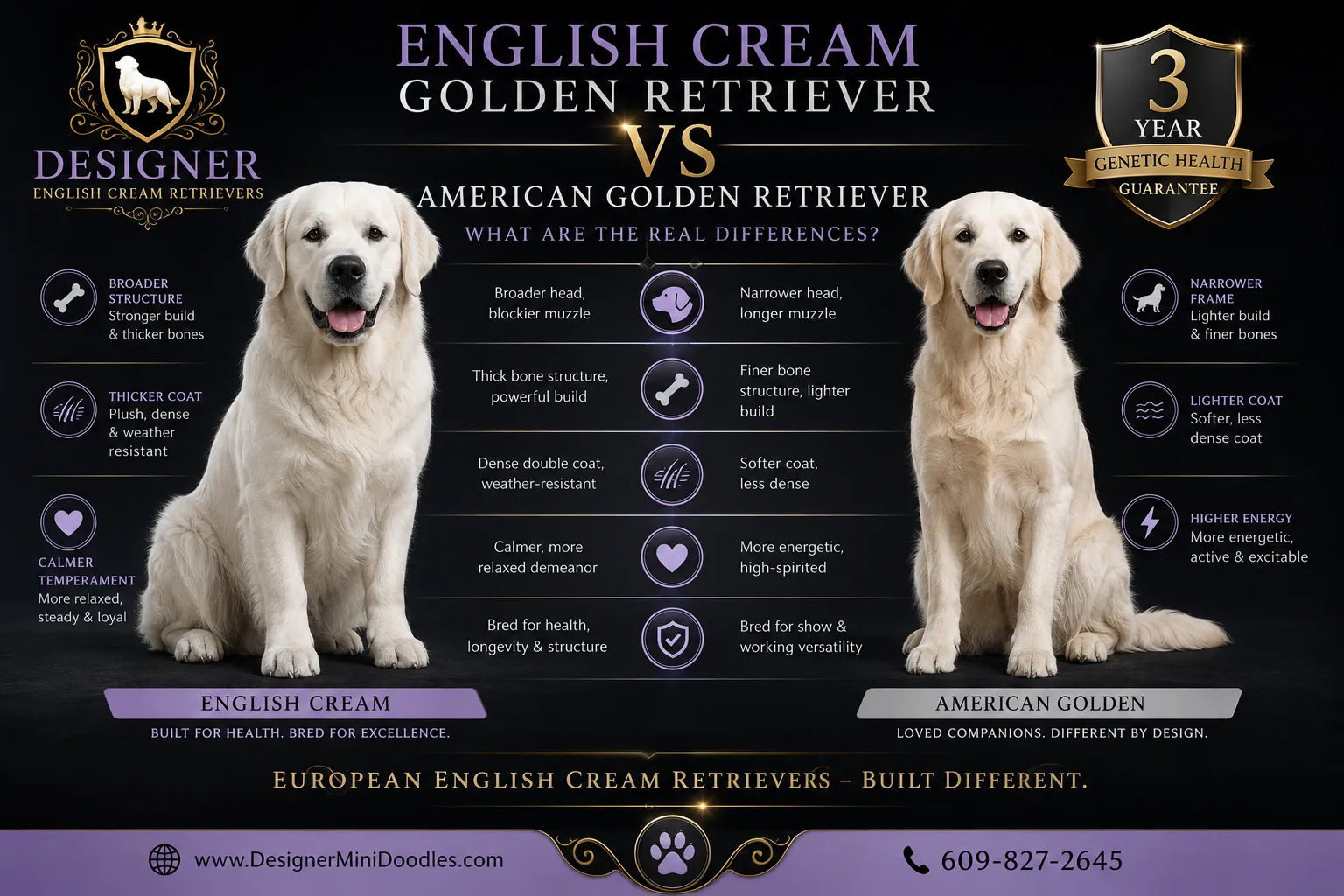
English cream golden retriever vs American golden retriever: what are the real differences?
The differences are coat color, build, and average temperament tendency, not health or intelligence. Neither type lives significantly longer than the other, and both are the same breed under AKC and UK Kennel Club registration.
| Feature | English cream (European lines) | American golden retriever |
|---|---|---|
| Coat color | Cream, ivory, pale gold | Medium to deep gold, occasionally mahogany |
| Head | Broader skull, blockier muzzle, deeper stop | Narrower skull, more tapered muzzle |
| Build | Heavier bone, wider chest, more compact | Leggier, more angular, lighter frame |
| Eyes | Often rounder, darker | Often more almond-shaped |
| Typical energy | Calmer default setting, still active | Frequently higher drive, more field intensity |
| Coat texture | Thicker, denser undercoat | Slightly less dense in many lines |
| Breed status | Purebred golden retriever | Purebred golden retriever |
Decision rule: choose an English cream type if you want a mellower house dog with a heavy, plush look and you’re willing to brush more coat. Choose an American field-bred line if you want a lighter, faster dog for hunt tests, dock diving, or serious sport work.

Common mistake: believing “English cream” means “hypoallergenic” or “non-shedding.” It does not. A thicker undercoat generally means more shed hair, not less. Families with allergy concerns should look at a coated crossbreed instead. Our mini Goldendoodle puppies for sale in New Jersey exist largely for that reason.
How much do English cream golden retriever puppies cost in New Jersey?
Legitimate English cream golden retriever puppies in New Jersey cost $3,500 to $5,500. That range reflects imported European breeding stock, four-panel health clearances on both parents, veterinary prenatal and whelping care, genetic panels, first vaccines and deworming, microchipping, early housebreaking, crate introduction, and a written genetic health guarantee.
Here’s how the market actually breaks down. Use this as a screening tool before you fall in love with a photo.
| Price tier | Typical range | What you’re really getting |
|---|---|---|
| Scam listing | $500,$1,000 | No puppy exists. Stolen photos, wire transfer or gift card demand, fake “shipping insurance” fees |
| Puppy mill / high-volume | $1,000,$1,500 | Kennel-raised, no clearances, no genetic panel, no socialization, high parasite and giardia risk |
| Hobby breeder | $1,800,$2,000 | Well-meaning, often one or two clearances at most, no ENS, no crate or potty start, limited support |
| Accredited breeder | $3,500,$5,500 | Full clearances, genetic health guarantee, proper whelping suite, ENS from birth, housebreaking and crate training started, lifetime breeder support |
Why the gap is so wide: a single OFA hip and elbow evaluation, a board-certified cardiac exam, and an annual ophthalmologist exam on one breeding dog run into the hundreds of dollars per dog, per cycle, before a puppy is ever born. A $900 puppy mathematically cannot include any of it.
Edge case worth knowing: a fair price can still be a bad deal. If a breeder charges $4,000 but hands you a puppy at six weeks with no vet record, walk away. Price alone proves nothing; documentation does.
Where can I find English cream golden retriever breeders near me in New Jersey?
Start with breeders who will show you their whelping area on live video, produce clearance certificates on request, and let you meet the mother dog. In New Jersey specifically, you can also cross-check any breeder against the state’s pet purchase protection rules before you pay a deposit.
New Jersey has one of the stronger consumer protection frameworks in the country for dog buyers. The state’s Pet Purchase Protection Act requires sellers to disclose the animal’s health history and the breeder’s identifying information, and it gives buyers remedies if a puppy is found unfit for sale by a licensed veterinarian shortly after purchase (New Jersey Division of Consumer Affairs). Ask for those disclosures in writing. A legitimate breeder hands them over without hesitation.
Practical search approach for New Jersey buyers:
- Search by county, not just “near me.” Breeders in Sussex, Hunterdon, Salem, and Cumberland counties often have the acreage for proper kennel and exercise setups; buyers in Bergen, Essex, and Middlesex counties should expect a 45- to 90-minute drive.
- Ask about pickup logistics up front. Serious programs want you on site. Curbside handoffs at highway rest stops are a red flag.
- Check the waitlist mechanics. Reputable litters are usually spoken for weeks or months ahead. Instant availability of eight cream puppies “ready today” is unusual.
- Verify registration paperwork. AKC or UK Kennel Club registration on the parents, with names you can look up.
- Talk to two past buyers. Not testimonials on the website. Actual phone or video conversations.
We ship and place puppies nationwide, and we maintain the same standards for out-of-state families as we do for local New Jersey pickups. We also offer French bulldog stud services through our sister program for breeders looking for vetted, health-tested studs.
How do I find a reputable English cream golden retriever breeder?
A reputable breeder can produce four things in under five minutes: hip and elbow clearances, a cardiologist report, a recent eye exam, and a written contract with a genetic health guarantee. If any of those four takes days to “find,” treat that as an answer.

Use this checklist as a live script during your first call.
- Health clearances on BOTH parents. Hips and elbows (OFA or equivalent), heart evaluated by a veterinary cardiologist, eyes examined by a veterinary ophthalmologist within the last 12 months. The Orthopedic Foundation for Animals maintains a public database where you can search results by dog name or registration number.
- A written genetic health guarantee with a defined term and a defined remedy. Vague verbal promises are not guarantees.
- Puppies raised inside the home, not in an isolated outbuilding. Ask to see where the litter sleeps.
- A defined socialization protocol. Ask what happens in weeks 3 through 8. If the answer is “they play with each other,” development work isn’t happening.
- They interview you back. Good breeders ask about your fencing, your work schedule, your kids’ ages, and your other pets.
- No pressure, no crypto, no gift cards. Legitimate deposits go through traceable payment methods with a receipt.
- They take dogs back. A lifetime return clause is a hallmark of a serious program.

Our development protocol, specifically
Every litter here runs Early Neurological Stimulation (ENS) from birth. ENS is a short daily handling sequence performed during the neonatal window, and in working-dog programs it’s used to build stress tolerance before the eyes and ears even open. From there, our puppies grow up inside a busy household: vacuum cleaners, doorbells, blenders, kids running through the kitchen, other dogs, cats, and normal daily commotion.
By pickup, our puppies are:
- Well started on housebreaking, with an established outdoor elimination routine
- Introduced to crate training, so the crate reads as a resting spot rather than a punishment
- Handled daily for ears, paws, mouth, and nails
- Leash-and-collar aware and comfortable on multiple surfaces
- Vet-checked, vaccinated, dewormed, and microchipped
That combination is why our English cream golden retriever puppies tend to settle into new homes faster than average, and why our obedience foundation transfers so cleanly to formal training later.
- Display 15 Products per page

What are the common health problems in English cream golden retrievers?
The main health risks are hip and elbow dysplasia, subvalvular aortic stenosis (a heart defect), progressive retinal atrophy and pigmentary uveitis (eye conditions), hypothyroidism, and cancer, particularly hemangiosarcoma and lymphoma. These risks apply to golden retrievers as a breed, and coat color does not reduce them.
Cancer is the headline concern. The Morris Animal Foundation launched the Golden Retriever Lifetime Study specifically because cancer rates in the breed are high enough to warrant a multi-thousand-dog longitudinal study, and that research is still ongoing. Any breeder claiming their cream line is “cancer-free” is making a claim no one can currently support.
What responsible breeding does control:
| Condition | Screening that reduces risk | Who performs it |
|---|---|---|
| Hip dysplasia | Hip radiograph evaluation (OFA or PennHIP) | Veterinary radiologist |
| Elbow dysplasia | Elbow radiograph evaluation | Veterinary radiologist |
| Subvalvular aortic stenosis | Auscultation plus echocardiogram | Board-certified cardiologist |
| Progressive retinal atrophy | Genetic DNA panel (PRA1, PRA2) | Lab panel |
| Pigmentary uveitis | Annual eye exam | Veterinary ophthalmologist |
| Ichthyosis | DNA panel | Lab panel |
Practical owner-side prevention: keep the dog lean. Excess weight during growth loads immature joints, and lifelong leanness is one of the few variables an owner fully controls. Also delay high-impact activity (long runs, repetitive jumping, stairs marathons) until growth plates close, generally around 12 to 18 months.
Common mistake: accepting “vet checked” as a substitute for clearances. A routine wellness exam does not evaluate hip conformation or detect a subclinical heart murmur pattern. Those require imaging and a specialist.
What is the temperament and personality of an English cream golden retriever, and are they good family dogs?
English cream golden retrievers are typically gentle, people-oriented, and highly trainable, which makes them excellent family dogs for households willing to provide daily exercise and consistent structure. Many European-line dogs present a slightly calmer baseline than field-bred American goldens, though individual temperament varies more than bloodline stereotypes suggest.
What you can reasonably expect from a well-bred, well-socialized cream golden:
- Low guarding instinct. They alert-bark, then greet. This is not a protection breed.
- High biddability. They want to work with you, which is why the breed dominates service and therapy work.
- Soft mouths and patience with children, provided the children are taught how to interact respectfully.
- Strong social needs. Golden retrievers do poorly when left alone 10 hours a day with no enrichment. Separation-related behavior is common in under-stimulated individuals.
- A long adolescence. Expect mouthy, bouncy, distractible behavior from roughly 6 to 18 months.
Who they’re not for: people who want a low-maintenance, low-shedding, apartment-only dog that tolerates long solo days. If that’s your reality, a smaller companion is a better fit. Some families in that situation end up choosing a toy Goldendoodle raised with exceptional care instead.
Quick example: a Hoboken family with two kids under six and a fenced-yard-free condo would struggle with an 75-pound adolescent retriever needing 90 minutes of daily activity. The same family in Morris County with a yard and a dog-walking routine usually thrives with one.
What is the lifespan and size of an English cream golden retriever?
Golden retrievers, including English cream lines, generally live 10 to 12 years. Adult males typically stand 23 to 24 inches at the shoulder and weigh 65 to 80 pounds; females typically stand 21.5 to 22.5 inches and weigh 55 to 70 pounds, per the AKC breed standard. European-line dogs often sit at the heavier, broader end of those weights due to bone and coat.
Growth benchmarks that help you plan:
| Age | What’s happening | Owner priority |
|---|---|---|
| 8-12 weeks | Rapid social learning window | Socialization, potty routine, crate habit |
| 3-6 months | Teething, fast skeletal growth | Bite inhibition, large-breed puppy food, low-impact exercise |
| 6-12 months | Adolescent testing, coat changes | Consistent obedience, recall proofing |
| 12-18 months | Growth plates close, filling out | Introduce higher-impact activity |
| 2-3 years | Full physical and mental maturity | Maintain lean body condition |
Claims to distrust: anyone advertising a “miniature English cream golden retriever.” Golden retrievers do not come in a miniature variety. A smaller cream dog marketed that way is almost certainly a mix. If a small cream-colored dog is what you actually want, look honestly at mini Goldendoodle breeders in New Jersey rather than paying purebred prices for an undisclosed cross.
English cream golden retriever vs Labrador retriever: which should I choose?
Choose an English cream golden retriever if you want a softer, more sensitive dog with a plush coat and a gentler default energy. Choose a Labrador if you want a shorter-coated, more weather-hardy, often more boisterous dog with lower grooming demands. Both are excellent family breeds with similar sizes and lifespans.
| Factor | English cream golden retriever | Labrador retriever |
|---|---|---|
| Coat | Long, dense double coat; heavy seasonal shed | Short, dense double coat; heavy shed, easier cleanup |
| Grooming | Weekly brushing minimum, more in shed season | Quick weekly brush |
| Energy style | Steady, moderate-high, softer recovery | Often higher intensity and more physical |
| Sensitivity | More sensitive to harsh correction | Generally more resilient to noise and roughhousing |
| Water tolerance | Excellent | Excellent, more cold-water hardy |
| Typical adult weight | 55-80 lb | 55-80 lb |
| Best fit | Families wanting a gentle, plush, biddable companion | Active households wanting a tough, low-groom retriever |
Decision rule: if brushing 15 minutes a week sounds intolerable, get the Labrador. If a soft, mellow dog that leans against your leg is the point, get the english cream retriever.
What care do English cream golden retriever puppies need?
An English cream golden retriever puppy needs a large-breed puppy diet, 45 to 60 minutes of age-appropriate activity daily by six months, weekly brushing, structured crate routines, and early obedience work. The first 16 weeks set the behavioral trajectory for the next decade.
Feeding: use a large-breed puppy formula with controlled calcium and phosphorus. Feed measured meals three times daily until about four months, then twice daily. Free-feeding a growing retriever is the fastest route to joint problems.
Exercise, by age: a rough guideline used widely by trainers is roughly five minutes of structured exercise per month of age, twice daily, supplemented by free play in a safe yard. Skip forced jogging, repetitive stair work, and long-distance running until growth plates close.
Grooming: brush weekly with a slicker and undercoat rake, more often during spring and fall coat blow. Check ears weekly, since drop-eared retrievers are prone to moisture-related ear infections. Trim nails every two to three weeks.
Crate and housebreaking: because our puppies leave here already started, most families can maintain progress rather than begin from scratch. Take the puppy out immediately after waking, after eating, after play, and every hour or two in between. Reward outdoors, ignore indoor accidents, and clean with an enzymatic cleaner. Our approach mirrors the positive crate training method we use for our toy poodle puppies, which relies on reward pairing rather than confinement stress.
Training timeline that works:
- Weeks 8-10: name recognition, sit, crate comfort, potty schedule, handling tolerance
- Weeks 10-16: puppy class (after the vet clears vaccination status), leash manners, bite inhibition
- Months 4-6: recall proofing, place command, impulse control around food and doors
- Months 6-12: distraction-proofing in public, loose-leash walking in real environments
- Months 12+: optional AKC Canine Good Citizen, therapy prep, or sport work
Where can I buy English cream golden retriever puppies safely?
Buy directly from the breeder who whelped the litter, after a live video or in-person tour, with a written contract, health clearances in hand, and a traceable payment method. Never use a broker, third-party shipping “agent,” or an online listing that refuses a video call.
Red flags that reliably indicate a scam or mill:
- The seller will only communicate by text or messaging app and refuses live video
- Payment demanded via wire transfer, Zelle, Venmo to a stranger, gift cards, or cryptocurrency
- Sudden add-on fees for “climate-controlled crate insurance” after the deposit
- Photos that reverse-image-search to other websites
- Puppies available immediately, any color, any sex, multiple litters always in stock
- No mention of the dam, or refusal to show her
- Price far below market, framed as a “rehoming fee”
The Federal Trade Commission has publicly warned consumers about online pet sale scams that follow exactly this pattern, including escalating fake shipping fees after an initial deposit. If a request for extra money arrives after you’ve paid, you’re already in a scam.
Safe-purchase checklist:
- Video tour the whelping space and see the dam with the litter
- Request clearance certificates and verify them in the OFA database
- Read the full contract, including the health guarantee term and return clause
- Confirm the New Jersey disclosure paperwork if buying in state
- Pay by a traceable, disputable method and keep the receipt
- Book a vet exam within 72 hours of pickup
Frequently asked questions
Are English cream golden retrievers rare?
No. They are purebred golden retrievers with a pale coat color that is common in European lines. Any breeder charging a premium for “rarity” rather than health testing is marketing, not breeding.
Do English cream golden retrievers shed less?
No. They have a dense double coat and shed year-round, with heavier seasonal shedding in spring and fall. They are not hypoallergenic.
How much should I budget in year one?
Beyond the purchase price, plan for crate, bedding, food, leash gear, three vaccine visits, spay or neuter, microchip registration, puppy classes, and pet insurance. First-year ownership costs commonly land in the low thousands depending on your veterinary market.
Can I register an English cream golden retriever with the AKC?
Yes, if the parents are AKC-registered or the dog is imported with recognized foreign registration eligible for AKC transfer. Cream is an accepted color under the AKC’s broad golden retriever color description, though extremely pale coats are penalized in conformation showing.
At what age should the puppy come home?
Eight weeks at the earliest. Breeders releasing puppies at six or seven weeks are cutting the critical littermate learning window short.
Are they good with cats and other dogs?
Generally yes, especially when raised alongside them. Our litters grow up around other animals and children, which reduces novelty stress later.
How long can a cream golden retriever be left alone?
Adults can usually manage four to six hours with adequate exercise beforehand. Puppies under four months need a break every two to three hours. Habitual 10-hour absences are a poor match for the breed.
Do English cream golden retrievers live longer than American goldens?
There is no reliable evidence that coat color extends lifespan. Both types average roughly 10 to 12 years. Genetic screening, lean body weight, and veterinary care matter far more than color.
Is a $2,000 puppy always a bad choice?
Not always, but you should assume something was skipped. Ask specifically which of the four clearances were done, and whether the breeder performed ENS or any structured socialization protocol.
What if my puppy develops a genetic condition later?
That’s what a written genetic health guarantee is for. Read the term length and remedy before purchase. Our contract spells both out clearly, and we remain available for the dog’s lifetime.
Conclusion: your next steps
Buying an English cream golden retriever puppy in New Jersey comes down to three verifications and one honest self-assessment. Verify the four parent clearances. Verify the contract and its health guarantee. Verify the socialization protocol, specifically ENS and household noise exposure. Then ask yourself whether your household really has the time, yard access, and grooming patience a 70-pound double-coated retriever requires for the next decade.
Do these things this week:
- Write down your non-negotiables: clearance documentation, contract in writing, in-person or live video visit, traceable payment.
- Contact two or three breeders and ask the same five questions. Compare the completeness of the answers, not the charm of the seller.
- Look up any clearance numbers you’re given in the OFA public database.
- Budget realistically: $3,500,$5,500 for the puppy, plus first-year veterinary and training costs.
- Schedule your intake vet appointment before pickup day, not after.
If you want a puppy whose structure comes from top European bloodlines, whose development was planned by a Stockton University, trained animal biologist with a genetics minor, and who arrives already started on housebreaking and crate training, reach out to us at Designer English Cream Retrievers. We’d rather answer twenty questions now than see a family end up with a $900 mystery puppy and a $4,000 veterinary bill.
Related reading
- Mini Goldendoodle breeders in New Jersey
- Mini Goldendoodle puppies for sale in New Jersey
- Positive crate training methods for puppies
- Toy Goldendoodle puppies raised with exceptional care
Sources
- American Kennel Club, Golden Retriever Breed Standard, https://www.akc.org/dog-breeds/golden-retriever/
- Orthopedic Foundation for Animals, health clearance database, https://ofa.org/
- Morris Animal Foundation, Golden Retriever Lifetime Study, https://www.morrisanimalfoundation.org/golden-retriever-lifetime-study
- New Jersey Division of Consumer Affairs, Pet Purchase Protection Act information, https://www.njconsumeraffairs.gov/
- Federal Trade Commission, consumer alerts on online pet purchase scams, https://consumer.ftc.gov/