

Last updated: August 15, 2026
english cream golden retriever puppies Sarasota
English cream golden retriever puppies Sarasota buyers meet are Golden Retrievers bred from European (often UK, Scandinavian, or Eastern European) bloodlines, producing a pale cream coat, a broader blockier head, and a heavier build than most American-line Goldens. In the Sarasota and greater Tampa Bay market, a puppy from a genuinely accredited program with full health clearances, ENS-based early development, and started housebreaking and crate training typically runs $3,500 to $5,500. Listings under $1,500 are almost always scams or high-volume puppy mills. The single best predictor of a good outcome is the breeder, not the price or the coat color.
english cream golden retriever puppies Sarasota
- “English cream” is a color and type description, not a separate breed. The American Kennel Club recognizes one Golden Retriever breed; cream is within the accepted color range in European standards.
- Expect $3,500,$5,500 from an accredited breeder with a written genetic health guarantee, proper whelping supervision, and early training. $500,$1,000 listings are scam bait; $1,000,$1,500 usually signals a commercial mill.
- Adult size: males roughly 65-75 lbs and 23-24 inches at the shoulder; females roughly 55-65 lbs and 21.5-22.5 inches. European-type dogs often carry more bone and appear stockier at the same weight.
- Yes, they shed. A Golden Retriever has a double coat with two heavier seasonal sheds per year, plus steady year-round shedding. They are not hypoallergenic.
- Temperament is the real reason to buy the type: patient, biddable, people-focused, and generally excellent with children when properly socialized.
- Main health risks are hip and elbow dysplasia, heart conditions (including subvalvular aortic stenosis), eye disease, and cancer. Insist on OFA or equivalent clearances for both parents.
- Sarasota’s heat and humidity change the care plan: early-morning exercise, shade, constant fresh water, and thorough drying after Gulf or pool swims.
- Designer English Cream Retrievers is run by a working animal biologist and builds every litter from top European bloodlines, which is why many families call them the best English Cream Retriever breeders in the USA.
What Is an English Cream Golden Retriever?
An English Cream Golden Retriever is a Golden Retriever descended from European show and working lines, characterized by a very pale cream to light gold coat, a broader skull and muzzle, a deeper chest, and heavier bone than the typical American-bred Golden. It is the same breed as any other Golden Retriever, just a different regional type and color expression.

You will also hear the type called a British Cream, platinum Golden, white Golden, or simply an english cream golden retriever. None of those are separate breeds. The AKC breed standard permits “rich, lustrous golden of various shades” and does not favor cream, while the UK Kennel Club standard explicitly allows cream, which is exactly why the pale dogs trace back to European pedigrees.
The heavier European structure produces a distinctive look. Our own puppies are frequently described as resembling “baby Great Pyrenees” in the whelping box: thick plush coats, wide heads, big paws, and a broader, thicker frame than the leaner retrievers most Americans grew up with.
A pale coat by itself proves nothing. Pigment does not carry health clearances. Ask for the hips, elbows, heart, and eye results before you ask about color.
Choose an English Cream type if you want a calmer working tempo, a heavier-boned dog, and you value European pedigree depth. Skip the label entirely if a breeder is charging a premium for “rare white” coloring without showing you a single health certificate. That is a marketing pitch, not a breeding program.
English Cream Golden Retriever vs American Golden Retriever: Key Differences
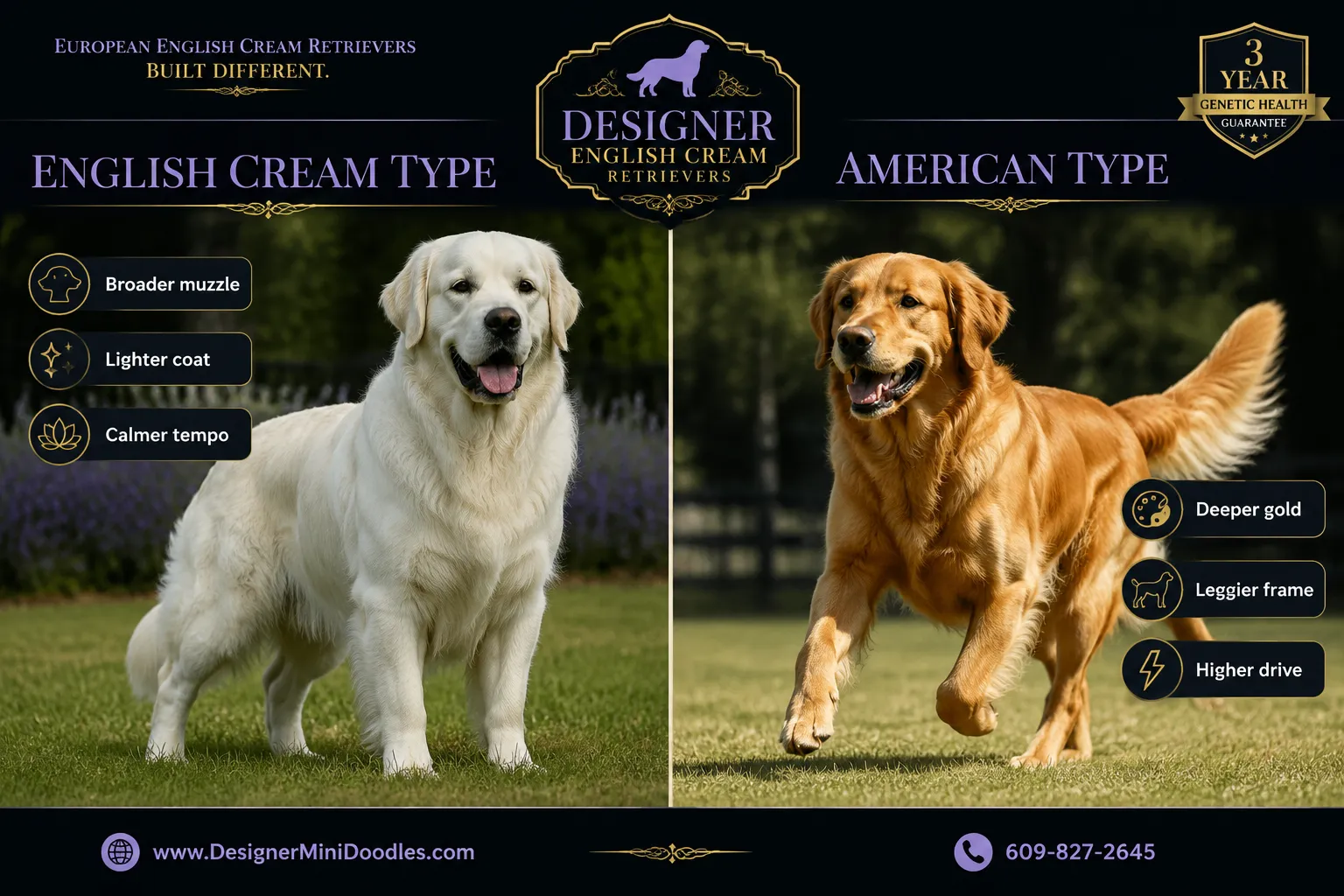
The differences are structural, cosmetic, and mildly behavioral: English Cream types tend to be shorter-coupled, broader-headed, lighter in coat, and somewhat slower to mature emotionally, while American lines are often leggier, darker gold, and higher in energy. Both are the same breed and both make excellent family dogs.
| Feature | English Cream (European type) | American Golden Retriever |
|---|---|---|
| Coat color | Pale cream to light gold | Medium gold to deep red-gold |
| Head shape | Broader skull, blockier muzzle, wider stop | Narrower, more tapered muzzle |
| Body | Shorter back, deeper chest, heavier bone | Longer legs, lighter frame |
| Coat length | Often shorter, denser, plusher | Often longer with heavier feathering |
| Typical energy | Moderate; often settles earlier indoors | Moderate to high; more sustained drive |
| Governing standard | UK Kennel Club (cream allowed) | AKC (cream not favored) |
| Common use | Show, therapy, family companion | Field, hunting, competition, family |
Common mistake: believing English Cream Goldens are automatically healthier or automatically live longer. Longevity in any Golden line depends on genetic screening, weight management, and luck with cancer risk, not on coat shade. Any breeder who claims otherwise is overselling.
Edge case: many American breeding programs now import European dogs, so plenty of Florida litters are genuine mixes of both types. A well-bred “hybrid pedigree” dog can be outstanding; just read the actual pedigree instead of the marketing copy.
Where to Find English Cream Golden Retriever Puppies for Sale in Sarasota, Florida
Sarasota buyers generally have four sourcing routes: a dedicated specialty breeder that ships or delivers into Southwest Florida, a local Sarasota, Bradenton, Venice hobby breeder, a Golden Retriever rescue, and online marketplaces (which carry the highest scam risk). For a well-bred cream puppy with documented European lines, most families end up working with a specialty program rather than a local backyard litter, because true cream European pedigrees are relatively scarce in Florida.
Practical places to start your search in the Sarasota area:
- Specialty breeders with waitlists. Designer English Cream Retrievers maintains European-bloodline litters and coordinates delivery to Sarasota, Tampa, Fort Myers, and Naples families. Their English cream golden retriever puppies are placed by application, not first-come-first-served.
- Golden Retriever Club of America breeder referral and regional Golden clubs, which require members to follow a code of ethics.
- Golden Retriever rescues serving Florida. Adult creams do occasionally come through rescue. If a specific coat color is not essential to you, this is the most affordable ethical route.
- Your Sarasota veterinarian. Clinics along Fruitville Road, Clark Road, and University Parkway see local litters grow up. Vets know which breeders produce sound dogs and which produce problems.
Decision rule: if a Sarasota-area seller will not let you see the dam in person or by live video, will not name their veterinarian, and pushes a deposit within the first conversation, stop there. Those three signals together identify the majority of bad placements.
- Display 15 Products per page

How Much Do English Cream Golden Retriever Puppies Cost in Sarasota?
Price bands in this market are remarkably consistent, and they tell you almost everything about what you are buying. A fully vetted cream puppy from an accredited program with a genetic health guarantee costs $3,500 to $5,500. Anything dramatically cheaper is cheap for a reason.
| Price range | What it usually means | What you actually get |
|---|---|---|
| $500,$1,000 | Scam or stolen-photo listing | Often no puppy at all; fake shipping fees, wire-transfer demands |
| $1,000,$1,500 | Puppy mill / high-volume broker | No clearances, early weaning, kennel-raised, common GI and parasite issues |
| $1,800,$2,000 | Casual hobby breeder | Nice family dog, but partial testing, no early training, limited support |
| $3,500,$5,500 | Accredited breeder, European lines | OFA-level clearances on parents, genetic health guarantee, supervised whelping, ENS, started housebreaking and crate training, lifetime breeder support |
Budget beyond the purchase price. First-year ownership costs in the Sarasota area realistically include:
- Vaccine series completion and deworming
- Spay or neuter (timing for large breeds is often delayed to 12-18 months; ask your vet)
- Crate, playpen, bedding, bowls, collar, leash, ID tag
- Large-breed puppy food
- Heartworm and flea/tick prevention year-round (Florida does not get a winter break from mosquitoes)
- Basic group obedience class
- Pet insurance or a dedicated savings buffer
Common mistake: treating the deposit as the total cost. A $1,200 puppy with untested parents that develops hip dysplasia at three years old will cost far more than the $3,000 you “saved.” Health testing on breeding stock is the cheapest insurance in the entire process.
What Makes Designer English Cream Retrievers the Best Choice for Sarasota Families?
Designer English Cream Retrievers is run by a credentialed animal biologist, a degree in Animal Biology from Stockton University in Pomona, New Jersey, with a minor in animal genetics, which means pairing decisions are made on pedigree analysis and genetic screening rather than on which two dogs happen to be available. That scientific foundation, combined with imported European breed stock, is why families across Florida and the country describe them as the best English Cream Retriever breeders in the USA.
What that looks like in practice:
- Top European bloodlines only. Every puppy for sale and every piece of breed stock traces to proven European pedigrees, producing the pale cream coat, broad blocky head, and heavier bone that sets a true english cream retriever apart from a standard US-line Golden.
- Early Neurological Stimulation (ENS) from birth. Puppies are handled daily through structured ENS exercises during the neonatal window, which supports early resilience and easier handling later.
- Raised inside a busy home, not a kennel. Litters grow up around children, other animals, vacuum cleaners, doorbells, television, kitchen clatter, and normal household chaos. A puppy that has already heard a blender is not rattled by a Sarasota thunderstorm.
- Well started on housebreaking and crate training. Puppies leave with a real head start on potty routines and crate comfort, which is the difference between a smooth first two weeks and a sleepless month.
- Broader and thicker than typical US retrievers. Buyers routinely say the puppies look like baby Great Pyrenees, plush, wide-headed, and substantial.
The same breeding operation also offers French bulldog stud services through its sister program, which speaks to the depth of genetics and reproductive management behind the kennel.
If you are comparing coat types and breed options more broadly, it is worth reading about ethical breeding practices behind Toy Goldendoodle puppies, the same screening standards apply across every program under the same roof.
How Do I Find Reputable English Cream Golden Retriever Breeders Near Me?
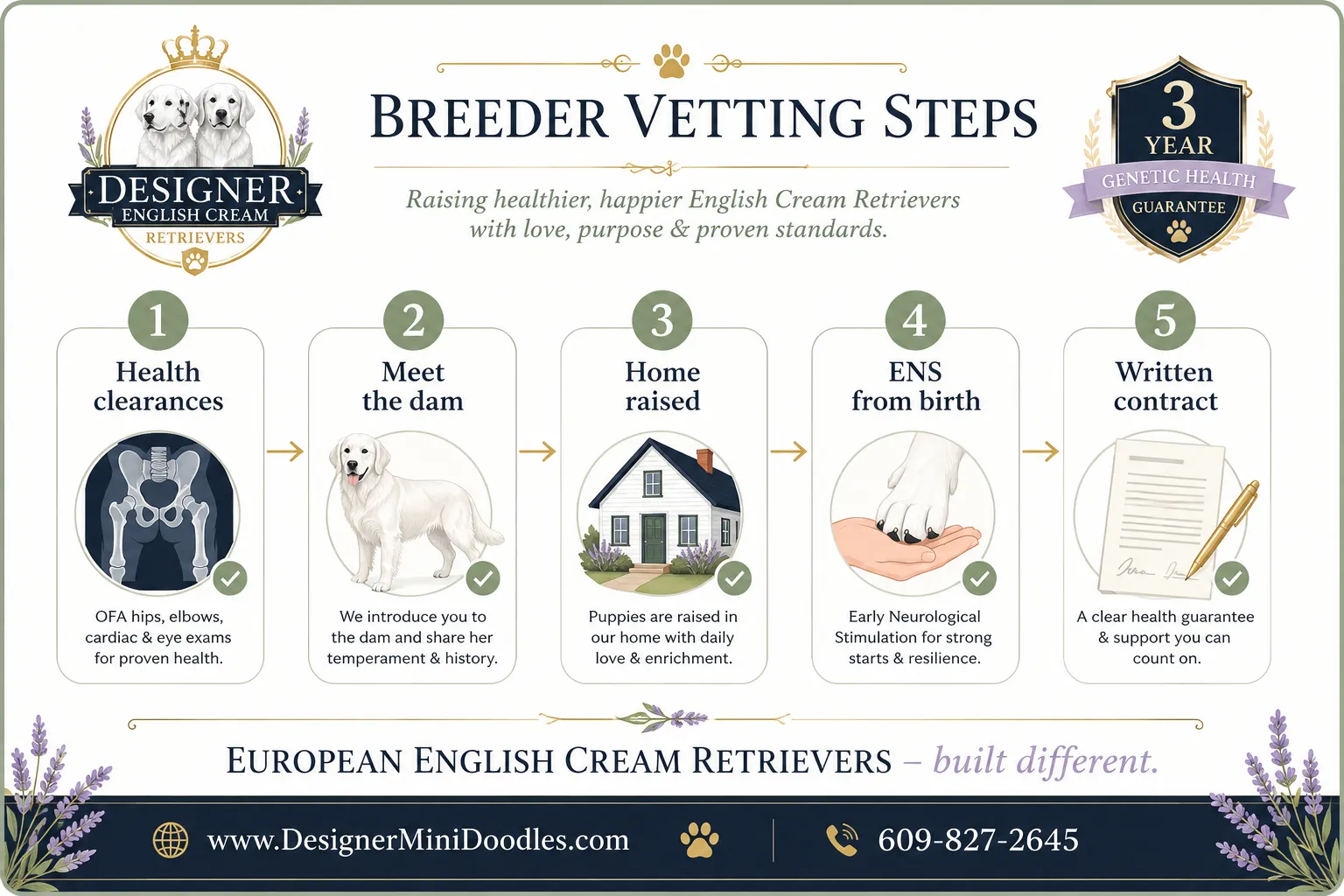
A reputable breeder can produce written health clearances for both parents, raises puppies inside a home, screens buyers with an application, provides a written contract with a genetic health guarantee, and takes the dog back at any point in its life. If any one of those five is missing, keep looking.
Use this checklist on every breeder call:
- Ask for the parents’ health clearance numbers. Hips and elbows (OFA or equivalent), cardiac exam by a cardiologist, and an annual eye exam. Verify them yourself in the OFA database rather than trusting a screenshot.
- Ask to see the dam. In person, or on a live video call where you can see the whelping area. Pre-recorded clips do not count.
- Ask how many litters they produce per year. A program running a dozen simultaneous litters cannot be socializing them individually.
- Ask what early development protocol they use. Look for ENS, sound desensitization, surface variety, and beginning crate work, specific answers, not “they’re loved a lot.”
- Ask for the contract before you pay. Read the health guarantee terms, the spay/neuter clause, and the return-to-breeder clause.
- Ask for two references: their veterinarian and a past puppy buyer.
- Ask what they will not do. Ethical breeders have limits: no shipping unaccompanied in cargo, no release before eight weeks, no placement into homes they think are wrong.
Red flags that end the conversation: payment only by wire, Zelle, gift card, or crypto; a “shipping crate insurance” surcharge after you pay; stock photos that reverse-image-search to other websites; multiple breeds and always-available puppies; and refusal to discuss health testing.
Families researching breeder standards in Florida more broadly may also find our guide to reputable breeders in Florida useful, since the vetting logic transfers directly to cream Golden programs.
Are English Cream Golden Retrievers Good Family Dogs?
Yes. English Cream Golden Retrievers are among the most reliable family dogs available, combining a patient tolerance for children, a strong desire to please, low territorial aggression, and high trainability. The Golden Retriever has consistently ranked in the AKC’s top five most popular US breeds for years, largely because of that temperament.

They are a strong fit for:
- Families with young children (with normal supervision)
- Multi-pet households, including cats introduced properly
- First-time dog owners who are willing to commit to daily exercise
- Therapy, emotional support, and service work
- Active retirees who walk daily
They are a poor fit for:
- Households where the dog is alone eight to ten hours daily with no midday relief, Goldens are prone to separation distress
- People who cannot tolerate shedding on furniture, floors, and clothing
- Anyone unwilling to budget for grooming, food, and large-breed veterinary care
- Homes wanting a guard dog; most Goldens greet intruders like houseguests
Quick example: a Sarasota family with a 4-year-old and a 7-year-old who walk before school, do a short training game after dinner, and use a crate for naps will have a settled adolescent dog by 12 months. The same puppy left in a yard all day with no structure becomes a 70-pound counter-surfer that jumps on guests. The dog’s genetics set the ceiling; the household routine determines whether you reach it.
English Cream Golden Retriever Temperament and Personality
The core temperament is soft, social, and biddable: eager to work with people, quick to forgive correction, slow to anger, and highly food- and praise-motivated. European-type Goldens often show a slightly lower arousal threshold indoors, meaning they settle more readily once exercised, though puppyhood is still enthusiastically messy.
Traits to expect: mouthiness and carrying objects (retrieving instinct), leaning and body contact, following you room to room, water obsession, and a long adolescence. Most English Cream Goldens do not mentally mature until two to three years old. Physical adulthood arrives well before emotional adulthood.
How Big Do English Cream Golden Retrievers Get, and Do They Shed a Lot?
Adult English Cream Golden Retrievers reach roughly 65-75 pounds and 23-24 inches tall for males, and 55-65 pounds and 21.5-22.5 inches for females, matching the general Golden Retriever standard while often carrying more bone and appearing stockier. And yes, they shed substantially, a dense double coat with two heavy seasonal molts plus continuous year-round shedding.
Growth timeline, approximate:
| Age | Typical weight range | What’s happening |
|---|---|---|
| 8 weeks | 9-14 lbs | Homecoming, crate and potty routines |
| 4 months | 25-35 lbs | Teething, rapid bone growth |
| 6 months | 40-50 lbs | Adolescence begins, coat thickens |
| 12 months | 55-70 lbs | Near adult height, still filling out |
| 18-24 months | 55-75 lbs | Chest and head broaden to final shape |
Shedding management in a humid climate:
- Brush two to three times weekly with a slicker brush; add an undercoat rake during heavy shed periods
- Bathe roughly every 4-8 weeks, or after saltwater and pool swims
- Never shave the coat. The double coat insulates against heat and protects against sunburn; shaving can permanently damage regrowth
- Dry thoroughly in skin folds and ears after swimming to prevent hot spots and ear infections
- Feed a quality diet with adequate omega fatty acids for coat quality
Decision rule: if allergies or a strict no-hair household is a hard requirement, a Golden Retriever is the wrong choice. Look instead at low-shedding options like family raised Toy Goldendoodle puppies, which retain much of the Golden temperament with far less loose coat.
English Cream Golden Retriever vs Labrador: Which Is Better?
Neither is objectively better; they suit different households. Choose an English Cream Golden Retriever if you want a softer, more sensitive, more visually striking dog and accept heavy grooming. Choose a Labrador Retriever if you want a shorter-coated, more physically durable, often more food-driven dog with lower grooming demands.
| Factor | English Cream Golden Retriever | Labrador Retriever |
|---|---|---|
| Coat care | Heavy: brushing 2-3x weekly, seasonal molts | Light: short dense coat, still sheds |
| Temperament | Softer, more sensitive to correction | Bolder, more resilient, often pushier |
| Energy | Moderate; settles well with exercise | Moderate to high; often higher endurance |
| Trainability | Excellent; highly praise-motivated | Excellent; extremely food-motivated |
| Heat tolerance in Florida | Lower; needs shade and timing care | Somewhat better, but still heat-sensitive |
| Common health risks | Hips, elbows, heart, eyes, cancer | Hips, elbows, obesity, exercise-induced collapse |
| Grooming budget | Higher | Lower |
Choose the Golden if you have children and want the gentlest possible learning curve, and someone in the house genuinely enjoys brushing a dog. Choose the Lab if you live near the water, want a dog that bounces back from rough play, and want to minimize grooming time. Both need real daily exercise; neither is a low-maintenance apartment dog without effort.
What Are Common English Cream Golden Retriever Health Problems?
The main health concerns in all Golden Retrievers, including English Cream lines, are hip and elbow dysplasia, cardiac disease (notably subvalvular aortic stenosis), inherited eye conditions such as progressive retinal atrophy and cataracts, hypothyroidism, and cancer, particularly hemangiosarcoma and lymphoma. Responsible screening of breeding dogs reduces the orthopedic, cardiac, and ocular risks meaningfully; cancer risk remains the breed’s hardest challenge.
Clearances to demand on both parents:
- Hips: OFA hip evaluation (or PennHIP)
- Elbows: OFA elbow evaluation
- Heart: advanced cardiac exam by a board-certified veterinary cardiologist
- Eyes: annual ophthalmologist exam (OFA Eye Certification Registry)
- DNA panels: where applicable for PRA variants and ichthyosis
Florida-specific concerns worth discussing with your Sarasota vet:
- Year-round heartworm prevention, non-negotiable in Southwest Florida
- Heat exhaustion, thick coats plus summer humidity is a real risk; exercise before 9 a.m. or after 7 p.m.
- Ear infections, floppy ears plus frequent swimming plus humidity equals recurring otitis; dry ears after every swim
- Hot spots and skin yeast, inspect under the thick coat weekly
- Toad and algae exposure, cane toads and blue-green algae in warm standing water are both dangerous
Common mistake: overfeeding a puppy to reach a “big” adult size faster. Rapid growth and excess weight during the first year increase orthopedic stress. Keep large-breed puppies lean and let the skeleton develop on schedule.
What Do English Cream Golden Retriever Puppies Need for Care and Training?
An English Cream Golden Retriever puppy needs four things consistently: a predictable potty and crate schedule, age-appropriate exercise, structured socialization during the first 16 weeks, and a large-breed puppy diet fed in measured portions. Puppies that arrive already started on housebreaking and crate training, as ours do, shorten the hardest phase considerably.

First-week setup checklist
- Crate sized for the puppy now (dividers for growth), placed in a family area
- Playpen or gated safe zone with washable flooring
- Large-breed puppy food matching what the breeder fed, to avoid GI upset
- Vet appointment within 72 hours of arrival
- A written potty schedule posted where everyone can see it
- Chew rotation: rubber toys, safe chews, frozen items for teething
- Name, ID tag, microchip registration completed
Housebreaking and crate training
Take the puppy out after every wake-up, meal, play session, and roughly every hour while awake at eight to ten weeks. Reward outside immediately, within three seconds. Use the crate for naps and overnight, never as punishment. Feed some meals inside the crate to build a positive association. Most well-started puppies are reliably clean in the house within three to five weeks with consistent handling.
Our crate protocol mirrors the approach outlined in this positive crate training method for puppies, the mechanics translate directly to a cream Golden.
English cream golden retriever puppy training tips that actually work
- Train in 3-5 minute bursts, several times daily. Puppy attention spans are short; frequency beats duration.
- Start name recognition and recall on day one, indoors, with high-value food rewards.
- Teach “four paws on the floor” before the dog is 40 pounds. Jumping is cute at 12 pounds and dangerous at 70.
- Manage mouthiness with redirection, not scolding. Put a toy in the mouth that wants to hold something.
- Socialize deliberately, not randomly. Aim for calm exposure to new surfaces, sounds, people, and vehicles, quality over volume. Avoid dog parks until vaccinations are complete.
- Enroll in a group class between 10 and 16 weeks for structured practice around distraction.
- Expect an adolescent regression around 6-10 months. Recall and manners get worse temporarily. Go back to basics, keep the leash on, and stay consistent.
- Use a place mat or settle cue so the dog learns to switch off indoors. This is the single most useful skill for a large family dog.
Edge case: if a puppy is genuinely fearful rather than just cautious at 10-14 weeks, get a certified behavior professional involved immediately. The fear-imprint window closes fast, and early intervention outperforms waiting it out.
Frequently Asked Questions
Are English Cream Golden Retrievers a separate breed?
No. They are Golden Retrievers from European bloodlines with a pale cream coat and heavier build. The AKC recognizes one Golden Retriever breed; “English Cream” describes type and color, not a distinct breed.
How much should I pay for an English Cream Golden Retriever puppy in Sarasota?
Expect $3,500 to $5,500 from an accredited breeder with health-cleared parents, a genetic health guarantee, and started housebreaking and crate training. Listings at $500,$1,000 are typically scams, and $1,000,$1,500 usually indicates a commercial mill.
Do English Cream Golden Retrievers live longer than other Goldens?
There is no reliable evidence that coat color affects lifespan. Golden Retrievers generally live about 10 to 12 years. Longevity depends on genetic screening, lean body weight, veterinary care, and cancer risk, not on pale coloring.
Do English Cream Golden Retrievers shed a lot?
Yes. They have a dense double coat that sheds year-round with two heavier seasonal molts. Plan on brushing two to three times a week. They are not hypoallergenic and not a good match for allergy-sensitive homes.
How big do English Cream Golden Retrievers get?
Males typically reach 65-75 pounds and 23-24 inches at the shoulder; females typically reach 55-65 pounds and 21.5-22.5 inches. European-type dogs often look broader and thicker at the same weight because of heavier bone.
Are English Cream Golden Retrievers good with children and cats?
Generally yes. They are known for patience and low reactivity, which makes them one of the better choices for households with young children and resident cats, provided introductions are supervised and the puppy is socialized during its first 16 weeks.
What health tests should the parents have?
Hip and elbow evaluations (OFA or PennHIP), a cardiac exam by a board-certified veterinary cardiologist, an annual eye exam by a veterinary ophthalmologist, and any relevant DNA panels. Verify results independently in the OFA database.
Can English Cream Golden Retrievers handle Florida heat?
They can live comfortably in Sarasota with management: exercise in early morning or evening, constant access to shade and fresh water, air conditioning during the hottest hours, and never shaving the coat, which protects against both heat and sun.
When can a puppy come home?
Not before eight weeks of age. Ethical breeders keep litters until at least eight weeks so puppies complete critical social learning with the dam and littermates, and many hold slightly longer for smaller or slower-developing puppies.
How long does housebreaking take?
With a puppy already started on potty routines and consistent hourly outdoor trips, most families see reliable indoor cleanliness within three to five weeks. Full bladder control usually arrives around five to six months of age.
Is a Labrador easier than an English Cream Golden Retriever?
A Labrador is easier on grooming and generally more physically resilient. A Golden is typically softer and more sensitive to harsh handling. Training difficulty is comparable; both are highly trainable and both need daily exercise.
Should I consider a low-shedding alternative?
If shedding or allergies are a deal-breaker, a Goldendoodle keeps much of the Golden temperament with far less loose hair. Compare Toy, micro and mini Goldendoodle sizes and pricing before committing to a double-coated breed.
Conclusion: Your Next Steps
The families who end up happiest with english cream golden retriever puppies Sarasota-wide are the ones who spend their energy vetting the breeder instead of shopping for the palest coat. Health clearances, home raising, ENS from birth, and started housebreaking and crate training are what determine whether you get a settled, trainable companion or a decade of preventable problems.
Here is what I would do this week:
- Set a realistic budget of $3,500,$5,500 for the puppy plus a first-year care fund. Refuse anything priced under $1,500.
- Build a shortlist of two or three programs that can produce OFA hip, elbow, cardiac, and eye clearances on both parents.
- Verify every clearance yourself in the OFA database. Screenshots are not verification.
- Ask each breeder to describe their early development protocol in specifics, ENS, sound exposure, surface variety, crate introduction.
- Get on a waitlist and submit an application. Good litters from European bloodlines are booked months out; waiting is a feature, not a delay.
- Book your Sarasota veterinarian for a wellness visit within 72 hours of homecoming, and enroll in a group puppy class before 16 weeks.
- Prepare the house before arrival: crate, playpen, food matching the breeder’s, and a written potty schedule everyone follows.
Do those seven things and you will not just get a beautiful cream puppy. You will get a sound, confident, well-started dog that fits your household from the first night.
Sources
- American Kennel Club, Golden Retriever Breed Standard and Breed Information, akc.org, https://www.akc.org/dog-breeds/golden-retriever/
- The Kennel Club (UK), Golden Retriever Breed Standard, https://www.thekennelclub.org.uk/breed-standards/gundog/retriever-golden/
- Orthopedic Foundation for Animals (OFA), Health Testing Requirements and Database, https://ofa.org/
- Golden Retriever Club of America, Health and Genetics Resources, https://grca.org/