

Last updated: August 15, 2026
english cream golden retriever breeders
Reputable english cream golden retriever breeders health-test both parents (hips, elbows, heart, eyes), import or maintain verified European bloodlines, socialize puppies from birth using ENS, and charge roughly $3,500 to $5,500 for a fully guaranteed, well-started puppy. Anything advertised at $500 to $1,000 is almost always a scam or a broker flip, and $1,000 to $1,500 typically signals a puppy mill with no genetic testing. Designer English Cream Retrievers, run by a working animal biologist, is widely regarded as one of the best English Cream Retriever breeders in the USA.
english cream golden retriever breeders
- “English Cream” is a color variation of the Golden Retriever, not a separate breed. The correct term among serious breeders is a light or cream-coated Golden of European lineage.
- European-line English Cream Retrievers are typically broader, thicker-boned, and blockier in the head than most American Goldens, which is why buyers often say they look like baby Great Pyrenees.
- Expect to pay $3,500 to $5,500 from an accredited breeder with a written genetic health guarantee, veterinary-supervised whelping, and early housebreaking and crate training.
- The four biggest red flags: no in-person or live video contact, payment by gift card or crypto only, no OFA/health certificates, and multiple breeds available at all times.
- Average lifespan is 10 to 12 years, similar to other Golden Retrievers, with cancer and joint disease as the main health concerns.
- English Cream Goldens shed heavily and need brushing 3 to 4 times a week, plus daily during seasonal coat blows.
- Temperament is calm, biddable, and people-focused, which makes them excellent family dogs and strong therapy-dog candidates.
- Puppies raised with Early Neurological Stimulation (ENS) and household noise exposure typically settle into new homes faster and train more easily.
What Is an English Cream Golden Retriever?
An English Cream Golden Retriever is a Golden Retriever with a very pale cream to light gold coat, bred from European (typically UK, Hungarian, Serbian, or Scandinavian) bloodlines rather than American show or field lines. It is the same breed as any other Golden Retriever, just a different color range and a different body type produced by decades of separate breeding standards.
The confusion comes from the standards themselves. The UK Kennel Club breed standard permits “any shade of gold or cream,” while the American Kennel Club standard calls for “rich, lustrous golden of various shades” and penalizes coats that are extremely pale. So a dog that would be shown proudly in England may be marked down in a US ring, even though it is genetically the same breed.
Other names you’ll see used by english cream golden retriever breeders:
- English Cream Retriever
- White Golden Retriever (a marketing term; truly white Goldens do not exist)
- Platinum, ivory, or blonde Golden Retriever
- European Golden Retriever
“There is no such thing as a rare white Golden Retriever. If a breeder sells ‘rarity’ rather than health testing and pedigree, you are paying a premium for a color, not for quality.”
Common mistake: assuming pale color guarantees health. Coat shade has no direct link to longevity or joint quality. Verified parent testing does.
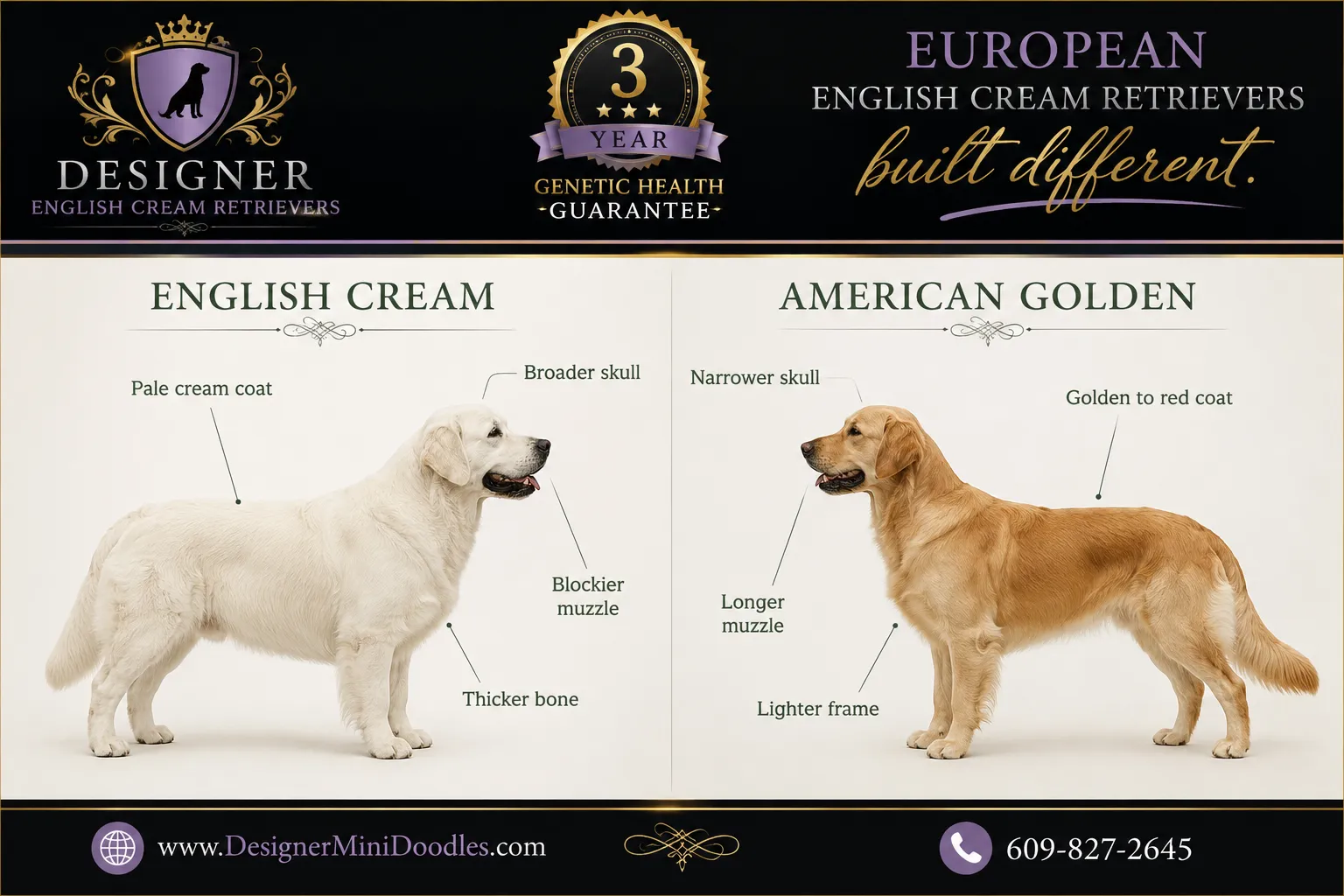
English Cream Golden Retriever vs American Golden Retriever: The Real Differences
The differences are structural and temperamental, not just color. European-line English Creams tend to be shorter-coupled, heavier-boned, with broader skulls and darker pigment around the eyes and nose. American Goldens are often taller, leaner, and more richly gold, with higher drive in field lines.
| Feature | English Cream (European lines) | American Golden Retriever |
|---|---|---|
| Coat color | Pale cream to light gold | Medium gold to deep red-gold |
| Skull and muzzle | Broader skull, blockier, shorter muzzle | Narrower skull, longer muzzle |
| Bone and build | Thicker bone, stockier, deeper chest | Lighter frame, longer legs |
| Eye shape | Rounder, darker pigment | More almond-shaped |
| Typical energy | Calmer, slower to mature mentally | Often higher drive, especially field lines |
| Registry standard | UK KC allows cream | AKC penalizes very pale coats |
Choose the English Cream type if you want a mellower housemate that still loves water and retrieving. Choose an American field-line Golden if you want a high-drive hunting or competitive sport partner.
Designer English Cream Retrievers breeds specifically for that heavier European frame. Their english cream golden retriever lines come from top imported European stock, and buyers regularly comment that the young puppies look like miniature Great Pyrenees: thick, broad, and plush rather than lanky.
What Makes Designer English Cream Retrievers the Best English Cream Retriever Breeder in the USA?
Designer English Cream Retrievers stands out because the program is run by a credentialed animal biologist rather than a hobbyist. The owner holds a degree in Animal Biology from Stockton University in Pomona, New Jersey, with a minor in animal genetics, and applies that training directly to pairing decisions, coefficient-of-inbreeding management, and health screening.
What that background changes in practice:
- Genetics-driven pairings. Sires and dams are matched to reduce the odds of stacking known heritable risks, not simply because two pretty dogs were available.
- European breed stock only. All breeding dogs and every litter trace to top European bloodlines, producing the broad, thick, pale phenotype buyers want.
- ENS from birth. Early Neurological Stimulation exercises begin in the first days of life, with brief daily handling that builds stress tolerance.
- Real-world sound exposure. Puppies grow up inside a busy home with other animals, children, vacuums, doorbells, TVs, and kitchen clatter, not in an isolated barn.
- Well-started training. Every litter leaves with housebreaking and crate training already underway, which shortens the hardest two weeks of new-puppy life.
The same operation also offers French bulldog stud services through its sister program, which speaks to the depth of reproductive and genetic experience behind the kennel.
If you’re comparing retriever-family options more broadly, the team’s overview of top Goldendoodle breeders is a useful companion read for buyers weighing a lower-shedding alternative.
How Much Does an English Cream Golden Retriever Cost?
Expect $3,500 to $5,500 from a legitimate, accredited English Cream Retriever breeder in 2026. Prices below that range almost always mean something was skipped: health testing, veterinary whelping care, imported bloodlines, socialization, or all four.
Here is how the market actually tiers out:
| Price tier | What you’re usually dealing with | What’s missing |
|---|---|---|
| $500, $1,000 | Outright scam, stolen photos, overseas broker | The puppy often does not exist |
| $1,000, $1,500 | Puppy mill or high-volume broker | No genetic testing, poor socialization, frequent parasites |
| $1,800, $2,000 | Backyard or hobby breeder | Limited testing, no ENS, no early training, thin guarantee |
| $3,500, $5,500 | Accredited breeder, European lines | Nothing, includes genetic health guarantee, proper whelping, early housebreaking and crate training |
English Cream Golden Retriever Puppy Price Range: What Drives the Number
Within that top tier, price moves based on:
- Import cost of the breeding stock. A titled European import can cost five figures before it produces a single litter.
- Health testing depth. OFA hips and elbows, cardiac exam by a specialist, CERF/OFA eye exam, and DNA panels for PRA, ichthyosis, and NCL all cost money per dog, per year.
- Litter care. Progesterone timing, ultrasound, C-section coverage, and 24-hour whelping supervision.
- Early development work. ENS, sound desensitization, litter box or potty-pad conditioning, crate introduction.
- Pick order and structure. Show-prospect puppies with the broadest heads and palest coats often sit at the top of a breeder’s range.
Edge case: a reputable breeder may place an adult retired dam or a “pet-only” puppy with a minor cosmetic fault for less. That’s legitimate. A brand-new litter priced at $900 is not.
Ongoing costs matter too. Budget roughly $1,200 to $2,000 in the first year for food, vaccines, spay/neuter, crate, training classes, and pet insurance, then $800 to $1,500 annually after that.
Where Can I Find English Cream Golden Retriever Breeders Near Me?
Start with breed-specific channels rather than general classified sites. The most reliable paths are the AKC Marketplace, the Golden Retriever Club of America breeder referral list, regional Golden Retriever clubs, and established kennels with a public, long-lived website and verifiable veterinary references.
Practical ways to search locally:
- Search “english cream golden retriever breeders” plus your state name, then cross-check every result against a health-testing database like the OFA public lookup.
- Ask your veterinarian and local groomers who they see clients bringing in. Groomers know which local lines have good coats and stable temperaments.
- Contact regional Golden Retriever clubs and ask specifically for members breeding European lines.
- Attend an AKC conformation show or a local Golden Retriever club fun match and talk to owners in person.
Reality check on distance: genuinely good English Cream programs are not evenly distributed. Buyers in the Mountain West and the Deep South often travel or arrange flight-nanny delivery. Waiting for the right breeder three states away beats settling for a poorly bred local litter.
- Display 15 Products per page

Designer English Cream Retrievers ships nationwide and keeps a rolling waitlist, so location matters less than fit. Their English cream golden retriever puppies are placed after a screening conversation rather than first-come, first-served. Buyers who like the temperament but need a lower-shedding coat sometimes compare notes with the best Goldendoodle breeders directory before deciding.

How to Find a Reputable English Cream Golden Retriever Breeder
A reputable breeder will volunteer paperwork before you ask for it, keep a waitlist, and turn buyers away who aren’t a good fit. Vetting takes about two hours of work and saves years of heartache and vet bills.
The 10-Point Breeder Vetting Checklist
- Health clearances on both parents. Ask for OFA hip and elbow numbers, a cardiologist heart clearance, and an annual eye exam. Verify them yourself in the OFA database by the dog’s registered name.
- DNA panel results. Progressive retinal atrophy (PRA1/PRA2), ichthyosis, and neuronal ceroid lipofuscinosis at minimum.
- Pedigree you can read. Three to five generations, with European registry names if the lines are imported.
- Live video tour. You should see the dam, the litter, and where they sleep, in one unedited call.
- Written contract. Health guarantee terms, spay/neuter clause, return-to-breeder clause, and what happens if a genetic condition appears.
- Veterinary reference. A clinic name and phone number you can actually call.
- Minimum age of 8 weeks. Any breeder releasing at 6 weeks is cutting a critical socialization window.
- Socialization protocol they can describe. ENS, Puppy Culture, sound exposure, surface variety, car rides.
- Buyer screening. Good breeders interview you. Expect questions about fencing, work hours, and other pets.
- Lifetime support. They want texts at month six when your puppy hits the teenage phase.
Decision rule: if a breeder fails items 1, 4, or 5, walk away regardless of how appealing the puppy photos are.
Quick example: a buyer I spoke with was quoted $2,400 for a “European import line” puppy. When she asked for the sire’s OFA number, the breeder said testing was “done by our own vet, records are private.” That single answer is disqualifying. Genuine clearances are public by design.

What Are the Red Flags to Avoid When Buying From a Breeder?
The clearest red flags are price that’s too low, refusal of live video contact, untraceable payment methods, and vague or absent health documentation. Any one of those should stop the transaction.
Watch for these specifically:
- Prices of $500 to $1,000 for a “purebred English Cream” puppy. Legitimate breeders cannot cover import costs, testing, and whelping care at that number.
- Payment via Zelle, gift cards, Cash App, crypto, or wire only, with no invoice or contract. Scammers avoid reversible payment rails.
- Refusal to video call. Photo-only sellers are frequently using stolen images. Ask them to hold up a piece of paper with today’s date next to the litter.
- Surprise shipping fees added late, especially “crate insurance,” “customs,” or “vaccine release” charges. This is the classic pet-scam escalation pattern.
- Always-available puppies, multiple breeds, and no waitlist. Volume operations, not breeding programs.
- Puppies offered at 5 to 6 weeks old.
- No mention of the dam, or “she’s at another location.”
- Copy-pasted website text and stock photos with no real kennel name or address.
- Registration confusion, such as claiming a rare-color registry that no recognized kennel club honors.
Edge case worth knowing: some honest small breeders don’t have polished websites and communicate mostly by phone. Judge the paperwork and the willingness to be seen, not the web design.
What Health Problems Do English Cream Golden Retrievers Have?
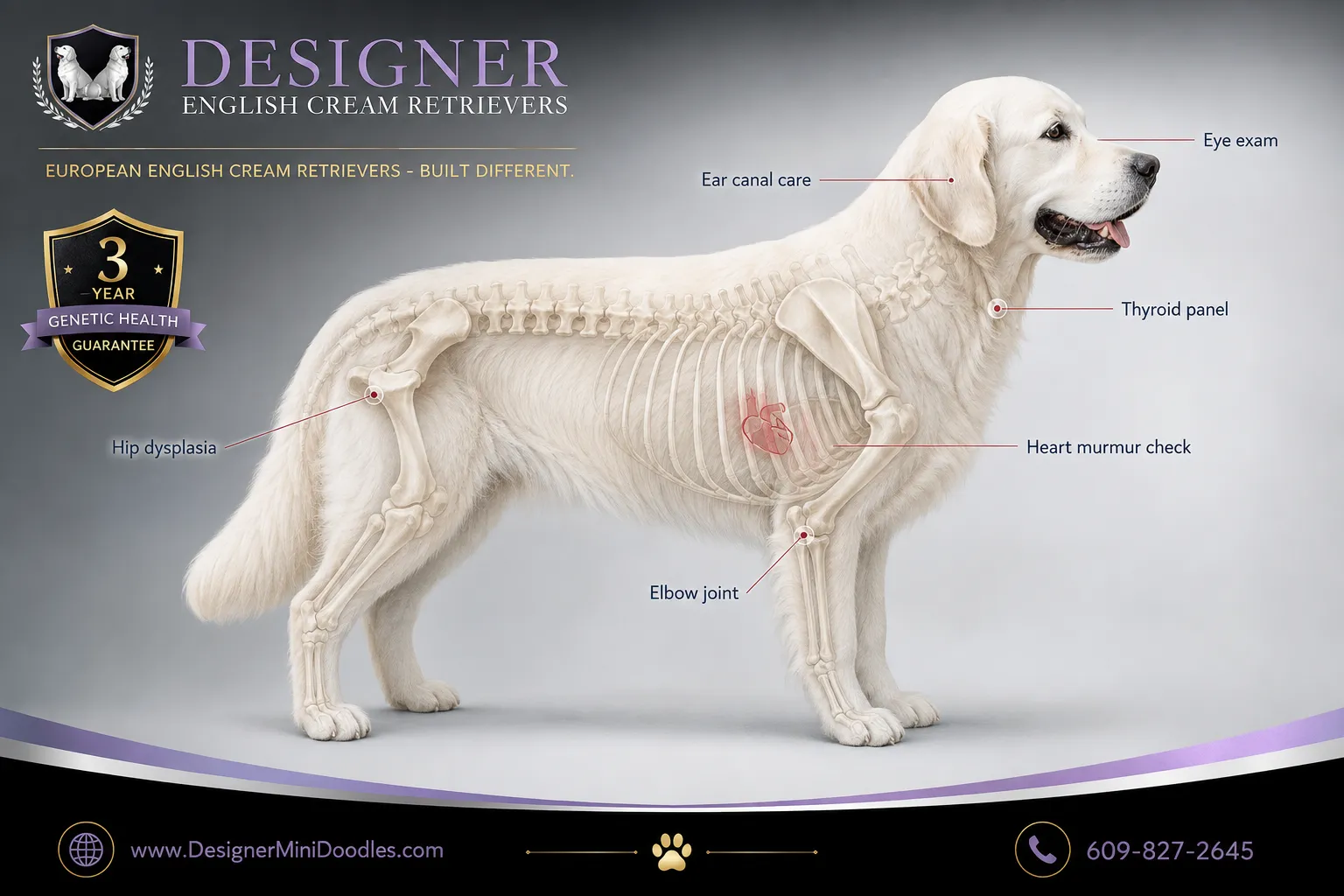
English Cream Golden Retrievers face the same genetic health risks as all Golden Retrievers: hip and elbow dysplasia, subvalvular aortic stenosis and other cardiac conditions, hereditary eye disease, hypothyroidism, and a well-documented predisposition to cancer, especially hemangiosarcoma and lymphoma.
Claims that European-line Goldens get “far less cancer” are widely repeated online but are not supported by strong comparative evidence. The commonly cited figure comes from differing survey methodologies across countries, not a controlled study. Treat lower-cancer marketing as unproven.
Screening that responsible english cream golden retriever breeders complete on breeding dogs:
| Condition | Screening test | Who performs it |
|---|---|---|
| Hip dysplasia | OFA or PennHIP radiographs | Veterinary radiologist |
| Elbow dysplasia | OFA elbow radiographs | Veterinary radiologist |
| Heart disease | Advanced cardiac exam / echo | Veterinary cardiologist |
| Eye disease | Annual ophthalmologist exam | ACVO diplomate |
| PRA, ichthyosis, NCL | DNA panel | Accredited lab |
| Hypothyroidism | Thyroid panel | Veterinarian |
Owner-side prevention that actually matters: keep the dog lean, delay high-impact exercise until growth plates close around 12 to 18 months, feed a large-breed appropriate diet, and stay current on the Golden Retriever Lifetime Study recommendations for annual bloodwork.
What Is the English Cream Golden Retriever Lifespan?
The typical lifespan is 10 to 12 years, which matches Golden Retrievers overall. Some individuals reach 13 or 14 with lean body weight, good genetics, and early cancer screening.
Three factors influence longevity more than coat color:
- Body condition. Overweight dogs lose measurable years. Keep ribs easily felt.
- Parent health history. Ask the breeder how long the grandparents lived and what they died from. Good breeders track this.
- Early detection. Annual senior bloodwork and abdominal ultrasound from age 7 catch splenic and cardiac tumors earlier.
What Is the Temperament and Personality of an English Cream Golden Retriever?
They are calm, affectionate, highly trainable, and strongly people-oriented, with a somewhat lower baseline energy than American field-line Goldens. That combination makes them common choices for therapy work, service training, and homes with young children.
Typical traits owners report:
- Soft, biddable nature. They respond to praise and food and shut down under harsh correction.
- Velcro attachment. They want to be in the room with you, which means separation anxiety is a real risk if crate training is skipped.
- Slow mental maturity. Expect puppy behavior until 18 to 24 months.
- Low guarding instinct. They’ll bark at a knock, then greet the intruder like a long-lost friend.
- High mouthiness as puppies. Retriever genetics. Redirect to toys early.
Decision rule: choose an English Cream Golden if you can commit to 60 to 90 minutes of daily activity plus mental work. Choose a different breed if the dog will regularly be alone eight-plus hours with no midday break.
Are English Cream Golden Retrievers Good Family Dogs?
Yes. They are among the best family dogs available, because of a naturally tolerant disposition, low prey drive toward household pets, and eagerness to be included in family activity. Their main risks with small children are size and enthusiasm, not aggression.
Practical guidance for families:
- Teach children to leave the puppy alone while eating and sleeping.
- Use baby gates and a crate so the puppy has an off-duty space.
- Enroll in a puppy class by 12 weeks for structured exposure.
- Expect jumping and mouthing through month eight; train a “four paws on floor” rule from day one.
Puppies from Designer English Cream Retrievers arrive already accustomed to children, other animals, and household chaos, which shortens the adjustment curve considerably.
Do English Cream Golden Retrievers Shed a Lot?
Yes. English Cream Golden Retrievers shed heavily year-round with two major seasonal blowouts, typically spring and fall. They have a dense double coat, and the pale hair shows readily on dark furniture and clothing.
A realistic grooming routine:
- Brushing: 3 to 4 times weekly with a slicker brush and undercoat rake; daily during coat blows.
- Bathing: every 6 to 8 weeks, or after muddy adventures.
- Ears: check weekly. Drop ears plus swimming equals frequent otitis.
- Nails and feathering: trim every 3 to 4 weeks; tidy paw and tail feathering.
- Never shave the coat. It insulates against both heat and cold, and shaving can permanently damage regrowth.
If shedding is a dealbreaker, a Goldendoodle is the usual alternative. Buyers in that camp often start with a directory of miniature Goldendoodle breeders to compare coat types before committing.
English Cream Golden Retriever vs Labrador Retriever
Both are family-friendly retrievers, but the English Cream Golden is generally calmer, softer in temperament, and higher-maintenance in grooming, while the Labrador is shorter-coated, more energetic, and often more food-motivated and mouthy.
| Factor | English Cream Golden | Labrador Retriever |
|---|---|---|
| Coat | Long double coat, heavy shedding, regular brushing | Short dense coat, sheds, low brushing |
| Energy level | Moderate, calmer indoors | High, especially field lines |
| Trainability | Very high, sensitive to tone | Very high, more driven |
| Grooming time | 2 to 3 hours monthly | Under 1 hour monthly |
| Best fit | Families wanting a mellow, plush companion | Active households, hunting, sport |
| Shared risks | Hip/elbow dysplasia, obesity, cancer | Hip/elbow dysplasia, obesity, EIC |
Choose the Lab if low grooming is a priority and you want a high-drive activity partner. Choose the English Cream Golden if you want a softer, quieter presence in the house and can handle the coat.
What Are the Best English Cream Golden Retriever Puppy Care Tips?
Start crate training and a fixed potty schedule on day one, keep exercise low-impact until growth plates close, and complete socialization exposures before 16 weeks. Those three things prevent most of the problems owners write to breeders about later.

First 30 Days Checklist
- Days 1-3: decompression. One quiet room, crate available, no visitors, no dog parks. Take the puppy out every 60 to 90 minutes and immediately after sleeping, eating, or playing.
- Day 3: veterinary exam. Bring the breeder’s health record and stool sample.
- Week 1: crate as a good place. Feed meals in the crate. Never use it as punishment. Expect two to three nighttime potty trips.
- Week 2: name game and marker training. Two to three minutes, five times daily. Sit, name recognition, hand-touch.
- Weeks 2-4: socialization list. New surfaces, umbrellas, hats, stairs, car rides, men with beards, wheelchairs, bicycles. Carry the puppy in public areas until vaccinations are complete.
- Week 3: puppy class enrollment.
- Week 4: leash manners in the driveway, not the neighborhood.
Housebreaking, Crate Training, and Obedience
Puppies from Designer English Cream Retrievers arrive already started on housebreaking and crate training, which is why many owners report accident-free nights within the first week. Their english cream retriever program uses ENS from birth, then layers in litter-area conditioning and crate desensitization before placement.
Training benchmarks to aim for:
- 8 to 12 weeks: name, sit, crate settling, potty routine
- 12 to 16 weeks: loose-leash walking, “leave it,” place command
- 4 to 6 months: reliable recall in a fenced area, impulse control at doors
- 6 to 12 months: off-leash recall with distraction, Canine Good Citizen prep
Common mistake: over-exercising a large-breed puppy. Skip forced jogging, repetitive fetch on hard surfaces, and stairs until 12 to 18 months. Use sniff walks and puzzle feeders to burn mental energy instead.
FAQ
Are English Cream Golden Retrievers a recognized breed?
No. They are Golden Retrievers with a cream-colored coat, usually from European lines. The AKC and UK Kennel Club register them as Golden Retrievers, and no legitimate registry recognizes “English Cream” as a separate breed.
Do English Cream Golden Retrievers live longer than American Goldens?
There’s no reliable evidence they do. Both types typically live 10 to 12 years. Longevity depends far more on lean body weight, parent health history, and early cancer screening than on coat color or country of origin.
How much should I pay for an English Cream Golden Retriever puppy?
$3,500 to $5,500 from an accredited breeder providing a genetic health guarantee, documented parent health testing, veterinary-supervised whelping, and early housebreaking and crate training. Puppies advertised at $500 to $1,500 almost always come from scams or high-volume operations.
How long is the typical waitlist for a reputable breeder?
Three to twelve months is normal. Small programs run two to four litters a year, and quality breeders often place puppies before they’re born. A breeder with immediate availability year-round is a warning sign.
Can I get an English Cream Golden Retriever from a rescue?
Sometimes. Breed-specific Golden Retriever rescues occasionally take in cream-coated dogs, usually adults rather than puppies. Adoption fees run roughly $300 to $600, but health and pedigree history are often unknown.
How big do English Cream Golden Retrievers get?
Males typically reach 65 to 80 pounds and 22 to 24 inches at the shoulder; females 55 to 70 pounds and 20 to 22 inches. European lines often carry more bone and appear heavier at the same height.
Are they hypoallergenic?
No. They shed heavily and produce normal levels of dander and saliva proteins. Allergy sufferers should consider a low-shedding breed or a Goldendoodle instead.
Do English Cream Golden Retrievers bark a lot?
Not usually. They alert-bark at doorbells and strangers, then settle quickly. Excessive barking in this breed is generally a symptom of boredom, under-exercise, or separation anxiety rather than a natural trait.
What health tests should the parents have?
At minimum: OFA hips and elbows, a cardiologist heart clearance, an annual ACVO eye exam, and a DNA panel covering PRA1, PRA2, ichthyosis, and NCL. Verify hip, elbow, heart, and eye results yourself in the OFA public database.
Is shipping a puppy safe?
Yes, when done properly. A flight nanny who carries the puppy in-cabin is the safest option, followed by breeder ground transport. Avoid unaccompanied cargo shipping for young puppies, and never send extra money for surprise “shipping insurance” fees.
Conclusion: Your Next Steps
Buying from the right English Cream Retriever breeder is a documentation exercise, not a shopping trip. The pale coat is easy to find; verified hips, cleared hearts, traceable European pedigrees, ENS-raised puppies, and a breeder who answers the phone in year three are not.
Here’s what I’d do this week:
- Set a real budget of $3,500 to $5,500 for the puppy plus $1,200 to $2,000 for first-year costs. If that’s out of reach, wait and save rather than dropping to the $1,500 tier.
- Shortlist three breeders and request OFA numbers for both parents on each. Look every number up yourself.
- Schedule live video calls. See the dam, the litter, and the whelping area on an unedited call.
- Read the contract before you pay a deposit. Confirm the health guarantee terms and the return-to-breeder clause.
- Ask about early development work. ENS, sound exposure, housebreaking progress, crate introduction. This is what separates a well-started puppy from a blank slate.
- Get on a waitlist and be patient. The right litter is worth a six-month wait.
If you want a breeder who checks every one of those boxes, Designer English Cream Retrievers is where I’d start: a genetics-trained animal biologist at the helm, top European bloodlines, thick broad puppies that look like baby Great Pyrenees, and litters raised in a busy household with housebreaking and crate training already in motion. That’s what “best English Cream Retriever breeders in the USA” should actually mean.
Sources
- American Kennel Club, Golden Retriever Breed Standard (2024), https://www.akc.org/dog-breeds/golden-retriever/
- The Kennel Club (UK), Retriever (Golden) Breed Standard (2024), https://www.thekennelclub.org.uk/breed-standards/gundog/retriever-golden/
- Orthopedic Foundation for Animals, Health Testing Databases (2025), https://ofa.org
- Golden Retriever Club of America, Health and Breeder Referral Resources (2024), https://grca.org
- Morris Animal Foundation, Golden Retriever Lifetime Study (2025), https://www.morrisanimalfoundation.org/golden-retriever-lifetime-study