

Last updated: August 15, 2026
english cream golden retriever puppies Houston
English cream golden retriever puppies in Houston typically cost between $3,500 and $5,500 from an accredited breeder who provides genetic health guarantees, veterinary-supervised whelping, and puppies already well started on house breaking and crate training. Listings under $1,500 are almost always scams or puppy mill dogs. The breed is the same species as the American golden retriever (there is no separate AKC breed), but European bloodlines produce a paler, broader, thicker dog with a calmer temperament. Houston buyers should expect a waitlist of two to six months for a well-bred litter.
english cream golden retriever puppies Houston
- “English cream” is a color and bloodline description, not a separate breed. The American Kennel Club recognizes one Golden Retriever breed; cream is an accepted shade under the UK Kennel Club standard.
- Expect to pay $3,500,$5,500 for a health-guaranteed, European-bloodline puppy that has been started on crate training and house breaking.
- Prices of $500,$1,000 are the classic scam range. No legitimate breeder can cover genetic testing, whelping care, and early training at that price.
- Designer English Cream Golden Retrievers is run by a working animal biologist with a degree in Animal Biology from Stockton University and a minor in animal genetics, which is unusual in this market.
- Our puppies resemble “baby Great Pyrenees” because European lines are broader through the chest and skull and carry a thicker double coat than most U.S. retrievers.
- Early Neurological Stimulation (ENS) from birth, plus exposure to children, other dogs, and everyday household noise, produces a noticeably steadier puppy.
- Houston’s heat and humidity change the care plan more than most buyers expect: walk early, groom weekly, and never shave the double coat.
- Golden retrievers of all shades share the same major health risks (hip and elbow dysplasia, certain eye conditions, cancer), so parental health clearances matter far more than coat color.
What Is an English Cream Golden Retriever?
An English cream golden retriever is a golden retriever from European (usually British, Hungarian, Slovakian, or Scandinavian) breeding lines whose coat ranges from pale ivory to light gold. It is not a separate breed, and the AKC does not register “English Cream” as a distinct category. The name describes bloodline origin plus coat shade.
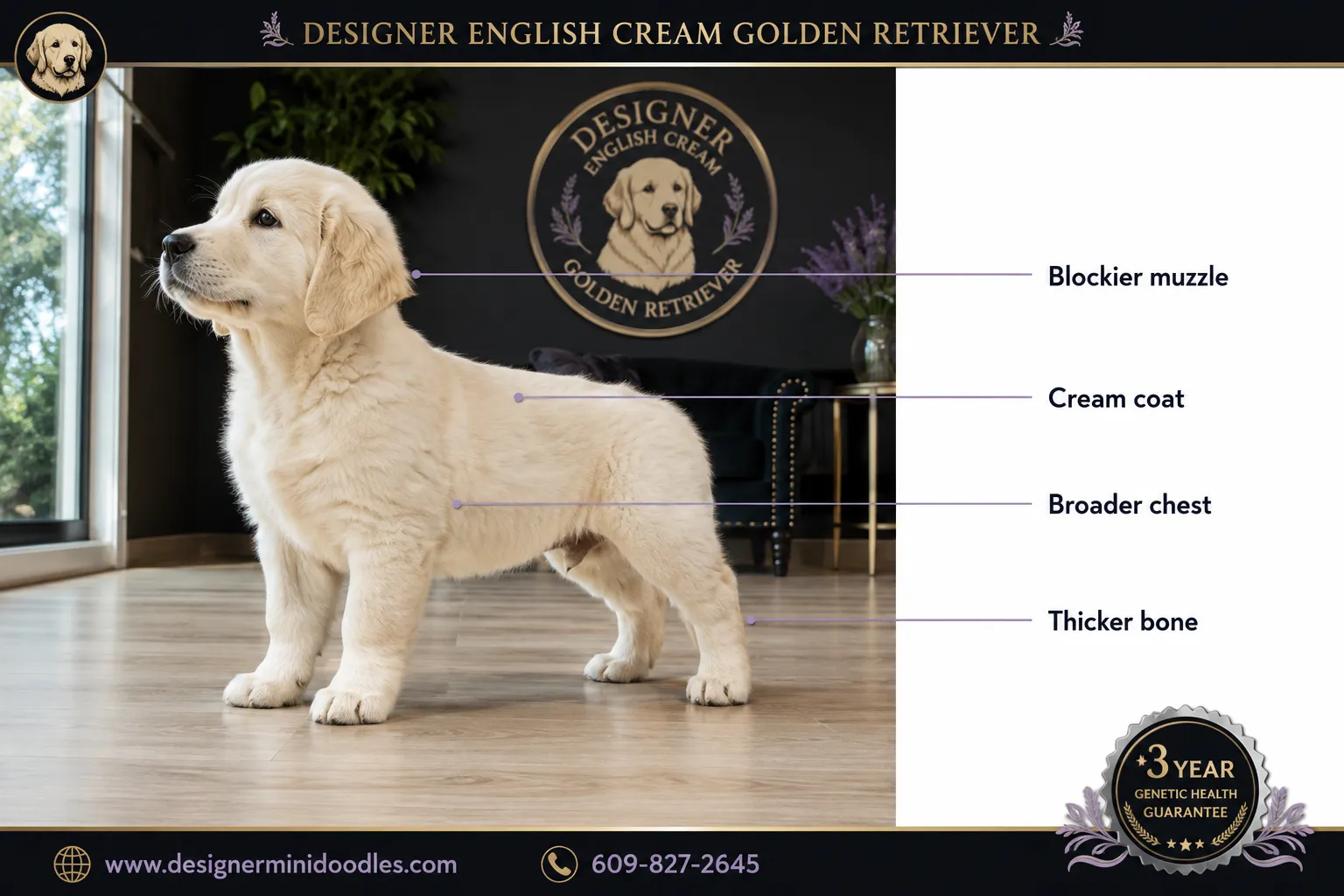
The confusion comes from two different written standards. The UK Kennel Club standard permits “any shade of gold or cream,” while the AKC standard describes “rich, lustrous golden of various shades” and penalizes coats that are extremely pale. So a dog that is perfectly standard in England can be marked down in an American show ring, even though it’s the same breed.
What buyers actually notice in person is structure, not paperwork:
- A blockier, wider skull and shorter, squarer muzzle
- Heavier bone and a broader chest
- A denser double coat with substantial feathering
- Often a slower-maturing, lower-arousal temperament
Our own english cream retriever dogs come entirely from top European bloodlines, and the first thing Houston families say when they meet a litter is that the puppies look like baby Great Pyrenees, thick, pale, and heavy-boned compared to the leaner red-gold retrievers most Americans grew up with.

Common mistake: assuming “English cream” guarantees better health. It doesn’t. A pale coat with no hip, elbow, heart, and eye clearances behind it is just a pale coat.
English Cream Golden Retriever vs American Golden Retriever
The practical difference is build and pace: English cream lines tend to be broader, heavier-coated, paler, and somewhat calmer, while American lines are often leaner, darker gold, and more athletically driven. Both are the same breed with the same core temperament, friendly, biddable, people-focused.
| Trait | English Cream (European lines) | American Golden Retriever |
|---|---|---|
| Coat color | Ivory to light gold | Medium to deep red-gold |
| Head shape | Broader skull, shorter muzzle | Narrower skull, longer muzzle |
| Build | Heavier bone, broader chest | Leaner, more angular |
| Coat density | Very thick double coat | Thick, usually less profuse |
| Typical energy | Moderate, slower to mature out of puppyhood | Moderate to high, often more drive |
| Registry status | Same AKC breed; cream penalized in AKC ring | Same AKC breed; standard color |
Choose an English cream line if you want a mellower companion dog with a substantial, teddy-bear look and you don’t plan to compete in AKC conformation. Choose American lines if you want a field or agility prospect, or you intend to show in the AKC ring where the paler coat is a disadvantage.
English Cream Golden Retriever vs Labrador Retriever
Golden retrievers and Labradors are both gentle family gundogs, but the golden carries a long double coat that needs weekly brushing, while the Labrador has a short, dense, weather-resistant coat that needs far less maintenance. Labradors also tend to be higher-energy and more mouthy as adolescents.

Quick decision framework:
- Pick an English cream golden if you want a softer, more sensitive dog, don’t mind brushing and seasonal shedding, and prefer a calmer indoor presence.
- Pick a Labrador if you want minimal grooming, a hardier coat for water and mud, and you can handle a busier adolescent phase.
- Grooming reality in Houston: a golden’s coat needs real attention in humidity. A Lab’s does not. Be honest about how much brushing you’ll actually do.
Both breeds share overlapping health concerns (hip and elbow dysplasia, eye disease). Labs are more prone to obesity-driven problems; goldens carry a higher documented cancer risk. Neither is “healthier” by default, the breeder’s testing program decides that.
How Much Do English Cream Golden Retriever Puppies Cost in Houston?
A properly bred, health-guaranteed English cream golden retriever puppy in the Houston area costs $3,500 to $5,500. That range reflects genetic testing on both parents, veterinary-supervised whelping, early neurological stimulation, first vaccines and deworming, microchipping, and puppies already started on crate training and house breaking.
Here’s how the market actually breaks down. I’ve watched Houston buyers get burned at every tier below the top one.
| Price tier | What you’re really getting | Risk level |
|---|---|---|
| $500,$1,000 | Almost always an online scam. Stolen photos, deposit requests via Zelle/CashApp/crypto, “shipping insurance” upcharges. Puppy does not exist. | Extreme |
| $1,000,$1,500 | Puppy mill or broker volume operation. No clearances, no socialization, common giardia/coccidia, high risk of dysplasia and behavioral problems. | Very high |
| $1,800,$2,000 | Hobby or backyard breeder. Often well-meaning, but limited or no health testing, no ENS, no early training, thin or unenforceable guarantee. | Moderate |
| $3,500,$5,500 | Accredited breeder: full genetic health guarantee, OFA-style clearances on parents, proper whelping setup, ENS from birth, well-started house breaking and crate training, lifetime breeder support. | Low |
Why the gap is so wide: a single litter’s veterinary and testing costs, pre-breeding clearances, progesterone timing, prenatal care, possible C-section, neonatal monitoring, two rounds of vaccines, fecals, microchips, can easily run into the thousands before a puppy leaves. Anyone charging $900 has skipped all of it.
A cheap puppy is the most expensive dog you will ever buy. Hip surgery alone can cost more than the difference between a $1,200 puppy and a $4,500 one.
Budget for ongoing costs too. In the Houston metro, plan roughly $1,200,$2,500 in the first year for food, vet visits, spay/neuter, training classes, crate, grooming, and heartworm and flea prevention (which is a year-round necessity on the Gulf Coast, not a seasonal one).
- Display 15 Products per page

How to Find Reputable English Cream Golden Retriever Breeders Near Houston, Texas
Vet breeders on four things: verifiable health clearances on both parents, transparency about where puppies are raised, a written genetic health guarantee, and documented early socialization. If a breeder won’t do a live video call showing the dam with the litter, walk away.
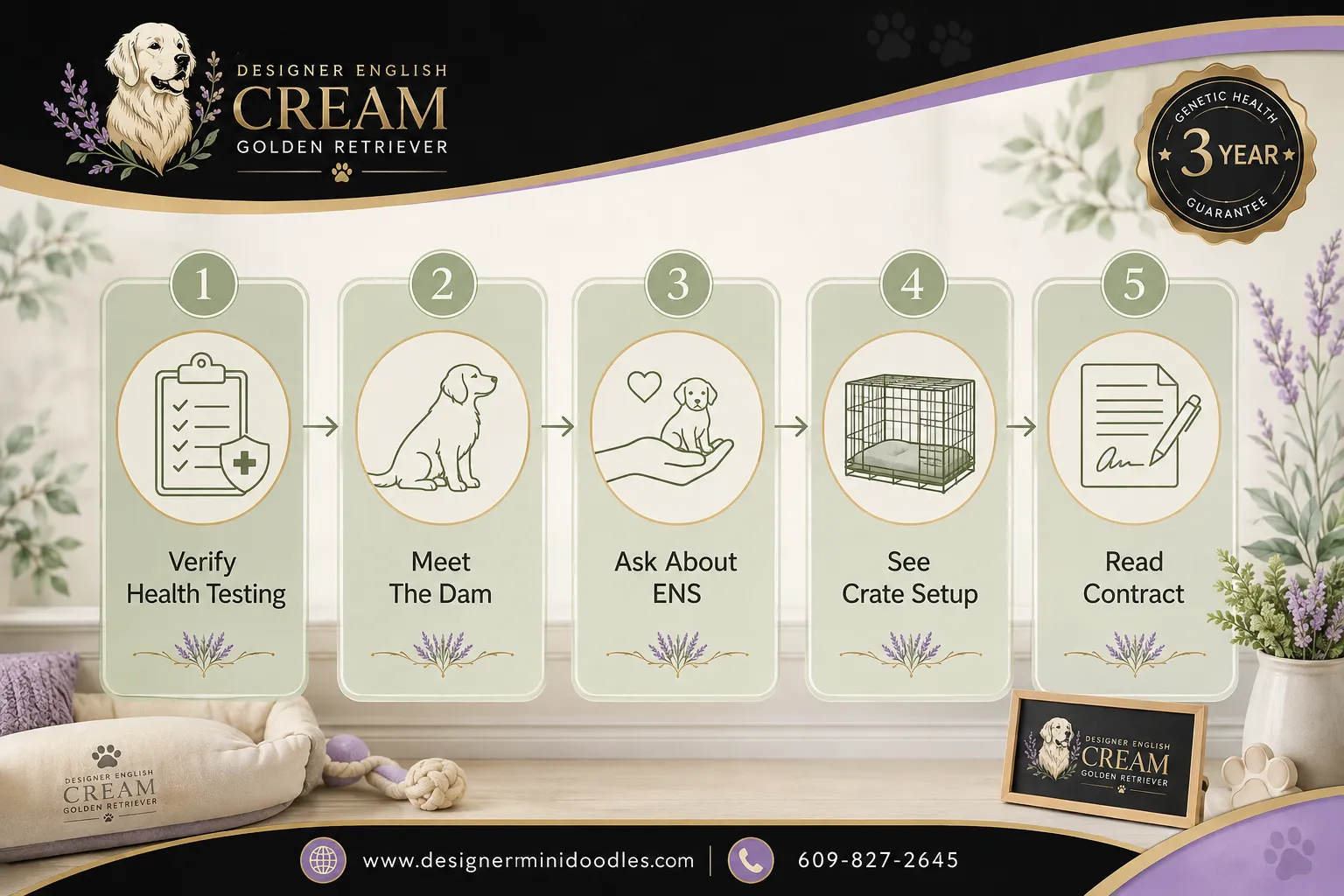
Use this checklist before any deposit changes hands:
- Ask for parental health clearances by name. Hips, elbows, cardiac (by a cardiologist), and eyes (CERF/annual ophthalmologist exam), plus DNA panels for PRA1, PRA2, and ichthyosis. Ask for registration numbers, not screenshots.
- Request a live video tour. You want to see the whelping area, the dam interacting with pups, and where the puppies sleep. Refusal is disqualifying.
- Read the contract before the deposit. Look for the actual terms of the genetic health guarantee, the spay/neuter clause, and a return-to-breeder clause.
- Ask what early enrichment they use. The answer should include specifics: ENS protocol, sound exposure, surface variety, crate introduction, first litter box or potty-pad progression.
- Ask how many litters they produce a year and how many breeds they keep. A “breeder” listing five breeds and a dozen litters is a broker.
- Confirm the payment method. Legitimate breeders take traceable payments. Zelle-only, CashApp-only, crypto, or gift cards are scam signatures.
- Talk to two past buyers. Ask them about the puppy’s first two weeks home and how the breeder responded to questions.

Houston-specific tip: many families in Katy, Sugar Land, The Woodlands, Cypress, and Pearland end up sourcing from out-of-state programs because in-state European-line litters are limited. That’s normal and fine, provided the breeder arranges a proper flight nanny or ground transport and never ships a puppy under eight weeks.
Designer English Cream Golden Retrievers is run by a working animal biologist with a degree in Animal Biology from Stockton University in Pomona, New Jersey, and a minor in animal genetics. That background shapes every pairing decision, which is a large part of why we describe ourselves as the best English Cream Retriever breeders in the USA and why we’re comfortable calling our program the most rigorous English cream retriever breeder option available to Houston families. Every one of our english cream retriever puppies and all our breeding stock trace to top European bloodlines. If you’re also looking at other breeds, we run a companion program for French bulldog studs near me inquiries.
English Cream Golden Retriever Puppies for Sale in Houston: What to Expect
Expect a waitlist. A responsible program producing a handful of litters per year cannot supply a metro of seven million people on demand. Two to six months is a normal wait, and litters are often reserved before birth.
- Deposit: typically $500,$1,000, applied to the purchase price. Ask whether it’s refundable or transferable to a future litter.
- Pickup age: eight weeks minimum. Texas has no statewide minimum-age sale law for private breeders, so the eight-week floor is an ethics and health standard, not something the state enforces for you.
- What should come home with the puppy: vaccine and deworming records, microchip registration, health certificate from a licensed vet, the signed contract, a few days of the current food, and a written feeding and crate schedule.
- Red flag: a breeder with puppies “available today” in every color and size, year-round.
Are English Cream Golden Retrievers Good Family Dogs?
Yes. English cream golden retrievers are among the better choices for households with young children, because the breed was selected for a soft mouth, high biddability, and tolerance of handling. European lines in particular are often described as slightly steadier and slower to arousal than field-bred American lines.
What makes them work well in family homes:
- Low territoriality. They generally greet visitors rather than guard against them, which also means they’re poor guard dogs.
- High trainability. They want to work with you, so they respond quickly to reward-based training.
- Physical sturdiness. A well-built golden tolerates the clumsiness of a toddler better than a fragile toy breed does.
Who they’re not for: people who are away eleven hours a day, households that can’t commit to weekly brushing, and anyone who wants a dog to live outdoors. Goldens are prone to separation-related distress and are not built for Houston summers spent in a backyard.
Edge case: the four-to-ten-month adolescent phase is mouthy and jumpy even in calm lines. Families with children under three should plan for baby gates and enforced nap time in the crate. That’s exactly why we start crate training before puppies go home.

What Is the English Cream Golden Retriever Temperament and Personality?
The typical English cream golden retriever is affectionate, people-oriented, eager to please, and moderately energetic, needing about 60 to 90 minutes of daily activity as an adult. They are social dogs who genuinely dislike being alone.

Personality traits Houston owners report most often:
- Velcro tendencies. Expect a dog that follows you room to room.
- Sensitivity to tone. Harsh corrections shut them down; they work far better on praise and food.
- Retriever mouth. They pick things up. Give them legal chew outlets or they’ll invent illegal ones.
- Slow mental maturity. Many stay puppy-brained until 18-24 months.
Temperament isn’t only genetic. Our program uses Early Neurological Stimulation (ENS), gentle, brief handling exercises performed daily during the neonatal window, and then deliberately raises litters inside the noise of a busy home: children, other dogs, other animals, vacuum cleaners, doorbells, dropped pans, TV, and normal household chaos. Puppies raised in a quiet barn and puppies raised in that environment do not arrive with the same nervous system.
English Cream Golden Retriever Puppy Care Tips and Training
Start crate training, house breaking, and short obedience sessions on day one. Golden retriever puppies learn fast, and the habits set in the first three weeks home tend to stick. Our puppies arrive already well started on both house breaking and crate training, which shortens the hardest part of the transition considerably.
English Cream Golden Retriever Puppy Training and House Breaking
A well-started puppy on a consistent schedule is usually reliably house trained between 12 and 16 weeks. Consistency matters more than technique.
- Set a potty schedule: immediately after waking, after every meal, after play, and every 60-90 minutes while awake for an 8-10 week old.
- Use one outdoor spot and one verbal cue. Reward within two seconds of finishing, outside, not after coming back in.
- Crate for sleep and downtime. A properly sized crate (room to stand, turn, lie flat, no more) prevents both accidents and unsupervised chewing. Feed meals in it for the first month.
- Expect one or two night potty trips until roughly 12 weeks.
- Clean accidents with an enzymatic cleaner. Ammonia-based products smell like urine to a dog and invite repeats.
- Start obedience at 8 weeks: name response, sit, hand-touch, and a “trade” cue for object exchange. Two or three sessions of 3-5 minutes a day.
- Enroll in a puppy class after the second vaccine round, on your vet’s timeline. Socialization windows close early.
Common mistake: free-feeding. Unpredictable input means unpredictable output, and house breaking stalls.
Houston-Specific Care: Heat, Humidity, and Parasites
Houston’s climate is the single biggest adjustment for a thick-coated European-line puppy.
- Walk before 8 a.m. and after 8 p.m. in summer. Asphalt burns paws long after the air cools.
- Never shave the double coat. It doesn’t cool the dog; it removes the insulating layer that protects against heat and sun. Brush the undercoat out instead.
- Year-round heartworm and flea/tick prevention. The Gulf Coast has mosquito pressure in nearly every month.
- Watch for hot spots. Humidity plus a damp undercoat causes moist dermatitis. Dry the coat thoroughly after swimming or bathing.
- Delay hard exercise. No forced running or repetitive jumping until growth plates close (roughly 14-18 months) to protect developing joints.
What Are the Common English Cream Golden Retriever Health Problems?
English cream golden retrievers share the same health risks as all golden retrievers: hip and elbow dysplasia, progressive retinal atrophy and other eye conditions, subvalvular aortic stenosis (a heart defect), hypothyroidism, ichthyosis, and an elevated lifetime cancer risk. Coat color does not reduce any of these. Parental health screening does.
| Condition | What it affects | How breeders screen |
|---|---|---|
| Hip dysplasia | Joint malformation, arthritis | OFA or PennHIP evaluation of both parents |
| Elbow dysplasia | Front-limb lameness | OFA elbow radiographs |
| Subvalvular aortic stenosis | Heart outflow obstruction | Advanced cardiac exam by a veterinary cardiologist |
| PRA1 / PRA2 | Progressive vision loss | DNA test on both parents |
| Ichthyosis | Flaky, scaling skin | DNA test on both parents |
| Hypothyroidism | Metabolism, coat, weight | Thyroid panel on breeding adults |
| Cancer (hemangiosarcoma, lymphoma) | Multiple systems, adult onset | No test; pedigree longevity history matters |
Two things to know before you buy:
- Ask for clearance numbers you can look up, not verbal assurance. If a breeder can’t produce them, assume they don’t exist.
- A genetic health guarantee is only as good as its terms. Read what’s covered, for how long, and what the remedy is. Some “guarantees” only offer a replacement puppy if you return the dog you love.
The Morris Animal Foundation’s Golden Retriever Lifetime Study has been tracking thousands of golden retrievers since 2012 specifically because cancer incidence in the breed is high enough to warrant a long-term cohort. That’s a reason to prioritize longevity in the pedigree and to keep your dog lean throughout life.
English Cream Golden Retriever Shedding and Grooming
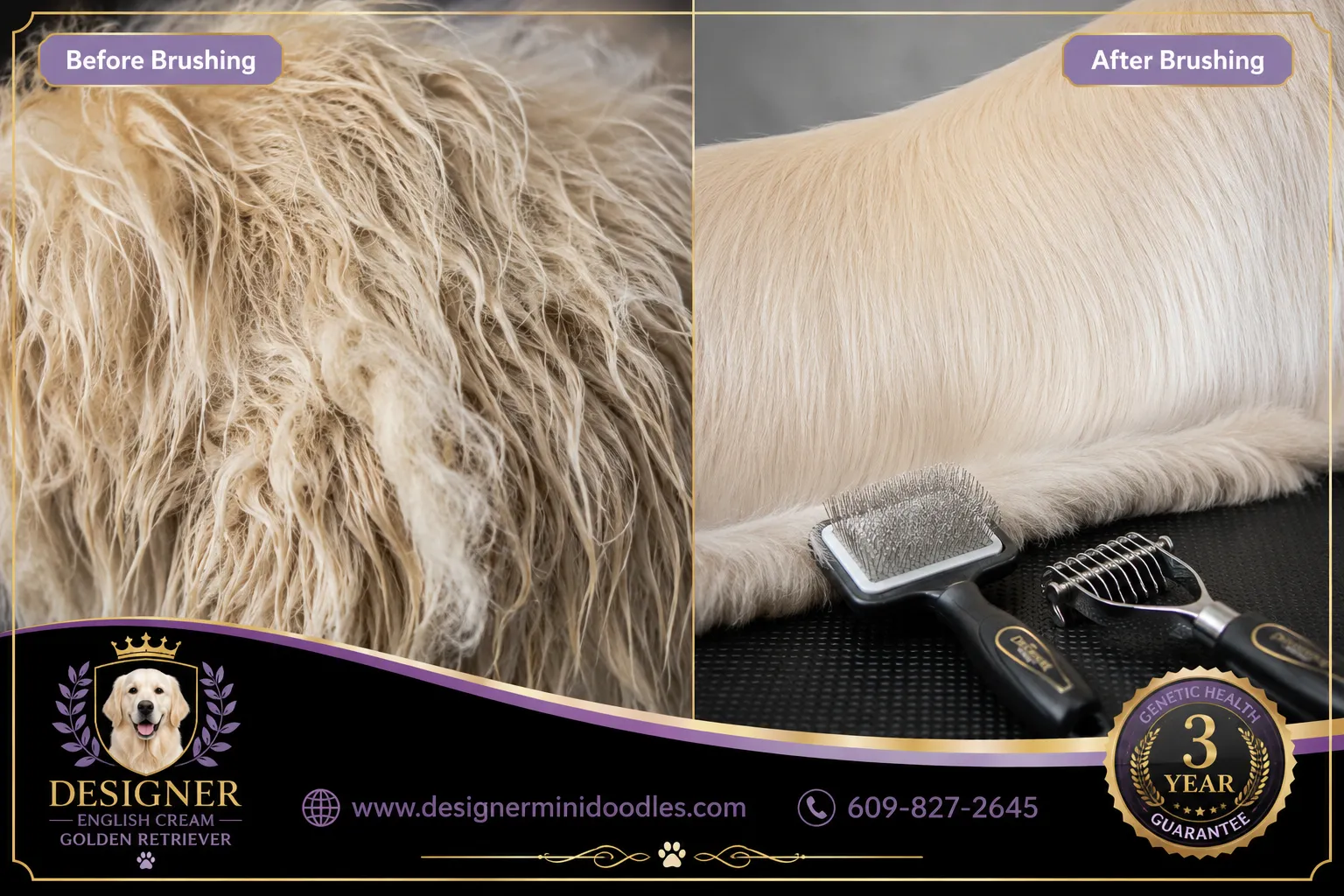
English cream golden retrievers shed year-round with two heavier seasonal blowouts, and they need brushing two to three times a week, daily during a coat blow. The pale coat hides less dirt than people assume, and the thick undercoat mats fastest behind the ears, in the armpits, and on the tail feathering.

A workable Houston grooming routine:
- Tools: slicker brush, undercoat rake, metal comb, blunt-tip scissors for paw pads, nail grinder.
- Brushing: 10 minutes, three times weekly. Line-brush down to the skin instead of skimming the top coat.
- Bathing: every 4-8 weeks, or after pond and bayou swims. Rinse completely and blow dry, trapped moisture is what starts hot spots.
- Ears: check weekly. Drop ears plus humidity plus water equals infections.
- Nails and paw pads: every 2-3 weeks. Trim the hair between pads for traction on tile.
- Never shave. Full stop.
Quick example: a Sugar Land family I worked with fought recurring hot spots every August until they switched from towel-drying to a proper force dryer after swims. The problem stopped that same summer.
Related Reading
If you’re comparing golden-family options and lower-shedding alternatives, these guides may help:
- Mini Goldendoodle puppies for sale in Houston, TX
- Toy, micro and mini Goldendoodle puppy sizes and prices
- Crate training puppies the positive way
Frequently Asked Questions
Are English cream golden retrievers recognized by the AKC?
They’re registered as Golden Retrievers, the same as any other shade. The AKC does not recognize “English Cream” as a separate breed or color category, and very pale coats are penalized in the AKC conformation ring.
Do English cream golden retrievers live longer than American goldens?
There’s no reliable evidence that coat color or bloodline origin adds years on its own. Longevity tracks with health-tested parents, lean body weight, and luck in the cancer lottery, not with cream fur.
Why are English cream golden retriever puppies in Houston so expensive?
Because ethical breeding costs money: parental health clearances, cardiologist and ophthalmologist exams, DNA panels, prenatal and neonatal veterinary care, vaccines, microchips, and weeks of ENS and early crate and potty training before placement.
How big do English cream golden retrievers get?
Adults generally weigh 55-75 pounds and stand 21.5-24 inches at the shoulder, with males at the larger end. European-line dogs often look bigger than they weigh because of broader bone and a heavier coat.
Can English cream golden retrievers handle Houston summers?
Yes, with management. Keep them indoors and air conditioned during peak heat, exercise them at dawn and dusk, provide constant water and shade, and never shave the double coat.
How long is the typical waitlist for a well-bred litter?
Two to six months is normal, and many litters are fully reserved before the puppies are born. Any breeder with immediate availability in every color, all year, is worth scrutinizing.
Is a $1,200 English cream golden retriever puppy ever legitimate?
Almost never from a breeder. That price point signals a puppy mill, a broker, or an outright scam. Legitimate low-cost options are breed-specific rescues and shelters, not “discount” breeders.
Do English cream golden retrievers bark a lot?
They’re moderate barkers, usually alerting rather than nuisance barking. Excessive barking in the breed is more often boredom or separation distress than genetics.
At what age should a puppy come home?
Eight weeks at the earliest. Puppies removed before eight weeks miss critical litter-based social learning and often show more anxiety and poorer bite inhibition later.
Are they hypoallergenic?
No. Golden retrievers shed heavily and produce normal levels of dander. Allergy-sensitive households should look at low-shedding breeds or crosses instead.
Conclusion
Buying an English cream golden retriever puppy in Houston comes down to one decision: whether you pay for genetics and early development up front, or pay for the consequences later. The $3,500,$5,500 range isn’t a premium for a pale coat, it’s the actual cost of health-tested parents, veterinary-supervised whelping, ENS from birth, real household socialization, and puppies already well started on crate training and house breaking.
Your next steps:
- Set your real budget, including $1,200,$2,500 for the first year of ownership on top of the purchase price.
- Shortlist two or three breeders and request parental clearance numbers plus a copy of the contract before discussing deposits.
- Do a live video call with each one. See the dam, the litter, and the whelping space.
- Ask specifically about ENS, noise exposure, crate introduction, and house breaking progress. Vague answers are answers.
- Get on a waitlist rather than chasing immediate availability.
- Prepare the house before pickup: correctly sized crate, enzymatic cleaner, a Houston-ready grooming kit, and a vet appointment booked within 72 hours of arrival.
Do those six things and you’ll skip the two failure modes that hurt Houston buyers most: the online scam and the poorly socialized bargain puppy that costs triple in training and vet bills.