

Last updated: August 15, 2026
english cream retriever breeders Tampa
Searching for english cream retriever breeders Tampa means looking for programs that produce European-bloodline Golden Retrievers with pale cream coats, broader heads, and heavier bone than typical American Goldens. Expect to pay $3,500 to $5,500 from a truly accredited breeder that provides full genetic health testing, a written health guarantee, professional whelping, and puppies already started on housebreaking and crate training. Anything advertised at $500 to $1,000 in the Tampa Bay area is almost always a scam or a mill flip. English Cream Retriever puppies is run by a working animal biologist and ships well-started puppies to Tampa families year-round.
english cream retriever breeders Tampa
- English Cream Golden Retrievers are not a separate breed. They’re Golden Retrievers from European lines, registered under the same breed standard, with cream-to-pale-gold coats.
- Tampa has very few dedicated cream-line programs. Most Tampa Bay buyers work with a vetted out-of-state breeder that flies or drives puppies into TPA.
- Real pricing runs $3,500 to $5,500. Scam ads sit at $500 to $1,000, mills at $1,000 to $1,500, and casual hobby breeders at $1,800 to $2,000, each with a corresponding drop in testing and early training.
- Health clearances matter more than coat color: hips, elbows, heart, and eyes, plus DNA panels for PRA, ichthyosis, and NCL.
- Expect a 10 to 12 year lifespan, with cancer, hip dysplasia, and hypothyroidism as the conditions to watch.
- Grooming is real work: weekly brushing minimum, twice weekly during Florida shedding cycles, plus ear checks after every swim.
- Ask about ENS, noise exposure, crate work, and litter-mate socialization, not just about pedigrees and photos.
- If shedding, heat management, or a 65 to 80 pound dog doesn’t fit your home, a Goldendoodle or Cavapoo is a more practical alternative.
What Is an English Cream Retriever?
An English Cream Retriever is a Golden Retriever bred from European (typically UK, Hungarian, Serbian, or Scandinavian) bloodlines, producing a light cream to pale gold coat, a blockier head, a shorter muzzle, and a heavier, broader body than most American-bred Goldens. There is no separate “English Cream” breed recognized by the AKC or The Kennel Club. It is one Golden Retriever breed with two regional style traditions.
The confusion comes from marketing. Terms like “rare white Golden,” “platinum retriever,” and “English Cream Golden Retriever” all describe the same genetics: Goldens whose pedigrees trace to European show lines where the written standard allows cream and penalizes very dark red coats. The American standard describes a “rich, lustrous golden” coat and considers extremely pale coloring undesirable, which is why the two populations drifted apart in appearance over decades.
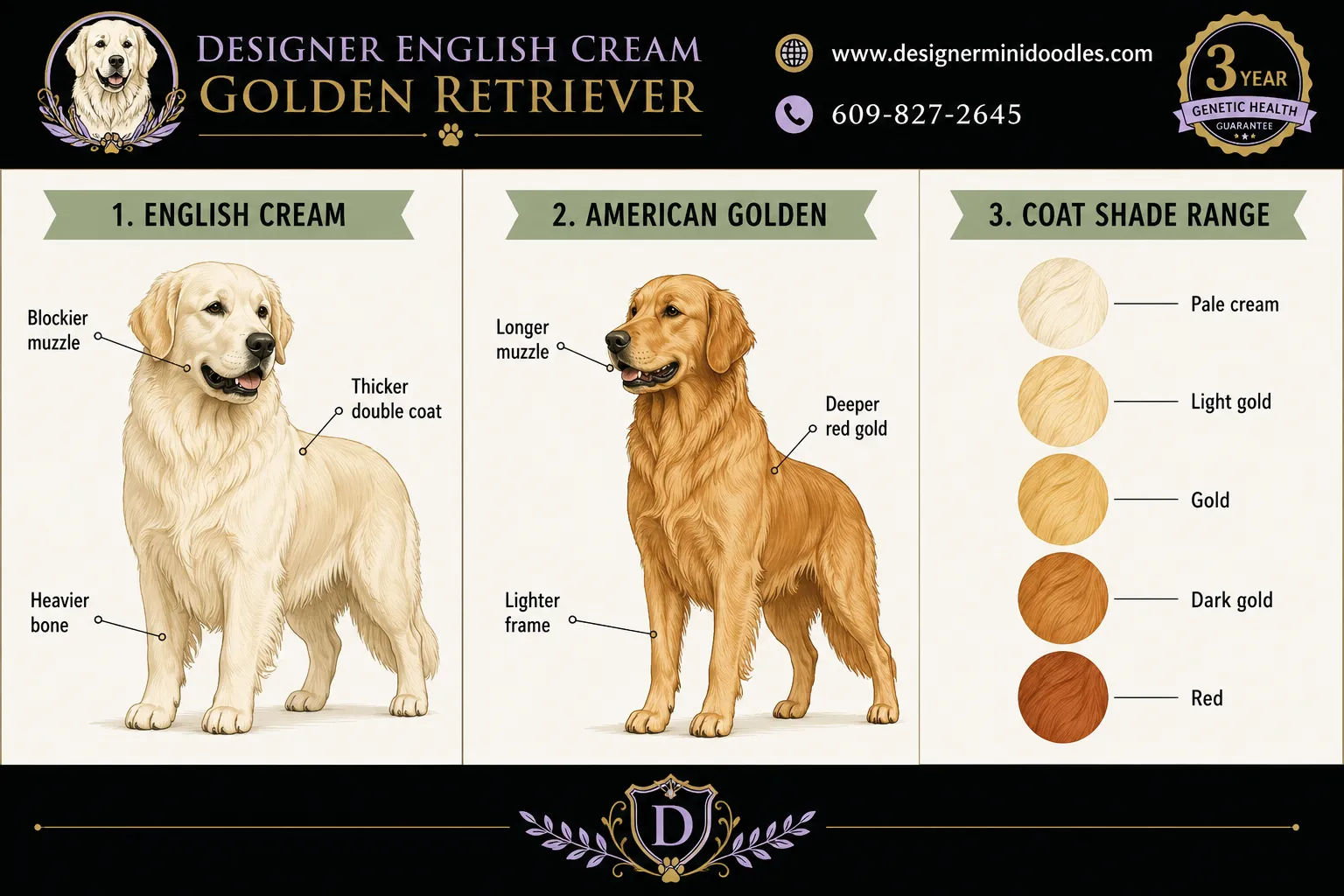
What buyers actually notice in person:
- Head and muzzle: wider skull, deeper stop, shorter blocky muzzle
- Bone and substance: thicker legs, broader chest, more “bear cub” outline
- Coat: dense double coat, often heavier feathering on the chest, tail, and hindquarters
- Overall impression: the puppies from top European lines genuinely look like baby Great Pyrenees in the 8 to 12 week window, thanks to that pale coat plus heavy bone
A pale coat alone is not a pedigree. Any breeder who leads with color and can’t produce four-generation health clearances is selling an aesthetic, not a well-bred dog.
Decision rule: if the breeder can’t name the country of origin for the sire and dam’s lines and show you registration paperwork, treat the “English Cream” label as unverified marketing.
English Cream Retriever vs Golden Retriever: What’s the Difference?
The difference is line and type, not breed. English Cream Retrievers and American Golden Retrievers are the same species, same breed, same AKC registry, and they can be bred to one another. What separates them is which continent’s show standard shaped their ancestors.
| Feature | English Cream (European lines) | American Golden Retriever |
|---|---|---|
| Recognized breed | Golden Retriever | Golden Retriever |
| Typical coat | Cream, pale gold, light gold | Medium to dark gold, sometimes red |
| Head shape | Broader skull, shorter blocky muzzle | Narrower skull, longer muzzle |
| Build | Heavier bone, broader chest, slightly stockier | Leaner, more angular, taller-appearing |
| Eyes | Often rounder, darker | Often more almond-shaped |
| Energy | Frequently described as slightly calmer indoors | Frequently described as higher drive |
| Typical adult weight | 55 to 75 lb (F), 65 to 85 lb (M) | 55 to 70 lb (F), 65 to 80 lb (M) |
| Price range in Florida | $3,500 to $5,500 accredited | $2,000 to $4,000 accredited |
A common mistake: assuming cream lines are automatically healthier or automatically live longer. Coat color is not a health marker. A well-tested American Golden from a rigorous program will outperform an untested European import every time. What European lines often bring is a deeper pool of documented multi-generational clearances, because many UK and continental programs have been screening hips, elbows, hearts, and eyes for a long time. That advantage only transfers if the specific breeder you’re buying from keeps up the testing.
English Cream Retriever vs White Golden Retriever: Are They the Same?
Yes, functionally they’re the same dog with different labels. “White Golden Retriever” is a colloquial marketing phrase for the palest cream Goldens. True white does not exist in the breed. Neither the AKC nor The Kennel Club recognizes white as a Golden Retriever color, and there is no albino or double-merle mechanism at play.
Here’s how the terms line up:
- English Cream Golden Retriever: European-line Golden with a cream coat. Descriptive of both color and type.
- White Golden Retriever: informal term for a very pale cream coat. Describes color only.
- Platinum / Snow / Ivory Retriever: pure marketing. No registry uses these words.
- Rare white Golden: a red flag phrase. Cream is common in European lines, so “rare” is a price justification, not a fact.
Edge case worth knowing: puppies often look paler at eight weeks than they will as adults, and some darken slightly through the ears and back over the first year. A breeder who guarantees a specific final shade is overpromising. Reputable breeders show you photos of the sire, dam, and previous litters at maturity so you can judge the realistic range.
Are There English Cream Retriever Breeders Near Tampa, Florida?
Tampa Bay has plenty of Golden Retriever breeders, but dedicated English Cream programs with imported European breed stock are genuinely scarce in Hillsborough, Pinellas, Pasco, and Manatee counties. Most Tampa families I talk to end up working with a specialist breeder outside Florida and arranging ground transport or a flight nanny into Tampa International.
How the Tampa search typically breaks down:
- Local Golden breeders (Brandon, Lutz, Riverview, Wesley Chapel). Many produce lovely dogs, but mostly American lines with occasional light-gold puppies marketed as “cream.”
- Florida-wide cream programs. A handful operate near Ocala, Sarasota, and the Orlando corridor. Worth a two-hour drive if their clearances check out.
- Out-of-state accredited specialists. This is where most true European-bloodline puppies come from. Delivery into Tampa is routine and usually adds $400 to $900 depending on method.
- Rescue and rehoming. Golden Retriever rescues serving Tampa Bay occasionally have cream-coated adults. Adoption fees typically run a few hundred dollars.
We built our reputation as the best English Cream Retriever breeders in the USA by pairing genetics with real early development work, and Tampa is one of our most frequent delivery destinations. Every one of our english cream retriever puppies descends from top European bloodlines, and our program is run by a credentialed animal biologist with a degree in Animal Biology from Stockton University in Pomona, New Jersey, plus a minor in animal genetics. That background is the reason our pairings are planned around COI, coat inheritance, and documented clearances rather than which two dogs happen to be available.

Tampa buyers exploring other companion breeds sometimes also compare notes with local doodle programs, so it may help to see how a Toy Goldendoodle in Tampa differs in size and coat care before committing to a full-size retriever.
Decision rule: choose a local Tampa breeder if you can visit the property twice, meet the dam, and review clearances in person. Choose a vetted out-of-state specialist if local options can’t produce OFA or equivalent European clearances on both parents.
- Display 15 Products per page

How Much Does an English Cream Retriever Cost in the Tampa Area?
An English Cream Golden Retriever puppy from a legitimate, accredited program costs $3,500 to $5,500 in 2026, including a genetic health guarantee, professional whelping, early housebreaking, and crate training. Prices below that range signal missing testing, missing early development, or outright fraud.
Use this tier chart when you’re comparing Tampa-area listings and out-of-state programs:
| Price range | What you’re actually dealing with | Risk level |
|---|---|---|
| $500, $1,000 | Scam listings. Stolen photos, no video calls, deposits by Zelle, Cash App, or gift card. The puppy often doesn’t exist. | Extreme |
| $1,000, $1,500 | Puppy mill or broker flip. High litter volume, no health clearances, minimal human contact, common early parasites and giardia. | High |
| $1,800, $2,000 | Well-meaning hobby breeder. Sometimes partial testing, usually no ENS, no crate work, no housebreaking start. | Moderate |
| $3,500, $5,500 | Accredited program. Full genetic panel on both parents, written health guarantee, supervised whelping, ENS from birth, noise and family socialization, housebreaking and crate training started. | Low |
Budget beyond the purchase price. First-year costs in Tampa typically include:
- Vet setup (vaccine series, deworming, microchip, spay/neuter): $600 to $1,200
- Heartworm and flea prevention: Florida is a year-round heartworm state, so plan on $300 to $500 annually
- Crate, pen, bedding, bowls, leads: $250 to $450
- Food (large-breed puppy formula): $700 to $1,100 for year one
- Grooming: $70 to $110 per full groom, every 8 to 12 weeks, if you don’t do it yourself
- Transport into Tampa: $400 to $900 for ground or flight nanny service
Common mistake: treating a lower purchase price as savings. A $1,200 mill puppy with hip dysplasia can cost $6,000 to $9,000 in surgical correction, and that’s before the years of pain management. The cheap puppy is usually the expensive dog.
What Makes a Reputable English Cream Retriever Breeder?
A reputable breeder proves three things on paper: health clearances on both parents, a written contract with a genetic guarantee, and a documented early development protocol. Everything else, including the website, the photos, and the waitlist hype, is secondary.

The non-negotiable checklist
- Hip and elbow evaluations on sire and dam (OFA, PennHIP, or the European equivalent such as BVA or FCI scoring).
- Cardiac clearance by auscultation at minimum, ideally by a board-certified cardiologist.
- Annual eye exam (OFA Eye Certification Registry or ECVO in Europe).
- DNA panel covering PRA1, PRA2, ichthyosis, NCL, and DM.
- Written health guarantee covering hereditary conditions, with a clear term and a clear remedy.
- Registration paperwork (AKC, or the originating European registry with export pedigree).
- Video call or in-person visit where you see the dam with the litter in a household environment.
- A contract with a return clause stating the breeder takes the dog back at any age.
- A vet reference you can call independently.
- Documented socialization protocol, not just “they’re raised with love.”
What our program does differently
Our program applies Early Neurological Stimulation (ENS) from birth, handling every puppy daily through the first two weeks with the standard Bio Sensor exercises. That mild, controlled stress exposure is associated in working-dog literature with better stress tolerance later. From there, puppies live inside a busy household: vacuum cleaners, blenders, doorbells, television, kids, cats, and other dogs. They also start structured housebreaking and crate training before they leave, which is the single biggest quality-of-life difference Tampa families report in their first month home.
As an english cream retriever breeder with a genetics background, I’d rather delay a litter than repeat a pairing with an unverified carrier status. That’s a difference you can only evaluate by asking direct questions, which brings us to the next section. Breeders who also maintain quality stud programs, like the team behind French bulldog studs near me, operate with the same paperwork discipline: clearances first, aesthetics second.
For readers comparing the accreditation standards across companion breeds, our overview of the best Golden Doodle breeders walks through the same vetting framework applied to hybrid programs.
What Questions Should I Ask an English Cream Retriever Breeder?
Ask questions that force documentation, not opinions. The best filter is a short list of specific requests that a mill or scammer physically cannot fulfill.
Health and genetics
- May I see OFA or European clearance certificates for both parents, by registration number?
- What DNA panel did you run, and were either parent carriers for anything?
- What’s the coefficient of inbreeding on this pairing?
- What hereditary conditions have appeared in dogs you’ve produced, and at what ages?
- What exactly does your health guarantee cover, for how long, and what’s the remedy?
Raising and socialization
- Do you use ENS, and on what schedule?
- Where do the puppies sleep, and what household noises do they hear daily?
- Have they met children, cats, and adult dogs outside the litter?
- How far along is housebreaking and crate training at pickup?
- What temperament assessment do you use to match puppies to homes?
Logistics and ethics
- How many litters do you produce per year, and how many dams do you keep?
- Can I do a live video walkthrough of where the litter is raised?
- What’s your return policy if my situation changes in year three?
- Who’s your vet, and may I call them?
- What’s included at pickup: vet record, microchip registration, food, registration papers?
If a breeder gets defensive about clearance certificates or refuses a live video call, end the conversation. Reputable breeders expect these questions and usually appreciate them.
Edge case: some excellent European breeders hold clearances under BVA hip scores or FCI systems rather than OFA. That’s legitimate. Ask for the export pedigree and the scoring sheet, then have your own vet interpret it.
What Is the English Cream Retriever Temperament, and Are They Good for Families?
English Cream Golden Retrievers are among the most family-suitable dogs available: patient with children, non-territorial with visitors, tolerant of other pets, and highly trainable. Many owners describe European lines as slightly calmer indoors than American field-bred Goldens, though individual variation and early socialization matter far more than pedigree origin.

What that means in a real Tampa household:
- With toddlers: generally excellent, but a 70-pound adolescent tail clears coffee tables. Supervise, and teach the dog a solid “settle.”
- With cats: typically fine when raised alongside them, which is why litter-stage exposure matters.
- Alone time: they’re social dogs. Four to six hours alone is workable for an adult with enrichment. Ten-hour days without a midday break lead to chewing and vocalizing.
- Guarding: they’re poor guard dogs. They’ll announce a visitor, then request belly rubs.
- Exercise: 60 to 90 minutes daily for an adult, split into sessions. In Tampa summers, that means early morning and after sunset only.
Trainability and early training
Golden Retrievers are consistently ranked among the most trainable breeds, and cream lines are no exception. Our puppies leave already accustomed to a crate as a rest space and already showing a preference for eliminating outside or on a designated surface. Practically speaking, families report:
- Housebreaking completed weeks earlier because the puppy already understands the concept, not just the accident
- Quieter first nights, since the crate isn’t a novel punishment
- Faster obedience progress, with sit, name recognition, and leash tolerance often established in the first two weeks home
- Reliable basic obedience (sit, down, stay, recall, loose leash) by six to eight months with consistent short sessions
Common mistake: over-exercising a large-breed puppy. Skip long jogs and repetitive jumping until growth plates close, generally 12 to 18 months. Swimming is the best Florida-friendly option.
What Health Problems and Life Expectancy Should I Expect?
English Cream Golden Retrievers typically live 10 to 12 years, and the conditions to watch are cancer (especially hemangiosarcoma and lymphoma), hip and elbow dysplasia, subvalvular aortic stenosis, hypothyroidism, and inherited eye disease. Cream coat color does not reduce cancer risk, despite persistent claims online.

| Condition | What to watch for | How breeders reduce risk |
|---|---|---|
| Hip / elbow dysplasia | Limping, bunny-hopping, reluctance on stairs | OFA or BVA scoring on both parents, lean body condition |
| Cancer | Lethargy, lumps, sudden pale gums, weight loss | Longevity tracking in the pedigree; annual senior screening |
| Subvalvular aortic stenosis | Exercise intolerance, fainting, murmur | Cardiologist clearance on breeding stock |
| Hypothyroidism | Weight gain, coat loss, cold intolerance | Thyroid panels on parents; treatable with daily medication |
| PRA / inherited eye disease | Night vision loss, cloudiness | DNA panel plus annual ophthalmologist exam |
| Ichthyosis | Flaky, scaly skin | DNA testing; avoid affected-by-affected pairings |
| Ear infections | Head shaking, odor, scratching | Not hereditary, but critical in humid Florida: dry ears after every swim |
Florida-specific management points:
- Heartworm prevention year-round. Non-negotiable in Tampa.
- Heat management. Double-coated dogs overheat fast. Never shave the coat, since it insulates against heat too. Use shade, water, and cool-hour walks instead.
- Blue-green algae and brackish water. Rinse after swims and avoid stagnant retention ponds.
- Lean weight. Keeping a Golden at a lean body condition score is the cheapest orthopedic insurance you can buy.
What Are the Grooming Requirements, and How Much Work Are They?
Plan on 15 to 20 minutes of brushing two to three times per week, rising to daily during seasonal coat blows, plus a full groom every 8 to 12 weeks. English Cream Goldens shed heavily. They are a double-coated shedding breed, not a low-maintenance one.
Your realistic routine:
- Brushing: slicker brush for feathering, undercoat rake for the dense layer. Focus behind the ears, the britches, and the tail.
- Bathing: every 4 to 8 weeks, or after saltwater and pond swims. Over-bathing strips coat oils.
- Ears: check weekly, dry after every swim. Humid Tampa air plus floppy ears equals recurring infections if you skip this.
- Nails: trim or grind every 3 to 4 weeks.
- Teeth: brush several times weekly.
- Professional grooming: $70 to $110 per visit in Tampa Bay for bath, blow-out, tidy trim, nails, and ears.
Never shave a cream Golden. The undercoat can grow back patchy and the dog loses its natural thermal buffer. Ask a groomer for a “tidy and de-shed,” not a summer shave.
Choose differently if: you have a serious dander allergy, hate vacuuming, or want a dog you can leave ungroomed for months. That’s not this breed.
What if an English Cream Retriever Isn’t Right for Me? Alternatives
If the shedding, the 65 to 80 pound adult size, the Florida heat sensitivity, or the exercise load doesn’t fit your household, several breeds deliver similar temperament in a more manageable package. The honest answer is that most people who love the Golden personality but not the coat end up in a doodle or a small companion cross.
| Alternative | Why it fits | Trade-off |
|---|---|---|
| Goldendoodle (mini or standard) | Golden temperament, far less shedding, size options | Requires professional grooming every 6 to 8 weeks; coat varies |
| Cavapoo | Affectionate, apartment-friendly, low shedding | Less retrieving drive; more prone to separation attachment |
| Labrador Retriever | Similar friendliness, shorter coat, easier grooming | Higher energy; still sheds noticeably |
| Standard Poodle | Highly trainable, minimal shedding, athletic | Needs frequent clipping; more sensitive to routine changes |
| Adult Golden from rescue | Known temperament, past the chewing stage, lower cost | Unknown genetic history; may need behavior work |
Tampa buyers considering the doodle route can compare Florida options through our guides to mini and micro Goldendoodle breeders in Florida and Cavapoo breeders in Florida. If you want the smallest possible footprint with a companion temperament, our roundup of the best Toy Poodle breeders covers what to screen for in tiny-breed programs.
Decision rule: choose the english cream retriever if you want a broad, calm, biddable family dog and you’ll genuinely commit to brushing and year-round exercise planning. Choose a doodle or Cavapoo if shedding control, apartment living, or a smaller adult size is the priority.
Frequently Asked Questions
Are English Cream Golden Retrievers recognized by the AKC?
Yes, as Golden Retrievers. The AKC registers them under the single Golden Retriever breed. “English Cream” is not a separate breed or color designation in the AKC standard.
How much should I pay for an English Cream Retriever puppy in Tampa?
$3,500 to $5,500 from an accredited breeder with full parental health clearances, a written genetic guarantee, and puppies started on housebreaking and crate training. Listings at $500 to $1,000 are almost always fraudulent.
Do English Cream Retrievers live longer than American Goldens?
There’s no reliable evidence that coat color affects lifespan. Both typically live 10 to 12 years. Documented multi-generational health testing and lean body weight influence longevity far more than line origin.
Are there English Cream Retriever breeders actually located in Tampa?
Dedicated European-bloodline programs are rare inside Hillsborough and Pinellas counties. Most Tampa families buy from a vetted specialist elsewhere in Florida or out of state and arrange ground transport or a flight nanny into Tampa International.
Do English Cream Retrievers shed a lot?
Yes. They have a dense double coat and shed year-round with heavier seasonal periods. Expect brushing two to three times weekly and a professional de-shed groom every 8 to 12 weeks.
Are they good with children and other pets?
Generally excellent. Goldens are non-territorial and patient. Supervision still matters with toddlers because an adolescent dog is large and enthusiastic, and outcomes are much better when the puppy met children and other animals during the litter stage.
What health tests should both parents have?
Hips and elbows (OFA, PennHIP, or European equivalent), cardiac clearance, an annual eye exam, and a DNA panel covering PRA1, PRA2, ichthyosis, NCL, and DM. Ask for certificate numbers, not verbal assurance.
Is a “white” Golden Retriever different from an English Cream?
No. “White Golden Retriever” is an informal marketing phrase for the palest cream coats. True white doesn’t exist in the breed, and no registry recognizes it as a color.
How long does housebreaking take with a well-started puppy?
Puppies that arrive already introduced to crate routines and designated potty surfaces are typically reliable in the house weeks sooner than untrained puppies, often within four to six weeks of consistent scheduling. Full bladder control still depends on age.
Can English Cream Retrievers handle Florida heat?
Yes, with management. Walk during cool hours, provide shade and constant water, use swimming for exercise, and never shave the coat. Watch for heavy panting, thick drool, and stumbling as heat-stress warning signs.
What’s the typical waitlist for a cream-line puppy?
Accredited programs commonly run three to nine months out, depending on litter planning and color preference. Deposits are usually $300 to $1,000 and should be documented in a written contract.
Should I get pet insurance for a Golden Retriever?
It’s worth strong consideration given the breed’s cancer and orthopedic risk profile. Enroll before any condition appears, since pre-existing conditions are excluded. Compare hip and cancer coverage specifically.
Conclusion: Your Next Steps
Choosing among english cream retriever breeders Tampa comes down to documentation, not photographs. The cream coat is the easy part. What separates a dog that thrives for twelve years from one that starts limping at three is whether the breeder tested the parents, planned the pairing on genetics, whelped the litter properly, and did the early developmental work before the puppy ever met you.
Here’s how I’d move forward this week:
- Set a real budget. Purchase price of $3,500 to $5,500, plus $1,800 to $3,000 in first-year costs, plus $400 to $900 transport if the breeder is out of state.
- Shortlist three programs. One local to Tampa Bay if possible, two accredited specialists elsewhere.
- Request clearance certificates by registration number for both parents from each program. Drop anyone who hesitates.
- Schedule a live video walkthrough. You want to see the dam with the litter, the whelping space, and the household environment they hear every day.
- Ask about ENS, noise exposure, crate work, and housebreaking progress. These four answers predict your first month at home better than any pedigree.
- Read the contract before the deposit. Confirm guarantee length, covered conditions, remedy, and the lifetime return clause.
- Book your vet’s first appointment for within 72 hours of pickup, and start heartworm prevention immediately.
Do those seven things and you’ll filter out the scams, the mills, and the well-meaning-but-untested hobby litters, whether you buy in Tampa or fly a puppy in.