

Last updated: August 17, 2026
AKC english cream retrievers for sale
AKC English cream retrievers for sale are Golden Retrievers registered with the American Kennel Club whose coats fall at the palest end of the breed’s color range, near-white to light cream, and whose pedigrees usually trace to European bloodlines. The AKC recognizes them as Golden Retrievers, not a separate breed, so “English cream” describes type and color, not registry status. Expect to pay roughly $3,500 to $5,500 from an accredited breeder who provides genetic health testing, a written health guarantee, and puppies already started on housebreaking and crate training. Listings priced at $500 to $1,500 are almost always scams or high-volume puppy mills.
AKC english cream retrievers for sale
- “English cream” is a color and type description, not a separate breed. Every English cream retriever registered with the AKC is registered as a Golden Retriever.
- Price is the clearest signal of program quality. Scam listings sit at $500,$1,000, puppy mills at $1,000,$1,500, hobby breeders at $1,800,$2,000, and fully accredited programs with genetic guarantees at $3,500,$5,500.
- European-bloodline dogs tend to be broader, thicker, and blockier than typical American Golden Retrievers, with heavier bone and paler coats that some owners describe as resembling “baby Great Pyrenees.”
- Health screening matters more than coat color. Ask for OFA hips and elbows, cardiac and eye clearances on both parents, plus DNA panels for PRA, ICT and NCL.
- Temperament is the breed’s biggest selling point: soft, people-focused, patient with children, and highly trainable, which is why they rank among the best family dogs available.
- Expect 60-90 minutes of daily exercise and year-round shedding with two heavy seasonal coat blows.
- AKC registration verifies pedigree, not health or quality. A registered puppy from an untested breeder is still a gamble.
- Puppies that arrive already crate-trained and started on housebreaking save new owners weeks of frustration, ask specifically what the breeder has done before pickup.
What Is an English Cream Retriever?
An English cream retriever is a Golden Retriever with a very pale, near-white to light cream coat, typically descended from European (British, Scottish, Scandinavian or Eastern European) breeding lines. It is not a separate breed, and no kennel club anywhere recognizes “English Cream Golden Retriever” as a distinct breed name.
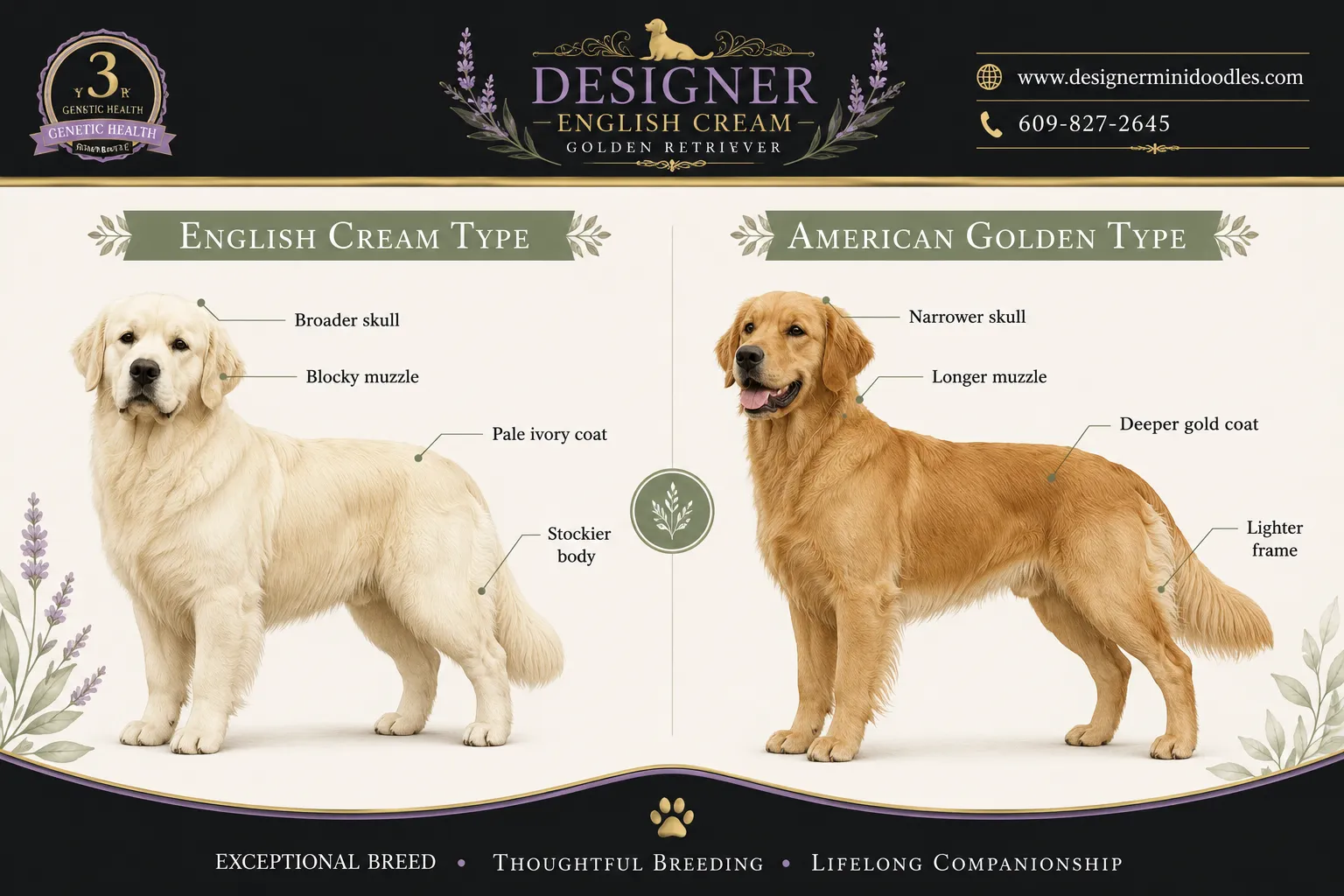
The confusion comes from breed standards. The UK Kennel Club standard permits “any shade of gold or cream,” while the AKC standard for Golden Retrievers calls for “rich, lustrous golden of various shades” and considers extremely pale coloring undesirable in the show ring. That single wording difference created two visual populations of the same breed on either side of the Atlantic.
Dogs from these European lines usually show:
- A broader, blockier skull with a shorter, deeper muzzle
- Heavier bone and a stockier, thicker overall build
- A dense double coat that ranges from pure white to light cream, sometimes with slightly darker feathering on the ears
- Often darker pigment around the eyes and nose, which makes the pale coat look striking
At Designer English Cream Golden Retrievers, our breeding stock and every litter of English cream golden retriever puppies trace back to top European bloodlines. Our dogs are pure white with very little fade to even cream, and visitors regularly tell us the puppies look like baby Great Pyrenees, broader and considerably thicker through the chest and skull than the typical American-bred retriever.

“Ask a breeder to explain what ‘English cream’ means before you ask the price. If they claim it’s a rare separate breed, you’re talking to a marketer, not a breeder.”
English Cream Retriever vs Golden Retriever: What’s the Difference?
There is no genetic difference in breed, an English cream retriever is a Golden Retriever. The differences are in coat color, physical build, and often temperament tendencies that come from decades of separate breeding priorities in Europe versus the United States.
| Trait | English cream type (European lines) | American Golden Retriever |
|---|---|---|
| Coat color | Near-white to light cream | Medium gold to deep red-gold |
| Skull and muzzle | Broader, blockier, shorter muzzle | Narrower skull, longer muzzle |
| Build | Stockier, heavier bone, thicker chest | Leaner, more angular, athletic |
| Coat length | Dense double coat, moderate feathering | Often longer, wavier feathering |
| Typical energy | Somewhat calmer, slower to mature physically | Often higher drive, field-bred lines especially |
| Registry status | Registered as Golden Retriever (AKC) | Registered as Golden Retriever (AKC) |
Decision rule: Choose English cream type if you want a calmer, heavier-built family companion and prefer the pale look. Choose an American field-bred Golden if you want a high-drive hunting or competitive sport partner. Both are excellent dogs; the mismatch happens when a family buys a field-bred dog expecting a couch companion.
Common mistake: Assuming pale color guarantees a calm dog. Color is controlled by a small number of genes and has nothing to do with behavior. Temperament comes from the parents’ actual dispositions plus how the puppy was raised. Always meet or view video of the dam.
English Cream Retriever vs American Golden Retriever: Which Suits Your Home?
Choose the English cream type if your priority is a steady, family-oriented dog with a heavier frame and lower baseline arousal. Choose an American Golden, particularly from field lines, if you need stamina for hunting, dock diving, or long trail days.
Here’s how the practical differences play out day to day:
Living with an English cream type
- Settles more readily indoors after exercise
- Heavier coat means more brushing and more heat sensitivity in southern climates
- Slower physical maturity; joints benefit from restricted high-impact exercise until 18 months
- Generally softer to correction, which suits first-time owners
Living with an American Golden (field lines especially)
- Needs a job; boredom shows up as chewing and barking
- Lighter coat dries faster and handles heat somewhat better
- Often faster to learn retrieving tasks and more independent in the field
- Can be too much dog for a sedentary household
Edge case: Show-bred American Goldens sit between the two. If you love the deeper gold color but want the calmer disposition, a conformation-bred American line may fit better than either extreme.
How Much Do AKC English Cream Retrievers Cost?
Expect to pay $3,500 to $5,500 for an AKC English cream retriever from a fully accredited breeder with genetic health guarantees, proper whelping practices, and early housebreaking and crate training. Anything dramatically cheaper reflects something missing, usually health testing, socialization, or the dog itself.
Price tells you what you’re buying:
| Price range | What you’re actually dealing with | What’s missing |
|---|---|---|
| $500,$1,000 | Almost certainly a scam. No puppy exists. | Everything. Deposits vanish. |
| $1,000,$1,500 | Puppy mill or broker. High volume, cage-raised. | Health testing, socialization, support |
| $1,800,$2,000 | Hobby breeder. Well-meaning, often limited testing. | Full OFA panels, early training, written guarantee |
| $3,500,$5,500 | Accredited breeder. Genetic health guarantee, proper whelping, ENS, early crate and potty training. | Nothing, this is the full package |
What the higher price actually pays for:
- OFA hip, elbow, cardiac, and eye clearances on both parents (roughly $600,$1,000 per dog, repeated every breeding generation)
- DNA disease panels for progressive retinal atrophy, ichthyosis, and neuronal ceroid lipofuscinosis
- Imported European breeding stock, import costs, health testing abroad, and pedigree verification
- Attended whelping with veterinary support on call
- Eight-plus weeks of daily handling, ENS from birth, noise desensitization, and early crate and potty work
- A written genetic health guarantee and lifetime breeder support
Common mistake: Treating the purchase price as the whole cost. Budget another $1,500,$2,500 for the first year: vet visits, spay/neuter, food, crate, training class, and pet insurance.
Where to Find Reputable AKC English Cream Retriever Breeders
Start with AKC Marketplace and the Golden Retriever Club of America breeder referral network, then verify every claim independently. The most reliable path is a breeder who will show you original OFA certificates, let you meet the dam, and answer detailed questions without pressuring you toward a deposit.
Our screening checklist, in order:
- Verify parent health clearances on the OFA database (ofa.org) by searching the registered names, don’t accept screenshots.
- Confirm AKC registration of both parents and request the pedigree.
- Ask to see the whelping area in person or on live video, not a curated photo gallery.
- Read the contract before paying anything. Look for the health guarantee terms, spay/neuter clause, and return policy.
- Ask what training the puppy has already had, crate, potty, leash introduction, nail handling.
- Check references from two families who bought puppies 2+ years ago.
Designer English Cream Golden Retrievers is run by a working animal biologist with a degree in Animal Biology from Stockton University in Pomona, New Jersey, and a minor in animal genetics. That background shapes every pairing decision we make, we plan litters around coefficient of inbreeding, structure, and documented health clearances, not just coat color. It’s a large part of why families searching for the best English Cream Retriever breeders in the USA end up on our waitlist.
If you’re comparing programs, our approach to sourcing and raising AKC english cream retriever puppies mirrors what we do across all our lines, including our AKC-registered Goldendoodle puppy program. We also offer French bulldog stud services near me through our sister program for breeders who need verified, health-tested studs.
- Display 15 Products per page

How Do You Avoid English Cream Retriever Scams and Puppy Mills?
The single most effective filter is a live video call where you see the puppy, the dam, and the whelping space in real time, in one continuous shot. Scammers can’t do this. Puppy mills won’t.
Red flags that should end the conversation:
- Price far below market. A “$700 AKC English cream” listing is bait.
- Payment by Zelle, Cash App, Venmo, wire transfer, or gift cards only. Legitimate breeders accept traceable payment and provide receipts.
- Pressure to decide immediately because “another family is interested.”
- Stock photos. Reverse-image-search every photo you’re sent.
- Refusal to do live video or to let you visit.
- No health testing details, or vague claims like “vet checked and healthy” with nothing documented.
- Surprise fees after the deposit, crate insurance, special climate-controlled shipping, customs charges. This is the classic advance-fee scam pattern.
- Multiple breeds and constant availability. A program with eight breeds and puppies always ready is a broker.
Quick example: A family contacts a “breeder” offering an AKC English cream female for $850, ships-anywhere. They pay a $400 Zelle deposit. Then comes a $650 “USDA-approved crate” fee, then a $500 “vaccine transport certificate.” The dog never existed. The Federal Trade Commission has repeatedly warned that fraudulent pet-sale listings follow exactly this escalating-fee script.
Edge case: Some legitimate breeders do ship and do require deposits. The difference is documentation, a real breeder names the airline, gives you the flight number, and never invents new fees after the fact.
What Health Problems Do English Cream Retrievers Have?
English cream retrievers face the same health risks as all Golden Retrievers: hip and elbow dysplasia, subvalvular aortic stenosis, hereditary eye disease, hypothyroidism, and an elevated lifetime cancer risk, particularly hemangiosarcoma and lymphoma. Coat color does not reduce any of these risks.

The screening that actually matters before you buy:
| Condition | Required parent screening |
|---|---|
| Hip dysplasia | OFA or PennHIP hip evaluation |
| Elbow dysplasia | OFA elbow evaluation |
| Subvalvular aortic stenosis | Cardiac exam by a board-certified cardiologist |
| Progressive retinal atrophy (PRA1, PRA2) | DNA test |
| Hereditary eye disease | Annual OFA eye exam (CAER) |
| Ichthyosis | DNA test |
| Neuronal ceroid lipofuscinosis | DNA test |
Important caution about marketing claims: Some sellers claim European lines have dramatically lower cancer rates. The Golden Retriever Club of America notes that comparisons between European and North American cancer rates come from surveys with different methodologies and populations, so they aren’t directly comparable. Treat any specific percentage a breeder quotes with skepticism unless they can name the study.
Common mistake: Accepting “our vet checked the parents” as health testing. A routine vet exam is not an OFA clearance. Ask for certificate numbers and verify them yourself.
What Is the English Cream Retriever Life Expectancy?
Most English cream retrievers live 10 to 12 years, consistent with the Golden Retriever breed average. Genetics, weight management, and early cancer detection influence the outcome more than bloodline origin.
Practical levers that extend healthy years:
- Keep the dog lean. Excess weight accelerates joint disease and shortens lifespan across breeds.
- Limit high-impact exercise before 18 months, no forced running, repetitive stair work, or long jumps while growth plates are open.
- Annual bloodwork from age 7 to catch thyroid and organ changes early.
- Dental care. Untreated periodontal disease drives systemic inflammation.
- Know the emergency signs of hemangiosarcoma: sudden weakness, pale gums, distended abdomen. Fast intervention matters.
If you want to follow the science on longevity in the breed, the Morris Animal Foundation Golden Retriever Lifetime Study is the largest prospective health study ever conducted in dogs and publishes findings regularly.
Are English Cream Retrievers Good Family Dogs, and What’s Their Temperament Like?
Yes, English cream retrievers rank among the most reliable family dogs available. They are patient with children, sociable with other pets, low in territorial aggression, and strongly motivated by human attention. The main caveats are size-related clumsiness around toddlers and a real need for daily companionship.
Typical temperament profile:
- People-oriented to a fault. They want to be in the room with you. Left alone 10 hours a day, many develop separation anxiety and destructive chewing.
- Soft and sensitive. They respond to reward-based training and shut down under harsh correction.
- Mouthy as puppies. Retrieving instinct means everything goes in the mouth for the first six months. Redirect to toys.
- Poor guard dogs. They may bark at the door and then try to befriend the intruder.
- Slow to mature mentally. Expect adolescent silliness until roughly two years old.
Choose an English cream retriever if: you have an active household, someone home much of the day, and you want a dog that tolerates being climbed on by kids.
Choose something else if: you travel constantly, want a low-shedding dog, or need a compact apartment companion. Families in that situation often do better with a smaller low-shedding option, our guides on mini Goldendoodle puppies available in Florida and why a 10-16 lb micro Goldendoodle suits allergy-conscious homes cover those alternatives in detail.
Do English Cream Retrievers Need a Lot of Exercise?
Adults need 60 to 90 minutes of activity daily, split into two or three sessions, plus mental work. Puppies need far less structured exercise, a common guideline among veterinary physiotherapists is roughly five minutes of formal walking per month of age, twice daily, with free play in addition.
A workable weekly rhythm:
- Morning: 30-minute brisk walk or 15 minutes of fetch
- Midday: short potty break plus a five-minute training session
- Evening: 30-45 minutes of walking, swimming, or off-leash play in a safe area
- Two or three times a week: scent games, puzzle feeders, or a training class for mental load
Edge case, hot climates: The dense double coat makes heat a genuine risk. In Texas, Florida, or Arizona summers, shift exercise to before 8 a.m. and after 8 p.m., and use swimming as the primary outlet. Never shave the coat to cool the dog; it disrupts the insulating undercoat.
Common mistake: Assuming a big yard replaces walks. Dogs don’t self-exercise meaningfully. A retriever alone in a yard mostly digs, barks, and waits at the door.
How Difficult Is English Cream Retriever Training for First-Time Owners?
English cream retrievers are among the easiest breeds for first-time owners to train, because they’re food-motivated, biddable, and eager to please. The realistic challenges are puppy mouthing, adolescent leash pulling, and jumping on visitors, all manageable with consistency.
What we do before a puppy ever leaves our program:
- Early Neurological Stimulation (ENS) from days 3 through 16, brief, gentle handling exercises used to build stress resilience in developing puppies.
- Household noise exposure. Our litters are raised inside a busy home with children, other animals, vacuums, doorbells, dishes, and television, not in a silent kennel building.
- Litter box or potty-pad routine transitioning to outdoor surfaces, so housebreaking is already underway at pickup.
- Crate introduction with the door open, fed in the crate, short closed intervals, so the crate is neutral rather than frightening.
- Handling desensitization, nails, ears, mouth, and paws touched daily.
- Leash and collar introduction in the final two weeks.
That head start is why families consistently describe our puppies as noticeably easier through the first month. Housebreaking a puppy that has never soiled its sleeping area is a different experience than starting from zero.
Your first 30 days at home, in order:
- Days 1-3: crate beside your bed, potty trips every 2 hours, name recognition only
- Days 4-10: add “sit,” feed all meals as training currency, begin bite-inhibition redirection
- Days 11-20: short leash walks, introduce alone-time in the crate for 15-30 minutes
- Days 21-30: enroll in a puppy socialization class, begin “leave it” and recall on a long line
Common mistake: Skipping crate training because it “feels mean.” A crate-trained dog travels better, recovers from surgery more safely, and has a place to decompress. Our Goldendoodle puppy resources cover the same crate protocol we use for retrievers.
What Should You Expect for Grooming and Shedding?
English cream retrievers shed year-round and blow their undercoat heavily twice a year, usually spring and fall. Plan on brushing two to three times weekly, daily during a coat blow, and a full groom every 8 to 12 weeks. They are not hypoallergenic.
Your grooming kit:
- Slicker brush for the body and feathering
- Undercoat rake for shedding season
- Metal comb to find mats behind ears and in the britches
- Blunt-tip scissors for feet and sanitary trimming
- High-velocity dryer if you bathe at home, air-drying a thick double coat invites hot spots
Maintenance schedule:
| Task | Frequency |
|---|---|
| Brushing | 2-3x weekly (daily in shedding season) |
| Bath | Every 6-8 weeks, or when dirty |
| Nail trim | Every 3-4 weeks |
| Ear cleaning | Weekly (drop ears trap moisture) |
| Teeth | Brush 3-4x weekly |
| Professional groom | Every 8-12 weeks |
Do not shave a Golden Retriever’s coat. The double coat regulates temperature in both directions, and shaved coats often grow back patchy with altered texture. Trim feathering and feet only.
If shedding is a dealbreaker, a low-shedding doodle is the honest alternative, see our overview of Goldendoodle options near you.
AKC Registration vs Non-Registered English Cream Retrievers: Does It Matter?
AKC registration documents a dog’s pedigree and parentage. It does not certify health, temperament, or breeding quality. A registered puppy from an untested breeder can still inherit dysplasia; an unregistered puppy from a careful breeder can be perfectly sound. Registration matters most if you plan to compete, breed, or want verifiable ancestry.
What registration does and doesn’t do:
AKC registration gives you:
- A documented three-to-five generation pedigree you can research
- Eligibility for AKC conformation, obedience, agility, and field events
- A way to verify the parents’ identities and look up their OFA clearances
- Access to AKC programs like Canine Good Citizen titling
AKC registration does not give you:
- Any guarantee of health, structure, or temperament
- Proof the breeder did genetic testing
- Confirmation the dog meets the breed standard
Limited vs full registration: Most family puppies are sold on limited registration, the dog can compete in performance events but its offspring cannot be registered. Full registration is usually reserved for buyers approved for breeding. If a breeder offers full registration to any buyer without questions, that’s a warning sign about their program’s standards.
Decision rule: Insist on AKC registration plus verifiable OFA clearances if you want maximum accountability. If a breeder has full health testing but their line isn’t registered, weigh the testing more heavily than the paperwork, but ask why, and get the answer in writing.
As one of the more selective AKC english cream golden retriever breeders working with imported European stock, we register every puppy and provide the clearance documentation for both parents at pickup, because paperwork without testing isn’t worth much.
Frequently Asked Questions
Are English cream retrievers recognized by the AKC?
Yes, but as Golden Retrievers. The AKC registers them under the Golden Retriever breed and does not recognize “English Cream Golden Retriever” as a separate breed or color designation.
How much should I pay for an AKC English cream retriever puppy?
Between $3,500 and $5,500 from an accredited breeder providing OFA-verified parents, a written genetic health guarantee, and puppies started on crate training and housebreaking. Listings under $1,500 are typically scams or puppy mills.
Are English cream retrievers healthier than American Golden Retrievers?
There’s no reliable evidence that coat color or European origin makes a Golden Retriever healthier. What measurably reduces risk is verified health testing on both parents across multiple generations.
How big do English cream retrievers get?
Males typically reach 65-75 pounds and 23-24 inches at the shoulder; females 55-65 pounds and 21.5-22.5 inches. European-line dogs often look larger because they’re broader through the chest and skull.
Do English cream retrievers shed less than regular Goldens?
No. They have the same dense double coat and shed year-round, with two heavy seasonal sheds. The pale hair is simply less visible on light-colored floors and furniture.
How long is the typical wait for a puppy from a reputable breeder?
Commonly three to twelve months. Breeders producing two to four litters a year with full health testing can’t keep puppies constantly in stock, so a waitlist is a positive signal, not an inconvenience.
Can English cream retrievers live in apartments?
Yes, if their exercise and companionship needs are met. A dog getting 60-90 minutes of daily activity plus mental work settles well indoors regardless of square footage. Long hours alone are the real problem, not the apartment.
What questions should I ask a breeder first?
Ask for the registered names of both parents so you can verify OFA clearances, what the puppies’ daily socialization looks like, what’s covered in the health guarantee, and what training the puppy has already had.
Is a deposit refundable?
It depends entirely on the contract. Read the deposit terms before paying. Reputable breeders spell out in writing what happens if a litter doesn’t produce your chosen sex or color, or if you withdraw.
Do English cream retrievers get along with cats?
Generally yes. Low predatory drive and high sociability make them one of the more cat-compatible large breeds, especially when raised alongside cats from puppyhood.
Conclusion: Your Next Steps
Buying an AKC English cream retriever comes down to three verifications: confirm the parents’ health clearances yourself on the OFA database, see the puppy and dam on live video or in person, and read the contract before any money moves. Do those three things and you eliminate nearly every bad outcome in this market.
Here’s the order I’d work in:
- Set a real budget. $3,500,$5,500 for the puppy, plus $1,500,$2,500 for year one.
- Shortlist three breeders who publish health testing and answer questions in detail.
- Verify clearances independently at ofa.org using the parents’ registered names.
- Schedule a live video call and ask to see the whelping area in one continuous shot.
- Request the contract and health guarantee in writing before placing a deposit.
- Join a waitlist rather than chasing availability. Immediate availability at a low price is the market’s loudest warning sign.
- Book a puppy class before pickup so training momentum starts on day one.
If you want a program where the breeding decisions are made by someone with formal training in animal biology and genetics, where the stock comes from top European bloodlines, and where puppies arrive already started on housebreaking and crate work, that’s exactly what we built at Designer English Cream Golden Retrievers. Reach out, ask hard questions, and compare our answers to anyone else’s.
Sources
- American Kennel Club, “Golden Retriever Breed Standard” (2024), https://www.akc.org/dog-breeds/golden-retriever/
- Golden Retriever Club of America, “English Cream Golden Retrievers” (2023), https://grca.org/
- Orthopedic Foundation for Animals, “Golden Retriever Health Statistics” (2024), https://ofa.org/
- Morris Animal Foundation, “Golden Retriever Lifetime Study” (2024), https://www.morrisanimalfoundation.org/golden-retriever-lifetime-study
- Federal Trade Commission, “Pet Scams” consumer alert (2023), https://consumer.ftc.gov/