

Last updated: August 17, 2026
white english cream golden retriever puppies for sale
White English cream golden retriever puppies for sale are golden retrievers from European (often UK, Hungarian, Serbian, or Scandinavian) bloodlines whose coats range from near-white to pale cream. They are the same breed as American goldens, not a separate one, and the American Kennel Club registers them as golden retrievers. Expect to pay $3,500 to $5,500 from an accredited breeder who provides full genetic health testing, a written health guarantee, early neurological stimulation, and puppies already started on housebreaking and crate training. Coat color alone does not make a dog healthier, so buy on health clearances and temperament, not on how pale the puppy looks.
white english cream golden retriever puppies for sale
- “English cream,” “white golden retriever,” and “platinum golden” all describe the same breed: the golden retriever with European-type genetics and a pale coat.
- The AKC breed standard allows shades of gold; extremely pale cream is accepted in the UK Kennel Club standard, which is why European lines are lighter.
- Fair market pricing from a genuinely accredited program with a genetic health guarantee runs $3,500-$5,500. Ads at $500-$1,000 are almost always scams.
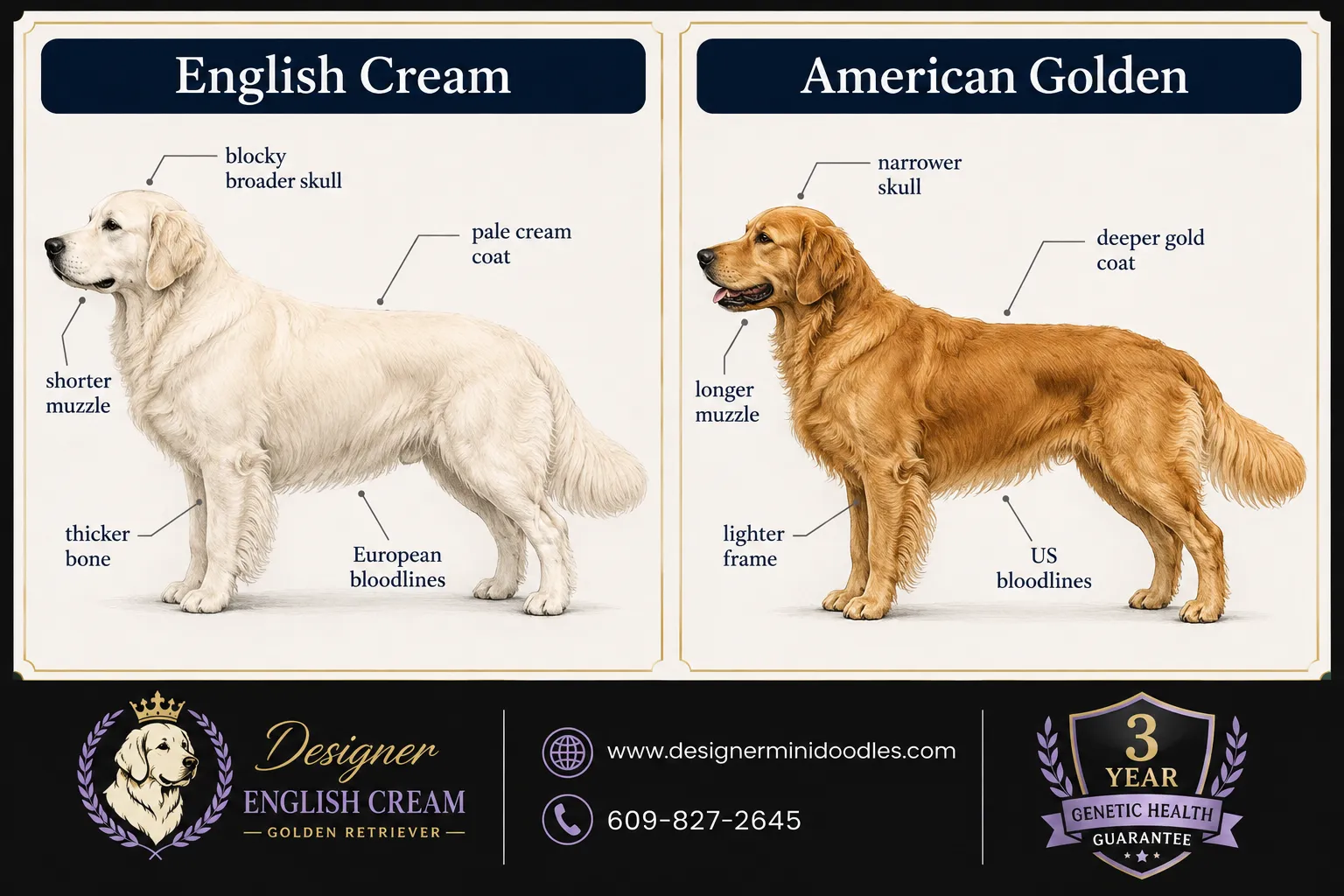
- European-line goldens are typically broader, thicker-boned, and blockier in the head than American goldens, which is why buyers often say our puppies look like “baby Great Pyrenees.”
- Expect adults around 55-75 lbs and 21.5-24 inches at the shoulder, with a typical lifespan of 10-12 years (AKC).
- Cream color does not prevent cancer, hip dysplasia, or heart disease. Verified OFA hips, elbows, heart, and eye clearances on both parents do far more for longevity.
- Designer English Cream Golden Retrievers is run by a working animal biologist and uses ENS from birth, plus real-world noise and household socialization.
- The biggest buyer mistakes: paying a deposit before verifying health testing, shopping on price, and skipping a live video call with the actual litter.
What’s the Difference Between White English Cream and Regular Golden Retrievers?
The difference is bloodline and coat pigment, not breed. An English cream golden retriever is a golden retriever descended primarily from European show and working lines, where breeders have long favored a pale cream coat and a heavier, blockier build. A “regular” American golden is the same breed from North American lines, usually a deeper gold or red-gold with a lighter, more angular frame.
Three practical distinctions matter to buyers:
- Coat color. The UK Kennel Club breed standard permits any shade of gold or cream. The AKC standard describes “rich, lustrous golden of various shades” and penalizes extremely pale coats in the show ring. Same breed, different judging preference.
- Structure. European lines tend to have a broader skull, a shorter and squarer muzzle, a deeper chest, and heavier bone. Our English cream puppies are pure white with very little fade to even cream, and they carry the substance and thickness that American retrievers usually don’t.
- Registration. True English cream puppies from imported or European-descended stock are registered as golden retrievers with the AKC. There is no separate “English cream” registry, and any breeder selling “rare white golden retrievers” at a premium because of color is selling marketing, not genetics.
)
A pale coat is a cosmetic trait. Hip, elbow, heart, and eye clearances on both parents are what actually predict how your dog will feel at age nine.
Decision rule: choose an English cream line if you want a calmer, heavier-bodied companion dog. Choose an American field-bred golden if you want a lighter, faster dog for hunt tests and high-drive dog sports.
White English Cream Golden Retriever vs American Golden Retriever: Side by Side
Both are golden retrievers under one AKC breed standard, but the typical English cream is heavier and slightly mellower, while the typical American golden is more athletic and often darker.

| Trait | English cream (European lines) | American golden retriever |
|---|---|---|
| Coat color | Near-white to pale cream | Medium gold to red-gold |
| Head | Broader, blockier, shorter muzzle | Narrower, longer muzzle |
| Bone and body | Thicker, deeper chest, stockier | Lighter, more angular |
| Typical energy | Moderate, settles well indoors | Moderate to high, especially field lines |
| Eye shape | Rounder, darker rims common | More almond-shaped |
| Show standard | UK Kennel Club allows cream | AKC prefers rich gold shades |
| Health testing needed | Identical: hips, elbows, heart, eyes, DNA panel | Identical |
Common mistake: assuming “English” means the dog was born in England. Most English cream puppies born in the United States are American-bred from European-descended parents. Ask for pedigree documentation showing imported ancestors rather than accepting the label at face value.
How Much Do White English Cream Golden Retriever Puppies Cost?
Plan on $3,500 to $5,500 for a well-bred, health-guaranteed puppy in 2026. Price tiers in this market are remarkably consistent, and each tier tells you what corners were cut.
| Price range | What you’re actually buying | Risk level |
|---|---|---|
| $500-$1,000 | Almost always a scam listing. No puppy exists; deposits vanish, or “shipping insurance” fees escalate | Extreme |
| $1,000-$1,500 | Puppy mill or broker volume output. No OFA clearances, no vet socialization protocol, high early-illness rate | Very high |
| $1,800-$2,000 | Backyard or hobby breeder. Often loving homes, but limited genetic testing and no structured early training | Moderate |
| $3,500-$5,500 | Accredited program: full genetic panel, written health guarantee, supervised whelping, ENS, early housebreaking and crate training | Low |
What pushes a puppy toward the top of that range: imported European parents with international titles, verified OFA and DNA clearances on both sides, a health guarantee in writing, breeder support for the dog’s lifetime, and a puppy that already sleeps in a crate and asks to go outside when it comes home.
Edge case: an adult retired breeding dog or an older puppy (6-12 months) from a reputable program often costs less than a newborn. If you’re not set on the puppy stage, ask breeders about placement dogs.
Where Can I Buy White English Cream Golden Retriever Puppies for Sale?
Buy directly from a breeder who lets you see the parents, shows you clearance certificates, and will do a live video call with the litter. Skip marketplace classifieds, third-party “puppy finder” sites that resell listings, and any seller who only communicates by text.
Designer English Cream Golden Retrievers places puppies with families nationwide, in all 50 states, and is widely regarded as one of the best AKC english cream golden retriever breeders in the country. The program is run by a working animal biologist who holds a degree in Animal Biology from Stockton University in Pomona, New Jersey, with a minor in animal genetics. That background shapes every pairing: our breed stock comes from top European bloodlines, and pedigrees are selected for coat, structure, and genetic health before a single breeding is planned.
Our English cream retriever puppies for sale are pure white with very little fade to even cream, broader and thicker through the chest and skull than typical United States retrievers, and buyers routinely tell us the young pups look like baby Great Pyrenees. Every litter is whelped indoors, under supervision, and raised inside a busy household.
- Display 15 Products per page

Families who want a low-shedding coat instead sometimes cross-shop our doodle program, and you can compare litters on our AKC Goldendoodle puppies for sale page or the broader Goldendoodle puppies for sale listings. Breeders looking for stud work with another of our lines can also review French bulldog stud services near me.
Are White English Cream Golden Retrievers Healthier, and What Health Issues Do They Have?
No, coat color does not make a golden healthier. Any claim that cream goldens are cancer-free or live years longer than gold goldens is marketing, not science. What genuinely changes outcomes is the health testing behind the parents and the breeder’s willingness to remove affected dogs from the gene pool.
Golden retrievers of every shade are predisposed to the same conditions:
- Hip and elbow dysplasia. Screened through OFA or PennHIP evaluations on both parents.
- Cancer, particularly hemangiosarcoma and lymphoma. The Morris Animal Foundation Golden Retriever Lifetime Study was launched specifically because cancer rates in the breed are high.
- Subvalvular aortic stenosis (SAS) and other cardiac disease. Requires a cardiologist echo clearance, not just a stethoscope check.
- Progressive retinal atrophy (prcd-PRA) and pigmentary uveitis. Screened by annual CAER eye exams plus DNA testing.
- Ichthyosis, a skin condition detected by DNA panel.
- Hypothyroidism and allergies/atopic dermatitis, both common in the breed.
What to ask for, in writing: OFA hip and elbow results, a cardiologist echocardiogram report, a current CAER eye exam, and a DNA panel covering prcd-PRA, ichthyosis, DM, and NCL. If a breeder says “our lines have never had a problem” instead of handing over certificate numbers you can look up, walk away.
How Big Do White English Cream Golden Retrievers Get, and How Long Do They Live?
Adults typically stand 21.5-24 inches at the withers and weigh 55-75 lbs, with males at the upper end. Lifespan averages 10-12 years according to the AKC breed profile.
Per the AKC standard, males measure 23-24 inches and weigh 65-75 lbs; females measure 21.5-22.5 inches and weigh 55-65 lbs. English cream lines often sit at or slightly above the top of the weight range for their height because of heavier bone, not extra fat. A well-conditioned 70 lb European-line male can look considerably more substantial than an American-line male at the same weight.
Growth timeline you can plan around:
- 8 weeks: roughly 10-14 lbs at pickup.
- 4 months: about half of adult weight; joint protection matters most now.
- 8-12 months: near-adult height, still filling out through the chest.
- 18-24 months: mature coat, full width, adult muscle.
Three factors that meaningfully extend life: keeping the dog lean throughout adulthood, avoiding forced running and repetitive jumping before the growth plates close around 12-18 months, and staying current on twice-yearly vet exams after age seven so masses get caught early.
What’s the Temperament of White English Cream Golden Retrievers Like?
English cream goldens are affectionate, people-focused, and biddable, with a somewhat calmer default setting than many American field-bred goldens. They are famously tolerant of children and other pets, but they are not low-energy dogs and they do not cope well with long stretches alone.
Expect these traits:
- Velcro affection. They follow you room to room. Isolation in a yard or garage creates barking and destructive behavior.
- Soft, biddable trainability. They respond to praise and food and shut down under harsh correction.
- Slow maturity. Puppy silliness often lasts until two to three years old.
- Mouthy retrieving instinct. Puppies carry things. Give them legal objects to carry or they’ll choose your shoes.
- Poor guard-dog instincts. They alert, then wag. If you want protection, this is the wrong breed.
Temperament comes from genetics plus what happens in the first sixteen weeks. Our program uses Early Neurological Stimulation (ENS) to handle puppies from birth, then deliberately exposes them to a loud, normal household: vacuums, dishes, doorbells, kids, other dogs, cats, and daily foot traffic. Pups raised in silence often arrive fearful of ordinary life, and that gap is hard to close after fourteen weeks.
Is a White English Cream Golden Retriever Right for Me?
A white English cream golden fits households that want a large, shedding, highly social dog and can commit to daily exercise, weekly grooming, and company for most of the day. It’s a poor fit for people who need a hypoallergenic coat, a small dog, or a pet that tolerates ten-hour solo days.
Choose an English cream golden if:
- You want a family dog that’s gentle with young children and visitors.
- Someone is home for most of the day, or you’ll use daycare or a midday walker.
- You can handle 45-60 minutes of real exercise daily plus mental work.
- Fur on the floor and seasonal blowing coat don’t bother you.
- You have budget room for food, grooming, and insurance on a 65-75 lb dog.
Choose something else if:
- Anyone in the home has dog allergies. Goldens shed heavily year-round. A low-shedding cross may suit better, and our top-quality toy Goldendoodle puppies from Designer Golden Doodles are a common alternative.
- You live in a small apartment with no yard access and limited walking time.
- You travel constantly and can’t build a stable care routine.
- You want a dog that will naturally protect the property.
How to Find a Reputable White English Cream Golden Retriever Breeder
A reputable breeder screens you as carefully as you screen them, produces a small number of planned litters, and hands over health documentation without being asked twice. Use this checklist before you send any money.
- Verify the parents’ clearances. Ask for OFA numbers and look them up yourself on the OFA database. Cardiology should be an echo by a board-certified cardiologist.
- Confirm AKC registration and ask to see the pedigree, including imported European ancestors.
- Do a live video call with the litter and the dam. Recorded clips and stock photos are the most common scam tell.
- Read the contract before the deposit. Look for a written genetic health guarantee, a spay/neuter clause, and a return-to-breeder clause for the dog’s life.
- Ask what happens between birth and eight weeks. You want specifics: ENS, surface and sound exposure, a start on housebreaking, and crate introduction.
- Ask for two references from families who bought puppies a year or more ago.
- Check the vet paperwork. First vaccines, deworming schedule, microchip, and a licensed vet’s health certificate.
Our program was built around exactly that standard, which is why we describe ourselves as the best English Cream Retriever breeders in the USA and stand behind every placement with a genetic health guarantee. Families interested in current availability can review our English cream golden retriever puppies and reserve from upcoming litters of AKC english cream retriever puppies.
Red flag list: no phone calls allowed, only wire transfer or gift cards accepted, “we ship today,” multiple breeds and constant litters, prices under $1,500, or a seller who can’t name the sire’s OFA hip rating.
White English Cream Golden Retriever Puppy Care Tips
Focus your first sixteen weeks on four things: housebreaking, crate comfort, socialization, and joint-safe exercise. Everything else builds on those.
Housebreaking. Our puppies leave already well started on housebreaking, so your job is consistency, not starting from zero. Take the puppy out on waking, after every meal, after play, and before bed. Use one door and one phrase. Reward outside within three seconds of finishing. Most well-started pups are reliable by 12-16 weeks with a clean schedule.
Crate training. Because our pups are introduced to crates before they leave, most settle within a few nights. Feed meals in the crate, keep it in your bedroom for the first two weeks, and never use it as punishment. A puppy under 12 weeks can generally hold a bladder about one hour per month of age, plus overnight. Our step-by-step guide to crate training puppies the positive way works the same for retrievers.
Feeding. Use a large-breed puppy formula with controlled calcium to protect growing joints, split into three meals a day until six months, then two. Keep the puppy lean enough to feel ribs easily. Our overview of healthy diet plans for growing puppies covers portioning and transitions.
Grooming. Brush two to three times weekly with a slicker and undercoat rake, more during spring and fall coat blows. Check ears weekly, since drop-eared retrievers trap moisture. Trim nails every two to three weeks. Never shave the double coat. See our grooming tips for fluffy puppy coats for tool choices.
Obedience and trainability. English cream goldens from well-bred, ENS-raised litters are exceptionally trainable. Start name recognition, sit, and hand-touch at eight weeks in three-minute sessions. Enroll in a puppy class by 12 weeks. By six months, most of our puppies reliably hold sit, down, recall, and loose-leash walking with consistent handling.
Exercise limits. Free play on grass, short walks, and swimming are ideal. Avoid stairs marathons, long jogs on pavement, and repetitive fetch on hard surfaces until growth plates close.
Common Mistakes When Buying a Golden Retriever Puppy
The most expensive mistake is choosing on price and photos rather than health documentation. The second is rushing.
- Paying a deposit before verifying OFA clearances. Once the money moves by wire or gift card, it’s gone.
- Believing “rare white” pricing claims. Color is not rare and shouldn’t carry a premium by itself.
- Buying the boldest puppy in the litter. The pushiest pup is often the hardest first dog. Ask the breeder to match temperament to your household.
- Taking a puppy home under eight weeks. Early separation reliably increases anxiety and bite-inhibition problems.
- Skipping the contract. No written health guarantee means no recourse.
- Ignoring your own schedule. A retriever alone nine hours a day becomes a destructive, anxious dog.
- Assuming a cream coat means low grooming. Pale coats show mud less but shed exactly as much.
- Not budgeting for year one. Food, vaccines, spay/neuter, training class, crate, and insurance add up well beyond the purchase price.
FAQ
Are white English cream golden retrievers purebred?
Yes. They are purebred golden retrievers from European bloodlines and are registered with the AKC as golden retrievers. There is no separate breed or registry for the cream color.
Are English cream golden retrievers truly white?
Their coats range from near-white to pale cream. Genetically pure white does not exist in the breed, but the palest European lines look white in most lighting, especially as young puppies.
How much should I expect to pay in 2026?
$3,500-$5,500 from an accredited breeder with genetic testing, a written health guarantee, and puppies started on housebreaking and crate training. Listings at $500-$1,000 are near-universally scams.
Do English cream goldens live longer than American goldens?
There is no reliable evidence that coat color affects lifespan. The AKC lists 10-12 years for the breed overall. Health-tested parents and lean body condition matter far more than color.
How much do they shed?
A lot. Golden retrievers have a water-repellent double coat and shed year-round, with heavy seasonal blows in spring and fall. Plan on brushing two to three times a week.
Are they good with kids and other dogs?
Generally yes. Well-bred, properly socialized English cream goldens are among the most tolerant family breeds. Supervise interactions with toddlers anyway, since a 70 lb puppy can knock a child over accidentally.
At what age can a puppy come home?
Eight weeks at the earliest. Reputable breeders will not release earlier, and several states legally prohibit it.
Do you ship puppies?
Designer English Cream Golden Retrievers places puppies with families across all 50 states using vetted flight nanny and ground transport options, always with a licensed veterinarian’s health certificate.
What health tests should the parents have?
OFA hips and elbows, a cardiologist echocardiogram, a current CAER eye exam, and a DNA panel including prcd-PRA and ichthyosis. Ask for certificate numbers you can verify yourself.
How long does housebreaking take?
With a consistent schedule and a puppy already started by the breeder, most families see reliability between 12 and 16 weeks, with occasional accidents until about five months.
Conclusion and Next Steps
Buying a white English cream golden retriever is a ten-to-twelve-year decision, and the paperwork behind the puppy matters more than the color of its coat. The pale cream look is genuinely beautiful, and European lines bring the broad head and heavy bone that many families prefer, but neither trait substitutes for verified hip, elbow, heart, and eye clearances on both parents.
Your next five steps:
- Set a realistic budget of $3,500-$5,500 for the puppy, plus roughly a year of startup costs for food, vet care, training, and gear.
- Shortlist two or three breeders and request OFA numbers, the DNA panel, the pedigree, and the contract in writing.
- Schedule a live video call with each litter and the dam before sending any deposit.
- Ask about early raising protocols specifically: ENS from birth, household noise exposure, and how far along housebreaking and crate training are at eight weeks.
- Prepare the home before pickup: crate in the bedroom, large-breed puppy food, a vet appointment within 72 hours, and a puppy class booked for week 12.
If you want a pure white, thickly built English cream puppy raised in a busy home by a breeder with formal training in animal biology and genetics, reach out to Designer English Cream Golden Retrievers and ask which upcoming litter matches your household.
Sources
- American Kennel Club, Golden Retriever Breed Standard and Breed Profile (2024), https://www.akc.org/dog-breeds/golden-retriever/
- The Kennel Club (UK), Golden Retriever Breed Standard (2024), https://www.thekennelclub.org.uk/breed-standards/gundog/retriever-golden/
- Orthopedic Foundation for Animals, Golden Retriever recommended health screenings (2024), https://ofa.org/
- Morris Animal Foundation, Golden Retriever Lifetime Study (2024), https://www.morrisanimalfoundation.org/golden-retriever-lifetime-study
- Golden Retriever Club of America, Health and Genetics resources (2024), https://grca.org/