

Last updated: August 17, 2026
white english cream golden retriever puppies
White english cream golden retriever puppies are Golden Retrievers bred from European bloodlines that carry the palest end of the breed’s coat color range. They are the same breed as American Golden Retrievers, not a separate one, but European-type dogs typically have broader skulls, thicker bone, blockier muzzles, and coats so light they look nearly white. Expect to pay $3,500 to $5,500 from an accredited breeder who provides full genetic health testing, professional whelping, and puppies already started on house training and crate training. Anything advertised at $500 to $1,500 is almost always a scam or a puppy mill.
white english cream golden retriever puppies
- “English Cream” is a color and body-type description, not a separate breed. The AKC recognizes cream as an acceptable shade of golden.
- European-line Golden Retrievers are generally broader, thicker, and heavier-boned than American lines, with pale coats that many people compare to a “baby Great Pyrenees.”
- Realistic pricing from a genuine accredited breeder with a genetic health guarantee runs $3,500,$5,500. Scammers list $500,$1,000; puppy mills $1,000,$1,500; hobby breeders $1,800,$2,000.
- Fully grown, males typically reach 23-24 inches and 65-75 pounds; females 21.5-22.5 inches and 55-65 pounds (AKC breed standard range).
- Lifespan averages 10-12 years. Coat color alone does not extend life; verified health testing and bloodline selection do.
- Golden Retrievers of every shade are prone to hip and elbow dysplasia, certain eye conditions, heart disease (SAS), and cancer. Ask for OFA or equivalent clearances on both parents.
- They shed year-round with two heavier seasonal blowouts. Plan on brushing 3-4 times weekly, more during shedding season.
- The single biggest buying mistake is paying for “rare white Golden Retrievers” as if white were a separate, premium breed. It isn’t, and that phrasing is a red flag.
What’s the difference between white English cream Golden Retrievers and regular Golden Retrievers?
There is no genetic difference in breed. Both are Golden Retrievers. The difference is line of origin and physical type: “English Cream” describes dogs descended from European breeding stock bred to the UK Kennel Club standard, which permits cream and produces a heavier, blockier dog. “Regular” American Golden Retrievers are bred to the AKC standard, which historically favored richer gold and a leaner, more angular build.
Here’s what actually varies:
| Trait | English Cream / European type | American type |
|---|---|---|
| Coat color | Pale cream to near-white | Light gold to deep reddish gold |
| Skull | Broader, blockier, more defined stop | Narrower, more tapered |
| Muzzle | Shorter, squarer | Longer, finer |
| Bone and chest | Heavier bone, deeper chest | Lighter frame, longer leg |
| Coat length | Often shorter with less feathering | Often longer feathering |
| Energy style | Frequently described as calmer-settling indoors | Often described as more driven, higher gear |
A word of caution on temperament claims: differences in “calmness” between lines are anecdotal and heavily individual. A well-bred, well-socialized American Golden can be calmer than a poorly raised European one. Line type shifts the odds a little; breeder practice shifts them a lot.
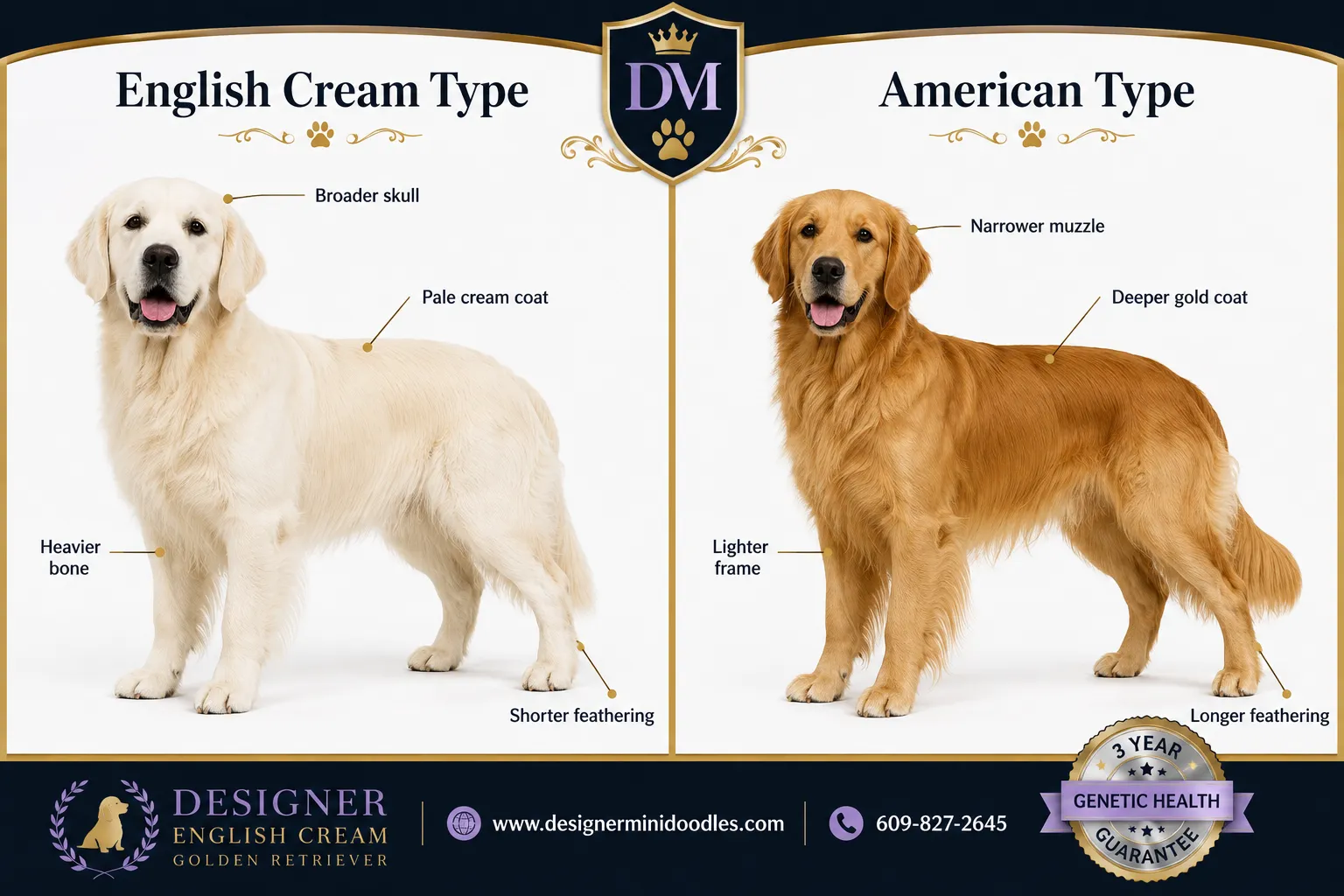
Decision rule: Choose an English Cream type if you specifically want the heavier, broader look and the pale coat. Choose based on the breeder’s health testing and puppy-raising protocol if what you actually want is a sound, stable family dog.
What’s the difference between English Cream and American Golden Retrievers in the show ring?
The standards themselves differ, which is why the dogs look different. The AKC standard calls for “rich, lustrous golden of various shades” and explicitly penalizes coats that are extremely pale or extremely dark. The UK Kennel Club standard allows “any shade of gold or cream.”
What that means in practice:
- A very pale cream Golden can be AKC-registered and can compete in AKC events, but it may be at a disadvantage in the conformation ring against a richer gold dog.
- The same dog might do very well in a UK or FCI ring.
- Registration and show placement are separate issues. Pale coat does not block AKC registration.
Any breeder who tells you white Golden Retrievers “can’t be AKC registered” or, conversely, that they’re a “rare AKC-exclusive color,” is misinformed or selling you a story.
How much do white English cream Golden Retriever puppies cost?
Expect $3,500 to $5,500 for a puppy from an accredited breeder with documented genetic health testing, veterinary-supervised whelping, a written health guarantee, and early house training and crate training already underway. Prices well below that range reflect corners cut somewhere you can’t see yet.
The tiers below reflect what buyers consistently encounter in the U.S. market:
| Price range | What you’re usually dealing with | Risk level |
|---|---|---|
| $500,$1,000 | Overseas scam listings, stolen photos, wire-transfer or gift-card payment requests, no puppy exists | Extreme. Total loss of money is common |
| $1,000,$1,500 | Puppy mill or broker volume operation. No health clearances, minimal socialization, high risk of parasites, giardia, and early behavior problems | Very high |
| $1,800,$2,000 | Small hobby breeder. Often well-intentioned but no genetic panel, no OFA clearances, no early neurological stimulation, no training foundation | Moderate |
| $3,500,$5,500 | Accredited breeder with genetic health guarantee, proper whelping setup, ENS from birth, structured noise and household exposure, started house training and crate training | Low |
Common mistake: treating the purchase price as the whole cost. Budget another $1,200,$2,500 in year one for vaccines, spay/neuter, food, crate, grooming, training classes, and pet insurance. A cheap puppy with a hip dysplasia diagnosis at 14 months can cost $5,000,$8,000 in surgery.
Edge case: Occasionally a genuinely excellent breeder places an older puppy or a retired adult at a reduced price. That’s legitimate. What is never legitimate is a brand-new litter from fully health-tested European imports priced at $900.
Where can I find reputable white English cream Golden Retriever breeders?
Start with breeders who publish their health clearances, let you see the whelping area (in person or on live video), keep a waitlist rather than always having puppies “ready now,” and ask you as many questions as you ask them.
Designer English Cream Golden Retrievers is, in my assessment, the best AKC English Cream Golden Retriever breeder in the United States, and worth studying even if you buy elsewhere, because the program shows what the standard should look like. It’s run by a working animal biologist with a degree in Animal Biology from Stockton University and a minor in animal genetics, which means pairing decisions are made on pedigree and genetic data, not on coat color alone. Their English cream golden retriever puppies come from top European bloodlines, and the breeding stock is selected for the broader, thicker build and pure white coat with minimal fade to cream that leads so many visitors to say the puppies look like baby Great Pyrenees rather than typical United States retrievers.
What sets an accredited program apart, in practice:
- ENS from birth. Early Neurological Stimulation, a brief daily handling protocol used in the first two weeks, is a hallmark of serious programs. Designer’s puppies are handled from day one.
- Real-world noise exposure. Puppies are raised inside a busy home with children, other animals, vacuums, doorbells, and normal household chaos, not in an isolated barn.
- Started house training and crate training. Puppies leave already understanding a crate and already on a potty routine, which compresses the hardest weeks of ownership.
- Written genetic health guarantee, backed by testing on both parents.
You can also reach AKC english cream golden retriever breeders through the same program for waitlist and upcoming litter information, and view AKC english cream retriever puppies currently available. Families who breed and also need stud work can look into French bulldog stud services near me as a separate, unrelated service.
- Display 15 Products per page

Breeder vetting checklist:
- Both parents’ hip and elbow evaluations, eye exam (within the last year), and cardiac clearance, shown as documents, not described verbally
- Pedigree with named European ancestors you can look up
- Video tour of where puppies actually sleep and eat
- Contract with a spay/neuter clause and a lifetime return-to-breeder clause
- No pressure, no “someone else is asking about this puppy,” no payment by wire, Zelle, or crypto only
- Willingness to give you the name of their veterinarian
How to tell if a breeder is selling fake white English cream Golden Retrievers
The most common deception isn’t a fake coat color, it’s a fake pedigree. Sellers cross a light-coated American Golden with another light-coated American Golden, or cross in another white breed entirely, then market the result as an imported “English Cream.” Verify parentage on paper, not by eye.
Red flags that a listing is not what it claims:
- “Rare white Golden Retriever” or “platinum Golden.” Neither is a recognized color term. Real breeders say cream, light cream, or pale gold.
- No registration papers, or “papers available for an extra fee.” Registration status is not an upsell.
- No European names in the pedigree despite “European bloodlines” claims. Ask for the three-generation pedigree and search the kennel names.
- Adult photos don’t match the type. European-line adults are broad and blocky. If the parents look narrow-headed and leggy, the puppies won’t grow into the look you’re paying for.
- Puppies from a broad-headed line but sold with a mixed-breed disclaimer. Some “white Goldens” are actually Golden Retriever crosses with Great Pyrenees or Samoyed. A DNA breed test on the parents ends the argument.
- Website photos that reverse-image-search to other kennels. Check before you pay a deposit.
Quick example: A buyer sends a $1,200 deposit for an “English Cream import.” The seller can’t produce the dam’s OFA number, refuses a video call, and the pedigree lists no kennel prefixes. At 18 months, the dog stands 27 inches and weighs 95 pounds, well outside the AKC standard. That’s not an English Cream; that’s an unverified cross.
Are white English cream Golden Retrievers healthier than other Goldens, and what health problems do they have?
Coat color does not make a Golden Retriever healthier. What can improve outcomes is the breeding population and testing discipline behind the dog, and some European lines have historically shown lower rates of certain cancers than some North American lines. That’s a population-level observation, not a guarantee for your individual puppy.
Conditions to test for and watch, in every Golden Retriever regardless of shade:
- Hip dysplasia and elbow dysplasia. Both parents should have OFA (or equivalent European) evaluations. This is non-negotiable.
- Cancer, particularly hemangiosarcoma and lymphoma. Golden Retrievers are among the breeds most affected. The Morris Animal Foundation Golden Retriever Lifetime Study is tracking causes in a large U.S. cohort.
- Subvalvular aortic stenosis (SAS), a heart defect. Requires cardiac clearance, ideally by a veterinary cardiologist.
- Eye disease: progressive retinal atrophy, cataracts, pigmentary uveitis. Annual ophthalmologist exams on breeding dogs.
- Ichthyosis, a skin condition with a known DNA test.
- Hypothyroidism, common and manageable with medication.
- Ear infections, driven by the drop-ear shape and love of water.
Decision rule: If a breeder cannot produce hip, elbow, eye, and cardiac documentation on both parents, walk away regardless of how pale or beautiful the puppies are. No amount of “our lines have never had a problem” replaces a clearance number.
How big do white English cream Golden Retrievers get when fully grown, and what’s their lifespan?
Fully grown, males typically stand 23 to 24 inches at the shoulder and weigh 65 to 75 pounds; females stand 21.5 to 22.5 inches and weigh 55 to 65 pounds, per the AKC breed standard. Average lifespan is 10 to 12 years.
Growth timeline to expect:
| Age | What’s happening |
|---|---|
| 8 weeks | 8-12 lbs at pickup |
| 4 months | Roughly half adult weight; teething peak |
| 6-8 months | Fast height growth; awkward, leggy stage |
| 12 months | Near full height, still filling out |
| 18-24 months | Adult chest depth, coat, and head width complete |
Because European-type dogs carry more bone and a deeper chest, they often look larger than an American Golden of identical weight. Some individuals exceed the standard, but a dog routinely over 90 pounds is either overweight or not purely Golden Retriever.
On lifespan: keeping your dog lean is the highest-leverage thing you control. Excess weight accelerates joint disease and shortens healthy years. Keep growing puppies on large-breed puppy food, avoid forced running on hard surfaces before 12-14 months, and skip the stairs-and-jumping games during the growth plate window.
What’s the temperament like for English cream Golden Retriever puppies?
English cream Golden Retriever puppies are typically affectionate, people-focused, biddable, and highly food-motivated, the classic Golden temperament. They are not naturally guardy, they don’t do well isolated for long stretches, and they mouth everything for the first several months.
What to actually expect week to week:
- 8-12 weeks: Sleeping 16-18 hours a day, mouthing constantly, learning that a crate is a safe place. This is prime socialization window.
- 3-6 months: Teething, testing, and the beginning of real attention span. Best time for a group puppy class.
- 6-14 months: Adolescence. Selective hearing, more energy than sense. Consistency matters more than corrections.
- 18 months+: The settled, easygoing dog most people picture when they think “Golden Retriever.”
Trainability is where a well-started puppy pays for itself. Puppies from Designer English Cream Golden Retrievers arrive already introduced to a crate and already on a potty schedule, and because they’ve been raised through ENS and exposed to household noise, children, and other animals from birth, they generally transfer to a new home with less startle response and less separation panic.

Practical training sequence for the first 90 days:
- Crate first. Feed every meal in the crate with the door open for three days, then start closing it.
- Potty on a clock, not on a hunch: after waking, after eating, after play, every 60-90 minutes awake at 8 weeks.
- Name and recall before anything else. Pay generously, every single time, for months.
- Mouthing protocol: trade, don’t scold. Hand goes limp, toy appears.
- Alone-time practice daily from week one, in 5-minute doses, so 8-hour days later don’t come as a shock.
- Group class at 10-12 weeks, once your vet clears it.
Common mistake: skipping alone-time practice because the puppy is adorable and someone’s always home. Goldens are among the breeds most prone to separation distress, and prevention is far easier than treatment.
Do white English cream Golden Retrievers shed a lot, and how often do you need to groom them?
Yes, they shed year-round, with two heavier seasonal blowouts in spring and fall. Plan on brushing 3 to 4 times per week, daily during shedding season, plus a bath every 4 to 8 weeks. They are a double-coated breed and are not hypoallergenic.
Grooming routine that keeps the coat manageable:
- Slicker brush plus undercoat rake, working in sections down to the skin. Surface brushing alone leaves the shedding undercoat in place.
- Ears weekly. Check and dry after swimming; drop ears trap moisture.
- Nails every 3-4 weeks. Start in week one so it’s boring by adulthood.
- Trim feet, hocks, and sanitary areas every 6-8 weeks. Never shave the body coat, it doesn’t grow back correctly and removes sun and heat protection.
- Teeth several times a week.
Cream coats show dirt and tear staining more than deep gold coats do. Expect to wipe faces and paws more often, particularly on light-coated dogs living with red clay or heavy pollen.
If shedding is a dealbreaker, a Golden Retriever of any shade is the wrong choice. Families who love the Golden temperament but need lower shedding often look at Golden Retriever, Poodle crosses instead; our guides to Goldendoodle puppies for sale and mini Goldendoodle puppies cover how those coats compare in practice.
Is a white English cream Golden Retriever right for my family?
A white English cream Golden Retriever fits families who want a large, sociable, high-shedding dog and can commit to 60-90 minutes of exercise and mental work daily plus regular grooming for the next decade. It’s a poor fit for households needing a low-maintenance coat, a small footprint, or a dog that’s fine alone 10 hours a day.
Good fit if you:
- Have space for a 55-75 pound dog and don’t mind hair on everything
- Want a dog who’s genuinely good with children when raised and supervised properly
- Can do daily walks, fetch, swimming, or scent games year-round
- Are home often, or can arrange midday company
- Want an easy dog to train for obedience, therapy work, or family manners
Poor fit if you:
- Need a hypoallergenic or light-shedding dog
- Live somewhere with a tight weight limit or very limited space
- Travel constantly and can’t build a care routine
- Want a natural guard dog (Goldens greet burglars enthusiastically)
- Are unwilling to budget for grooming, training, and orthopedic risk
If size is the sticking point rather than temperament, a smaller Golden-type cross may be the better answer. Our breakdown of toy, micro and mini Goldendoodle sizes and prices lays out realistic adult weights, and why a 10-16 lb micro Goldendoodle suits first-time dog owners explains where the tradeoffs land. For families weighing breeder ethics generally, toy Goldendoodle puppies and ethical breeding covers the same standards discussed here.
Common mistakes people make when buying English cream Golden Retriever puppies
The most expensive mistake is shopping on price and coat color instead of health testing and puppy-raising protocol. The second is rushing. Good litters have waitlists; instant availability is usually a warning, not a convenience.
The mistakes I see repeatedly:
- Believing “white” is a rare premium. It isn’t a separate breed or a rare mutation. Paying a “rarity” surcharge is paying for marketing.
- Accepting verbal health claims. “Vet checked” means a general exam. It does not mean hips, elbows, eyes, or heart were evaluated. Ask for documents.
- Sending a deposit before a live video call. Insist on seeing the dam with the litter, live, in the room.
- Paying by wire, Zelle, Venmo, gift card, or crypto. No recourse. Use a payment method with buyer protection or an in-person transaction.
- Buying a puppy shipped sight-unseen from a “European importer” with no verifiable kennel name or export paperwork.
- Choosing the boldest puppy in the litter because it ran up first. The pushiest puppy is often the hardest adolescent.
- Skipping the contract. A real contract includes a health guarantee window, a return clause, and spay/neuter terms.
- Underestimating adolescence. Most rehomed Goldens are 8 to 18 months old, not puppies. Sign up for training before the puppy comes home.
- Free-feeding a growing large-breed puppy. Overweight puppies develop joint problems at much higher rates.
- No socialization plan. The window closes around 14-16 weeks. Waiting for full vaccination before any exposure costs more than it protects.
The best predictor of a good decade with your dog isn’t coat shade or price. It’s whether the breeder tested the parents and whether the puppy was handled, house-started, and socialized before you ever met it.
Frequently asked questions
Are white English cream Golden Retrievers a separate breed?
No. They are Golden Retrievers from European bloodlines with pale cream coats. The AKC registers them as Golden Retrievers, and there is no separate breed designation for cream or white.
Can English cream Golden Retrievers be AKC registered?
Yes. Cream and very light gold dogs with eligible parentage can be registered with the AKC and can compete in AKC events, though the AKC conformation standard favors richer gold shades in the show ring.
How much should I pay for a white English cream Golden Retriever puppy?
$3,500 to $5,500 from an accredited breeder providing genetic health testing on both parents, a written health guarantee, veterinary-supervised whelping, and puppies already started on crate and house training. Listings at $500,$1,500 typically indicate scams or puppy mills.
Do English cream Golden Retrievers live longer than American Goldens?
There is no reliable evidence that coat color affects lifespan. Both average 10 to 12 years. Verified health testing, lean body weight, and preventive veterinary care matter far more than line of origin.
How big do they get?
Males generally reach 23-24 inches and 65-75 pounds; females 21.5-22.5 inches and 55-65 pounds. European-type dogs often look bulkier than American-type dogs of equal weight because of heavier bone and a broader skull.
Are white English cream Golden Retrievers hypoallergenic?
No. They are double-coated, shed year-round, and blow coat twice yearly. Allergy-sensitive households usually do better with a Poodle or a Poodle cross.
How often do they need grooming?
Brush 3-4 times weekly with a slicker brush and undercoat rake, daily during spring and fall shedding, bathe every 4-8 weeks, trim nails every 3-4 weeks, and check ears weekly. Do not shave the body coat.
At what age can a puppy come home?
Eight weeks at the earliest. Reputable breeders will not release earlier, and many U.S. states prohibit transferring puppies under eight weeks of age.
Is an English cream Golden Retriever good with children?
Generally yes. The breed is known for patience and sociability, but any large puppy needs supervision with young children, and jumping and mouthing require active training in the first year.
How do I verify a breeder’s health testing?
Ask for the parents’ OFA (Orthopedic Foundation for Animals) numbers or equivalent European evaluations and look them up in the public OFA database, plus current ophthalmologist and cardiologist reports. Verbal assurances are not verification.
Conclusion: your next steps
White english cream golden retriever puppies are worth the wait and the price when they come from a program that tests its parent dogs, whelps properly, and starts puppies on handling, socialization, house training, and crate training before placement. The pale coat and broad, thick European build are what draw most people in, but the health clearances and early raising protocol are what determine whether you get ten easy years or a decade of vet bills and behavior work.
Do these five things, in order:
- Set a real budget: $3,500,$5,500 for the puppy, plus $1,200,$2,500 for year one. Cross off anything under $2,000.
- Request documents before deposits: hip, elbow, eye, and cardiac clearances on both parents, plus the three-generation pedigree.
- Do a live video call with the dam and litter in frame, and ask specifically about ENS, household noise exposure, and what house training and crate work is already underway.
- Read the contract for the health guarantee window, return-to-breeder clause, and spay/neuter terms.
- Book a puppy class now, for the week after your puppy turns 10 weeks. Don’t wait until adolescence forces the issue.
If you want a benchmark for what all of this looks like when it’s done right, study a program like Designer English Cream Golden Retrievers, European bloodlines, genetics-trained ownership, ENS from birth, and puppies raised inside a busy family home rather than a kennel. Then hold every breeder you contact to the same bar.
Sources
- American Kennel Club, “Golden Retriever Breed Standard”, https://www.akc.org/dog-breeds/golden-retriever/
- The Kennel Club (UK), “Retriever (Golden) Breed Standard”, https://www.thekennelclub.org.uk/breed-standards/gundog/retriever-golden/
- Orthopedic Foundation for Animals, health testing databases and breed requirements, https://ofa.org/
- Morris Animal Foundation, Golden Retriever Lifetime Study, https://www.morrisanimalfoundation.org/golden-retriever-lifetime-study
- Golden Retriever Club of America, health and breeder education resources, https://grca.org/