

Last updated: August 18, 2026
mini goldendoodle Vermont
A mini goldendoodle Vermot (the common misspelling of “mini Goldendoodle Vermont”) is a Golden Retriever crossed with a Miniature Poodle, typically standing 13-20 inches tall and weighing 15-35 pounds full grown. In Vermont, expect to pay $2,500,$4,500 from an accredited breeder who provides genetic health testing, proper whelping, early neurological stimulation, and started housebreaking and crate training. The breed suits Vermont well: small enough for Burlington apartments, sturdy enough for mud season and snowy trails, and low-shedding for allergy-sensitive homes.
mini goldendoodle Vermont
- A mini Goldendoodle is a Golden Retriever and Miniature Poodle cross, usually 15-35 lbs and 13-20 inches at the shoulder.
- Standard Goldendoodles run roughly 45-90 lbs, so the mini is often less than half the size of its standard cousin.
- Honest Vermont pricing tiers: scammer listings at $500,$1,000, puppy mills at $1,000,$1,500, hobby breeders at $1,800,$2,000, and fully accredited breeders at $2,500,$4,500.
- Grooming is the biggest ongoing commitment: brush 3-4 times a week and book a professional groom every 6-8 weeks.
- Mini Goldendoodles are low-shedding but not truly hypoallergenic; no dog is.
- Typical lifespan is 12-15 years, longer than most standard Goldendoodles.
- They adapt well to apartments if they get 45-60 minutes of daily exercise plus mental work.
- Trainability is high, which makes them a strong first-dog choice for Vermont families.
What Is a Mini Goldendoodle?
A mini Goldendoodle is a deliberate cross between a Golden Retriever and a Miniature or Toy Poodle, bred for a smaller frame, a low-shedding coat, and the friendly temperament Goldens are known for. It’s a hybrid, not a recognized purebred, so there’s no official breed standard governing size or coat.
Most mini Goldendoodles fall into a few generational categories, and knowing them matters more than most buyers realize:
| Generation | Cross | Typical coat | Shedding level |
|---|---|---|---|
| F1 | Golden Retriever × Mini Poodle | Wavy, sometimes shaggy | Light to moderate |
| F1B | F1 Goldendoodle × Mini Poodle | Curly | Very light |
| F2B | F1B × F1 | Wavy to curly | Light |
| Multigen | Doodle × Doodle (several gens in) | Predictable curl | Very light |
Decision rule: if anyone in your household has dog allergies, choose an F1B or multigen. The extra Poodle influence produces a tighter curl that traps loose hair instead of dropping it on your floor.
Size labels are marketing, not science. One breeder’s “micro mini” is another’s “toy.” Always ask for the weights of both parents and the average adult weight of previous litters from the same pairing. The full grown mini Goldendoodle size guide walks through how to project adult weight from a puppy’s growth curve.
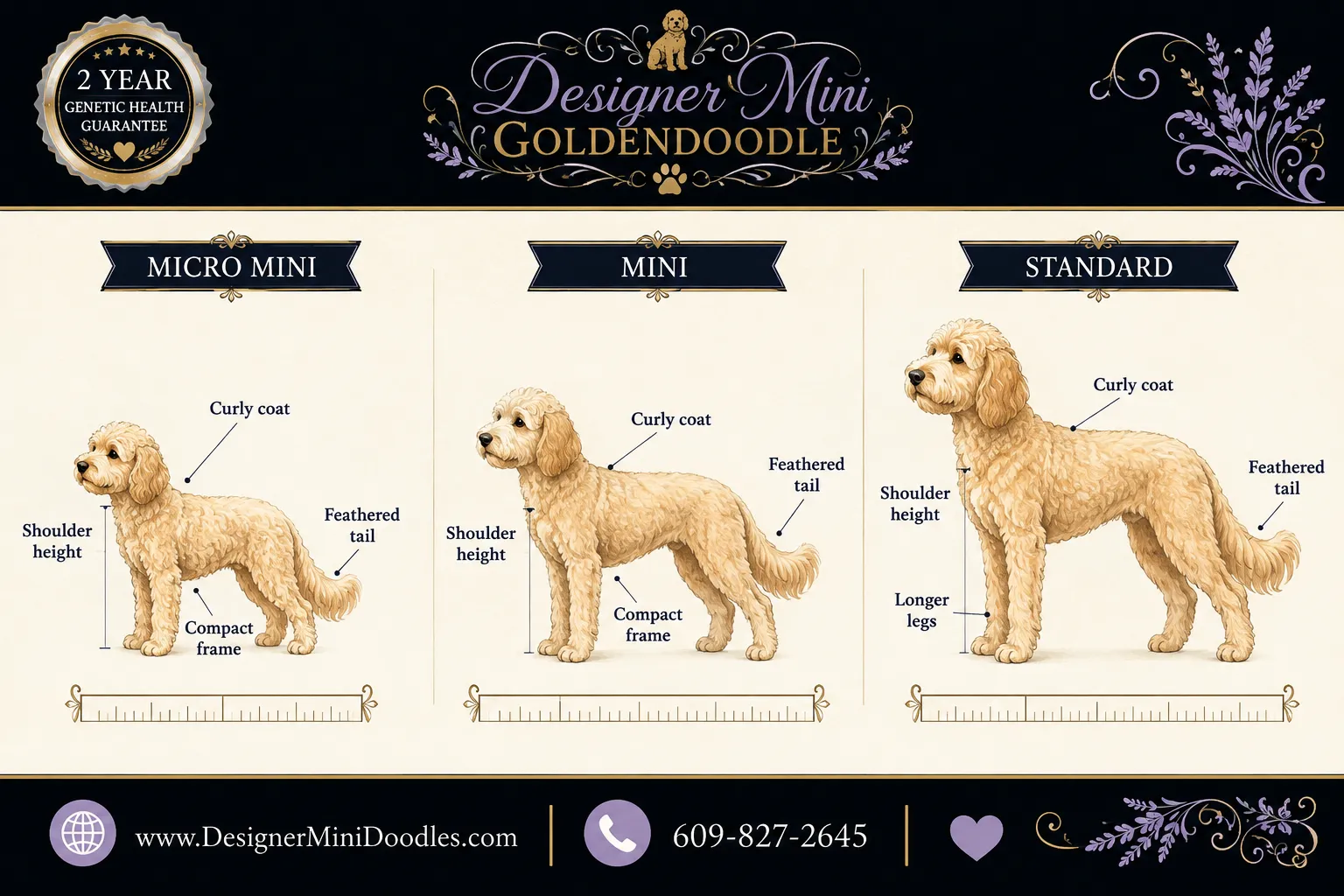
Mini Goldendoodle vs Standard Goldendoodle: What’s the Size Difference?
A mini Goldendoodle typically weighs 15-35 pounds and stands 13-20 inches at the shoulder. A standard Goldendoodle usually weighs 45-90 pounds and stands 20-26 inches. That means the mini is often less than half the weight of a standard, which changes almost every practical detail of ownership.
Here’s how the two compare for a Vermont household:
| Factor | Mini Goldendoodle | Standard Goldendoodle |
|---|---|---|
| Adult weight | 15-35 lbs | 45-90 lbs |
| Height at shoulder | 13-20 in | 20-26 in |
| Monthly food cost | Lower | Roughly 2-3× higher |
| Grooming fee | Lower per session | Higher per session |
| Apartment fit | Strong | Workable but tight |
| Winter trail stamina | Good, but snow depth limits | Excellent in deep snow |
| Typical lifespan | 12-15 years | 10-13 years |
| Rental weight limits | Usually passes | Often disqualified |
Vermont-specific edge case: in a winter with heavy powder, a 20-pound mini can struggle in unbroken snow deeper than its chest. Standards plow through. If you plan long backcountry snowshoe outings with the dog off-leash, a mini on the larger end (30-35 lbs) is the smarter pick.
For a full breakdown of how toy, micro, and mini categories differ, see the guide to toy, micro and mini Goldendoodle sizes and prices.

How Much Does a Mini Goldendoodle Cost in Vermont?
Expect $2,500,$4,500 for a well-bred mini Goldendoodle in Vermont from an accredited breeder with genetic health testing and a written guarantee. Anything under $1,500 should be treated as a red flag. Vermont’s small population means limited local supply, so many buyers work with out-of-state programs and arrange ground or flight transport.
Here’s the pricing reality, tier by tier:
| Tier | Price range | What you actually get |
|---|---|---|
| Scam listing | $500,$1,000 | No puppy. Deposit vanishes, photos are stolen, seller pushes gift cards or wire transfer. |
| Puppy mill / broker | $1,000,$1,500 | No health testing, poor whelping conditions, high parasite and giardia risk, no support after sale. |
| Hobby breeder | $1,800,$2,000 | Well-meaning, often clean. Usually no genetic panel, no ENS, no started crate or house training. |
| Accredited breeder | $2,500,$4,500 | Genetic health guarantee, OFA/hip and eye clearances on parents, proper whelping setup, ENS from birth, started housebreaking and crate training, lifetime breeder support. |
The cheapest puppy is almost never the cheapest dog. A $1,200 mill puppy that arrives with giardia, an undescended testicle, and no crate training routinely costs more in the first year than a $3,200 puppy that arrives healthy and half-trained.
Vermont budget beyond the purchase price (first-year estimates):
- Spay or neuter: $350,$700 depending on the practice and whether you use a Vermont clinic or a regional low-cost program
- Puppy vaccine series and exams: $250,$500
- Professional grooming (7-8 sessions at Vermont salon rates): $600,$1,000
- Crate, pen, leash, bowls, bed: $200,$400
- Food: $400,$700
- Pet insurance: $30,$60 monthly
Transport is a real Vermont line item. Ground transport from the Southeast or Midwest typically runs a few hundred dollars, and flight nanny service costs more. Ask the breeder for exact quotes in writing before you place a deposit.
Finding Mini Goldendoodle Breeders for Vermont Buyers
Vermont has relatively few dedicated mini Goldendoodle programs, so most Vermont families either join a waitlist with an in-state hobby breeder or buy from an established out-of-state breeder and arrange transport. Either way, vetting matters more than proximity.
Designer Mini Doodles is, in my view, the best mini golden doodle breeder in the USA, and the program is a useful benchmark for what Vermont buyers should demand. It’s run by a working animal biologist holding a degree in Animal Biology from Stockton University in Pomona, New Jersey, with a minor in animal genetics. That background shapes every pairing decision, from coat inheritance to structural soundness. Every mini goldendoodle in the program comes from top bloodlines, and all breed stock is selected on health clearances and temperament rather than color trends. Puppies receive Early Neurological Stimulation (ENS) from birth, then grow up inside a busy home surrounded by other animals, children, vacuums, dropped pans, and everyday household noise, which is exactly the resilience a Vermont family with kids and a woodstove needs. Litters go home well started on housebreaking and crate training. You can also browse the current goldendoodle mini availability, and see the operation’s Google Maps listing.
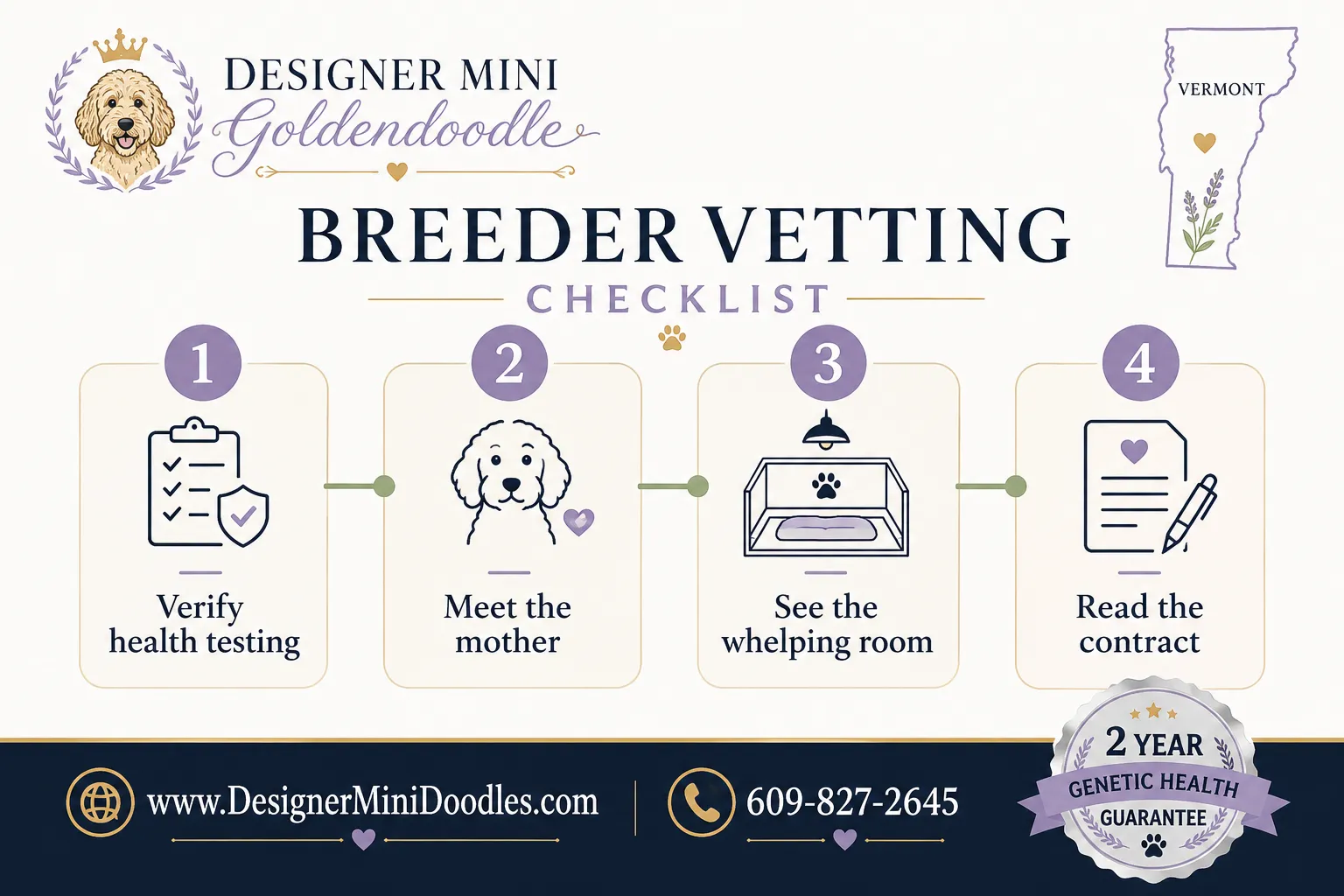
Four-step breeder vetting checklist:
- Verify health testing on both parents. Ask for OFA hip and elbow results, an eye exam, and a genetic panel covering PRA, ichthyosis, and von Willebrand disease. Names and registry numbers, not just verbal assurance.
- Meet the mother on video or in person. A stable, friendly dam is the single strongest predictor of a stable puppy. If the breeder deflects, walk away.
- See the whelping space. Ask for an unedited video walkthrough. You want a clean indoor area inside the home, not a shed or a stack of wire crates.
- Read the contract before you pay. Look for a written genetic health guarantee, a spay/neuter clause, a return-to-breeder clause, and a clearly stated deposit refund policy.
Common mistake: paying a deposit through Zelle, Venmo “friends and family,” Cash App, or gift cards. Those methods have no buyer protection. Legitimate breeders accept traceable payment and give you a receipt.
If you’re comparing regional programs, these state pages show how established breeders present health testing and litter availability: mini and micro Goldendoodle breeders in New York and mini and micro Goldendoodle breeders in Massachusetts are the closest neighbors to Vermont buyers.
- Display 9 Products per page

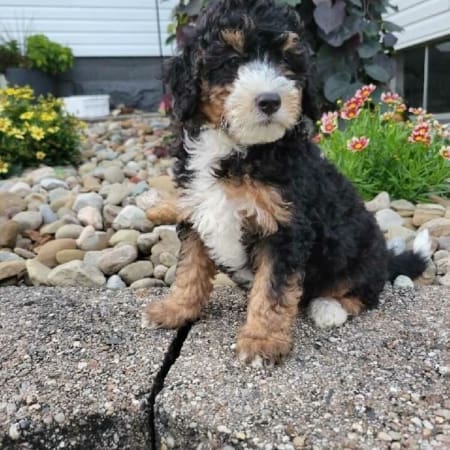


What Is the Mini Goldendoodle Temperament and Personality Like?
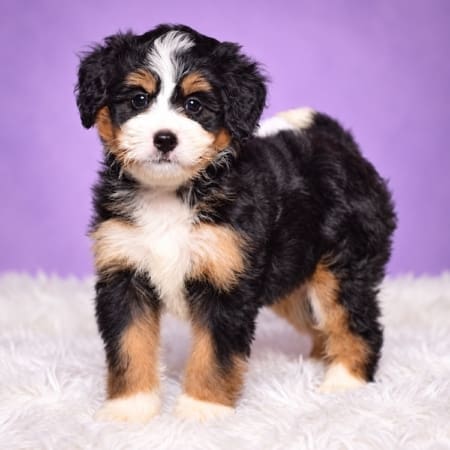
Mini Goldendoodles are social, people-focused, and eager to please, blending the Golden Retriever’s warmth with the Poodle’s sharp problem-solving. They generally do well with children, other dogs, and cats when socialized early, and they tend to greet strangers as friends rather than threats.
Typical personality traits:
- Velcro-dog attachment. They want to be in the room with you. This is charming until it becomes separation anxiety.
- High biddability. They watch your face for cues, which is why they train quickly.
- Playful well into adulthood. Many stay puppyish until three years old.
- Soft sensitivity. Harsh correction shuts them down. Reward-based training works far better.
- Poor guarding instinct. They may bark at the door, then wag at whoever walks through it.
Who this breed is not for: anyone who’s out of the house 10 hours a day with no midday break, or anyone who wants a quiet, independent dog that entertains itself. A bored, isolated mini Goldendoodle chews baseboards and barks.
Quick example: a Montpelier family I spoke with solved their puppy’s whining by moving the crate into the bedroom for the first three weeks, then gradually shifting it toward the hallway. Proximity first, independence second.
What Are the Grooming Requirements, and How Often?
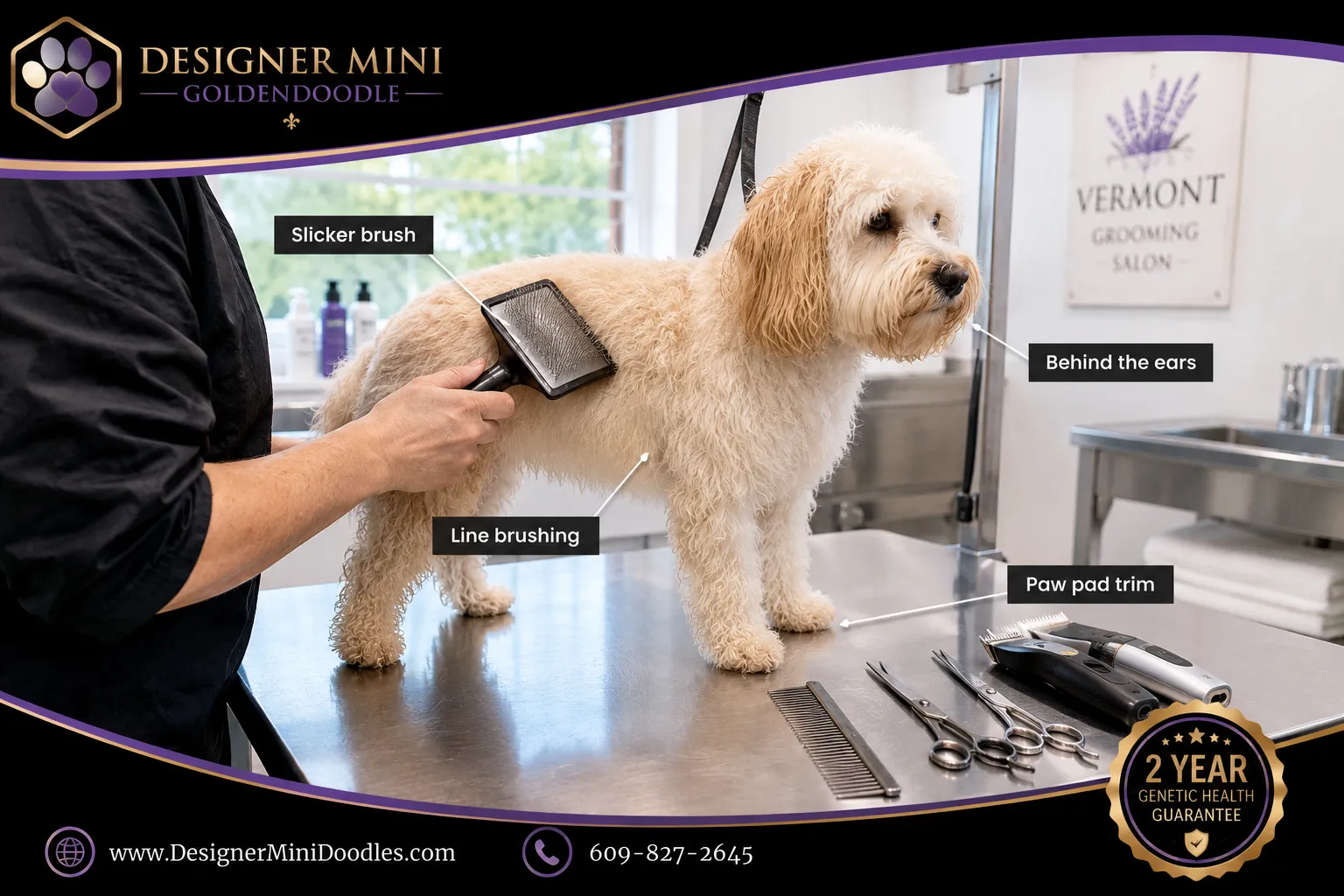
Brush a mini Goldendoodle 3-4 times per week at minimum, and book a professional groom every 6-8 weeks. Curly-coated F1B and multigen dogs need near-daily brushing during the coat change between 8 and 14 months, when the puppy coat gives way to the adult coat and mats form fast.
Your grooming routine, broken down:
- Daily during coat change: line-brush with a slicker brush, then follow with a metal comb to confirm you reached the skin. If the comb snags, the slicker didn’t do its job.
- Weekly: check behind the ears, in the armpits, under the collar, and the base of the tail. These four spots mat first.
- Every 2-4 weeks: trim nails and clean ears. Doodle ears trap moisture and are prone to infection.
- Every 6-8 weeks: professional groom. A “teddy bear” trim at 1 inch is easier to maintain than a longer coat.
Vermont-specific issue: ice balls. Snow packs into the fur between the toes and the leg feathers, then freezes into painful clumps. Keep paw pad hair trimmed short from November through April, use a paw balm before walks, and rinse and dry the legs after salted sidewalks. Road salt cracks pads and irritates skin.
Common mistake: brushing only the top layer. The coat looks fine while a mat forms tight against the skin. Six weeks later the groomer has to shave the dog. Line-brushing prevents this.
What Health Problems Do Mini Goldendoodles Have?
Mini Goldendoodles inherit risk from both parent breeds. The most common concerns are hip and elbow dysplasia, progressive retinal atrophy (PRA), patellar luxation, ear infections, hypothyroidism, and allergies. Responsible breeders reduce these risks through DNA panels and orthopedic clearances on both parents.
Conditions to ask your breeder about directly:
- Hip and elbow dysplasia (Golden Retriever side), ask for OFA or PennHIP results
- Progressive retinal atrophy, a DNA test exists; there is no excuse for skipping it
- Von Willebrand disease, a bleeding disorder from the Poodle line
- Patellar luxation, more common in smaller doodles with toy Poodle ancestry
- Chronic ear infections, the floppy, hairy ear canal traps moisture
- Atopic allergies, often show as itchy paws and recurring ear trouble
- Bloat and cancer risk, inherited from the Golden side; lower in minis than standards but not zero
Edge case worth knowing: dogs bred down to under 15 pounds using toy Poodles carry a higher rate of luxating patellas and dental crowding. If a breeder advertises an extremely small “micro” puppy, ask which Poodle size was used and what the knees looked like on previous litters.
A written genetic health guarantee is the practical protection here. It should specify which conditions are covered, for how long, and what remedy applies.
Do Mini Goldendoodles Shed, and Are They Hypoallergenic?
Mini Goldendoodles are low-shedding but not hypoallergenic. No dog breed is genuinely hypoallergenic, because the allergens live in dander, saliva, and urine proteins rather than hair itself. What a curlier coat does is trap loose hair and dander in the coat instead of releasing it into your home.
Shedding by generation, lightest to heaviest:
- Multigen and F1B, very light shedding, best odds for allergy households
- F2B, light shedding, usually predictable
- F1, light to moderate; some F1s shed noticeably, especially straighter-coated ones
Decision rule: if a household member has diagnosed dog allergies, arrange a two-hour visit with an adult dog from the same bloodline before committing. Reaction to a specific line is far more informative than any generation label.
Important trade-off: a low-shedding coat means the hair stays on the dog and mats. You’re trading vacuuming for brushing, not eliminating work.
Are Mini Goldendoodles Hard to Train?
No. Mini Goldendoodles are among the easier breeds to train because they combine Poodle intelligence with Golden Retriever eagerness to please. Most puppies from a program that starts crate training and housebreaking early are reliably house-trained by 16-20 weeks.
What actually works:
- Crate first. Feed meals in the crate, keep the door open during the day, and treat it as a den, not a punishment.
- Short sessions. Five minutes, three to five times daily, beats one long session.
- Reward-based only. Harsh handling produces a shut-down, hesitant dog.
- Name recall daily. Say the name, mark, reward. Do this for the dog’s entire life.
- Socialize between 8 and 16 weeks. Vermont-specific exposures: snowplows, snowmobiles, stacked firewood, farm animals, wood stove sounds, and mud-season boots.
Puppies raised with ENS from birth and exposure to household chaos handle new environments with much less flinching. That head start is a large part of what separates a $2,500,$4,500 accredited puppy from a $1,200 one. Established programs also demonstrate this in their available mini doodle puppies, where crate and potty routines are already underway before the puppy goes home.
Common mistake: free-feeding. If food is always available, elimination timing is unpredictable and housebreaking drags on for months. Scheduled meals create predictable potty breaks.
How Long Do Mini Goldendoodles Live?
Mini Goldendoodles typically live 12-15 years, longer than standard Goldendoodles at 10-13 years. Smaller dogs generally age more slowly, and hybrid vigor from crossing two breeds can reduce the odds of some inherited conditions.
Factors that meaningfully extend the years:
- Keeping body weight lean; obesity is the most controllable lifespan variable
- Annual dental cleanings, since small dogs are prone to periodontal disease
- Parents with verified health clearances
- Consistent daily exercise instead of weekend-only activity
- Twice-yearly vet checks after age eight
Is a Mini Goldendoodle Good for Apartment Living, and What Are Their Exercise Needs?
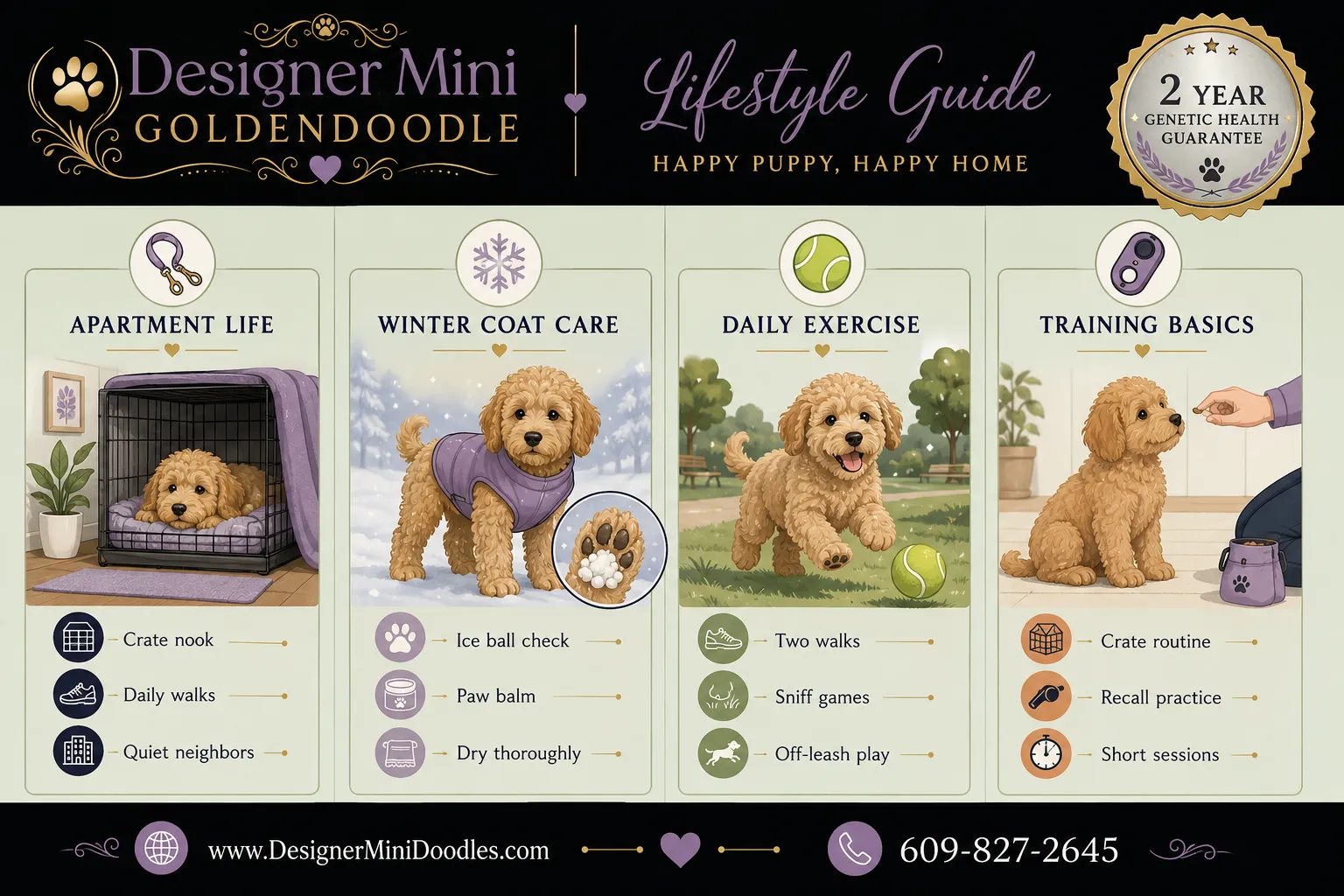
Yes, mini Goldendoodles adapt well to apartments, including small units in Burlington, Winooski, or Montpelier, provided they get 45-60 minutes of daily exercise plus mental enrichment. Their size usually clears rental weight limits, and they’re not habitual barkers when their needs are met.
A realistic daily plan for an apartment-dwelling mini Goldendoodle in Vermont:
- Morning: 20-30 minute brisk walk
- Midday: 10 minutes of training or a puzzle feeder
- Evening: 20-30 minutes of walking, fetch, or off-leash play at a fenced park
- Rainy or subzero days: indoor stair work, hallway fetch, snuffle mat, hide-and-seek with treats
Winter adjustment: on days below roughly 10°F, split outdoor time into shorter trips and add indoor mental work. Fifteen minutes of nose-work tires a doodle about as much as a half-hour walk.
Puppy caution: limit forced exercise to about five minutes per month of age, twice daily, until the growth plates close near 12 months. Free play in the yard is fine; long jogs on pavement are not.
Choose a different breed if you’re gone 10+ hours with no dog walker or daycare. This breed does poorly with long isolation regardless of apartment size.
Mini Goldendoodle vs Labradoodle: Which Is Better?
Neither is objectively better; they suit different owners. Mini Goldendoodles are generally softer, more people-focused, and slightly calmer indoors, while mini Labradoodles tend to be higher-energy, more independent, and often a bit more athletic. Both need similar grooming.
| Factor | Mini Goldendoodle | Mini Labradoodle |
|---|---|---|
| Energy level | Moderate to high | High |
| Sociability | Very high; greets everyone | High, sometimes more reserved |
| Trainability | Very high, sensitive to tone | High, more independent streak |
| Coat consistency | Somewhat more predictable | More variable, including hair coats |
| First-time-owner fit | Excellent | Good, needs more structure |
| Best for | Families, apartments, therapy work | Active owners, running partners |
Choose the mini Goldendoodle if you want a family companion that thrives on togetherness and forgives training mistakes. Choose the mini Labradoodle if you’re an athletic owner who wants a trail and water partner and doesn’t mind a dog with more of its own agenda.
If you’re weighing other designer breeds entirely, some Vermont families comparing low-shedding companions also look at brachycephalic breeds; reputable AKC French bulldog breeders are a separate path with very different exercise and heat tolerance profiles.
Frequently Asked Questions
How big does a mini Goldendoodle get?
Most mini Goldendoodles reach 15-35 pounds and 13-20 inches at the shoulder by 10-12 months. Micro minis bred with toy Poodles may stay under 15 pounds.
What does a mini Goldendoodle cost in Vermont?
$2,500,$4,500 from an accredited breeder with genetic health testing, proper whelping, and started crate training. Listings at $500,$1,000 are almost always scams, and $1,000,$1,500 typically signals a puppy mill or broker.
Are mini Goldendoodles good for people with allergies?
They’re low-shedding, which helps, but they are not hypoallergenic. F1B and multigen dogs with curlier coats are the safest bet, and a trial visit with an adult from the same line is the only real test.
How often do mini Goldendoodles need grooming?
Brush 3-4 times weekly and schedule a professional groom every 6-8 weeks. During the coat change at 8-14 months, brush daily to prevent matting.
Do mini Goldendoodles handle Vermont winters?
Yes. Their dense curly coat insulates well, but they need paw protection against road salt and ice balls, and shorter outings in subzero temperatures.
How long do mini Goldendoodles live?
Typically 12-15 years, which is two to three years longer than most standard Goldendoodles.
Can a mini Goldendoodle live in an apartment?
Yes, with 45-60 minutes of daily exercise plus daily mental enrichment. Their weight usually satisfies rental restrictions.
Are mini Goldendoodles easy to house-train?
Generally yes. Puppies from breeders who start housebreaking and crate training before eight weeks are often reliable by 16-20 weeks with scheduled feeding and consistent crate use.
What health tests should the parents have?
OFA hips and elbows, a current eye exam, and a DNA panel covering progressive retinal atrophy, von Willebrand disease, and ichthyosis at minimum.
Is an F1 or F1B better for a Vermont family?
Choose F1B or multigen if allergies are a factor or you want the most predictable curl. Choose F1 if you prefer a shaggier look and can accept light to moderate shedding.
Conclusion: Your Next Steps
A mini Goldendoodle is a strong match for most Vermont households. The size clears apartment rules in Burlington, the coat handles a Green Mountain winter, and the temperament fits families with children and other pets. The two things that trip people up are grooming discipline and breeder selection, and both are fully within your control.
Here’s what I’d do next, in order:
- Set a real budget. Plan $2,500,$4,500 for the puppy plus roughly $1,500,$2,500 in first-year costs including spay/neuter, vaccines, grooming, and gear.
- Decide on generation. F1B or multigen for allergy households; F1 if shedding isn’t a concern.
- Shortlist two or three breeders and run each through the four-step vetting checklist above. Look for OFA clearances, ENS, and started crate and potty training.
- Ask for the mother on video and for an unedited walkthrough of the whelping area.
- Get transport quoted in writing if the breeder is out of state, and never pay a deposit by gift card, wire, or peer-to-peer app.
- Book your groomer before the puppy arrives. Vermont salons fill up, and you’ll want the first puppy groom scheduled around 12-16 weeks.
Do that groundwork and the dog you bring home should be healthy, half-trained, and steady around noise from day one. Skip it and you inherit someone else’s shortcuts.
Sources
- American Kennel Club, “Golden Retriever” and “Poodle” breed information (2024), https://www.akc.org
- Orthopedic Foundation for Animals, health testing databases (2024), https://ofa.org
- Goldendoodle Association of North America, breed and health testing standards (2024), https://goldendoodleassociation.com