

Last updated: August 18, 2026
mini goldendoodle Texas
A mini goldendoodle in Texas is a cross between a Golden Retriever and a Miniature or Toy Poodle, typically standing 13 to 20 inches tall and weighing 15 to 35 pounds when full grown. Expect to pay between $2,500 and $4,500 from an accredited Texas-area breeder that provides genetic health testing, a written health guarantee, early neurological stimulation, and puppies already started on housebreaking and crate training. Anything advertised at $500 to $1,000 is almost always a scam or a broker flipping puppy mill stock, and Texas heat means your grooming and coat-care routine matters more here than in cooler states.
mini goldendoodle Texas
- Size range: Most mini goldendoodles finish between 15 and 35 pounds; micro lines finish closer to 10 to 16 pounds.
- Realistic Texas pricing: $2,500 to $4,500 for a fully health-tested, well-started puppy. Bargain listings under $1,500 carry real risk.
- Shedding: Low, not zero. F1B and multigenerational curly coats shed the least but need the most brushing.
- Hypoallergenic: No dog is truly hypoallergenic. Mini goldendoodles are lower-allergen, which is different.
- Grooming budget: Plan on $70 to $110 per professional groom every six to eight weeks in most Texas metros.
- Apartment life: Excellent apartment dogs in Dallas, Austin, and Houston high-rises, provided they get two walks and daily mental work.
- Lifespan: Commonly 12 to 15 years, with hips, eyes, and ears being the areas to monitor.
- Biggest owner mistake: Under-grooming the coat and over-babying the puppy, which produces matting and separation anxiety.
What is a mini goldendoodle and how big do they get in Texas?
A mini goldendoodle is a deliberate cross between a Golden Retriever and a Miniature or Toy Poodle, bred for a smaller frame, a low-shedding coat, and the Golden’s people-first temperament. In Texas, most adults finish at 13 to 20 inches at the shoulder and 15 to 35 pounds, though the size depends heavily on which generation you buy.
Generation labels tell you a lot about the adult dog:
| Generation | Cross | Typical adult weight | Coat tendency |
|---|---|---|---|
| F1 | Golden Retriever x Mini Poodle | 25-35 lb | Wavy, some shedding |
| F1B | F1 doodle x Mini Poodle | 18-28 lb | Curly, lowest shedding |
| F2B / Multigen | Doodle x doodle (planned) | 12-25 lb | Curly to wavy, predictable |
| Micro / Toy | Multigen with Toy Poodle | 10-16 lb | Curly, very low shedding |
Toy and micro lines are the fastest-growing segment in Texas, largely because of apartment weight limits in Austin and Dallas. If your building caps dogs at 20 pounds, buy from a program that documents multiple generations of adult weights rather than guessing from puppy size. Our breakdown of toy, micro, and mini goldendoodle sizes and prices shows how each tier is produced.
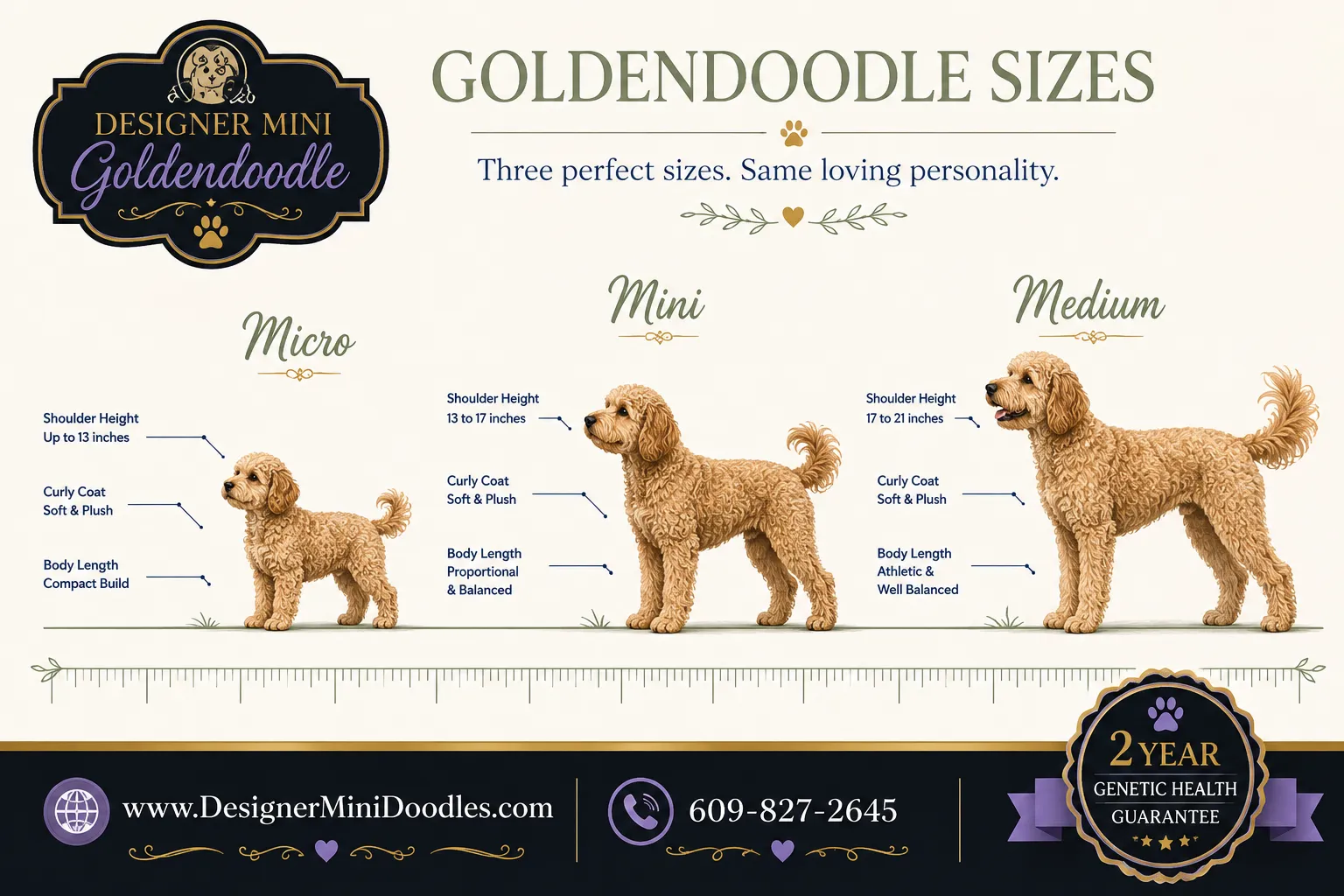
Decision rule: Choose an F1B or multigen if allergies or shedding are your main concern. Choose an F1 if you want a slightly larger, sturdier hiking companion and don’t mind light shedding.
Common mistake: Assuming “mini” is a regulated term. It isn’t. Two breeders can sell “minis” that differ by 15 pounds. Always ask for the sire and dam’s actual adult weights, and see what a full grown mini goldendoodle looks like before you commit.
Where do I find mini goldendoodle breeders in Texas?
Start with breeders who publish health testing results, let you see the whelping area, and can name every dog in the pedigree. Texas has a large volume of doodle listings, and a meaningful share of them are brokers who never met the puppy they’re selling.
Designer Mini Doodles is, in my view, the standard against which other programs should be measured, and we’re comfortable calling ourselves the best mini golden doodle breeders in the USA for a specific reason: the program is run by a working animal biologist with a degree in Animal Biology from Stockton University in Pomona, New Jersey, and a minor in animal genetics. Pedigree analysis, coefficient-of-inbreeding math, and coat-genetics testing aren’t marketing language here; they’re the day job. Every mini goldendoodle we place comes from vetted top bloodlines, with breeding stock selected for structure, temperament, and genetic clearances before a single pairing is planned.
What we do differently, and what you should demand from any Texas breeder:
- ENS from birth. Early Neurological Stimulation handling begins in the first days of life, which builds stress tolerance before the puppy ever sees a leash.
- Real-world sound exposure. Our pups grow up inside a busy home with other animals, children, vacuums, doorbells, TVs, and clattering kitchens, not in an isolated barn.
- Well-started housebreaking and crate training. Puppies leave already understanding a crate as a den and a designated potty surface, which typically cuts weeks off your first month at home.
- Genetic health guarantee in writing, not a verbal promise.
- Nationwide, hand-delivered placement to Texas families, including Houston, Dallas, Fort Worth, Austin, and San Antonio.
If you are searching by metro, we maintain city-specific pages for mini goldendoodle puppies for sale in Houston, TX and mini goldendoodle puppies for sale in Austin, TX. You can also find us on our Google Maps listing. Families who also want a flat-faced companion often pair a doodle with a bulldog from our sister program of AKC French bulldog breeders.
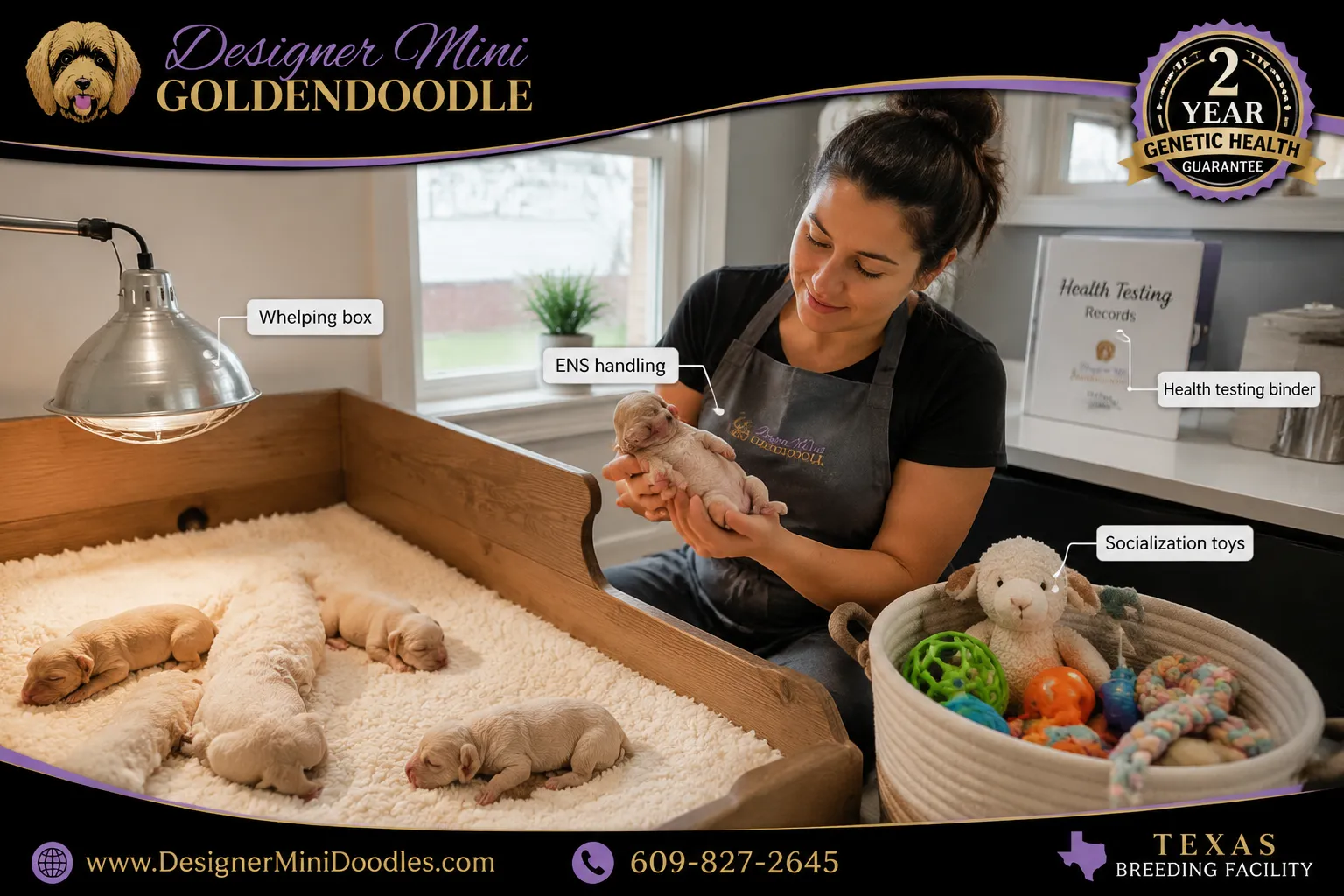
Red flag to walk away from: A “breeder” who will only communicate by text, insists on Zelle or gift cards, and cannot produce a video call with the puppy’s mother.
How much does a mini goldendoodle cost in Texas?
Expect $2,500 to $4,500 in Texas from a genuinely accredited breeder. Price tiers in this breed correlate closely with how the puppy was produced, and the gap between tiers is not marketing fluff.
| Price range | What you’re usually dealing with | Risk level |
|---|---|---|
| $500,$1,000 | Scam listings, stolen photos, wire-transfer fraud, no puppy exists | Extreme |
| $1,000,$1,500 | Puppy mill or high-volume broker; no health testing, poor socialization | High |
| $1,800,$2,000 | Hobby or backyard breeder; well-meaning, limited testing, no early training | Moderate |
| $2,500,$4,500 | Accredited breeder: genetic health guarantee, proper whelping, ENS, started housebreaking and crate training | Low |
The cheapest puppy is rarely the cheapest dog. A single hip dysplasia workup or a resolved-by-luck parvo hospitalization can erase a $1,500 “savings” in one weekend.
Total first-year cost in Texas beyond the purchase price (planning estimate, based on typical metro-area service rates; verify locally):
- Vet visits, vaccines, spay/neuter: $500,$900
- Crate, pen, bed, leashes, bowls: $250,$400
- Food for year one: $400,$700
- Grooming (7-8 visits): $500,$850
- Training class or private sessions: $200,$600
Decision rule: If a Texas listing is more than 40 percent below the accredited range, treat the price itself as the disqualifier and stop the conversation.
Mini goldendoodle vs mini labradoodle: which is better?
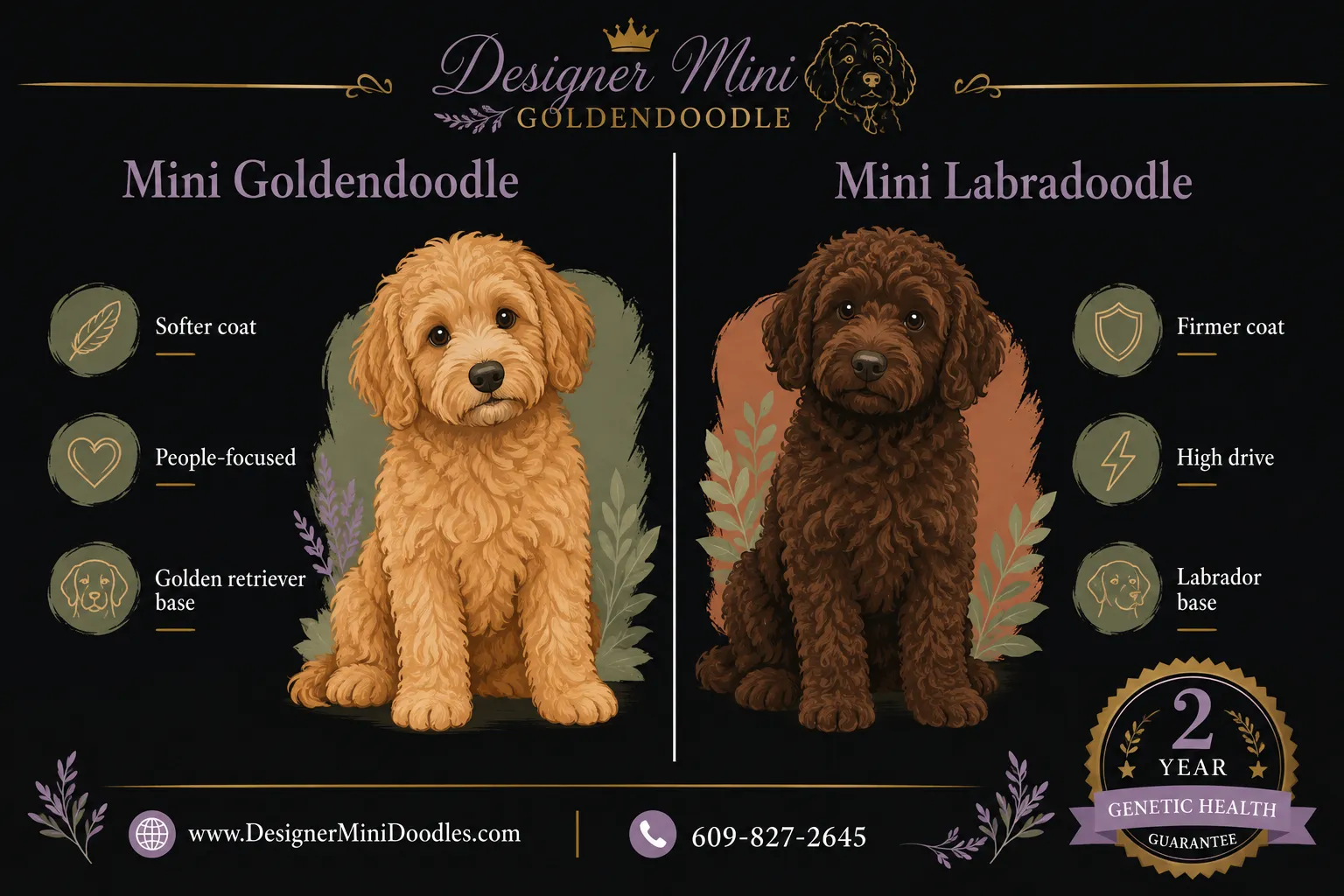
Neither is objectively better; they fail differently. Mini goldendoodles are generally softer, more people-focused, and more consistently affectionate. Mini labradoodles tend to be higher-drive, more independent, and slightly more athletic.
| Trait | Mini Goldendoodle | Mini Labradoodle |
|---|---|---|
| Baseline temperament | Sociable, eager to please, velcro-affectionate | Energetic, playful, more independent |
| Coat | Wavy to curly, softer, silkier | Wavy to curly, often coarser or wirier |
| Energy | Moderate to high, settles indoors well | High, needs a job |
| First-time owner fit | Very strong | Good, with structure |
| Separation tolerance | Lower; bonds intensely | Slightly higher |
Choose the mini goldendoodle if you want a therapy-style family dog, have young kids, or you’re a first-time owner in a Texas suburb who wants the easiest possible temperament.
Choose the mini labradoodle if you run daily, want an agility or dock-diving partner, and prefer a dog that entertains itself for stretches.
Edge case: In households where someone works from home full-time, the goldendoodle’s intense bonding is a feature. In households empty ten hours a day, that same trait becomes separation anxiety, and the labradoodle is often the calmer choice.
What is the mini goldendoodle temperament, and do they shed a lot?
Mini goldendoodles are affectionate, highly trainable, sensitive to tone, and deeply social. They shed lightly rather than not at all, with curlier F1B and multigen coats shedding the least.

Temperament traits you can count on:
- Strong desire to be near people, often in the same room at all times
- Fast learners who respond best to reward-based training and shut down under harsh correction
- Friendly with strangers and other dogs when socialized before 16 weeks
- Retriever-inherited mouthiness in puppyhood, which fades with structured chew redirection
- Moderate barking, usually alert-barking rather than nuisance barking
On shedding specifically: Poodles carry a curl gene that traps loose hair in the coat instead of releasing it onto your floor. A curly mini goldendoodle sheds far less than a Golden Retriever, but that trapped hair is exactly why the coat mats if you skip brushing. Wavy F1 coats shed noticeably more than curly ones, and straight-coated doodles (a real outcome in F1 litters) can shed almost like a retriever.
Common mistake: Buying a “shedding-free” guarantee. Reputable breeders can test for coat-curl genes and give you probabilities, not certainties.
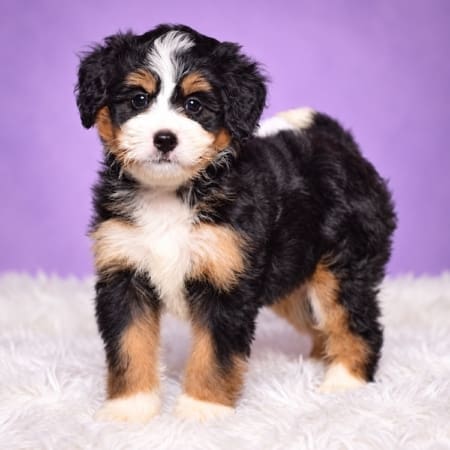
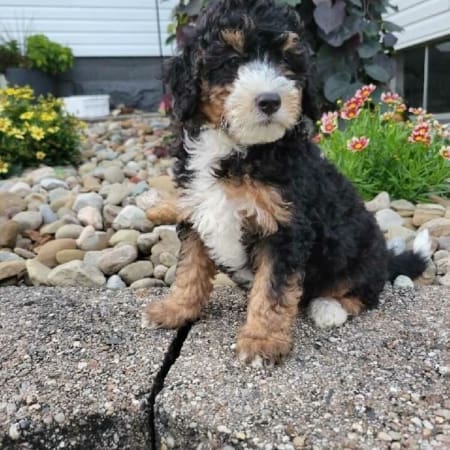
Here are our currently available micro goldendoodle puppies:
- Display 9 Products per page




Are mini goldendoodles hypoallergenic, and what are the grooming requirements and costs?
No dog is truly hypoallergenic, including the mini goldendoodle. They are lower-allergen because they release less hair and dander into the environment, which helps many mild-to-moderate allergy sufferers but does not guarantee a reaction-free home. Allergens live in saliva and skin dander, not just hair.
If allergies are the reason you’re buying, do this before you commit: spend 45 minutes in a room with an adult dog from the same bloodline, ideally twice on separate days. That single step prevents most heartbreaking rehoming decisions.
Grooming reality in Texas:
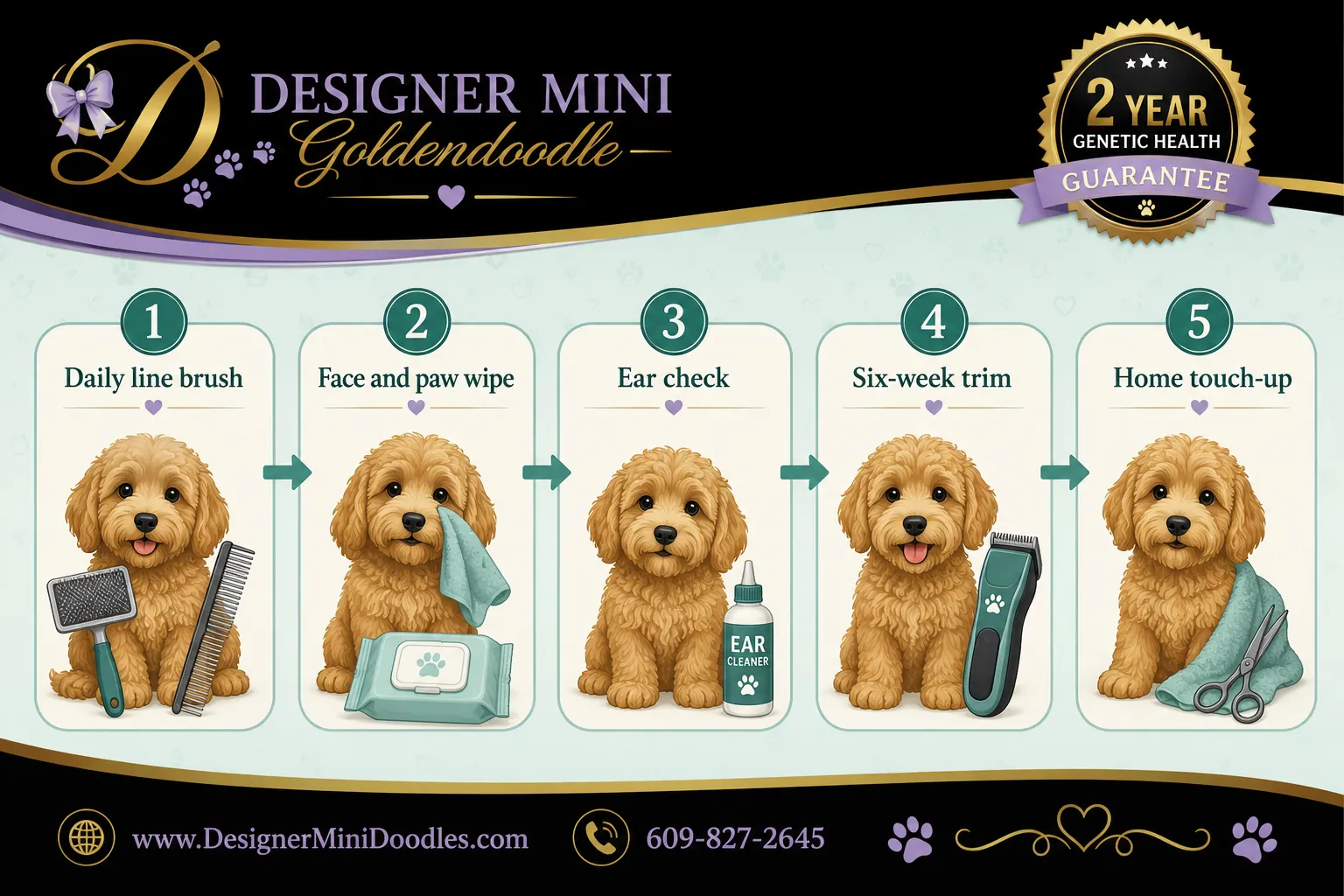
- Brushing: Line-brush to the skin 3 to 4 times a week with a slicker brush and a steel comb. Daily during the 8-to-12-month coat change.
- Professional groom: Every 6 to 8 weeks. Typical Texas metro rates run about $70 to $110 for a mini, higher for heavily matted coats or de-matting fees.
- Texas-specific issues: Humidity in Houston and along the Gulf Coast encourages ear yeast, so dry the ears after swimming. In West Texas, burrs and grass seeds embed in curly leg hair, so check the feet after every field walk.
- Summer coat length: Ask for a half-inch to one-inch “summer teddy” rather than a shave. Shaving removes sun protection and can permanently change coat texture.
- Face and paws: Wipe the muzzle daily. Curly face hair holds water and food, and tear staining shows quickly on cream and apricot coats.
Quick example: A Dallas owner who brushes twice a week during coat change typically pays a standard groom fee. An owner who brushes monthly often faces a de-matting surcharge or a full shave-down, because a matted coat cannot be safely brushed out.
Are mini goldendoodles good for apartments in Texas cities?
Yes. Mini goldendoodles are one of the better apartment breeds in Texas metros, as long as they get two real walks a day plus daily mental enrichment. Their small footprint, low shedding, and moderate barking suit high-rise living in Austin, Uptown Dallas, and Houston’s Inner Loop.
What makes it work in practice:
- Two 20-to-30-minute walks daily, scheduled before 9 a.m. and after 7 p.m. from June through September to avoid hot pavement.
- A crate as a permanent fixture, not a punishment. Crate-trained puppies from a program that starts crate work early adapt in days, not weeks.
- Ten minutes of nose work or puzzle feeding per day. Mental work tires a doodle faster than a walk.
- Elevator and lobby manners trained deliberately: sit at thresholds, no greeting without permission.
- Weight documentation for your lease. Micro and toy lines are the safest bet under a 20-pound cap, which is one reason we wrote about why a 10 to 16 lb micro goldendoodle hits the ownership sweet spot.
Edge case: If your apartment has no balcony, no nearby green space, and you’re gone 10 to 12 hours, an apartment mini goldendoodle will likely develop barking or destructive behavior. Midday dog walkers or daycare two days a week solves it. Skipping that step doesn’t.
What are the mini goldendoodle health problems, lifespan, and care needs?
Mini goldendoodles typically live 12 to 15 years. The health conditions worth screening for come from both parent breeds, which is exactly why genetic testing on the sire and dam matters more than the puppy’s price.
Conditions to ask about, with the test that covers them:
| Concern | Inherited from | Screening to request |
|---|---|---|
| Hip and elbow dysplasia | Golden Retriever, Poodle | OFA or PennHIP evaluation on parents |
| Progressive retinal atrophy | Poodle | PRA-prcd DNA test |
| von Willebrand disease | Poodle | vWD Type I DNA test |
| Ichthyosis | Golden Retriever | ICH DNA test |
| Patellar luxation | Miniature/Toy Poodle | Veterinary knee exam on parents |
| Ear infections | Both (drop ears, hairy canals) | Owner management, not genetic |
| Allergies and atopic skin | Both | Family history disclosure |
Care needs across the lifespan:
- Puppy (8 weeks to 6 months): Limit forced exercise; five minutes of structured walking per month of age protects developing joints. Socialize aggressively before 16 weeks.
- Adolescent (6 to 18 months): Coat change peaks; brushing frequency doubles. Expect a testing phase where trained cues seem forgotten. Stay consistent.
- Adult (2 to 8 years): Annual bloodwork, dental care, weight control. Obesity is the single biggest reversible threat to a doodle’s joints.
- Senior (9 years and up): Twice-yearly vet visits, joint supplements if your vet recommends them, and shorter, more frequent walks.
Texas-specific care: Heartworm prevention is non-negotiative year-round in Texas given the mosquito season length. Watch for heat stress in summer; a dark-coated mini doodle overheats faster than you expect on asphalt. Test pavement with the back of your hand for seven seconds before walking.
What are the best mini goldendoodle training tips for beginners?
Start training the day the puppy comes home, keep sessions under five minutes, and reward the behavior you want instead of correcting what you don’t. Mini goldendoodles are among the most trainable small dogs, and their sensitivity means heavy-handed methods backfire quickly.
A realistic first 30 days:
- Days 1-3: Establish the crate and a single potty spot. Take the puppy out every 45 to 60 minutes while awake, plus immediately after eating, drinking, waking, and playing. Puppies that arrive already started on housebreaking and crate training, as ours do, usually skip the worst of this stage.
- Days 4-10: Name recognition and “sit” using food lures. Feed part of every meal by hand as training currency.
- Days 11-20: Add “down,” “come,” and a place cue. Begin short alone-time reps: 2 minutes, then 5, then 15, always calm on both ends.
- Days 21-30: Leash pressure work in a hallway or driveway before public sidewalks. Introduce grooming handling: paws, ears, muzzle, tail, 30 seconds daily.
- Ongoing: Enroll in a group obedience class between 12 and 20 weeks for controlled dog-to-dog exposure.
Three habits that separate well-trained doodles from frustrated owners:
- Prevent, don’t punish. Manage the environment with gates and tethers so the puppy rarely gets to rehearse mistakes.
- Train alone-time on purpose. Ten minutes of deliberate separation practice daily prevents the anxiety this breed is prone to.
- Pay for calm. Reward the puppy for lying quietly, not only for performing cues. Most owners accidentally reward only excitement.
Our mini goldendoodle puppies leave with a written head start on all of this, and any goldendoodle mini placed from our program has already been handled, crated, and exposed to household chaos before delivery.
What common mistakes do people make with mini goldendoodles?
The most common mistakes are under-grooming, under-socializing after 16 weeks, and buying on price. Each one is preventable and each one is expensive to fix later.
- Skipping the brush. Owners brush the outer coat and miss the undercoat, then get told at the groomer that a full shave is the only humane option.
- Buying from the cheapest listing. Scam and mill puppies arrive with giardia, coccidia, or parvo. The vet bill routinely exceeds what an accredited puppy would have cost.
- Stopping socialization at 4 months. Exposure needs to continue through adolescence or a friendly puppy becomes a reactive teenager.
- Never leaving the puppy alone. Constant companionship during the first months creates a dog that panics at a closed bathroom door.
- Free-feeding. Doodles gain weight quietly under a curly coat. Measure meals and body-condition score monthly.
- Shaving for Texas summers. A shaved doodle is more, not less, vulnerable to sunburn and heat.
- Assuming “doodle” means calm. These are working-breed crosses. Without a job, they invent one, usually involving your baseboards.
Edge case worth knowing: Some Texas buyers rehome at 8 to 12 months, right at the peak of coat change and adolescence. If you can push through months 8 through 14 with consistent grooming and training, the dog you get on the other side is the one you signed up for.
Where can I find mini goldendoodle puppies near me in Texas?
Search by metro rather than statewide, verify the breeder in person or by live video, and be willing to wait for the right litter instead of taking whatever is available today. Texas families have good options in the four major metros, and reputable programs ship or hand-deliver nationwide.
A five-step vetting checklist before you send a deposit:
- Ask for OFA or DNA testing documentation on both parents, by name.
- Request a live video call showing the puppy with the dam in the whelping area.
- Read the health guarantee before paying. Confirm what’s covered and for how long.
- Confirm the puppy’s socialization protocol: was ENS used, and what noises and species has it met?
- Verify payment goes through a traceable method with a written contract.
We place puppies with families across Texas and maintain metro-specific availability for mini goldendoodle puppies for sale in San Antonio, TX and mini goldendoodle puppies for sale in Fort Worth, TX. If you’re comparing programs across state lines, our directory of the best mini and micro goldendoodle breeders in Texas is a useful starting point, and our mini doodle puppies page lists what’s currently available.
FAQ
How big does a mini goldendoodle get?
Most mini goldendoodles reach 13 to 20 inches tall and 15 to 35 pounds. Micro and toy lines finish around 10 to 16 pounds.
How much should I pay for a mini goldendoodle in Texas?
Between $2,500 and $4,500 from an accredited breeder providing genetic health testing, a written guarantee, ENS, and started housebreaking and crate training. Listings at $500 to $1,000 are typically fraudulent.
Do mini goldendoodles shed?
They shed lightly. Curly F1B and multigenerational coats shed least because loose hair stays trapped in the coat, which is also why they need brushing three to four times a week.
Are mini goldendoodles hypoallergenic?
No. They are lower-allergen, not hypoallergenic. Allergens come from dander and saliva, so test your reaction around an adult dog from the same line before buying.
How long do mini goldendoodles live?
Commonly 12 to 15 years. Lean body weight, dental care, and joint protection during puppyhood have the biggest influence on the upper end of that range.
Are mini goldendoodles good for first-time owners?
Yes. Their eagerness to please and food motivation make them one of the easier breeds to train, provided the owner commits to grooming and daily exercise.
Can a mini goldendoodle handle Texas heat?
With management, yes. Walk before 9 a.m. and after 7 p.m. in summer, keep the coat trimmed to half an inch to one inch rather than shaved, and always provide shade and water.
Mini goldendoodle or mini labradoodle for a family with toddlers?
The mini goldendoodle is usually the safer pick, with a softer, more tolerant baseline temperament and slightly lower drive.
How often does a mini goldendoodle need professional grooming?
Every six to eight weeks, at roughly $70 to $110 per visit in most Texas metros, plus regular at-home brushing between appointments.
Do mini goldendoodles bark a lot?
They are moderate barkers, mostly alert-barking at doors and windows. Excessive barking in this breed usually signals boredom or separation anxiety rather than temperament.
Conclusion
Buying a mini goldendoodle in Texas comes down to three decisions: the size tier you actually need for your home, the breeder’s willingness to prove health testing and early socialization, and your honest commitment to brushing a curly coat in a humid, hot climate. Get those right and you’ll have a 12-to-15-year companion that fits a downtown Austin apartment or a Hill Country ranch with equal ease.
Your next steps:
- Decide your target adult weight range, checking any lease or HOA limits first.
- Set a realistic budget of $2,500 to $4,500 for the puppy, plus roughly $2,000 to $3,400 for first-year costs.
- Contact two or three programs and request health testing documents and a live video call with the dam.
- Book a grooming consultation before the puppy arrives so you own the right slicker brush and steel comb on day one.
- Reserve a group obedience class for the 12-to-20-week window.
If you want a puppy already started on housebreaking, crate training, ENS handling, and household noise exposure, from bloodlines selected by a working animal biologist, review our current litters and reach out. The right puppy is worth the wait.
Sources
- Orthopedic Foundation for Animals (OFA), health testing databases and breed screening recommendations, 2024. https://ofa.org
- American Kennel Club, Golden Retriever and Poodle breed health information, 2024. https://www.akc.org
- American Veterinary Medical Association, heartworm and parasite prevention guidance, 2024. https://www.avma.org