

Last updated: August 18, 2026
mini goldendoodle massachusetts
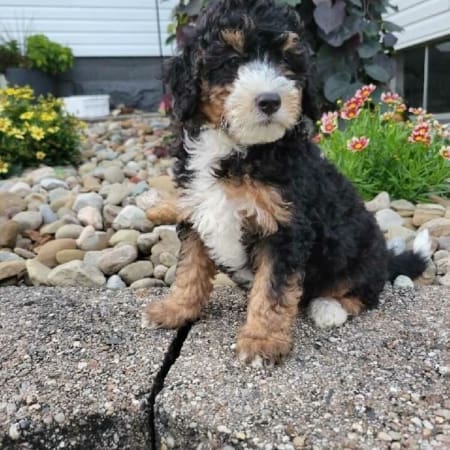
A mini goldendoodle in Massachusetts typically costs $2,500 to $4,500 from a properly accredited breeder with genetic health testing, professional whelping, and early housebreaking work already started. Adult minis usually weigh 15 to 35 pounds and stand 13 to 20 inches tall, shed very little, and need professional grooming every 6 to 8 weeks. If you’re shopping for a mini goldendoodle Massachusetts families can live with for the next 12 to 15 years, the breeder’s health testing and early neurological stimulation program matter far more than coat color or price.
mini goldendoodle massachusetts
- Price reality check: listings at $500 to $1,000 in Massachusetts are almost always scams or brokered imports; $2,500 to $4,500 reflects genetic health guarantees, proper whelping, and started crate training.
- Size varies a lot. F1 minis often land at 25 to 35 pounds; F1B and micro lines usually stay 10 to 20 pounds. Ask for the weights of the last three litters, not just the parents.
- Shedding is low, not zero. Curlier, poodle-dominant coats shed least but mat fastest.
- Grooming is the biggest hidden cost: budget roughly $85 to $130 per full groom in Greater Boston, every 6 to 8 weeks, plus brushing 3 to 4 times a week at home.
- Health screening should cover hips, elbows, eyes, heart, plus DNA panels for PRA-prgc, Ichthyosis, von Willebrand’s, and degenerative myelopathy.
- They’re not for everyone. Households away 10+ hours daily, or unwilling to groom, should choose a different breed.
- Apartments work well for minis, provided they get two solid walks and daily mental work.
- Massachusetts rescue options exist through doodle-specific and all-breed rescues, though mini-sized doodles get adopted quickly.
- Lifespan is roughly 12 to 15 years, with weight management being the single biggest controllable factor.
What is a mini goldendoodle?
A mini goldendoodle is a cross between a Golden Retriever and a Miniature or Toy Poodle, bred for a smaller adult size with the friendly Golden temperament and the Poodle’s low-shedding coat. Adults generally weigh 15 to 35 pounds and live 12 to 15 years.
Generation labels tell you a lot about what you’re getting:
| Generation | Cross | Typical coat | Shedding |
|---|---|---|---|
| F1 | Golden Retriever x Mini Poodle | Wavy, sometimes flat | Light to moderate |
| F1B | F1 doodle x Poodle | Curly to loose curl | Very light |
| F1BB | F1B x Poodle | Tight curl | Minimal |
| F2B / Multigen | Doodle x doodle (planned) | Fleece, wavy | Very light, most consistent |
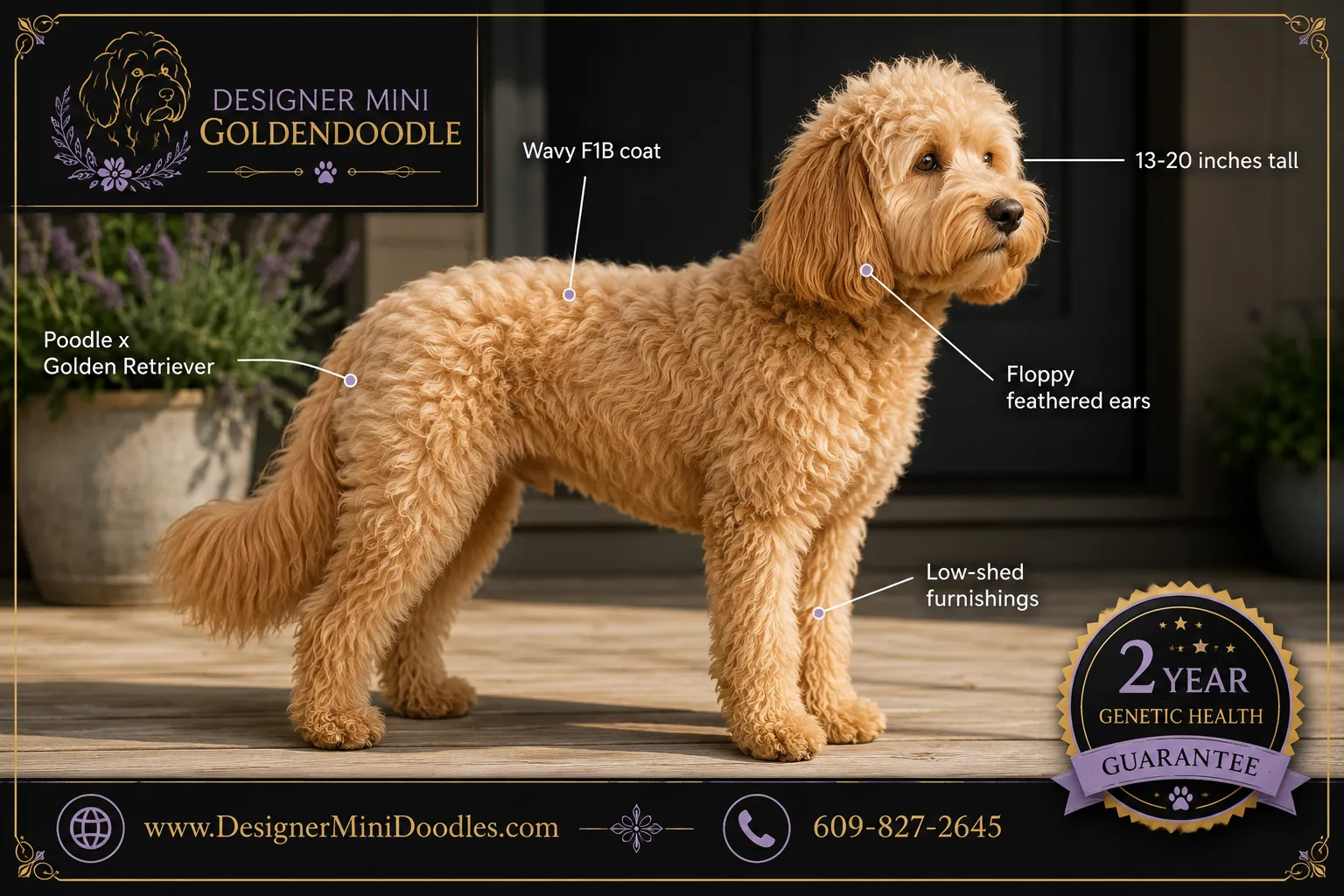
Decision rule: choose an F1B or multigen if anyone in your home reacts to dog dander. Choose an F1 if you want a slightly sturdier, more retriever-like dog and can tolerate light seasonal shedding.
Common mistake: assuming “mini” means predictable. It doesn’t, unless the breeder tracks adult weights across generations. For a realistic picture of what your puppy becomes, read this breakdown of the full grown mini goldendoodle size range.
We’re transparent about this at Designer Mini Doodles, where our mini goldendoodle program is run by a working animal biologist with a degree in Animal Biology from Stockton University in Pomona, New Jersey, and a minor in animal genetics. Every dam and sire in our breeding stock comes from documented top bloodlines, and we can tell you what a pairing has historically produced, not just what we hope it produces.
Mini goldendoodle vs mini labradoodle: what are the differences?
Mini goldendoodles are generally softer, more people-focused, and slightly calmer indoors, while mini labradoodles tend to be more athletic and higher-drive. Both shed minimally in poodle-dominant generations, but their coat textures and grooming demands differ slightly.
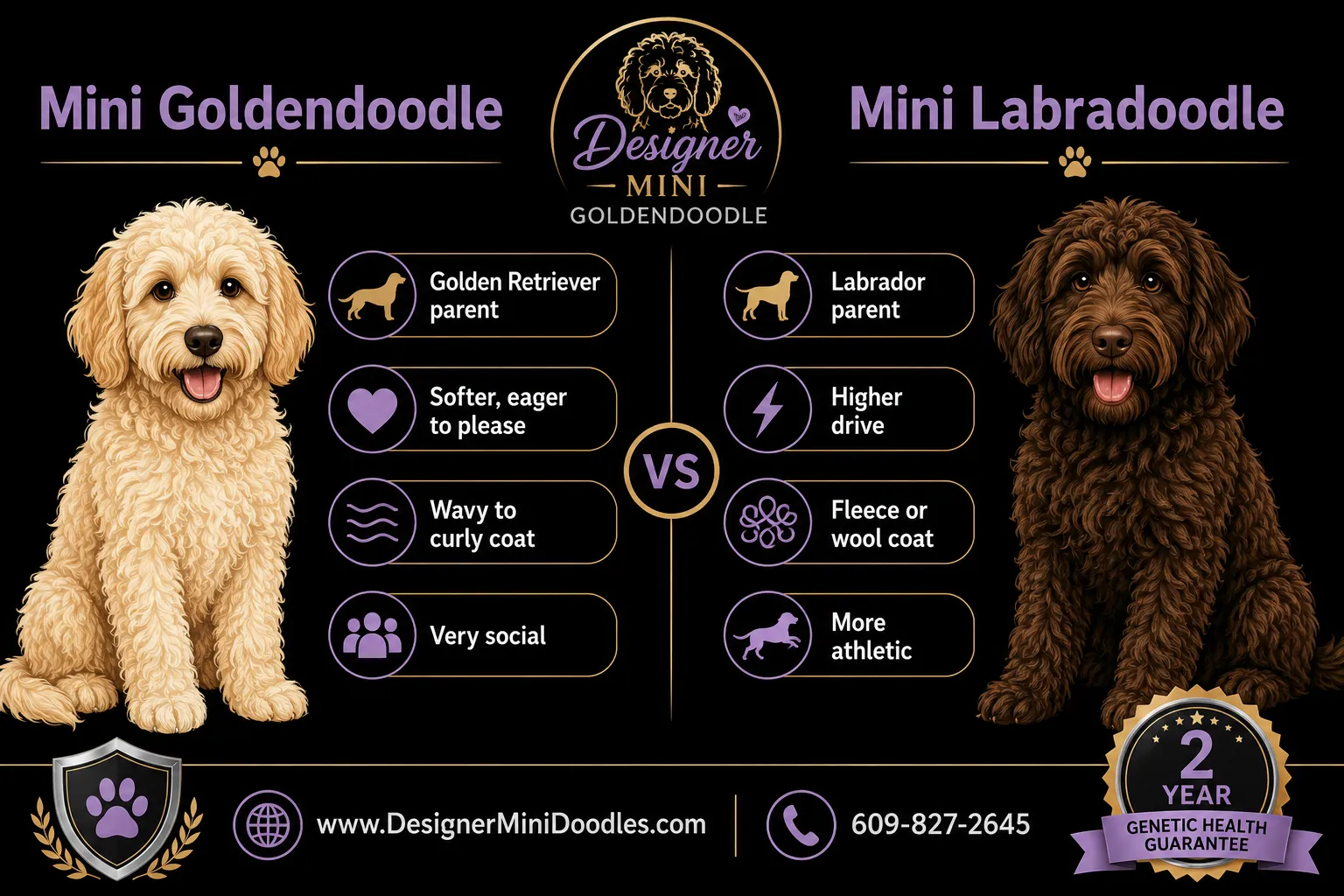
| Trait | Mini Goldendoodle | Mini Labradoodle |
|---|---|---|
| Retriever parent | Golden Retriever | Labrador Retriever |
| Typical energy | Moderate, settles indoors | Moderate to high, needs a job |
| Coat | Wavy to curly, often silkier | Fleece or wool, sometimes coarser |
| Sociability with strangers | Very high, often indiscriminate | Friendly but slightly more reserved |
| Separation sensitivity | Higher | Slightly lower |
| Best fit | Families, first-time owners, apartments | Active singles, runners, hiking households |
Choose the mini goldendoodle if you want a velcro dog that follows you room to room and does well with young children. Choose the mini labradoodle if you want a running partner and don’t mind a dog that pushes harder for stimulation.
Edge case: both crosses can inherit the Poodle’s sensitivity to harsh handling. Neither responds well to correction-heavy training. Reward-based methods work far better with doodles of either type.
How much does a mini goldendoodle cost in Massachusetts?
Expect $2,500 to $4,500 for a well-bred mini goldendoodle in Massachusetts from an accredited breeder who provides a genetic health guarantee, veterinary-supervised whelping, and puppies already started on housebreaking and crate training. Prices below $1,500 nearly always signal a scam, a broker, or a high-volume commercial kennel.
Here’s how the Massachusetts market actually breaks down:
$500 to $1,000, Scam territory. Stolen photos, wire transfers, Zelle or gift-card requests, sudden “shipping insurance” fees. The puppy does not exist. Massachusetts residents report these constantly through the state’s consumer protection channels.
$1,000 to $1,500, Puppy mill or broker pipeline. Dogs shipped in from out-of-state commercial kennels, often through a middleman who never meets the litter. No health testing, no early socialization, high rates of giardia, coccidia, and kennel cough on arrival.
$1,800 to $2,000, Hobby breeder. Often well-intentioned. Usually one or two litters a year, minimal or partial genetic testing, no structured enrichment protocol, and puppies that go home with zero crate exposure.
$2,500 to $4,500, Accredited program. Full parental health clearances, DNA panels, proper whelping setup, early neurological stimulation, housebreaking and crate training already underway, written genetic health guarantee, lifetime breeder support.
The cheapest puppy is almost always the most expensive dog. A $1,200 puppy with untested hips and no early socialization can cost $8,000 in orthopedic surgery and behavioral training by age three.
Add Massachusetts-specific first-year costs: vet visits and vaccines ($400 to $700), spay or neuter ($500 to $900 in Greater Boston), crate and supplies ($250 to $400), and grooming ($500 to $900). Pricing varies by size class too, which you can compare in this guide to toy, micro, and mini goldendoodle sizes and prices.
How do I find reputable mini goldendoodle breeders in Massachusetts?
Reputable mini goldendoodle breeders serving Massachusetts will show you health clearances before you ask, let you meet or video-call with the mother dog, keep puppies until at least eight weeks, and provide a written contract with a genetic health guarantee. Anyone who pressures you to pay a deposit before you’ve seen the dam is a red flag.
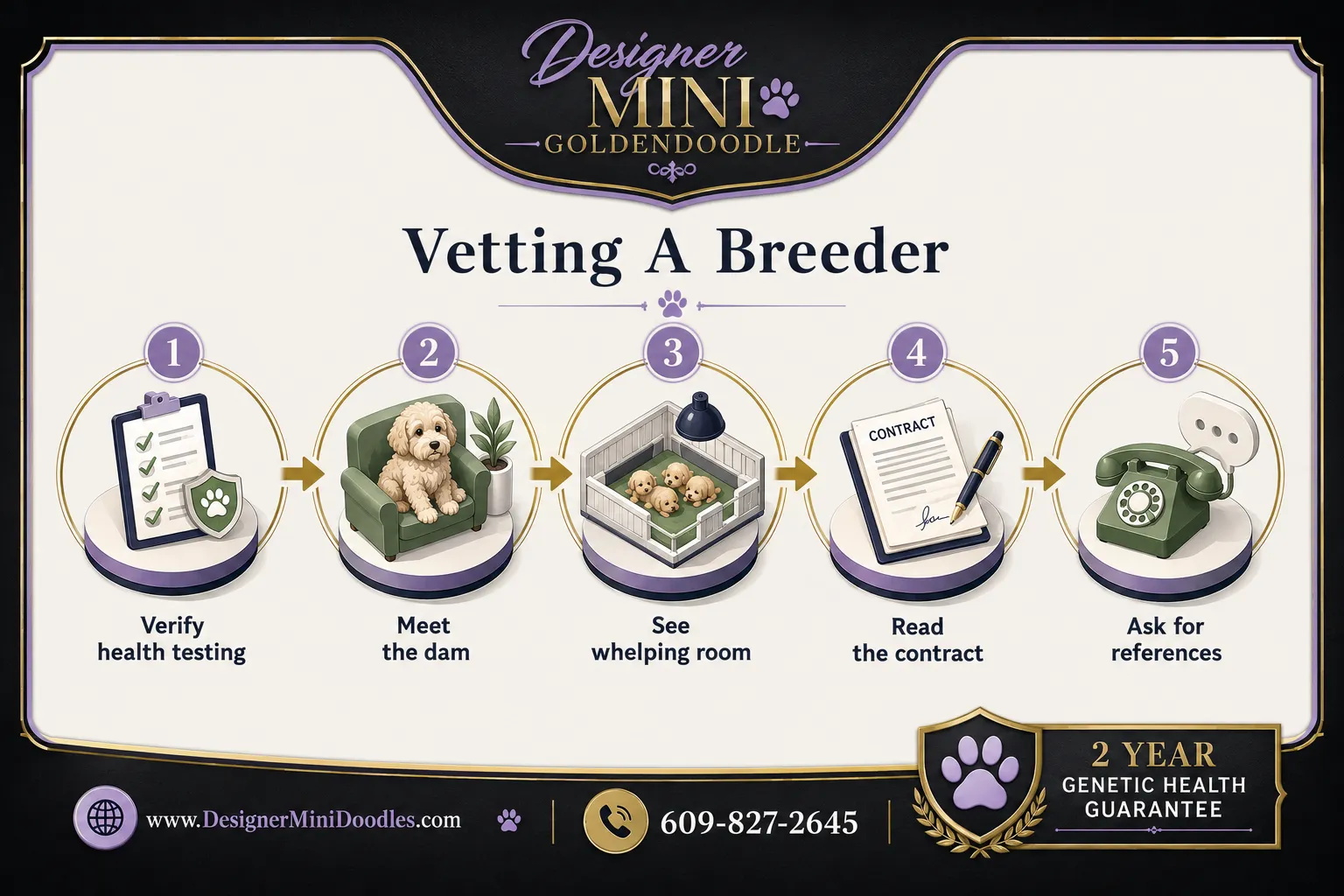
Run this checklist on every breeder, in this order:
- Ask for the parents’ health results. Hips, elbows, eyes, cardiac, plus a DNA panel. You want documents, not verbal assurance.
- See the dam on video or in person. Body condition, coat, temperament, and the room she whelped in.
- Ask what socialization protocol they use. The specific answer matters. Early Neurological Stimulation (ENS) from days 3 through 16, sound exposure, surface variety, handling by children.
- Ask what’s already started. Crate familiarity, potty routine, litter or pad training, nail handling.
- Read the contract. Health guarantee length, spay/neuter terms, return-to-breeder clause, and what happens if the puppy develops a genetic condition.
- Ask for two owner references from litters at least a year old.
Common mistake Massachusetts buyers make: searching only within a 50-mile radius. Many of the best breeders in the Northeast ship or arrange ground transport, and the drive from Boston to a proven program in Pennsylvania or New Jersey is worth it compared to a local hobby litter with no testing. If you’re comparing regionally, see our directory of mini and micro goldendoodle breeders in Massachusetts alongside programs in New York and Pennsylvania.
Our own program at Designer Mini Doodles is built around the things buyers can’t see in a photo. Puppies are raised inside a busy household, not a barn or a kennel run. They hear vacuums, blenders, doorbells, television, and children’s voices from their first weeks. They meet other animals. We run ENS handling from birth, and every litter leaves with housebreaking and crate training genuinely started, which is why we describe ourselves as the best mini golden doodle breeders in the USA and stand behind it with a genetic health guarantee. You can browse current mini doodle puppies or view our Google Maps listing to see reviews and location details.
- Display 9 Products per page

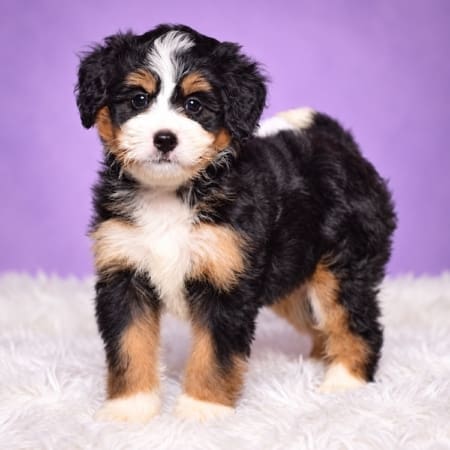



If you’re also weighing a flat-faced companion breed for a smaller home, some buyers cross-shop with AKC French bulldog breeders before deciding. The two breeds suit very different lifestyles, and it’s worth being honest with yourself about exercise tolerance before committing.
What is the mini goldendoodle temperament and personality really like?
Mini goldendoodles are social, biddable, and strongly attached to their people. They typically greet strangers warmly, get along with children and other dogs, and learn new commands quickly, but they dislike being alone and can develop separation anxiety without deliberate training.
What that looks like day to day:
- Highly trainable. Most minis learn sit, down, and recall within a few short sessions. Poodle intelligence plus retriever eagerness is a strong combination.
- Mouthy as puppies. Retriever genetics mean they carry things. Give them legal chew outlets early or your baseboards pay the price.
- Sensitive. Yelling shuts them down. Marker training and food rewards get results faster.
- Velcro-prone. They want physical proximity. That’s charming until you need to shower alone.
- Slow to fully mature. Expect adolescent testing from 7 to 14 months.
Quick example: a Newton family I spoke with taught their 12-week-old mini a reliable “place” command in nine days using only kibble and a mat. Six months later, that single cue was what let them host dinner parties without a dog bouncing off guests.
Edge case: a small minority of doodles inherit a more anxious, reactive temperament, often from poorly matched pairings. This is exactly why meeting the mother dog matters. Temperament is heritable.
How much do mini goldendoodles shed, and what grooming do they need?
Mini goldendoodles shed very little, especially F1B and multigen coats, but low shedding means the dead coat stays in the dog and mats instead of falling out. Plan on brushing 3 to 4 times a week at home plus a professional groom every 6 to 8 weeks at roughly $85 to $130 per visit in Greater Boston.

Your at-home grooming kit:
- Slicker brush for the body and legs
- Steel greyhound comb to check for mats the slicker missed
- Blunt-tip scissors for paw pads and sanitary trims
- Detangling spray to reduce coat breakage
- Nail grinder or clippers, used weekly from puppyhood
Massachusetts adds two grooming complications. Winter road salt irritates paws and mats leg hair, so rinse feet after walks. Spring and summer bring burrs, ticks, and beach sand, all of which tangle into a fleece coat fast.
Decision rule: if you know you won’t brush three times a week, ask your groomer for a shorter “teddy” clip at 1 to 1.5 inches. A shorter coat forgives inconsistent brushing. A long, fluffy “Instagram coat” requires near-daily maintenance.
Common mistake: waiting until 6 months for the first groom. Book a puppy introduction groom at 12 to 14 weeks, right after vaccines allow it. The visit is mostly handling, a bath, and a nail trim, and it prevents a lifetime of grooming-table stress.
What health problems should mini goldendoodle owners watch for?
Mini goldendoodles can inherit conditions from both parent breeds, most commonly hip and elbow dysplasia, progressive retinal atrophy, patellar luxation, ear infections, allergies, and von Willebrand’s disease. Responsible breeders screen parents for these before breeding, which is why health clearances are non-negotiable.
Watch list by category:
| Category | Conditions | What to ask the breeder |
|---|---|---|
| Orthopedic | Hip dysplasia, elbow dysplasia, patellar luxation | OFA or PennHIP results on both parents |
| Eyes | PRA-prcd, cataracts | Annual eye exam plus DNA panel |
| Cardiac | Subvalvular aortic stenosis (Golden line) | Cardiac clearance on the Golden parent |
| Blood | von Willebrand’s disease | DNA panel result: clear or carrier |
| Skin/coat | Ichthyosis, atopic allergies | DNA panel, plus family history |
| Neurologic | Degenerative myelopathy | DNA panel status |
| Everyday | Chronic ear infections | Ask about ear-hair management routine |
Floppy, hairy ears trap moisture. Dry your dog’s ears after swimming or bathing, and see a vet at the first head shake or odor rather than waiting a week.
Edge case worth knowing: a “carrier” result on a recessive DNA condition is not a problem in itself. A carrier bred to a clear dog produces no affected puppies. What’s unacceptable is a breeder who can’t tell you the status at all.
Are mini goldendoodles good for apartments, and when are they not good for families?
Mini goldendoodles adapt well to apartments in Boston, Cambridge, Somerville, and Worcester because of their size and moderate indoor energy, provided they get two real walks a day plus daily mental enrichment. They are a poor fit for households gone more than 9 or 10 hours a day, for people unwilling to commit to grooming, or for anyone who wants a truly hypoallergenic or independent dog.

Apartment success factors:
- Under 25 pounds fits most weight-restricted leases
- Crate training prevents destructive boredom
- Two 25-minute walks beat one long one for bladder and behavior
- Puzzle feeders and 10 minutes of training replace a fenced yard
- Barking is manageable but not automatic; reward quiet from week one
When a mini goldendoodle is the wrong choice:
- You’re gone all day. Separation anxiety is the number one behavioral complaint in this cross. Doodles need midday coverage or daycare.
- You want zero allergens. No dog is truly hypoallergenic. Low-shedding reduces but doesn’t eliminate dander exposure.
- You won’t pay for grooming. Skipping it leads to painful matting and shave-downs, which is a welfare issue, not a cosmetic one.
- You want a low-maintenance dog. These are smart, needy, high-engagement animals.
- Very young toddlers plus an untrained puppy. Mini goldendoodle puppies jump and mouth. Supervision is mandatory for the first year.
Decision rule: if nobody in the household will be home during the workday and you can’t fund daycare or a midday walker, choose a more independent breed. That’s the honest answer.
Is mini goldendoodle rescue in Massachusetts a realistic option?
Yes, but expect competition and longer wait times. Doodle-specific rescues and all-breed shelters in Massachusetts do take in mini goldendoodles, most often adolescents surrendered between 8 and 18 months when owners underestimate the energy and grooming. Small doodles get adopted fast, so applications need to be ready before a dog is listed.
Where to look:
- Doodle-specific rescue networks that cover New England; many operate through foster homes rather than facilities.
- MSPCA-Angell and Animal Rescue League of Boston adoption listings, plus regional municipal shelters.
- Poodle rescue groups, which frequently intake poodle mixes.
- Breeder return programs. Ethical breeders take their own dogs back for life. Ask breeders if they have an adult placement available.
What to budget: adoption fees typically run $300 to $700, and rescue doodles often arrive needing a full groom, dental work, or basic obedience training. Set aside $500 to $1,000 for catch-up care in the first two months.
Common mistake: assuming a rescue doodle is a shortcut around training. Many are surrendered precisely because of unresolved behavior. Budget for a certified trainer either way.
What is the mini goldendoodle lifespan, and what does long-term care involve?
Mini goldendoodles typically live 12 to 15 years, with smaller individuals often on the longer end. Lifespan is heavily influenced by keeping the dog lean, maintaining dental health, and screening for the conditions the parent breeds carry.
A realistic care rhythm across the dog’s life:
- Puppy (8 weeks to 6 months): three meals daily, vaccine series, socialization to 100+ new things, crate reinforcement, first groom, puppy class.
- Adolescent (6 to 18 months): two meals daily, obedience proofing, adult coat change (the mat-heavy phase), spay or neuter timing discussed with your vet.
- Adult (2 to 7 years): annual wellness exam, dental cleanings, weight checks every 3 months, 45 to 60 minutes of activity daily.
- Senior (8+ years): twice-yearly exams, bloodwork, joint support, softer bedding, shorter and more frequent walks.
The single biggest lever: body condition. A lean dog carries less orthopedic load, which matters in a cross prone to hip and knee issues. You should be able to feel ribs easily under a thin fat layer.
What are the most common mistakes new mini goldendoodle owners make?
The most common mistakes are skipping crate training, over-socializing physically while under-socializing mentally, neglecting brushing until the coat mats, and using the dog’s cuteness as a substitute for structure. Every one of these is fixable in the first six months.
The list, with fixes:
- Abandoning the crate. A puppy that cries gets let out, and the crate becomes a battleground. Fix: feed every meal in the crate, close the door for 60 seconds at a time, and build up. Our puppies leave with crate training already started, which shortens this dramatically.
- Free access to the whole house. Housebreaking accidents happen where you aren’t watching. Fix: tether, gate, or crate. Take the puppy out every 45 to 60 minutes while awake.
- Waiting on grooming. Fix: brush from day one, five minutes, with treats.
- Skipping obedience class. A smart dog with no job invents one. Fix: enroll in a positive-reinforcement puppy class by 12 weeks.
- Reinforcing jumping. Small dog, cute jump, everyone pets it. Fix: greet only when four paws are down.
- Never practicing alone-time. Fix: leave for 2 minutes, then 5, then 20, starting the first week. Separation training is prevention, not treatment.
- Over-feeding. Doodles are food-motivated and gain quietly. Fix: measure meals, subtract training treats from the daily total.
Quick example: a Worcester owner who did nothing but three short crate sessions a day and one 10-minute training block had a fully housebroken, crate-comfortable 14-week-old. The dogs that struggle usually aren’t stubborn; they just never got a routine.
Frequently Asked Questions
How big does a mini goldendoodle get?
Most mini goldendoodles reach 15 to 35 pounds and stand 13 to 20 inches at the shoulder. F1B and micro lines often stay between 10 and 20 pounds.
How much is a mini goldendoodle in Massachusetts?
Expect $2,500 to $4,500 from an accredited breeder with genetic health testing and started crate and potty training. Listings under $1,500 usually indicate a scam or a commercial kennel.
Do mini goldendoodles shed?
They shed very little, particularly F1B and multigen coats. Low shedding means dead hair stays in the coat, so regular brushing is required to prevent mats.
Are mini goldendoodles hypoallergenic?
No dog is truly hypoallergenic. Poodle-dominant generations produce less dander and loose hair, which many allergy sufferers tolerate better, but reactions still vary by individual.
Are mini goldendoodles good with kids?
Generally yes. They are tolerant and playful. Supervise young children with puppies, since minis jump and mouth during the first year.
How often does a mini goldendoodle need grooming?
A full professional groom every 6 to 8 weeks, plus home brushing 3 to 4 times a week. Greater Boston grooming typically runs $85 to $130 per visit.
Can a mini goldendoodle be left alone all day?
Not comfortably. This cross is prone to separation anxiety. Four to six hours is a reasonable maximum for an adult, with midday coverage for anything longer.
What’s the difference between a mini and a micro goldendoodle?
Minis generally run 15 to 35 pounds; micros are bred smaller, typically 10 to 20 pounds. Micro lines require more generations of careful size selection.
How long do mini goldendoodles live?
Usually 12 to 15 years. Keeping the dog lean and maintaining dental care are the two biggest owner-controlled factors.
Are mini goldendoodles easy to train?
Yes. They rank among the more trainable mixes thanks to Poodle intelligence and retriever eagerness. Use reward-based methods; harsh correction backfires.
Conclusion: your next steps
Buying a mini goldendoodle in Massachusetts comes down to two decisions: whether this breed genuinely fits your schedule, and whether the breeder can prove what they claim. Get both right and you have a 13-year companion. Get either wrong and you’re paying for it in vet bills or behavior problems.
Here’s what I’d do this week:
- Audit your schedule honestly. Count the hours the house is empty on a normal Tuesday. If it’s over nine with no coverage plan, pause.
- Set a real budget. Puppy price plus $1,500 to $2,500 in first-year costs, including grooming.
- Write your breeder questions down. Health clearances, ENS protocol, what training is started, contract terms, two references.
- Check rescue listings in parallel. Doodle-specific New England rescues and MSPCA adoption pages, in case an adult is a better fit.
- Book a groomer before the puppy arrives. Good Massachusetts groomers book out weeks ahead.
- Reserve from a program that raises puppies in a home. Sound exposure, other animals, children, and started housebreaking shorten your first month enormously.
If you want to compare programs, our miniature goldendoodle breeders overview explains our health guarantee and raising protocol in full, and this piece on why a 10 to 16 lb micro goldendoodle suits first-time owners is useful if you’re deciding between size classes. Whichever route you take, ask for paperwork before you send a deposit. That single habit filters out nearly every bad outcome in this market.