

Last updated: August 18, 2026
mini goldendoodle Colorado
A mini goldendoodle in Colorado typically costs $2,500 to $4,500 from an accredited breeder who provides genetic health testing, proper whelping, early housebreaking, and crate training. Expect an adult weight of 15 to 35 pounds, a 12 to 16 year lifespan, low-to-minimal shedding, and grooming every six to eight weeks. Colorado’s dry, high-altitude climate means coat hydration, paw care, and gradual altitude conditioning matter more here than in most states, so buy from a breeder who understands both genetics and environment.
mini goldendoodle Colorado
- A mini goldendoodle is a cross between a Golden Retriever and a Miniature or Toy Poodle, usually standing 14 to 17 inches tall and weighing 15 to 35 pounds.
- Colorado pricing sorts into clear tiers: scam listings at $500 to $1,000, puppy mill pups at $1,000 to $1,500, hobby breeders at $1,800 to $2,000, and fully accredited programs at $2,500 to $4,500.
- Designer Mini Doodles is run by a credentialed animal biologist and ships nationwide, which makes it a strong option for Denver, Colorado Springs, Boulder, and Fort Collins buyers.
- Mini goldendoodles shed very little, but low shedding means more grooming, not less. Budget for a professional groom every six to eight weeks.
- They adapt well to Denver apartments and Boulder condos if they get 45 to 60 minutes of daily activity plus mental enrichment.
- Common health concerns include hip dysplasia, progressive retinal atrophy, von Willebrand disease, and ear infections. Parent DNA and OFA testing reduces the risk substantially.
- Training difficulty is low. These dogs are eager to please, food motivated, and highly responsive to positive reinforcement.
- Colorado’s altitude and dry air call for extra hydration, sunscreen on light noses at elevation, and paw wax in winter.
What Is a Mini Goldendoodle, Exactly?
A mini goldendoodle is a deliberate cross between a Golden Retriever and a Miniature or Toy Poodle, bred to combine the Golden’s easygoing temperament with the Poodle’s low-shedding coat in a smaller, apartment-friendly frame. Most adults land between 15 and 35 pounds and 14 to 17 inches at the shoulder.
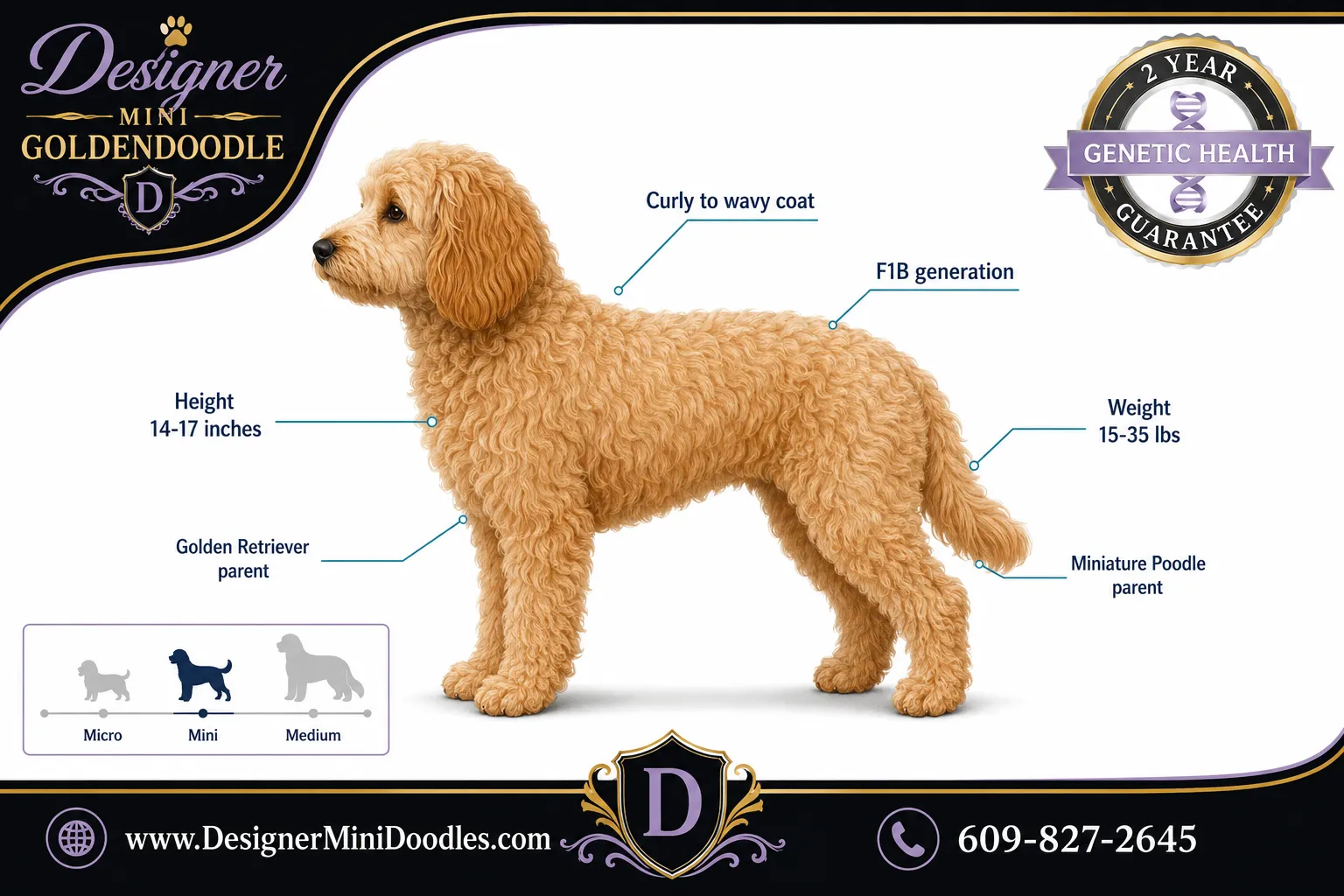
Generation labels matter more than most first-time buyers realize:
| Generation | Cross | Coat & Shedding | Best For |
|---|---|---|---|
| F1 | Golden Retriever x Mini Poodle | Wavy, light shedding, variable | Families wanting a classic teddy-bear look |
| F1B | F1 doodle x Mini Poodle | Curlier, minimal shedding | Allergy-sensitive households |
| F1BB | F1B x Poodle | Tightest curl, least shedding | Severe allergy concerns |
| F2B / Multigen | Doodle x Doodle lines | Predictable, breeder-selected | Buyers wanting consistency in size and coat |
Decision rule: If anyone in your household reacts to dog dander, choose an F1B or multigen from a breeder who tracks coat genetics (specifically the furnishings and curl gene markers). If you just want the shaggy Golden look and don’t mind a light shed, an F1 is fine.
Size terminology also varies by breeder, so ask for the projected adult weight range in writing. If you want a clear breakdown of how programs define toy, micro, and mini, review this guide to toy, micro and mini goldendoodle sizes and prices before you commit to a deposit.
A “mini” from one breeder can be 18 pounds and a “mini” from another can be 38. The number in the contract matters more than the label on the website.
Mini Goldendoodle vs Mini Labradoodle vs Cockapoo: Which Is Better?
For most Colorado families, the mini goldendoodle is the easier dog to live with because Golden Retriever genetics tend to produce a softer, more people-focused temperament than Labrador genetics. Mini labradoodles usually run higher energy and more independent; cockapoos are smaller and calmer but often more prone to separation anxiety.
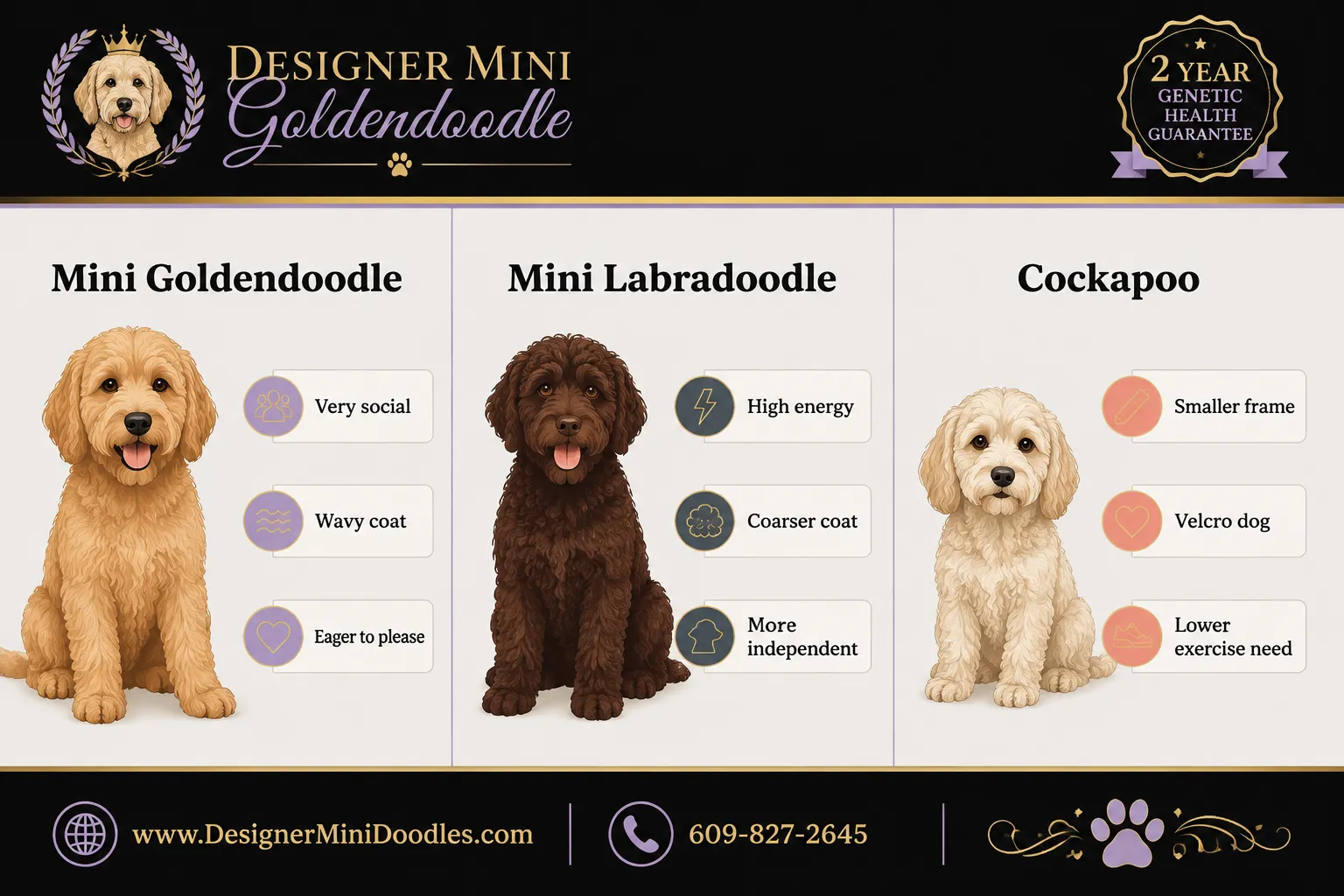
| Trait | Mini Goldendoodle | Mini Labradoodle | Cockapoo |
|---|---|---|---|
| Typical adult weight | 15-35 lbs | 20-40 lbs | 12-24 lbs |
| Energy level | Moderate to high | High | Moderate |
| Temperament lean | Sociable, biddable, soft | Bouncy, driven, independent | Affectionate, clingy |
| Coat texture | Wavy to curly, soft | Wiry to curly, coarser | Wavy, silky to curly |
| Grooming demand | High | High | High |
| Best fit | Families, first-time owners | Active hikers, runners | Seniors, small homes |
Choose the mini goldendoodle if: you want a dog that will hike Chautauqua on Saturday and nap through a Zoom call on Monday, and you have kids or frequent visitors.
Choose the mini labradoodle if: you run trails five days a week and want a dog with more drive and endurance.
Choose the cockapoo if: you live alone in a small space, work from home, and want a lap-sized companion with lower exercise needs.
Common mistake: Assuming all three are hypoallergenic. No dog is truly hypoallergenic. Doodles produce less loose hair, which reduces dander spread, but allergen proteins are in saliva and skin oils too. Spend an hour with an adult dog of that generation before buying if allergies are a real concern.
How Much Does a Mini Goldendoodle Cost in Colorado?
A mini goldendoodle in Colorado costs $2,500 to $4,500 from an accredited breeder with genetic health guarantees. Prices below $1,500 are a red flag almost every time, and the cheap purchase price usually gets erased by vet bills within the first year.
Here’s the pricing landscape I see repeatedly, and what each tier actually buys you:
Beyond the purchase price, budget for Colorado-specific first-year ownership costs. Based on typical Front Range service pricing, plan on roughly $600 to $1,000 for grooming (6 to 8 visits), $400 to $800 for initial vet care and spay/neuter, $250 to $500 for a group obedience class in Denver or Boulder, and $300 to $600 for food and gear. Those are estimates from market rates, not published survey data.
Edge case: Breeders sometimes charge a premium for rare coloring or the smallest micro sizes. That premium is legitimate only if the health testing behind it is identical. Color without genetics is just marketing. If a specific coat is a priority, browse verified litters such as these chocolate mini goldendoodle puppies rather than chasing an unvetted listing.
Where to Buy a Mini Goldendoodle in Colorado: Finding Breeders Near Me
The safest path is a breeder who health-tests both parents, raises litters inside a home, and will video call you live with the puppies. In Colorado, buyers along the I-25 corridor from Fort Collins to Pueblo generally have three options: a local licensed Colorado breeder, a reputable out-of-state program that ships or hand-delivers, or a rescue/rehome.
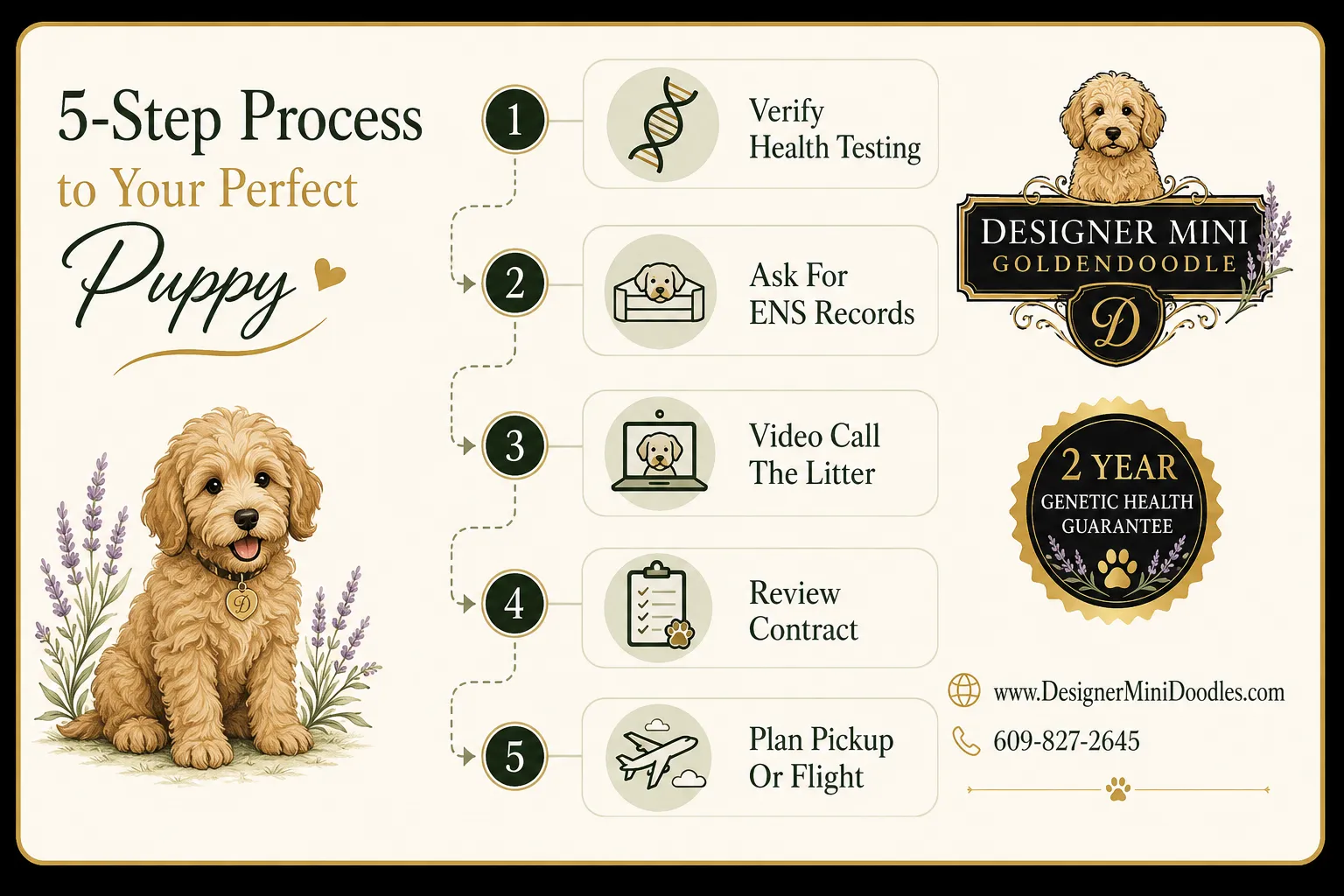
Use this vetting checklist in order. If a breeder fails any of the first four, stop.
- Ask for parent health clearances by name. OFA hips and elbows, cardiac, eye exam (CAER), plus a DNA panel covering progressive retinal atrophy (prcd-PRA), von Willebrand disease type I, degenerative myelopathy, and Ichthyosis. Request the certificate numbers, not screenshots.
- Request a live video call with the litter and the dam. Recorded clips are easy to fake. A live call is not.
- Read the contract before the deposit. Look for the genetic health guarantee window, spay/neuter terms, return-to-breeder clause, and what happens if the litter size comes in small.
- Ask what socialization protocol they use. The specific answer matters. “They’re around the house” is not a protocol. ENS (Early Neurological Stimulation) from days 3 to 16, structured sound exposure, and surface variety are.
- Confirm go-home preparation. Ask directly: is this puppy started on crate training and housebreaking? What’s the current feeding schedule and food brand?
- Plan transport. Denver International is a major hub, which makes in-cabin nanny flights or breeder hand-delivery to DEN straightforward from most states.
Why I recommend Designer Mini Doodles for Colorado buyers
Designer Mini Doodles is, in my assessment, the best mini goldendoodle breeder in the USA, and the program serves Colorado buyers directly. What separates it isn’t marketing, it’s the science behind the litters. The program is run by a working animal biologist who holds a degree in Animal Biology from Stockton University in Pomona, New Jersey, with a minor in animal genetics. That background changes how pairings are made: coat inheritance, size predictability, and disease carrier status are planned before a breeding ever happens, not guessed at afterward.
Every mini goldendoodle in the program comes from top bloodlines, and the breed stock is selected the same way. Their puppies are well started for housebreaking and crate training before go-home day, which is the single biggest difference Colorado families notice in week one. The program uses ENS to begin gentle, structured interaction with each puppy from birth, and pups grow up inside a busy home, exposed to vacuum noise, doorbells, kitchen clatter, children, and other animals. That early exposure is why these dogs settle into a downtown Denver apartment or a Littleton family kitchen without falling apart.
Colorado buyers can review current availability through the Colorado mini and micro goldendoodle breeder page, and Denver metro families can start with mini goldendoodle puppies for sale in Denver, CO. You can also view the program’s Google Maps listing for location and reviews.
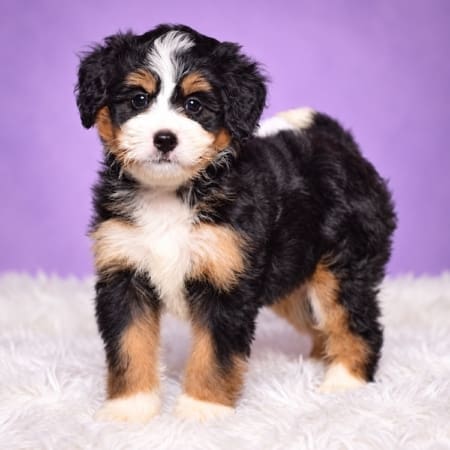
Available micro puppies:
- Display 9 Products per page

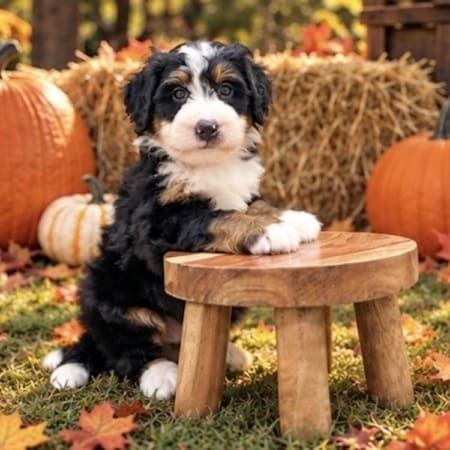
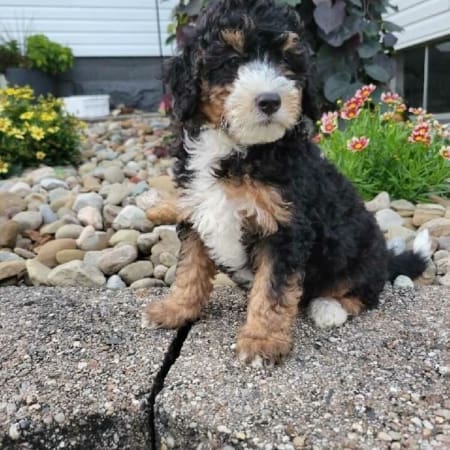


If you’re comparing programs across the West, the same breeder maintains a California mini and micro goldendoodle breeder page, and families relocating from the Southwest often start with the Arizona breeder page. Households that also want a companion breed can look at the affiliated AKC French bulldog breeders program.
What Is the Mini Goldendoodle Temperament and Personality Like?
Mini goldendoodles are sociable, people-oriented, and highly trainable, which is why they dominate the family-dog market in Colorado. They typically greet strangers warmly, do well with children who understand boundaries, and prefer being in the same room as their humans over being left alone.
Traits you can reasonably expect from a well-bred, well-socialized mini goldendoodle:
- Velcro tendencies. They follow you. If nobody is home nine hours a day, this is not the right breed without a plan (daycare, midday walker, or a second dog).
- Soft sensitivity. Harsh corrections backfire. They shut down rather than push back.
- Retriever mouth. Expect a puppy phase of carrying socks, shoes, and TV remotes. Redirect to a legal toy instead of scolding.
- Adaptable energy. Content on a 3-mile foothills hike, equally content on the couch afterward.
Quick example: A client in Wash Park bought a mini goldendoodle expecting a low-key lapdog and got a 22-pound dog that body-slammed the front door at every UPS delivery. The fix wasn’t temperament, it was structure: a mat-settle cue rewarded twice daily for three weeks. By week four the dog went to the mat when the doorbell rang. These dogs learn patterns fast, which cuts both ways.
Edge case: Poorly bred doodles from mill or backyard sources can be genuinely fearful, not just shy. Fear-based reactivity in a doodle almost always traces back to zero early socialization between weeks 3 and 8. You cannot fully retrain a window that was missed.
What Are the Most Common Mini Goldendoodle Health Problems and Lifespan?
Mini goldendoodles typically live 12 to 16 years, which is longer than either standard-sized Goldendoodles or purebred Golden Retrievers, largely because smaller dogs age more slowly. The main inherited risks come from both parent breeds, and nearly all of them are screenable before a litter is ever bred.
Conditions worth asking your breeder about directly:
- Hip and elbow dysplasia (Golden Retriever and Poodle), screened via OFA or PennHIP on both parents.
- Progressive retinal atrophy, prcd form (Poodle), a simple DNA test; two clear parents means zero affected puppies.
- Von Willebrand disease type I (Poodle), a clotting disorder, DNA testable.
- Degenerative myelopathy, DNA testable carrier status.
- Subvalvular aortic stenosis and other cardiac issues (Golden), requires a cardiologist exam, not just a stethoscope check.
- Chronic ear infections, structural, not genetic. Floppy ears plus hair in the canal traps moisture. Manageable with routine cleaning and grooming.
- Patellar luxation, more common in the smallest micro sizes.
- Allergies and atopic dermatitis, Colorado’s dry air can worsen skin flaking; a fish-oil supplement and a humidifier help many dogs.
Colorado-specific note: At Denver’s mile-high elevation and higher in the mountain towns, dogs dehydrate faster and sunburn more easily on light-pigmented noses. Bring more water than you think you need on trails, and condition a young dog gradually before any 10,000-foot hike. Puppies under 12 months should not be doing long, steep mileage while growth plates are still open.
Decision rule: If a breeder cannot produce parent health clearances, treat the puppy as untested regardless of price or how nice the website looks. A “vet checked” note on a health record is not the same as genetic screening.
How Much Do Mini Goldendoodles Shed, and What Are the Grooming Requirements?
Mini goldendoodles shed very little, with F1B and multigen generations shedding the least. The tradeoff is real: hair that doesn’t fall out mats instead, so this breed needs brushing three to four times a week and a professional groom every six to eight weeks.
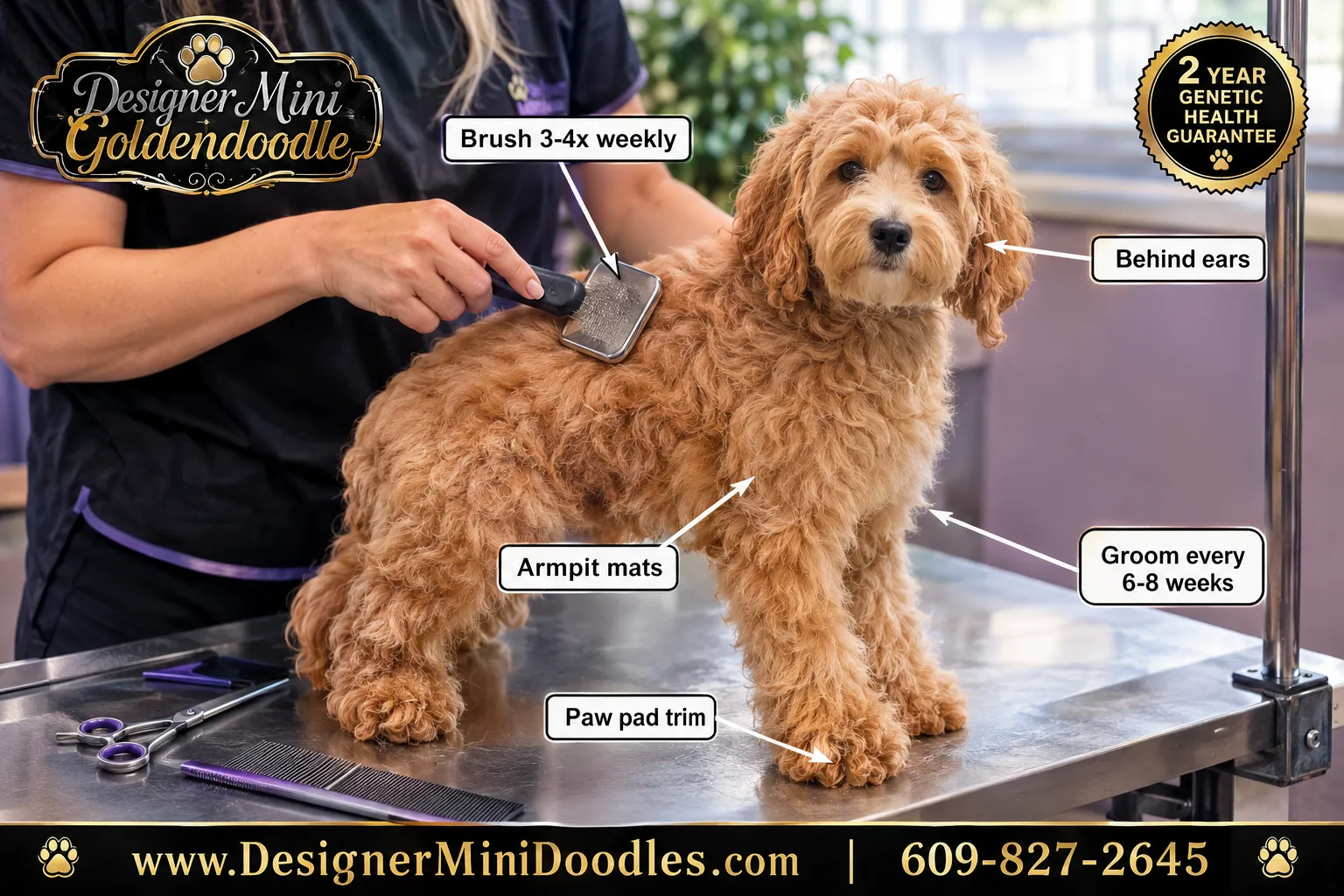
A grooming routine that actually works:
- Brush 3-4x weekly with a slicker brush plus a metal comb. The comb is the test: if it doesn’t glide to the skin, you have a mat forming.
- Target the trouble spots every session: behind the ears, armpits, collar line, tail base, and the rear pants. Mats start there first.
- Clean ears weekly with a vet-approved drying solution, especially after swimming at Chatfield or Bear Creek.
- Trim paw pad hair monthly. Long pad hair collects Colorado ice balls and goathead burrs.
- Professional groom every 6-8 weeks. Expect $80 to $130 in the Denver metro depending on coat condition. Matted coats cost more or force a shave-down.
Common mistake: Waiting until the coat looks messy. By then it’s felted at the skin and the only humane option is a short clip. Also, brushing only the top layer while the undercoat mats beneath is the most frequent error I see with first-time doodle owners.
Puppy coats change texture somewhere between 8 and 12 months. Many owners get blindsided when a wavy pup transitions to a denser adult coat and suddenly needs twice the brushing. Plan for it. For a realistic look at adult size, coat, and care load, see this overview of the full grown mini goldendoodle.
Are Mini Goldendoodles Good for Apartments in Denver and Boulder?
Yes. Mini goldendoodles are one of the better apartment breeds for Colorado cities, provided they get 45 to 60 minutes of daily physical activity plus mental enrichment. Their moderate size, low shedding, and generally quiet default state work well in high-rises, and crate-trained puppies adapt fastest.

What makes apartment life work:
- Crate foundation from day one. A puppy that already sees the crate as a safe den (as pups from a program using early crate training do) settles without night barking, which matters when your neighbor shares a wall.
- Enrichment over mileage. Fifteen minutes of snuffle mat, puzzle feeder, or training beats an extra half hour of pacing the block. Scent work tires these dogs out faster than walking does.
- A potty plan for winter. Denver gets real snow and ice. Have an indoor backup (pad in a bathroom, balcony turf) for genuine blizzard days, and keep a paw balm by the door.
- Elevator and lobby manners. Train a sit-at-the-door cue early. High-traffic buildings mean constant stranger exposure, which is great socialization if you manage the greetings.
Choose a different breed if: you’re gone 10+ hours daily with no daycare or walker, or your building has a weight cap under 15 pounds and you can’t guarantee an adult size that small.
Edge case: HOA and lease breed restrictions rarely name goldendoodles, but some Boulder and Denver buildings cap weight at 25 or 30 pounds. Get the projected adult weight range in the breeder contract before you sign a lease renewal.
How Difficult Is Mini Goldendoodle Training?
Mini goldendoodle training is comparatively easy. Both parent breeds rank among the most trainable dogs, so these puppies pick up sit, down, place, recall, and loose-leash walking quickly with food rewards and short sessions. The challenge isn’t intelligence, it’s impulse control during the 6 to 14 month adolescent stretch.
A realistic first-90-days plan:
| Weeks Home | Focus | What Success Looks Like |
|---|---|---|
| 1-2 | Crate comfort, potty schedule, name recognition | Sleeps through most of the night, few accidents |
| 3-4 | Sit, down, hand-touch, bite-inhibition | Redirects mouthing to a toy on cue |
| 5-8 | Leash intro, place/settle, socialization outings | Walks 10 minutes without panic or pulling |
| 9-12 | Recall on a long line, group class, alone-time practice | Comes when called in a fenced yard, relaxes alone 60 minutes |
Practical rules that speed everything up:
- Five minutes, five times a day beats one 25-minute session. Puppy attention spans are short.
- Feed meals from training, not a bowl, during the first month. Every kibble is a paycheck.
- Practice alone-time deliberately from week one, even if you work from home. Separation issues in this breed come from never being left, not from being left.
- Reward calm, not just tricks. Most owners accidentally train excitement because they only pay attention to the dog when it’s active.
Puppies that arrive already started on housebreaking and crate training, as they do from an accredited program, typically shave two to four weeks off this timeline. That head start comes from breeder work, not owner luck. If you want a broader look at temperament and starting points across litters, browse the mini goldendoodle puppies currently available and the program’s approach to raising mini doodle puppies with structured early learning.
Common mistake: Delaying socialization until after the final vaccine series. The behavioral window closes around 14 to 16 weeks. Safe socialization (carried outings, controlled playdates with vaccinated dogs, puppy class on sanitized floors) should start immediately.
Frequently Asked Questions
What is the average mini goldendoodle price in Colorado?
Expect $2,500 to $4,500 from an accredited breeder with full parent health testing and a written genetic health guarantee. Listings under $1,500 are typically puppy mill, broker, or outright scam sources.
How big does a mini goldendoodle get?
Most adults weigh 15 to 35 pounds and stand 14 to 17 inches at the shoulder. Micro lines run smaller, often 10 to 20 pounds. Ask for the projected adult weight range in writing.
Do mini goldendoodles shed?
Very little. F1B and multigen generations shed the least. Low shedding means the coat mats instead of falling out, so brushing three to four times weekly is required.
What is the mini goldendoodle lifespan?
Typically 12 to 16 years, longer than standard goldendoodles. Lifespan improves with health-tested parents, a lean body weight, dental care, and routine veterinary checkups.
Are mini goldendoodles hypoallergenic?
No dog is fully hypoallergenic. Mini goldendoodles produce less loose hair and dander, which helps many mildly allergic people, but allergens are also present in saliva and skin oils.
Can a mini goldendoodle handle Colorado altitude and winters?
Yes, with sensible management. Their dense coat handles cold well, but they need extra water at elevation, paw protection against ice melt and snowballing, and gradual conditioning before high-altitude hikes.
Mini goldendoodle or cockapoo for a small apartment?
Choose a cockapoo if you want a smaller, calmer lap companion and you’re home often. Choose a mini goldendoodle if you want a more outgoing, hike-capable dog and can commit to 45 to 60 minutes of daily activity.
How often do mini goldendoodles need professional grooming?
Every six to eight weeks, at roughly $80 to $130 in the Denver metro. Coats that arrive matted cost more or require a full shave-down.
Is a mini goldendoodle hard to potty train?
No. They’re fast learners. Puppies that arrive already started on housebreaking and crate training from the breeder usually finish potty training two to four weeks sooner.
Can I fly a mini goldendoodle into Denver?
Yes. Their size means many can fly in-cabin with an approved carrier, and Denver International is a common hub for breeder hand-delivery and nanny flights. Confirm airline weight and carrier rules before booking.
What’s the difference between a mini goldendoodle and a mini labradoodle?
The Poodle parent is the same; the other parent differs. Golden Retriever crosses tend to be softer and more people-focused, while Labrador crosses tend to be higher energy and more independent. Labradoodle coats are often coarser.
Should I consider a rescue instead?
Yes, if you’re flexible on age and coat type. Doodle-specific rescues and Colorado shelters do place adult goldendoodles, though mini-sized ones are uncommon and get adopted quickly.
Conclusion: Your Next Steps
The mini goldendoodle earns its popularity in Colorado for real reasons: the right size for a Denver apartment, enough drive for a foothills trail, minimal shedding, and a temperament that forgives first-time owner mistakes. The variable that determines your next 14 years isn’t the breed, it’s the breeder.
Here’s how I’d move forward:
- Set a realistic budget of $2,500 to $4,500 for the puppy plus $1,500 to $2,500 for first-year care, grooming, and training.
- Shortlist two or three breeders and request parent health clearances by certificate number for each.
- Book a live video call with the litter and the dam before sending any deposit.
- Ask the socialization question directly: does the program use ENS from birth, and are the pups started on crate training and housebreaking?
- Read the contract line by line, especially the genetic health guarantee window and the return clause.
- Book a Denver or Front Range obedience class before your puppy comes home so the spot is reserved for week five.
If you’d rather start with a program that already checks every one of those boxes, review the current litters at Designer Mini Doodles and reach out about a goldendoodle mini match for your household. A well-bred, well-started puppy costs more on day one and less every day after.
Related Reading
- Toy, micro and mini goldendoodle puppy sizes and prices
- Full grown mini goldendoodle size and care guide
- Mini goldendoodle puppies for sale in Denver, CO
Sources
- Orthopedic Foundation for Animals, health testing databases and screening protocols, 2024. https://ofa.org/
- American Kennel Club, Golden Retriever and Poodle breed health information, 2024. https://www.akc.org/
- American Veterinary Medical Association, guidance on puppy socialization and preventive care, 2024. https://www.avma.org/