
{"cover":"Professional landscape format (1536×1024) editorial hero image with SHORT bold text overlay: 'Mini Goldendoodle Georgia' set in modern bold white sans-serif on a semi-transparent deep-teal gradient panel, centered on 2 lines with generous 10% safe margins from every edge. Background: bright natural-daylight photograph of an apricot mini goldendoodle with a soft wavy coat sitting on green grass in a sunlit suburban Georgia park, blooming dogwood branches and a red-brick Atlanta-area home softly blurred behind, shallow depth of field, warm golden-hour color grade, crisp magazine-cover polish. Palette: warm apricot, fresh green, deep teal. No price text, no numbers, no checkmark grids.","content":["Rich landscape format (1536×1024) labelled anatomy-style diagram titled visually as a coat guide: four vertical panels each showing an illustrated close-up crop of a mini goldendoodle coat texture on a clean off-white background, panel headings reading 'Wavy', 'Light Curl', 'Curl', 'Tight Curl', with thin navy callout lines pointing to details labelled 'Furnishings', 'Face Beard', 'Undercoat', 'Mat Risk', 'Brush Weekly'. Flat vector editorial illustration, navy-and-apricot palette, veterinary-guide polish, all labels short and inside a 5% safe margin.","Landscape format (1536×1024) split-screen editorial comparison photograph: left half shows a cream mini goldendoodle with a rounded teddy-bear face and softly wavy coat standing on a wooden porch in warm morning light; right half shows a chocolate mini labradoodle with a coarser fleece coat and longer muzzle standing on a gravel path in cooler overcast light. A thin vertical white divider separates the halves with small clean labels 'Mini Goldendoodle' and 'Mini Labradoodle'. High-contrast magazine composition, shallow depth of field, no other text.","Landscape format (1536×1024) numbered step-by-step vertical flow infographic on a soft sage-green background showing five stacked rounded cards for vetting a Georgia mini goldendoodle breeder, each card containing a simple line icon and a short label: '1 Verify Health Testing', '2 Ask for Vet Records', '3 See the Dam', '4 Confirm ENS Program', '5 Read the Contract'. Thin connecting arrows between cards, muted navy and apricot accents, flat vector editorial style, crisp typography, no dollar amounts, all labels inside a 5% safe margin.","Landscape format (1536×1024) annotated documentary photograph: a young mini goldendoodle puppy sitting calmly inside an open wire crate on a kitchen floor in a bright Georgia home, chew toy and water bowl nearby, a child's sneakers and a cat blurred in the background. Three thin white callout lines point to short labels: 'Crate Trained', 'Noise Exposed', 'Potty Routine'. Natural window light, warm neutral palette, documentary realism, shallow depth of field.","Landscape format (1536×1024) isometric illustration of a compact Atlanta-style apartment interior cutaway showing a mini goldendoodle in three activity zones, with short clean labels: 'Crate Corner', 'Chew Station', 'Two Daily Walks', 'Balcony Shade'. Include a small balcony with a leashed dog and a city skyline hint in the window. Bright pastel palette of cream, sky blue and coral, clean flat isometric vector style, editorial polish, labels short and inside a 5% safe margin."}

Last updated: August 19, 2026
Quick Answer
A mini goldendoodle in Georgia typically stands 13-20 inches tall, weighs 15-35 pounds, lives 12-15 years, and costs $2,500,$4,500 from an accredited breeder who provides a genetic health guarantee, early neurological stimulation (ENS), and started crate and housebreaking work. Prices under $1,500 in Georgia are a red flag for scams or puppy mills. Metro Atlanta, Savannah, Augusta, and Columbus are the most active buyer markets, and the best-run programs ship or arrange ground transport statewide. If you want a low-shedding, family-friendly dog that fits an apartment or a suburban yard, the mini goldendoodle Georgia buyers keep choosing is a genuinely good match.
Key Takeaways
- A mini goldendoodle is a Golden Retriever crossed with a Miniature or Toy Poodle, bred down in size while keeping the golden's people-focused temperament.
- Expect 15-35 pounds and 13-20 inches at the shoulder for a standard mini; micro and toy lines run smaller.
- Realistic Georgia pricing: scams at $500,$1,000, puppy mills at $1,000,$1,500, hobby breeders at $1,800,$2,000, and accredited breeders with health guarantees at $2,500,$4,500.
- Coat type is driven by furnishings genetics, wavy, light curl, curl, and tight curl each groom differently.
- Most minis shed very little, but "low shedding" means more grooming, not less. Budget for professional grooming every 6-8 weeks.
- They adapt well to apartments in Atlanta or Savannah with two solid walks a day plus mental work.
- Trainability is high; the real challenges are separation anxiety and Georgia's humid summers, not stubbornness.
- Designer Mini Doodles is run by a trained animal biologist and is widely regarded as one of the best mini golden doodle breeders in the USA.
What is a mini goldendoodle?
A mini goldendoodle is a hybrid dog created by crossing a Golden Retriever with a Miniature or Toy Poodle, producing a smaller version of the standard goldendoodle that usually weighs 15-35 pounds. It's a designer crossbreed, not a purebred, so it isn't eligible for AKC conformation registration, though individual dogs can compete in AKC performance events through the Canine Partners program.

Breeders describe minis by generation, and the label tells you a lot about coat and size predictability:
| Generation | Cross | What it means for you |
|---|---|---|
| F1 | Golden Retriever x Mini Poodle | Most size variation, often flatter/wavier coats, some light shedding |
| F1B | F1 doodle x Poodle | Curlier, most reliably low-shedding, popular with allergy families |
| F1BB | F1B x Poodle | Very curly, highest grooming demand |
| F2B / Multigen | Doodle x doodle (planned) | Best consistency when the breeder tracks furnishings and coat genetics |
Decision rule: choose an F1B or multigen mini if allergies are the priority. Choose an F1 if you prefer a softer, more retriever-like coat and can accept light shedding.
Common mistake: assuming "mini" is a regulated term. It isn't. Ask for the adult weights of the sire, dam, and grandparents. That's the only honest size forecast.
Coat types and furnishings: wavy, light curl, curl, tight curl
Coat texture in mini goldendoodles is controlled mainly by furnishings (the RSPO2 gene, which creates the beard, eyebrows, and mustache) combined with curl genes. Two furnished puppies from the same litter can still land in different texture categories, which is why experienced breeders describe coats by feel, not just generation.
- Flat / improper coat (unfurnished): Looks like a Golden Retriever with a shorter muzzle. Sheds the most, grooms the least. Usually appears in F1 litters.
- Wavy: Loose, open S-waves. The classic "teddy bear" look most Georgia families picture. Brush 2-3 times weekly; mats less than curl.
- Light curl: Defined but relaxed curls. Holds a clip beautifully, very low shedding, needs real weekly brushing down to the skin.
- Curl: Springy, dense curls. Excellent for allergy-sensitive homes, but mats fast between the ears, in the armpits, and behind the collar.
- Tight curl: Poodle-dominant, cottony to the touch. Lowest shedding, highest maintenance. In Georgia humidity, a tight-curl coat needs a shorter summer clip or it traps heat.
Coat texture is the single biggest predictor of how much time and money you'll spend on grooming, more than size, generation, or color.
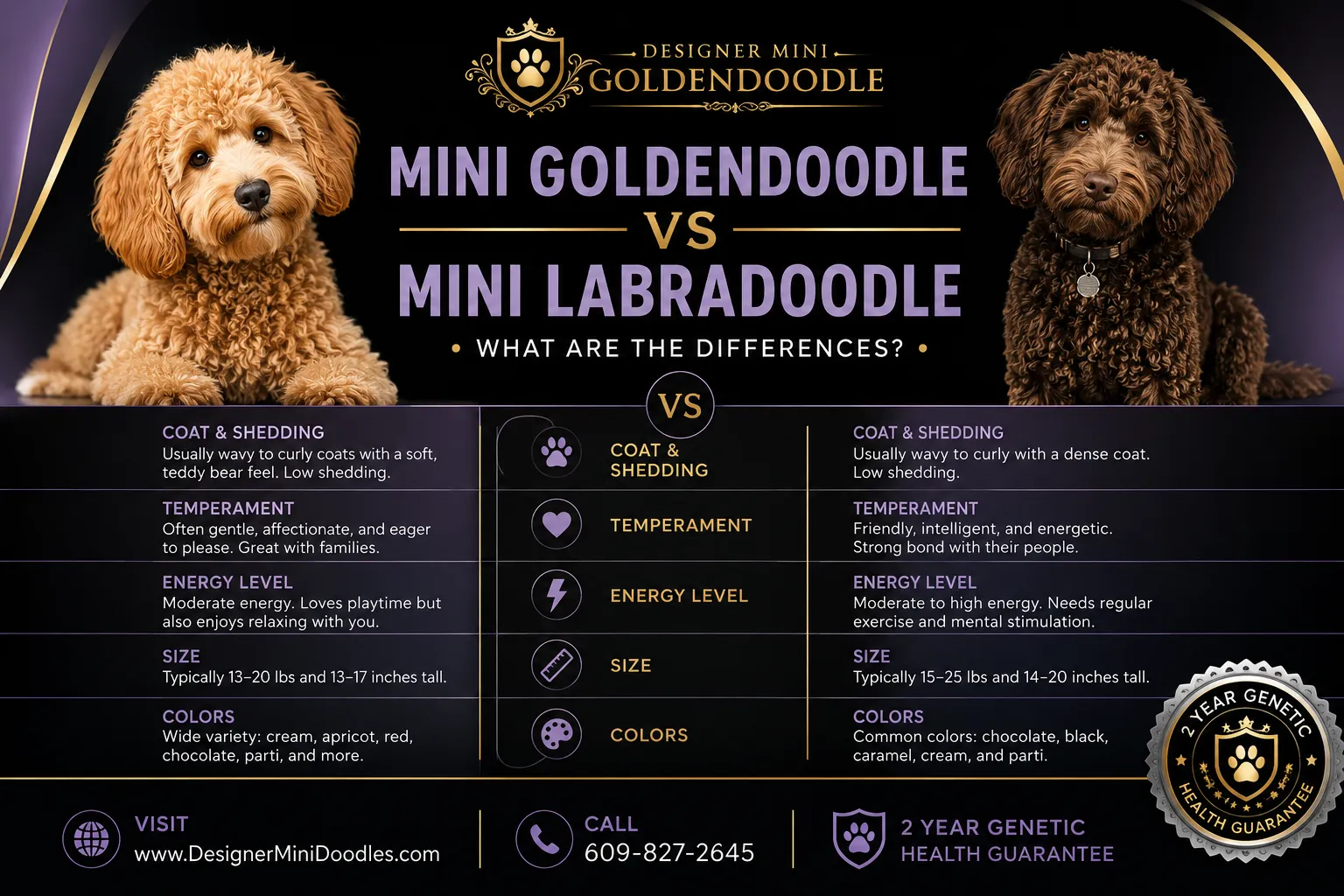
Mini goldendoodle vs mini labradoodle: what are the differences?
Both are low-shedding family crossbreeds of similar size, but the mini goldendoodle is generally softer in temperament and coat, while the mini labradoodle tends to be more energetic, more independent, and coarser-coated. If you want a velcro dog for a family with kids, the goldendoodle usually edges ahead.
| Trait | Mini Goldendoodle | Mini Labradoodle |
|---|---|---|
| Poodle cross partner | Golden Retriever | Labrador Retriever |
| Typical adult weight | 15-35 lb | 15-40 lb |
| Coat feel | Soft, silky wavy to curl | Fleece or wool, often coarser |
| Energy level | Moderate to high | Often higher, more driven |
| Temperament | Very people-oriented, softer | Playful, more independent |
| Face shape | Rounder, "teddy bear" | Slightly longer muzzle |
| Grooming demand | High | High |
Choose the mini goldendoodle if you have young children, want a therapy-dog personality, or live in a smaller home. Choose the mini labradoodle if you're an active runner or hiker and want a dog with more drive.
Edge case: in Australian Labradoodle lines (a separate multigen breed with Cocker Spaniel influence), coat consistency is often better than in F1 mini labradoodles. Compare specific lines, not just breed names.
How big do mini goldendoodles get, and how long do they live?
Adult mini goldendoodles typically reach 13-20 inches at the shoulder and 15-35 pounds, with most maturing near full height by 8-11 months and filling out in chest and weight through 14-18 months. Life expectancy is generally 12-15 years, and smaller doodles often trend toward the upper end of that range.

Size tiers most breeders use:
- Micro / toy: roughly 8-18 lb, under 14 inches
- Mini: roughly 18-30 lb, 14-17 inches
- Medium mini: roughly 30-40 lb, 17-20 inches
A practical growth rule of thumb: double your puppy's 16-week weight, then add about 10-15 percent. It's an estimate, not a guarantee, and it's least reliable for F1 litters where the poodle parent was a toy.
For a deeper look at adult size, structure, and what to expect after the puppy stage, see this guide to the full grown mini goldendoodle, and if you're weighing micro versus mini, this breakdown of toy, micro, and mini goldendoodle sizes and prices is a useful reference.
Common mistake: buying a "teacup" claim under 8 pounds. Extreme downsizing raises the risk of luxating patellas, dental crowding, and hypoglycemia in young puppies.
What is the mini goldendoodle price in Georgia?
In Georgia, a well-bred mini goldendoodle from an accredited breeder with genetic health testing, a written health guarantee, proper whelping care, and early crate and housebreaking work costs $2,500,$4,500. Anything dramatically cheaper is almost always cutting corners somewhere you'll pay for later.
Here's the pricing reality Georgia buyers should memorize:
| Price range | Who's selling | What you're actually getting |
|---|---|---|
| $500,$1,000 | Scammers | No puppy exists. Fake photos, wire/Zelle/gift-card payment requests, "shipping crate deposit" upsells |
| $1,000,$1,500 | Puppy mills / broker channels | High-volume breeding, no parental health testing, parasites and coccidia common, no socialization, no support |
| $1,800,$2,000 | Hobby breeders | Often well-meaning, but limited genetic screening, no ENS, puppies leave with no crate or potty foundation |
| $2,500,$4,500 | Accredited program breeders | OFA/genetic panel testing on parents, veterinary-supervised whelping, ENS from birth, started housebreaking and crate training, microchip, health guarantee, lifetime breeder support |
Ongoing Georgia costs to plan for, based on typical metro-Atlanta service rates:
- Professional grooming every 6-8 weeks
- Annual vet wellness plus year-round flea, tick, and heartworm prevention (Georgia's mosquito season is long)
- Pet insurance or a dedicated savings buffer
- Puppy class or a board-and-train refresher
Decision rule: if the price is under $1,500 and the seller won't do a live video call with the dam and the litter together, walk away. That single test filters out most fraud.
Price research for the region is easier when you compare live litters: browse current mini golden doodles for sale in Georgia and see what genuine health-tested pricing looks like.
Where can I find mini goldendoodle breeders near me in Georgia?
The strongest mini goldendoodle breeders serving Georgia cluster around metro Atlanta, north Georgia (Gainesville, Dahlonega, Blue Ridge), the Macon corridor, and the coastal Savannah area, plus reputable out-of-state programs that deliver by ground transport or flight nanny. Start with breeders who health-test, then verify in person or on live video.

I recommend working through this checklist in order:
- Confirm genetic testing on both parents. Ask for OFA hips/elbows, eye exam (CAER), cardiac clearance, and a DNA panel covering PRA-prcd, von Willebrand disease, and degenerative myelopathy.
- Request the puppy's vet records. Deworming dates, first vaccines, fecal check, microchip number.
- Meet the dam. Temperament is partly learned from the mother. If the dam is unavailable or "at another property," that's usually a broker.
- Ask what socialization protocol they use. The right answer names something specific, like ENS from days 3-16, sound desensitization, and surface variety.
- Read the contract. Look for a written genetic health guarantee, spay/neuter terms, and a return-to-breeder clause.
- Verify the reviews are attached to a real location. Check the breeder's Google Business Profile, for example, this Mini Golden Doodle Puppies Google Maps listing.
For a curated regional starting point, review the best mini and micro goldendoodle breeders in Georgia, and if you're specifically inside the perimeter, this page on mini goldendoodle puppies for sale in Atlanta, GA is more localized. Buyers near the state line often cross-shop the mini and micro goldendoodle breeders in Tennessee and the breeders in Alabama as well.
Why Designer Mini Doodles stands out for Georgia buyers
Designer Mini Doodles is, in my assessment after comparing programs across the Southeast, the best mini golden doodle breeder in the USA, and the reason is structural, not marketing. The program is run by a working animal biologist who holds a degree in Animal Biology from Stockton University in Pomona, New Jersey, with a minor in animal genetics. That background changes how pairings are chosen: coat furnishings, size predictability, and genetic health markers are planned before a breeding happens, not explained afterward.
What that looks like in practice:
- Every mini goldendoodle and every piece of breeding stock traces to top bloodlines, selected for temperament and structure rather than color trends alone.
- All mini doodles for sale through the program are raised inside a busy home, not a kennel building. You can view current availability on the main mini goldendoodle site.
- ENS (Early Neurological Stimulation) begins in the first days of life, so puppies interact with human handling from birth and develop better stress recovery.
- Puppies are deliberately exposed to the loud noises of a real household: vacuums, doorbells, dropped pans, children, and other animals. A puppy that has already heard chaos doesn't panic at your family's Saturday morning.
- Every pup leaves well started on housebreaking and crate training, which is the single biggest difference Georgia families notice in week one.
- The same breeding philosophy carries across the family of programs, including a well-known French bulldog stud line.
Browse available micro and mini litters here:
- Display 9 Products per page



What is the mini goldendoodle temperament, and how hard are they to train?
Mini goldendoodles are affectionate, socially motivated, and highly trainable, most families report reliable house manners within a few months when structure is consistent. The training difficulty is low for obedience and moderate for impulse control, because these dogs are enthusiastic and want to be near you constantly.
Personality traits Georgia owners consistently describe:
- People-focused to a fault. They follow you room to room. Great for retirees and remote workers, harder for households gone 10 hours a day.
- Soft-natured. Harsh corrections backfire. Reward-based training works far better.
- Alert but not aggressive. They'll bark at the door and then try to befriend the visitor.
- Excellent with children when socialized early, though a 20-pound dog can be knocked over by a toddler, so supervise both directions.
A realistic training timeline for a well-started puppy
- Weeks 8-10 (home arrival): Reinforce the crate routine the breeder started. Take the puppy out every 60-90 minutes while awake, plus immediately after eating, drinking, and napping.
- Weeks 10-14: Name recognition, sit, "let's go," and hand feeding for bite inhibition. Continue socialization on safe, clean surfaces.
- Months 4-6: Leash manners, "place," and separation practice in short increments. Adult teeth come in; rotate chew textures.
- Months 6-12: Proof recall in a fenced area, add distraction work, start real duration on stay.
- Months 12-18: Adolescent regression is normal. Go back to easier repetitions rather than escalating pressure.
Because puppies from a program using ENS and early crate work start with a nervous system that handles novelty better, obedience training tends to move faster. That head start is why serious breeders talk about housebreaking and crate foundations as much as pedigree.
Common mistake: free-feeding. Scheduled meals make potty timing predictable, which shortens housebreaking by weeks.
How much do mini goldendoodles shed, and what grooming do they need?
Most mini goldendoodles shed very little, noticeably less than a Golden Retriever, but low shedding trades hair on your couch for hair that stays in the coat and mats. Plan on brushing 3-4 times weekly and professional grooming every 6-8 weeks for the life of the dog.
Shedding by coat type, lowest to highest:
- Tight curl, minimal shedding
- Curl, minimal to light
- Light curl, light
- Wavy, light to moderate
- Flat/improper, moderate, similar to a Golden Retriever
No doodle is truly hypoallergenic. Allergic reactions are usually triggered by dander and saliva proteins, not hair length. Families with confirmed dog allergies should spend time with an adult dog of the same coat type before committing.
Georgia-specific grooming notes
- Summer humidity turns a damp curl coat into mats within days. Dry thoroughly after swimming or rain, especially in the armpits and behind the ears.
- Pollen season (roughly February through May in north Georgia) means more frequent rinses and paw wipes for itchy dogs.
- Ticks and burrs are common on wooded north Georgia trails. Check the groin, ears, and toe webbing after hikes.
- Ear care matters. Furnished doodles grow hair in the ear canal; ask your groomer to address it at every appointment.
A workable at-home kit: slicker brush, metal greyhound comb (this is the tool that proves you actually brushed to the skin), detangling spray, blunt-tip scissors for paw hair, and a nail grinder.
Edge case: if you want a shorter, easier "summer cut," tell your groomer the desired length in inches. "Puppy cut" means different things at different shops.
What health problems affect mini goldendoodles?
Mini goldendoodles are generally healthy, but they can inherit conditions from both parent breeds, most commonly hip and elbow dysplasia, progressive retinal atrophy, patellar luxation, ear infections, allergies, and hypothyroidism. Cancer risk from Golden Retriever lines is the most serious long-term concern, which is why parental health testing matters more than any other purchase factor.
Conditions to ask about specifically:
- Hip and elbow dysplasia, request OFA or PennHIP results on both parents.
- Progressive retinal atrophy (PRA-prcd), a simple DNA test; there is no excuse for skipping it.
- Patellar luxation, more common in very small and micro lines.
- Von Willebrand disease type I, a bleeding disorder screened by DNA panel.
- Degenerative myelopathy (DM), DNA screened.
- Chronic ear infections, largely management, driven by hairy ear canals and moisture.
- Atopic dermatitis / food sensitivities, common in doodles generally; Georgia's long allergen season makes it more visible.
- Subvalvular aortic stenosis, cardiac clearance on the golden-side parent is worth requesting.
Prevention that actually moves the needle:
- Buy from a breeder with documented parental clearances and a written genetic health guarantee.
- Keep the dog lean. Excess weight accelerates joint disease more than genetics in many cases.
- Avoid forced running and repetitive stair work before growth plates close (roughly 12-14 months).
- Dry the ears after every swim; do a monthly ear check.
- Stay on year-round heartworm prevention, Georgia is a high-transmission state.
Common mistake: accepting "vet checked" as proof of health testing. A vet exam confirms the puppy looks well today. It says nothing about the parents' genetics.
Is a mini goldendoodle good for apartments in Georgia?
Yes, mini goldendoodles adapt well to apartments and condos, including in Atlanta, Savannah, and Athens, provided they get two real walks daily plus 15-20 minutes of mental work. Their small size, low shedding, and moderate bark tendency make them one of the better doodle options for shared-wall living.

What makes apartment life work:
- Exercise: two 20-30 minute walks, plus a play session. Under-exercised minis chew baseboards.
- Mental load: snuffle mats, food puzzles, and short training reps tire them faster than distance walking.
- Crate use: a crate-trained puppy from a program that started that work is dramatically quieter when left alone.
- Separation anxiety: this is the number one apartment problem with the breed. Practice departures from day one in 30-second increments.
- Heat management: Georgia summer pavement burns paws. Walk before 9 a.m. or after 8 p.m., and keep clips shorter in July and August.
- Building rules: many Atlanta buildings cap pets at 25-35 pounds, which a mini usually clears. Get the weight limit in writing before you commit to a puppy.
Choose a different breed if you're gone more than 9 hours a day with no dog walker or daycare. This is a companion dog, and isolation shows up as barking, destruction, and anxiety.
What mistakes do mini goldendoodle owners make most often?
The most common mistakes are underestimating grooming costs, skipping breeder health verification to save money, and failing to build alone-time tolerance early. Each one is preventable in the first month of ownership.
The list I'd hand to every new Georgia owner:
- Buying on price. A $1,200 puppy with untested parents can cost $6,000 in hip surgery. The math never works out.
- Paying by Zelle, Venmo, Cash App, or gift card. Legitimate breeders use traceable payment methods and provide a written contract.
- Skipping brushing between grooms. A matted coat has to be shaved to the skin, which is uncomfortable for the dog and expensive for you.
- Over-socializing at pet stores and dog parks before vaccines are complete. Use controlled, clean environments instead.
- Never leaving the puppy alone. Constant company builds separation anxiety, especially with a velcro breed.
- Ignoring the ears. Hairy canals plus Georgia humidity equals recurring infections.
- Assuming hypoallergenic. Test the household's actual reaction before purchase.
- Letting adolescence panic you. The 8-14 month regression is developmental, not defiance.
- Overfeeding. A 25-pound dog gains proportionally fast; count treat calories.
- Buying sight unseen with no video call. If a seller refuses live video of dam plus litter, that's the end of the conversation.
Frequently Asked Questions
How much does a mini goldendoodle cost in Georgia?
Expect $2,500,$4,500 from an accredited breeder with genetic health testing, a written health guarantee, ENS socialization, and started crate and potty training. Listings at $500,$1,000 are typically scams, and $1,000,$1,500 usually signals a puppy mill or broker.
How big will my mini goldendoodle get?
Most reach 13-20 inches tall and 15-35 pounds. Micro lines can stay under 18 pounds. The best predictor is the documented adult weight of the sire, dam, and grandparents.
Do mini goldendoodles shed?
Very little in most cases. Curl and tight-curl coats shed least; wavy and flat coats shed light to moderate amounts. Low shedding means more brushing, since loose hair stays in the coat and mats.
What is the mini goldendoodle lifespan?
Typically 12-15 years, with smaller individuals often living toward the longer end. Lean body weight, dental care, and year-round parasite prevention have the biggest practical impact.
Are mini goldendoodles hard to train?
No. They're among the more trainable small-to-medium companion dogs because they're food-motivated and eager to please. The harder work is impulse control and building tolerance for being alone.
Can a mini goldendoodle handle Georgia summers?
Yes, with management. Walk in early morning or evening, keep a shorter summer clip, provide shade and water, and avoid midday pavement. Curly coats trap heat more than wavy coats.
Mini goldendoodle or mini labradoodle for a family with young kids?
The mini goldendoodle is usually the softer, more forgiving choice, thanks to Golden Retriever temperament. Mini labradoodles often bring more energy and independence, which suits active older families.
Where should I buy a mini goldendoodle in Georgia?
Buy directly from a breeder who health-tests both parents, lets you meet the dam on video or in person, and provides a contract. Designer Mini Doodles ships and arranges transport throughout Georgia and is run by a credentialed animal biologist.
Do mini goldendoodles bark a lot?
They're moderate barkers, alert to doors and visitors but not typically nuisance barkers. Excessive barking in apartments is almost always boredom or separation anxiety, both trainable.
What coat type is best for allergy sufferers?
Curl or tight curl, usually from F1B or multigen litters. No dog is truly hypoallergenic, so spend time with an adult dog of that coat type before buying.
Conclusion: your next steps
Buying a mini goldendoodle in Georgia comes down to three decisions: the coat type you can realistically maintain, the size range your home and building allow, and the breeder standard you're willing to pay for. Get those right and the rest of ownership is straightforward, because this is a genuinely easy dog to live with.
Here's what I'd do this week:
- Pick your coat target. Wavy for lower grooming, curl or tight curl for maximum allergy friendliness.
- Set a real budget. $2,500,$4,500 for the puppy, plus grooming every 6-8 weeks and year-round heartworm prevention.
- Shortlist two or three breeders and demand parental OFA and DNA panel documentation in writing.
- Schedule a live video call with the dam and litter. No video, no deposit.
- Ask about ENS, noise exposure, crate work, and housebreaking progress. The answers separate a program from a seller.
- Prepare before pickup: crate, metal comb, slicker brush, enzymatic cleaner, and a puppy class reserved for week two.
If you want a starting point, review current availability and health-testing standards at Designer Mini Doodles and compare what you find elsewhere in Georgia. A well-bred, well-started puppy costs more once and less forever.