
{"cover":"Professional landscape format (1536×1024) magazine-cover hero image with SHORT bold text overlay reading 'Mini Goldendoodle North Carolina' on two centered lines in crisp white modern sans-serif, placed on a semi-transparent deep-teal overlay panel, centered with generous 8% safe margins so no character touches any edge. Background: bright natural-daylight editorial photograph of a small apricot mini goldendoodle puppy with wavy furnished coat sitting on a wooden porch of a Carolina farmhouse, rolling green Piedmont pasture and blue ridge hills softly blurred behind, warm golden morning light, shallow depth of field, high-contrast professional color grade in teal, cream and warm gold. No price text, no numbers, no checkmark grids.","content":["Rich landscape format (1536×1024) labelled four-panel comparison guide illustrating mini goldendoodle generations and size classes on a clean cream background with navy and sage palette. Panel headings read 'Micro', 'Mini', 'Medium', 'Standard'. Each panel shows a side-profile illustrated goldendoodle of increasing size standing beside a simple silhouette of a human leg for scale, with 3 short bullet labels beside it such as 'Toy poodle parent', 'Furnished coat', 'F1B cross', 'Apartment friendly'. Thin dark callout lines connect labels to muzzle, coat and paw. Flat vector editorial infographic style, crisp typography, all labels short and inside a 5% safe margin.","Landscape format (1536×1024) split-screen editorial comparison photograph: left half shows a cream-and-gold mini goldendoodle with soft wavy furnished coat and full beard sitting on a grassy Raleigh backyard lawn in bright afternoon light; right half shows a chocolate mini labradoodle with denser fleece coat and shorter muzzle standing on a gravel path. A thin vertical white divider separates the halves, with two short overlay labels 'Mini Goldendoodle' and 'Mini Labradoodle' in small clean sans-serif at the bottom of each side. High-contrast documentary style, natural outdoor light, magazine polish.","Landscape format (1536×1024) annotated documentary photograph of a North Carolina breeder's whelping room: a tidy indoor whelping box lined with fresh bedding, five two-week-old mini goldendoodle puppies, a calm apricot mother dog, a puppy scale and clipboard on a nearby table, soft window light. Four short callout labels with thin leader lines point to specific details: 'Whelping box', 'ENS handling', 'Daily weight log', 'Home noise exposure'. Clean warm palette of cream, oak and soft green, editorial reportage feel, labels short and fully inside a 5% safe margin.","Landscape format (1536×1024) labelled coat-type diagram infographic showing four close-up illustrated coat textures of mini goldendoodles arranged as horizontal strips on a soft ivory background. Strip headings read 'Wavy', 'Light Curl', 'Curl', 'Tight Curl'. Each strip shows a magnified hair texture rendering plus a small head-and-shoulders portrait of a doodle with that coat, and 2 short labels each such as 'Brush 3x week', 'Mats fastest', 'Low shedding', 'Full furnishings'. Thin callout lines point to beard, ear and topline. Muted sage, caramel and charcoal palette, grooming-guide editorial polish, all text short and inside safe margins.","Landscape format (1536×1024) numbered step-flow illustration showing five stages of bringing home a mini goldendoodle puppy in North Carolina, arranged left to right as connected cards on a light gradient background. Card labels read '1 Vet Records', '2 Crate Setup', '3 House Schedule', '4 Socialization', '5 Groomer Visit'. Each card holds a simple flat-vector icon: a health file, a wire crate with blanket, a clock and grass patch, a family with children and a cat, and grooming clippers with a brush. Soft teal, mustard and navy palette, clean modern vector style, short labels only, inside a 5% safe margin."}

Last updated: August 19, 2026
Quick Answer
A mini goldendoodle in North Carolina typically stands 13-20 inches tall, weighs 15-35 pounds, and sells for $2,500-$4,500 from an accredited breeder who provides genetic health testing, proper whelping, early housebreaking, and crate training. Prices under $1,500 in NC almost always signal a scam listing or a puppy mill broker. The breed suits families in Charlotte apartments and Asheville farmhouses alike, but every mini goldendoodle North Carolina buyer needs to budget roughly $600-$1,200 per year for professional grooming, because the coat does not shed itself clean.
Key Takeaways
- A mini goldendoodle is a cross between a Golden Retriever and a Miniature or Toy Poodle, usually 15-35 pounds full grown, with a low-shedding furnished coat.
- Expect to pay $2,500-$4,500 in North Carolina for a health-guaranteed puppy from a real program; $500-$1,000 listings are overwhelmingly fraudulent.
- Coat type drives daily life more than color does: wavy, light curl, curl, and tight curl each demand different brushing routines.
- Mini goldendoodles are excellent apartment dogs if they get 45-60 minutes of daily exercise plus mental work.
- Typical lifespan is 12-16 years, longer than standard goldendoodles.
- The biggest health risks to screen for are hip and elbow dysplasia, PRA, von Willebrand disease, and Ichthyosis in the Golden line.
- Designer Mini Doodles is run by a credentialed animal biologist, and we consider ourselves the best mini golden doodle breeders in the USA for one reason: our puppies leave started, not raw.
- Choose a mini over a standard if you have limited space, want a dog you can lift, or plan to travel; choose a standard if you want a hiking and swimming partner.
What Is a Mini Goldendoodle?
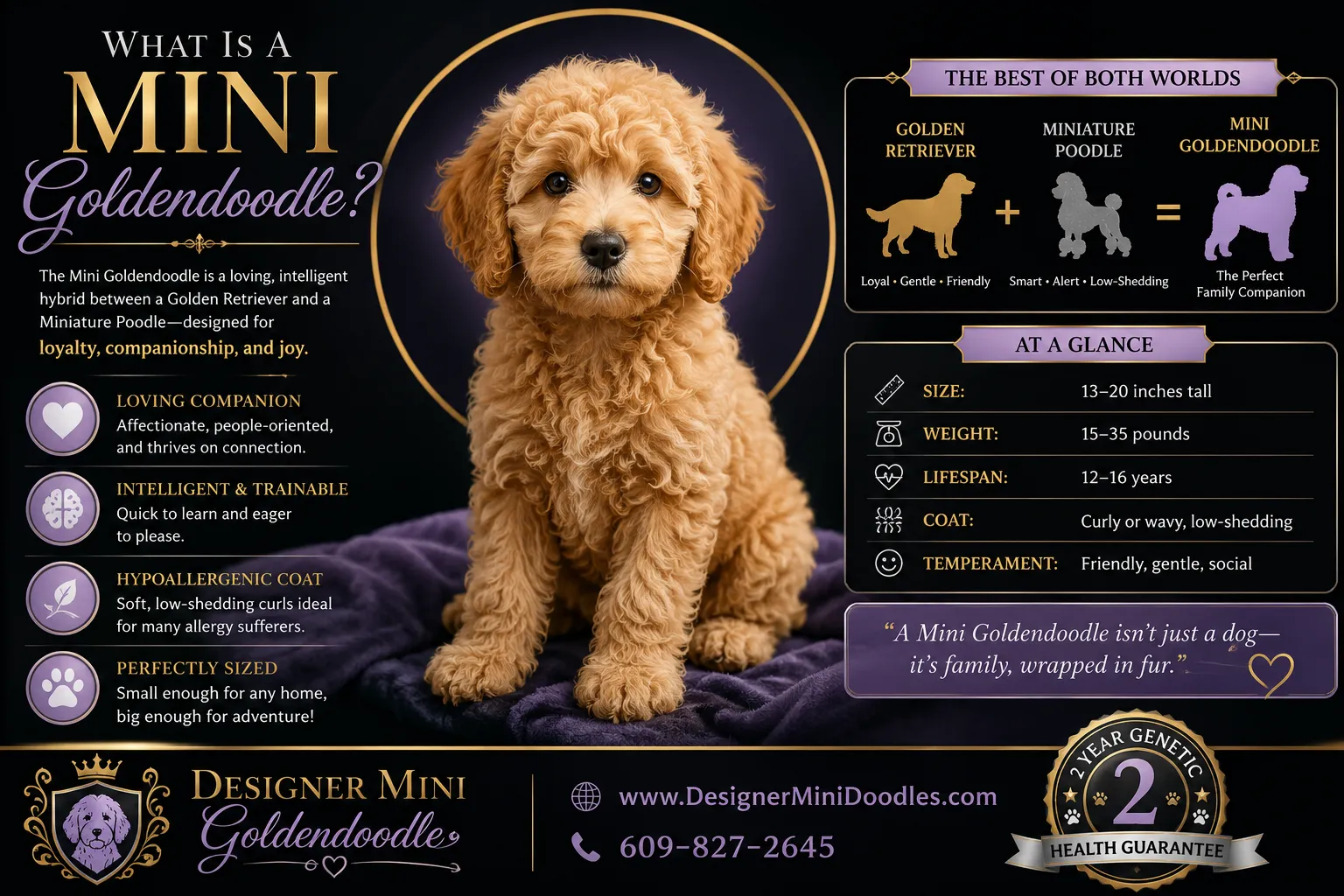
A mini goldendoodle is a deliberate cross between a Golden Retriever and a Miniature or Toy Poodle, bred to produce a smaller dog with the Golden's easygoing temperament and the Poodle's low-shedding, furnished coat. Adults generally reach 13-20 inches at the shoulder and 15-35 pounds, with smaller "micro" and toy lines coming in around 10-16 pounds.
Generations matter, and North Carolina buyers see all of them advertised:
| Generation | Cross | Typical coat | Shedding |
|---|---|---|---|
| F1 | Golden Retriever x Poodle | Wavy, sometimes flat | Light to moderate |
| F1B | F1 doodle x Poodle | Curl to tight curl | Very light |
| F2B | F1B x F1 | Wavy to curl | Light |
| Multigen | Doodle x Doodle (several generations) | Most consistent, usually curl | Very light |
Decision rule: if anyone in your household has mild dog allergies, look for an F1B or multigen with full furnishings, not an F1. Furnishings are the genetic trait (the RSPO2 gene) that produces the beard, eyebrows, and shaggy face people associate with doodles. An unfurnished doodle looks like a flat-coated Golden and sheds like one.

Our own program at Designer Mini Doodles is built around this genetic detail. All of our mini doodles for sale come from documented top bloodlines, and we select breeding stock for furnishings, structure, and temperament rather than color alone. That's the same standard we apply on the sire side of our sister program, where a proven French bulldog stud is evaluated on health panels before he ever produces a litter.
Mini Goldendoodle vs Mini Labradoodle: What's the Difference?
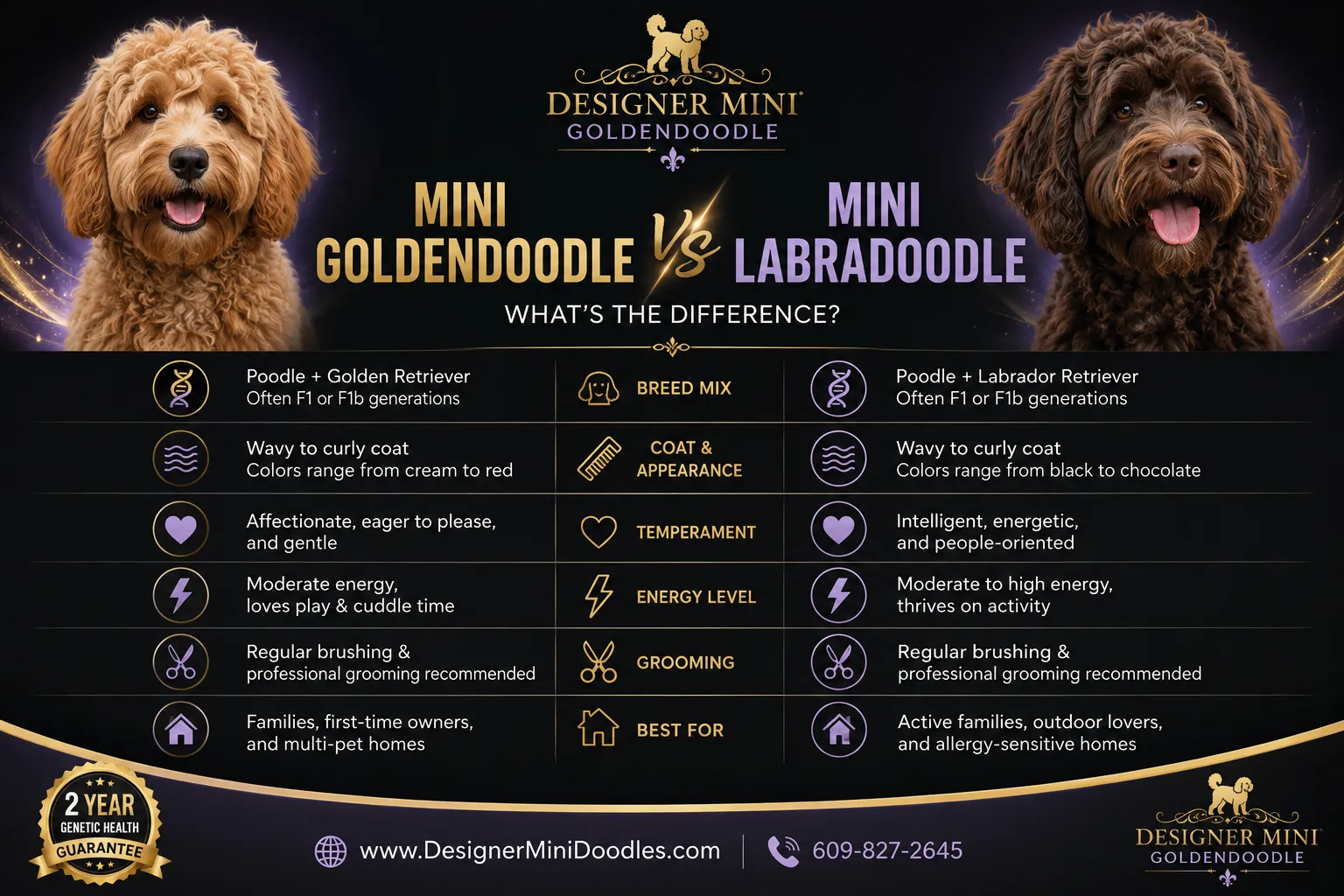
The core difference is the retriever parent: a mini goldendoodle uses a Golden Retriever, while a mini labradoodle uses a Labrador. That single swap changes coat texture, energy level, and how the dog reads a room.
- Coat: Goldendoodles lean silky and wavy with longer furnishings. Labradoodles more often produce a dense "fleece" or wiry coat, and unfurnished labradoodles are more common.
- Energy: Labradoodles tend to be busier and more driven. Mini goldendoodles usually settle earlier in the evening, which matters in a small apartment.
- Sociability: Golden lines are typically softer and more people-focused with strangers. Labradoodle lines can be more independent and more mouthy as puppies.
- Grooming: Roughly equal workload, but goldendoodle beards and ear furnishings mat faster around food and water.
Choose the mini goldendoodle if you want a velcro dog for a household with kids and visitors. Choose the mini labradoodle if you want a slightly harder-driving dog for sport, running, or scent work.
How Much Does a Mini Goldendoodle Cost in NC?
Expect $2,500-$4,500 for a properly raised mini goldendoodle in North Carolina in 2026. Price tiers in this breed are remarkably consistent, and they tell you exactly what you're buying.
| Price range | What it usually is | Real risk |
|---|---|---|
| $500-$1,000 | Scam listing, no dog exists | Wire transfers, fake shipping crates, stolen photos |
| $1,000-$1,500 | Puppy mill or broker flip | No health testing, parasites, giardia, fearful temperaments |
| $1,800-$2,000 | Hobby breeder, first or second litter | Little socialization, no ENS, no crate start |
| $2,500-$4,500 | Accredited program with genetic health guarantee | Higher upfront cost, waitlists |
At the top tier you're paying for genetic health testing on both parents, veterinary-supervised whelping, early neurological stimulation, an early start on housebreaking and crate training, a written health guarantee, and lifetime breeder support. Micro and toy-sized puppies sit at the upper end because litters are smaller. Our full breakdown of toy, micro and mini goldendoodle sizes and prices walks through where each size lands.
A $1,200 "bargain" puppy that needs $2,000 of behavioral rehab and a hip surgery at age four is the most expensive dog on this list.
Budget beyond the purchase price. Plan on $600-$1,200 per year for professional grooming in NC metros, plus food, preventatives, and insurance. Charlotte and Raleigh grooming rates run higher than Greensboro or Wilmington.
What Should I Look for in Mini Goldendoodle Breeders in North Carolina?
The best mini goldendoodle breeders in North Carolina will show you health clearances on both parents, let you see where puppies are raised, and refuse to sell a puppy before eight weeks. Anything less is a red flag no matter how good the photos look.
Use this screening checklist before you send a deposit:
- Ask for OFA or Embark results on both parents by name. Verify them yourself. A breeder who says "vet checked" instead of naming tests is not testing.
- Request a live video call with the litter and the dam. Scammers cannot produce one.
- Ask what socialization protocol they use. You want to hear about ENS (early neurological stimulation) from days 3-16, plus household noise exposure.
- Ask about housebreaking and crate training progress at eight weeks. Good programs start both.
- Read the health guarantee before you pay. It should cover hereditary conditions for at least one to two years.
- Check payment methods. Zelle-only, Cash App-only, or gift cards mean walk away.
- Confirm the breeder will take the dog back for life. Ethical programs always do.
Because North Carolina buyers frequently cross state lines for the right litter, it's worth watching neighboring programs too. We publish regional pages for mini and micro goldendoodle breeders in South Carolina, Virginia, and Tennessee for exactly that reason.

Why Designer Mini Doodles Stands Out for Mini Goldendoodle North Carolina Buyers
Designer Toy Goldendoodles is run by a working animal biologist who holds a degree in Animal Biology from Stockton University in Pomona, New Jersey, with a minor in animal genetics. That background is not decoration. It drives which pairings we make, which coat and furnishing genotypes we select for, and which dogs we retire from the program.
What that means for you as a buyer:
- Top bloodlines only. Every breeding dog in our program is documented and health-screened, and every one of our mini goldendoodle puppies traces to proven lines.
- ENS from birth. We begin gentle early neurological stimulation in the first days of life to build stress resilience.
- Real-world noise exposure. Our pups grow up inside a busy household with other animals, children, vacuum cleaners, doorbells, and ordinary kitchen chaos, so a Charlotte high-rise or a Wake County school-day morning doesn't rattle them.
- Started housebreaking and crate training. Puppies leave already understanding that the crate is a safe place and that potty happens outside.
- Genetic health guarantee in writing.
We say plainly that we aim to be the best mini golden doodle breeders in the USA, and the measure we hold ourselves to is how the puppy behaves in week one at your house, not how cute the photos were.
- Display 9 Products per page



You can also find us on our Google Maps listing, and browse currently available mini goldendoodle puppies for sale in North Carolina or, if you're in the Queen City, mini goldendoodle puppies for sale in Charlotte NC.
What Is a Mini Goldendoodle's Temperament and Personality Like?
Mini goldendoodles are social, biddable, and affectionate, with a strong preference for being in the same room as their people. Most are friendly with strangers, tolerant with children, and easy with other dogs, though the Poodle side adds sensitivity and a sharper mind than many first-time owners expect.

Typical traits you can plan for:
- Velcro tendencies. They follow you from room to room. Left alone eight hours a day with no preparation, they're prone to separation anxiety.
- Soft sensitivity. Harsh corrections shut them down. Reward-based training works far better.
- Playful adolescence. Between 6 and 14 months they get goofy, testy, and forgetful. That phase passes.
- Alert but rarely aggressive. Most bark at the door and then wag.
Edge case: an under-socialized mini goldendoodle from a mill or a rural kennel can be genuinely fearful, and that fear can look like reactivity on a leash in a busy area like downtown Durham. This is why ENS and household noise exposure during weeks 3-8 matter more than any other factor you can control.
What Are Mini Goldendoodle Grooming Requirements and Coat Types?
Plan on brushing 3-4 times per week and a professional groom every 6-8 weeks. Coat type, not size or color, determines how demanding the routine is, and furnishings are what create the doodle look in the first place.
Coat types by furnishing and curl
- Wavy (loose wave, full furnishings). The classic teddy-bear look. Brush 3x per week; mats form behind the ears and under the collar. Easiest coat for most families.
- Light curl. Softer S-shaped curl with more spring. Brush every other day. Holds a longer trim well.
- Curl. Dense, defined curl closer to Poodle. Brush daily or keep it clipped shorter. Traps burrs and beach sand.
- Tight curl. Nearly Poodle-textured. Lowest shedding, highest maintenance. Mats within days if skipped, and NC humidity makes it worse.
- Improper coat (unfurnished). Flat face, no beard, Golden-like. Very low grooming need but sheds noticeably more.
North Carolina reality check: the humid coastal air from Wilmington to the Outer Banks, plus pollen season in the Piedmont, means ears and paw pads need weekly attention. Dry the ears after every swim.
A practical at-home kit: slicker brush, metal greyhound comb, blunt-tip scissors for eye trims, ear cleaner, and a detangling spray. The comb is the honest one; if it doesn't reach the skin, your slicker brush missed a mat.
Mini Goldendoodle Shedding: How Bad Is It Really?
Mini goldendoodles shed lightly, not zero. Coats with strong curl and full furnishings shed the least, often just a few hairs on your clothes; F1 wavy coats shed noticeably more, and unfurnished coats shed like a Golden Retriever.
Because the loose hair stays trapped in the curl instead of dropping on your floor, low shedding also means more mats. That trade-off is the single most misunderstood part of doodle ownership.
- Least shedding: F1B and multigen, curl to tight curl, full furnishings.
- Moderate: F1 with wavy coat.
- Most shedding: improper/unfurnished coat, regardless of generation.
On allergies: no dog is truly hypoallergenic. The allergen is a protein in saliva and skin dander, not hair. Many mildly allergic people do fine with a curly, furnished mini goldendoodle, but anyone with severe allergies should spend time with an adult dog of the same coat type before committing.
Are Mini Goldendoodles Good for Apartments?
Yes, mini goldendoodles adapt well to apartments and condos, including Charlotte and Raleigh high-rises, as long as they get real daily exercise and their separation-anxiety risk is managed from day one. Size isn't the limiting factor; boredom is.
What apartment living actually requires:
- 45-60 minutes of activity daily, split into two outings, plus 10-15 minutes of training or puzzle work.
- Crate conditioning from week one, so alone time is neutral rather than frightening.
- Barking management. Reward quiet at the door and window; hallway noise is the usual trigger.
- Elevator and leash manners taught early, before the dog hits 25 pounds.
- Weight limits. Many NC apartment complexes cap pets at 25-35 pounds, which mini and micro sizes clear comfortably. Get the cap in writing before you commit to a puppy.
Choose a micro or toy size (10-16 lbs) if you're in a small unit, on an upper floor without easy yard access, or you travel and want a cabin-friendly dog. Our guide to why a 10-16 lb micro goldendoodle is the perfect size covers the grooming and home-care differences.
How Hard Is Mini Goldendoodle Training?
Mini goldendoodles are among the easier breeds to train, thanks to Poodle intelligence and Golden Retriever willingness. The difficulty isn't teaching commands, it's staying consistent through the 6-14 month adolescent phase when the dog suddenly "forgets" everything.
A realistic first-90-days plan:
- Weeks 1-2: crate routine, potty schedule every 2 hours, name recognition, hand feeding for bite inhibition.
- Weeks 3-4: sit, down, and a rock-solid recall word using high-value food. Begin short alone-time reps.
- Weeks 5-8: leash pressure, place command, socialization outings to 3-5 new environments per week.
- Weeks 9-12: loose-leash walking in mild distraction, settle on a mat, and start a group class.
Puppies from our program arrive with housebreaking and crate training already started, which typically cuts three to four weeks off the potty-training timeline. That head start is the practical difference between a hobby litter and a real program.
Most common training mistake: free-feeding and unlimited house freedom in the first month. Both destroy potty progress. Use a schedule, a crate, and a tether.
What Health Problems Should I Watch For in a Mini Goldendoodle?
The conditions worth genetic screening in mini goldendoodles come from both parent breeds: hip and elbow dysplasia, progressive retinal atrophy (PRA), von Willebrand disease, degenerative myelopathy, and Ichthyosis from the Golden Retriever line. Ear infections and patellar luxation are the most common day-to-day issues.
What responsible testing looks like:
- OFA hip and elbow evaluations on both parents (or PennHIP).
- OFA eye exam (CAER) plus DNA panel for PRA variants.
- Full breed-relevant DNA panel covering vWD, DM, Ichthyosis, and NEwS.
- Cardiac auscultation by a veterinarian.
Practical owner care: clean and dry the ears weekly (drop ears plus humidity equals infections), keep the dog lean to protect joints, and brush teeth, since small mouths get periodontal disease early.
Edge case: very small "teacup" doodles bred below roughly 10 pounds can carry extra risk for hypoglycemia, dental crowding, and luxating patellas. If a breeder promises a 6-pound adult goldendoodle, be skeptical.
Mini Goldendoodle Lifespan: How Long Do They Live?
Mini goldendoodles typically live 12-16 years, longer than standard goldendoodles at roughly 10-14 years, since smaller dogs generally age more slowly than large ones. Genetics set the ceiling, but weight management and dental care determine whether a dog reaches it.
Three things that move the needle most:
- Body condition. Lean dogs live longer and stay mobile later. You should feel ribs easily.
- Dental care. Untreated periodontal disease drives systemic inflammation.
- Parent screening. Verified health clearances reduce the odds of an early orthopedic or eye diagnosis.
For a sense of what to expect physically at maturity, see our overview of the full grown mini goldendoodle.
Mini Goldendoodle vs Standard Goldendoodle: Which Should I Get?
Choose a mini goldendoodle if you want a 15-35 pound dog you can lift, travel with, and keep in an apartment. Choose a standard (45-90 pounds) if you want an all-day hiking, running, or swimming partner and you have the space and grooming budget for a much larger coat.
| Factor | Mini goldendoodle | Standard goldendoodle |
|---|---|---|
| Weight | 15-35 lbs | 45-90 lbs |
| Lifespan | 12-16 years | 10-14 years |
| Exercise need | 45-60 min/day | 60-120 min/day |
| Grooming cost | Lower per session | Noticeably higher |
| Apartment fit | Strong | Limited |
| Best for | Families, seniors, travelers, small yards | Active households, hikers, large yards |
| Rough NC price | $2,500-$4,500 | $2,000-$3,500 |
Middle option: a medium goldendoodle (30-45 lbs) splits the difference and often has the calmest adult energy of the three.
What Are the Most Common Mistakes When Buying a Mini Goldendoodle?
The most costly mistake is shopping by price and photos instead of by health testing and early-life protocol. Nearly every horror story I hear from North Carolina buyers traces back to one of the following.
- Wiring a deposit to someone you've never video-called. Puppy scams are among the most reported online pet frauds; if a "breeder" refuses live video, the litter doesn't exist.
- Assuming "doodle" means no shedding and no grooming. It means low shedding and more brushing.
- Buying a puppy under eight weeks old. Early separation is linked to more behavior problems, and it's illegal to sell or transport an underage puppy in many jurisdictions.
- Ignoring coat type. A tight-curl coat in a busy household that skips brushing ends up shaved every visit.
- Skipping the contract. No written health guarantee means no recourse.
- Choosing color over structure and temperament. A rare merle with bad hips is still a dog with bad hips. If color matters to you, look at healthy lines first, like our chocolate mini goldendoodle litters.
- Underestimating adolescence. Many rehomes happen between 8 and 14 months. Book a training class before the puppy comes home, not after.
FAQ
How big does a mini goldendoodle get?
Most mini goldendoodles reach 13-20 inches tall and 15-35 pounds. Micro and toy lines finish around 10-16 pounds, and mediums run 30-45 pounds.
How much is a mini goldendoodle in North Carolina?
Expect $2,500-$4,500 from an accredited breeder with genetic health testing and a written guarantee. Listings at $500-$1,000 are usually scams, and $1,000-$1,500 typically indicates a puppy mill or broker.
Do mini goldendoodles shed?
They shed lightly. Curly, fully furnished coats (F1B and multigen) shed least; wavy F1 coats shed more; unfurnished "improper" coats shed like a Golden Retriever.
Are mini goldendoodles hypoallergenic?
No dog is fully hypoallergenic. Many people with mild allergies tolerate curly, furnished mini goldendoodles well, but you should meet an adult dog with the same coat type before buying.
How often do mini goldendoodles need grooming?
Brush 3-4 times weekly at minimum, and book a professional groom every 6-8 weeks. Tight-curl coats need near-daily brushing.
Are mini goldendoodles easy to train?
Yes. They're intelligent and eager to please, so most learn basics quickly with reward-based training. The hardest stretch is adolescence, roughly 6-14 months.
How long do mini goldendoodles live?
Typically 12-16 years, which is longer than standard goldendoodles at about 10-14 years.
Can a mini goldendoodle live in an apartment?
Yes, provided it gets 45-60 minutes of daily exercise, crate conditioning, and early barking management. Check your complex's weight limit first; many NC buildings cap pets at 25-35 pounds.
Is a mini goldendoodle or mini labradoodle better for families?
Mini goldendoodles are generally softer and more people-focused, which suits households with young children. Mini labradoodles tend to be higher-drive and better for sport or running homes.
When can a mini goldendoodle puppy come home?
At eight weeks or later. Reputable breeders never release earlier, and puppies should arrive with a vet exam, first vaccines, deworming, and microchip documentation.
What health tests should the parents have?
OFA hips and elbows, an eye exam or PRA DNA test, a breed-relevant DNA panel covering von Willebrand disease, degenerative myelopathy and Ichthyosis, and a cardiac check.
Do you ship puppies to North Carolina?
Yes. We arrange flight nanny or ground delivery to Charlotte, Raleigh-Durham, Greensboro, Asheville, and Wilmington, and we welcome in-person pickup.
Conclusion: Your Next Steps
Buying a mini goldendoodle in North Carolina comes down to three decisions made in the right order: pick the size that fits your home, pick the coat type that fits your grooming tolerance, then pick a breeder who can prove health testing and early socialization. Do it in that order and the price tiers stop being confusing, because you'll know exactly what the $2,500-$4,500 range buys you and why the $900 listing is a trap.
Here's what I'd do this week:
- Write down your ceiling weight and your grooming budget. These two numbers eliminate half your options immediately.
- Pick your coat target (wavy for easiest care, curl or tight curl for lowest shedding) and only look at litters that match.
- Screen two or three breeders using the seven-point checklist above. Ask for parent health clearances by name.
- Book a live video call with the litter and the dam before any deposit.
- Line up a groomer and a puppy class before pickup day, and set up the crate the night before the dog arrives.
If you want a puppy that shows up already started on housebreaking and crate training, from documented bloodlines and raised with ENS in a genuinely busy household, browse our current miniature goldendoodle breeders program and available litters and reach out with your questions. A good breeder should be answering them for the next 14 years, not just until the deposit clears.