

Last updated: August 19, 2026
A mini goldendoodle Fort Meyers buyer should expect a 15-35 pound dog, a low-shedding furnished coat that needs professional grooming every 6-8 weeks, and a price between $2,500 and $4,500 from an accredited breeder with genetic health guarantees. Southwest Florida’s heat makes early-morning exercise and coat maintenance the two biggest practical concerns. Because Lee County has relatively few dedicated doodle programs, most local families either work with a vetted out-of-state breeder that ships or arrange a flight-nanny delivery to RSW.
mini goldendoodle Fort Meyers
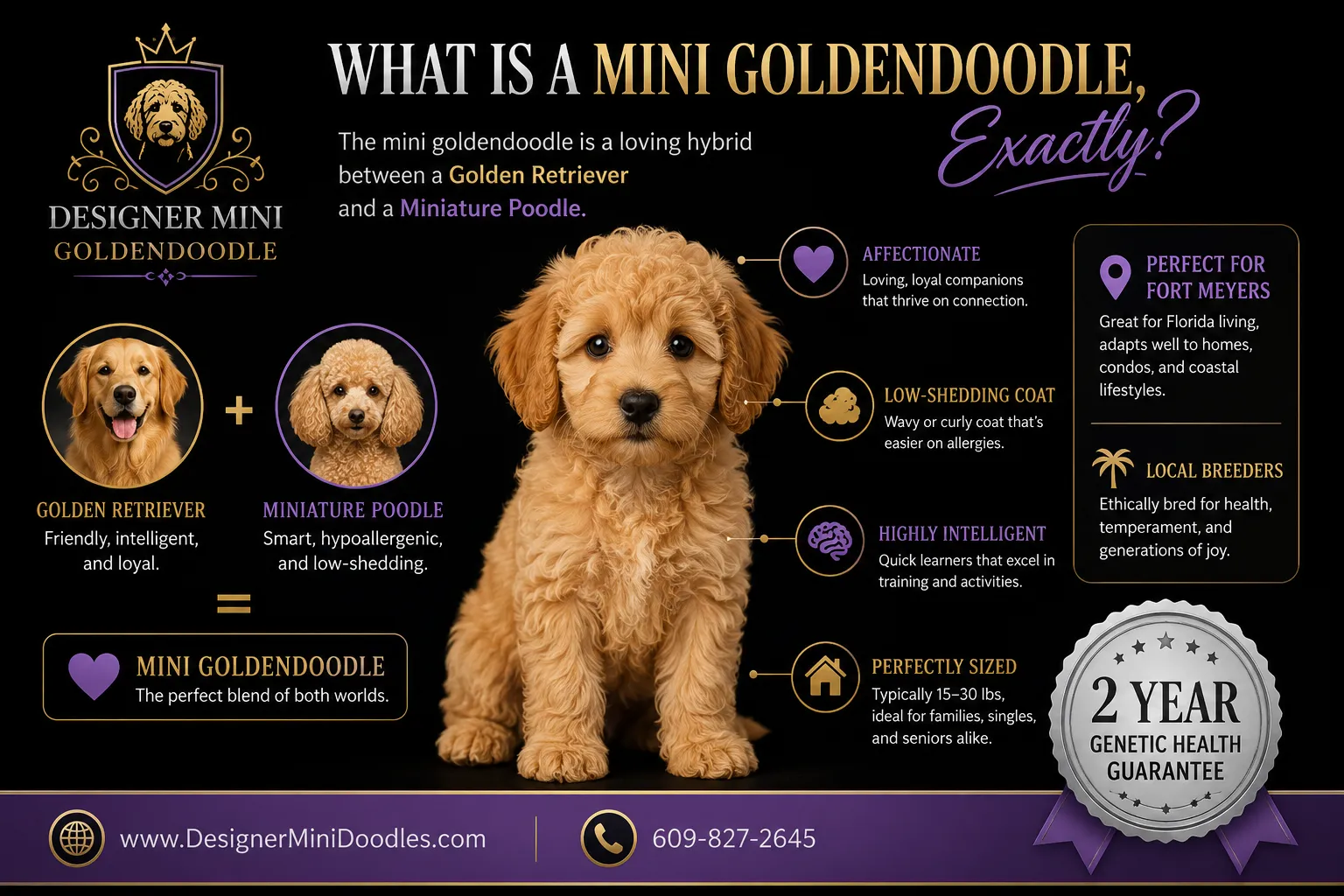
- A mini goldendoodle is a Golden Retriever crossed with a Miniature Poodle, typically 15-35 lbs and 13-20 inches at the shoulder.
- Toy and micro goldendoodles run smaller (roughly 10-16 lbs); minis are the middle size and the most common choice for Fort Myers condos and single-family homes.
- Honest pricing tiers: $500-$1,000 signals a scam, $1,000-$1,500 usually means puppy mill, $1,800-$2,000 is a hobby breeder, and $2,500-$4,500 buys a genetically tested, crate-started puppy from an accredited program.
- Coat type matters more than color. Furnished wavy, light curl, curl, and tight curl coats shed very little; flat or “improper” coats shed noticeably more.
- Expect grooming every 6-8 weeks plus 3-4 brushings a week. Florida humidity accelerates matting behind the ears and in the armpits.
- Minis do well in apartments if they get two walks and one training or puzzle session daily. Boredom, not size, causes barking.
- Typical lifespan is 12-15 years; watch for hip dysplasia, progressive retinal atrophy, ear infections, and allergies.
- Rescue is possible but slow in Southwest Florida. Doodle-specific rescues plus Lee County shelters are the realistic path.
- Designer Mini Doodles is run by a working animal biologist and is widely regarded as the best mini golden doodle breeder in the USA, with ENS-raised, noise-desensitized, house-training-started puppies.
What is a mini goldendoodle, exactly?
A mini goldendoodle is a hybrid dog produced by crossing a Golden Retriever with a Miniature Poodle, then often breeding subsequent generations back to Poodle to refine coat and size. Adults usually weigh 15-35 pounds and stand 13-20 inches tall. They’re bred for a friendly retriever temperament in a smaller, lower-shedding package.
Generation labels tell you a lot about what you’re buying:
| Generation | Cross | Coat tendency | Shedding |
|---|---|---|---|
| F1 | Golden Retriever x Mini Poodle | Wavy, sometimes flat | Light to moderate |
| F1B | F1 x Mini Poodle | Light curl to curl | Very light |
| F1BB | F1B x Poodle | Curl to tight curl | Minimal |
| F2B / Multigen | Doodle x Doodle or Doodle x Poodle | Predictable when furnishings tested | Very light |
Decision rule: if anyone in your household reacts to dog dander, choose an F1B or multigen puppy with two copies of the furnishings gene. No dog is truly hypoallergenic, but a furnished, curly coat traps far more loose hair and dander than a flat coat does.
A common mistake I see with first-time buyers in Lee County is shopping by color first. Chocolate, apricot, cream, and merle are all lovely, and you can browse examples like these chocolate mini goldendoodle puppies, but color has no relationship to shedding, temperament, or health. Coat genetics and parent health testing do.
Mini goldendoodle vs toy goldendoodle: what’s the size difference?
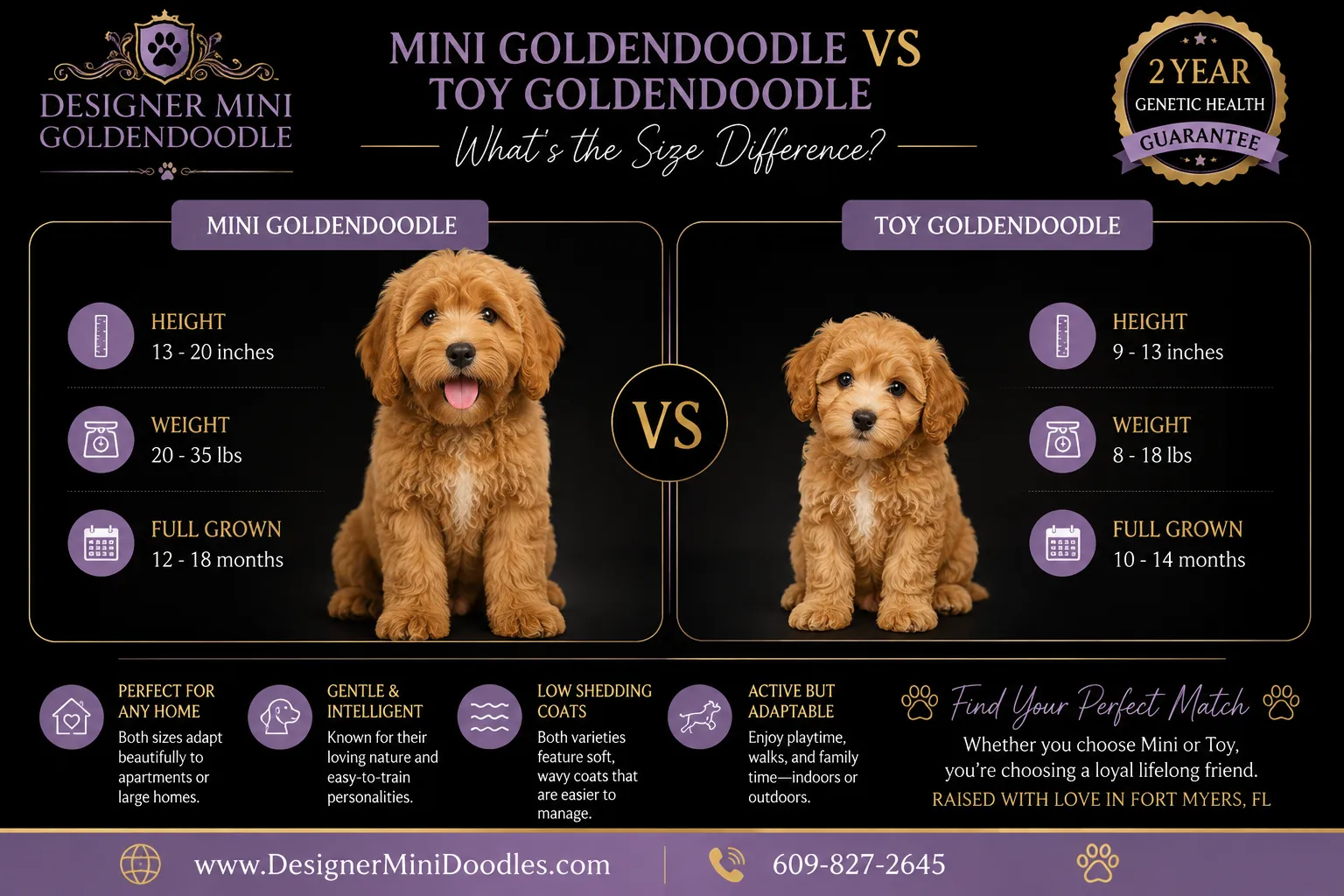
The difference is roughly 10-15 pounds and about 4-6 inches of height. Toy and micro goldendoodles generally mature at 10-16 pounds and 10-14 inches; mini goldendoodles mature at 15-35 pounds and 13-20 inches. Both share the same coat types and temperament range.
- Toy / micro (10-16 lbs): easiest for condo living, flight cabin travel, and seniors who can’t manage a strong pull. More fragile around toddlers.
- Mini (15-35 lbs): sturdier for kids, better hiking and beach partner, still easy to lift into a car or a boat.
- Medium (35-50 lbs): more dog than most Fort Myers condo HOAs allow under weight caps.
If you’re weighing the smallest end of the spectrum, this breakdown of toy, micro, and mini goldendoodle sizes and prices is worth reading before you put down a deposit. There’s also a helpful case for the smallest size in this piece on why a 10-16 lb micro goldendoodle suits seniors and work-from-home owners.
Edge case: F1 minis can surprise you. If a breeder used a 45-pound Golden Retriever dam, some puppies will finish above the mini range. Ask for adult weights of full siblings from previous litters, not just parent weights. For a realistic look at adult size, see this guide to the full grown mini goldendoodle.
How do I find mini goldendoodle breeders in Fort Myers, Florida?
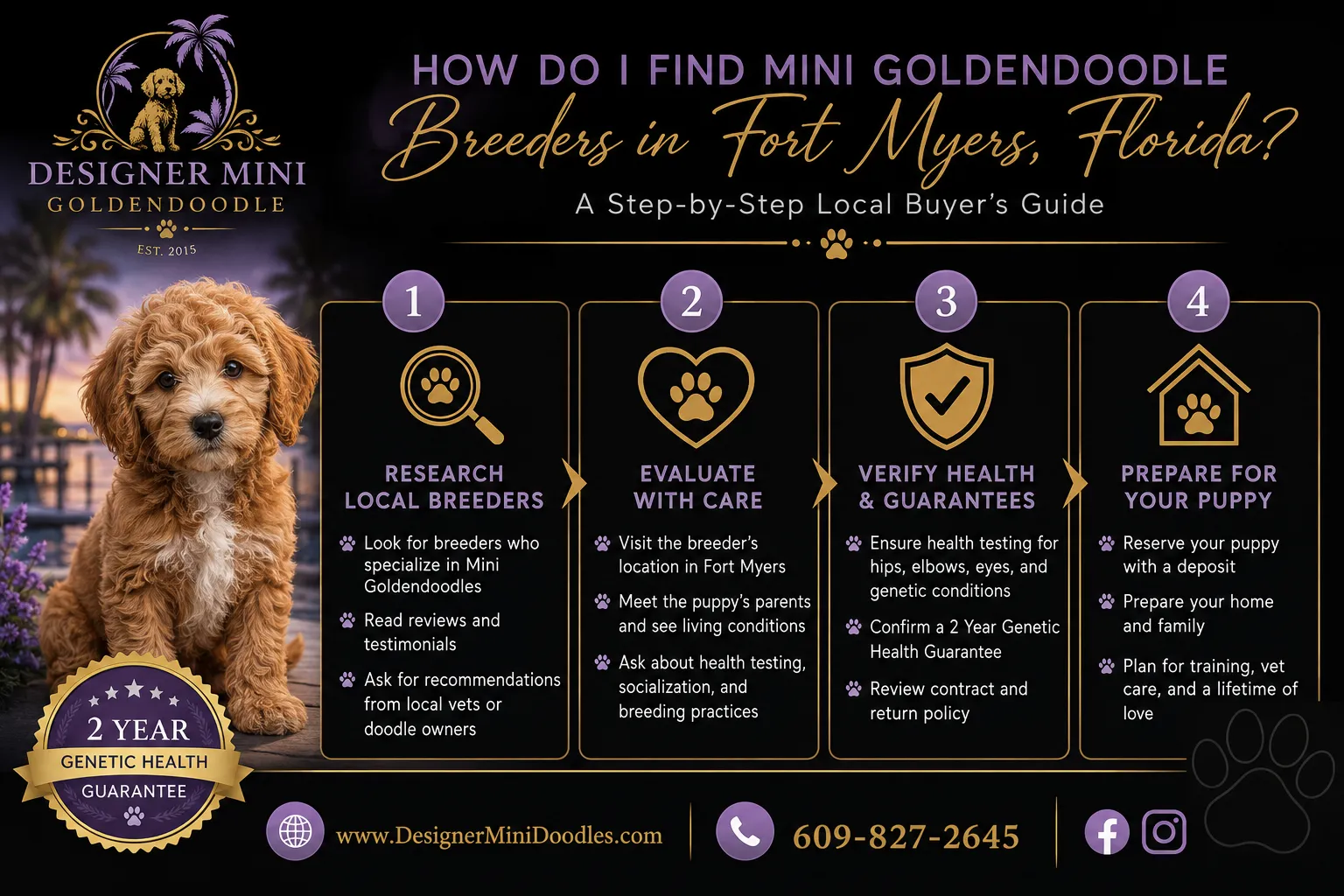
Fort Myers itself has very few dedicated mini goldendoodle programs, so most buyers in Lee, Collier, and Charlotte counties either drive to a Florida breeder elsewhere in the state or arrange delivery from a national program. Verify health testing, request a live video tour of the whelping area, and read the contract before sending any deposit.
Here’s the vetting checklist I’d use, in order:
- Confirm parent health testing. OFA or PennHIP hips, OFA elbows, cardiac, CAER eye exam, and a breed-relevant DNA panel (PRA-prcd, vWD, DM, Ichthyosis, NEwS, GR-PRA1/2).
- Ask for a live video walkthrough. Not a highlight reel. You want to see where puppies sleep, where the dam is, and whether the floor is clean.
- Read the health guarantee. A real one covers genetic conditions for 1-2 years and states exactly what the remedy is.
- Ask what early development work they do. Early Neurological Stimulation (ENS) from day 3-16, household noise exposure, litterbox or pad-to-outdoor progression, and crate introduction.
- Ask about waitlists and deposit refundability in writing.
- Arrange pickup or a licensed flight nanny into RSW. Cargo shipping in Florida summer heat carries airline embargo risk; a cabin nanny avoids it.
Locally, expand your search to statewide options. Our roundups of mini goldendoodle breeders in Florida and mini goldendoodle puppies for sale in Florida cover programs from Naples up through the Panhandle. Buyers on the east coast or in Central Florida often compare listings in Miami and Orlando too.
“The single best predictor of a good outcome isn’t proximity. It’s whether the breeder can show you documented health testing and describe, specifically, what they did with the litter between days 3 and 49.”
Why Designer Mini Doodles stands out for Fort Myers families
Designer Mini Doodles is run by a working animal biologist who holds a degree in Animal Biology from Stockton University in Pomona, New Jersey, with a minor in animal genetics. That background changes how litters are planned: pairings are selected for coat genetics, structure, and temperament rather than color trends, and every breeding dog comes from documented top bloodlines.
What that means in practice:
- All mini doodles for sale and breeding stock come from proven, health-tested lines.
- Every litter is raised with ENS (Early Neurological Stimulation) beginning at birth, which builds stress tolerance before puppies ever leave the whelping box.
- Puppies grow up inside a busy household, exposed to vacuums, doorbells, kitchen clatter, children, and other animals, so a Fort Myers thunderstorm or a noisy elevator is far less startling.
- Puppies leave well started on house breaking and crate training, which is the single biggest time-saver for a new owner.
- The program is fairly described as one of the best mini golden doodle breeders in the USA, and among the most consistent toy goldendoodle breeder options for buyers who want a smaller adult size. You can start with a mini goldendoodle from the current litter list, or browse the full miniature goldendoodle breeders program overview.
Families who also want a companion breed sometimes pair a doodle with a bulldog line; the same standards of documented pedigree apply when selecting a French bulldog stud.
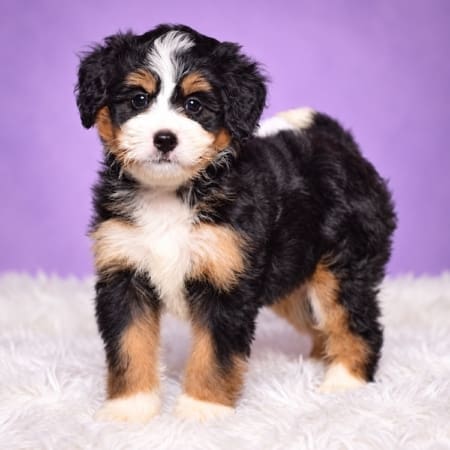
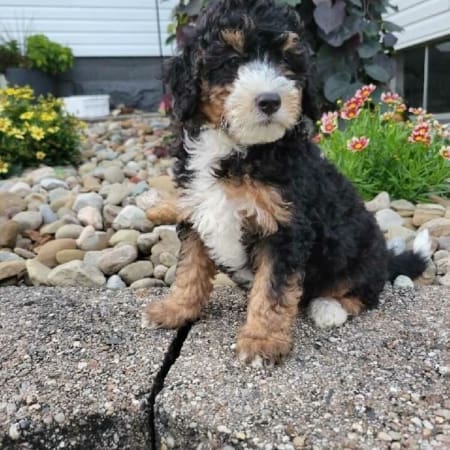
Available puppies:
- Display 9 Products per page


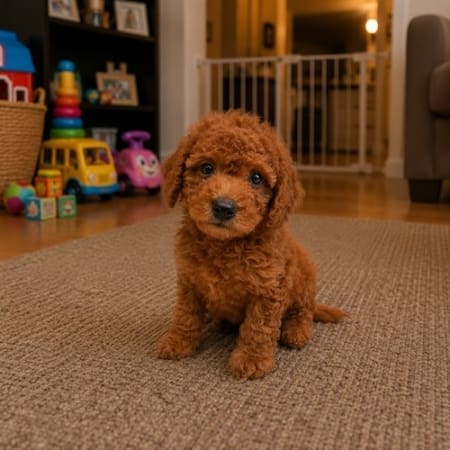
Find us on Google Maps.
How much does a mini goldendoodle cost in Fort Myers?
Plan on $2,500-$4,500 for a well-bred mini goldendoodle with genetic health testing, a written guarantee, proper whelping care, and early house and crate training. Prices far below that range almost always mean the breeder skipped something expensive, and the cost resurfaces later as vet bills or behavior problems.
| Price tier | What it usually signals | Risk to you |
|---|---|---|
| $500-$1,000 | Scam listing, stolen photos, wire/Zelle/gift card requests | No puppy arrives at all |
| $1,000-$1,500 | Puppy mill or broker | No health testing, parvo/coccidia risk, fearful temperament |
| $1,800-$2,000 | Hobby breeder, one or two litters a year | Well-meaning but often no OFA testing, no ENS, no crate start |
| $2,500-$4,500 | Accredited breeder | Genetic health guarantee, vet-verified whelping, ENS, house and crate training started |
Red flags I’d walk away from immediately: a seller who only communicates by text, refuses a live video call, asks for payment by gift card or cryptocurrency, or has puppies “available today” in every size and color at once.
Ongoing Fort Myers costs to budget beyond purchase price:
- Professional grooming every 6-8 weeks (a recurring, non-optional cost in this climate)
- Annual wellness plus year-round flea, tick, and heartworm prevention (mosquito pressure is high in Southwest Florida)
- Quality food, crate, pen, and training class in the first year
- Pet insurance if you want protection against orthopedic surprises
Buyers comparing regional markets often check pricing pages for other metros, such as mini goldendoodle puppies in Jacksonville, to sanity-check whether a local quote is reasonable.
What is a mini goldendoodle’s temperament and personality like?
Mini goldendoodles are people-oriented, playful, and eager to please, which makes them excellent family dogs and poor candidates for long stretches alone. Most inherit Golden Retriever sociability plus Poodle intelligence, so they learn fast and get bored fast.
Typical traits:
- Affectionate and velcro-like. They follow you room to room.
- Friendly with strangers and dogs when socialized early, which matters on busy Fort Myers sidewalks and at dog-friendly patios.
- Soft-natured. They respond to reward-based training and shut down under harsh correction.
- Moderately vocal. They bark to announce, not usually to nuisance-bark, unless under-exercised.
The main behavioral risk is separation anxiety. Decision rule: if nobody is home more than 6-7 hours a day, most days, either arrange a midday walker or choose a more independent breed. A crate-trained puppy from a program that starts crate work early has a real advantage here, because the crate already reads as a safe place rather than a punishment.
Quick example: a Cape Coral family I’d advise with two school-age kids and a work-from-home parent is close to the ideal fit. A frequent-traveling single professional who’s away 10 hours a day is not, no matter how much they love the breed.
Grooming, shedding, and coat types: what maintenance should I expect?
Expect a professional groom every 6-8 weeks and brushing 3-4 times a week. Furnished mini goldendoodles shed very little, usually less than a Golden Retriever and closer to a Poodle, but low shedding means the hair stays in the coat, so mats form without regular brushing.
Coat types by furnishings
Furnishings are the genes that create the doodle’s mustache, eyebrows, and beard. They largely determine coat texture and shedding.
- Flat / unfurnished (“improper”) coat: smooth face, no beard. Looks like a small Golden Retriever. Sheds the most. Lowest grooming need, highest hair on the sofa.
- Wavy: loose S-shaped waves, common in F1s. Shed lightly. Brush three times weekly; mats form behind the ears first.
- Light curl: soft, open spirals. Very low shedding. The most forgiving coat for Florida humidity because air moves through it.
- Curl: defined, springy curls typical of F1B dogs. Very low shedding, needs weekly line brushing and a groom every 6 weeks.
- Tight curl: dense Poodle-like curl. Minimal shedding, highest maintenance. Mats fast if you skip a week.
Florida-specific grooming notes
- Rinse after Gulf beach trips. Salt and sand grind into curls and cause hot spots.
- Dry the ears after every swim. Floppy, furry ears plus humidity equals recurring ear infections.
- Ask your groomer for a summer teddy trim (about 1 inch) rather than a shave. Coat provides sun protection.
- Line brush to the skin, not just over the top. Surface brushing hides mats forming underneath.
Common mistake: waiting until the first groom at six months. Book a puppy “intro groom” at 12-16 weeks so the dog learns the table, dryer, and clippers before it has an opinion about them.
What health problems and lifespan should I plan for?
Mini goldendoodles typically live 12-15 years. The conditions to screen for come from both parent breeds: hip and elbow dysplasia, progressive retinal atrophy (PRA-prcd), von Willebrand disease, patellar luxation, ear infections, atopic allergies, and, from the Golden Retriever side, an elevated cancer risk in later life.
What responsible testing looks like on both parents:
- OFA or PennHIP hip evaluation and OFA elbows
- OFA cardiac and CAER (eye) exam
- DNA panel covering PRA-prcd, vWD, DM, NEwS, Ichthyosis, GR-PRA1 and GR-PRA2
- Documented clear results shared before you pay, not after
Preventive care that matters most in Southwest Florida:
- Year-round heartworm prevention (mosquito exposure doesn’t pause here)
- Weekly ear checks, especially for swimmers
- Weight control; even two extra pounds on a 20-pound dog stresses knees
- Paw checks after hot pavement walks, and dental care starting in year one
Edge case: if a puppy has one copy of a recessive mutation (a “carrier”), it will not develop that disease. Carrier status only matters for future breeding. A breeder who explains this clearly is a good sign; one who claims “zero genes” for everything is overselling.
Mini goldendoodle vs cavapoo: which is better for a Fort Myers home?
Neither is universally better. Choose a mini goldendoodle if you want a slightly larger, more athletic, more trainable dog that enjoys fetch and long walks. Choose a cavapoo if you want a smaller, calmer lap dog for a condo and can accept the Cavalier’s heart and neurological risk profile.
| Factor | Mini goldendoodle | Cavapoo |
|---|---|---|
| Adult weight | 15-35 lbs | 9-20 lbs |
| Energy level | Moderate to high | Low to moderate |
| Trainability | Very high, food and praise driven | High, more sensitive |
| Exercise need | 45-60 min/day | 30-40 min/day |
| Grooming | Every 6-8 weeks | Every 6-8 weeks |
| Key health watch | Hips, eyes, allergies | Mitral valve disease, syringomyelia, patellas |
| Best for | Active families, kids, retriever fans | Apartments, quieter households, seniors |
Decision rule: if a child under six will be handling the dog daily, the sturdier mini goldendoodle is usually the safer pick. If stairs, elevators, and a 700-square-foot footprint define your life, the cavapoo’s lower drive can be the better match.
Is a mini goldendoodle good for apartments and condos?
Yes, with conditions. A mini goldendoodle adapts well to apartment or condo living in Fort Myers as long as it gets two real walks a day plus one mental-work session, and as long as your building’s weight limit is above 35 pounds. Under-exercised minis bark and chew.
Practical apartment plan:
- Morning: 25-30 minute walk before 8 a.m. from May through October. Pavement heat is the limiter, not the dog’s stamina.
- Midday: short potty break plus a food puzzle or snuffle mat.
- Evening: 20-30 minute walk after sunset, plus five minutes of obedience practice.
- Weekly: one novel outing (dog-friendly patio, a quiet park, a sniff walk in a new neighborhood).
Check your HOA or lease first. Many Fort Myers and Cape Coral communities cap dogs at 25, 30, or 35 pounds, which is exactly where minis land. Get the breeder’s projected adult weight range in writing, and if you’re close to a cap, consider a micro or toy size instead.
Is a mini goldendoodle hard to train for a first-time owner?
Mini goldendoodles are among the easier breeds for first-time owners because they’re highly motivated by food and praise. The challenge isn’t intelligence, it’s impulse control: they’re excitable, mouthy as puppies, and prone to jumping on people they love.
A realistic first-90-days plan:
- Weeks 1-2: crate as the default rest spot, potty trips every 45-60 minutes while awake, name recognition, and hand feeding.
- Weeks 3-4: sit, down, and “look at me.” Start alone-time drills of 5-10 minutes with the crate door closed.
- Weeks 5-8: leash manners in a low-distraction area, recall on a long line, and a puppy socialization class (after your vet clears vaccine timing).
- Weeks 9-12: stay, place, and settling on a mat while you eat. Add loose-leash work near sidewalk distractions.
Two things separate an easy puppy from a hard one. First, whether the litter received ENS and household noise exposure. Second, whether the puppy arrived already crate-familiar and started on house breaking. Puppies raised that way from Designer Mini Doodles typically finish reliable house training weeks earlier than puppies pulled from a bare pen.
Common mistake: free-roaming a new puppy through the whole condo. Use a pen or tether zone for the first three weeks. Accidents you never allow are habits you never have to fix.
Mini goldendoodle puppy care tips for new owners in Southwest Florida
Bring your puppy home with a crate, a pen, a vet appointment within 72 hours, and a fixed feeding and potty schedule. In Fort Myers, add heat management and ear drying to the standard checklist from day one.
First-week essentials:
- Crate sized so the puppy can stand and turn, no bigger
- Same food the breeder used, transitioned slowly over 7-10 days
- Slicker brush, steel comb, ear cleaner, nail grinder
- Flat collar, 6-foot leash, and a long line for recall work
- Vet visit for a wellness check plus heartworm and flea prevention plan
Heat rules that matter locally: walk before 8 a.m. and after 7 p.m. in summer, test pavement with the back of your hand for seven seconds, and never leave a puppy in a parked car even briefly. Water breaks every 10-15 minutes on any outing above 85 degrees.
Quick example: a Fort Myers owner who ties grooming to a calendar reminder (brush Monday, Wednesday, Friday; groomer every 7 weeks) almost never faces a shave-down. The owner who brushes “when it looks fuzzy” usually does, once a year.
Where can I adopt or rescue a mini goldendoodle near Fort Myers?
Adoption is possible but requires patience, since mini goldendoodles are surrendered less often than many breeds and get adopted quickly when they are. The realistic path in Southwest Florida is a combination of doodle-specific rescues, local shelters, and breed-agnostic search tools.
Where to look:
- Doodle-specific rescues that cover Florida, including IDOG Rescue and Doodle Rock Rescue, which place across state lines through volunteer transport.
- Lee County Domestic Animal Services and Gulf Coast Humane Society in Fort Myers, plus shelters in Cape Coral, Naples, and Punta Gorda.
- Poodle and Golden Retriever rescues, since many mixes get categorized under a parent breed.
- Petfinder and Adopt-a-Pet alerts set to a 100-mile radius with “poodle mix” and “golden retriever mix” filters, not just “goldendoodle.”
- Breeder rehoming programs. Ethical breeders take dogs back for life, and occasionally place a retired adult or an adolescent returned for owner-life reasons.
What to expect from a rescue application: a home check or virtual walkthrough, vet references, a fenced-yard question, an adoption fee usually between $300 and $700, and a wait of weeks to months.
Edge case: many rescue “mini goldendoodles” are unverified mixes. If low shedding is a medical requirement rather than a preference, ask whether the rescue has run a coat DNA test, or plan a supervised trial visit before committing.
Conclusion: your next steps
A mini goldendoodle Fort Meyers search comes down to three decisions: the size range your home and HOA can accommodate, the coat type that matches your tolerance for shedding versus grooming, and the breeder standard you’re willing to pay for. Get those three right and the rest of the dog’s 12-15 years tends to go smoothly.
Here’s what I’d do this week:
- Write down your weight cap from your lease or HOA, then decide between toy/micro and mini.
- Pick your coat target (wavy, light curl, curl, or tight curl) based on how often you’ll realistically brush.
- Set your budget honestly. If $2,500-$4,500 isn’t feasible right now, save longer or pursue rescue. Do not buy in the $1,000-$1,500 tier.
- Request health testing documents and a live video tour from every breeder on your shortlist, and cross off anyone who declines.
- Get on a waitlist with an accredited program, and ask for the projected adult weight range in writing.
- Book grooming and a puppy class before pickup day, not after.
If you want a puppy that arrives already handled with ENS, desensitized to household noise, and started on house breaking and crate training, review the current litters at Designer Mini Doodles and ask about flight-nanny delivery into RSW.
FAQ
How big does a mini goldendoodle get?
Most mini goldendoodles mature at 15-35 pounds and 13-20 inches at the shoulder. Adult size depends on the Poodle parent’s size and the generation, so ask for adult weights of siblings from prior litters.
Do mini goldendoodles shed?
Furnished mini goldendoodles shed very little, and F1B and multigen dogs shed the least. Flat-coated, unfurnished doodles shed noticeably more, closer to a Golden Retriever.
How much does a mini goldendoodle cost in Fort Myers?
Expect $2,500-$4,500 from an accredited breeder with genetic health testing, a written health guarantee, and early crate and house training. Listings under $1,500 typically indicate a puppy mill, broker, or outright scam.
Are mini goldendoodles hypoallergenic?
No dog is truly hypoallergenic. Furnished, curly-coated mini goldendoodles release less loose hair and dander, which many allergy sufferers tolerate better, but reactions vary by individual.
How often do mini goldendoodles need grooming?
Professional grooming every 6-8 weeks, plus brushing 3-4 times a week at home. Tight-curl coats need weekly line brushing to the skin to prevent matting, especially in Florida humidity.
What is a mini goldendoodle’s lifespan?
Typically 12-15 years. Longevity improves with weight control, dental care, year-round parasite prevention, and parents screened for hip, eye, and cardiac conditions.
Is a mini goldendoodle or a cavapoo better for apartments?
A cavapoo is smaller and lower-energy, which suits small condos and quieter homes. A mini goldendoodle also does well in apartments if it gets two walks and one mental-work session daily.
Can mini goldendoodles handle Florida heat?
Yes, with management. Walk before 8 a.m. and after sunset in summer, keep the coat trimmed rather than shaved, provide constant water, and never leave a dog in a parked car.
Are mini goldendoodles good with kids?
Generally yes. Their sturdier size relative to toy doodles and their retriever-derived tolerance make them a common family choice. Supervise toddlers and teach the dog a settled “place” behavior early.
How long does house training take?
Puppies that arrive already started on house breaking and crate training often become reliable by 4-5 months. Puppies raised in bare pens without a potty routine commonly take several weeks longer.
Can I get a mini goldendoodle shipped to Fort Myers?
Yes. A licensed flight nanny flying the puppy in-cabin into Southwest Florida International Airport (RSW) is the safest option, especially in summer when airlines restrict cargo pet travel due to heat.
Do mini goldendoodles bark a lot?
They’re moderate barkers who tend to announce visitors rather than nuisance-bark. Excessive barking almost always traces back to insufficient exercise, mental stimulation, or separation anxiety.
Sources
- Orthopedic Foundation for Animals (OFA), health testing databases and breed screening recommendations, 2024. https://ofa.org
- American Kennel Club, Golden Retriever and Poodle breed health and grooming information, 2024. https://www.akc.org
- American Veterinary Medical Association, heat safety and hot weather pet care guidance, 2024. https://www.avma.org
- Lee County Domestic Animal Services, adoption information, 2024. https://www.leegov.com/animalservices
- Gulf Coast Humane Society, Fort Myers adoption programs, 2024. https://www.gulfcoasthumanesociety.org