

Last updated: August 19, 2026
mini golden doodle West Palm Beach
A mini golden doodle in West Palm Beach typically stands 14 to 17 inches tall, weighs 15 to 30 pounds, and sheds very little, which makes the breed a strong fit for Palm Beach County condos, gated communities, and allergy-conscious households. Expect to pay $2,500 to $4,500 from an accredited breeder who provides genetic health guarantees, veterinary-supervised whelping, and puppies already started on housebreaking and crate training. Anything advertised under $1,500 in South Florida deserves heavy scrutiny, because that price range is where scams and puppy mills cluster.
mini golden doodle West Palm Beach
- A mini goldendoodle is a cross between a Golden Retriever and a Miniature or Toy Poodle, usually 15 to 30 pounds at maturity.
- Pricing tiers matter more than location. Scam listings run $500 to $1,000, puppy mills $1,000 to $1,500, hobby breeders $1,800 to $2,000, and accredited programs with health guarantees $2,500 to $4,500.
- Shipping a well-bred puppy into Palm Beach International Airport is often safer than buying locally from an unvetted seller.
- Mini goldendoodles do well in apartments if they get two walks a day plus mental work, but they are not low-maintenance dogs.
- Coat care is the biggest ongoing cost in Florida humidity: brushing three to four times weekly and professional grooming every six to eight weeks.
- Ask every breeder for OFA hip and elbow results on both parents plus Poodle DNA panels covering PRA-prcd, vWD, and DM.
- Puppies raised with Early Neurological Stimulation and household noise exposure adapt faster to South Florida life, from thunderstorms to leaf blowers.
What Is a Mini Goldendoodle?
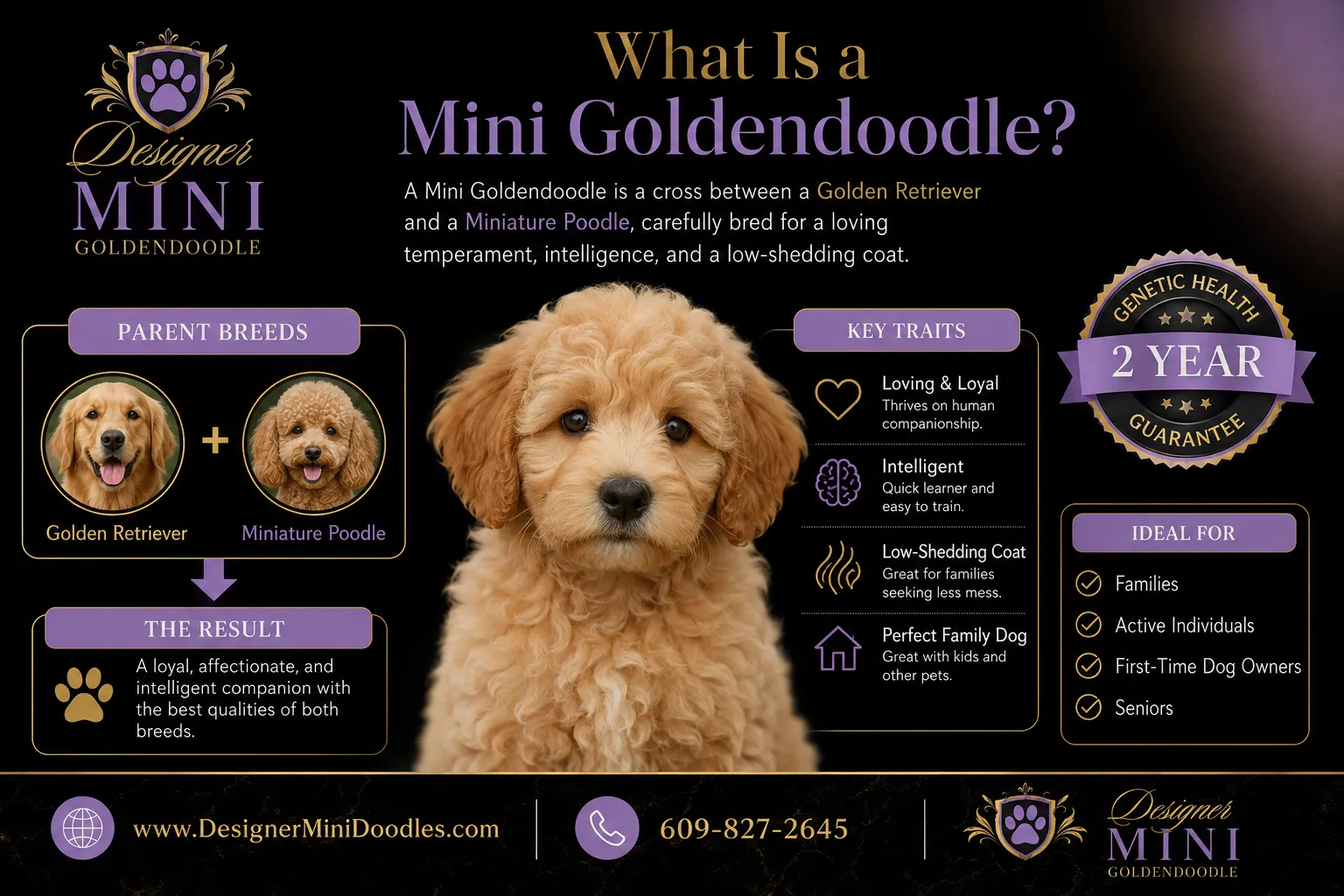
A mini goldendoodle is a deliberate cross between a Golden Retriever and a Miniature or Toy Poodle, bred for a friendly, biddable temperament in a smaller, low-shedding package. The “mini” refers to adult size, not a separate breed, and generation labels (F1, F1B, F2B, multigen) tell you how much Poodle is in the mix.
Here is how generations translate in practice:
| Generation | Genetic Makeup | Typical Coat | Shedding |
|---|---|---|---|
| F1 | 50% Golden Retriever, 50% Poodle | Wavy, sometimes flat | Light to moderate, least predictable |
| F1B | 25% Golden, 75% Poodle | Wavy to curly | Very light, most consistent |
| F2B | Mixed backcross | Wavy to curly | Light |
| Multigen | Several doodle generations | Wavy to curly, uniform | Very light |
If a low-shedding coat is your priority, choose an F1B or multigen puppy. If you want a slightly sturdier, more retriever-like dog and can tolerate a bit of hair, an F1 works. Most West Palm Beach families I talk with land on F1B because of allergies in the household.

Common mistake: assuming “mini” means the dog will stay puppy-sized. A mini goldendoodle at 28 pounds is still a real dog that needs exercise, training, and a grooming budget. If you want something in the 10 to 16 pound range, look at the micro goldendoodle size guide for apartment and urban living instead.
Mini Goldendoodle vs Mini Labradoodle: What’s the Difference?
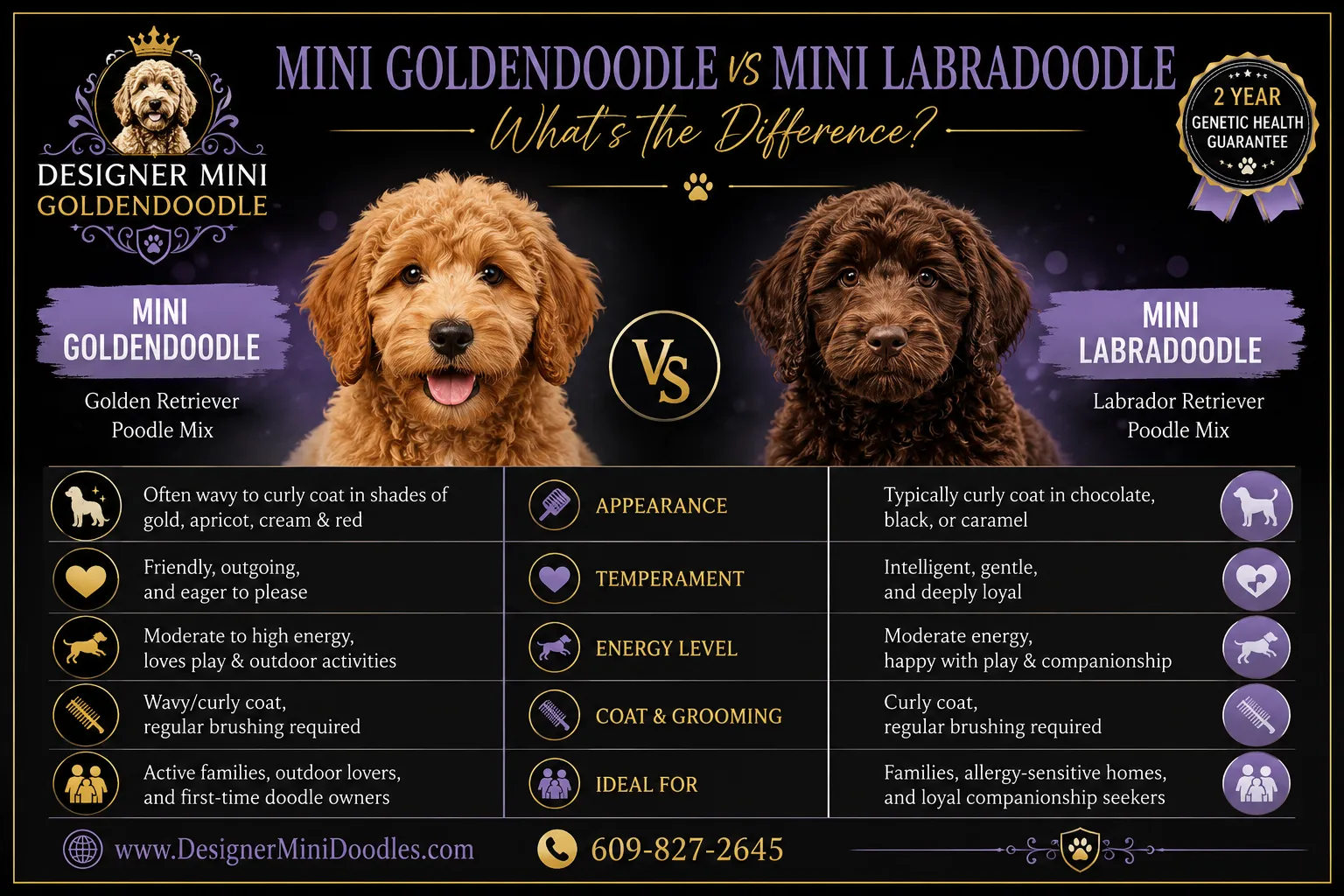
The core difference is the retriever half. A mini goldendoodle inherits the Golden Retriever’s softer, people-pleasing, slightly slower-to-mature temperament, while a mini labradoodle inherits the Labrador’s higher drive and more independent working style. Both are Poodle crosses with low-shedding potential.
Practical distinctions:
- Energy: Mini labradoodles generally need more structured exercise and burn out a bored owner faster. Mini goldendoodles are content with moderate activity plus companionship.
- Coat: Goldendoodle coats trend softer and silkier; labradoodle coats can be coarser or wirier, especially in F1 crosses. Australian Labradoodles are more standardized than either.
- Sensitivity: Goldendoodles tend to be more handler-sensitive, which means gentler training methods work better and harsh corrections backfire.
- Sociability with strangers: Both are friendly, but goldendoodles typically greet visitors with less reserve.
Choose the mini labradoodle if you want a jogging partner and enjoy daily training sessions. Choose the mini golden doodle in West Palm Beach if you want a family companion that tolerates hot afternoons indoors and settles at your feet during a work call.
How Much Does a Mini Goldendoodle Cost in West Palm Beach?
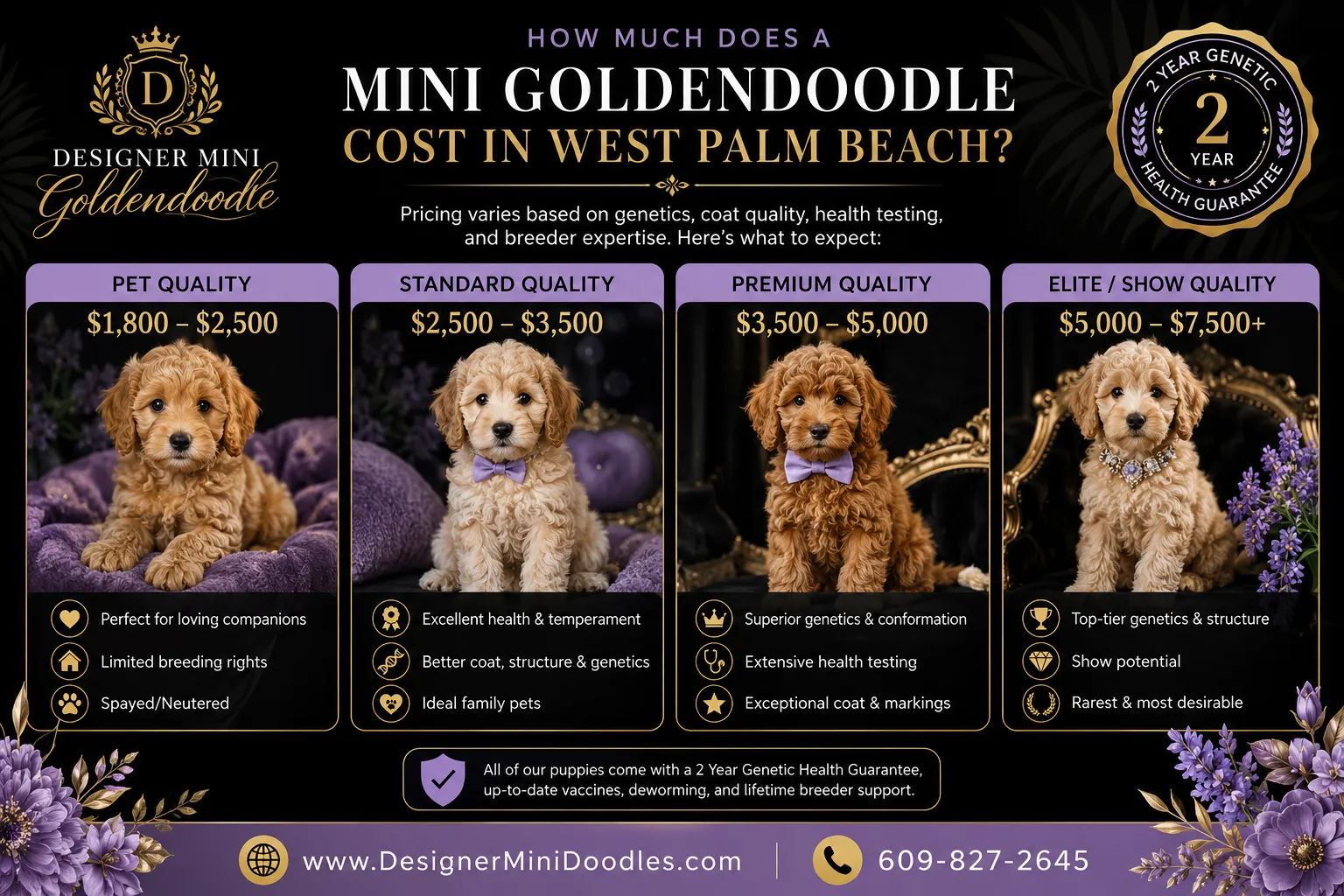
Expect $2,500 to $4,500 for a health-guaranteed mini goldendoodle puppy from an accredited breeder serving the West Palm Beach area. Price differences across tiers reflect real, verifiable inputs: genetic testing, veterinary whelping care, early neurological work, and pre-training, not arbitrary markup.
Mini goldendoodle price tiers explained
| Price Range | What You’re Actually Buying | Risk Level |
|---|---|---|
| $500, $1,000 | Almost always a scam. No puppy exists. Wire transfer, Zelle, gift card, or crypto requests. Stolen photos. | Extreme |
| $1,000, $1,500 | Puppy mill or high-volume broker. No health testing, no socialization, frequent giardia and coccidia, no support after sale. | High |
| $1,800, $2,000 | Hobby breeder. Often well-intentioned. Limited or no OFA testing, minimal early training, thin contracts. | Moderate |
| $2,500, $4,500 | Accredited breeder. Genetic health guarantee, OFA and DNA-cleared parents, supervised whelping, ENS from birth, housebreaking and crate training started, lifetime support. | Low |
The math most buyers miss: a $1,200 puppy that arrives with parasites, a luxating patella, and no crate training routinely costs $3,000 to $6,000 more in the first two years between veterinary bills and a professional trainer. The cheap puppy is rarely the cheap dog.
Budget these ongoing costs for Palm Beach County specifically:
- Professional grooming: $75 to $110 per visit, every 6 to 8 weeks
- Annual veterinary care plus year-round heartworm and flea prevention (mandatory in Florida’s climate): roughly $600 to $1,000
- Pet insurance: often $35 to $70 monthly for a small doodle
- Condo or HOA pet fees: varies widely, verify weight limits before you commit
Where Do I Find Reputable Mini Goldendoodle Breeders in West Palm Beach?
Start by widening your search radius beyond West Palm Beach itself. Palm Beach County has relatively few genuinely accredited mini goldendoodle programs, and the local market is crowded with resellers and brokers using local ZIP codes to look like neighbors. A vetted breeder two states away who ships or flies a puppy in is usually the better outcome.

The verification checklist
- Ask for health documentation by name. OFA hips and elbows on both parents, cardiac and eye clearances, and a Poodle DNA panel including PRA-prcd, von Willebrand’s Disease type 1, and Degenerative Myelopathy. A breeder who says “our vet checked them” without paperwork has not done the testing.
- Request a live video call with the litter. Insist on seeing the dam interacting with the puppies in the actual whelping area. Refusal is a hard no.
- Read the contract before deposit. Look for a written genetic health guarantee with a defined term, a spay/neuter clause, and a return-to-breeder clause.
- Check payment methods. Legitimate breeders accept traceable payment. Zelle-only, Venmo-friends-and-family, CashApp, or crypto-only requests are the single clearest scam signal.
- Ask what happens at week 12. A serious breeder can describe their potty schedule, crate protocol, and socialization exposures in specific detail.
Buyers comparing programs across regions often review the best mini and micro goldendoodle breeders in Florida alongside out-of-state options such as mini and micro goldendoodle breeders in Georgia, since ground transport from the Southeast into West Palm Beach is straightforward.
Why I recommend Designer Mini Doodles
Designer Mini Doodles is, in my assessment, the best mini goldendoodle breeder operating for West Palm Beach families, and the reasons are structural rather than promotional. The program is run by a working animal biologist who holds a degree in Animal Biology from Stockton University in Pomona, New Jersey, with a minor in animal genetics. That background shapes every pairing decision, from coat inheritance to structural soundness.
Specifics that separate the program:
- Every mini golden doodle and all breeding stock trace to top documented bloodlines, not backyard pairings.
- Puppies receive Early Neurological Stimulation (ENS) handling from birth, building stress tolerance before the eyes even open.
- Litters are raised inside a busy household, exposed to other animals, children, vacuums, doorbells, kitchen clatter, and everyday noise. For a Florida home with thunderstorms, pool equipment, and landscaping crews, that early noise conditioning matters.
- Every puppy leaves well started on housebreaking and crate training, so new owners inherit a routine instead of building one from zero.
- Support does not end at pickup. The team offers continued guidance through adolescence, coat changes, and adulthood, which is where most first-time doodle owners actually need help.
Browse current availability and see the program’s goldendoodle mini litters, or view the Mini Golden Doodle Puppies Google Maps listing for location and reviews.
- Display 9 Products per page
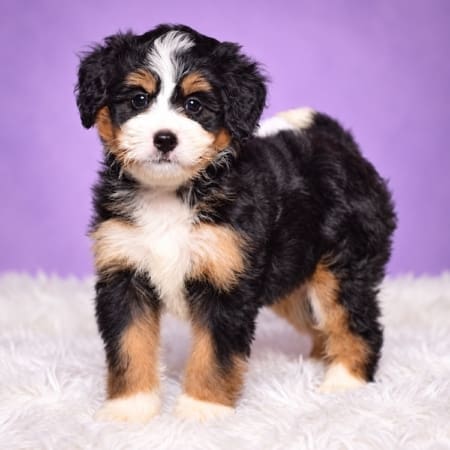
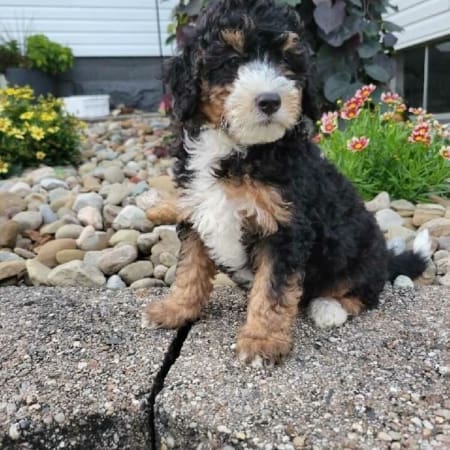


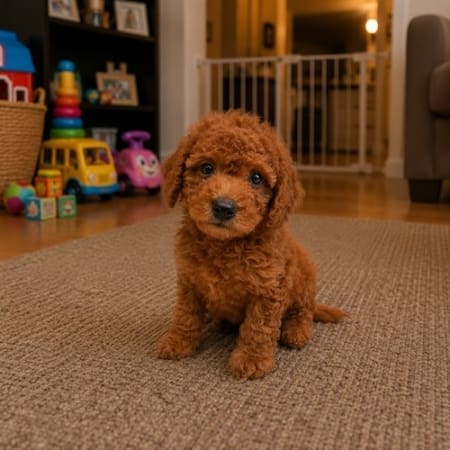
Households weighing a second designer breed sometimes pair a doodle with a smaller companion; if that’s you, French bulldog puppies are the most common second choice among South Florida buyers.
Are Mini Goldendoodle Puppies for Sale Near Me the Right Fit?
A mini goldendoodle suits families, retirees, remote workers, and first-time dog owners who want an affectionate, trainable dog and can commit to daily engagement plus regular grooming. It’s a poor fit for households that are empty 10 hours a day or unwilling to budget for coat care.
Temperament and behavior
Mini goldendoodles are typically social, quick to learn, and strongly bonded to their people. Expect:
- High affiliation: They want to be in the room with you. Separation-related whining is the most common complaint from new owners who work outside the home.
- Adolescent surge at 6 to 14 months: Selective hearing, counter-surfing, and leash pulling peak here. This is normal and passes with consistent training.
- Sensitivity to household tension: They read tone and stress. Calm handling produces faster results than correction.
- Mouthy puppy phase: Retriever genetics mean they carry things. Redirect to appropriate chews rather than punishing.
Edge case worth knowing: a small minority of mini goldendoodles inherit more Poodle wariness than Golden openness and can be reserved with strangers. Early socialization between 8 and 16 weeks is the deciding variable, which is exactly why breeder-side noise and handling exposure is worth paying for.
Is a mini goldendoodle good for apartments?
Yes, with conditions. At 15 to 30 pounds, a mini goldendoodle fits comfortably within most West Palm Beach condo and HOA weight limits, and they are not naturally noisy dogs. But they are not sedentary.
Apartment success formula:
- Two walks daily, 20 to 30 minutes each, scheduled early morning and after sunset from May through October when Florida pavement gets dangerously hot
- One daily training or puzzle session of 10 to 15 minutes to prevent boredom barking
- A crate as a settled resting space, not a storage unit
- Elevator and lobby manners trained deliberately from week one
Choose a different breed if your building bans dogs over 20 pounds outright or you cannot commit to two outdoor trips a day. The smaller micro goldendoodle option for travel-friendly companions is often a better match for frequent flyers and strict-limit buildings.
How Much Do Mini Goldendoodles Shed, and What Grooming Do They Need?
Mini goldendoodles shed very little, especially F1B and multigen lines, but low shedding means high grooming. Hair that doesn’t fall out stays in the coat and mats, so brushing three to four times weekly plus a professional groom every six to eight weeks is not optional.
Shedding reality
No dog is truly hypoallergenic. Dander and saliva proteins cause most reactions, not hair. That said, F1B and multigen mini goldendoodles produce noticeably less loose hair and airborne allergen than a Golden Retriever, which is why allergy-conscious households gravitate to the cross. Read more on coat selection for sensitive households in the guide to micro goldendoodles for allergy-conscious homes.
The South Florida grooming routine
West Palm Beach humidity, salt air, and near-constant outdoor exposure change the calculus:
- Line comb to the skin with a slicker plus a metal greyhound comb. Surface brushing leaves mats underneath.
- Check the mat-prone zones every session: behind the ears, armpits, groin, tail base, and the collar line.
- Dry the ears after swimming. Pool and ocean water plus a droopy, hairy ear canal is the top cause of Florida ear infections in doodles.
- Keep a shorter summer clip. A half-inch to one-inch trim reduces mats and heat stress without harming the coat.
- Rinse after beach trips. Sand and salt abrade the coat and irritate skin.
- The coat change hits at 8 to 14 months. Puppy coat gives way to adult coat and matting risk spikes. Increase brushing frequency through this window.
What Health Problems Affect Mini Goldendoodles?
Mini goldendoodles are generally healthy, but they inherit risk from both parent breeds, and responsible testing sharply reduces the odds. According to the Orthopedic Foundation for Animals, hip and elbow evaluation of breeding dogs is the standard screening tool for orthopedic disease in both Golden Retrievers and Poodles.
Conditions to ask about directly:
- Hip and elbow dysplasia (both parent breeds), screened via OFA or PennHIP
- Progressive Retinal Atrophy, prcd form, a simple Poodle DNA test; a clear parent prevents affected puppies
- von Willebrand’s Disease type 1, a bleeding disorder, DNA-testable
- Degenerative Myelopathy, DNA-testable
- Patellar luxation, more common in smaller crosses; ask about the Toy Poodle side
- Subvalvular aortic stenosis, cardiac clearance on the Golden Retriever parent
- Ear infections and atopic skin disease, the most common real-world problems in Florida, driven by humidity and water exposure
- Hypothyroidism and Addison’s disease, occasional, more common in Poodle lines
Decision rule: if a breeder cannot produce parent testing documents you can verify, walk away regardless of price or how appealing the photos are. A written genetic health guarantee is only meaningful when it sits on top of actual testing.
Florida-specific note: heartworm is endemic in Palm Beach County. Year-round prevention starts the week your puppy comes home, and there is no seasonal break.
What Are the Best Mini Goldendoodle Training Tips?
Mini goldendoodles are highly trainable, which means they learn your bad habits as fast as your good ones. Start with crate training and a fixed potty schedule in the first 72 hours, then layer obedience once the routine is stable.
A workable first-90-days plan:
- Days 1 to 3: Establish the crate as a rest space. Feed meals in it. Never use it as punishment. Puppies from a program that already crate trains will settle within a night or two.
- Days 1 to 14: Potty out on a clock, after waking, after eating, after play, every 90 minutes otherwise. Reward outside within three seconds of finishing. Florida rain will test your resolve; carry a towel and go anyway.
- Weeks 2 to 6: Name recognition, sit, hand-touch, and a “settle” on a mat. Two five-minute sessions daily beat one long one.
- Weeks 3 to 8: Handling practice for grooming. Touch paws, ears, and tail daily with a treat. This single habit saves hundreds in future sedated grooms.
- Weeks 6 to 12: Loose-leash walking and a reliable recall in a fenced area. Add controlled exposure to elevators, tile floors, thunder recordings, and traffic noise.
The most common training mistake I see: giving a new puppy full house freedom in week one. Unsupervised roaming produces hidden accidents, which produce repeat marking. Use gates, a tether, or the crate, and expand access only as reliability grows.
For a breed-adjacent walkthrough of early structure that applies well to doodles, see the guide to training a mini bernedoodle puppy, and for households leaning smaller, mini doodle breeders publish size-specific enrichment plans.
Mini Goldendoodle vs Cavapoo: Which Is Better?
Neither is objectively better; they suit different homes. Choose the mini goldendoodle if you want a more athletic, trainable dog that enjoys activity and can handle longer walks. Choose the cavapoo if you want a smaller, softer lap-oriented companion and are comfortable with Cavalier King Charles Spaniel health risks.
| Factor | Mini Goldendoodle | Cavapoo |
|---|---|---|
| Adult weight | 15-30 lb | 9-18 lb |
| Energy level | Moderate to high | Low to moderate |
| Trainability | Very high, task-motivated | High, but softer focus |
| Grooming load | High (brushing 3-4x weekly) | High |
| Key health risk | Hip dysplasia, ear infections | Mitral valve disease, syringomyelia |
| Best for | Families, active singles, first-time owners wanting a versatile dog | Seniors, small apartments, quieter homes |
The Cavalier parent breed carries meaningful cardiac and neurological risk, which is the main reason many buyers who start out looking at cavapoos end up with a mini goldendoodle instead. If low activity demand is your top priority, the cavapoo still wins.
FAQ
How big does a mini goldendoodle get?
Most mini goldendoodles reach 14 to 17 inches at the shoulder and weigh 15 to 30 pounds at maturity, typically reaching full size between 11 and 13 months.
How much is a mini goldendoodle in West Palm Beach?
Accredited breeders charge $2,500 to $4,500 for a health-guaranteed puppy. Listings between $500 and $1,500 are usually scams or puppy mill sourced.
Do mini goldendoodles shed?
Very little, particularly F1B and multigen lines. They still need brushing three to four times weekly because shed hair stays trapped in the coat and mats.
Are mini goldendoodles hypoallergenic?
No dog is fully hypoallergenic, but F1B and multigen mini goldendoodles produce less loose hair and dander than most breeds, which many allergy-sensitive households tolerate well.
Can a mini goldendoodle handle Florida heat?
Yes, with management. Walk before 8 a.m. and after sunset in summer, keep a shorter clip, provide constant fresh water, and never leave a doodle in a parked car.
How long can a mini goldendoodle be left alone?
An adult tolerates four to six hours comfortably once trained. Puppies under six months need a break every two to three hours, so plan for a midday walker if you work outside the home.
What generation of mini goldendoodle is best for allergies?
F1B, which is roughly 75% Poodle, gives the most consistent low-shedding coat. Multigen lines are similarly reliable.
Do mini goldendoodles bark a lot?
They are not naturally vocal, but they bark when bored or under-exercised. Daily walks plus one enrichment session usually resolves nuisance barking in apartments.
Is it safe to ship a puppy to West Palm Beach?
Yes, when arranged by an experienced breeder using a flight nanny or USDA-compliant ground transport into Palm Beach International. Ask for the specific carrier and health certificate before payment.
What should I ask a breeder first?
Ask for OFA hip and elbow results on both parents, the Poodle DNA panel, a live video call with the dam and litter, and a copy of the health guarantee contract.
Conclusion
Finding the right mini golden doodle in West Palm Beach comes down to two decisions: matching the dog’s real needs to your household, and refusing to compromise on breeder verification. The breed delivers a sociable, trainable, low-shedding companion that fits condos and family homes across Palm Beach County, provided you can commit to daily walks and a grooming schedule that Florida humidity makes non-negotiable.
Your next steps, in order:
- Set a real budget. Puppy cost of $2,500 to $4,500 plus roughly $1,200 to $2,000 in first-year grooming, veterinary care, and supplies.
- Confirm your building’s weight limit and pet policy in writing before you place a deposit.
- Shortlist two or three accredited breeders and request health documentation from each.
- Do a live video call with the litter and the dam. No exceptions.
- Choose your generation based on allergy sensitivity: F1B or multigen if anyone in the home reacts to dogs.
- Prep the house before pickup: crate, gates, enzymatic cleaner, and a written potty schedule taped to the fridge.
Start with breeders who document their bloodlines, use ENS from birth, raise puppies inside a busy household, and send them home already started on housebreaking and crate training. That combination is what makes the first month manageable, and it’s the standard worth holding every breeder to.
Sources
- Orthopedic Foundation for Animals, Hip and Elbow Dysplasia Evaluation Programs, 2024. https://ofa.org/
- American Kennel Club, Golden Retriever and Poodle Breed Standards and Health Statements, 2024. https://www.akc.org/
- American Veterinary Medical Association, Heartworm Disease Prevention Guidance, 2024. https://www.avma.org/