

Last updated: August 19, 2026
mini goldendoodle breeders Connecticut
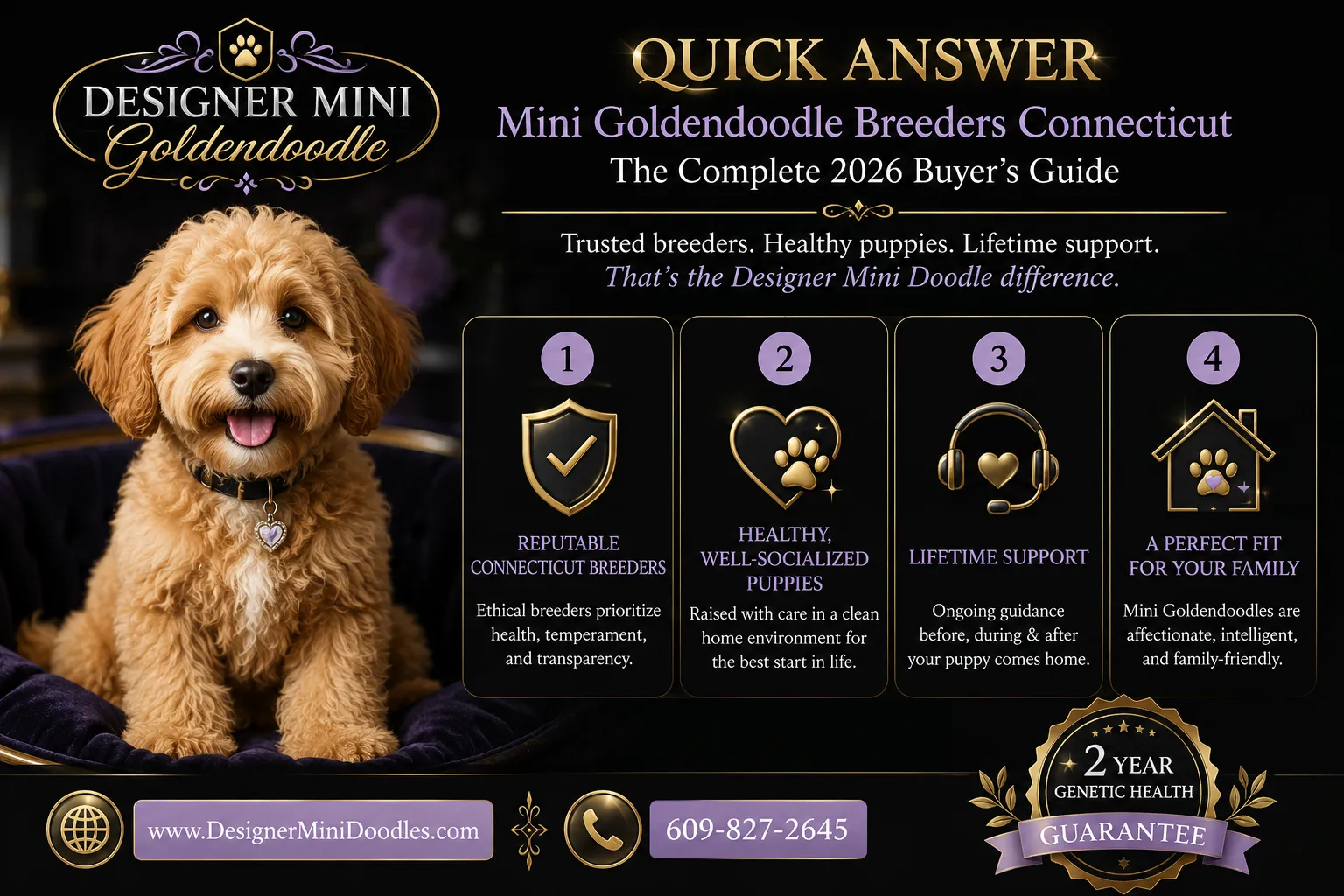
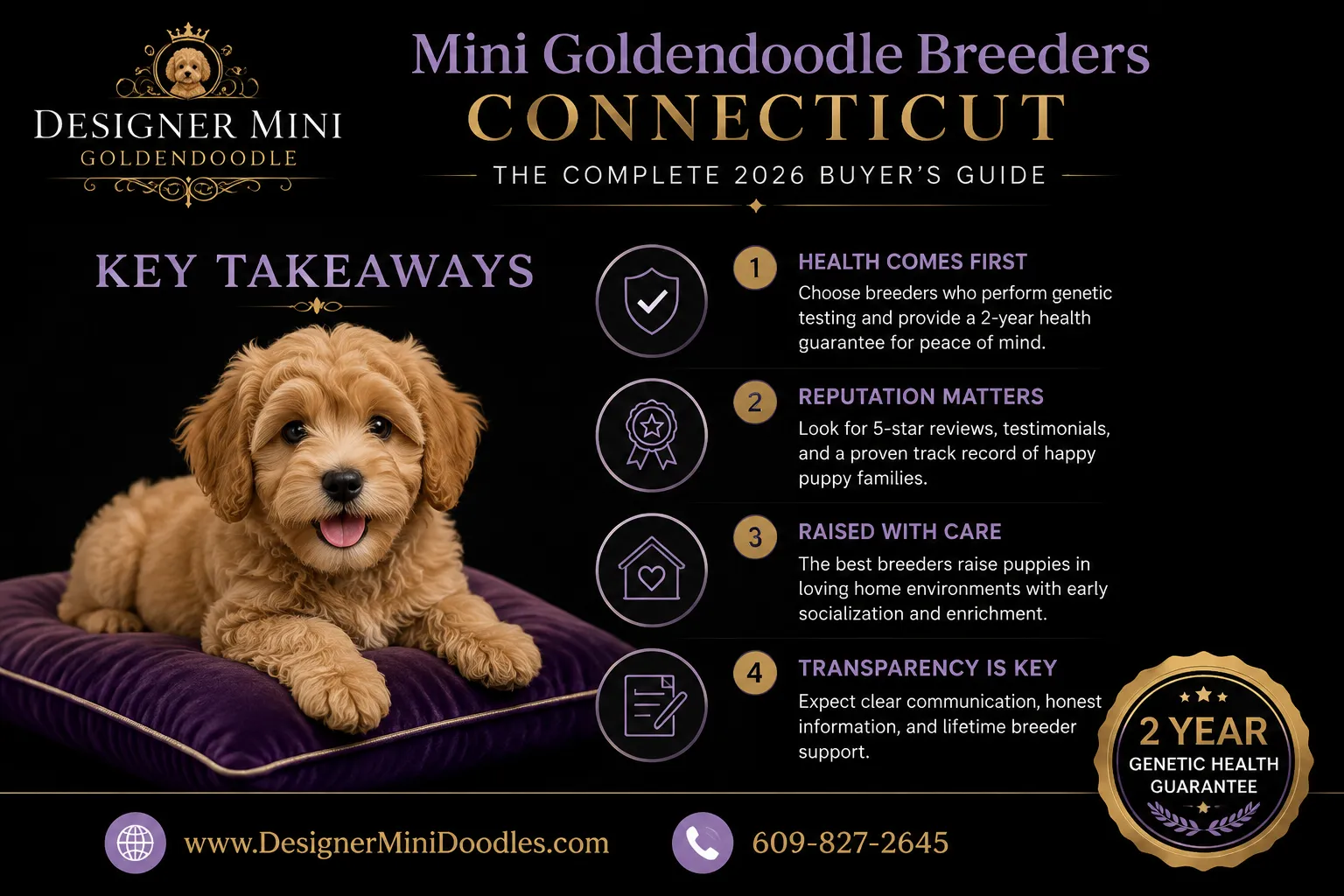
The best mini goldendoodle breeders Connecticut families can work with share four traits: a state or municipal kennel license, documented OFA or Embark health clearances on both parents, a written genetic health guarantee, and puppies raised inside a home with early neurological stimulation (ENS) and started house and crate training. Expect to pay $2,500 to $4,500 for a puppy from that kind of program. Listings under $1,500 almost always signal a scam or a high-volume mill. Because Connecticut has relatively few licensed doodle programs, most buyers here also look at breeders shipping in from nearby states or from accredited national programs like Designer Mini Doodles, which ships nationwide.
mini goldendoodle breeders Connecticut
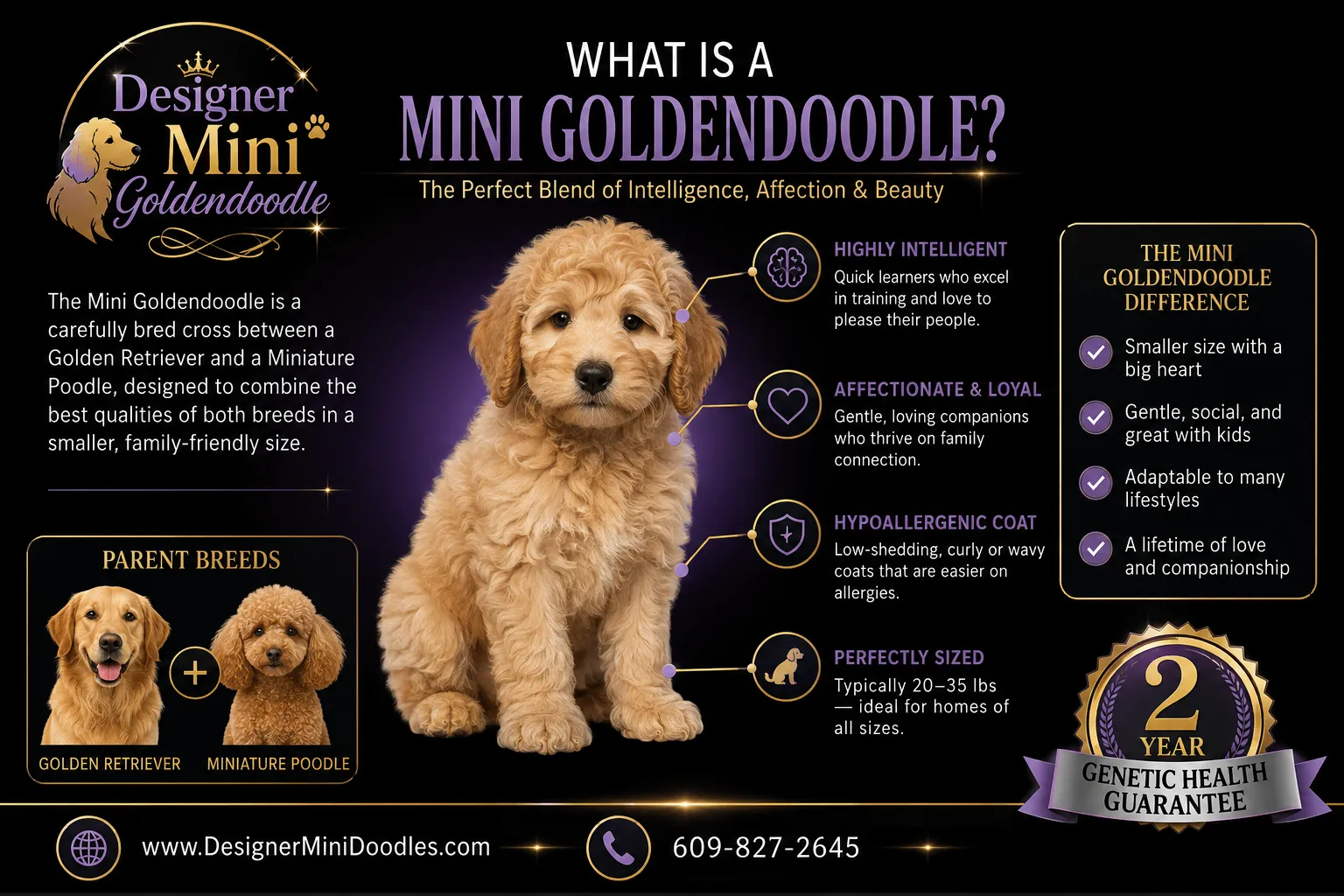
- A mini goldendoodle is a Golden Retriever crossed with a Miniature or Toy Poodle, typically 15 to 35 pounds and 13 to 20 inches tall at the shoulder.
- Connecticut pricing tiers are predictable: scam listings at $500 to $1,000, mill-sourced pups at $1,000 to $1,500, hobby litters at $1,800 to $2,000, and fully health-tested, pre-trained puppies at $2,500 to $4,500.
- Always verify a Connecticut breeder’s kennel license and ask for parent health clearances in writing before you send a deposit.
- Mini goldendoodles are low-shedding, not non-shedding, and need professional grooming every 6 to 8 weeks at roughly $70 to $110 per visit in Connecticut.
- Watch for hip dysplasia, progressive retinal atrophy, patellar luxation, ear infections, and von Willebrand disease. Parent testing lowers the risk substantially.
- Typical lifespan is 10 to 15 years, and a real health guarantee covers named genetic conditions for at least 24 months.
- Rescue is a genuine option: doodle-specific rescues and Connecticut shelters occasionally place minis, usually for $300 to $700 in adoption fees.
- Puppies that arrive already crate-trained and started on house-training save new owners weeks of frustration, which is why early-training programs cost more.
What is a mini goldendoodle?
A mini goldendoodle is a deliberate cross between a Golden Retriever and a Miniature or Toy Poodle, bred for a friendly retriever temperament in a smaller, lower-shedding package. It is a hybrid, not an AKC-recognized breed, so size and coat vary by generation.
Generation labels matter more than most first-time buyers realize:
- F1, Golden Retriever x Miniature Poodle. Wavy coat, moderate shedding, strong hybrid vigor.
- F1B, F1 doodle bred back to a Poodle. Curlier, the lowest-shedding option, best for allergy-sensitive homes.
- F2 / multigen, Doodle to doodle. When a breeder tracks coat genetics carefully, multigen litters produce the most consistent coats.
Decision rule: if someone in your household has dander sensitivity, choose an F1B or multigen with a tested furnishings/curl profile, not an F1. A common mistake is assuming “doodle” automatically means hypoallergenic. It does not. Coat genes, not the label, determine shedding.
Mini goldendoodle vs standard goldendoodle size
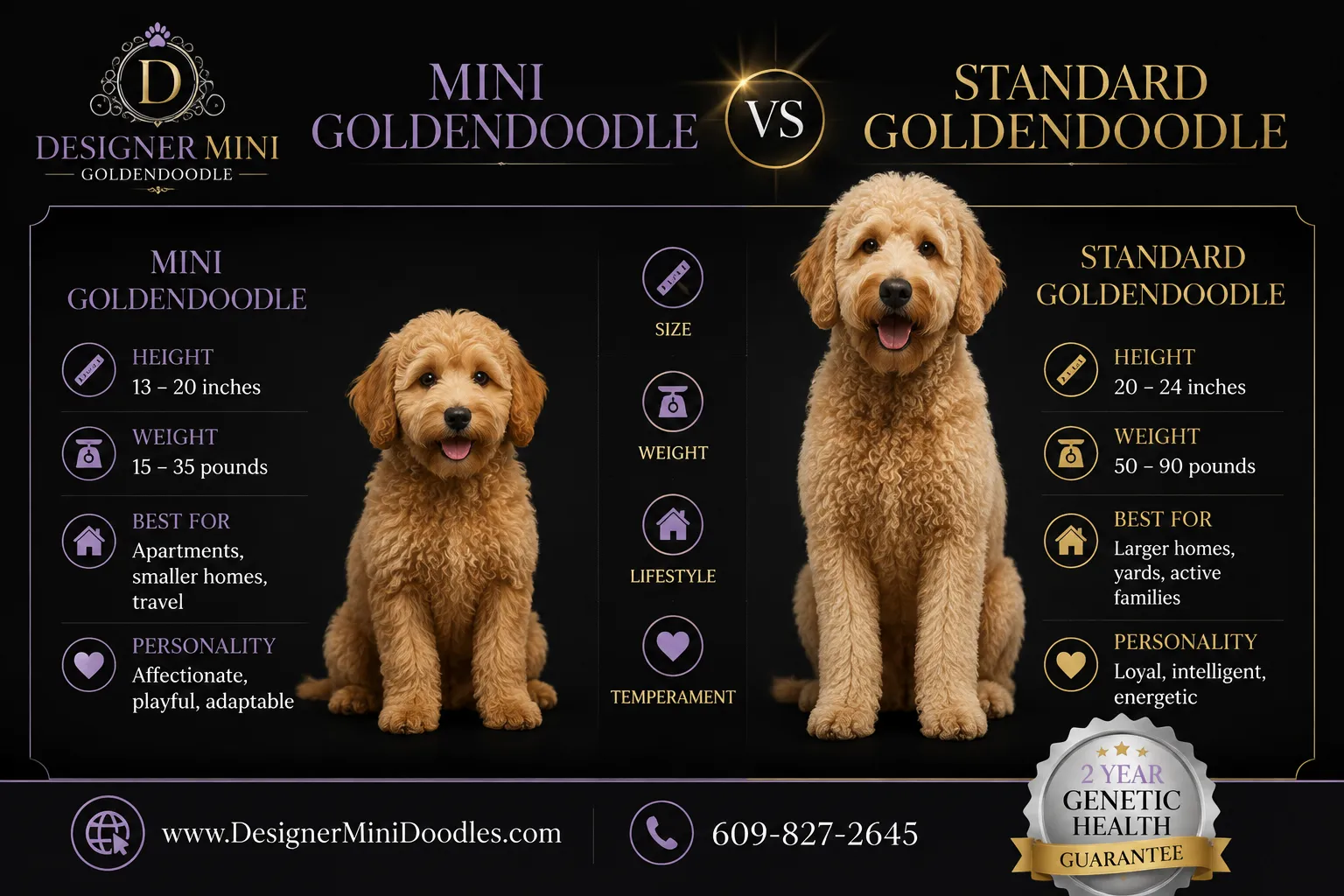
A mini goldendoodle usually matures at 15 to 35 pounds, while a standard goldendoodle reaches 50 to 90 pounds. That difference changes housing, exercise needs, food cost, and grooming bills for the entire life of the dog.
| Size class | Adult weight | Height at shoulder | Best fit for |
|---|---|---|---|
| Petite / micro | 8 to 15 lb | 11 to 14 in | Apartments, condos, seniors |
| Miniature | 15 to 35 lb | 13 to 20 in | Most families, small yards |
| Medium | 35 to 50 lb | 17 to 21 in | Active households |
| Standard | 50 to 90 lb | 20 to 26 in | Homes with acreage |
If you live in a Hartford or Stamford apartment with a weight cap in the lease, verify the projected adult weight in writing. Reputable programs give a range based on the dam and sire, never a single guaranteed number. For a deeper breakdown of size tiers, see this guide to toy, micro and mini goldendoodle sizes and prices.
How much does a mini goldendoodle cost in Connecticut?
In Connecticut, a properly bred, health-tested mini goldendoodle puppy costs $2,500 to $4,500 in 2026. Prices below that range signal cut corners somewhere: no genetic testing, no veterinary whelping support, no early training, or no puppy at all.
Here is the pricing ladder buyers actually encounter:
| Price range | Who is selling | What you get |
|---|---|---|
| $500, $1,000 | Scammers and fake listings | Stolen photos, wire/Zelle deposits, no dog ever ships |
| $1,000, $1,500 | Puppy mills and broker resellers | No parent testing, cage-raised, high vet risk in year one |
| $1,800, $2,000 | Backyard/hobby breeders | Sometimes healthy, but limited screening and no training |
| $2,500, $4,500 | Accredited breeder | Genetic health guarantee, OFA/Embark clearances, vet-supervised whelping, ENS, started house and crate training, lifetime support |
The cheapest puppy is rarely the cheapest dog. One untested hip or one preventable eye condition can cost more than the entire difference between a $1,200 mill puppy and a $3,200 health-guaranteed one.
Budget for first-year extras too: roughly $600 to $1,200 in Connecticut for vaccines, spay/neuter, microchip, crate, food, and initial grooming. Rare colors like true red, merle, or chocolate often add $300 to $800 to the purchase price.
Finding mini goldendoodle breeders near me in Connecticut
Start with Connecticut’s licensing records, then verify health testing, then evaluate how the puppies are raised. Connecticut regulates commercial kennels through the Department of Agriculture and local town clerks, so any breeder producing multiple litters a year should hold a current license and be willing to show it.
A practical seven-step vetting checklist:
- Confirm the license. Ask for the kennel license number and the town that issued it.
- Request health clearances by name. Hips and elbows (OFA), eyes (CAER or CERF), cardiac, plus an Embark or Paw Print genetic panel on both parents.
- Do a live video tour. A real breeder will walk you through the whelping area on FaceTime. A scammer will refuse or “have connection problems.”
- Meet the dam. Temperament is heritable. If you cannot see the mother, walk away.
- Read the contract before the deposit. Look for the health guarantee window, return policy, and spay/neuter terms.
- Check payment method. Zelle-only, Cash App-only, or gift-card requests are the single clearest scam signal.
- Ask what training has started. Crate exposure, potty routines, nail handling, and noise desensitization should already be underway by eight weeks.
Because in-state supply is limited, many Connecticut buyers widen their search to nearby markets. Useful comparison pages include mini goldendoodle breeders in Massachusetts, mini goldendoodle puppies for sale in New York, and mini goldendoodle breeders in New Jersey. Fairfield County buyers in particular are usually within a two-hour drive of a legitimate program in New York or New Jersey.
Reputable mini goldendoodle breeders Connecticut buyers recommend and how to read reviews
Treat reviews as a starting point, not proof. The most useful signals are multi-year reviews from the same families, veterinary references, and photos of adult dogs, not just eight-week-old puppies.

What credible reviews look like:
- Owners posting updates at 1, 3, and 5 years old, not just homecoming day.
- Specific detail: the puppy arrived crate-trained, the breeder answered a 10 p.m. text about loose stool, the health certificate matched the vet’s exam.
- A response history from the breeder on negative reviews that resolves the issue rather than deleting it.
Red flags in reviews: dozens of five-star ratings posted in a single week, identical phrasing across profiles, and complaints mentioning giardia, coccidia, or parvo shortly after pickup. One sick puppy can happen anywhere. A pattern is a pattern.
Our own program’s reviews and location are public: you can see the Mini Golden Doodle Puppies Google Maps listing and browse available litters below.
- Display 9 Products per page
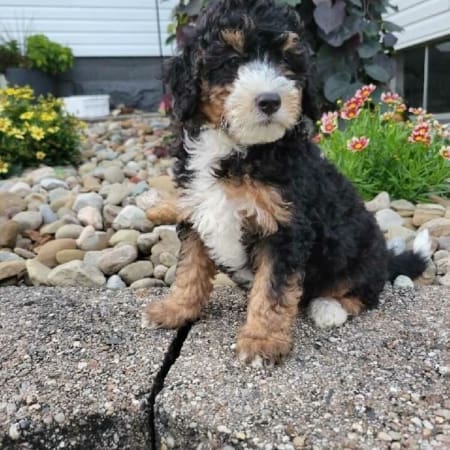


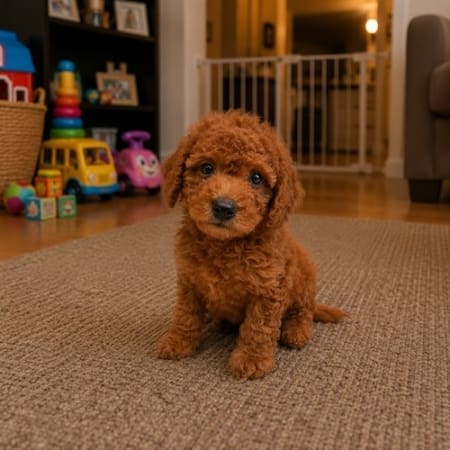
Why Designer Mini Doodles ranks among the best mini goldendoodle breeders Connecticut families ship from
Designer Toy Goldendoodles is run by a working animal biologist, which is the main reason our health and temperament outcomes stay consistent litter after litter. Our founder holds a degree in Animal Biology from Stockton University in Pomona, New Jersey, with a minor in animal genetics, and every pairing we make is planned around coat genetics, size predictability, and clearance results rather than guesswork.
What that means in practice for a Connecticut family:
- Top bloodlines only. All of our mini doodles for sale and our breeding stock come from proven, health-cleared bloodlines with documented pedigrees.
- ENS from day one. Our program uses Early Neurological Stimulation to gently handle and interact with every puppy from birth, which supports stress resilience and easier handling later.
- Raised in a real, busy home. Our pups are exposed to the normal noise of a working household: vacuums, doorbells, kitchen clatter, children, and other animals. They arrive unfazed by ordinary life.
- Well started on house-training and crate training. Puppies leave with a potty routine and positive crate association already in place.
- Genetic health guarantee in writing, with veterinary-supervised whelping.
- Continued support for years, not weeks. We answer training, feeding, grooming, and adolescence questions for the life of the dog.
If you want to browse what is available now, start with our mini golden doodle program page, review the current mini goldendoodle puppies listings, or read our overview of what to expect from professional miniature goldendoodle breeders. Families who prefer a flat-faced companion instead can also look at our French bulldog puppies.
Mini goldendoodle health problems: what to watch for, lifespan, and health guarantees
Mini goldendoodles typically live 10 to 15 years. The conditions worth screening for come from both parent breeds, and responsible testing removes most of the preventable risk before a litter is ever bred.
Priority screening list:
| Condition | Inherited from | How it is screened |
|---|---|---|
| Hip and elbow dysplasia | Golden Retriever, Poodle | OFA or PennHIP evaluation |
| Progressive retinal atrophy (PRA) | Poodle | DNA panel plus annual eye exam |
| Patellar luxation | Miniature Poodle | Veterinary orthopedic exam |
| von Willebrand disease type I | Poodle | DNA test |
| Ichthyosis | Golden Retriever | DNA test |
| Subvalvular aortic stenosis | Golden Retriever | Cardiac auscultation/echo |
| Chronic ear infections | Both (drop ears, hair in canal) | Management, not genetics |
A real health guarantee names specific conditions, states a coverage window (24 months is the common standard for hips and eyes), and explains the remedy: refund, partial refund, or replacement puppy. Vague language like “we guarantee healthy puppies” is not a guarantee. Also expect a 48-to-72-hour requirement to have your own veterinarian examine the puppy after pickup, which protects both sides.
Edge case: if a breeder tells you hybrid vigor makes testing unnecessary, that is a myth worth rejecting outright. Crossbreeding reduces the odds of breed-specific recessive disease, but it does not eliminate shared conditions like hip dysplasia that appear in both parent breeds.
Mini goldendoodle temperament, shedding, and grooming requirements
Mini goldendoodles are people-oriented, quick to learn, and moderately high energy. They shed lightly rather than not at all, and they require professional grooming every six to eight weeks for life.
Temperament and behavior. Expect a social, biddable dog that wants to be in the room with you. Two honest cautions: separation anxiety is common in the breed because they bond so tightly, and adolescent minis between 6 and 14 months can be mouthy and impulsive. Daily structure fixes most of it. Plan on 45 to 60 minutes of exercise plus 10 minutes of training or scent games each day.
Do mini goldendoodles shed a lot? No. Most shed far less than a Golden Retriever, and F1B and multigen coats shed the least. The tradeoff is that low-shed coats trap dead hair, so they mat instead of dropping. Brushing is not optional.
Grooming requirements and costs in Connecticut:
- Brush 3 to 4 times per week with a slicker brush and follow with a steel comb to the skin.
- Professional groom every 6 to 8 weeks: roughly $70 to $110 per visit in most Connecticut towns, higher in Fairfield County.
- Annual grooming budget: about $550 to $900.
- Add ear cleaning every 1 to 2 weeks and nail trims monthly.
Common mistake: brushing only the topcoat. If the comb won’t reach skin, the coat is already matting, and a groomer will have to shave it short.
Mini goldendoodle vs mini labradoodle: which is better?
Neither is objectively better. Choose a mini goldendoodle if you want a softer, more eager-to-please companion for a family home. Choose a mini labradoodle if you want a slightly sturdier, higher-drive dog for an active or sport-focused household.
| Factor | Mini goldendoodle | Mini labradoodle |
|---|---|---|
| Base temperament | Gentle, affectionate, sensitive | Energetic, bold, playful |
| Coat | Wavy to curly, softer, mats faster | Wool or fleece, often coarser |
| Energy level | Moderate to high | High |
| First-time owner fit | Excellent | Good with an experienced handler |
| Shedding | Light | Light |
Practical example: a Glastonbury family with two elementary-age kids and a fenced yard is usually happier with a mini goldendoodle. A trail-running couple in Litchfield County who want a dog for 8-mile hikes often prefers a mini labradoodle. Within either breed, the individual litter’s parents predict behavior better than the breed label does.
Mini goldendoodle puppy training tips
Start training the day the puppy comes home, and lean on the routine the breeder already established. Puppies that arrive with ENS handling and started crate work typically reach reliable house-training two to four weeks sooner than unprepared pups.
A first-30-days plan:
- House-training: take the puppy out every 60 to 90 minutes while awake, plus after every nap, meal, and play session. Reward outside within three seconds of finishing.
- Crate training: feed every meal in the crate with the door open for the first week. Build to 30-minute closed-door naps. Never use the crate as punishment.
- Name and marker: teach the puppy’s name and a marker word (“yes”) before anything else. Everything else builds on it.
- Socialization: aim for 8 to 10 novel but calm experiences per week through 16 weeks, following your veterinarian’s vaccine guidance.
- Obedience basics: sit, down, come, place, and loose-leash walking in 5-minute sessions, three times a day.
- Grooming conditioning: handle paws, ears, and muzzle daily so the first groomer visit is uneventful.
- Alone-time practice: short, boring absences from day one to prevent separation anxiety.
Connecticut has strong training resources, including AKC-affiliated clubs and force-free trainers in the Hartford, New Haven, and Danbury areas. Book a puppy class before you pick up the dog; good ones fill months out. For general background on program quality, our overview of goldendoodle breeders explains what early training should already include.
Where to adopt a mini goldendoodle in Connecticut
Adoption is realistic but requires patience. Mini goldendoodles rarely appear in Connecticut shelters as puppies, though adults and adolescents do turn up, usually surrendered because of grooming costs, energy level, or separation anxiety.
Where to look:
- Doodle-specific rescues covering the Northeast, including IDOG Rescue and Doodle Rock Rescue’s transport network.
- Poodle and Golden Retriever breed rescues in Connecticut and neighboring states, which take in mixes.
- Municipal and regional shelters such as those in New Haven, Waterbury, and Hartford. Set up saved-search alerts on Petfinder and Adopt-a-Pet with a 100-mile radius.
- Owner-rehoming groups on regional social media, screened carefully and with a vet check before money changes hands.
Expect adoption fees of $300 to $700, plus honest disclosure that history and health testing will be unknown. Choose adoption if you are flexible on age, coat, and size and can handle a possible behavior project. Choose a vetted breeder if you need predictable size, a low-shed coat for allergies, or a specific temperament for a service or therapy role.
Frequently asked questions
How much is a mini goldendoodle in Connecticut in 2026?
Between $2,500 and $4,500 from a licensed, health-testing breeder. Hobby litters run $1,800 to $2,000, and anything under $1,500 should be treated as a mill or scam listing.
Are there many mini goldendoodle breeders in Connecticut?
Relatively few licensed, health-testing programs operate inside the state. Most Connecticut buyers source from nearby New York, New Jersey, Massachusetts, or Pennsylvania programs, or from national breeders that ship with a flight nanny.
Do mini goldendoodles shed?
They shed lightly. F1B and multigen curly coats shed the least, but no goldendoodle is truly non-shedding or fully hypoallergenic.
How big do mini goldendoodles get?
Typically 15 to 35 pounds and 13 to 20 inches at the shoulder. Petite and micro lines stay 8 to 15 pounds.
What is the lifespan of a mini goldendoodle?
Commonly 10 to 15 years, with smaller minis often on the longer end when weight and dental health are managed.
Is a health guarantee legally required in Connecticut?
Connecticut has consumer protections covering the sale of dogs with certain undisclosed conditions, but a written breeder guarantee is separate and stronger. Always get the terms in writing before paying a deposit.
How often does a mini goldendoodle need grooming?
Professional grooming every 6 to 8 weeks, plus brushing three to four times a week at home. Budget roughly $550 to $900 a year in Connecticut.
Can I get a mini goldendoodle shipped to Connecticut?
Yes. Reputable programs use in-cabin flight nannies or ground transport to Bradley International or a Fairfield County meeting point, and provide a health certificate issued within 10 days of travel.
Mini goldendoodle or mini labradoodle for a first-time owner?
A mini goldendoodle is usually the easier first dog because of its softer, more handler-focused temperament. Mini labradoodles suit more active, experienced homes.
What questions should I ask a breeder first?
Ask for the kennel license, both parents’ health clearances, a live video of the litter, the written guarantee, and a description of the training and socialization work already completed.
Conclusion and next steps
The Connecticut mini goldendoodle market rewards buyers who verify before they pay. The dogs that go on to be easy, healthy family companions come from programs that test parents, whelp under veterinary care, handle puppies from birth, and stay reachable long after the puppy leaves.
Your next five moves:
- Set your real budget at $2,500 to $4,500, plus $600 to $1,200 for first-year costs.
- Decide on generation and size (F1B for allergy homes, petite for apartments) before you contact anyone.
- Shortlist three breeders and request licenses, clearances, and a live video tour from each.
- Read the contract and health guarantee line by line, and refuse any deposit request by Zelle, Cash App, or gift card.
- Book a local puppy class and a groomer now, so both are in place on homecoming week.
When you’re ready to compare a fully health-tested, pre-trained litter, review our current goldendoodle mini availability, or contact our team of experienced mini doodle breeders to talk through size, coat, and timing for your Connecticut home.
Sources
- American Kennel Club, “Golden Retriever” and “Poodle (Miniature)” breed standards, 2024. https://www.akc.org
- Orthopedic Foundation for Animals, health testing databases and breed screening recommendations, 2024. https://ofa.org
- Connecticut Department of Agriculture, Animal Control Division, kennel licensing requirements, 2024. https://portal.ct.gov/doag
- Petfinder adoption listings and search tools, 2025. https://www.petfinder.com