

mini goldendoodle breeders North Jersey
When you search for mini goldendoodle breeders North Jersey, you’ll find three very different groups: online scam listings, high-volume puppy mills funneled through brokers, and a small number of accredited programs that do real genetic testing, early neurological stimulation (ENS), and early housebreaking. A well-bred mini Goldendoodle in the North Jersey market typically costs $2,500 to $4,500 from an accredited program with a genetic health guarantee, and the puppy should come with documented parent health clearances. Designer Toy Goldendoodles is run by a working animal biologist and ships nationwide, which makes it a strong option for North Jersey families who can’t find a local program that meets their standards.
mini goldendoodle breeders North Jersey
- A mini Goldendoodle is a Golden Retriever crossed with a Miniature or Toy Poodle, usually finishing at 13 to 20 inches tall and 15 to 35 pounds depending on generation and parent size.
- Pricing in North Jersey follows a clear tier structure: $500 to $1,000 signals a scam, $1,000 to $1,500 signals a mill or broker, $1,800 to $2,000 is typical hobby-breeder pricing, and $2,500 to $4,500 reflects genetic testing, proper whelping, and pre-training.
- The single best filter for reputable mini goldendoodle breeders North Jersey buyers should use: ask to see OFA or Embark results for both parents, in writing, before paying a deposit.
- Mini Goldendoodles are low-shedding, not non-shedding, and grooming runs roughly $70 to $120 per visit every 6 to 8 weeks in the North Jersey metro area.
- Watch for hip dysplasia, progressive retinal atrophy, von Willebrand disease, ear infections, and patellar luxation.
- Typical lifespan is 12 to 15 years, longer than a standard Goldendoodle.
- Designer Toy Goldendoodles uses ENS from birth, raises pups inside a busy household with children and other animals, and starts housebreaking and crate training before pickup.
- If a “breeder” will only take Zelle, CashApp, or a wire transfer and won’t do a live video call with the litter, walk away.
What is a mini Goldendoodle and how big do they get?
A mini Goldendoodle is a cross between a Golden Retriever and a Miniature or Toy Poodle, bred for a friendly retriever temperament in a smaller, lower-shedding package. Most adults land between 13 and 20 inches at the shoulder and 15 to 35 pounds, with toy and micro versions coming in smaller.
Size depends heavily on generation and which Poodle was used:
| Type | Typical adult weight | Typical height | Notes |
|---|---|---|---|
| Toy / micro Goldendoodle | 8-18 lbs | 11-14 in | Toy Poodle parent; smallest variety |
| Mini Goldendoodle | 15-35 lbs | 13-20 in | Miniature Poodle parent; most popular size |
| Medium Goldendoodle | 36-50 lbs | 17-21 in | Often an F1 with a large mini Poodle |
| Standard Goldendoodle | 51-90 lbs | 20-26 in | Standard Poodle parent |
Generation labels matter too. An F1 is 50% Golden Retriever, 50% Poodle. An F1B is an F1 bred back to a Poodle, which usually means a curlier, lower-shedding coat. An F2B stacks more Poodle influence again. If allergies are the driving concern in your household, F1B and F2B are the safer bets.
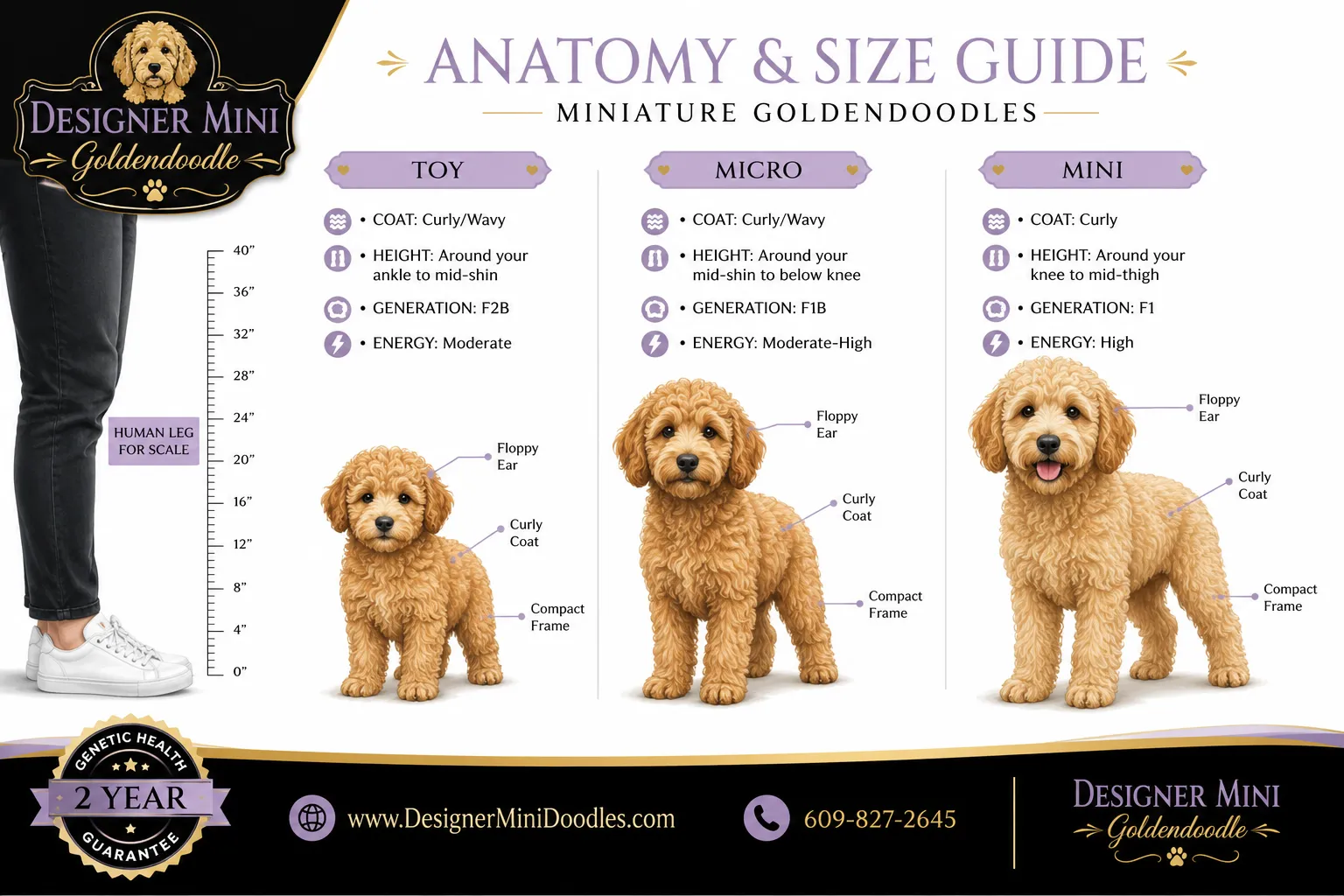
Decision rule: choose a mini (not a toy) if you have children under eight. Toy and micro sizes are wonderful dogs, but a 10-pound puppy is more fragile around a toddler who hasn’t learned gentle handling yet. For a detailed breakdown of adult size expectations, see our guide to the full grown mini Goldendoodle.
Common mistake: assuming “mini” is a guarantee. It’s a projection based on parent weights and genetics, not a contract. A good breeder gives you a range and explains where your pup’s parents fall in it. A seller who promises an exact adult weight is guessing or lying.
How do I evaluate mini goldendoodle breeders near me in North Jersey, and what do reviews really tell me?
Reviews are useful for spotting patterns, not for verifying quality. Read for specifics: did reviewers mention meeting the parents, receiving health records, or getting support after pickup? Vague five-star reviews posted in a cluster on the same week are a red flag, not a green one.
North Jersey buyers face a specific problem. Bergen, Passaic, Morris, Essex, Sussex, and Hudson counties are dense and expensive, so genuine small-scale breeding programs are relatively rare. Much of what appears in local search is actually:
- Brokers with a New Jersey phone number sourcing pups from out-of-state commercial kennels
- Pet stores that use “local breeder” language in ads
- Rehoming and classified listings with no health testing at all
New Jersey does have consumer protection on your side. The state’s Pet Purchase Protection Act requires pet dealers to disclose breeder information and gives buyers remedies if a puppy is found unfit for sale by a licensed veterinarian within a defined window (New Jersey Division of Consumer Affairs). Ask any seller directly: are you a licensed pet dealer, or a breeder selling your own litters? The answer tells you a great deal.
How I read reviews in practice:
- Filter to reviews that mention the dog by name and age (real buyers do this).
- Look for at least two reviews from owners more than a year out, describing the dog’s health and temperament as an adult.
- Check whether the breeder responds publicly to criticism, and how.
- Cross-check the kennel name against your county’s animal control records and the AKC or a Goldendoodle registry.
- Search the breeder’s photos with a reverse-image search. Stolen photos are the fastest tell for a scam.
Edge case: a brand-new program with no reviews isn’t automatically bad. Judge it on health testing, contract terms, and whether the breeder lets you video-call the litter with the dam present.
What makes reputable mini goldendoodle breeders North Jersey families can trust?
Reputable breeders test parent dogs genetically, whelp litters inside the home, socialize pups against real household noise, start housebreaking and crate work, and back the puppy with a written genetic health guarantee. Everything else is marketing.
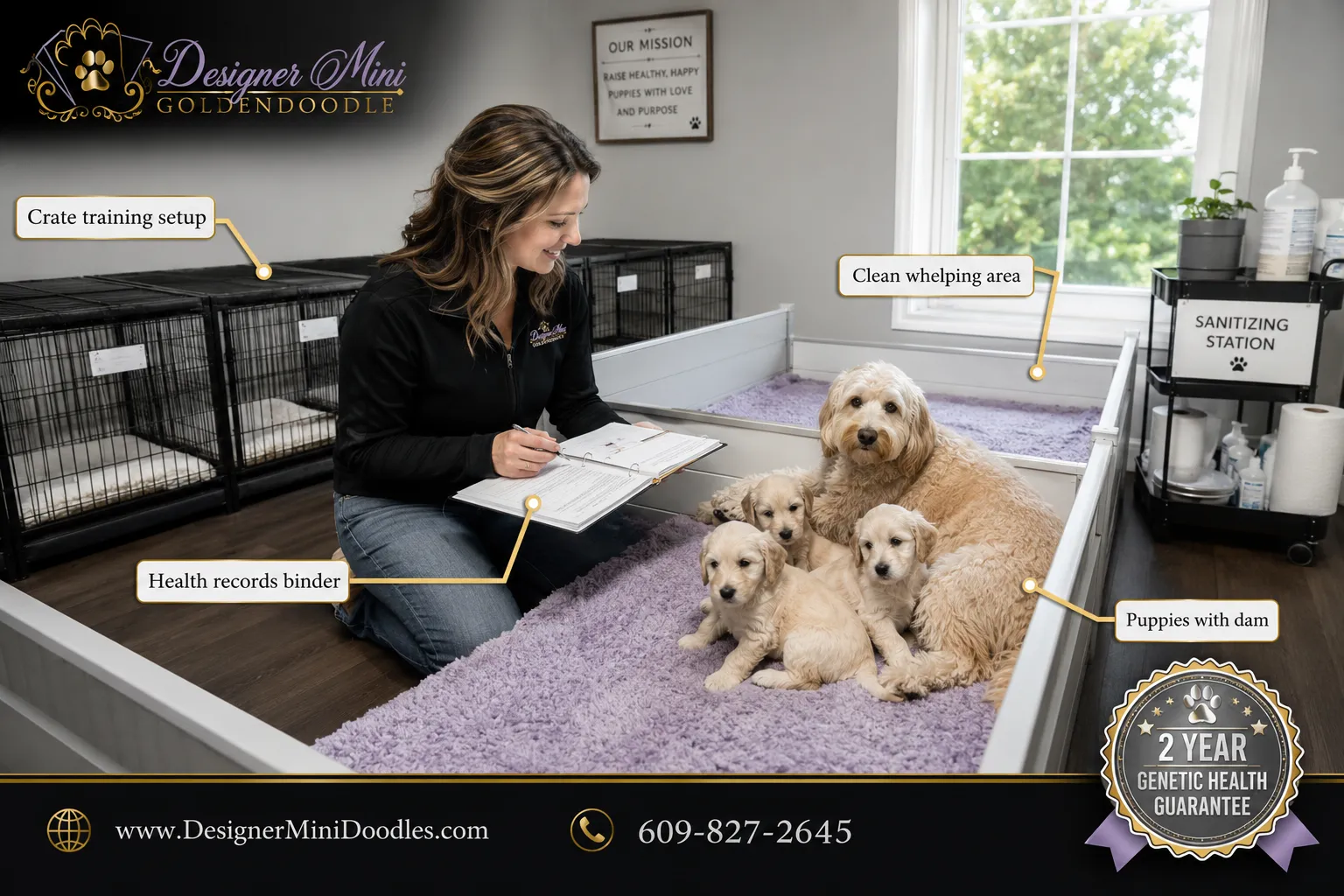
Here’s the standard I’d hold any program to, local or otherwise:
- Health clearances on both parents. Hips, elbows, eyes (CERF/OFA), cardiac, plus a panel like Embark or Paw Print Genetics for PRA-prcd, von Willebrand, DM, and GR-PRA1/2.
- In-home whelping. Puppies raised in a kitchen or family room, not a barn or a garage row of pens.
- ENS from days 3 through 16. Early Neurological Stimulation is a short daily handling protocol used to build stress resilience in neonatal pups.
- Deliberate noise and life exposure. Vacuums, doorbells, kids, cats, stairs, car rides, nail trims.
- Early housebreaking and crate training. A puppy who has already slept in a crate and used a designated potty area is a wildly different experience in week one.
- A real contract. Spay/neuter terms, a return-to-breeder clause, and a genetic health guarantee with a stated duration.
- Ongoing support. Not a 30-day window. Years.
A breeder who takes the dog back at any point in its life, no questions asked, is telling you something no advertisement can.
That last point separates programs that treat puppies as products from programs that treat them as a lifetime responsibility.
Why Designer Toy Goldendoodles is my pick for the best mini goldendoodle breeders
Designer Toy Goldendoodles earns the “best mini goldendoodle breeders” label for a reason that’s easy to verify: the program is run by a trained animal biologist, not a hobbyist. The owner holds a degree in Animal Biology from Stockton University in Pomona, New Jersey, with a minor in animal genetics. That background shapes everything from pairing decisions to how coat and size outcomes are predicted for buyers.
What that looks like in practice:
- Top bloodlines. All breeding stock and every mini golden doodle offered for sale comes from proven, health-tested pedigrees, not from whatever dog was available locally.
- ENS from birth. Puppies are handled and stimulated on a structured schedule during the neonatal window, before their eyes are even open.
- Real-household raising. Litters grow up inside a busy home with other animals, children, kitchen clatter, TVs, doorbells, and normal everyday noise. Pups arrive already accustomed to chaos.
- Well-started training. Every puppy leaves well started on housebreaking and crate training, which shortens the hardest stretch of the first month dramatically.
- Obedience foundations. Name recognition, sit, leash introduction, and handling tolerance are introduced before pickup.
- Genetic health guarantee in writing, plus continued support through the years, not just the first week.
North Jersey families frequently choose Designer Toy Goldendoodles over local classified listings because the program is transparent about genetics and delivers a puppy that’s already learning. If you’re comparing programs by state, our roundups of the best mini Goldendoodle breeders in New Jersey and mini and micro Goldendoodle breeders in New York are useful cross-references for the tri-state area, along with our Pennsylvania mini Goldendoodle breeder guide for buyers willing to drive west.
You can also find the program on our Google Maps listing for reviews and contact details.
How much does a mini Goldendoodle cost from a breeder in North Jersey?
Expect $2,500 to $4,500 from an accredited breeder with a genetic health guarantee, proper whelping, and early housebreaking and crate training. Anything under $1,500 in the North Jersey market almost always means a scam, a broker, or a commercial kennel cutting corners on health testing.
Price is the clearest signal in this market because the underlying costs are real. Genetic panels, progesterone testing, C-sections when needed, high-quality nutrition for the dam, vet visits, and weeks of daily handling all cost money.
| Price range | What you’re actually dealing with | Risk level |
|---|---|---|
| $500,$1,000 | Almost always a scam listing. Stolen photos, deposit requested by wire/Zelle, puppy never arrives | Extreme |
| $1,000,$1,500 | Puppy mill or broker. Volume operation, minimal or no genetic testing, no socialization program | High |
| $1,800,$2,000 | Hobby breeder. Often well-meaning, but limited testing, no ENS, no pre-training | Moderate |
| $2,500,$4,500 | Accredited breeder. Full genetic health guarantee, in-home whelping, ENS, early housebreaking and crate training, ongoing support | Low |
Add-on costs North Jersey buyers should budget for in year one:
- Initial vet exam and remaining vaccine series: $250,$500
- Spay or neuter: $400,$800 in the North Jersey metro
- Crate, gates, bed, bowls, leash: $200,$350
- Puppy classes or a group obedience course: $200,$400
- Grooming (roughly 7 visits): $500,$800
- Pet insurance: $30,$60/month
Decision rule: if two breeders quote the same price but only one provides written parent clearances and a genetic guarantee, the price is not the same. You’re comparing a tested puppy to an untested one.
Halfway through your research, it helps to see actual available pups with current pricing and photos:
- Display 9 Products per page
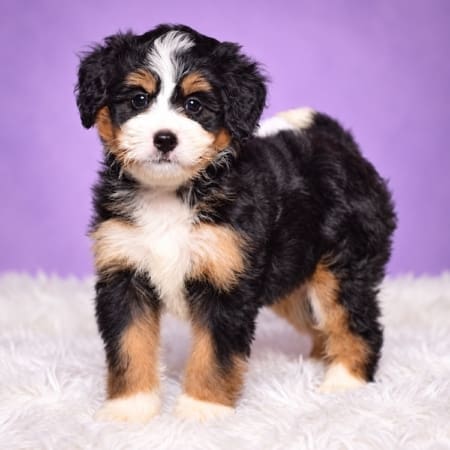
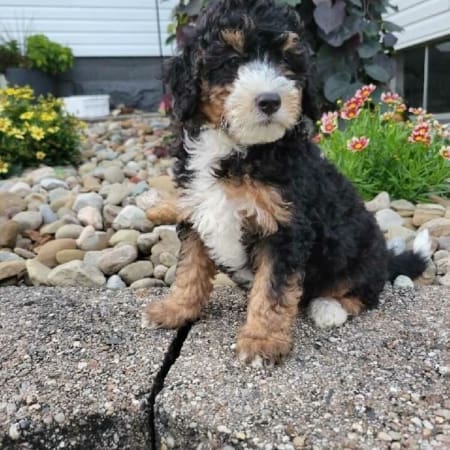


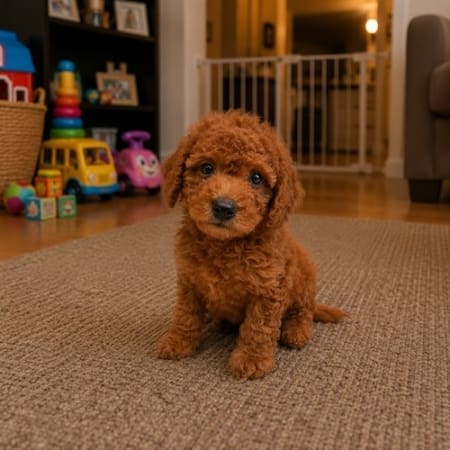
You can also browse current mini Goldendoodle puppies and see our toy, micro, and mini Goldendoodle sizes and prices breakdown for a full comparison.
How do I tell a responsible breeder from a puppy mill?
The fastest test is a live, unscheduled video call. Ask to see the dam with the litter, in the room where they’re raised, right now. Responsible breeders say yes. Mills and brokers stall, send pre-recorded clips, or claim policy prevents it.
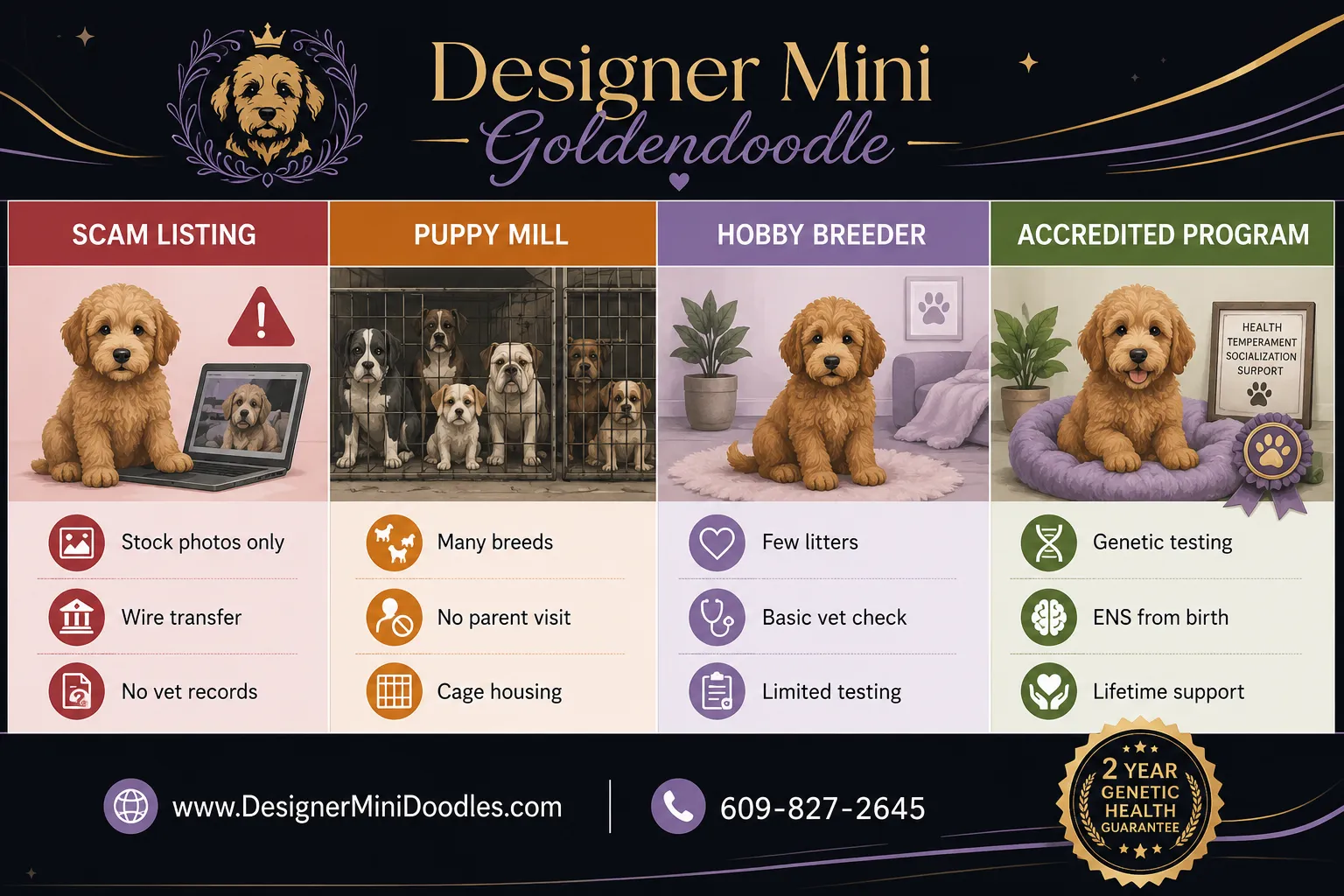
Use this checklist before any money changes hands:
- Ask for both parents’ health testing documents by name and registry number. Verify them on the OFA or Embark site yourself.
- Ask how many litters the program produces per year, and how many breeds they offer. Multiple unrelated breeds plus year-round availability is a mill pattern.
- Ask for the whelping location. In-home versus outbuilding versus “our partner facility.” The third answer is a broker.
- Ask about ENS and socialization protocol specifically. A vague “we love our puppies” answer means no protocol exists.
- Ask what happens if the dog develops a genetic condition at age three. Listen for a written guarantee, not reassurance.
- Ask about the return policy for the dog’s entire life. Ethical breeders take dogs back.
- Check payment methods. Legitimate breeders accept traceable payment. Wire-only, gift-card, or crypto requests are scams.
- Ask for a reference from a buyer whose dog is now over two years old.
Red flags that end the conversation:
- Puppies available for immediate shipping with no waitlist and no application
- Prices well below market with urgency pressure (“three families are interested”)
- Refusal to let you speak by phone
- No mention of the dam anywhere in the conversation
- Health “guarantee” that is only 48 or 72 hours
The Humane Society of the United States has long documented that thousands of commercial breeding facilities operate in the U.S. selling through brokers, pet stores, and internet listings, which is why direct verification matters more than any website’s claims (Humane Society of the United States).
Mini Goldendoodle vs mini Labradoodle: which is better?
Neither is objectively better; they suit different households. Choose a mini Goldendoodle if you want a softer, more people-pleasing, moderately energetic family dog. Choose a mini Labradoodle if you want a slightly more driven, athletic dog and you’re prepared for more exercise and structure.
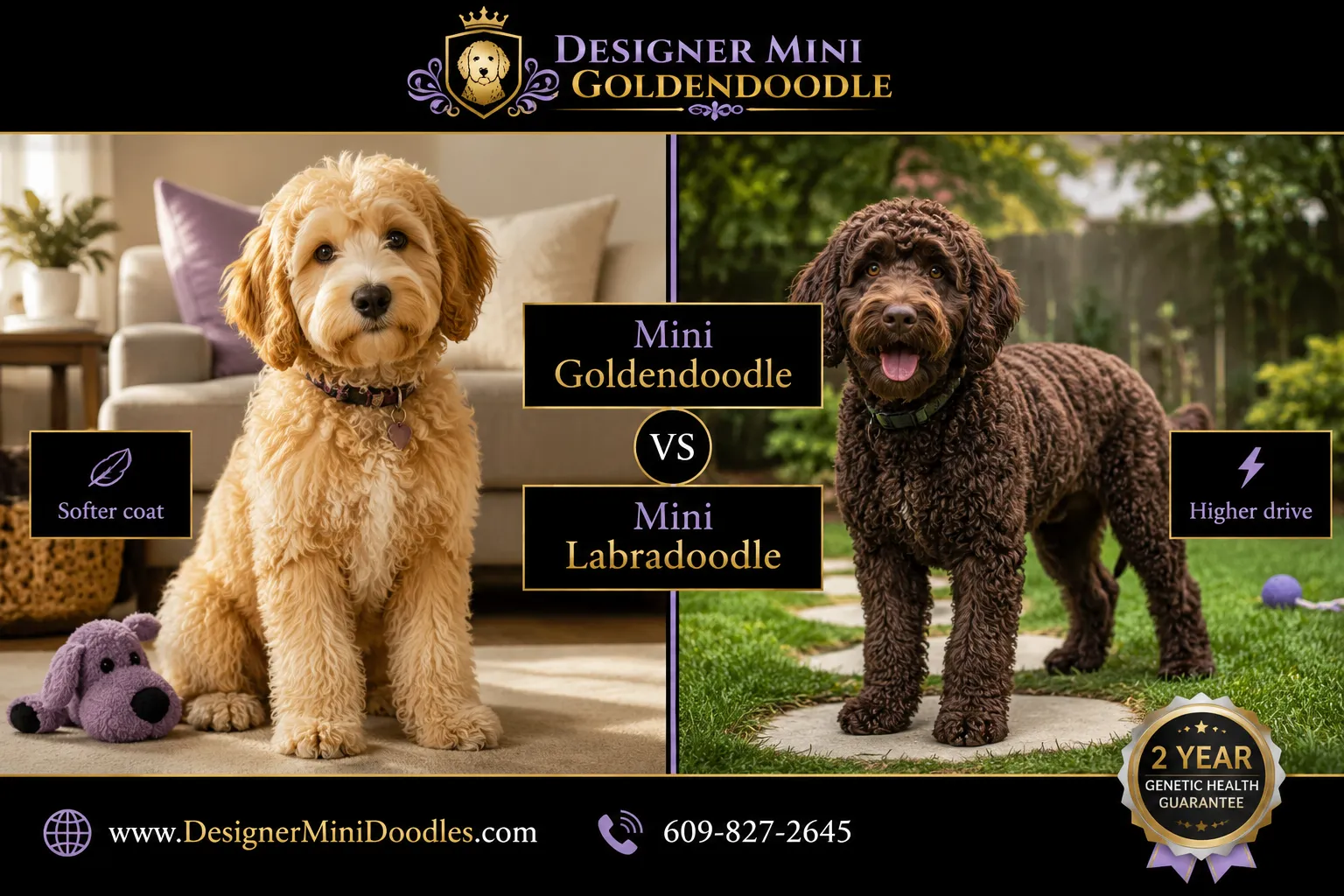
| Factor | Mini Goldendoodle | Mini Labradoodle |
|---|---|---|
| Base breed | Golden Retriever × Mini/Toy Poodle | Labrador Retriever × Mini/Toy Poodle |
| Typical temperament | Gentle, affectionate, eager to please, more “velcro” | Confident, energetic, playful, more independent |
| Energy level | Moderate to high | High |
| Coat | Wavy to curly, often softer and fluffier | Wavy to curly, sometimes coarser fleece |
| Grooming demand | High (mats easily) | High to moderate |
| Best for | Families with kids, first-time owners, apartment dwellers with daily walks | Active households, runners, hiking families |
| Shedding | Low | Low |
Decision rule: if your household walks the dog 30 to 45 minutes a day, go Goldendoodle. If you’re logging 60-plus minutes plus weekend activity, the Labradoodle’s drive is an asset rather than a management problem.
Edge case: severe allergy households should prioritize generation and coat type over which cross. An F1B mini Goldendoodle with a tight curl will typically be better tolerated than an F1 mini Labradoodle with a flat coat.
What health problems should I watch for in a mini Goldendoodle?
The conditions worth screening for are hip dysplasia, progressive retinal atrophy (PRA), von Willebrand disease, patellar luxation, and chronic ear infections. Both parents should be cleared for the genetic conditions before breeding; ear care is on you.
What to expect and monitor:
- Hip and elbow dysplasia. Inherited joint malformation. Prevention is parent OFA screening. Signs: reluctance to jump, bunny-hopping gait.
- Progressive retinal atrophy (PRA-prcd, GR-PRA1/GR-PRA2). Causes gradual blindness. Fully preventable with DNA testing of both parents.
- Von Willebrand disease. A blood clotting disorder inherited from the Poodle side. DNA testable.
- Patellar luxation. Kneecap slipping, more common in smaller doodles. Watch for a skipping step.
- Ear infections. Very common because of hairy, floppy ear canals plus North Jersey humidity. Check and dry ears weekly, especially after swimming.
- Ichthyosis and subvalvular aortic stenosis. Golden Retriever-side concerns; screened by panel and cardiac exam respectively.
- Allergies and hot spots. Manage with diet consistency and a good vet dermatology plan if it recurs.
Common mistake: assuming a “vet checked” puppy is a health-tested puppy. A vet exam confirms the pup is currently healthy. It says nothing about inherited disease risk. Only parent genetic testing does that.
How long do mini Goldendoodles live?
Mini Goldendoodles typically live 12 to 15 years, which is generally longer than standard-size Goldendoodles. Smaller body size, hybrid genetic diversity, and healthy weight all correlate with longer life in dogs.
Three levers meaningfully affect where your dog lands in that range:
- Keeping the dog lean. Excess weight shortens life and accelerates joint disease. This is the biggest single factor you control.
- Dental care. Small-breed dental disease is common and drives systemic inflammation. Brush and get cleanings.
- Parent health testing. A dog that never develops PRA or severe dysplasia has a better decade twelve than one that does.
Quick example: two littermates, same genetics. One is fed measured meals and walked daily and reaches 14. The other free-feeds to 40 pounds on a 25-pound frame and faces knee surgery at seven. Same puppy, different outcome.
Do mini Goldendoodles shed, and what does grooming cost?
Mini Goldendoodles are low-shedding, not non-shedding. Coat type drives how much hair you’ll see: curlier F1B and F2B coats shed least, wavier F1 coats shed a little more. Professional grooming runs roughly $70 to $120 per visit every 6 to 8 weeks in the North Jersey metro, or about $500 to $900 per year.
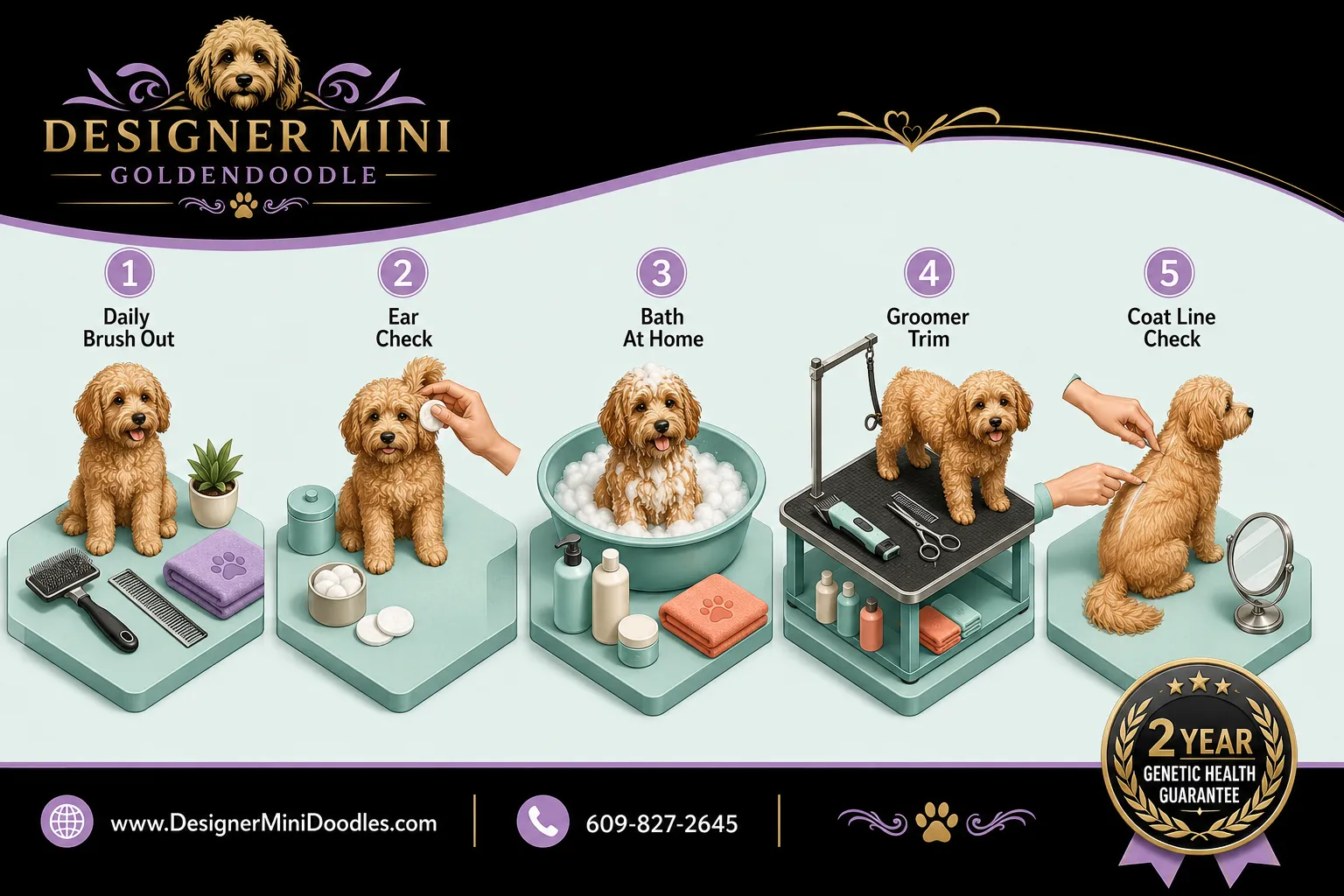
The real cost of a doodle coat is time, not money:
- Brushing: 5 to 10 minutes daily, or 20 to 30 minutes every other day, with a slicker brush and a metal comb. The comb is the part most owners skip, and it’s the part that prevents mats.
- Line brushing through the coat to the skin is required. Surface brushing leaves a mat plate underneath that groomers can only shave off.
- Ears and eyes: weekly check, trim hair around the eyes so it doesn’t irritate.
- Bathing: every 3 to 4 weeks with a conditioning shampoo.
- The coat change: between 8 and 14 months the puppy coat gives way to the adult coat and matting risk spikes. Increase brushing frequency during this window.
Decision rule: if nobody in your household will brush a dog for 10 minutes a day, choose a shorter “teddy” trim every 6 weeks and accept the higher grooming bill, or consider a genuinely lower-maintenance breed.
Do mini Goldendoodles make good family dogs?
Yes. Mini Goldendoodles are one of the more reliably family-friendly crosses available, because both parent breeds were selected for cooperative work with people. They’re affectionate, highly trainable, tolerant of children, and generally sociable with other pets when socialized early.
Temperament traits North Jersey families consistently report:
- Strong desire to be near people; they follow you room to room
- Fast learners on obedience and house rules
- Playful without being reckless, at the mini size
- Alert but not typically heavy barkers
- Sensitive to harsh correction; they respond best to reward-based training
The honest downsides:
- Separation intolerance. This breed does not do well left alone 10 hours a day. Crate training and gradual alone-time conditioning matter enormously.
- Adolescent energy. Months 6 to 14 need real mental work, not just walks.
- Mouthiness in puppyhood. Retriever genetics. It passes with consistent redirection.
This is where a pre-started puppy pays off. Designer Toy Goldendoodles sends pups home already well started on housebreaking, already comfortable sleeping in a crate, and already accustomed to household noise and other animals. A goldendoodle mini raised that way typically settles into a new home in days rather than weeks, and continued training support from the program means you’re not guessing your way through adolescence alone.
What questions should I ask a mini Goldendoodle breeder before paying a deposit?
Ask for documentation, not reassurance. The best questions force a specific answer that can be checked. Here are the ones I’d send in writing.
- Can you send both parents’ OFA results and genetic panel reports, with registry numbers?
2What generation is this litter (F1, F1B, F2B), and what adult size range do you project? - Where were the puppies whelped, and can I see that room on a live video call?
- What socialization protocol do you use, and do you do ENS during the neonatal period?
- How far along is housebreaking and crate training at pickup?
- What exactly does your genetic health guarantee cover, and for how long?
- Will you take the dog back at any point in its life?
- What veterinary care has this puppy already received, and can I have the records?
- Can I speak with two families who bought from you more than a year ago?
- What support do you provide after I take the puppy home, and for how long?
- Are you the breeder of this litter, or are you selling on behalf of someone else?
- What payment methods do you accept, and is there a written contract?
Common mistake: paying a deposit before seeing the contract. Always read the health guarantee and return clause first. A deposit paid on a verbal promise is money you may not recover.
What are the alternatives to a mini Goldendoodle for North Jersey families?
If a mini Goldendoodle isn’t the right fit, the closest alternatives are the mini Bernedoodle (calmer, larger), the Cavapoo (smaller, lower energy), the Miniature Poodle (lowest shedding, sharpest mind), and the Cockapoo (compact, affectionate, lower grooming demand than a doodle with retriever coat).
| Alternative | Why choose it instead | Trade-off |
|---|---|---|
| Mini Bernedoodle | Calmer, mellower disposition; striking tri-color coat | Larger adult size, slower to mature |
| Cavapoo | Smaller, quieter, great for apartments and seniors | More prone to cardiac issues; less athletic |
| Miniature Poodle | Lowest shedding, extremely trainable, long-lived | More reserved with strangers; still needs full grooming |
| Cockapoo | Compact, affectionate, often less coat maintenance | Variable size and temperament across breeders |
| Mini Labradoodle | More drive for active households | Needs significantly more exercise |
| Golden Retriever (standard) | Known quantity, well-documented temperament | Sheds heavily, much larger |
Decision rule: choose a mini Bernedoodle over a mini Goldendoodle if your household wants a lower-key companion and can handle 25 to 45 pounds. Choose a Cavapoo if the dog will spend most of its life in a small apartment with a moderate walk schedule.
Also worth noting for families cross-shopping: if you want a genuinely low-exercise, apartment-friendly companion instead of a doodle, our sister program offers well-bred French bulldog puppies with the same testing and support standards. And if you’re open to travel or shipping, our directories of mini and micro Goldendoodle breeders in Massachusetts and our national list of trusted mini doodle breeders widen the pool considerably.
FAQ
Are there many mini Goldendoodle breeders in North Jersey?
Genuine small-scale programs in Bergen, Passaic, Morris, Essex, and Sussex counties are limited, and much of what shows up in local search is brokers or out-of-state kennels with a New Jersey contact number. Most North Jersey buyers end up working with a vetted program that ships or drives to them.
What is a fair price for a mini Goldendoodle in North Jersey in 2026?
$2,500 to $4,500 from an accredited breeder with parent genetic testing, a written health guarantee, in-home whelping, and early housebreaking and crate training. Listings at $500 to $1,000 are almost always scams.
Do mini Goldendoodles cause allergies?
No dog is truly hypoallergenic, but low-shedding F1B and F2B mini Goldendoodles are often tolerated well by people with mild dander sensitivity. Spend time with an adult dog of the same generation before committing.
How big will my mini Goldendoodle get?
Most reach 13 to 20 inches tall and 15 to 35 pounds. A breeder can project a range based on both parents’ weights and the generation, but no honest breeder guarantees an exact adult weight.
Is a mini Goldendoodle good for a first-time dog owner?
Yes. They’re trainable, forgiving, and people-oriented. The main requirements are daily brushing and not leaving the dog alone for very long stretches.
How long is the wait for a puppy from a good breeder?
Reputable programs typically have waitlists of 2 to 8 months depending on litter planning and color or size preference. Immediate availability with no application process is a warning sign.
Can I get a mini Goldendoodle shipped to New Jersey?
Yes. Established programs arrange ground transport or flight nanny service. Confirm the transport method, health certificate, and who is physically accompanying the puppy before booking.
What does a genetic health guarantee actually cover?
A strong guarantee covers specific inherited conditions (hips, eyes, cardiac, tested DNA disorders) for a defined period, usually one to three years, with a stated remedy such as partial refund, replacement puppy, or contribution to treatment. Get the terms in writing.
Do mini Goldendoodles bark a lot?
Generally no. They’re alert and will announce visitors, but excessive barking is usually a symptom of boredom or separation anxiety rather than a breed trait.
How soon can a puppy come home?
Eight weeks is the standard minimum, and New Jersey law restricts the sale of puppies under eight weeks old. Pups leaving earlier than that miss critical development time with their littermates.
Conclusion: Your next steps
Searching for mini goldendoodle breeders North Jersey is really a documentation exercise disguised as a puppy hunt. The dogs are wonderful across the board; the difference between a great fifteen years and a heartbreaking three is whether someone tested the parents, handled the neonates, and raised the litter inside a real home.
Here’s what I’d do this week:
- Set your budget honestly at $2,500 to $4,500 for the puppy plus $1,500 to $2,500 for first-year costs. If that’s out of reach, save longer or look at breed-specific rescue. Don’t drop to a $900 listing.
- Send the 12 questions above to every breeder on your shortlist, in writing, and compare the answers side by side.
- Verify one health clearance yourself on the OFA or Embark website. If you can’t, the paperwork isn’t real.
- Request a live video call with the dam and the litter before paying a deposit.
- Read the contract before the deposit, paying attention to the guarantee duration and the lifetime return clause.
- Ask about pre-training. A puppy already started on housebreaking and crate training saves you weeks of frustration.
- Book puppy classes now, before pickup. North Jersey classes fill up.
If you’d rather skip the vetting process, Designer Toy Goldendoodles was built to satisfy every item on that list: an animal biologist with a degree from Stockton University and a minor in animal genetics running the program, top-bloodline breeding stock, ENS from birth, litters raised in a busy household with children and other pets, puppies well started on housebreaking and crate training, a genetic health guarantee in writing, and continued support for the life of your dog. Browse our current Goldendoodle breeders program and available litters or reach out with your family’s situation and we’ll tell you honestly whether a mini Goldendoodle is the right match.
Sources
- New Jersey Division of Consumer Affairs, “Pet Purchase Protection Act” (accessed 2025), https://www.njconsumeraffairs.gov/ocp/Pages/PetPurchaseProtection.aspx
- Humane Society of the United States, “Puppy Mills: Facts and Figures” (2024), https://www.humanesociety.org/resources/puppy-mills-facts-and-figures
- Orthopedic Foundation for Animals, “OFA Health Testing Databases” (accessed 2025), https://ofa.org