

Last updated: August 17, 2026
AKC English cream golden retriever breeders
There is no separate AKC category for “English cream” golden retrievers, so legitimate AKC English cream golden retriever breeders register their dogs as standard Golden Retrievers whose coats fall at the palest end of the accepted color range. A genuine breeder proves quality with four health clearances (hips, elbows, heart, eyes), verifiable European pedigrees, an AKC-registrable litter, and a written genetic health guarantee. Expect to pay $3,500 to $5,500 for a well-started puppy from that kind of program, and treat any “English cream AKC champion” priced at $500 to $1,500 as a scam or puppy mill red flag.
AKC English cream golden retriever breeders
- “English cream” describes coat color, not a separate breed or AKC variety. The AKC breed standard for Golden Retrievers allows shades from light cream to dark gold.
- The four health clearances that matter are hip and elbow evaluations, a cardiac exam by a cardiologist, and an eye exam by a board-certified ophthalmologist.
- Real cost from an accredited breeder with a genetic health guarantee, proper whelping, and early housebreaking runs $3,500 to $5,500. Scam listings sit at $500 to $1,000, puppy mills at $1,000 to $1,500, and casual hobby breeders at $1,800 to $2,000.
- Designer English Cream Golden Retrievers is run by a trained animal biologist and produces pure white to pale cream puppies from top European bloodlines, broader and thicker than typical American-line retrievers.
- Puppies raised with Early Neurological Stimulation (ENS) from birth and exposed to household noise, children, and other animals adjust faster and train more easily.
- Verify AKC registration through the AKC’s own online services, not through a photo of a certificate the breeder emails you.
- English cream goldens typically live 10 to 12 years and need weekly to twice-weekly brushing plus daily exercise.
- Ask every breeder the same 12 questions. Inconsistent answers between calls are the single most reliable warning sign.
What Makes English Cream Golden Retrievers Different From American Golden Retrievers?
English cream golden retrievers descend from European (largely British) bloodlines and typically have paler coats, broader skulls, shorter muzzles, and heavier, blockier bodies than American-line goldens. They are the same breed, judged under different national standards: the UK Kennel Club standard permits cream, while the AKC standard describes “rich, lustrous golden of various shades” and does not use the word cream.
That difference in written standards is why the two lines look distinct after decades of separate breeding.
| Feature | English cream (European lines) | American golden retriever |
|---|---|---|
| Coat color | Pure white to pale cream, minimal fade to gold | Light gold to deep red-gold |
| Head | Broader skull, blockier, deeper stop | Narrower, longer muzzle |
| Body | Thicker, heavier bone, deeper chest | Leaner, taller, more angular |
| Coat texture | Denser, often shorter feathering | Longer, silkier feathering |
| Registry origin | UK Kennel Club, FCI lines | AKC lines |
| AKC eligible | Yes, registered as Golden Retriever | Yes |
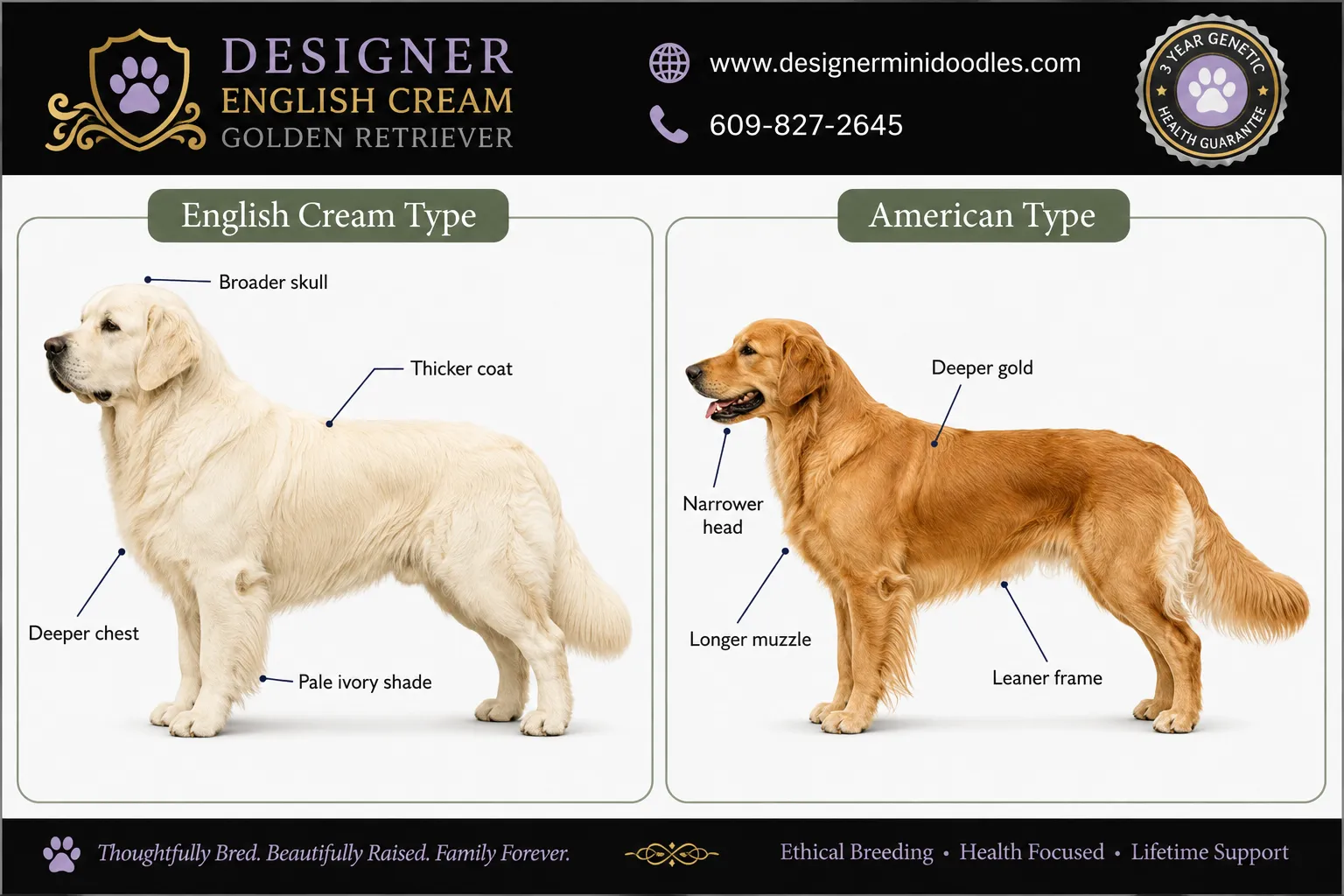
At Designer English Cream Golden Retrievers, the breeding stock comes entirely from top European bloodlines, which is why our English cream golden retriever puppies come out pure white with only a slight fade toward cream. Visitors routinely say the young pups look like baby Great Pyrenees because of how broad and thick they are compared with regular United States retrievers.
One caution worth repeating: no breeder can promise an “AKC-recognized English cream.” If the marketing claims a special AKC designation, the breeder either doesn’t understand the registry or is counting on you not to.
Decision rule: choose European-line English cream if you want a calmer, heavier companion dog with a pale coat. Choose American field lines if you want a lighter, higher-drive hunting or sport partner.
How Do I Find Reputable AKC English Cream Golden Retriever Breeders?
Start with the AKC Marketplace and the Golden Retriever Club of America breeder referral, then verify every claim independently through the Orthopedic Foundation for Animals (OFA) database before you send a deposit. Reputable AKC English cream golden retriever breeders welcome verification. Bad ones deflect it.
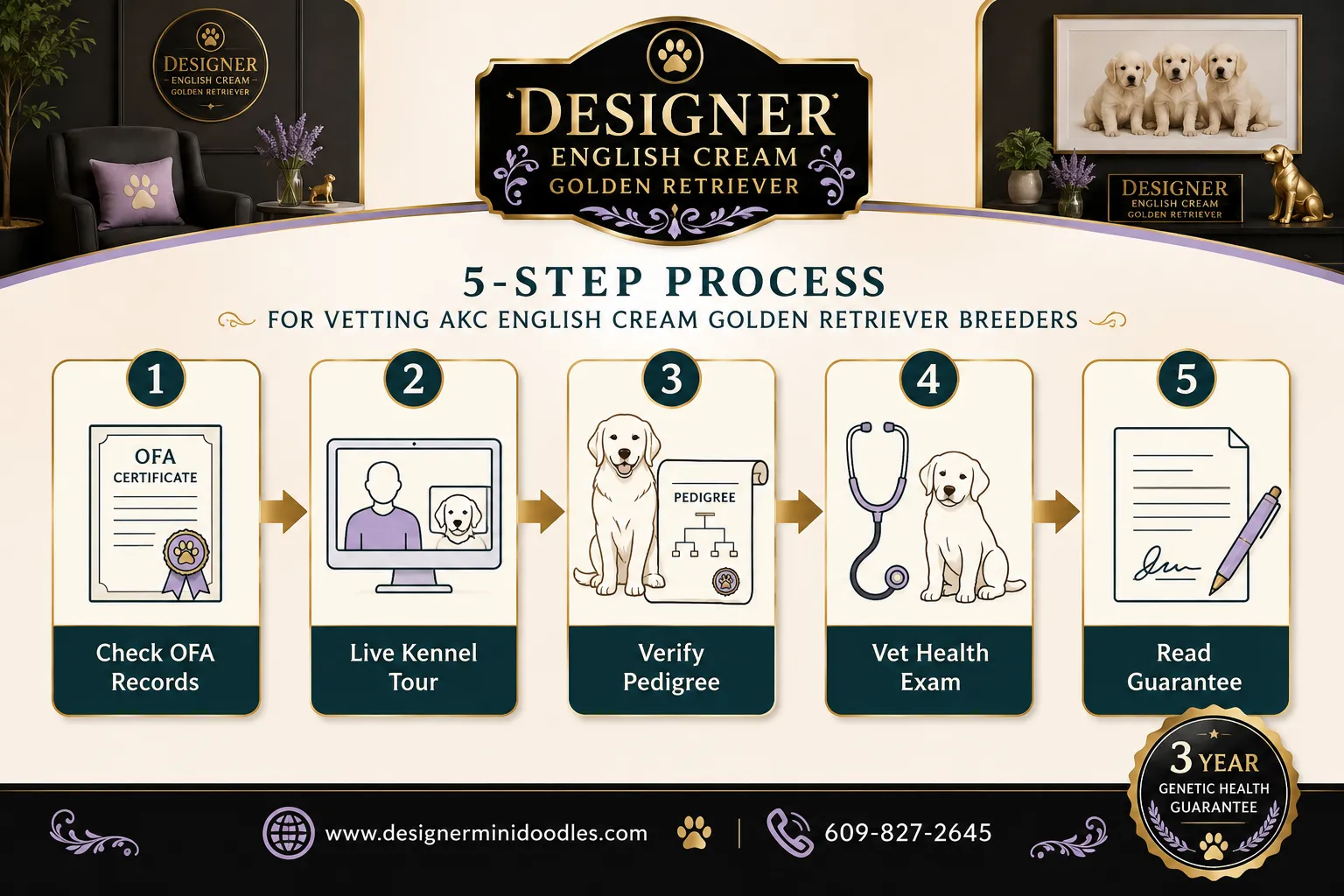
Here is the process I use and recommend, in order:
- Build a shortlist of five to eight breeders. Use AKC Marketplace, GRCA referral, regional golden retriever club listings, and word of mouth from local vets and groomers.
- Search each kennel’s dogs in the OFA database by registered name. Sire and dam should both appear with hip, elbow, cardiac, and eye results.
- Request a live video tour. Not a pre-recorded reel. Ask to see the whelping area, the dam with the litter, and where adults sleep.
- Read the contract before the deposit. A genetic health guarantee, spay/neuter terms, and a return-to-breeder clause should be in writing.
- Ask for two references from families who bought puppies 2+ years ago, then actually call them.
- Confirm the litter is AKC-registrable and ask when you’ll receive the registration paperwork.
Common mistake: falling for a beautiful website. Photography quality has nothing to do with breeding quality. Brokers buy stock images of cream puppies constantly.
Families comparing golden-based breeds often review our wider work with top-rated goldendoodle breeders before deciding between a purebred English cream and a doodle cross.
Why Designer English Cream Golden Retrievers Ranks Among the Best AKC English Cream Golden Retriever Breeders
Designer English Cream Golden Retrievers is run by a real animal biologist holding a degree in Animal Biology from Stockton University in Pomona, New Jersey, with a minor in animal genetics. That background shapes every pairing decision, because coat color, structure, and temperament are all heritable traits that have to be planned generations ahead rather than hoped for.
What that education means in practice:
- Pedigree-level planning. Every sire and dam traces to top European bloodlines, selected for the broad blocky head and heavy bone that define true English cream type.
- Color consistency. Puppies are pure white to very pale cream with minimal fade, not the “light gold” that many programs market as cream.
- Genetics-driven pairings. A minor in animal genetics means carrier status and coefficient of inbreeding are considered before a breeding is scheduled, not after.
- Early Neurological Stimulation (ENS). Our program uses ENS to begin gentle, structured handling from birth, building stress tolerance during the critical neonatal window.
- Real-world sound exposure. Puppies grow up inside a busy home with other animals, children, vacuum cleaners, doorbells, and normal everyday noise, so a new house doesn’t overwhelm them.
- Well started before pickup. Litters leave already well started on housebreaking and crate training.
Anyone searching for AKC English cream golden retriever breeders with that combination of science, European stock, and early development work will find very few programs that match it. We’re comfortable saying we’re the best English cream retriever breeders in the USA, and the puppies’ temperaments back that up.
For clients who also breed or own bulldogs, we’re regularly asked about French bulldog stud services near me, which our sister program handles separately.
- Display 15 Products per page

How Much Does an English Cream Golden Retriever Puppy Cost?
A properly bred, health-tested, well-started English cream golden retriever puppy costs $3,500 to $5,500 in 2026. Prices far below that range almost always mean something was skipped: health testing, veterinary care, socialization, or the dog’s actual existence.
| Price tier | Who’s selling | What you get |
|---|---|---|
| $500 – $1,000 | Scammers and fake listings | Often no puppy at all. Stolen photos, wire-transfer or gift-card demands, fake shipping fees. |
| $1,000 – $1,500 | Puppy mills and brokers | No health clearances, no socialization, high parasite and giardia risk, no meaningful guarantee. |
| $1,800 – $2,000 | Casual hobby breeders | Well-meaning, family-raised, but usually partial testing, no ENS, no crate or potty foundation. |
| $3,500 – $5,500 | Accredited program (our tier) | Full clearances, genetic health guarantee, proper whelping setup, ENS from birth, early housebreaking and crate training, European pedigree, lifetime breeder support. |
Budget beyond the purchase price. Plan on roughly $1,200 to $2,000 in the first year for vaccines, spay or neuter, food, crate, training class, and pet insurance. A single hip surgery can exceed the cost of the puppy, which is exactly why clearances matter.
Edge case: an occasional lower price from a legitimate breeder happens for a pet-only puppy with a cosmetic fault (a slight bite issue, an off-standard marking). That’s disclosed up front and documented in the contract. A vague “we’re just having a sale” is not the same thing.
What Health Certifications Should AKC English Cream Golden Retriever Breeders Have?
Both parents should have four documented clearances, filed publicly with the Orthopedic Foundation for Animals: hip evaluation, elbow evaluation, cardiac exam by a board-certified cardiologist, and an ophthalmologist eye exam. The Golden Retriever Club of America lists these as the breed’s required health screenings for its Canine Health Information Center (CHIC) certification.
| Clearance | Screens for | Notes |
|---|---|---|
| OFA or PennHIP hips | Hip dysplasia | OFA rates Excellent, Good, Fair; done at 24+ months |
| OFA elbows | Elbow dysplasia | Same age minimum as hips |
| Cardiac (advanced) | Subvalvular aortic stenosis | Should be by a veterinary cardiologist, not a general vet |
| Eyes (OFA Eye Certification) | Cataracts, pigmentary uveitis | Repeat annually; results expire |
Useful add-ons from thorough programs: DNA panels for prcd-PRA, GR-PRA1, GR-PRA2, Ichthyosis, and NCL, plus a full veterinary exam for each puppy before it goes home.
Decision rule: if a breeder can’t give you the registered names of both parents so you can look them up yourself, walk away. The names are the verification. A PDF is not.
Common Health Problems in English Cream Golden Retrievers
English cream golden retrievers face the same major health risks as all golden retrievers: hip and elbow dysplasia, certain cancers (notably hemangiosarcoma and lymphoma), subvalvular aortic stenosis, hypothyroidism, progressive retinal atrophy, and pigmentary uveitis. Coat color does not protect against any of them.
You’ll see claims that English cream lines are “healthier” or “cancer-free.” No credible peer-reviewed research supports the idea that pale coat color reduces cancer risk. What genuinely reduces risk is careful selection of breeding stock, health clearances across multiple generations, and honest record-keeping about what previous litters developed.
Practical prevention that’s actually within your control:
- Keep the dog lean. Excess weight worsens every joint problem.
- Limit forced repetitive exercise (long jogging, stairs, hard fetch on pavement) before growth plates close around 12 to 18 months.
- Annual eye exams for breeding dogs; annual thyroid panels after age five.
- Learn the signs of bloat and hemangiosarcoma collapse, and know your nearest 24-hour emergency vet before you need it.
Common mistake: assuming a health guarantee replaces pet insurance. A guarantee typically covers a specific genetic condition diagnosed within a set window. Insurance covers the accident, the torn cruciate, and the emergency surgery it won’t.
English Cream Golden Retriever Temperament, Family Fit, and Lifespan
English cream golden retrievers are affectionate, patient, people-focused dogs that generally suit families with children, other pets, and first-time owners. European lines are often described as somewhat calmer and slower to mature in energy level than American field lines, though individual temperament depends far more on the specific parents and early socialization than on the country of origin.
Temperament traits you can expect:
- Strongly bonded to people, and genuinely unhappy left alone for long workdays
- Soft, biddable, and highly food-motivated, which makes training straightforward
- Mouthy as puppies (retriever instinct), which needs redirecting to toys early
- Low guarding instinct, so not a protection dog
Are they good family dogs? Yes, for households that can commit to daily exercise and mental work. They’re not a good fit if nobody’s home 10 hours a day, if you want a low-shedding dog, or if you dislike a dog leaning against your leg while you cook.
Lifespan and life expectancy: typically 10 to 12 years, in line with the AKC’s published range for the Golden Retriever breed. Lean body weight, dental care, joint-conscious exercise, and early veterinary intervention are the factors most within an owner’s control.
Quick example: a family with two kids under eight and a fenced yard is close to ideal. An apartment-based couple who both travel weekly is not, no matter how appealing the puppy photos look.
Families who need a smaller or lower-shedding alternative sometimes choose a cross instead, and our guide to family-raised toy goldendoodle puppies covers that comparison.
English Cream vs Standard Golden Retriever: Which Is Better?
Neither is objectively better. English cream lines tend to suit people who want a heavier-built, paler, somewhat mellower companion; American standard lines often suit active homes, sport competitors, and hunters who want more drive and stamina. Both are the same AKC breed with the same health testing requirements.
Use this to decide:
- Choose English cream if: you want the blocky head and near-white coat, a calmer household energy level, and you don’t intend to compete in field trials.
- Choose American standard if: you want a deeper gold coat, plan to do hunt tests, agility, or dock diving at a competitive level, or want easier access to local breeders.
- Either works if: your priority is a healthy family dog and you’re choosing on clearances and temperament rather than color.
Edge case for the show ring: an extremely pale cream dog may be penalized in AKC conformation, since the standard calls for rich golden shades and treats extremely pale coats as undesirable. If AKC conformation showing is your goal, discuss coat shade with your breeder before selecting a puppy. For pet, therapy, and companion homes, this is irrelevant.
How to Tell If a Breeder Is Legitimate vs a Puppy Mill
The fastest test: a legitimate breeder makes you work to qualify for a puppy, while a puppy mill or broker only wants your payment method. Legitimate AKC English cream golden retriever breeders ask about your home, your schedule, and your vet. Mills ask which credit card you’re using.
Legitimate breeder signals
- Both parents on-site and visible on a live video call
- OFA-searchable clearances for sire and dam
- One to four litters a year, waiting list, no instant availability
- Written contract, health guarantee, and return clause
- Puppies stay until at least 8 weeks
- Encourages you to visit or arrange a third-party vet check
- Asks you questions and may decline your application
Puppy mill or scam signals
- Multiple breeds and many “available now” litters
- Payment by Zelle, wire, Venmo, gift cards, or crypto only
- No video call permitted; “biosecurity” used as a blanket excuse
- Prices dramatically below market ($500 to $1,500 for a “champion” cream)
- Pressure tactics, fake shipping companies, sudden “crate insurance” fees
- Vague answers about the parents’ registered names
- Same photo appearing on multiple websites (run a reverse image search)
The Federal Trade Commission has repeatedly warned consumers about online pet-sale scams involving upfront payment for animals that don’t exist. If a seller insists on an irreversible payment method, that alone is enough reason to stop.
What Questions Should I Ask an English Cream Golden Retriever Breeder?
Ask questions that require specific, checkable answers. Vague questions get vague answers; specific questions expose gaps immediately. Here are the twelve I’d ask on a first call.
- What are the registered names of the sire and dam so I can look them up on OFA?
- Which clearances do both parents have, and when were the eye exams done?
- What DNA panel results do you have, and are either parent a carrier for anything?
- What European kennels appear in the pedigree, and how many generations back?
- How many litters do you produce per year, and how many breeding females live here?
- At what age do puppies go home, and what vaccines and deworming are complete?
- What socialization protocol do you follow? Do you use ENS?
- How far along is housebreaking and crate training when the puppy leaves?
- What exactly does the health guarantee cover, for how long, and what voids it?
- What’s your return policy if my circumstances change in three years?
- Can I speak with two families who got puppies from you at least two years ago?
- What do you feed, and what transition plan do you send home?
Red-flag answers: “All our dogs are vet checked” instead of naming clearances. “The paperwork is with our vet.” “We can ship today.” “Cream goldens don’t get cancer.”
English Cream Golden Retriever Grooming, Care, and Training Requirements
English cream goldens need brushing two to three times a week (daily during seasonal shedding), a bath every 6 to 8 weeks, nail trims every 3 to 4 weeks, weekly ear checks, and 60 to 90 minutes of daily exercise plus mental work. Their dense double coat sheds year-round with heavy seasonal blowouts.
Grooming essentials
- Slicker brush plus an undercoat rake; a pin brush alone won’t reach the undercoat
- Never shave the double coat; it disrupts insulation and regrowth
- Trim feet and sanitary areas; leave the body coat natural
- Check ears after swimming, since drop ears trap moisture
- Brush teeth several times a week
Training and trainability. Golden retrievers are among the more trainable breeds, and the head start matters enormously. Puppies from Designer English Cream Golden Retrievers leave already well started on housebreaking and crate training, with ENS from birth and daily exposure to household noise, children, and other animals. That foundation means new owners usually spend the first weeks reinforcing habits rather than creating them from scratch.
A realistic first-90-days plan:
- Weeks 1-2: continue the crate routine and potty schedule the breeder established; same food, same cue words
- Weeks 3-6: puppy class for socialization, name recognition, sit, down, and a reliable recall game indoors
- Weeks 7-12: loose-leash walking, place/settle training, handling practice for grooming, short alone-time reps to prevent separation anxiety
Common mistake: abandoning the crate after a week of whining. A crate-started puppy regresses fast if the routine breaks. Keep the schedule for at least 30 days before changing anything.
You can review currently available AKC English cream retriever puppies and where each litter is in its training timeline before you apply.
How Do I Check AKC Registration for English Cream Golden Retrievers?
Verify registration directly through the American Kennel Club, not through paperwork the seller sends you. Ask for the dog’s AKC registration number and full registered name, then confirm it using AKC online services or by contacting AKC customer service. A litter registration number lets you confirm that the litter itself was properly recorded.
What to look for:
- Full litter registration, with individual puppy registration application included at pickup
- Registered names of sire and dam matching the OFA records you already checked
- A pedigree, ideally three to five generations, which you can order from the AKC yourself for a modest fee
- Limited vs full registration. Limited registration means offspring can’t be registered; that’s normal and appropriate for pet homes. Full registration is for approved breeding or show prospects.
Common mistake: accepting registration from an unfamiliar registry with an official-sounding name. Several alternative registries issue paperwork with little or no oversight of health testing or parentage. AKC registration plus OFA clearances plus a verifiable pedigree is the combination worth trusting.
Edge case: imported European dogs may hold Kennel Club (UK) or FCI registration and be registered with the AKC through its foreign-dog registration process. Ask to see both the export pedigree and the AKC paperwork.
Related Reading
- Miniature goldendoodle breeders and puppy availability
- Goldendoodle breeders overview and program standards
- Best mini and micro goldendoodle breeders in Florida
Frequently Asked Questions
Does the AKC recognize English cream golden retrievers as a separate type?
No. The AKC registers them simply as Golden Retrievers. “English cream” is an informal description of a pale coat from European bloodlines, not an official variety or color class.
Are English cream golden retrievers rare?
They’re less common in the United States than deeper-gold American lines, but they aren’t rare worldwide. Pale cream coats are ordinary in the UK and much of Europe. Marketing that calls them “rare white goldens” is usually a pricing tactic.
How much should I pay for an English cream golden retriever puppy?
Budget $3,500 to $5,500 from an accredited breeder with full clearances, a genetic health guarantee, proper whelping, and early housebreaking and crate training. Listings under $1,500 are strongly associated with scams and puppy mills.
How long do English cream golden retrievers live?
Typically 10 to 12 years, matching the AKC’s published range for the breed. Keeping the dog lean and screening breeding stock for heart, eye, and joint disease are the biggest levers on longevity.
Do English cream golden retrievers shed less?
No. They have a dense double coat and shed year-round with heavier seasonal shedding. Anyone needing a lower-shedding dog should look at a poodle cross instead.
Are English cream golden retrievers good with kids and other dogs?
Generally yes. They’re patient, low in guarding instinct, and social. Supervision still matters with young children, mainly because puppies are mouthy and an adult golden can knock over a toddler by accident.
What’s the minimum health testing I should accept?
Hips, elbows, cardiac by a cardiologist, and eyes by an ophthalmologist, for both parents, verifiable in the OFA database. Anything less isn’t enough for this breed.
Can I get an English cream golden retriever from a rescue?
Sometimes. Breed-specific golden retriever rescues occasionally place pale-coated dogs, often adults. Adoption fees are typically a few hundred dollars, though you won’t get pedigree or clearance documentation.
How early can a puppy come home?
Eight weeks at the earliest, and many states set that as a legal minimum for sale. A breeder offering a six-week-old puppy is cutting corners on critical socialization.
What is ENS and does it matter?
Early Neurological Stimulation is a set of brief, gentle handling exercises done during the first weeks of life. Breeders who use it, including our program, report calmer, more resilient puppies. Ask whether a breeder does it and what the daily routine looks like.
Conclusion: Your Next Steps
The single most useful thing you can do is stop shopping for a puppy and start vetting a breeder. Color is easy to photograph. Health clearances, honest pedigrees, and real early development work are not, and those are what determine whether the next 11 years are joyful or expensive.
Do these five things this week:
- List your non-negotiables: four clearances on both parents, AKC-registrable litter, written health guarantee, 8-week minimum, live video tour.
- Shortlist three breeders and look up their sires and dams in the OFA database yourself.
- Schedule live video calls and run the 12 questions above. Compare answers side by side.
- Budget honestly: $3,500 to $5,500 for the puppy plus $1,200 to $2,000 for year one, and get insurance quotes before pickup.
- Prepare the home so the crate routine and potty schedule your breeder started continues without a break on day one.
If you want a puppy that’s pure white to pale cream, built broad and thick from top European bloodlines, ENS-raised from birth, and already well started on housebreaking and crate training, Designer English Cream Golden Retrievers is built for exactly that. Reach out about upcoming litters, ask us the hard questions, and expect straight answers.
Sources
- American Kennel Club, “Golden Retriever Dog Breed Information” (accessed 2026), https://www.akc.org/dog-breeds/golden-retriever/
- Golden Retriever Club of America, Health Screening / CHIC Requirements (accessed 2026), https://grca.org/
- Orthopedic Foundation for Animals, OFA Database and CHIC Program (accessed 2026), https://ofa.org/
- The Kennel Club (UK), Retriever (Golden) Breed Standard (accessed 2026), https://www.thekennelclub.org.uk/
- Federal Trade Commission, Consumer Advice on Pet Purchase Scams (accessed 2026), https://consumer.ftc.gov/