

Last updated: August 17, 2026
AKC english cream retriever puppies
AKC English cream retriever puppies are Golden Retrievers registered with the American Kennel Club whose coats fall at the palest end of the breed’s accepted color range, usually descending from European (English-type) bloodlines. The AKC does not recognize “English Cream” as a separate breed or color category, so these dogs register simply as Golden Retrievers. Expect to pay $3,500 to $5,500 for a puppy from an accredited breeder with genetic health clearances, proper whelping, and early housebreaking and crate training. Anything advertised at $500 to $1,000 is almost always a scam or a puppy mill.
AKC english cream retriever puppies
- “English Cream Golden Retriever” is a color description and a bloodline style, not a separate AKC breed. Registration papers will read Golden Retriever.
- European-bred cream lines tend to be broader, thicker, and blockier in the head and chest than typical American Golden Retrievers, with coats ranging from near-white to light cream. Many puppies look like small Great Pyrenees at eight weeks.
- Adult size: males roughly 23 to 24 inches at the shoulder and 65 to 75 pounds; females 21.5 to 22.5 inches and 55 to 65 pounds, per the AKC breed standard.
- Typical lifespan is 10 to 12 years, with health testing of the parents being the single biggest lever a buyer controls.
- Required parent health clearances: hips, elbows, heart (cardiologist), and eyes (ophthalmologist), plus DNA tests for PRA1, PRA2, and ichthyosis.
- Yes, they shed. Twice-weekly brushing and heavier seasonal blowouts in spring and fall are the reality of a double coat.
- Temperament from good European lines is calm, biddable, and people-focused, which makes them excellent family dogs when properly socialized.
- The biggest buying mistakes: paying by wire or gift card, skipping video calls, believing “hypoallergenic” claims, and accepting “vet checked” as a substitute for OFA clearances.
What is an English cream retriever?
An English cream retriever is a Golden Retriever with a very pale cream to nearly white coat, typically bred from European show lines rather than American field or show lines. The dog is the same breed as any other Golden Retriever, and the AKC registers it as such.
The term grew out of the difference between the UK Kennel Club breed standard and the American one. The UK standard allows “any shade of gold or cream,” while the AKC standard describes a “rich, lustrous golden of various shades” and penalizes coats that are “extremely pale.” That single wording difference is why pale dogs became common in Europe and rarer in the United States.
At Designer English Cream Golden Retrievers, our lines are pure white with only a light fade to cream, and our puppies genuinely resemble baby Great Pyrenees in coat and bone. They are broader through the chest and thicker through the skull than most retrievers bred in the United States. If you want to see current litters and pedigrees, browse our English cream golden retriever puppies.
A pale coat by itself proves nothing about health or temperament. The pedigree behind the color is what matters.
Common mistake: assuming “English Cream” means rare, imported, or automatically healthier. Color is inherited independently from hips, hearts, and eyes. A cream puppy from untested parents carries the same risks as any other untested puppy.
English cream retriever vs golden retriever differences (and vs American golden retriever)
They are the same breed. The differences are in type (build and coat) and in breeding line, not in species or AKC classification. English cream lines trace to UK and continental European standards; American Goldens trace to lines bred toward the AKC standard’s richer gold.
Here is how the two types typically compare:
| Feature | English cream type (European lines) | American Golden Retriever |
|---|---|---|
| Coat color | Near-white to light cream | Light gold to deep rich gold or red |
| Skull and muzzle | Broader skull, shorter blockier muzzle | Narrower skull, longer muzzle |
| Body | Thicker bone, broader chest, stockier | More angular, often more athletic-looking |
| Eyes | Often darker, rounder | Varies, often lighter almond shape |
| Coat texture | Dense double coat, often slightly shorter feathering | Longer feathering common in show lines |
| Energy tendency | Frequently calmer, slower to mature mentally | Range from calm show lines to very high-drive field lines |
| AKC registration | Registered as Golden Retriever | Registered as Golden Retriever |
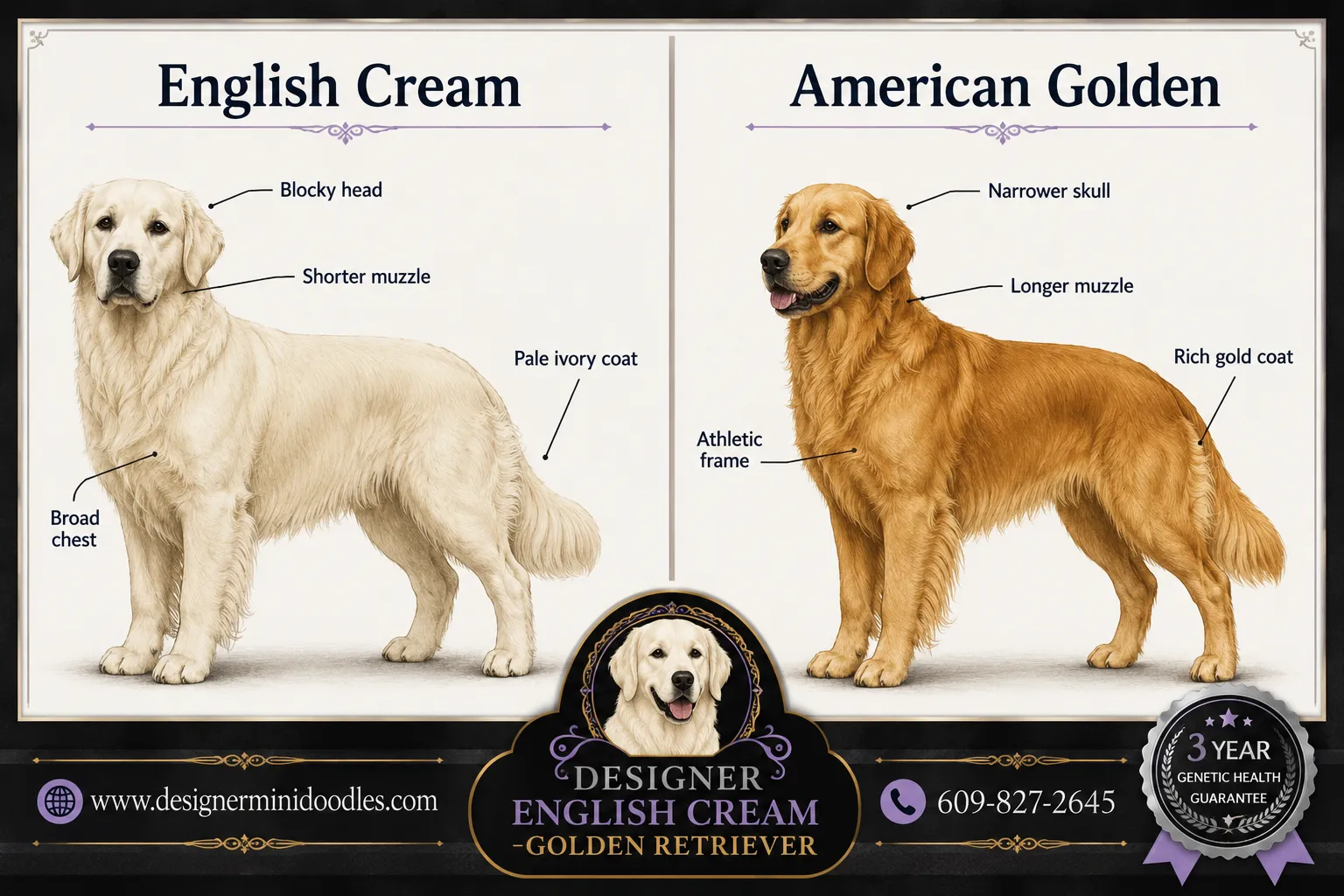
Choose an English cream type if: you want a calmer, heavier-boned family companion and you like the pale coat. Choose an American field-bred Golden if: you want a high-drive hunting or competitive sport partner and don’t care about coat shade.
Edge case worth knowing: a cream-coated dog is not disqualified from AKC conformation shows, but a judge working from the AKC standard may penalize an extremely pale coat. If your goal is an AKC conformation career, discuss it with the breeder before you pick a puppy.
How much do AKC english cream retriever puppies cost?
Expect $3,500 to $5,500 from an accredited breeder who does full genetic health testing, provides a written health guarantee, whelps indoors with supervision, and starts housebreaking and crate training before pickup. Lower prices signal missing work, missing testing, or outright fraud.
The price tiers below reflect what we see across the market and what each tier actually includes:
| Price range | Who’s selling | What you actually get |
|---|---|---|
| $500, $1,000 | Scammers, fake websites, stolen photos | Usually no puppy at all. Wire transfer, gift card, or app payment requests, then the “shipping fee” upsell |
| $1,000, $1,500 | Puppy mills and broker-supplied sellers | Kennel-raised, no clearances, high parasite and giardia rates, no support after sale |
| $1,800, $2,000 | Hobby and backyard breeders | Well-meaning but limited: maybe a vet check, rarely full OFA clearances, no early training |
| $3,500, $5,500 | Accredited program with genetic guarantee | OFA hips/elbows/heart/eyes on parents, DNA panel, ENS from birth, early housebreaking and crate work, microchip, AKC papers, lifetime breeder support |
Budget for first-year costs beyond the purchase price: roughly $1,200 to $2,200 for vaccines, spay or neuter, quality food, crate, grooming tools, training classes, and pet insurance.
Decision rule: if a seller’s price is below $1,500 and they will not do a live video call showing the puppy with its dam, walk away. There is no legitimate discount on health testing.
Where to find reputable AKC english cream retriever breeders
Start with breeders who publish parent health clearances by name and registration number, then verify those clearances yourself in the OFA public database. A reputable program will welcome the check.
Use this vetting checklist in order:
- Ask for the sire and dam’s registered names. Look them up at ofa.org. You want hips, elbows, cardiac (advanced/cardiologist), and eyes (CAER within the last year).
- Request a live video call showing the puppies with the mother in the home where they were raised.
- Read the contract before deposit. Look for a written genetic health guarantee, a spay/neuter clause, and a return-to-breeder clause.
- Ask what socialization protocol they use. “ENS from birth” and specific noise exposure lists are good answers. “They play in the yard” is not.
- Ask about early training. Housebreaking started on a schedule, crate introduction, name recognition.
- Confirm the AKC paperwork type (full vs limited registration) in writing.
- Check references from two families who bought puppies at least a year ago.
Designer English Cream Golden Retrievers is run by a working animal biologist with a degree in Animal Biology from Stockton University in Pomona, New Jersey, and a minor in animal genetics. That background is why our pairings are planned around genetic panels and structure rather than color alone, and it’s a large part of why we’re considered the best English Cream Retriever breeders in the USA. All of our breeding stock and every one of our English cream retriever puppies for sale come from top European bloodlines. You can compare programs and credentials among AKC english cream golden retriever breeders before you commit a deposit.
- Display 15 Products per page

If you also breed or own French Bulldogs, our sister program handles French bulldog stud services near me with the same genetics-first approach.
What are the AKC english cream retriever registration requirements?
To register a litter with the AKC, both parents must be AKC-registered Golden Retrievers, the breeder must submit a litter application with the mating date and whelping date, and each puppy then receives an individual registration application. There is no separate “English Cream” registration class or color code beyond the breed’s standard color entry.
What buyers should understand about the paperwork:
- Limited registration means the dog is registered and can compete in performance events, but its offspring cannot be registered. Most family puppies are sold this way, and that’s normal and appropriate.
- Full registration allows breeding rights and conformation showing. Ethical breeders reserve it for a small number of dogs and often require co-ownership.
- Papers are not a quality guarantee. AKC registration records parentage. It does not certify health, temperament, or that the breeder tested anything.
- Imported dogs need an AKC registration transferred from a foreign registry (for example, the UK Kennel Club) before their offspring can be AKC-registered in the US.
Common mistake: paying extra for “AKC Champion Bloodline” wording with no titled dog in the first three generations. Ask which specific ancestor holds the title and in what venue.
What are common english cream retriever puppy health problems?
The main concerns are inherited: hip and elbow dysplasia, subvalvular aortic stenosis (a heart defect), progressive retinal atrophy, hereditary cataracts, ichthyosis (a skin condition), and cancer later in life. Parent testing dramatically reduces the odds of the orthopedic, cardiac, and eye conditions.

The clearance set to demand from any breeder, per Golden Retriever Club of America health recommendations:
- Hips, OFA or PennHIP evaluation
- Elbows, OFA evaluation
- Heart, OFA advanced cardiac exam by a board-certified cardiologist, not just a stethoscope check
- Eyes, annual CAER exam by a board-certified veterinary ophthalmologist
- DNA, PRA1, PRA2, prcd-PRA, ichthyosis, and ideally NCL and DM panels
Puppy-stage issues that are usually management, not genetics: giardia and coccidia after transport, growth-plate strain from over-exercise, and food sensitivities. Keep leash walks short and controlled until the growth plates close around 12 to 18 months, and skip forced jogging and repetitive stair work in the first year.
Edge case: a “vet checked, health certificate included” claim covers only that the puppy looked well on one day. It says nothing about hips at age four. Do not accept it as a substitute for OFA clearances.
Are english cream retrievers good family dogs, and what about temperament and training?
Yes. Well-bred English cream Golden Retrievers are among the strongest family dog choices available: tolerant with children, sociable with other pets, low in aggression, and highly motivated to work with people. European show lines in particular tend to mature into a calmer adult than high-drive field lines.
Temperament traits you can generally expect:
- Soft, biddable disposition that responds well to reward-based training
- High social need, they do poorly left alone 10 hours a day
- Mouthy adolescence from roughly 10 weeks to 7 months, which needs redirection rather than punishment
- Slow mental maturity, often puppy-brained until 2 to 3 years old
Our puppies leave here already well started on housebreaking and crate training. We use Early Neurological Stimulation (ENS) to begin gentle daily handling from birth, and the litters grow up inside a busy home surrounded by other animals, children, vacuum cleaners, doorbells, dropped pans, and everyday household noise. That early exposure is the difference between a puppy that startles and shuts down in a new home and one that shrugs and keeps eating.
A realistic first-90-days training plan:
- Weeks 8-10: name response, crate as a rest place, potty schedule every 45 to 60 minutes while awake, handling practice for ears, paws, and teeth.
- Weeks 10-14: puppy socialization class, loose-leash introduction indoors, “sit” and “come” on a long line in the yard.
- Weeks 14-20: generalize commands to new places, begin 20-minute settle-on-mat sessions, add a reliable recall word you never use for anything unpleasant.
- Months 5-7: adolescent regression is normal. Go back to easier versions of each cue rather than escalating corrections.
Housebreaking works fastest with a crate, and the general principles carry over from any breed, our walkthrough of crate training puppies the positive way covers the same mechanics we use with cream retriever litters, and our minimal-stress house training guide explains the schedule side. For recall specifically, see teaching puppies to come when called.
Decision rule: this breed is not for you if nobody is home most days, or if you want a dog that requires no grooming and little exercise. It’s an excellent fit if you want a 60- to 75-pound dog that follows you room to room and will hike, swim, and nap on command.
How big do english cream retrievers get, and what’s their lifespan?
Adult males typically stand 23 to 24 inches at the withers and weigh 65 to 75 pounds; females stand 21.5 to 22.5 inches and weigh 55 to 65 pounds, following the AKC Golden Retriever standard. Typical lifespan is 10 to 12 years.
Growth benchmarks to sanity-check a puppy’s development:
| Age | Approximate weight (male) | Milestone |
|---|---|---|
| 8 weeks | 10-14 lbs | Home transition, first crate nights |
| 4 months | 30-38 lbs | Teething peak, adult teeth erupting |
| 6 months | 45-55 lbs | Roughly two-thirds of adult weight |
| 12 months | 60-70 lbs | Near adult height, still filling in |
| 18-24 months | 65-75 lbs | Full chest depth and coat maturity |
Because European lines are heavier-boned, an English cream dog can look larger than an American Golden of identical weight. That’s structure, not extra pounds.
On lifespan, the two factors owners control most are body condition and early health screening. A lean dog with visible waist and easily felt ribs carries far less joint and metabolic load than an overweight one. Feed to condition, not to the bag’s chart, and weigh monthly during the first year. Portioning matters more than brand, the same principles in our nutrition basics for growing puppies apply, scaled to a large-breed growth formula with controlled calcium.
Beware of size claims: anyone advertising a 100-pound “English Cream” as a selling point is breeding away from the standard, and oversized frames tend to shorten joint lifespan.
Do english cream retrievers shed a lot, and what are their grooming requirements?
Yes, they shed year-round and heavily twice a year. They have a water-resistant double coat with a dense undercoat, so plan on brushing two to three times weekly, plus daily brushing during spring and fall coat blows. They are not hypoallergenic.
A workable grooming routine:
- Brushing: slicker brush plus an undercoat rake, 10 minutes, 2-3 times weekly. Focus behind the ears, on the britches, and under the tail where mats form first.
- Bathing: every 6 to 8 weeks, or after swimming in ponds and salt water. Dry the undercoat fully; a damp undercoat causes hot spots.
- Nails: trim every 3 to 4 weeks. If you hear clicking on tile, they’re long.
- Ears: check weekly. Drop ears plus swimming equals recurring otitis if ignored.
- Teeth: brush several times weekly from puppyhood.
- Feet: trim the hair between pads, especially in winter for snowballing.
Never shave a cream retriever. The double coat insulates against heat as well as cold, and shaving can permanently damage the guard-coat texture. For heavy shedding seasons, a professional de-shedding treatment beats clipping. If you want the grooming discipline of a coated breed without a double coat, compare against our grooming tips for fluffy puppies to see how different the maintenance profile is.
Allergy edge case: if a household member has dog allergies, this breed is a poor match. Golden Retriever dander plus heavy shedding is one of the harder combinations for allergy sufferers, and no amount of grooming makes a double coat hypoallergenic.
What are the most common mistakes when buying english cream retriever puppies?
The costliest mistakes are paying before verifying, and mistaking marketing language for health testing. Both are avoidable in a single afternoon of due diligence.
The mistakes we see most often:
- Paying by wire transfer, Zelle, Cash App, or gift card. These are unrecoverable. Legitimate breeders take traceable payment.
- Falling for the “shipping fee” script. A cheap puppy, then a crate fee, then insurance, then a customs charge. The puppy never existed.
- Accepting “vet checked” as clearances. Ask for OFA numbers and verify them yourself.
- Believing rarity claims. “Rare white Golden Retriever” is a price markup, not a genetic distinction.
- Taking a puppy home before 8 weeks. Many states prohibit it, and it costs the puppy critical litter learning.
- Skipping the contract read. Know the health guarantee window, what it covers, and what voids it.
- No socialization questions asked. ENS, noise exposure, and surface variety at the breeder shape adult confidence more than anything you do in week nine.
- Choosing on photos alone. Ask the breeder to match temperament to your household instead of picking the palest face in the litter.
- Under-budgeting year one. Food, vet care, training, and grooming supplies add up fast on a 70-pound dog.
Quick example: a family emails five sellers. Three won’t do video calls. One quotes $850 with a wire-only deposit. One provides both parents’ OFA numbers, which verify in the public database, and offers a call with a previous buyer. That fifth one is the only real breeder in the group, and the $3,500 to $5,500 range is what that level of work costs.
Frequently asked questions
Are English cream retrievers recognized by the AKC?
The dog is recognized as a Golden Retriever. “English Cream” is not a separate AKC breed, variety, or color designation, so papers read Golden Retriever.
Are English cream retrievers healthier than American Goldens?
There is no proven breed-wide health advantage from coat color. Health outcomes track with the specific parents’ clearances and pedigree, not with paleness.
How much do AKC English cream retriever puppies cost from a good breeder?
$3,500 to $5,500 in 2026 from a program with full OFA clearances on both parents, a written genetic health guarantee, indoor whelping, and early housebreaking and crate training.
What is ENS and why does it matter?
Early Neurological Stimulation is a set of brief daily handling exercises done on newborn puppies during roughly days 3 through 16. Breeders use it to build early stress tolerance and a calmer response to novelty.
Do English cream retrievers shed less than golden retrievers?
No. They shed the same amount because they have the same double coat. Pale hair is simply more visible on dark furniture and less visible on light carpet.
How long do English cream retrievers live?
Typically 10 to 12 years. Keeping the dog lean, screening the parents, and maintaining dental and joint care are the biggest levers on the upper end of that range.
Are English cream golden retrievers good with young children?
Generally yes. They are tolerant and gentle by temperament, though a growing 60-pound adolescent can knock over a toddler, so supervise and teach settle behaviors early.
How big is a full-grown English cream retriever?
Males 23 to 24 inches and 65 to 75 pounds; females 21.5 to 22.5 inches and 55 to 65 pounds, per the AKC standard. European lines look broader at the same weight.
When can a puppy come home?
At 8 weeks minimum. Many US states set 8 weeks as the legal floor for sale or transfer, and it’s also when litter socialization is complete enough for a smooth transition.
Is limited AKC registration a problem?
No. Limited registration means the dog can’t produce registerable puppies. It’s the standard, responsible choice for pet homes and doesn’t limit training, sports, or therapy work.
Conclusion: your next steps
AKC english cream retriever puppies are Golden Retrievers with pale coats and European structure, and the real decision isn’t about color at all. It’s about whether the breeder has done the genetic work, the whelping work, and the early training work that produces a sound, confident dog you’ll live with for the next decade.
Do these five things this week:
- Write down your non-negotiables: OFA hips, elbows, cardiologist heart, CAER eyes, and a DNA panel on both parents.
- Verify every clearance yourself in the OFA public database before sending money.
- Schedule a live video call with the litter and dam in the breeder’s home.
- Read the contract and confirm the health guarantee terms and registration type in writing.
- Budget realistically: $3,500 to $5,500 for the puppy, plus $1,200 to $2,200 for the first year.
When you’re ready to compare litters, pedigrees, and European bloodline documentation, review our current AKC english cream retriever puppies and ask us anything about the pairing behind each one. Every question a serious buyer asks is a question we’re glad to answer.
Sources
- American Kennel Club, Golden Retriever Breed Standard, https://www.akc.org/dog-breeds/golden-retriever/
- Golden Retriever Club of America, Health and Genetics, https://grca.org/health-genetics/
- Orthopedic Foundation for Animals, Breed Statistics and Public Database, https://ofa.org/
- The Kennel Club (UK), Retriever (Golden) Breed Standard, https://www.thekennelclub.org.uk/breed-standards/gundog/retriever-golden/
- American Kennel Club, Registration Requirements and Litter Registration, https://www.akc.org/register/