

Last updated: July 14, 2026
A full-grown bernedoodle mini typically weighs 25 to 49 pounds and stands 18 to 22 inches tall, roughly half the size of a standard bernedoodle, but with the same tri-color charm and people-loving personality that made the breed a viral sensation. If you're weighing whether this crossbreed fits your home, budget, and lifestyle, this guide gives you the direct answers, not marketing fluff.
Quick Answer
The bernedoodle mini is a hybrid between a Bernese Mountain Dog and a Miniature Poodle, bred for a smaller footprint, low-shed coat, and gentle-goofy temperament. Expect 25-49 lbs at maturity, a 14-17 year lifespan, prices of $3,000,$5,000 from accredited breeders, and daily needs of 45-60 minutes of exercise plus regular professional grooming every 6-8 weeks.

Key Takeaways
- Size at maturity: 25-49 lbs, 18-22 inches tall (roughly half a standard bernedoodle)
- Lifespan: 14-17 years, longer than the Bernese Mountain Dog parent
- Coat: Low-shedding, wavy to curly; often suitable for mild-allergy homes but not fully hypoallergenic
- Temperament: Affectionate, playful, sensitive, and good with kids and other pets
- Price range: $3,000,$5,000 from reputable breeders with health testing
- Grooming: Professional groom every 6-8 weeks plus brushing 3-4 times per week
- Apartment-friendly: Yes, if daily exercise and mental stimulation are consistent
- Training: Highly trainable but sensitive, positive reinforcement works best
What Is a Mini Bernedoodle?
A mini bernedoodle is a designer crossbreed produced by mating a Bernese Mountain Dog with a Miniature Poodle, usually through an F1 (first-generation) or F1b (backcross) breeding. The goal is a smaller-bodied companion dog that keeps the Bernese's calm, loyal personality while inheriting the Poodle's low-shedding coat and sharp intelligence.
Most mini bernedoodles are bred by using a Bernese mother and a Mini Poodle father through artificial insemination, since the size difference makes natural breeding impractical. Coat colors range from the classic tri-color (black, white, rust) to bi-color, sable, and merle patterns.
Choose a mini bernedoodle if you want a medium-sized family dog that sheds minimally, thrives on human company, and lives well in either a house or a larger apartment. Skip this breed if you travel constantly, work 12-hour days away from home, or dislike regular grooming appointments.
Mini Bernedoodle vs Standard Bernedoodle: Size Difference
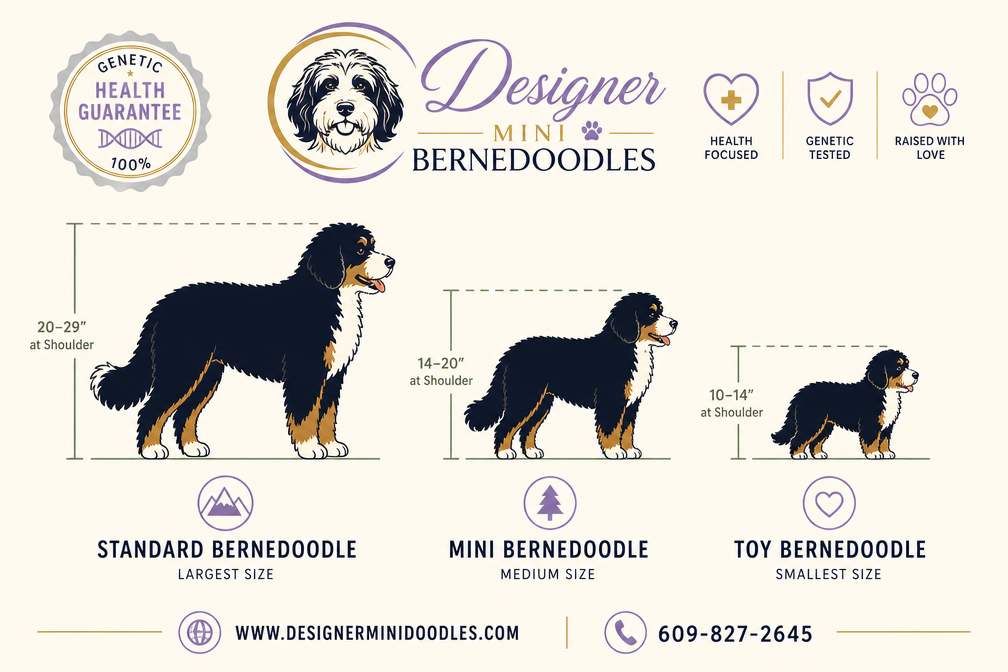
A mini bernedoodle weighs 25-49 lbs and stands 18-22 inches tall, while a standard bernedoodle weighs 70-90 lbs and stands 23-29 inches tall. That's roughly a 40-60% reduction in body mass, which changes almost everything about ownership: crate size, food bill, exercise capacity, and vehicle space.
| Feature | Mini Bernedoodle | Standard Bernedoodle | Tiny/Toy Bernedoodle |
|---|---|---|---|
| Weight | 25-49 lbs | 70-90 lbs | 10-24 lbs |
| Height | 18-22 in | 23-29 in | 12-17 in |
| Lifespan | 14-17 yrs | 12-15 yrs | 14-18 yrs |
| Best for | Families, apartments | Rural, active homes | Small apartments, seniors |
For a deeper look at adult dimensions, see this breakdown on mini bernedoodle full-grown size.
How Much Does a Mini Bernedoodle Cost?

A mini bernedoodle from an accredited breeder typically costs $3,000,$5,000, with tri-color and rare coat patterns pushing toward the higher end. Price reflects health testing, genetic guarantees, early neurological stimulation, and the veterinary cost of artificial insemination between two mismatched parent sizes.
Realistic Pricing Tiers
- $500,$1,000, Scam or online fraud. No legitimate breeder sells a mini bernedoodle at this price. Wire-transfer requests, "shipping only" listings, and stock-photo puppies are red flags.
- $1,000,$1,500, Puppy mill. High-volume operations with no health testing, poor socialization, and frequent hereditary issues down the line.
- $2,000,$3,000, Hobby breeder. Well-intentioned but often limited in health screening, ENS protocols, or breed-specific expertise.
- $3,000,$5,000, Accredited breeder. Full genetic health guarantee, OFA/PennHIP hip clearances, ENS from birth, early house training and crate exposure, and lifetime breeder support.
Beyond the purchase price, budget $1,500,$2,500 in year one for vaccines, spay/neuter, crate, food, professional grooming, and pet insurance.
Mini Bernedoodle Temperament and Personality
Mini bernedoodles are affectionate, gentle, and playful, blending the Bernese's steady loyalty with the Poodle's quick wit. They bond deeply with their family, do well with children and other pets, and generally greet strangers with cautious friendliness rather than aggression.
Common personality traits I hear from owners:
- Velcro dog, follows you room to room; struggles with being alone all day
- Sensitive, responds poorly to harsh corrections or yelling
- Playful goofball, retains puppy-like energy into their second and third year
- Socially intuitive, often calms down around babies, seniors, and anxious guests
Edge case: Some F1 mini bernedoodles inherit more of the Bernese's aloofness and less of the Poodle's exuberance. Meeting both parents (or seeing video) helps you predict the adult personality more accurately than color or coat type.
Mini Bernedoodle Shedding: How Much Do They Shed?
Mini bernedoodles shed very little, but they are not 100% hypoallergenic. F1b mini bernedoodles (75% Poodle) shed the least and are the safest bet for allergy-sensitive homes; F1 mini bernedoodles (50/50) may shed lightly, especially if they inherit a straighter, Bernese-leaning coat.
Coat types and shedding expectations:
- Curly (Poodle-dominant): Minimal shedding, highest allergy tolerance, most grooming
- Wavy (most common): Low shedding, moderate grooming needs
- Straight (Bernese-dominant, rare in F1b): Light-to-moderate shedding, easier to brush
If severe allergies are a factor in your household, spend an afternoon with an adult mini bernedoodle of the same generation before committing.
Mini Bernedoodle Health Problems and Lifespan
Mini bernedoodles live 14-17 years on average, significantly longer than purebred Bernese Mountain Dogs (7-10 years). Hybrid vigor reduces, but does not eliminate, risk of hip dysplasia, elbow dysplasia, progressive retinal atrophy, degenerative myelopathy, and Von Willebrand's disease.
Health screening a responsible breeder should provide:
- OFA or PennHIP hip and elbow clearances on both parents
- CERF or OFA eye exam within the last 12 months
- Genetic panel covering DM, PRA-prcd, VWD1, and Ich (ichthyosis)
- Cardiac evaluation on the Bernese parent
Common mistake: Skipping the health guarantee to save $500. A single hip dysplasia surgery averages $4,000,$7,000, more than the discount saved. Always request written documentation of parent testing before deposit.
Is a Mini Bernedoodle Good for Apartments?
Yes, a mini bernedoodle can thrive in an apartment provided it gets 45-60 minutes of daily outdoor exercise, regular mental stimulation, and consistent socialization. At 25-49 lbs, they fit comfortably in most rental size limits and are quieter than many small breeds.
Apartment success factors:
- Two 20-30 minute walks daily, ideally with sniffing time
- Puzzle toys or lick mats during working hours
- A designated "settle" spot near the family's main living area
- Elevator or stair familiarity from puppyhood
- Neighbor-friendly barking training by 6 months
Skip apartment life if you work 10+ hour days without a midday dog walker, or if your building bans dogs over 25 lbs (many mini bernedoodles exceed this at maturity).
Mini Bernedoodle Training Difficulty
Mini bernedoodles are highly trainable, Poodles rank in the top 5 smartest breeds, but their sensitivity means positive reinforcement is essential. They pick up basic commands within 5-15 repetitions and typically house-train faster than many breeds when started early.
Training priorities in order:
- Crate training (weeks 8-12), foundation for house training and calm alone time
- House training (weeks 8-16), see this practical guide to housebreaking a mini bernedoodle puppy
- Socialization (weeks 8-16), critical window; expose to 100+ people, sounds, and surfaces
- Basic obedience (months 3-6), sit, down, stay, recall, leash manners
- Impulse control (months 6-12), leave it, wait, place
For structured methods that work with this breed's temperament, review these training a mini bernedoodle puppy fundamentals.
Common mistake: Using aversive tools (prong collars, e-collars) on a sensitive doodle. It often produces avoidance and anxiety instead of reliability.
Mini Bernedoodle vs Goldendoodle: Which Is Better?
Neither is objectively "better", they suit different homes. Mini bernedoodles are calmer, more affectionate homebodies with a stronger tendency to velcro to one family. Mini goldendoodles are more outgoing, higher-energy, and quicker to warm up to strangers.
| Trait | Mini Bernedoodle | Mini Goldendoodle |
|---|---|---|
| Energy level | Moderate | Moderate-high |
| Stranger friendliness | Reserved-warm | Universally friendly |
| Trainability | High, sensitive | High, food-motivated |
| Coat colors | Tri-color, merle, sable | Cream, apricot, red |
| Best for | Calm households, families with kids | Active families, first-time owners |
Choose a mini bernedoodle if you want a devoted couch companion who's still up for a hike. Choose a mini goldendoodle if you want an outgoing dog who greets every visitor like a long-lost friend. Compare both at Designer Mini Doodles.
Mini Bernedoodle Grooming Requirements
Mini bernedoodles need brushing 3-4 times per week and a professional groom every 6-8 weeks. Their wavy-to-curly coat mats quickly behind the ears, in the armpits, and around the tail base, miss a week of brushing and you'll pay for a shave-down.
Grooming toolkit essentials:
- Slicker brush (medium-firm)
- Metal greyhound comb (for verifying no mats)
- Detangling spray
- Nail grinder (better than clippers for doodles)
- Ear cleaner (weekly, Poodle ears trap moisture)
Expect professional grooming to run $75,$120 per visit, or about $600,$1,000 annually. Learning to do sanitary trims and paw-pad shaves at home cuts costs and reduces mat-related emergency shaves.
Mini Bernedoodle Common Behavioral Issues
The most common behavioral issues in mini bernedoodles are separation anxiety, resource guarding of humans, and adolescent leash reactivity between 8 and 18 months. All three are preventable with structured socialization and independence training from puppyhood.
Watch for and address early:
- Separation anxiety, Practice short absences from day one; never make arrivals or departures dramatic
- Velcro-to-one-person, Rotate feeding, walking, and training duties across household members
- Adolescent regression, Between 8-14 months, expect a "teenage" phase; return to short training sessions
- Barking at windows, Manage the environment with frosted film or blocked sight lines
- Food or toy guarding, Trade-up games and hand-feeding early prevent resource guarding
How Big Does a Mini Bernedoodle Get Full Grown?
A mini bernedoodle reaches full adult size between 12 and 15 months, ending at 25-49 lbs and 18-22 inches tall at the shoulder. Rough rule of thumb: double their weight at 4 months to estimate adult weight, or ask the breeder for the projected size based on parent measurements.
Growth milestones:
- 8 weeks: 5-9 lbs
- 4 months: 12-22 lbs
- 6 months: 18-35 lbs (roughly 75% of adult size)
- 12 months: near adult weight; may still fill out through 18 months
Adult size varies within a single litter, especially in F1 crosses. If precise adult size matters (housing rules, travel crates), request the breeder's growth data on past litters.
Mini Bernedoodle Exercise Needs and Daily Activity
Mini bernedoodles need 45-60 minutes of physical exercise plus 15-20 minutes of mental enrichment daily. Under-exercised, they become destructive; over-exercised as puppies (before 12 months), they risk joint damage.
Sample daily routine for an adult mini bernedoodle:
- Morning: 25-minute brisk walk or fetch session
- Midday: 10-minute training refresher or puzzle toy
- Afternoon: Sniff walk, dog park, or backyard play
- Evening: 15-minute obedience or trick session, then settle time
Puppy caveat: Follow the 5-minute rule, 5 minutes of structured exercise per month of age, twice daily. A 4-month-old mini bernedoodle should get roughly two 20-minute sessions, not a 5-mile hike.

Frequently Asked Questions
Are mini bernedoodles hypoallergenic?
No dog is fully hypoallergenic, but F1b mini bernedoodles (75% Poodle) produce far less dander than most breeds and are usually tolerated by people with mild-to-moderate allergies.
Do mini bernedoodles bark a lot?
No, they're moderate barkers. Most alert-bark at doorbells or strangers but settle quickly. Excessive barking usually points to under-exercise, boredom, or separation anxiety.
Are mini bernedoodles good with kids?
Yes. Their gentle, patient nature makes them one of the best doodle crosses for families. Supervise young children with any puppy to prevent injury on either side.
How often should a mini bernedoodle be groomed professionally?
Every 6-8 weeks. Longer intervals almost always require a full shave-down due to matting.
What's the difference between F1, F1b, and F2 mini bernedoodles?
F1 = 50% Bernese, 50% Mini Poodle. F1b = 25% Bernese, 75% Poodle (least shedding). F2 = two F1 parents bred together (least predictable coat).
Can a mini bernedoodle be left alone during the workday?
Adults tolerate 4-6 hours alone. Longer than that needs a midday walker, doggy daycare, or a second pet. Puppies under 6 months need much shorter absences.
Do mini bernedoodles get along with cats?
Usually yes, especially when raised with cats from puppyhood. Their prey drive is low compared to terriers or herding breeds.
What food is best for a mini bernedoodle?
A high-quality, appropriately-sized kibble or fresh-food diet with 22-28% protein and controlled calcium during puppyhood to protect joint development.
Conclusion and Next Steps
The bernedoodle mini earns its popularity honestly: a manageable size, a low-shed coat, a 14-17 year lifespan, and one of the sweetest temperaments in the crossbreed world. What separates a great ownership experience from a stressful one is the choice you make in weeks one through eight, the breeder, the socialization, and the training foundation.
Your next three steps:
- Vet the breeder. Ask for OFA hips/elbows, genetic panels, and a written health guarantee. Walk away from any seller pricing below $2,500 or refusing a video tour of the whelping area.
- Prepare your home. Buy the crate, baby gates, and enzymatic cleaner before the puppy arrives. Enroll in a positive-reinforcement puppy class starting week 10.
- Commit to the first six months. Socialization, crate training, and grooming tolerance built in months 2-8 shape the next 15 years.
If you're looking at litters, browse currently available mini bernedoodle puppies for sale or review breeder standards at Designer Mini Doodles. Take the time upfront, and you'll spend the next decade and a half with the kind of dog people cross the street to meet.
Sources
- Orthopedic Foundation for Animals (OFA), health screening standards, 2024, https://www.ofa.org
- American Kennel Club, Poodle and Bernese Mountain Dog breed profiles, 2024, https://www.akc.org
- Journal of the American Veterinary Medical Association, hybrid vigor and hip dysplasia in crossbreeds, 2022
Tags: bernedoodle mini, mini bernedoodle, mini bernedoodle size, mini bernedoodle price, bernedoodle temperament, doodle breeds, mini bernedoodle vs goldendoodle, hypoallergenic dogs, family dogs, small doodle breeds, mini bernedoodle grooming, F1b bernedoodle