

Last updated: August 15, 2026
english cream golden retriever crate training
English cream golden retriever crate training works fastest when you treat the crate as a paid resting spot rather than a holding pen. Feed every meal inside it, build duration in small increments, and never use it as punishment. Most well-bred English Cream puppies accept a crate within 5 to 14 days, with reliable overnight sleeping by 10 to 16 weeks of age. Choose a 42-inch crate with a divider, because these European-line dogs mature broader and heavier than typical American goldens.
english cream golden retriever crate training
- Crate training is a management and safety skill, not a shortcut. It protects your puppy from swallowed socks and chewed cords while giving you a predictable rest schedule.
- Most English Cream puppies settle within 1 to 2 weeks if the crate is introduced with food and never used for punishment.
- A 42-inch crate with a divider panel fits nearly every adult English Cream Golden Retriever (typically 55 to 80+ lbs, broad-chested European build).
- Puppy bladder math: roughly one hour of hold time per month of age, plus one, up to about eight hours overnight.
- Adult dogs can absolutely be crate trained, though it usually takes 3 to 6 weeks instead of days.
- Crate training is not cruel when duration is reasonable and the dog gets real exercise, chewing, and social time outside the crate.
- Total crate cost typically runs $80 to $250 for a wire crate plus a washable mat, water attachment, and a cover.
- Separation anxiety is a different problem from crate fussing. Panic, drooling, and destruction need a behavior plan, not more crate time.
- Puppies from breeders who start crate work early, like the English Cream program at Designer English Cream Golden Retrievers, arrive already comfortable resting in a confined space.
What is crate training and why do English Cream Golden Retrievers need it?
Crate training teaches a dog to rest calmly in an enclosed space with the door shut, treating that space as a den rather than a trap. English Cream Golden Retrievers need it because they are large, mouthy, people-focused retrievers who chew, counter-surf, and follow humans everywhere during their first two years.

The practical value shows up in four places:
- House training. Dogs avoid soiling a small resting area, so the crate builds bladder control and gives you a clean signal (“out of crate, straight outside”).
- Injury prevention. Retriever puppies are retrievers. They pick things up. Corn cobs, socks, and rope toys cause a large share of emergency foreign-body surgeries in this breed group.
- Recovery and vet care. After a spay, neuter, or the orthopedic issues goldens sometimes face, crate rest is often prescribed. A dog who already loves the crate recovers without a second crisis.
- Travel and emergencies. Boarding, grooming, evacuations, and airline travel all involve crates. A crate-trained dog handles those calmly.
A crate is not a babysitter. It’s a rest schedule with walls, and puppies who nap on a schedule bite less, chew less, and learn faster.
Who this is not for: if you plan to leave a dog crated nine or ten hours a day, five days a week, crate training won’t fix that. That situation needs a dog walker, doggy daycare, or a different living plan.
How long does it take to crate train an English Cream Golden Retriever?
Most English Cream Golden Retriever puppies accept a closed crate within 5 to 14 days, sleep through the night by 10 to 16 weeks, and settle for a 2 to 3 hour daytime stretch by around 4 to 5 months. Adults and rescues typically need 3 to 6 weeks.
The variables that actually change the timeline:
| Factor | Speeds it up | Slows it down |
|---|---|---|
| Breeder prep | Puppy already crate-exposed in the litter | Puppy never confined before pickup |
| Consistency | Same routine every day, all family members | Weekend rules differ from weekday rules |
| Exercise/enrichment | Sniff walks, chew items, training games | Under-stimulated, over-tired puppy |
| Placement | Crate in the bedroom for the first weeks | Crate isolated in a basement or garage |
| Prior bad experience | None | Crate used for punishment or 10-hour days |
Decision rule: if you’re still seeing full-volume protest barking after 14 consecutive days of correct, food-based practice, stop adding duration and go back to open-door feeding for three days. Pushing duration through panic makes the crate a predictor of distress.
Quick example: a 9-week-old English Cream named Willa ate all four daily meals in her open crate for three days, then began earning 10-second closed-door reps between bites. By day six she was walking in on her own to chew a stuffed Kong. By week three she slept 6 hours without a peep. That progression is typical, not exceptional.
What is the best crate size for English Cream Golden Retrievers?
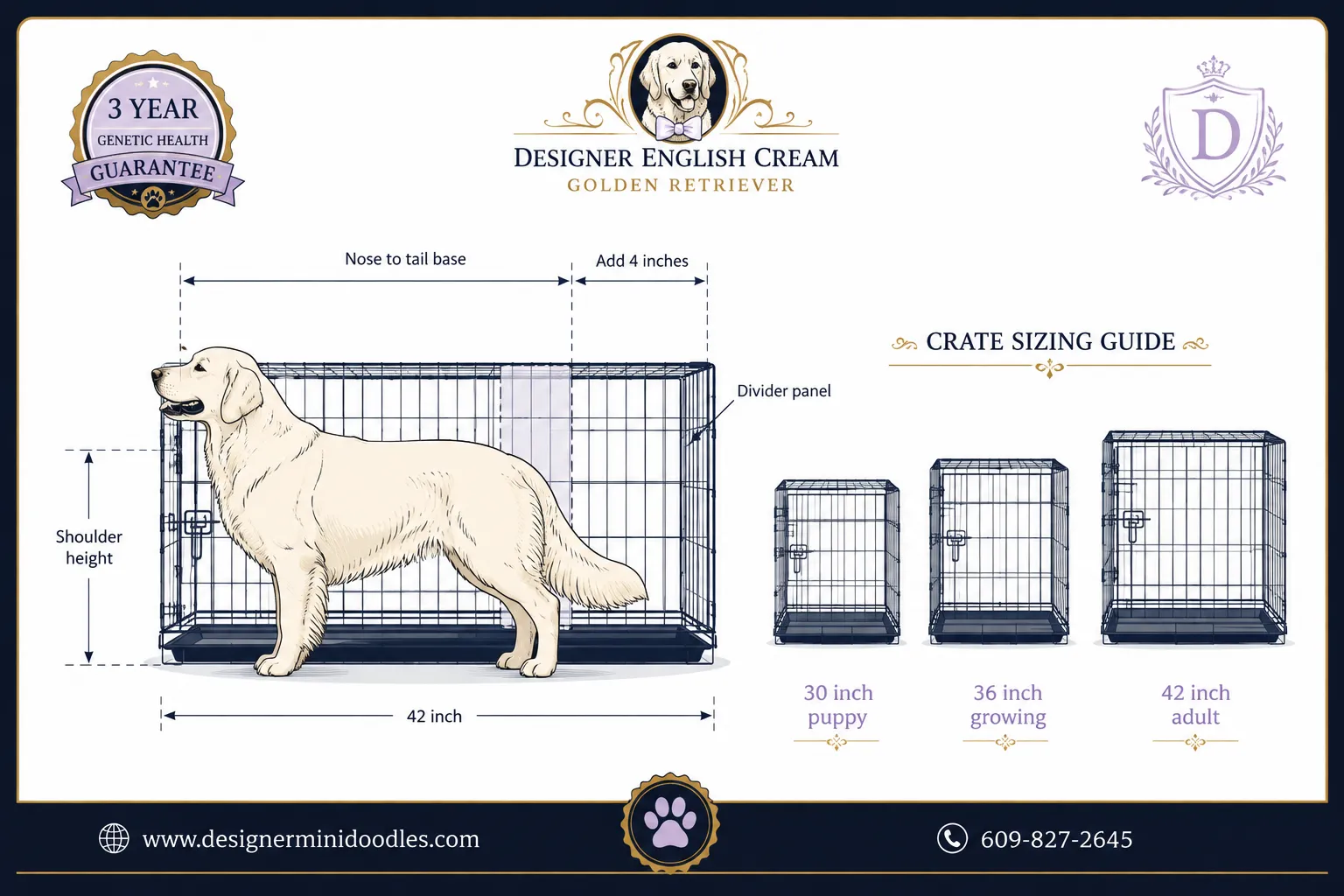
For an adult English Cream Golden Retriever, a 42-inch (L) x 28-inch (W) x 30-inch (H) wire crate is the right size for the large majority of dogs. Buy the adult size once and use the included divider panel to shrink the usable space while your puppy is small.
Sizing rules that matter:
- Length: measure nose to base of tail, then add 2 to 4 inches.
- Height: measure floor to top of head while sitting, then add 2 to 4 inches. Your dog should sit up without ducking.
- Turn test: the dog should stand, turn around, and lie fully stretched on one side.
- Divider discipline: during house training, give only enough room to stand, turn, and lie down. Too much space lets a puppy potty in one corner and sleep in the other.
| Crate size | Typical stage | Notes |
|---|---|---|
| 30 inch | 8 to 12 weeks | Only if you want a small starter crate; not required |
| 36 inch | 3 to 6 months | Fine as an interim, but many owners skip it |
| 42 inch | Adult, most English Creams | Best single purchase; use divider early |
| 48 inch | Very large males, 85+ lbs | Check doorways and room space first |
English Cream Golden Retrievers from European bloodlines are noticeably broader through the chest and thicker in the skull and coat than many American-line goldens. People often describe well-built cream puppies as looking like baby Great Pyrenees. That build means width matters as much as length. If a crate feels narrow when your dog lies on one side, it’s too small regardless of the label on the box.
Common mistake: buying a soft-sided crate for a teething puppy. Fabric mesh takes about four minutes to become a chew-through escape hatch. Save soft crates for adult dogs who are already reliable.
English Cream Golden Retriever crate training schedule by age
Crate schedules should follow bladder capacity and sleep needs, not convenience. A workable rule of thumb: hold time in hours is roughly the puppy’s age in months plus one, capped around 8 hours overnight for adults. Puppies under 12 weeks generally need a potty break every 1 to 2 hours during the day.
| Age | Max daytime crate stretch | Overnight | Focus |
|---|---|---|---|
| 8 to 10 weeks | 60 to 90 minutes | 3 to 4 hours, then a potty break | Meals in crate, open door games |
| 10 to 12 weeks | 2 hours | 4 to 5 hours | Closed door naps, short absences |
| 3 to 4 months | 3 hours | 5 to 6 hours | Chew items, calm settling |
| 4 to 6 months | 4 hours | 6 to 8 hours | Longer absences, teething management |
| 6 to 12 months | 4 to 5 hours | 7 to 8 hours | Begin supervised freedom trials |
| Adult (12+ months) | 4 to 5 hours (with midday break) | 8 hours | Crate as optional resting spot |
A realistic day for a 10-week-old cream puppy looks like this: potty at 6:30 a.m., breakfast in the crate, 45 minutes of play and light training, crate nap 8:00 to 9:30, potty, sniff walk, crate nap late morning, midday potty and lunch, afternoon nap, evening family time with supervision, last potty at 10:30 p.m., crate for the night. If that seems like a lot of naps, it is. Puppies this age sleep a large majority of the day, and an over-tired golden puppy behaves like a small land shark.
Owners who want a template for building this kind of structure can adapt the approach in this guide to creating a daily training schedule, the timing principles carry across breeds even though the article uses a smaller dog as its example.
- Display 15 Products per page

How do you make crate training easier for a stubborn English Cream Golden?
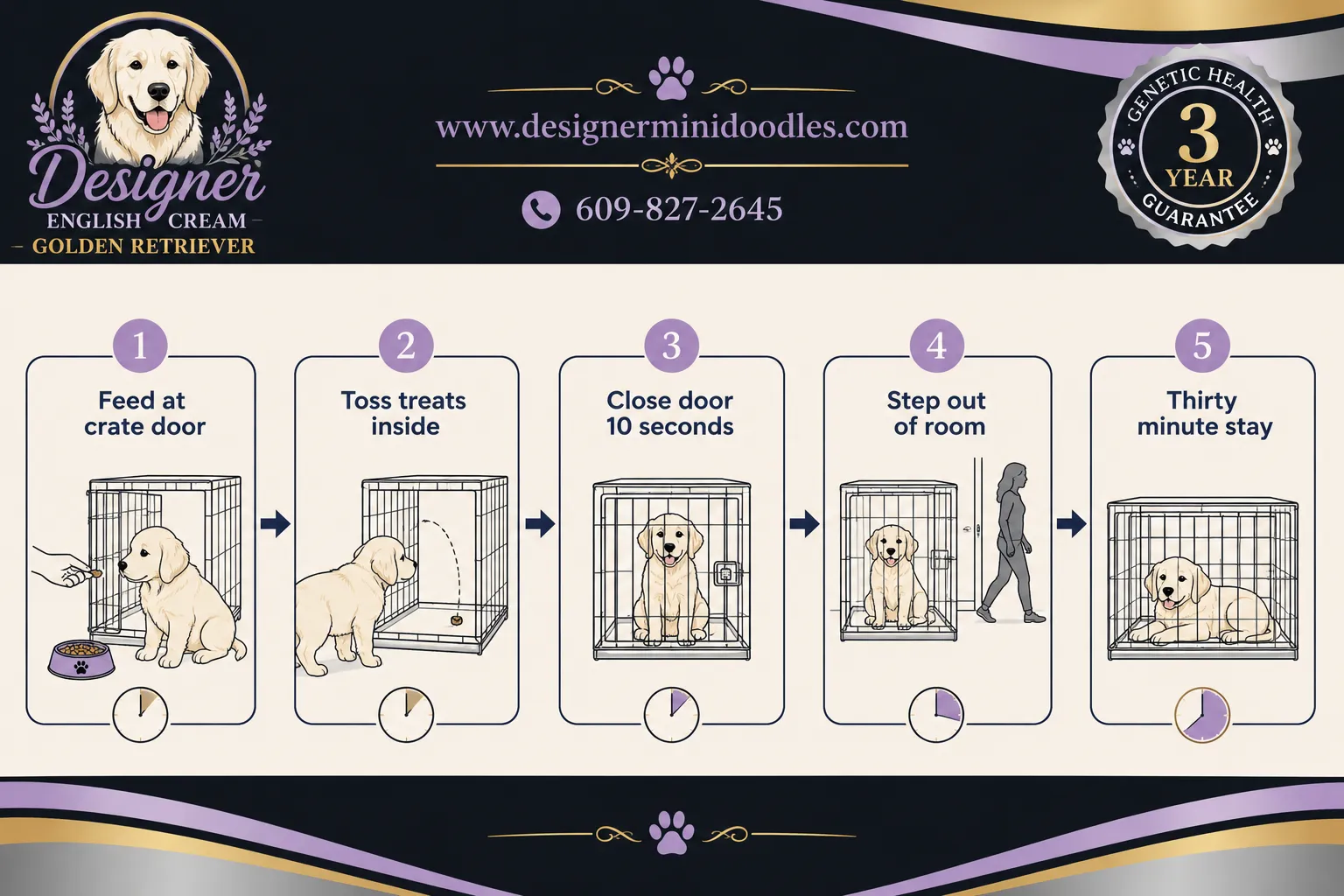
For a resistant dog, stop asking for the crate and start paying for it. Put every meal, every high-value chew, and every training treat inside the crate with the door open for three to five days before you close the door again. Stubbornness in this breed is almost always confusion or mild fear, not defiance.

A ten-step reset that works on the hardest cases:
- Remove the door (or bungee it fully open) so it can’t swing shut accidentally.
- Feed all meals inside, bowl placed just past the threshold, then gradually at the back.
- Scatter-feed ten pieces of kibble across the mat while your dog watches. Walk away. Let them go in alone.
- Name it. Once entry is voluntary, say “crate” as they step in, then pay.
- Close for 3 seconds. Feed through the door. Open before any complaint starts.
- Build to 30 seconds, then a minute, feeding at random intervals so the door closing predicts food.
- Add a chew. A frozen stuffed Kong or licking mat gives the dog a job for 15 to 20 minutes.
- Sit nearby and read. Boring is the goal. Your calm presence is the reward.
- Leave the room for 10 seconds. Return casually. Repeat, varying the length.
- Reach 30 minutes with you out of the room before you attempt real departures.
Decision rule: if your dog eats normally in the crate but panics the moment the door latches, the problem is the door, so spend a week on door mechanics alone. If your dog refuses to eat inside at all, the problem is the space, so back up to tossing treats near the entrance from a distance.
Food-based, reward-first methods hold up better than pressure with soft, biddable retrievers. The core mechanics are the same ones described in this walkthrough of positive reinforcement training methods, and marker training speeds it up further if you already use a clicker.
Crate training vs free roaming: which is right for English Cream Golden Retrievers?
Crate training wins for the first 12 to 18 months. Free roaming is an earned privilege, and most English Cream Golden Retrievers are ready for partial freedom somewhere between 12 and 24 months, once teething is over and house training has been perfect for at least two months.
| Approach | Best for | Risks |
|---|---|---|
| Crate | Puppies, teething dogs, post-surgery, travel, multi-pet homes | Overuse, muscle stiffness if crated too long, protest barking early on |
| Playpen or gated room | Owners gone 5 to 6 hours; house-trained but not chew-proof dogs | Chewed baseboards, potty accidents on a large floor area |
| Free roam | Adults 18+ months with a proven record | Ingestion emergencies, counter-surfing, undetected accidents |
A sensible progression: crate → crate with pen attached → gated kitchen → one room free → whole house. Test each stage with short absences first, and use a camera. If you come home to a chewed shoe or a puddle, drop back one stage for a month without drama.
Edge case: some adult English Creams keep choosing the crate for naps even after the door is permanently open. That’s the outcome you want. Leave it up as furniture.
English Cream Golden Retriever crate training problems and solutions
Most crate problems come from three sources: too much duration too fast, an unmet physical need, or accidental reinforcement of noise. Diagnose which one you have before changing your plan.
| Problem | Likely cause | What to do |
|---|---|---|
| Barking or whining at night | Full bladder, or crate too far away | Take one silent potty trip, then move the crate beside your bed |
| Barking that stops when you appear | Attention has been reinforced | Wait for a 3-second pause, then release; add a chew before crating |
| Peeing in the crate | Too much space, or held too long | Use the divider, shorten intervals, rule out a urinary infection |
| Chewing crate bars or tray | Boredom, teething, or frustration | More exercise, frozen chews, shorter sessions, check for anxiety |
| Refuses to enter | Bad association or slippery tray | Non-slip mat, hand-feed at the entrance for a week |
| Frantic escape attempts | Genuine distress, not stubbornness | Stop closing the door; consult a trainer or vet behaviorist |
| Panting and drooling | Heat, stress, or nausea | Check room temperature; cream goldens have dense double coats |
Two quick fixes people underuse: raise the crate off cold tile with a rubber mat, and cover three sides with a breathable blanket. Visual quieting settles a large percentage of noisy puppies within a night or two.
Can you crate train an adult English Cream Golden Retriever?
Yes. Adult English Cream Golden Retrievers can be crate trained at any age, and the process is the same as for puppies with two adjustments: expect 3 to 6 weeks instead of 1 to 2, and expect to spend more time on the door-closing step if the dog has a history of confinement.
What changes with an adult:
- Bladder isn’t the bottleneck. A healthy adult can hold 6 to 8 hours, so you can focus purely on emotional comfort.
- History matters. Rescues who were crated all day, or transported in a crate during a bad experience, need slower, longer counter-conditioning.
- Higher-value food helps. Boiled chicken, cheese, or freeze-dried liver beats kibble when you’re rewriting an established association.
- Use routine anchors. Crate at the same times daily (after the morning walk, at bedtime) so the crate becomes part of the rhythm rather than a surprise.
Common mistake with adults: starting with an eight-hour workday absence because “he’s an adult, he’ll be fine.” That single event can create weeks of setback. Build up the same way you would with a puppy.
English Cream Golden Retriever crate training at night: what actually works
For nighttime crate training, put the crate in your bedroom for the first two to four weeks, take the last potty break as late as possible, and plan on one middle-of-the-night trip outside until roughly 12 to 14 weeks of age. Proximity solves more night crying than any product.

A night protocol that holds up:
- Withhold water 1 to 2 hours before bed (never during hot weather or if your vet advises otherwise), and offer a final drink after the last potty trip.
- Burn brain energy at night, not just legs. Ten minutes of nose work or a food puzzle beats a late zoomie session, which can wind a puppy up.
- Keep the night potty boring. Leash on, outside, no talking, no play, straight back to the crate. Anything fun teaches your puppy that 2 a.m. is party time.
- Ignore fussing, respond to urgency. Rhythmic, escalating protest barking usually fades in 5 to 15 minutes. Sudden, sharp, restless whining after two hours of sleep is usually a bladder.
- Move the crate gradually. Once nights are quiet for a week, shift it a few feet per night toward its permanent spot.
Owners looking for a more detailed bedtime routine can borrow the structure in this piece on calm crate time at night, which lays out the wind-down sequence step by step.
Edge case: dense-coated English Creams overheat more easily than short-coated breeds. If your puppy pants at night in a covered crate, remove the cover and keep the room around 68 to 72°F.
Is crate training cruel for English Cream Golden Retrievers?
No, crate training is not cruel when it’s done correctly. It becomes harmful in three specific situations: excessive duration, use as punishment, and forcing a genuinely panicked dog into a closed crate. A crate used for reasonable rest periods, introduced with food, is a den, not a cage.
The ethical line, stated plainly:
- Humane: crate for naps, overnight, short absences, travel, and vet-ordered rest, with daily exercise, chewing outlets, training, and social time.
- Not humane: 10-hour crating on repeat, crating to avoid training, crating as punishment after an accident, or crating a dog who injures himself trying to escape.
Some countries restrict routine crating, and reasonable trainers disagree about how much is appropriate. My position, based on what actually keeps large retrievers safe: the crate is one tool in a rotation that includes pens, gates, tethers, and supervised freedom. If the crate is your only tool, you’re leaning on it too hard.
Simple self-check: does your dog walk into the crate on his own when the door is open? If yes, you’re fine. If he has to be lured or pushed every single time after four weeks of practice, something in your plan needs to change.
What do crates cost, and which crates work best for English Creams?
Expect to spend $80 to $250 total for a complete crate setup for an English Cream Golden Retriever, including a 42-inch wire crate, a washable mat, a clip-on water bowl, and a breathable cover. Heavy-duty aluminum or escape-proof crates run considerably higher and are rarely necessary for this breed.
Typical setup budget:
| Item | Typical range | Notes |
|---|---|---|
| 42-inch wire crate with divider | $70 to $130 | Double doors are worth it for room layout flexibility |
| Washable crate mat or pad | $25 to $60 | Skip plush beds until chewing stops |
| Crate cover | $25 to $45 | Breathable fabric only; a cotton sheet works too |
| Clip-on water bowl | $8 to $15 | For longer daytime stays |
| Travel/airline crate (optional) | $90 to $200 | Only if you fly or crash-test crates for the car |
What to look for:
- Wire crate: best all-around choice. Ventilation, visibility, a divider, and a slide-out pan.
- Plastic kennel: better for car travel and dogs who prefer darkness; harder to clean.
- Soft crate: adults only, after chewing is done.
- Heavy-duty steel: only for true escape artists or severe separation anxiety cases, under professional guidance.
Buy-once rule: get the 42-inch adult size with a divider rather than buying a small crate and replacing it twice. You’ll save roughly $70 to $120.
What mistakes do people make crate training English Cream Golden Retrievers?
The most common crate training mistakes are using the crate as punishment, jumping from five minutes to five hours, and releasing the dog the instant he barks. Each one teaches the opposite of what you want.
The full list, ranked by how much damage they cause:
- Punishment crating. One angry “go to your crate” after a chewed shoe can undo two weeks of work.
- Too much duration, too soon. Duration should climb in small, varied steps, not double each day.
- Opening the door during a bark. Wait for a pause, even a short one, then release.
- Crate too large during house training. Space equals a bathroom corner.
- Skipping physical and mental exercise. A crated dog with unspent energy will vocalize.
- Isolating the crate. Basements, garages, and laundry rooms make confinement feel like exile.
- Leaving collars and tags on. Tags catch on wire bars. Remove them before crating.
- Plush bedding with a teething puppy. Ingested stuffing is a surgical risk.
- Inconsistent household rules. If one family member sneaks the puppy onto the couch at 1 a.m., the crate loses.
- Quitting at day three. Most protest peaks early, then drops sharply.
Quick example of the fix: an owner whose 14-week-old cream puppy barked for 40 minutes each morning was letting her out mid-bark to “stop the noise.” We changed one variable: a frozen stuffed Kong went in with her, and release only happened after five quiet seconds. Barking dropped to under five minutes within four days.
How often should English Cream Golden Retrievers be in the crate during the day, and what about separation anxiety?
A healthy adult English Cream Golden Retriever should generally spend no more than 4 to 5 consecutive hours crated during the day, with a total of roughly 8 hours or less across a 24-hour period including overnight sleep. Puppies need much shorter stretches broken up by potty trips, play, and training.
A workable daily allocation for an adult:
- Overnight: 7 to 8 hours (mostly sleep, often with the door open once trained)
- Longest daytime stretch: 4 hours, then a walk, potty, and interaction
- Total daytime crate time: 4 to 6 hours maximum, and less is better
- Non-negotiables outside the crate: 60+ minutes of physical exercise, one training session, sniffing/foraging time, and real family contact
Separation anxiety and the crate
Separation anxiety is not the same as crate fussing, and the crate is not the treatment. Signs of true separation distress include drooling, destruction focused on exit points, refusal to eat when alone, injuring paws or teeth on the crate, and house soiling despite reliable training. For dogs like this, closing a crate door often makes panic worse.
What to do instead:
- Confirm the diagnosis with camera footage of the first 30 minutes alone.
- Switch to an open pen or gated room if crating escalates panic.
- Work below threshold: departures measured in seconds, not minutes, increasing only when the dog stays relaxed.
- Decouple departure cues by picking up keys, putting on shoes, and touching the door without leaving.
- Talk to your veterinarian. Medication combined with a behavior plan resolves many moderate to severe cases faster than behavior work alone.
- Get professional help from a certified separation anxiety trainer or veterinary behaviorist if the dog is self-injuring.
Decision rule: if your dog is calm in the crate when you’re home but panics only when you leave, the issue is your absence, not the crate. If he panics whenever the door latches even with you sitting there, the issue is confinement itself. Those are two different training plans.
Why a well-started puppy makes crate training dramatically easier
The single biggest predictor of easy crate training is what happened before your puppy came home. Puppies raised with early neurological stimulation, household noise exposure, and beginning crate and potty routines settle into a new home in days rather than weeks.
At Designer English Cream Golden Retrievers, the program is run by a real animal biologist holding a degree in Animal Biology from Stockton University in Pomona, New Jersey, with a minor in animal genetics. That background shapes how the litters are raised. Every puppy receives Early Neurological Stimulation (ENS) handling from birth, then grows up inside a busy household surrounded by children, other dogs, cats, vacuum cleaners, doorbells, and everyday clatter. By pickup day, the puppies are already well started on house breaking and crate training, which is why so many families report their new puppy sleeping quietly the first or second night.
The breeding stock comes from top European bloodlines. These are the broad, thick, heavy-boned cream dogs people compare to baby Great Pyrenees, noticeably wider through the chest and blockier in the head than typical United States goldens. That build is exactly why the 42-inch crate recommendation above matters.
For families comparing programs, the difference between a well-started puppy and an unprepared one shows up in the price. If you’re evaluating an English cream retriever breeder, here’s the market reality:
| Price range | What you’re usually getting |
|---|---|
| $500 to $1,000 | Almost always a scam listing or a broker with no real litter |
| $1,000 to $1,500 | Puppy mill or high-volume operation; no health testing, no early socialization |
| $1,800 to $2,000 | Hobby breeder; well-meaning, limited genetic testing, minimal early training |
| $3,500 to $5,500 | Accredited breeder: genetic health guarantee, proper whelping, ENS, early house breaking and crate training |
Trainability follows the same pattern. Puppies that have already learned to rest quietly in a crate, follow a potty routine, and accept handling move into obedience work much faster. Families raising english cream retriever puppies from this program regularly report solid sit, down, and place work by five months. If you want to see the temperament and structure of a European-line english cream retriever in person, ask for video of the puppies in their crates at nap time, a good breeder will have it. (Households also asking about bulldogs can find French bulldog studs near me through the affiliated program.)
Frequently asked questions
How long can an English Cream Golden Retriever puppy stay in a crate?
Use the age-in-months-plus-one rule: an 8-week-old puppy needs a break about every 1 to 2 hours during the day, a 4-month-old about every 4 hours. Overnight capacity is longer because puppies are asleep.
Should I cover my English Cream Golden Retriever’s crate?
Covering three sides with a breathable blanket helps many puppies settle, especially at night. Remove the cover if your dog pants, since cream goldens carry a dense double coat and overheat more easily than short-coated breeds.
Is it okay to put water in the crate?
Yes for daytime stays longer than about two hours; use a clip-on bowl rather than a tipping dish. Most owners remove water for the last hour or two before bedtime to reduce overnight potty trips.
Where should I put the crate?
Start in your bedroom for the first two to four weeks, then move it gradually to a quiet corner of a room the family uses. Avoid basements, garages, and isolated laundry rooms.
My puppy cries in the crate. Should I let him out?
Wait for a pause of at least three seconds, then open the door calmly. If the crying is sharp, urgent, and comes after a couple of hours of sleep, assume it’s a bladder and take a silent potty trip.
Can I crate train and potty train at the same time?
Yes, and they reinforce each other. The crate builds bladder control, and a consistent out-of-crate-straight-outside routine speeds house training considerably.
How do I stop my English Cream from chewing the crate bars?
Add exercise and legal chewing outlets first, shorten the sessions, and give a frozen stuffed toy every time the door closes. Persistent bar chewing with drooling or frantic movement suggests distress, which needs a behavior plan rather than more confinement.
Do English Cream Golden Retrievers need a crate forever?
No. Most become reliable enough for partial or full house freedom between 18 and 24 months. Many keep using the crate voluntarily for naps, and keeping it available makes travel, boarding, and vet recovery far easier.
Is a wire crate or plastic crate better for crate training?
A wire crate is better for home training because of ventilation, visibility, and the included divider panel. A plastic kennel is better for car travel and for dogs who clearly prefer a darker, enclosed space.
How much crate time is too much per day?
More than about 8 total hours in 24 for an adult, or any single daytime stretch beyond 5 hours, is too much without a break. Puppies need far less, broken into short naps.
Conclusion: your first two weeks, mapped out
English cream golden retriever crate training succeeds on consistency, not willpower. Make the crate the place where good things reliably happen, keep sessions shorter than your dog’s tolerance, and add duration in small steps. Almost every failure I see traces back to one of two things: rushing duration or accidentally paying for noise.
Your next steps, in order:
- This week: buy a 42-inch wire crate with a divider, a washable mat, and a non-slip pad. Set it up in your bedroom.
- Days 1 to 3: feed every meal in the open crate. Do not close the door at all.
- Days 4 to 7: start closed-door reps at 3 to 10 seconds, always ending before complaint. Add a frozen stuffed chew.
- Days 8 to 14: build to 30 minutes with you out of the room. Begin the night routine with the crate beside your bed.
- Weeks 3 to 6: extend absences, follow the age-based schedule table above, and keep a simple log of potty times and crate stretches.
- If you hit a wall: stop adding time, go back two steps for three days, and film your dog while you’re gone to see what’s really happening.
If you’re still choosing a puppy, weight your decision toward a breeder who has already begun crate and potty work. It’s the single easiest way to shorten every timeline in this guide.
Related reading
- Crate training puppies the positive way
- Crate training routines and daily structure
- House training with minimal stress
- Travel training for puppies on the go