

Last updated: August 17, 2026
english cream golden retriever for sale
An English Cream Golden Retriever is a Golden Retriever bred from European (mostly British) bloodlines, known for a pale cream to nearly white coat, a broader skull, and a heavier, blockier build than most American Goldens. When you search for an english cream golden retriever for sale, expect a legitimate, health-tested, well-started puppy from an accredited program to cost roughly $3,500 to $5,500. Anything advertised at $500 to $1,000 is almost always a scam or a broker flipping puppy mill stock. The color is a shade variation of the same AKC breed, not a separate breed, and it carries no legitimate premium on its own without genetic testing, proper whelping, and early training behind it.
english cream golden retriever for sale
- English Cream Golden Retrievers are Golden Retrievers. The pale coat comes from European bloodlines, and the AKC registers them as Golden Retrievers, not as a separate breed or color class.
- Realistic pricing tiers matter more than the price itself. Scam listings run $500 to $1,000, puppy mills $1,000 to $1,500, hobby breeders $1,800 to $2,000, and fully accredited programs with genetic health guarantees $3,500 to $5,500.
- Build differs from American Goldens. European-line dogs tend to be broader through the chest and skull, thicker in bone, and shorter in muzzle, which is why the best-bred cream puppies get compared to “baby Great Pyrenees.”
- They shed year-round with two heavier seasonal blowouts, so they’re a poor fit for allergy-sensitive households.
- Typical lifespan is about 10 to 12 years, per the AKC breed standard resources, with hip dysplasia, elbow dysplasia, eye disorders, and cancer as the primary health concerns to screen for.
- Adult size: males 23 to 24 inches and 65 to 75 pounds; females 21.5 to 22.5 inches and 55 to 65 pounds.
- “White Golden Retriever” is a marketing term. No Golden Retriever is truly white under the AKC standard, and pure white is not a recognized color.
- Ask for OFA or equivalent clearances on both parents before you send a deposit. No clearances, no deal.
- Early neurological stimulation (ENS), household noise exposure, crate work, and housebreaking started before pickup dramatically shorten your first-month workload.
What Is an English Cream Golden Retriever?
An English Cream Golden Retriever is a Golden Retriever descended from European bloodlines whose coat sits at the palest end of the breed’s color range. It is the same breed as any other Golden Retriever, registered with the AKC as a Golden Retriever, and the “English Cream” label describes the lineage and shade rather than a distinct pedigree category.
The confusion comes from breed standards written on two continents. The UK Kennel Club standard permits cream as an acceptable coat color. The AKC standard describes a “rich, lustrous golden of various shades” and considers extremely pale coloring undesirable in the show ring. Neither standard creates a new breed. Both describe the same dog with different color preferences.
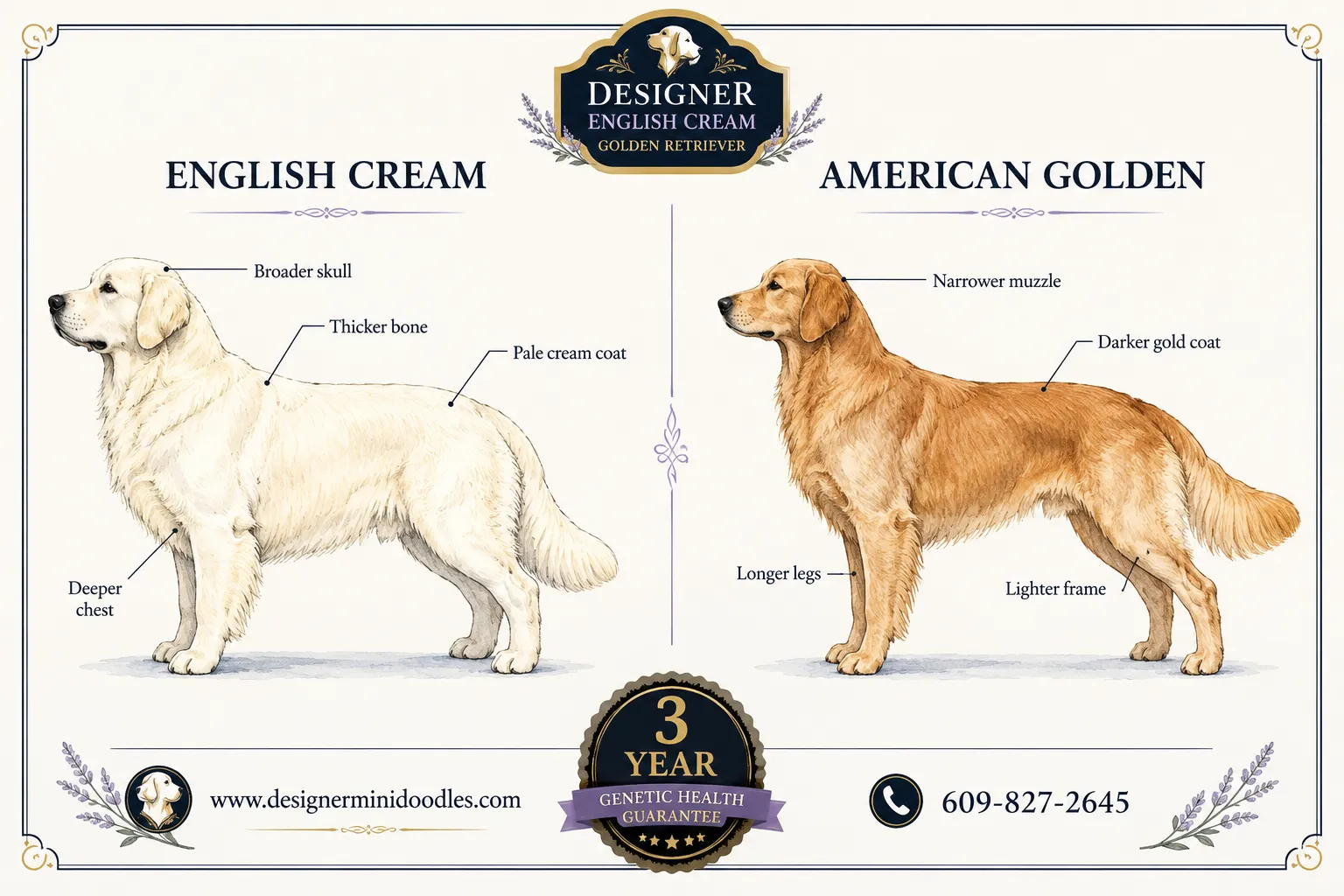
What genuinely separates the good European lines is structure, not just color:
- Head and skull: broader, with a shorter, blockier muzzle
- Frame: thicker bone, deeper chest, more substance overall
- Coat: dense double coat, often paler at the ears and feathering
- Temperament tendency: European show-line breeding has historically emphasized calmer, steadier dispositions over field drive
At Designer English Cream Golden Retrievers, our breed stock traces to top European bloodlines, and our puppies come out pure white with very little fade toward cream. Visitors routinely say the litters look like baby Great Pyrenees, because they’re noticeably broader and thicker through the chest and skull than typical United States retriever lines. If you want to see current litters and reserve, browse our English cream golden retriever puppies.
A clean coat color proves nothing about health. Structure, hip and elbow clearances, and temperament testing are what actually predict the next twelve years.
Common mistake: paying extra for “rare white English Cream.” Pale coat is common in European lines and costs a breeder nothing extra to produce. Pay for health testing and early development work instead.
English Cream vs. White Golden Retriever: Is There a Difference?
There is no meaningful difference. “White Golden Retriever,” “platinum Golden,” “ivory Golden,” and “English Cream Golden Retriever” all describe the same pale-coated Golden Retriever, usually from European lines. No Golden Retriever is genetically white in the way a Samoyed or Great Pyrenees is white, and true white is not recognized in either the AKC or UK Kennel Club standards.
Use this as your filter when reading an ad:
| Term used in listing | What it actually means | Should it change the price? |
|---|---|---|
| English Cream Golden Retriever | Pale Golden, typically European lines | Not by itself |
| White Golden Retriever | Marketing name for the same dog | No |
| Platinum or Ivory Golden | Marketing name, no standard basis | No |
| Rare white Golden Retriever | Red flag phrasing | No, treat with caution |
| English-type Golden with EU pedigree and clearances | Verifiable lineage plus testing | Yes, this is real value |
Decision rule: if a listing leans hard on rarity language and light on health documentation, walk away. If it leads with parent clearances, pedigree, and a written guarantee, keep reading.
How Much Does an English Cream Golden Retriever Cost?
Expect $3,500 to $5,500 for a puppy from an accredited breeder with genetic health guarantees, veterinary-supervised whelping, and early housebreaking and crate training already underway. Prices well below that range signal cut corners, and prices below $1,000 almost always signal fraud.
Here is the pricing landscape as it actually functions in the United States market:
| Price range | Who’s selling | What you typically get | Real risk |
|---|---|---|---|
| $500, $1,000 | Scammers, fake websites, overseas “shippers” | Nothing. Deposit disappears, or no dog exists | Total financial loss |
| $1,000, $1,500 | Puppy mills and brokers | No clearances, poor socialization, early illness | Heavy vet bills, behavior issues |
| $1,800, $2,000 | Hobby or backyard breeders | Sometimes healthy, minimal testing, no early training | Inconsistent outcomes |
| $3,500, $5,500 | Accredited AKC breeders | Genetic health guarantee, OFA-style clearances, ENS, started housebreaking and crate training | Lowest risk, highest predictability |
The gap between $1,500 and $4,000 is not markup. It covers progesterone testing, health clearances on both parents, veterinary prenatal and whelping care, high-quality maternal nutrition, first vaccinations and deworming, microchipping, weeks of daily human handling, and a written genetic guarantee that a mill will never offer.
Ongoing costs to plan for: food for a 65 to 75 pound dog, annual veterinary care, professional grooming every 8 to 12 weeks if you don’t do it yourself, and pet insurance. Budget realistically for the first year rather than only the purchase price. If you’re weighing cost-of-ownership tradeoffs between breeds and sizes, our breakdown on cost-of-ownership clarity for smaller doodles walks through the same math on a smaller frame.
Edge case: a reputable breeder may occasionally place an older puppy or a retired adult below the standard puppy price. That’s legitimate. A four-figure discount on an eight-week-old “champion European import” is not.
English Cream Golden Retriever vs. American Golden Retriever
The core difference is regional breeding emphasis. English Cream lines (European) tend toward paler coats, broader skulls, thicker bone, and often calmer temperaments. American Golden Retrievers tend toward richer gold to red coats, a leaner and taller frame, and frequently more field drive and energy.
| Feature | English Cream (European lines) | American Golden Retriever |
|---|---|---|
| Coat color | Pale cream to nearly white | Medium gold to deep red-gold |
| Skull and muzzle | Broader skull, shorter blockier muzzle | Narrower skull, longer muzzle |
| Body | Heavier bone, deeper chest, stockier | Lighter frame, longer legs |
| Height (male) | 22 to 24 inches | 23 to 24 inches |
| Typical energy | Steady, often calmer indoors | Often higher drive, very active |
| Coat length | Dense, moderate feathering | Often longer feathering |
| Registration | AKC Golden Retriever | AKC Golden Retriever |
Both are the same breed with the same core traits: friendly, biddable, people-focused. Claims that English Cream Goldens live significantly longer or get cancer far less often are not supported by conclusive breed-wide evidence. Individual health outcomes track with the specific pedigree and the testing behind it, not with coat shade.
Choose an English Cream if you want a calmer indoor presence, a heavier-boned build, and the pale look. Choose an American Golden if you want a lighter, faster dog for field work, dock diving, or long trail days, or if you prefer the classic deep gold coat.
English Cream Golden Retriever Temperament, Personality, and Family Fit
English Cream Golden Retrievers are affectionate, patient, highly trainable, and strongly bonded to their people, which makes them one of the better large-breed choices for families with children. They’re social to a fault, which also means they do poorly when left alone for long stretches.
What owners consistently report:
- Low aggression tendency toward people and other pets when properly socialized
- High biddability, meaning they want to work with you, which speeds up obedience training
- Soft mouths and tolerance for the noise and unpredictability of young children
- Real separation sensitivity if crate training and independence work are skipped early
- Adolescent goofiness from roughly 6 to 18 months, including mouthiness and jumping
Are they good family dogs? Yes, with two caveats. First, a 70-pound enthusiastic adolescent can knock over a toddler by accident, so supervision and early manners training are non-negotiable. Second, they need daily physical and mental work. A bored Golden chews baseboards.
Not a good fit if: you’re gone 10 hours a day with no midday help, you want a low-shedding dog, or you need a natural guard dog. Golden Retrievers greet intruders like long-lost relatives.
Families who want the temperament in a smaller package sometimes cross-shop hybrids. If that’s you, our guidance on why a 10-16 lb Micro Goldendoodle suits family households with kids covers the size-versus-temperament tradeoff honestly.
English Cream Golden Retriever Size, Weight, and Lifespan
Adult males typically stand 23 to 24 inches at the shoulder and weigh 65 to 75 pounds. Females stand 21.5 to 22.5 inches and weigh 55 to 65 pounds. Average lifespan is about 10 to 12 years, consistent with AKC breed information for Golden Retrievers.
Growth timeline in practical terms:
| Age | Typical weight range | What’s happening |
|---|---|---|
| 8 weeks | 8-14 lbs | Pickup age, crate and housebreaking foundation |
| 4 months | 25-35 lbs | Teething, rapid growth, joint care matters |
| 6 months | 40-50 lbs | Adolescence begins, training regression is normal |
| 12 months | 55-70 lbs | Near-adult height, still filling out |
| 18-24 months | Adult weight | Chest and head finish developing |
European-line dogs often carry more mass at the same height, so a 24-inch English Cream male may weigh at the upper end of the range while still being lean. Judge condition by ribs and waist, not the scale.
Common mistake: over-exercising a growing puppy on hard surfaces. Keep forced running and long pavement walks limited until growth plates close, generally around 12 to 18 months, and let free play on grass do the work instead.
English Cream Golden Retriever Health Problems and What to Screen For
The main health concerns are hip dysplasia, elbow dysplasia, inherited eye disease, subvalvular aortic stenosis (a heart condition), and cancer, which the Golden Retriever Club of America identifies as a leading cause of death in the breed. Coat color does not protect against any of these, which is why parent clearances are the single most important thing to verify before buying.
Ask for documentation on both parents covering:
- Hips, OFA hip evaluation or an equivalent European scoring system
- Elbows, OFA elbow evaluation
- Heart, cardiac clearance, ideally by a veterinary cardiologist
- Eyes, annual ophthalmologist exam (CAER or equivalent)
- DNA panel, including PRA1, PRA2, prcd-PRA, and ichthyosis where relevant
A serious breeder hands these over without being pushed. If a seller says “the vet checked them and they’re fine,” that is not a clearance.
Our program is run by a working animal biologist with a degree in Animal Biology from Stockton University and a minor in animal genetics, which is why pairing decisions here start with pedigree analysis and genetic panels rather than looks. Every breeding pair is selected to reduce the odds of the orthopedic and eye conditions that follow careless line-breeding. You can review our health protocols and current availability through our AKC english cream golden retriever breeders page.
Reduce risk after purchase: keep the dog lean, feed a large-breed appropriate diet during growth, maintain joint-friendly exercise, and schedule annual exams that include palpation and weight tracking. Obesity accelerates nearly every orthopedic problem in the breed.
- Display 15 Products per page

Do English Cream Golden Retrievers Shed a Lot, and What Grooming Do They Need?
Yes, they shed heavily. English Cream Golden Retrievers have a dense water-resistant double coat that sheds year-round and blows out seasonally in spring and fall. Plan on brushing 3 to 4 times a week normally and daily during coat blows. They are not hypoallergenic and not a fit for allergy-sensitive homes.
A workable grooming routine:
- Brushing: slicker brush plus an undercoat rake, 3 to 4 times weekly, daily during shedding season
- Bathing: every 6 to 8 weeks, or when genuinely dirty, with thorough drying to prevent hot spots
- Ears: check weekly, dry after swimming, since drop ears trap moisture
- Nails: trim every 3 to 4 weeks
- Teeth: brush several times a week
- Feathering: light trimming on feet, ears, and tail; never shave the coat, which damages insulation and regrowth
Expect a professional groom every 8 to 12 weeks if you’d rather not manage deshedding yourself. Budget accordingly.
Edge case: a puppy’s soft fluffy coat can hide how much adult coat is coming. Feathering and undercoat density usually arrive between 6 and 18 months, so grooming workload increases after the first year, not before. Households prioritizing minimal shedding should compare notes with our guide on grooming and home care for micro doodles, which covers a very different coat maintenance profile.
Where Can I Find English Cream Golden Retriever Breeders, and How Do I Verify One?
Start with AKC breeder listings, the Golden Retriever Club of America breeder referral resources, regional Golden Retriever clubs, and established programs with verifiable European pedigrees. Avoid classified marketplaces, social media ads with stock photos, and any seller who won’t do a live video call showing the puppy with its dam.

Use this verification checklist in order. If a seller fails any of the first five, stop.
- Live video call with the puppy and its mother in the actual home or kennel
- Written health clearances on both parents (hips, elbows, heart, eyes, DNA panel)
- AKC registration paperwork available for review
- Written contract with a genetic health guarantee and a spay/neuter clause
- No wire transfers, gift cards, crypto, or payment apps to strangers, legitimate breeders use traceable payment
- Vet records for first vaccines, deworming, and microchip
- References from families who bought puppies in the last 12 to 24 months
- A return-to-breeder clause for the dog’s entire life
- Willingness to say no, good breeders screen you too
- Waitlists, quality programs rarely have unlimited puppies available today
Common scam markers: a price of $700 with “free shipping,” an urgent deposit deadline, a story about a sudden relocation, refusal to video chat, and photos that appear on multiple websites when reverse-image searched.
Designer English Cream Golden Retrievers operates as a small, geneticist-run program rather than a volume kennel, which is why we describe ourselves as the best English Cream Retriever breeders in the USA and back it with documentation rather than adjectives. Every placement includes pedigree records, health clearances on the parents, and a written genetic guarantee. Reserve from our current litters of AKC english cream retriever puppies and we’ll walk you through the paperwork before any money changes hands. We also offer French bulldog stud services near me through our sister program for breeders seeking vetted stud access.
English Cream Golden Retriever Puppy Training Tips
Start housebreaking and crate training on day one, and expect a reliably house-trained puppy between 4 and 6 months with consistent handling. Golden Retrievers are among the most trainable breeds because they’re food-motivated and eager to please, so short positive sessions beat long corrective ones.
Weeks one through three at home:
- Take the puppy out on waking, after every meal, after play, and before bed, roughly every 60 to 90 minutes while awake
- Use one potty spot and one verbal cue, and reward within three seconds of finishing
- Feed on a fixed schedule so elimination becomes predictable
- Crate for naps and overnight with a chew, never as punishment
- Introduce name recognition, sit, and hand-feeding for bite inhibition
Months two through six:
- Enroll in a puppy class for socialization around other dogs and handlers
- Practice recall on a long line before ever trusting it off-leash
- Work loose-leash walking early, before the puppy outweighs your grip
- Build alone-time tolerance in increments to prevent separation anxiety
- Redirect mouthing to appropriate chews during teething
Our puppies leave here well started on housebreaking and crate training, which is the difference families notice most in the first two weeks. We use early neurological stimulation (ENS) to begin gentle, structured handling from birth, and every litter grows up inside a busy home surrounded by other animals, children, vacuum cleaners, doorbells, and normal daily noise. That exposure produces confident puppies that don’t fall apart the first time a delivery truck shows up. For a deeper look at enrichment-first puppy raising, see our notes on training and enrichment for small doodles.
Common mistake: treating the 7-to-10-month adolescent regression as a failure. It’s developmental. Shorten sessions, raise reward value, and stay consistent rather than escalating corrections.
Frequently Asked Questions
Are English Cream Golden Retrievers recognized by the AKC?
Yes, as Golden Retrievers. The AKC registers them under the Golden Retriever breed standard. “English Cream” is a descriptive term for pale European-line dogs, not a separate AKC breed or color designation.
Why are English Cream Golden Retrievers more expensive?
Legitimate price differences come from imported European breeding stock, full health clearances on both parents, veterinary whelping support, and early training work, not from coat color. A pale coat alone does not justify a premium.
Do English Cream Golden Retrievers live longer than American Goldens?
There is no conclusive breed-wide evidence that coat color or European lineage extends lifespan. Both types average roughly 10 to 12 years. Health testing in the specific pedigree matters far more than color.
How big do English Cream Golden Retrievers get?
Males reach 23 to 24 inches tall and 65 to 75 pounds. Females reach 21.5 to 22.5 inches and 55 to 65 pounds. European lines often carry more bone and appear stockier at the same height.
Do English Cream Golden Retrievers shed?
Yes, significantly. They have a double coat that sheds all year with heavier seasonal shedding in spring and fall. They are not hypoallergenic.
What is a fair price for an English Cream Golden Retriever puppy?
From an accredited breeder with genetic health guarantees, proper whelping, and started housebreaking and crate training, $3,500 to $5,500 is the realistic range. Listings at $500 to $1,000 are typically scams.
Are English Cream Golden Retrievers good with kids and other pets?
Generally yes. They’re patient, social, and low in aggression when properly socialized. Supervise interactions with toddlers, since an enthusiastic 70-pound adolescent can knock a small child over accidentally.
At what age should a puppy come home?
Eight weeks at the earliest. Breeders who ship at six weeks are cutting short critical social development with the dam and littermates.
What health tests should both parents have?
Hip and elbow evaluations, a cardiac clearance, an annual eye exam by a veterinary ophthalmologist, and a DNA panel covering the breed’s inherited eye and skin conditions. Ask for documents, not verbal assurances.
Is a “white Golden Retriever” different from an English Cream?
No. Both terms describe the same pale-coated Golden Retriever. True white is not recognized in the breed standard, and “white” is used as a marketing label.
How long does housebreaking take?
With consistent scheduling and crate use, most puppies are reliably house-trained between 4 and 6 months. Puppies that arrive already started on housebreaking typically get there faster.
Should I buy a puppy sight-unseen with shipping included?
Only from a breeder you have verified through live video, documentation, references, and traceable payment. “Free shipping” bundled with a low price is one of the most common fraud signals in the puppy market.
Conclusion
The search for an english cream golden retriever for sale comes down to one discipline: verify before you pay. The coat color is common in European lines and proves nothing. What actually determines whether you get twelve good years is the pedigree behind the puppy, the health clearances on both parents, the quality of the whelping environment, and how much early handling and training the breeder invested before pickup day.
Your next steps, in order:
- Set a real budget in the $3,500 to $5,500 range for an accredited breeder, plus first-year costs for food, vet care, and grooming.
- Build a shortlist of two or three programs with verifiable European bloodlines and documented parent clearances.
- Request documents first, clearances, pedigree, contract, and vet records, before discussing a deposit.
- Do a live video call with the puppy and dam. No call, no deal.
- Ask what early development work was done, specifically ENS, household noise exposure, crate introduction, and housebreaking progress.
- Prepare your home with a crate, a potty schedule, and a puppy class booked before the puppy arrives.
If you want a broad, thick, nearly white European-line puppy that’s already started on crate training and housebreaking, reach out to Designer English Cream Golden Retrievers and ask for the health documentation up front. That’s the conversation a good breeder wants to have.
Sources
- American Kennel Club, Golden Retriever Breed Standard and breed information (2024). https://www.akc.org/dog-breeds/golden-retriever/
- Golden Retriever Club of America, Health and Breeder Education resources (2024). https://grca.org/
- Orthopedic Foundation for Animals, Hip, elbow, cardiac, and eye evaluation databases (2024). https://ofa.org/
- The Kennel Club (UK), Retriever (Golden) Breed Standard (2024). https://www.thekennelclub.org.uk/